Athlete Vs. Mathlete Summary, Characters and Themes
Athlete Vs. Mathlete by W.C. Mack is a middle-grade novel about twin brothers who seem to belong to completely different worlds.
Owen is the basketball player, confident in his place on the court, while Russell is the academic star, most comfortable with science, math, and the Masters of the Mind team. When Russell is unexpectedly pushed toward basketball, both brothers are forced to rethink who they are and how they see each other. The story is funny, fast-moving, and thoughtful, using sibling rivalry, school pressure, and teamwork to show that talent can appear in unexpected places.
Summary
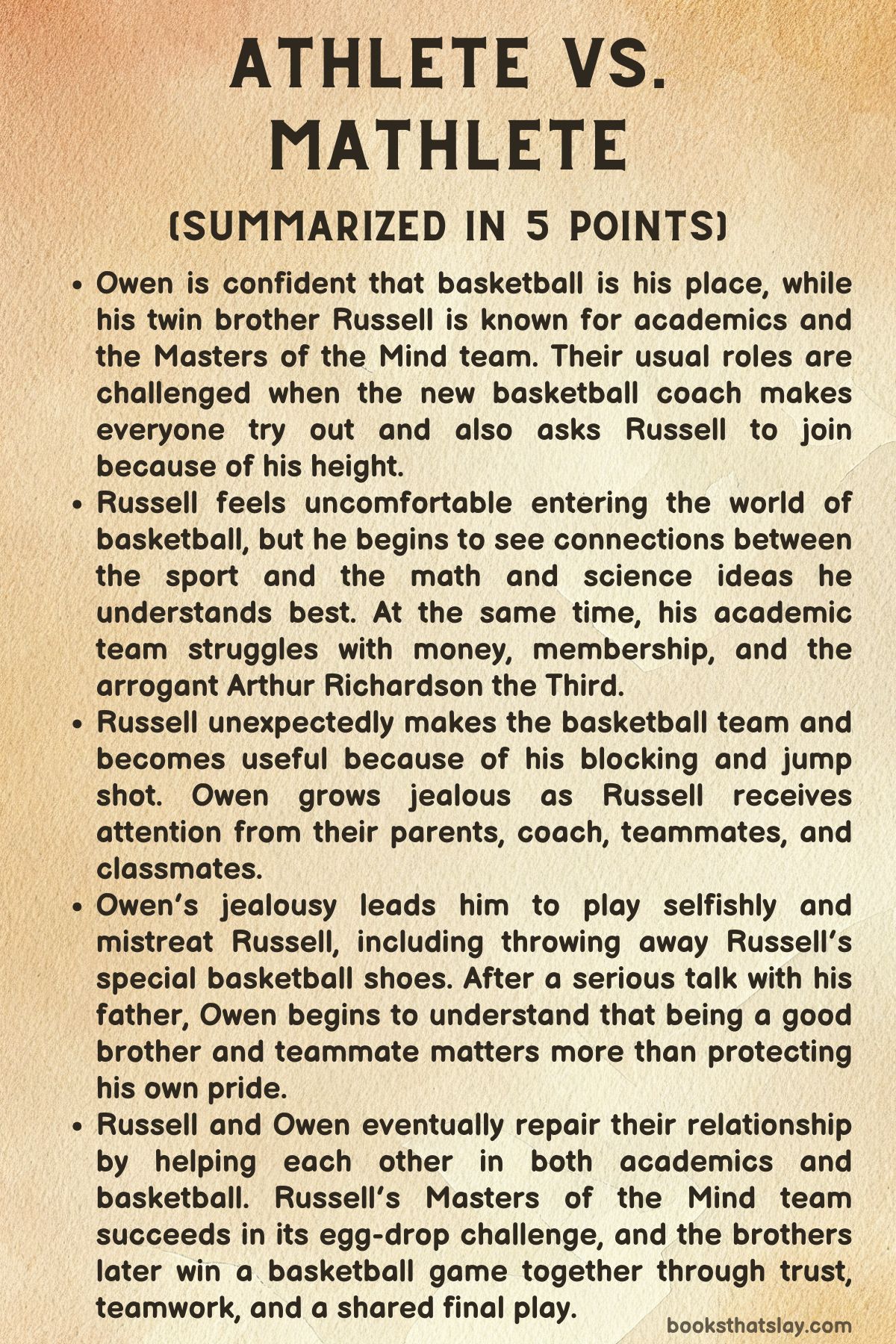
Owen and Russell are twin brothers, but they are used to being known for completely different things. Owen is the athlete.
Basketball is his space, the place where he feels skilled, noticed, and sure of himself. Russell is the mathlete.
He is tall, smart, analytical, and deeply involved in Masters of the Mind, an academic club that competes in creative problem-solving challenges. The two brothers love each other in the ordinary, complicated way siblings often do, but they do not fully understand each other’s interests.
Owen thinks of basketball as exciting and important, while Russell sees sports as strange and often unnecessary. Russell’s world is full of logic, patterns, experiments, and calculations, while Owen’s world is shaped by practice, competition, and team pride.
The trouble begins when Owen learns that the new basketball coach, Coach Baxter, will make everyone try out for the school team, even players who were on the team the year before. Owen and his friends are annoyed because they believe their past experience should guarantee them a place.
Coach Baxter makes it clear that no one will receive a jersey just because they played before. He wants to build the team his own way.
This unsettles Owen, who has always assumed basketball is his secure place at school.
Coach Baxter then notices Russell, mainly because Russell is several inches taller than Owen. The coach tells Russell he should try out too.
Russell is stunned because he has never considered himself athletic and has almost no basketball experience. Owen is embarrassed by the idea.
He imagines Russell fumbling through tryouts and making both of them look bad. At first, Owen offers to help Russell practice mostly because he wants to prevent public humiliation, not because he believes Russell can succeed.
Meanwhile, Russell has problems of his own. His Masters of the Mind team has lost a member, and they need someone new for an upcoming competition.
The challenge requires them to design a way to drop an egg from a height without breaking it. Russell is confident in his academic team, but the group is short on people and money.
The only student interested in joining is Arthur Richardson the Third, a smug and wealthy classmate who looks down on the club even while trying to use it to improve his own record. Russell’s friends dislike Arthur immediately, but they are also worried about having enough members and enough funds to compete.
At home, Russell is drawn unwillingly into Owen’s world. He watches basketball with Owen and their father but keeps interpreting the game in mathematical terms.
This frustrates Owen, who thinks Russell is missing the point. Russell, however, naturally sees angles, motion, and probability.
Basketball does not feel like instinct or excitement to him; it feels like a system he does not yet understand.
When Russell’s father learns that he needs to try out, he takes him shopping for basketball gear. Owen becomes jealous because Russell gets new shoes and clothes, even though Russell insists he will never make the team.
A pair of blue-and-silver Nike shoes briefly changes Russell’s attitude. For the first time, he feels curious about basketball, not because he suddenly loves the sport, but because it might help him connect with Owen and his father.
That hope is shaken when Russell overhears his parents arguing. His father thinks sports are an important part of childhood and wants Russell to have that experience.
His mother argues that Russell already has a childhood he enjoys and should not be pushed into becoming someone else. Russell feels caught between their views, but the new shoes still give him a small sense of possibility.
Owen gradually starts to take Russell’s training more seriously. At the park, Russell is terrible at many basic basketball skills, but Owen discovers that his height and awkward arm movements make him surprisingly good at blocking shots.
Owen realizes Russell might be useful on the court if he focuses on defense. Russell still doubts himself, but he begins to notice that basketball is not as separate from his own interests as he thought.
Movement, timing, force, and angles all matter.
Tryouts arrive, and both brothers feel nervous for different reasons. Owen worries about his own performance and about Russell embarrassing him.
Russell feels out of place in the locker room, where everyone stares at him as if he does not belong. During tryouts, Owen tries to do well while also helping Russell.
Russell improves a little, but the real surprise comes when he makes a clean jump shot. Then he makes several more.
His success shocks everyone, including Owen and Russell himself. Both brothers make the team.
At home, the family reacts with great excitement to Russell’s success. Owen’s achievement is treated almost as expected, while Russell’s is celebrated as extraordinary.
This hurts Owen deeply. Basketball has always been the one thing that made him feel special, and now Russell has entered that space and received more attention for it.
Owen starts to feel invisible.
Russell’s sudden basketball ability has an unexpected source. While thinking about the egg-drop problem for Masters of the Mind, he made a connection between the motion of a basketball and the way an object might be slowed or guided as it falls.
His academic thinking helped him understand the shot. He tries to explain this to his Masters of the Mind teammates, but they lose interest when he mentions basketball.
At the same time, Arthur uses Russell’s new schedule against him, pointing out that Russell is missing meetings and might not be reliable as a leader.
Russell’s life becomes more crowded. He must balance schoolwork, Masters of the Mind, basketball practices, games, and the pressure of being noticed in a new way.
His first basketball game goes well. His jump shot helps the team win, but Owen becomes colder toward him.
Owen is jealous of the attention Russell gets from the coach, the team, and the crowd. Basketball, which used to be fun for Owen, starts to feel like a contest for identity.
Owen’s jealousy grows worse. After playing with older students at the park, he decides that being aggressive gets results.
In the next school game, he refuses to pass, takes selfish shots, and even grabs the ball away from Russell. Coach Baxter pulls him from the game and calls out his poor sportsmanship.
Owen’s teammates also learn that he had allowed them to believe Coach Baxter once coached Michael Jordan, which was not true. Owen feels humiliated and angry.
In a cruel moment after the game, he throws Russell’s special Nike shoes into a dumpster.
Russell sees enough to know Owen took the shoes. When Owen admits what he did, Russell is furious and hurt.
Their conflict finally becomes direct. Owen’s father overhears the argument and speaks to Owen about what really matters.
He explains that being good at something is not enough if a person cannot support others. He reminds Owen that Russell has often had Owen’s back and asks why Owen has not done the same for his brother.
Owen retrieves the shoes from the dumpster. They are mostly unharmed, but the damage between the brothers is not fixed immediately.
Owen apologizes to Coach Baxter and the team, admitting that his ego got in the way. Russell, however, skips basketball practices and avoids Owen.
Without Russell, the team loses badly. Owen begins to understand that Russell is not stealing his place.
Russell has skills that help the team, and Owen misses him not only as a player but as a brother.
Russell uses his time away from basketball to reconnect with Masters of the Mind. His teammates reveal that Arthur does not truly care about the club and is mainly using it to look impressive for college in the future.
Russell decides they need a clever way to get Arthur to leave. He turns to Owen for help, calling on the brother who knows how to think a little deviously.
This becomes a turning point. Owen and Russell work together instead of against each other.
Owen admits the basketball team needs Russell, and Russell agrees to consider returning.
Together, they develop a plan to make Arthur believe that his record looks too narrowly academic and that he should become more “well-rounded.” The plan distracts Arthur so much that he leaves the Masters of the Mind competition in frustration. Russell and his real teammates are then able to focus.
For the egg-drop challenge, they build a parachute and a padded basket. Their egg lands safely, and their team advances to the next round.
Russell is thrilled when his family and Owen celebrate him with the same excitement they might show at a basketball victory. For once, his academic success feels just as visible and valued.
Russell returns to basketball, and Owen welcomes him back. In the next game, the team is behind by one point near the end.
Owen sees Russell open and passes without hesitation. Russell could take the shot, but instead he passes back to Owen.
Owen makes the winning basket. The victory matters, but what matters more is that the brothers finally act like true teammates.
Owen learns that sharing the spotlight does not make him smaller, and Russell learns that trying something unfamiliar does not mean giving up who he already is. By the end of Athlete Vs.
Mathlete, both brothers have changed. Owen is still an athlete, and Russell is still a mathlete, but they no longer see those roles as walls between them.
They understand that respect, trust, and teamwork can exist in both basketball and problem-solving, and that brothers can help each other become more than either one expected.
Characters
Owen
Owen is one of the two central characters in Athlete Vs. Mathlete, and his journey is built around pride, insecurity, jealousy, and eventual maturity.
At the beginning of the book, Owen sees basketball as his personal territory. He is comfortable being known as the athletic twin, and that identity matters deeply to him because it gives him a clear place in his family, school, and friend group.
When Coach Baxter decides that every player must try out again, Owen feels threatened because something he assumed was guaranteed suddenly has to be earned. His insecurity becomes even stronger when Russell, who has never been a basketball player, is pushed into trying out simply because of his height.
Owen’s first reaction is not generous or supportive; he worries that Russell will embarrass him and make him look bad by association. This shows how much Owen connects his own reputation to basketball and how little he initially understands Russell’s feelings.
Owen’s jealousy becomes the main force behind his worst choices. When Russell unexpectedly makes the team and begins to receive attention from their parents, coach, teammates, and classmates, Owen feels pushed aside.
His pain is understandable, but his behavior is selfish. Instead of being proud of his brother, he sees Russell’s success as an invasion of the only space where Owen feels special.
This jealousy changes the way he plays. He becomes aggressive, refuses to pass, and cares more about proving himself than helping the team.
His decision to throw away Russell’s shoes is the clearest sign of how far his resentment has gone. Still, Owen is not presented as a bad person.
He is a flawed boy who lets insecurity control him until he is forced to face the harm he has caused.
Owen’s growth comes through accountability. His father helps him understand that talent is not the same as character, and that being a good teammate and brother matters more than being the best player.
Owen’s decision to retrieve Russell’s shoes, apologize to the team, and ask Russell to return shows that he is capable of change. By the end of the story, Owen learns to share basketball without feeling erased by Russell’s presence.
His final pass to Russell, and Russell’s return pass to him, represents a healthier version of competition and brotherhood. Owen remains competitive and passionate, but he becomes less ruled by ego and more open to trust.
Russell
Russell is the other central character in the book, and he represents intelligence, curiosity, and the fear of being forced into a role that does not feel natural. He is used to being the academic twin, the boy who belongs in Masters of the Mind and thinks through problems using science, math, and logic.
At first, basketball feels foreign to him. He does not understand the rules, the culture around the sport, or why people treat athletics as more important than academic competitions.
His discomfort is not just about lacking skill; it is also about being seen as someone he does not believe himself to be. When Coach Baxter asks him to try out because of his height, Russell feels reduced to a body rather than recognized for his mind.
Russell’s strength lies in the way he processes the world. He connects basketball to angles, motion, force, and problem-solving, even when others do not understand those connections.
His unexpected jump shot is not magic or luck; it comes from applying his academic thinking to a physical task. This makes him an important character because he challenges the false separation between intelligence and athletic ability.
Russell does not become valuable to the basketball team by abandoning who he is. He succeeds because his mind helps him see the game differently.
His growth is not about turning from a mathlete into an athlete, but about realizing that he can be more than one thing.
Russell also has to deal with pressure from many sides. His father wants him to experience sports, his mother wants him to stay true to himself, Owen resents his success, and his Masters of the Mind teammates begin to question his commitment.
He feels stretched between two teams and two versions of himself. His hurt after Owen throws away his shoes is especially important because it shows that Russell wanted more than basketball success; he wanted connection with his brother.
When Owen breaks that trust, Russell withdraws. His later decision to work with Owen on the Arthur problem and return to the basketball team shows that Russell is forgiving, but not weak.
He needs proof that Owen values him, and once that begins to happen, he is able to rebuild their bond.
Coach Baxter
Coach Baxter is a major influence on the story because he disrupts the comfortable patterns that Owen and his friends expect. He does not allow returning players to assume they automatically belong on the team, and this immediately challenges Owen’s sense of entitlement.
Coach Baxter’s attitude is firm and demanding. He wants effort, discipline, and fairness, and he makes it clear that every player must prove himself.
In this way, he pushes the students to move beyond reputation and past success.
His decision to invite Russell to try out changes the direction of the entire book. At first, this choice seems based mostly on Russell’s height, which makes Russell uncomfortable, but Coach Baxter eventually sees that Russell has real potential.
He gives Russell extra attention because Russell has unusual skills that can help the team. This attention causes Owen’s jealousy, but it also shows that Coach Baxter is willing to recognize talent where others might not look for it.
He does not limit Russell to the label of “smart kid” or Owen to the label of “returning player.”
Coach Baxter also serves as a moral authority during Owen’s decline. When Owen plays selfishly and shows poor sportsmanship, Coach Baxter does not ignore it just because Owen is talented.
He pulls Owen from the game and makes it clear that selfishness hurts the whole team. This moment is important because it forces Owen to confront the difference between playing well and playing rightly.
Coach Baxter’s role is not warm or sentimental, but he is necessary. He helps create the conditions in which both brothers must grow.
Arthur Richardson the Third
Arthur Richardson the Third is the clearest example of arrogance in the story. He joins the Masters of the Mind group not because he respects the team or cares about their work, but because he wants another achievement attached to his name.
His attitude toward the other students is condescending. He speaks as if his wealth, status, and confidence make him superior, and he treats the club as a tool for self-promotion rather than a place for teamwork.
Arthur also functions as a contrast to both Russell and Owen. Like Owen, he wants recognition, but unlike Owen, he shows little real loyalty to any team.
Like Russell, he is associated with academics, but he lacks Russell’s sincerity and cooperative spirit. He is not interested in creative problem-solving for its own sake.
He wants credit without humility. His offer to solve the team’s money problem through his family’s wealth shows that he does not understand the group’s pride or desire to earn their own way.
His presence creates conflict within Masters of the Mind, especially when he questions Russell’s leadership and commitment. Arthur takes advantage of Russell’s busy schedule to make others doubt him.
However, his own weakness is his vanity. Owen and Russell’s plan works because Arthur is so focused on appearing impressive that he can be manipulated by the idea that he is not well-rounded enough.
Arthur’s exit allows the real team to succeed without his disruptive presence. He is important because he shows what ambition looks like when it is separated from respect.
Owen and Russell’s Father
The twins’ father is a well-meaning but imperfect parent who values sports because of his own history with basketball. He believes athletics can teach important lessons, and he wants Russell to experience the kind of childhood he thinks sports can provide.
His excitement over Russell trying out and making the team comes from pride and hope, but it also creates tension because he does not always see how much pressure Russell feels or how much Owen feels overlooked.
His most important role comes when he speaks honestly to Owen after Owen throws away Russell’s shoes. Rather than simply scolding him, he tells Owen about his own experience in basketball and explains that being talented does not guarantee lasting success or personal worth.
He teaches Owen that relationships matter more than status. This conversation helps Owen begin to understand that he has failed Russell as a brother.
The father’s wisdom is not abstract; it comes from experience, and that makes it meaningful.
At the same time, he is not a perfect guide. Earlier in the story, his desire for Russell to become involved in sports partly ignores Russell’s comfort with his existing life.
This makes him a realistic parent. He loves both boys, but his enthusiasm can accidentally deepen their rivalry.
By the end, however, he helps redirect Owen toward responsibility and supports Russell’s academic victory as well as his athletic success.
Owen and Russell’s Mother
The twins’ mother provides a balancing voice in the family. Unlike their father, she is more cautious about pushing Russell into basketball.
She understands that Russell already has interests and a sense of identity, and she questions the idea that sports are necessary for him to have a full childhood. Her perspective is important because it validates Russell’s existing world.
She sees that Russell’s academic life is not a lesser substitute for athletics.
Her role also highlights one of the book’s central tensions: the different value people place on sports and academics. While the father sees basketball as a meaningful growth opportunity, the mother worries that Russell is being asked to change for the sake of other people’s expectations.
This does not mean she opposes Russell’s growth. Rather, she wants his choices to come from himself instead of pressure.
Her concern helps the reader understand why Russell’s situation is emotionally complicated.
Though she is not as central to the action as Owen, Russell, or Coach Baxter, she adds emotional realism to the family dynamic. She represents protection, understanding, and respect for individuality.
Her presence keeps the story from treating basketball as the only valid path to confidence or belonging.
Owen’s Friends and Basketball Teammates
Owen’s friends and teammates help shape the social pressure around basketball. At the beginning, they share Owen’s belief that returning players should not have to prove themselves again.
Their reactions show the entitlement that Coach Baxter is trying to challenge. They also tease Owen about Russell, which increases Owen’s embarrassment and makes him more anxious about how Russell’s tryout will reflect on him.
As the story develops, the team becomes a place where Owen’s character is tested. His teammates admire Russell’s unexpected skills, and this makes Owen feel threatened.
When Owen acts selfishly during a game and the truth about Coach Baxter not coaching Michael Jordan comes out, the team’s disappointment matters. Owen loses standing not because he lacks ability, but because he has damaged trust.
The teammates help show that a team is not only about talent; it depends on honesty, passing, shared effort, and respect.
Their dependence on Russell after he stops attending practices also proves that Russell has earned his place. The team’s poor performance without him helps Owen see that Russell is not a joke or an intruder.
He is a real contributor. In that sense, the basketball team becomes the setting where Owen learns humility.
Russell’s Masters of the Mind Teammates
Russell’s Masters of the Mind teammates represent the academic community where Russell first feels most at home. They value intelligence, creativity, and problem-solving, but they are also insecure about their place in a school culture that seems to celebrate basketball more easily than academic competition.
Their frustration over funding and recruitment shows that their team has to fight for recognition in a way the basketball team does not.
Their relationship with Russell becomes strained when he starts missing meetings because of basketball. This strain is understandable because they depend on him, but it also shows their limits.
When Russell tries to connect basketball with the egg-drop challenge, they stop listening too quickly. Like Owen, they initially see academics and sports as separate worlds.
Their inability to accept Russell’s new experience makes him feel isolated.
Still, they are not unfair people. They care about the competition and eventually recognize that Arthur is not truly one of them.
They work with Russell to remove Arthur’s negative influence and succeed in the egg-drop challenge through genuine teamwork. Their victory shows that academic teams require trust and cooperation just as much as athletic teams do.
In Athlete Vs. Mathlete, they help prove that intellectual achievement deserves celebration and that Russell’s original identity remains valuable even as he grows.
Themes
Identity Beyond Labels
The characters are surrounded by labels from the beginning: Owen is the athlete, Russell is the mathlete, basketball is for popular kids, and academic competitions are for brainy students. These labels give the boys a sense of order, but they also trap them.
Owen depends on being known as the athletic twin because it makes him feel important. Russell depends on being known as the academic twin because that is where he feels skilled and accepted.
When Russell makes the basketball team, both identities are disturbed. Owen feels that his place has been stolen, while Russell feels unsure about whether trying something new means betraying the version of himself he already understands.
The book shows that labels can be comforting, but they become harmful when people treat them as limits. Russell’s success on the court does not erase his intelligence, and Owen’s eventual humility does not erase his athletic talent.
Their growth comes from realizing that identity can expand. A person can be logical and athletic, competitive and caring, nervous and brave.
The story encourages a broader view of selfhood, especially for young people who are often sorted into simple categories by school, family, and peers.
Sibling Rivalry and Brotherhood
Owen and Russell’s relationship is shaped by love, comparison, jealousy, and the desire to be seen. As twins, they are constantly measured against each other, even when their strengths are different.
Owen is used to basketball being the one area where he does not have to compete with Russell. When Russell enters that space and succeeds, Owen reacts as if his brother has taken something from him.
His jealousy is painful because it comes from a real fear: that he is no longer special. Russell, on the other hand, wants basketball partly because it might help him understand Owen and become closer to him.
This difference makes Owen’s betrayal with the shoes especially hurtful. Russell’s attempt at connection is answered with rejection.
Yet the book does not leave their bond broken. Owen learns that brotherhood is not about protecting personal territory; it is about showing up for someone else even when their success feels uncomfortable.
Russell also allows room for repair, though he does not forgive instantly. By the end, their teamwork on both the academic and basketball sides shows a healthier relationship.
They stop seeing each other as threats and begin to act like partners.
Teamwork, Trust, and Sportsmanship
The story uses both basketball and Masters of the Mind to show that teamwork is more than being placed in a group. A team only works when its members respect each other’s strengths and care about a shared goal.
Owen’s selfish play demonstrates what happens when personal pride becomes more important than the group. He may have skill, but his refusal to pass and his need to prove himself damage the team.
Coach Baxter’s criticism matters because it separates athletic talent from sportsmanship. A good player is not simply someone who scores; a good player understands timing, trust, and responsibility.
The same idea appears in Masters of the Mind. Arthur has intelligence and confidence, but he does not respect the team, so he weakens it rather than helping it.
Russell’s real teammates succeed when they cooperate, listen, and commit to solving the challenge together. Athlete Vs.
Mathlete presents teamwork as a moral skill, not just a practical one. Whether the goal is winning a basketball game or protecting an egg during a competition, the characters must learn that success depends on humility, communication, and the willingness to value other people’s contributions.
Jealousy, Recognition, and Self-Worth
Owen’s jealousy is one of the strongest emotional forces in the story because it grows from his need for recognition. He is not jealous only because Russell becomes good at basketball; he is jealous because everyone seems surprised and excited by Russell’s success while treating Owen’s success as ordinary.
That difference makes Owen feel unseen. The book captures how painful it can be when a person’s hard work is taken for granted because others expect them to do well.
Owen responds badly, but his feelings are not shallow. He wants proof that he matters.
His mistake is believing that Russell must be pushed down for him to feel important again. Russell also struggles with recognition, though in a different way.
His academic team has to raise funds and search for members, while the basketball team receives more attention and admiration. This contrast shows how schools and families can unintentionally value some achievements more loudly than others.
By the end, the story offers a healthier answer to the need for recognition. Owen is celebrated not just for scoring, but for passing and trusting.
Russell is celebrated not just for basketball, but for his academic victory. Both boys learn that another person’s success does not cancel their own worth.