As You Like It Summary, Characters and Themes
As You Like It is a comic play by William Shakespeare about exile, love, disguise, family conflict, and renewal. Set between a hostile court and the Forest of Arden, it follows Rosalind after she is banished from Duke Frederick’s court and escapes with Celia and Touchstone.
In the forest, mistaken identities and romantic confusion reshape the lives of nobles, shepherds, and fools alike. The play contrasts courtly ambition with the freer, rougher life of the countryside, using wit, performance, and reconciliation to move its characters toward forgiveness, marriage, and restored order.
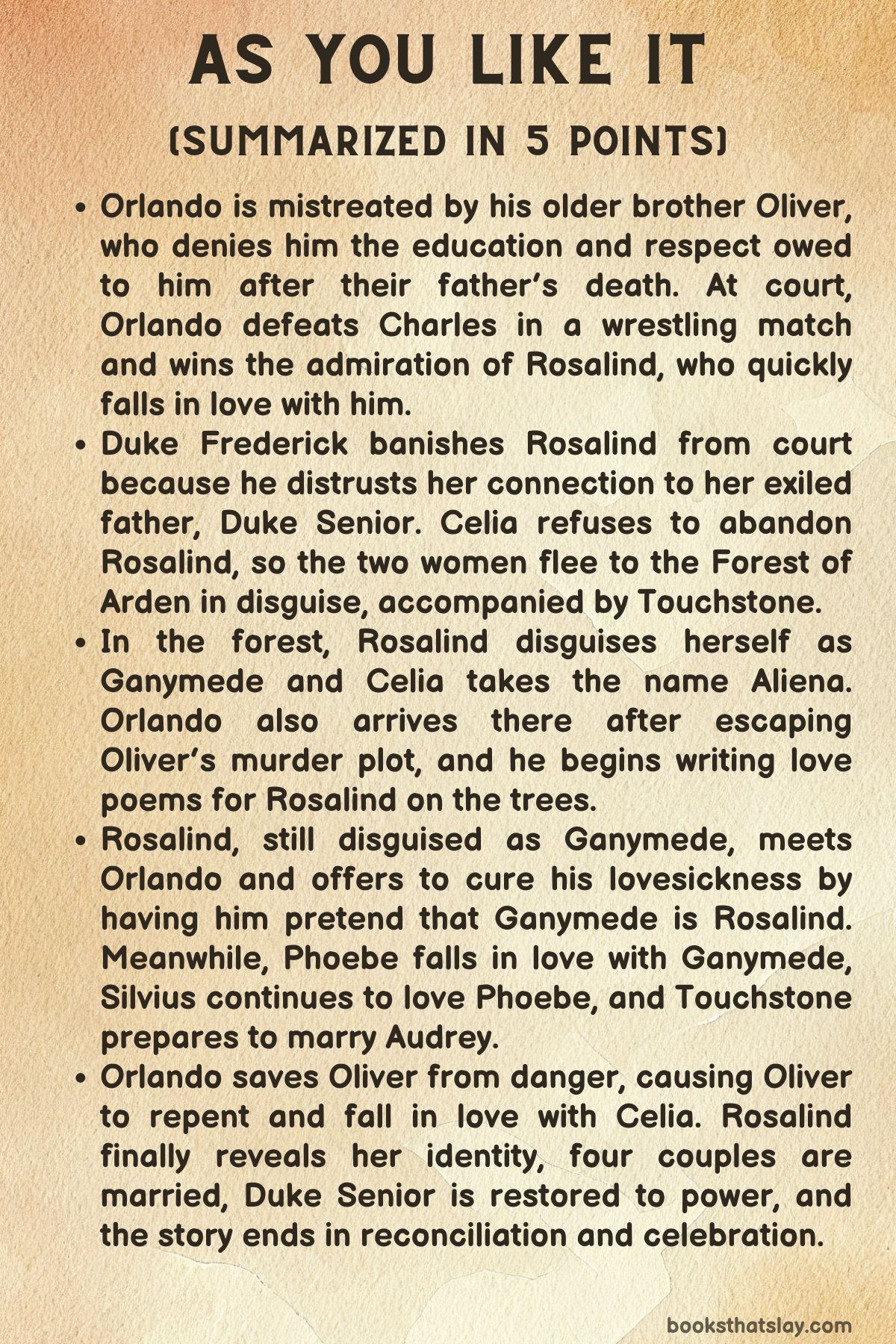
Summary
As You Like It begins in a duchy in France, where Orlando, the youngest son of the late Sir Rowland de Boys, feels wronged by his older brother Oliver. Their father had left instructions that Orlando should be raised as a gentleman, but Oliver has neglected him, denied him proper education, and treated him almost like a servant.
Orlando speaks bitterly about this injustice to Adam, an old and loyal family servant. When Oliver arrives, the brothers argue fiercely, and Orlando’s anger nearly turns violent.
Oliver hates Orlando not because Orlando has done anything wrong, but because Orlando possesses natural grace, strength, and nobility that make others admire him.
Soon after, Charles, the court wrestler, visits Oliver. He explains that Duke Frederick has seized power from his older brother, Duke Senior, and that Duke Senior now lives in exile in the Forest of Arden with loyal followers.
Duke Frederick has allowed Duke Senior’s daughter Rosalind to remain at court because she is very close to Celia, Frederick’s own daughter. Charles also tells Oliver that Orlando plans to challenge him in a wrestling match.
Oliver, secretly hoping Orlando will be hurt, poisons Charles’s opinion of him and encourages the wrestler to treat Orlando harshly.
At court, Rosalind is sorrowful because her father has been banished, but Celia tries to comfort her. The two young women share a deep friendship, and Celia promises that Rosalind will share in whatever fortune she has.
Touchstone, the court fool, joins them and lightens the mood with jokes. Their conversation is interrupted when they learn that Charles is wrestling.
Rosalind and Celia watch as Orlando enters to face the champion. They try to persuade him not to risk his life, but he insists on fighting.
Against expectation, Orlando defeats Charles.
The victory brings Orlando to the attention of Duke Frederick, who is displeased when he learns that Orlando is the son of Sir Rowland de Boys, a man Frederick disliked. Rosalind, however, is moved by Orlando’s courage and by his connection to her father’s old friend.
She gives him a chain as a token of affection, and the two quickly fall in love. Orlando is so overcome that he can barely speak.
After Rosalind and Celia leave, a courtier warns Orlando that Duke Frederick’s mood is dangerous and that he should leave.
Rosalind and Celia later speak about Rosalind’s sudden love for Orlando, but their private joy is interrupted by Duke Frederick. For no clear reason beyond suspicion and insecurity, he banishes Rosalind from court.
Celia pleads for her friend, but Frederick refuses to change his order. Celia then chooses loyalty over comfort and decides to leave with Rosalind.
They plan to travel to the Forest of Arden and seek Duke Senior. For safety, Rosalind disguises herself as a young man named Ganymede, while Celia dresses as a poor country woman named Aliena.
Touchstone agrees to accompany them.
In the Forest of Arden, Duke Senior has accepted exile with calm dignity. He tells his followers that life in the forest, though difficult, is more honest than life at court.
He finds value in hardship because it teaches people what they truly are. His companions include Amiens and the melancholy Jaques, who often reflects bitterly on human behavior.
The forest becomes a place where people from the court are tested, stripped of rank, and forced to see themselves more clearly.
Back at court, Duke Frederick discovers that Rosalind, Celia, and Touchstone have disappeared. Because Rosalind had shown interest in Orlando, Frederick suspects he may be involved.
He orders that Orlando be found and places pressure on Oliver to bring him back. Meanwhile, Adam warns Orlando that Oliver now plans to kill him by burning his lodging while he sleeps.
Adam offers Orlando his savings and asks to go with him. Orlando accepts with gratitude, and the two flee into the forest.
Rosalind, Celia, and Touchstone arrive in Arden exhausted and hungry. Still in disguise, they overhear the shepherd Silvius speaking with Corin about love.
Silvius is hopelessly devoted to Phoebe, who does not return his affection. Rosalind and Celia arrange to buy food and shelter, eventually settling into rural life.
Touchstone, who misses courtly comforts, mocks country manners but also adapts to the odd freedoms of the forest.
Orlando and Adam also struggle in Arden. Adam is weak from hunger, and Orlando goes in search of food.
He comes upon Duke Senior and his men, who are preparing to eat. Desperate, Orlando enters with his sword drawn and demands food, expecting savagery from forest dwellers.
Instead, Duke Senior treats him with kindness and invites him to eat. Orlando is ashamed of his rough behavior and returns with Adam.
When Duke Senior learns Orlando is the son of Sir Rowland de Boys, he welcomes him warmly for his father’s sake.
As Orlando settles in Arden, his love for Rosalind grows. He writes poems praising her and hangs them on trees throughout the forest.
Rosalind, still disguised as Ganymede, finds these verses and is both amused and excited. Celia discovers that Orlando is the author, and Rosalind can hardly contain her feelings.
When Orlando appears with Jaques, Rosalind listens from hiding, then approaches him as Ganymede. She claims she can cure him of lovesickness if he will pretend that Ganymede is Rosalind and practice wooing him.
Orlando agrees, unaware that he is speaking to the real Rosalind.
This arrangement lets Rosalind test Orlando’s love while also enjoying his courtship. As Ganymede, she teases him, challenges romantic clichés, and mocks the dramatic behavior of lovers.
Orlando plays along, addressing Ganymede as Rosalind. Their conversations are comic, but they also show Rosalind’s intelligence and emotional control.
She is deeply in love, yet her disguise gives her power to question Orlando freely and shape the terms of their relationship.
Other romantic confusions develop around them. Touchstone becomes involved with Audrey, a simple country woman, and seeks to marry her.
Jaques watches their relationship with amusement and criticism. Silvius continues to adore Phoebe, though she rejects him.
When Rosalind, as Ganymede, scolds Phoebe for treating Silvius cruelly, Phoebe unexpectedly falls in love with Ganymede. Rosalind warns her not to do so, but Phoebe sends a letter through Silvius declaring her feelings.
Rosalind uses the situation to push Phoebe toward accepting Silvius instead.
The conflict between Orlando and Oliver also changes. Duke Frederick has threatened Oliver with the loss of his lands if he does not find Orlando.
Oliver enters the forest, where he is attacked by danger and saved by the very brother he hated. Orlando finds Oliver sleeping near a lioness and, after wrestling with his own anger, chooses to rescue him.
Orlando is wounded in the process. This act of mercy transforms Oliver.
He repents of his cruelty and becomes reconciled with Orlando.
Oliver then meets Celia, still disguised as Aliena, and the two fall in love almost immediately. His change is so complete that he is willing to give his estate to Orlando and live as a shepherd with Celia.
Orlando is happy for his brother, but saddened because Oliver and Celia can marry openly while he still believes Rosalind is absent. Rosalind, as Ganymede, promises Orlando that she can use a kind of magic to bring Rosalind to him at the next day’s wedding.
The final gathering resolves the forest’s confusions. Duke Senior, Orlando, Oliver, Celia, Silvius, Phoebe, Touchstone, Audrey, and others assemble.
Rosalind, still in disguise, reminds everyone of their promises. Phoebe has agreed to marry Silvius if she cannot marry Ganymede.
Orlando has agreed to marry Rosalind if she appears. Rosalind and Celia leave briefly, then return in their true identities.
Rosalind is restored to her father, Orlando receives his bride, Celia reveals herself to Oliver, and Phoebe, realizing Ganymede was never available to her, accepts Silvius.
Four marriages are celebrated: Rosalind and Orlando, Celia and Oliver, Phoebe and Silvius, and Touchstone and Audrey. The mood of reconciliation expands when Jaques de Boys, another brother of Orlando and Oliver, arrives with news from the court.
Duke Frederick, who had marched toward the forest with hostile intent, has undergone a religious conversion after meeting a holy man. He has given up his claim to the dukedom and restored power to Duke Senior.
The injustice that began the play is undone without battle.
Most of the characters prepare to return to a repaired social order, but Jaques chooses a different path. Rather than join the celebrations, he decides to seek out Duke Frederick and follow a more contemplative life.
His departure keeps a note of distance within the comedy, reminding the audience that not everyone is suited to marriage, festivity, or public happiness. Rosalind then speaks the epilogue, directly addressing the audience and inviting both women and men to enjoy the play according to their liking.
Through disguise, wit, forgiveness, and love, As You Like It turns exile into renewal and conflict into celebration.
Characters
Rosalind
Rosalind is the emotional and intellectual center of the play. In As You Like It, she begins as a young woman wounded by her father’s exile, yet she does not remain passive in her suffering.
Her banishment from court forces her into danger, but it also gives her room to act with freedom, intelligence, and courage. Disguised as Ganymede, she becomes both protected and empowered, able to speak more boldly than she could as a noblewoman at court.
Her disguise allows her to test Orlando’s love, challenge foolish romantic behavior, and guide others toward clearer self-understanding. Rosalind is playful, witty, and sharp, but she is also deeply feeling.
Her humor often covers real anxiety, especially when Orlando is late or injured. She understands love better than most characters because she can both feel it intensely and examine it critically.
By the end of the story, she restores emotional order by revealing herself and helping unite the couples.
Celia
Celia is one of the most loyal and generous figures in the play. Though she is Duke Frederick’s daughter and could remain safe at court, she chooses exile rather than separation from Rosalind.
Her love for Rosalind is steady, practical, and self-sacrificing. Celia does not merely comfort Rosalind with words; she acts, giving up privilege, security, and her father’s protection to accompany her cousin into the Forest of Arden.
As Aliena, she becomes more subdued than Rosalind, but her presence is essential because she provides balance. Where Rosalind is bold, teasing, and verbally energetic, Celia is watchful, sensible, and emotionally grounded.
She often notices when Rosalind goes too far in her games with Orlando. Her sudden love for Oliver may seem quick, but it fits the comic world of the story, where the forest changes people rapidly.
Celia’s final union with Oliver also symbolically heals the broken relationship between hostile families.
Orlando
Orlando is a young man defined by natural nobility rather than social advantage. Denied education and proper status by Oliver, he nevertheless shows courage, physical strength, courtesy, and moral feeling.
His victory over Charles proves his bravery, but his greater worth appears in his loyalty to Adam and his mercy toward Oliver. Orlando’s love for Rosalind is sincere, though sometimes immature.
His poems on the trees show devotion, but they also invite Rosalind’s teasing because his idea of love is dramatic and idealized. Through his meetings with Ganymede, Orlando learns to speak and behave less like a conventional lover and more like a man capable of real partnership.
His decision to save Oliver from danger marks an important moral turning point. He has every reason to hate his brother, yet he chooses compassion.
Orlando’s final reward is not only marriage to Rosalind, but also restoration into a healthier family and social order.
Oliver
Oliver begins the play as one of its clearest examples of jealousy and moral corruption. As Orlando’s elder brother, he has power over him, but he uses that power cruelly.
He deprives Orlando of education, dignity, and affection, then secretly hopes Charles will injure or kill him. Oliver’s hatred is especially disturbing because it is rooted not in injury, but envy.
Orlando’s natural goodness makes Oliver feel smaller, so he tries to suppress him. Yet Oliver’s transformation in the Forest of Arden is dramatic.
When Orlando saves his life, Oliver is forced to confront the ugliness of his past behavior. His repentance appears sincere because he gives up his hostility and willingly offers his inheritance to Orlando.
His love for Celia, though sudden, becomes part of his renewal. Oliver’s character shows that the play’s comic world allows even severe wrongdoing to be corrected when a person experiences mercy and accepts moral change.
Duke Senior
Duke Senior represents patience, dignity, and philosophical acceptance. Though he has been wrongfully removed from power by his brother, he does not become bitter or vengeful.
In the Forest of Arden, he creates a community based on loyalty, reflection, and simplicity. He sees value in hardship because exile teaches truths that courtly comfort often hides.
His attitude toward the forest is not naive; he knows the weather is rough and the life is difficult, yet he finds moral clarity there. Duke Senior also serves as a contrast to Duke Frederick.
Where Frederick is suspicious, controlling, and threatened by others, Duke Senior is welcoming and generous. His kindness to Orlando shows his respect for old bonds and inherited virtue.
By the end of the play, his restoration to power feels like the return of rightful order. He is not the most active character, but his calm authority shapes the moral atmosphere of the forest.
Duke Frederick
Duke Frederick is the political force behind much of the play’s conflict. He has usurped his brother’s position and rules through suspicion rather than justice.
His decision to banish Rosalind reveals his insecurity. Rosalind has done nothing to deserve punishment, but Frederick fears what she represents: the memory of Duke Senior and the affection people still feel for him.
His treatment of Celia also shows the limits of his understanding, because he assumes power can control emotional loyalty. Frederick’s anger later extends to Orlando and Oliver, as he tries to force others to repair the disorder he has helped create.
He is not developed with the same psychological depth as some other figures, but he functions as a symbol of corrupt authority. His sudden religious conversion near the end may seem abrupt, but it fits the play’s comic movement from disorder to restoration.
His withdrawal allows peace to return without further violence.
Touchstone
Touchstone is the court fool, but his foolishness often exposes other people’s illusions. He speaks in jokes, riddles, mock logic, and comic exaggeration, yet much of what he says contains social criticism.
Touchstone helps As You Like It compare court and country life by carrying courtly wit into the Forest of Arden. He mocks shepherds, lovers, poetry, honor, manners, and even marriage, but he also becomes part of the same romantic confusion he ridicules.
His relationship with Audrey is comic and earthy rather than idealized. Unlike Orlando or Silvius, he does not speak of love in noble or poetic terms.
He treats marriage partly as desire, partly as convenience, and partly as a social performance. Still, Touchstone is important because he prevents the play from becoming too sentimental.
His sharp language punctures exaggerated emotion and reminds the reader that human behavior is often absurd, self-serving, and funny.
Jaques
Jaques is the play’s great observer of melancholy, criticism, and detachment. He stands apart from the festive energy around him and often responds to life with sadness or mockery.
His famous reflections on human existence present life as a sequence of roles, suggesting that people move through predictable stages without fully controlling their own performance. Unlike Rosalind, who uses performance creatively, Jaques sees performance as evidence of human emptiness and repetition.
He is fascinated by Touchstone because the fool has the freedom to criticize society openly, a freedom Jaques desires for himself. Yet his criticism can feel self-indulgent, and Duke Senior suggests that Jaques is not innocent enough to judge others so harshly.
Jaques does not join the marriages at the end, which is fitting. He is not suited to comic closure, domestic happiness, or public celebration.
His decision to follow Duke Frederick into religious retreat preserves his identity as an outsider.
Adam
Adam is a figure of loyalty, age, and moral goodness. As an old servant of Sir Rowland de Boys’s household, he remembers a better standard of honor than the one Oliver now represents.
His devotion to Orlando is practical and deeply moving. When he learns that Oliver plans to kill Orlando, Adam not only warns him but offers his life savings and his companionship.
He is physically weak because of age, yet morally strong. His willingness to leave security behind shows that service in the play is not merely social duty; it can also be an expression of love and chosen loyalty.
Adam’s hunger in the forest also brings out Orlando’s nobility, because Orlando’s desperate search for food is motivated by concern for him. Through Adam, the play honors old bonds, faithful service, and the quiet goodness of characters who do not seek power or attention.
Silvius
Silvius represents the extreme devotion of unreturned love. He is a shepherd whose entire emotional life seems centered on Phoebe.
His love is patient, humble, and self-effacing, even when Phoebe treats him dismissively. He accepts pain almost as proof of love, which makes him both sympathetic and comic.
Silvius shows the play’s interest in different kinds of romantic behavior. Unlike Rosalind, who can analyze love with wit, or Touchstone, who treats it bodily and practically, Silvius experiences love as total surrender.
His suffering also helps expose Phoebe’s pride, because her rejection of him is unnecessarily cold. Yet Silvius is not foolish in a cruel sense.
His constancy is rewarded when Phoebe finally agrees to marry him after the truth about Ganymede is revealed. His character suggests that faithful love may appear excessive, but it can survive humiliation and still lead to union in the comic world of the story.
Phoebe
Phoebe is proud, sharp-tongued, and emotionally inexperienced. She rejects Silvius because she has power over him and does not understand the pain caused by unreturned love.
Her confidence is disrupted when she meets Ganymede and suddenly experiences desire from the vulnerable side. This reversal is central to her role in the play.
Once Phoebe falls for Ganymede, she begins to understand the helplessness that Silvius has been expressing all along. Still, she remains proud and indirect, sending a letter that mixes insult with attraction.
Rosalind’s handling of Phoebe is firm because Phoebe needs correction, not pity. Phoebe’s eventual marriage to Silvius is not simply a reward for Silvius; it is also a humbling of Phoebe.
She learns that beauty and pride do not give her complete control over love. Her character adds another comic angle to the play’s study of desire, rejection, and self-knowledge.
Corin
Corin is an older shepherd who represents plain speech, rural honesty, and practical wisdom. He does not romanticize court life or pretend to be more refined than he is.
His conversation with Touchstone shows his grounded understanding of manners: what seems proper in one setting may seem ridiculous in another. Corin’s wisdom is local and experiential.
He understands sheep, labor, age, hunger, and the everyday needs of rural life. Unlike some of the courtly characters, he does not perform cleverness for attention.
His simplicity gives the forest world credibility, preventing it from becoming only a fantasy space for nobles in disguise. He helps Rosalind, Celia, and Touchstone find food and shelter, making him important to their survival.
Corin also serves as a contrast to Silvius. Both are shepherds, but Corin is seasoned and realistic, while Silvius is young and consumed by romantic longing.
Audrey
Audrey is a country woman whose relationship with Touchstone adds comic earthiness to the play’s treatment of love and marriage. She is not poetic, courtly, or intellectually quick, but she is direct and unpretentious.
Touchstone’s attraction to her is very different from Orlando’s love for Rosalind or Silvius’s devotion to Phoebe. Their relationship is less idealistic and more physical, even practical.
Audrey’s simplicity makes her vulnerable to Touchstone’s verbal games, yet she is not presented as false or scheming. She belongs to the rural world and reflects a kind of plain existence that courtly figures often misunderstand or mock.
Her planned marriage to Touchstone broadens the ending by showing that comic union is not reserved for noble or romantic lovers alone. Through Audrey, the play includes a less polished, less elevated form of desire, one that still has a place in the final celebration.
Amiens
Amiens is one of Duke Senior’s loyal followers and helps shape the atmosphere of the Forest of Arden. He is most strongly associated with music, companionship, and acceptance of exile.
His songs praise the simplicity of life away from court, even while acknowledging discomfort and harsh weather. Amiens does not have the restless dissatisfaction of Jaques or the verbal brilliance of Rosalind, but his role is important because he expresses the communal spirit of Duke Senior’s group.
He represents the followers who choose loyalty over political advantage. His music gives the forest a reflective and social quality, turning exile into a shared way of life rather than a private punishment.
Amiens also serves as a contrast to Jaques, who often twists cheerful songs into darker reflections. Where Jaques resists comfort, Amiens helps create it.
Charles
Charles is the court wrestler whose presence helps reveal both Orlando’s courage and Oliver’s malice. He is physically powerful and respected enough that Orlando’s decision to fight him seems dangerous.
Charles does not begin as Orlando’s personal enemy; rather, he is manipulated by Oliver, who encourages him to think badly of Orlando. This makes Charles part of the corrupt atmosphere around the court, where reputation can be shaped by deceit.
His defeat establishes Orlando as strong, brave, and unexpectedly capable. It also begins the romantic bond between Orlando and Rosalind, who witnesses his victory.
Charles is a minor character, but he performs an important structural role. Through him, the play turns Orlando’s private family grievance into a public display of merit.
Orlando’s victory over Charles proves that Oliver’s attempts to suppress him cannot erase his natural worth.
Le Beau
Le Beau is a courtier who helps explain the political and emotional situation at Duke Frederick’s court. He is not a central figure, but he acts as a messenger and commentator.
After Orlando defeats Charles, Le Beau warns him that Duke Frederick is displeased and that staying near court may be dangerous. This warning shows that Le Beau has some decency, even though he belongs to Frederick’s court.
He also explains the identities of Rosalind and Celia, helping Orlando understand the social world he has entered. Le Beau’s role highlights the tension between appearance and private knowledge at court.
People must read moods carefully because power is unstable and dangerous. Through Le Beau, the play shows that not everyone within a corrupt court is personally corrupt.
Some characters survive there by observing, reporting, and quietly advising caution.
Sir Oliver Martext
Sir Oliver Martext is a comic religious figure brought in to perform Touchstone and Audrey’s marriage. His presence makes the marriage plot more farcical, especially because Jaques persuades Touchstone to wait for a more proper ceremony.
Martext’s name itself suggests clumsiness with words and texts, making him part of the play’s comic treatment of social institutions. He is not developed as a deep character, but he helps the story mock hurried, careless, or questionable marriage arrangements.
His brief role also emphasizes Touchstone’s mixed motives. Touchstone wants marriage, but not necessarily with solemnity or moral seriousness.
By interrupting or delaying the ceremony, the play keeps Touchstone and Audrey’s union within the broader final celebration rather than allowing it to happen in a suspiciously casual way. Martext’s small appearance therefore supports the larger comic concern with proper social resolution.
William
William is Touchstone’s rustic rival for Audrey. He is a simple country youth whose main function is to be verbally defeated by Touchstone.
Touchstone questions him in a way that makes courtly wit look aggressive and ridiculous. William is not clever enough to compete, and he quickly gives way.
His presence reveals Touchstone’s vanity: although Touchstone often mocks others, he also enjoys proving his superiority over someone less educated. William therefore helps expose the cruelty hidden inside cleverness.
At the same time, the scene is comic because the rivalry is so uneven. William’s simplicity makes him a small but useful part of the country world, showing that rural life includes its own desires, competitions, and embarrassments.
He also helps define Audrey’s situation, as she is not merely an isolated comic figure but someone desired within her own social environment.
Jaques de Boys
Jaques de Boys, the brother of Orlando and Oliver, appears near the end and brings news that changes the political future of the story. His role is brief but important.
He reports that Duke Frederick has experienced a religious conversion and has chosen to restore Duke Senior’s lands and authority. This information resolves the conflict outside the forest and allows the ending to become fully restorative.
Jaques de Boys is different from the melancholy Jaques, though the shared name can be confusing. He functions mainly as a messenger of reconciliation and social repair.
His arrival expands the family story beyond Orlando and Oliver, reminding the reader that the de Boys family has a wider structure. By delivering news of Frederick’s withdrawal, he helps complete the movement from hostility to peace.
Hymen
Hymen, the god of marriage, appears in the final celebration as a symbolic figure rather than an ordinary human character. His presence gives the ending a ceremonial and almost magical quality.
The forest has already created confusion through disguise, mistaken desire, and hidden identity; Hymen’s arrival transforms that confusion into order. He presents Rosalind and Celia in their true identities and presides over the marriages.
As a dramatic device, Hymen turns private romantic promises into public bonds. His role also supports the play’s comic structure, where conflict is resolved not through punishment but through union, recognition, and restored harmony.
Though he appears only briefly, Hymen gives formal shape to the ending and confirms that the emotional disorder of the forest has reached a socially accepted conclusion.
Themes
Exile as a Path to Renewal
As You Like It treats exile not only as punishment, but also as a strange opportunity for renewal. Duke Senior loses political power, Rosalind is forced from court, Celia abandons privilege, Orlando flees a murderous brother, and Adam leaves the only household he knows.
Yet the Forest of Arden does not simply destroy them. It changes the terms of their lives.
At court, identity is tied to rank, inheritance, suspicion, and control. In the forest, those structures loosen.
Rosalind can become Ganymede, Celia can become Aliena, Oliver can become repentant, and Orlando can be valued for character rather than birth alone. The forest is not perfect; hunger, rough weather, danger, and emotional confusion are all present.
Still, it allows people to see themselves and others more clearly. Exile strips away false security and exposes both weakness and strength.
The play suggests that loss can become transformative when characters respond with courage, loyalty, and openness. What begins as banishment becomes the condition that makes forgiveness, love, and restoration possible.
Love as Performance and Education
Love in the story is rarely simple. Characters speak love, act love, exaggerate love, misunderstand love, and sometimes learn love by pretending.
Rosalind’s disguise as Ganymede makes this theme especially rich because she can teach Orlando how to love while secretly receiving his affection herself. Their courtship becomes a kind of rehearsal, but the emotions beneath it are real.
Orlando’s poems show sincerity, yet they also reveal how much he has learned from conventional romantic behavior. Rosalind challenges that behavior by mocking dramatic vows, testing his patience, and forcing him into conversation rather than empty praise.
Silvius and Phoebe present another lesson. Silvius loves with total submission, while Phoebe learns the pain of rejection only after she falls for someone unavailable.
Touchstone and Audrey offer a less idealized version of desire, closer to appetite and social convenience. Through these different couples, the play shows that love is partly feeling and partly conduct.
People must learn how to love wisely, not merely intensely. Romance becomes education, correction, and self-discovery.
Disguise, Identity, and Freedom
Disguise gives characters the freedom to become more honest than they could be in their ordinary social roles. Rosalind’s transformation into Ganymede protects her physically, but it also releases her voice.
As a young woman at court, she is vulnerable to political power and social expectation. As Ganymede, she can advise, mock, command, test, and arrange events.
Her disguise does not hide her true self as much as it reveals parts of her that society would normally restrict. Celia’s disguise as Aliena is quieter but still meaningful, since she gives up royal identity to live by chosen loyalty.
The forest itself becomes a place where identity is less fixed. Nobles live like shepherds, brothers become enemies and then friends, and lovers mistake appearances for truth.
Yet the play does not suggest that identity is meaningless. The final revelations matter because social truth must eventually return.
Disguise is useful because it creates space for growth, but the ending requires recognition. Freedom and order must meet before harmony can be restored.
Forgiveness and the Repair of Broken Families
Family conflict drives much of the play’s pain. Duke Frederick betrays Duke Senior, Oliver mistreats Orlando, and Rosalind is separated from her father.
These broken relationships show how ambition, envy, and insecurity can corrupt family bonds. Oliver’s cruelty toward Orlando is especially personal because he violates both brotherhood and their father’s wishes.
Duke Frederick’s betrayal is political, but it is also fraternal, since he takes power from his own brother and later banishes his niece. Against these acts of division, the play places loyalty and forgiveness.
Celia refuses to abandon Rosalind, Adam risks everything for Orlando, and Orlando saves Oliver despite having every reason to leave him to die. That act of mercy changes Oliver more effectively than punishment could have.
Duke Frederick’s conversion happens offstage, but it completes the same pattern on a political level. The ending restores families through recognition, repentance, and marriage.
The play’s vision of forgiveness is generous, though not entirely realistic. It imagines a world where mercy can undo inherited hatred and rebuild social order.