Assata Summary and Analysis
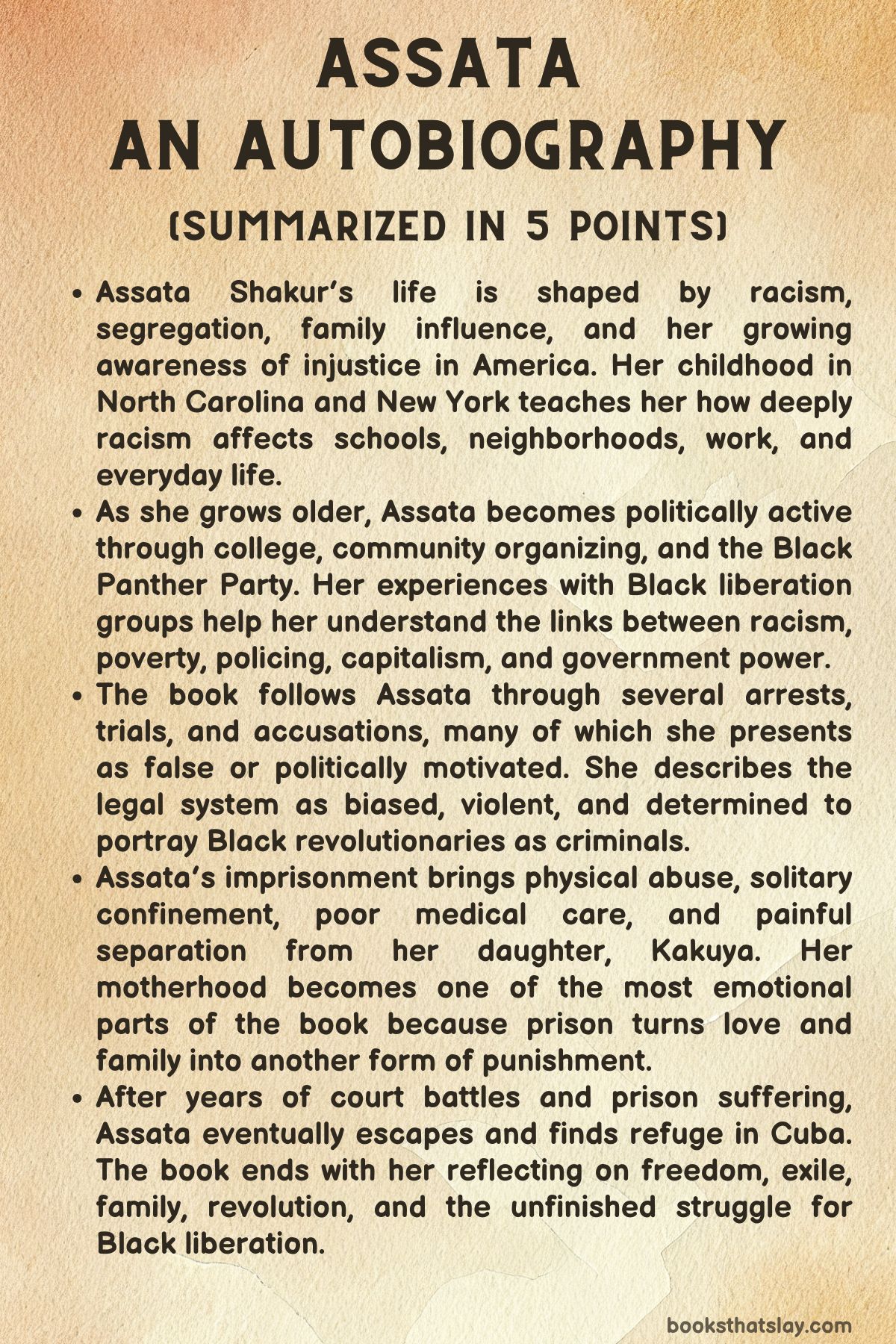
Assata (Full Book Name: Assata: An Autobiography) is the autobiography of Assata Shakur, a Black revolutionary, activist, mother, and former member of the Black Liberation Army. The book moves between her childhood, political awakening, court battles, imprisonment, and eventual exile in Cuba.
Shakur writes with urgency, anger, humor, and deep political conviction, showing how racism, poverty, state violence, and imprisonment shaped her life and her understanding of freedom. More than a personal memoir, Assata is also a critique of the American legal system, police power, media distortion, and the oppression faced by Black communities.
Summary
Assata opens with Assata Shakur badly wounded after a police shooting on the New Jersey Turnpike. She is in a car with Sundiata Acoli and Zayd Malik Shakur when state troopers stop them.
A violent exchange follows, leaving Zayd dead, a state trooper dead, another officer wounded, Sundiata arrested, and Assata gravely injured. Her memories are fragmented by pain, fear, and confusion.
She hears police threaten to kill her while she lies bleeding, and she is taken to a hospital under armed guard.
At the hospital, Assata is handcuffed to her bed, questioned while injured, and abused by officers who try to force a statement from her. She has bullet wounds, one of which has damaged her lung, and she cannot feel one of her arms.
Police try to manipulate her by claiming that Sundiata has blamed her for the shooting, but she recognizes the tactic as an attempt to divide comrades. Though isolated and physically weak, she refuses to cooperate.
Some nurses quietly show compassion by warning her how to call for help and bringing her books. Her aunt Evelyn Williams, who is also her lawyer, struggles to gain access to her.
When her mother and sister finally visit, their pride gives Assata strength.
The book then turns to Assata’s childhood. She grows up between Wilmington, North Carolina, and Jamaica, Queens.
In the South, she learns early about segregation, white intimidation, and the daily rules Black people are forced to follow. Her grandparents own property but face harassment from white people, and her grandmother teaches Assata dignity, pride, and self-control.
At the same time, Assata later recognizes that some of her grandmother’s lessons reflect middle-class prejudice within Black society. Her mother and relatives also teach her small acts of resistance, such as finding ways around whites-only spaces.
When Assata moves to New York, school becomes a new site of conflict. White teachers often treat her with contempt or indifference.
One teacher physically punishes her until Assata fights back and her mother intervenes. Her aunt Evelyn becomes one of the most important people in her young life.
Evelyn takes her to museums, exposes her to art and history, and gives her a broader education than she receives in school.
Back in jail after the Turnpike shooting, Assata is placed in isolation and begins preparing for trial. Evelyn helps her record a public statement in which Assata identifies herself as a Black revolutionary woman targeted by the United States government.
She argues that the state and the media portray Black liberation fighters as criminals while ignoring the violence committed against Black people. In jail, Assata meets women who are poor, Black, and Latina, many of them held for minor charges or because they cannot afford bail.
Their lives deepen her belief that prison punishes poverty and race more than crime.
Assata’s memories of adolescence show her restlessness and vulnerability. She runs away from home more than once, trying to survive in the city.
She meets boys and adults who exploit or endanger her, including people who pressure her into stealing or place her at risk of sexual violence. In Greenwich Village, she finds work, protection, and friendship among people living outside respectable society.
Miss Shirley, a transgender woman, helps her find shelter and warns her against dangerous schemes. These years teach Assata about gendered violence, street survival, and the limited choices available to young Black girls.
As Assata faces a series of criminal cases, the book shows the legal system as hostile, politicized, and often absurd. She is tried for bank robbery, kidnapping, and the Turnpike case, among other charges.
She describes judges who deny defense motions, marshals who beat defendants and supporters, and prosecutors who rely on weak or false evidence. In one case, the government tries to connect her to a bank robbery through a photograph of another Black woman.
In another, witnesses collapse under cross-examination. Assata and her lawyers, including Evelyn, Florence Kennedy, Stanley Cohen, William Kunstler, and others, fight these cases under intense pressure.
During one trial, Assata and co-defendant Kamau Sadiki protest their treatment in court and are repeatedly removed. Their political statements challenge the idea that they can receive justice in courts shaped by racism.
Assata and Kamau also develop a romantic relationship, and she becomes pregnant. Her pregnancy becomes another struggle.
Prison doctors dismiss her pain and offer poor care. A Black doctor, Dr. Ernest Wyman Garrett, confirms that she needs proper medical attention and argues that denying it would endanger her life.
Assata fights to have him treat her, even as prison and hospital authorities insist that as a prisoner she has no right to choose her doctor.
She gives birth to her daughter, Kakuya Amala Olugbala Shakur, under harsh circumstances. After briefly breastfeeding her newborn, she is separated from the child and returned to prison.
The separation devastates her. She refuses medical examination, is beaten, and is placed in solitary confinement.
Her milk dries up, and her grief turns into resistance. Her experience as a mother in prison becomes one of the book’s most painful threads, showing how incarceration punishes families as well as prisoners.
The memoir also traces Assata’s political education. After high school, she works low-paying jobs and becomes critical of the exploitation faced by working people.
At Manhattan Community College, she studies history, sociology, and psychology, and begins to question the official stories she has been taught about the Civil War, Abraham Lincoln, capitalism, colonialism, and American democracy. She meets African students, Black Muslims, Garveyites, and other activists.
These encounters reshape her thinking. She comes to believe that racism cannot be separated from class, empire, and state power.
Assata joins the Black Panther Party after visiting the West Coast, where she meets Native activists at Alcatraz, Chicano revolutionaries, Asian American organizers, and Panthers in the Bay Area. The Panthers’ community programs, especially free breakfast and medical work, inspire her.
In New York, she joins the medical cadre and helps serve children in East Harlem. She also learns from the Panther 21, reads revolutionary theory, and builds close bonds with comrades, including Zayd.
Yet Assata becomes critical of the Party’s internal problems. She objects to arrogance, sexism, weak political education, poor discipline, and confusion between public organizing and underground military action.
She also describes the damage caused by COINTELPRO, the FBI program that used surveillance, fake letters, informants, and manipulation to destroy Black radical organizations. The state’s campaign creates suspicion and division within the Black Panther Party, contributing to expulsions and internal breakdown.
Disappointed and alarmed, Assata leaves the Party and eventually goes underground after seeing wanted posters bearing her image.
While underground, she reflects on the weaknesses of the Black Liberation movement. She believes many activists had courage but lacked training, unity, organization, and clear ideology.
She rejects the idea that armed struggle alone can create revolution, but she also rejects reform as insufficient. Her time in hiding makes her think more seriously about underground structures and the need for long-term political preparation.
The final legal battle centers on the New Jersey Turnpike case. After several acquittals in other cases, Assata remains in solitary confinement while preparing for trial.
Her defense team struggles to find experts willing to challenge police evidence, because many fear losing police-related work. Stanley Cohen, one of her lawyers, dies under circumstances Assata views with suspicion, and police take his legal papers.
The trial proceeds under Judge Theodore Appleby, whom Assata portrays as biased and determined to restrict the defense. An all-white jury is selected, and defense motions about government surveillance and political targeting are denied.
Assata feels the courtroom is not a place of justice but a stage where her conviction has already been arranged.
After conviction and imprisonment, Assata is sent to high-security facilities, including Alderson in West Virginia and Clinton Correctional Facility in New Jersey. In prison she meets other political prisoners, including Rita Brown and Puerto Rican nationalist Lolita Lebrón.
These relationships broaden her sense of international struggle, feminism, religion, and solidarity. Her daughter Kakuya visits regularly, but the prison setting damages their bond.
During one visit, Kakuya tells Assata she could leave if she wanted to. The child’s pain convinces Assata that she cannot allow prison to become permanent.
Her grandmother also visits and tells her she has dreamed that Assata will come home. The words give Assata strength.
Shortly before her escape, she calls her grandparents and asks about family history, feeling the pull of memory and ancestry. She promises her grandmother that she will not get used to prison.
In the postscript, Assata reveals that she has escaped to Cuba, though she does not describe the details of the escape. In Cuba, she encounters a society with different racial categories and different political possibilities.
She is sometimes frustrated by Cuban views of race, especially when people classify her in ways she rejects. Still, she admires Cuba’s attempts to address inequality through free medical care, education, and social programs after the revolution.
Eventually, she contacts Evelyn, who is at first suspicious because the family has been harassed and deceived before. Assata proves her identity by singing a childhood rhyme only they would know.
The book ends with Assata awaiting her family’s arrival in Cuba, closing on survival, exile, and the continuing hope of reunion.
Key Figures
Assata Shakur
Assata Shakur is the central figure of Assata, and the book presents her as a woman formed by pain, political study, family memory, state violence, and a lifelong refusal to accept humiliation as normal. She is not shown as a simple symbol of rebellion, but as someone whose identity develops through childhood confusion, teenage vulnerability, hard-earned education, and direct confrontation with racism.
As a child, she is observant and sensitive to injustice, even when she does not yet have the language to explain it. Her experiences in segregated spaces, hostile classrooms, unstable homes, and dangerous city streets teach her that Black girls are often forced to grow up too quickly.
As she matures, her anger becomes more disciplined and political. She begins to understand racism not only as personal cruelty, but as something built into schools, courts, prisons, jobs, police systems, and media narratives.
Her strength comes from her ability to learn from every setting: family, jail, college, the streets, revolutionary groups, and motherhood. She is fiercely independent, sometimes stubborn, and often self-critical.
The book does not present her as flawless; she questions her past decisions, criticizes her own political movement, and admits where she believes she acted incorrectly. Her courage lies not only in resisting the state, but also in thinking honestly about struggle, failure, survival, and responsibility.
Evelyn Williams
Evelyn Williams, Assata’s aunt and lawyer, is one of the most important protective figures in the book. She represents intelligence, discipline, cultural education, and legal resistance.
During Assata’s childhood, Evelyn opens doors that formal schooling does not. She takes Assata to museums, teaches her to look at art and history seriously, and gives her a sense that the world is larger than the narrow spaces racism tries to assign to Black children.
Later, as Assata’s lawyer, Evelyn becomes a tireless defender in courtrooms designed to isolate and defeat her niece. Her role is both personal and political: she is family, advocate, strategist, and emotional anchor.
Evelyn’s love is practical rather than sentimental. She files motions, fights for access, challenges judges, handles legal pressure, and continues defending Assata even when the state makes that work exhausting.
Their relationship is not without tension, especially when legal strategy and political frustration collide, but the conflict does not erase the depth of their bond. Evelyn stands for the kind of loyalty that survives fear, public pressure, and institutional hostility.
Assata’s Mother
Assata’s mother is a complex figure because she is both a source of love and a source of conflict. She raises Assata in a world where Black parents must protect their children from racism while also trying to prepare them to survive it.
Her relationship with Assata becomes tense during Assata’s youth, especially as family instability and Assata’s repeated running away create distance between them. Yet the book shows that her mother’s love never disappears.
When Assata is wounded, imprisoned, or separated from her child, her mother remains connected to her. She also plays an important role in bringing Kakuya to visit Assata in prison, even though those visits are emotionally painful.
Assata’s mother represents the emotional cost borne by families of political prisoners. She must live with fear, harassment, separation, and the responsibility of caring for the next generation while her daughter is locked away.
Her character shows how state punishment spreads beyond the prisoner and enters the lives of mothers, children, and relatives.
Assata’s Grandmother
Assata’s grandmother shapes Assata’s earliest ideas about dignity, race, class, and self-respect. She teaches Assata to take pride in being Black, to respect elders, and to carry herself with confidence.
Her lessons are protective, born from a world where Black people must constantly guard themselves against white violence and social insult. At the same time, Assata later sees that her grandmother’s values are shaped by class prejudice, especially in the way she distinguishes between respectable Black people and those she considers less proper.
This makes her grandmother a layered figure rather than a simple moral guide. She passes down strength, but also some of the limitations of the Black middle-class worldview of her time.
Near the end of the book, her dream that Assata will come home becomes deeply significant. Her words give Assata emotional courage and connect her to family history just before escape becomes possible.
She represents ancestral faith, memory, and the refusal to let prison become a permanent spiritual condition.
Assata’s Grandfather
Assata’s grandfather appears as a figure of quiet resistance and practical courage. In Wilmington, he faces white harassment over his property and business, especially when white people try to intimidate the family by driving through the parking lot with guns.
His response is not dramatic speechmaking, but action: he puts up a chain to stop them. That act matters because it teaches young Assata that resistance can be direct, physical, and rooted in protecting one’s home and dignity.
He represents a generation of Black Southerners who survived by balancing caution with defiance. His presence helps Assata understand that racism is not abstract; it touches land, money, safety, mobility, and daily life.
Through him, the book shows that political education begins long before formal activism. It begins in family stories, property disputes, neighborhood threats, and the small acts by which Black people refuse to be driven out or broken down.
Sundiata Acoli
Sundiata Acoli is important because he is connected to the New Jersey Turnpike incident, one of the central events in the book. He is with Assata and Zayd when the police stop them, and after the shooting he is arrested while Assata is hospitalized and Zayd is killed.
Much of Sundiata’s role is shaped by absence and separation. The police try to use him against Assata by claiming that he has blamed her, but Assata understands this as a divide-and-control tactic.
Her refusal to believe the police shows the trust and political discipline that exist among comrades under pressure. Sundiata also represents the way Black revolutionary men and women were criminalized together, tried under hostile conditions, and separated by the legal system.
His case moving forward while Assata’s health forces delay adds another layer of sadness, because their shared situation becomes legally divided. He stands for comradeship under state pressure and the heavy cost of political struggle.
Zayd Malik Shakur
Zayd Malik Shakur is a powerful presence in the book even though he dies early in the central timeline. His death on the New Jersey Turnpike marks one of the deepest wounds in Assata’s life.
He is not only a fellow activist, but someone whose calm and composed personality had earlier balanced Assata’s sharper and more restless temperament during their work in the Black Panther Party. Their bond is political, personal, and emotional.
Zayd’s death becomes a symbol of the lethal danger faced by Black revolutionaries, but the book also remembers him as a person, not only as a martyr. His influence remains strong enough that Assata later takes the name Shakur in respect for him and his family.
Zayd represents sacrifice, loyalty, and the painful fact that political struggle often leaves survivors carrying the names, memories, and unfinished work of the dead.
Kamau Sadiki
Kamau Sadiki is both a political comrade and a romantic partner in the book. He appears during Assata’s legal battles, especially in connection with the Bronx bank robbery case.
His treatment by marshals, particularly when he tries to embrace his young daughter and is beaten, reveals the cruelty of the courtroom system and its refusal to recognize Black defendants as full human beings with families and emotions. Assata’s defense of him leads to violence in court, and their shared resistance strengthens their bond.
Their relationship grows under extreme pressure, and the possibility of having a child together carries both fear and hope. Kamau matters because he brings tenderness into a setting built to erase it.
His character shows that love, desire, and dreams of family can exist even in the middle of trials, guards, chains, and political persecution. He also reflects the burden placed on Black fathers whose parenthood is disrupted by imprisonment and state violence.
Kakuya Amala Olugbala Shakur
Kakuya, Assata’s daughter, is one of the most emotionally important figures in the book. Her birth represents joy, renewal, and future possibility, but it happens inside a system that immediately turns motherhood into suffering.
Assata’s separation from Kakuya after childbirth is devastating because it shows how prison attacks the most intimate human bonds. Kakuya is not simply a child in the background; she becomes a measure of what imprisonment steals.
Her visits to Assata are painful because she grows up seeing her mother behind bars, and her confusion turns into anger. When she tells Assata that she could leave if she wanted to, the moment reveals a child’s inability to understand the full machinery of incarceration, while also exposing the emotional truth that separation feels like abandonment.
Kakuya represents the future Assata wants to protect and the personal urgency behind her need for freedom.
Dr. Ernest Wyman Garrett
Dr. Ernest Wyman Garrett stands out as a figure of professional courage and moral clarity. When Assata is pregnant and physically vulnerable, prison medical staff dismiss her condition and fail to provide proper care.
Dr. Garrett’s arrival changes the situation because he treats her as a patient whose life matters, not as a prisoner whose suffering can be ignored. He recognizes the seriousness of her condition and is willing to say publicly that denying her medical care could amount to killing her.
His character exposes the difference between institutional medicine controlled by punishment and medical care rooted in ethics. He also becomes important because Assata’s fight to choose him as her doctor becomes a fight over bodily autonomy, dignity, and the right of imprisoned people to humane treatment.
Dr. Garrett represents the possibility of professional integrity within a system designed to strip prisoners of choice.
Florence Kennedy
Florence Kennedy appears as a Black feminist lawyer and political activist whom Assata turns to during a difficult phase in her legal defense. Assata is drawn to Kennedy not simply because of legal skill, but because she wants a lawyer who understands the political nature of the case.
Kennedy represents a form of advocacy that recognizes racism, sexism, and state power as connected. Her presence matters because Assata’s situation cannot be reduced to ordinary criminal defense; she is being tried in a climate shaped by media hostility, police violence, and anti-radical repression.
Kennedy’s character expands the book’s understanding of law by showing that legal battles for Black revolutionaries are also battles over public narrative, political identity, and the right to speak against power.
Stanley Cohen
Stanley Cohen is one of the most memorable lawyers in Assata because of his honesty, skill, and unexpected bond with Assata. At first, Assata is unsure about trusting a white lawyer, especially in a case shaped so heavily by racism.
Cohen wins her confidence by refusing to offer empty idealistic language. His blunt statement that he likes to win reveals a practical, combative personality.
He believes her, understands the strength of the state’s campaign against her, and commits himself to fighting. In court, he is sharp and strategic, especially when he exposes the weakness of identification evidence in the Queens bank robbery case.
His death later in the book carries a sense of unresolved suspicion and loss, particularly because police take his legal papers. Cohen represents the rare ally whose usefulness comes not from claiming innocence of racism in society, but from choosing a side and doing the work with seriousness.
William Kunstler
William Kunstler enters the book as a well-known defense lawyer associated with politically charged cases. His role in the New Jersey Turnpike trial is marked by conflict with a judge who seems determined to restrict the defense.
Kunstler’s presence shows how difficult it is to defend a political prisoner when the court itself controls what can be said, what evidence can be heard, and how the jury is shaped. He becomes part of a defense team trying to fight a case that appears already weighted toward conviction.
His character represents the limitations of even skilled legal advocacy when the court refuses to function as a neutral space. Through him, the book shows that the problem is not only bad prosecutors or hostile police, but a legal structure that can block meaningful defense while still appearing lawful.
Stuart Ball
Stuart Ball is brought into Assata’s defense because the team needs a lawyer familiar with New Jersey law. His presence reflects the practical complexity of fighting major criminal cases across different jurisdictions.
Unlike some of the more emotionally prominent figures, Ball is important because he shows the technical side of legal survival. Assata’s defense requires not only political commitment, but procedural knowledge, local expertise, and coordination among multiple lawyers.
His role also reveals one of the defense team’s problems: too many lawyers with different styles and judgments can create tension. Ball represents the necessary but difficult machinery of legal defense, where strategy, personality, jurisdiction, and timing all shape the outcome.
Lewis Myers
Lewis Myers, a young Black lawyer added to Assata’s defense team, represents generational commitment within Black legal resistance. His presence matters because Assata wants and needs people around her who understand that her cases are not detached from the wider condition of Black America.
As part of a crowded defense team, Myers joins a struggle that is legally complicated and emotionally draining. He stands for younger Black professionals who bring their skills into political cases despite the risks and pressures attached to them.
His character also shows that Assata’s defense is not the work of one heroic lawyer, but a collective effort involving family members, activists, seasoned attorneys, and younger advocates.
Rema Olugbala
Rema Olugbala is connected to the kidnapping case and to Black Liberation Army organizing. His death while trying to escape jail is a painful reminder of how many people around Assata are lost before their stories can fully unfold.
Assata knows of him through political work, and his sudden death creates grief while the legal process continues without mercy. Rema represents the vulnerability of activists once they are caught inside the prison system.
His character also shows how trials can become haunted by absence: a co-defendant dies, but the machinery of prosecution moves on. Through Rema, the book emphasizes that political struggle is marked not only by public speeches and courtroom arguments, but by sudden losses that comrades must carry privately.
Ronald Myers
Ronald Myers is charged alongside Assata and Rema in the kidnapping case. Assata is initially suspicious of him because she does not know him well, but she later learns that he is a young Black activist with political values close to her own.
His presence broadens the sense that the state is not only targeting famous figures, but also lesser-known activists who can be pulled into serious charges. Ronald’s role in the trial helps expose the weakness of the prosecution’s case, especially as testimony and evidence fall apart.
He represents the many young Black political people whose lives are endangered by association, surveillance, and accusation. His acquittal with Assata becomes one of the book’s rare moments where the legal system fails to complete the damage it has attempted.
Simba
Simba is a fellow Black revolutionary whom Assata encounters in jail. She is pregnant, and her child’s father, Kakuyan Olugbala, has been killed by police.
Simba’s presence is brief but meaningful because she mirrors some of Assata’s own fears about pregnancy, motherhood, and political struggle. She is facing a long prison sentence while carrying a child, which makes her situation both politically and emotionally painful.
Through Simba, the book shows that Black revolutionary women are often asked to endure impossible combinations of grief, pregnancy, incarceration, and public demonization. Her character also reminds the reader that Assata’s experience, while extraordinary in some ways, belongs to a wider pattern of Black women activists being punished by the state while also trying to preserve life.
Eva
Eva, whom Assata calls “Rhinoceros woman,” is one of the most vivid jailhouse figures in the book. She becomes close to Assata and shows a bold, protective kind of solidarity.
When male guards come looking to brutalize Assata, Eva identifies herself as Assata, using her size and nerve to unsettle them. This moment is both comic and dangerous, revealing Eva’s courage and her refusal to let Assata stand alone.
Eva represents the unexpected bonds formed among incarcerated women. She is not a political theorist or lawyer, but her action is deeply political because it challenges the guards’ power and protects another prisoner.
Her character shows that solidarity in jail often appears through quick decisions, humor, bodily risk, and loyalty among women whom society has already dismissed.
Miss Shirley
Miss Shirley is a protective and compassionate figure from Assata’s runaway years in Greenwich Village. As a transgender woman who recognizes Assata’s youth and vulnerability, she helps her find work and shelter in an environment full of danger.
Miss Shirley’s importance lies in her ability to see what others ignore: that Assata is a child trying to survive among adults who may exploit her. She warns Assata against schemes that could expose her to violence and tries to guide her toward safety.
Her character challenges narrow ideas of family and respectability. She is not related to Assata by blood, but she offers care at a moment when Assata badly needs it.
Miss Shirley represents chosen protection, street wisdom, and the presence of marginalized people who create safety for others despite their own social vulnerability.
Tina
Tina is part of Assata’s early runaway experience and represents the blurred line between friendship and exploitation. Through Tina, Assata enters a household where young people are supposedly cared for but are actually pushed into stealing.
Tina’s mother uses vulnerable children for criminal schemes while presenting herself as someone who loves having young people around. Tina herself appears caught in that same environment, shaped by survival and manipulation.
Her role in the book shows how young runaways can become trapped in informal systems of exploitation long before any official institution notices them. Tina helps reveal Assata’s growing awareness that not every shelter is safe and not every adult who offers care is trustworthy.
Tyrone
Tyrone is a boy Assata meets during her runaway period, and he is connected to gang life. Assata is attracted to him at first, but she soon recognizes that his world does not offer the future she wants.
Tyrone’s character is important because he shows one possible path available to young people living under pressure in urban Black communities. He is not presented as evil, but as part of a life shaped by danger, loyalty, masculinity, and limited opportunity.
Assata’s decision to leave that possibility behind marks a turning point in her self-understanding. Through Tyrone, the book shows how attraction and survival can pull a young person toward risky choices, but also how Assata begins learning to choose herself.
David
David is one of the first people Assata stays with after running away, and his role is unsettling because he appears helpful at first but soon becomes threatening. His attempts to pressure her sexually make her realize that the shelter he offers comes with danger.
David represents the vulnerability of runaway girls who must depend on strangers and are often sexualized by boys and men who know they have nowhere else to go. His character is not developed at length, but his function in the book is clear: he teaches Assata that survival outside home can quickly become another form of captivity.
Through him, the book shows how young Black girls are forced to read danger early and act quickly to protect themselves.
Pat and Ronnie
Pat and Ronnie are fellow runaway youths who draw Assata into the “Murphy game,” a scheme that targets white men who approach Black women sexually. Their relationship with Assata is based on shared street survival, humor, and risk.
They teach her how to use the assumptions and desires of men against them, but their influence also places her in danger. When they abandon her at a party, Assata is nearly assaulted by a group of boys and must save herself through quick thinking and disruption.
Pat and Ronnie represent the unstable alliances of runaway life. They are companions, but not reliable protectors.
Through them, the book shows how survival strategies can be clever and dangerous at the same time, especially for girls navigating racism, poverty, and sexual threat.
Robert Bey
Robert Bey, a leader in the New York Black Panther Party, represents the internal arrogance and hierarchy that Assata criticizes within revolutionary organizations. His conflict with Assata over discarded papers may seem minor at first, but it reveals a deeper problem: leadership that demands obedience without accountability.
Assata’s anger at him is not only personal; she sees arrogance as dangerous no matter who displays it. Robert’s later apology and her reinstatement show that conflict inside movements can be corrected, but the incident leaves a mark.
His character helps the book examine how liberation movements can reproduce forms of domination if they do not practice criticism, humility, and respect. Through Robert Bey, Assata shows that political commitment does not excuse mistreating comrades.
Huey Newton
Huey Newton appears mainly through Assata’s discussion of the Black Panther Party and the damage caused by government manipulation. As a major Panther leader, he carries symbolic weight, but the book presents his leadership as vulnerable to paranoia and misinformation.
COINTELPRO’s forged letters and false messages contribute to suspicion within the Party, and Huey’s decision to expel the Panther 21 becomes a major sign of internal breakdown. His character, as portrayed here, is not simply condemned; rather, he becomes an example of how state repression can exploit weaknesses in leadership and organization.
Huey represents both revolutionary influence and the dangers that arise when a movement becomes centralized around leaders who can be isolated, misled, or pressured into destructive decisions.
Eldridge Cleaver
Eldridge Cleaver appears in connection with the Black Panther Party’s internal conflicts and the government’s campaign to divide its members. The fake communication sent in his direction becomes part of the machinery that increases distrust between leaders and comrades.
His role is less personal than structural: he represents one pole in a fractured leadership environment that COINTELPRO is able to exploit. Through Cleaver’s place in the story, the book shows that state repression works best when movements already contain unresolved tensions.
His character helps illustrate how communication, trust, and political discipline become matters of survival in organizations under attack.
The Panther 21
The Panther 21 function as a collective character in the book. They are prominent Black Panther members charged in a major case, and they become important to Assata’s political growth.
Through them, she reads more deeply, studies revolutionary theory, and sees the seriousness of political commitment. They also become victims of internal suspicion when forged communications and state manipulation help turn Party leadership against them.
Their treatment reveals one of the book’s central political concerns: the state does not only attack movements from outside; it also encourages mistrust within them. The Panther 21 represent both the intellectual energy of Black radical politics and the vulnerability of movements that are under constant surveillance.
Rita Brown
Rita Brown, a white lesbian feminist activist from the George Jackson Brigade, becomes one of Assata’s important prison relationships. Assata respects Rita because she understands race, class, and gender as connected rather than separate.
This matters because Assata is often critical of white feminists who fail to understand racism or treat gender as if all women experience oppression in the same way. Rita’s solidarity is practical and grounded.
She does not ask Assata to ignore race for the sake of sisterhood; instead, she practices a form of sisterhood that recognizes difference and power. Rita represents the possibility of principled cross-racial alliance when it is based on honesty, humility, and shared struggle rather than shallow claims of unity.
Lolita Lebrón
Lolita Lebrón is one of the most respected figures Assata meets in prison. As a Puerto Rican nationalist and political prisoner, she embodies discipline, sacrifice, and devotion to collective liberation.
Assata admires her refusal to accept parole unless her comrades are also freed, seeing in that decision a rare level of loyalty. Their conversations also challenge Assata intellectually.
They disagree about religion, especially because Lolita’s Christian beliefs shape parts of her politics, while Assata is skeptical of that framework. Yet Assata learns to understand the role religion can play in liberation struggles, especially through liberation theology.
Lolita’s character expands the political world of the book beyond Black American struggle and places it in conversation with Puerto Rican independence, anti-colonial resistance, and the moral strength of political prisoners.
James Harper
James Harper, the state trooper who survives the Turnpike incident and becomes a central witness, is important because his testimony carries enormous legal weight. In the book, he is less a rounded personal figure than a representative of police authority and the power of the state’s version of events.
The defense’s interest in investigating him shows how crucial witness credibility is in a case shaped by public fear, media hostility, and racial politics. Harper represents the legal advantage given to police narratives, especially when the accused is already portrayed as dangerous.
His role highlights the imbalance between a wounded Black defendant fighting for credibility and a police witness whose account is more readily believed by courts and the public.
Werner Foerster
Werner Foerster is the state trooper killed during the New Jersey Turnpike shooting, and his death becomes central to the prosecution of Assata and Sundiata. In the book, Foerster’s role is largely tied to the state’s case and to the public image built around the incident.
His death is used to frame Assata as a violent criminal in the media and courtroom, while Assata argues that the wider context of police violence, political repression, and unreliable evidence is ignored. Foerster represents how a single death, when attached to state authority, can command public sympathy in ways that deaths of Black activists often do not.
His character’s significance lies in how the legal and media systems organize grief, blame, and punishment around him.
Judge Theodore Appleby
Judge Theodore Appleby is portrayed as one of the most damaging figures in Assata’s legal battles. He represents a courtroom that appears formal and lawful while functioning, in Assata’s view, as an instrument of racial and political punishment.
His handling of the New Jersey Turnpike trial is marked by denied motions, restrictive rulings, and jury selection practices that Assata sees as deeply biased. He limits the defense’s ability to present the political context of government surveillance and repression, which weakens Assata’s chance to explain why she was targeted.
Appleby’s character matters because he shows how injustice can operate through procedure. He does not need to shout or openly declare prejudice; his power lies in deciding what counts as evidence, what questions can be asked, and who sits on the jury.
Judge Lee P. Gagliardi
Judge Lee P. Gagliardi is another legal authority figure Assata portrays as hostile and racist. During the Bronx bank robbery trial, he denies defense motions and repeatedly removes Assata and Kamau from the courtroom when they challenge the legitimacy of the proceedings.
His courtroom becomes a place where Black defendants are disciplined for speaking politically about their own prosecution. Gagliardi represents the judge as enforcer of silence.
His authority depends on treating political speech as disorder and treating state violence in the courtroom as routine. Through him, the book criticizes the idea that legal procedure is neutral when the people controlling it are invested in suppressing the defendant’s voice.
Judge John E. Bachman
Judge John E. Bachman appears during the early phase of the Turnpike case and is significant because he denies defense motions and presides over a process Assata views as already poisoned by prejudice. The jury situation under his watch becomes so compromised that the case has to be moved.
Bachman’s role shows how deeply public opinion and courtroom procedure can be shaped by media narratives before a trial truly begins. He represents the early legal machinery that places Assata at a disadvantage from the start.
His character adds to the book’s larger argument that the courts do not simply judge facts; they often absorb the racial fears and political assumptions of the society around them.
Themes
State Violence and the Criminalization of Black Resistance
Assata presents state violence as a system that works through police, prisons, courts, hospitals, and newspapers. The book does not treat Assata’s arrest, shooting, medical abuse, or trials as isolated events.
Instead, it shows how Black political resistance is turned into criminality by institutions that already view Black radical thought as a threat. Police violence begins at the roadside, continues in the hospital, and follows Assata into jail through beatings, restraints, solitary confinement, and denial of medical care.
The legal system then gives that violence an official language, converting political repression into charges, motions, jury selection, and sentencing. Media coverage strengthens the process by presenting Assata as monstrous before the court has decided anything.
This theme is especially powerful because the book shows that state violence does not always appear as open brutality. Sometimes it appears as a judge’s ruling, a doctor’s refusal, a false witness, a misleading photograph, or a newspaper description.
The result is a world where Black resistance is treated as proof of guilt, while the violence used to crush that resistance is treated as law and order.
Political Education and the Making of Consciousness
Assata’s political consciousness does not arrive suddenly; it is built through lived experience, study, argument, and disappointment. Childhood segregation teaches her the emotional facts of racism before she can explain them intellectually.
School teaches her that official education often hides or distorts history. Work teaches her how capitalism exploits people while asking them to remain grateful.
College gives her the language to connect racism, class, colonialism, and imperialism. Her encounters with African students, Black Muslims, Garveyites, Panthers, Native activists, Chicano organizers, and Puerto Rican revolutionaries widen her understanding of freedom.
This theme matters because the book treats education as something larger than classrooms. Assata learns from elders, prisoners, comrades, street life, political texts, and mistakes inside movements.
She becomes more radical not because she rejects thought, but because she thinks more deeply about what she has seen. The book also shows that political education requires self-criticism.
Assata does not simply praise every organization she joins. She studies their weaknesses, including arrogance, sexism, poor discipline, shallow theory, and confusion about strategy.
Consciousness, in this story, is active and unfinished.
Motherhood, Family, and Separation
Family in the book is a source of love, conflict, memory, and survival, but it is repeatedly strained by racism and imprisonment. Assata’s relationship with her mother shows the tension between protection and independence.
Her aunt Evelyn offers cultural education and legal defense, becoming one of the strongest examples of family loyalty in the book. Her grandparents connect her to Southern history, dignity, and ancestral courage.
Yet the most painful expression of this theme comes through Assata’s daughter, Kakuya. Pregnancy gives Assata hope while she is surrounded by courts and cages, but prison immediately turns motherhood into punishment.
She must fight for proper medical care, fight to choose a doctor, give birth under state control, and then suffer separation from her newborn. Kakuya’s later visits show how incarceration damages a child’s emotional world.
Her anger at Assata is heartbreaking because it comes from love, confusion, and absence. The book makes clear that imprisonment is never only individual.
It reaches into families and changes how mothers, daughters, grandparents, and relatives experience time, touch, trust, and grief.
Solidarity, Betrayal, and the Fragility of Movements
The book shows political movements as necessary but vulnerable. Assata finds courage, knowledge, and purpose through collective struggle, especially in the Black Panther Party and the wider Black Liberation movement.
Comrades teach her, protect her, challenge her, and give her a sense of belonging beyond private survival. At the same time, the book is honest about the weaknesses that damage movements from within.
Assata criticizes arrogance, poor political education, sexism, lack of organization, and the failure to separate public community work from underground activity. COINTELPRO worsens these weaknesses by spreading false messages, suspicion, and fear.
The state does not need to destroy every activist directly if it can make comrades distrust one another. This theme is not cynical, because Assata still believes in collective struggle.
Her friendships with Eva, Rita Brown, Lolita Lebrón, Zayd, Sundiata, and others show that solidarity can be brave and life-saving. But the book insists that movements cannot survive on courage alone.
They need discipline, humility, political clarity, and structures strong enough to resist both outside attack and internal collapse.