Aura by Carlos Fuentes Summary, Characters and Themes
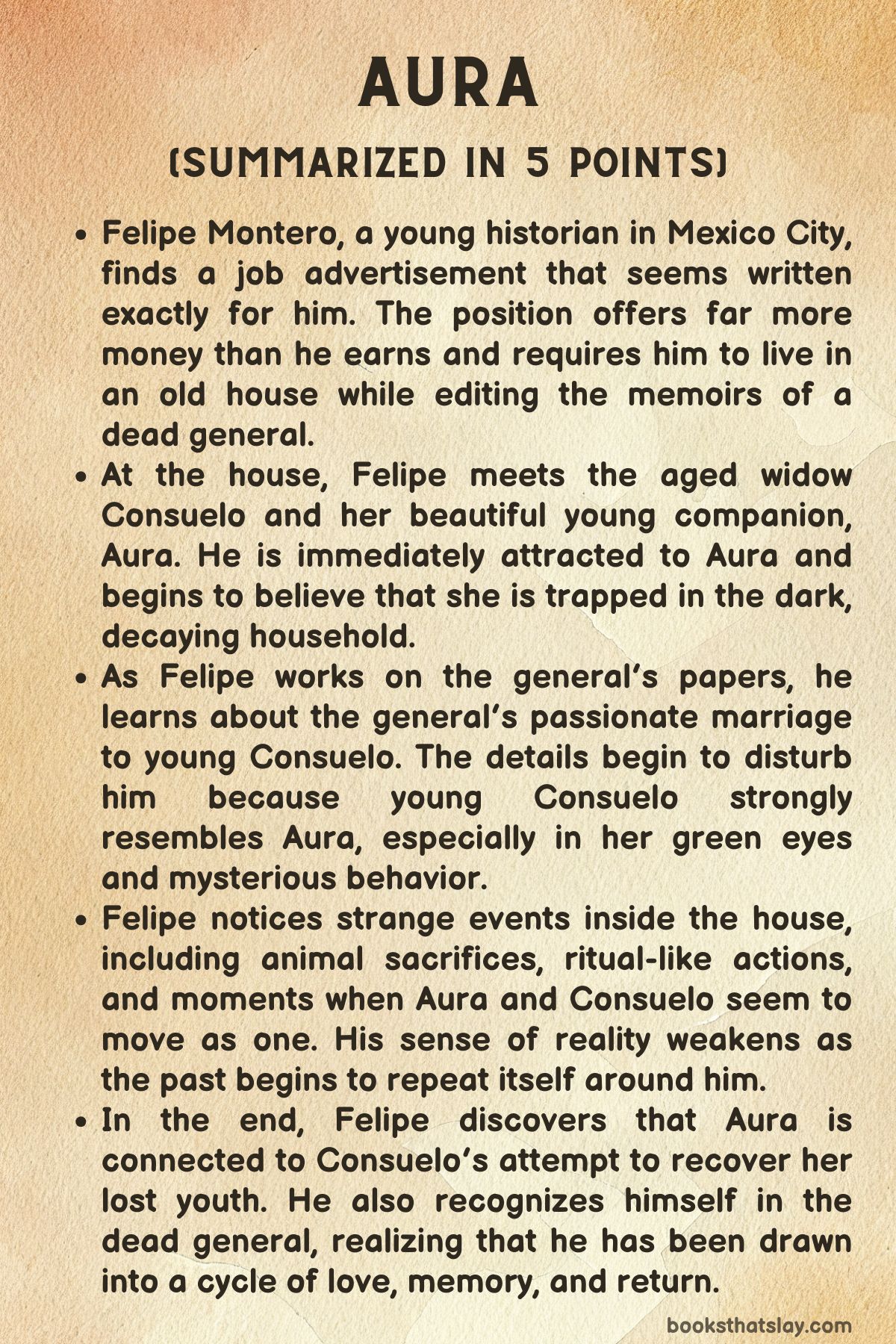
Aura by Carlos Fuentes is a short gothic novel about desire, memory, aging, identity, and the strange power of the past. The story follows Felipe Montero, a young historian in Mexico City, who accepts a well-paid live-in job editing the memoirs of a dead general.
Inside a dark old house, he meets the aged widow Consuelo and her mysterious niece Aura, whose beauty draws him deeper into the household’s secrets. The book creates unease through darkness, repetition, ritual, and blurred identities, gradually turning Felipe’s professional task into a disturbing encounter with love, obsession, and supernatural return.
Summary
Felipe Montero is a young historian living in Mexico City. He teaches part time at a private school and earns only 900 pesos a month, which is far below what he needs for the scholarly life he imagines for himself.
He has studied at the Sorbonne in Paris, speaks fluent French, and has strong academic ambitions, yet his education has not brought him the financial stability or recognition he hoped for. His daily life is ordinary and limited, shaped by routine, low pay, and the quiet frustration of being qualified for more than the world has offered him.
One morning, while eating breakfast at his usual café, Felipe notices a newspaper advertisement for a live-in position. The job asks for a young historian who knows colloquial French and offers a salary of 4,000 pesos a month.
The description seems almost made for him, but he does not immediately act on it. He assumes that many other poorly paid young historians must have seen the same opportunity and that the position will already be taken.
He leaves the café and continues with his normal day, but the advertisement remains in his mind because of how precisely it matches his abilities.
The next day, Felipe sees the same advertisement again. This time, he decides to investigate.
There is no telephone number, only an address: Donceles 815. The location is in the old historic center of Mexico City, an area filled with colonial houses that have mostly been converted into shops or businesses.
Very few people still live there, which makes the address feel unusual from the beginning. Felipe goes to the house and finds a dark, enclosed space that seems cut off from the life of the city outside.
Inside, he is guided by a woman’s voice through the shadowy interior. The house is difficult to navigate because it is so dark, and the atmosphere feels strange and old.
He eventually reaches a bedroom lit by many votive candles. There he meets an aged widow, Consuelo, who lies in a large bed with a rabbit nearby.
She tells him that she wants him to organize and prepare her late husband’s unfinished memoirs for publication before she dies. Her husband was a general, and the papers are written partly in French.
Consuelo examines Felipe closely, not only as a professional candidate but almost as though she has been expecting him personally. She insists that he must live in the house while he works.
Felipe hesitates at first, unsettled by the house and the widow’s conditions. Then Consuelo calls for Aura, her niece and companion.
Aura appears silently beside the bed, almost as if she has materialized from the darkness. She is young, beautiful, and has striking green eyes.
Felipe is instantly fascinated by her. His earlier hesitation disappears, and he agrees to move into the house.
Aura takes Felipe to his room on the top floor. Unlike the rest of the house, his room has a skylight and is filled with daylight.
It is decorated in an old-fashioned style, with wooden paneling and antique furniture. Felipe looks at himself in the mirror and observes his features, seeing himself as a young man of intelligence and seriousness.
The brightness of his room contrasts with the dark rooms below, making the house feel divided between the world Felipe knows and the shadowy world ruled by Consuelo.
At dinner, Felipe meets Aura in the dining room. The table is set for four people, though only he and Aura eat there.
A servant has apparently gone to collect his belongings, but the servant never becomes a real presence. Felipe is drawn strongly to Aura and finds it hard not to stare at her, though her face seems oddly difficult to hold in memory.
When he gives her the key to a drawer containing his personal documents, their hands touch, and she does not pull away. Felipe interprets this as a sign that she may share his attraction.
He begins imagining that Aura is trapped in the dark house and that he might rescue her from Consuelo’s control.
Felipe then visits Consuelo and finds her kneeling before religious images, praying intensely. Her devotion seems less peaceful than desperate, almost like a struggle.
She gives him the key to the chest containing the general’s papers. Felipe also notices signs of decay and infestation in the room, including what appears to be a rat’s nest, but Consuelo seems unconcerned.
The house appears neglected, yet it also feels carefully preserved, as if time has been held still inside it.
Felipe begins reading the general’s memoirs. He learns that the general grew up on a hacienda in Oaxaca, traveled to France, and later returned to Mexico with Maximilian I. After the French defeat, the general was exiled to Paris.
These papers connect the house to Mexico’s political past and to the lost world of empire, exile, and old loyalties. At first, Felipe approaches the material as a historian and editor.
He corrects, rewrites, and organizes the text, judging the work to be manageable. He also calculates that if he prolongs the job, he can save enough money to spend a year working on his own research into the Spanish Golden Age and the colonization of South America.
Yet Felipe’s attention increasingly shifts from the memoirs to Aura. He hears disturbing sounds, including the cries of cats.
Looking through the skylight, he sees cats burning in a side garden, a shocking image that suggests cruelty, sacrifice, or hallucination. When he asks Consuelo about the garden, she denies that such a place exists.
This denial makes Felipe question what he has seen and deepens the sense that the house obeys different rules from the outside world.
Consuelo eventually joins Felipe and Aura at lunch. As she talks, Aura remains silent.
Felipe notices that Aura appears to imitate Consuelo’s movements and behavior. The connection between the two women seems unnatural.
Aura is not simply a niece or companion; she appears bound to the old woman in a way Felipe cannot understand. When Felipe later enters Aura’s room, he finds it bare except for a large black Christ.
The lack of personal objects makes Aura seem less like an independent young woman and more like a figure created or maintained for a specific purpose. Still, Felipe convinces himself that she needs saving, and he casts himself as her rescuer.
That night, Felipe dreams of skeletal hands and is awakened by a soft body entering his bed. He believes it is Aura.
They make love, and before leaving at dawn, she calls him her husband. The encounter confirms his belief that their connection is intimate and fated, but it also increases the confusion between dream and reality.
He wakes feeling drained, as if the encounter has taken something from him.
Felipe later reads more of the general’s writings and discovers the young Consuelo of the past. The general describes meeting and falling in love with his wife when she was sixteen.
She had green eyes and dressed in green, just like Aura. He also remembers seeing her torture a cat, an act that should repel him but instead excites him.
Consuelo tells him the act is a sacrifice meant to preserve their love. These revelations unsettle Felipe because the resemblance between young Consuelo and Aura is too strong to ignore.
Felipe begins to suspect that Consuelo keeps Aura near her in order to preserve an illusion of youth. As he moves through the house, he sees more disturbing scenes.
He finds Aura in the kitchen beheading and skinning a kid, apparently unaware of his presence. He then sees Consuelo in her room performing a similar ritualistic action.
The two women seem to act as reflections of each other, separated by age but joined by will. Felipe becomes frightened and disoriented.
His sense of time, sequence, and reason begins to fail.
At dinner, he finds only one place set at the table and discovers a small rag doll beneath the napkin. He begins eating while holding the doll, but he soon feels disgust and drops it.
The doll suggests manipulation, ritual, and perhaps Felipe’s own helplessness. Later, he explores the covered patio by matchlight and notices medicinal and poisonous plants, including henbane, nightshade, and belladonna.
These plants suggest that Consuelo may use narcotics, magic, or hallucinatory substances in her attempts to preserve youth and power.
When Felipe goes to Aura’s room, he finds her waiting in a green robe. She no longer appears like a young girl but like a woman of about forty.
Her eyes and smile have changed, revealing both attraction and bitterness. She tells Felipe that they will play a game and that he does not need to do anything.
She washes his feet, dances with him, and then they undress. She offers him a wafer-like object, which creates an atmosphere of religious parody and ritual union.
Felipe declares that he will love her forever, even if she grows old and loses her beauty. His words matter because they bind him not only to Aura’s youth but also to the aged Consuelo hidden behind her.
After they sleep together again, Felipe wakes and sees Aura move toward a corner where Consuelo sits in the darkness. The two women look at him, smile, and move their heads at the same time.
They then rise together and leave through a connecting door. This moment makes clear that Aura and Consuelo are not separate in any ordinary sense.
Aura seems to be a projection, double, or temporary return of Consuelo’s youth.
The next day, Aura appears veiled. Felipe tries to speak openly with her, saying he wants to take her away from the house.
Aura tells him that Consuelo will be gone all day and suggests that they use the chance to leave forever. Yet Felipe hesitates, claiming that he is still under contract.
His desire to rescue Aura is revealed as unstable. He wants romance and control, but he is also bound by ambition, curiosity, and fear.
Aura asks him to meet her that evening in Consuelo’s bedroom.
After Consuelo leaves wearing her wedding dress, Felipe enters her room and gathers the final papers and some old photographs. In the general’s last writings, Felipe learns more about Consuelo’s obsession with youth.
The general writes that they could not have children, and Consuelo became increasingly consumed by herbs, narcotics, and visions of recreating her younger self. Her desire is not only to remain beautiful but also to recover love, fertility, and the past she lost.
The memoirs end with the idea that even the devil was once an angel, suggesting that corruption may begin in innocence, longing, or love.
The photographs finally reveal the truth. Felipe first thinks the woman in the pictures is Aura, but the writing identifies her as Consuelo.
He then begins to recognize himself in the general’s face. The likeness suggests that Felipe has not merely been hired by chance.
He is being drawn into the role of the dead husband, just as Aura is the renewed image of Consuelo. His identity begins to merge with the general’s, and the boundary between past and present collapses.
That evening, Felipe goes to Consuelo’s bedroom, believing he will find Aura. She tells him to lie beside her without touching her, but he cannot resist.
As moonlight enters the room, he sees that he is not embracing the young Aura but the aged, corpse-like Consuelo. Instead of recoiling, Felipe realizes that he loves her.
He also understands that he has returned, just as she has been waiting for him. Consuelo tells him that she can only keep Aura for three days at a time, but together they will bring her back.
The story ends with Felipe absorbed into the old cycle of desire, memory, and supernatural repetition, no longer simply an editor of the past but a participant in its return.
Characters
Felipe Montero
Felipe Montero is the central figure of the book, a young historian whose intelligence, poverty, ambition, and vanity make him vulnerable to the strange offer that brings him to Consuelo’s house. He begins as a recognizable modern intellectual: educated, underpaid, and frustrated by the gap between his abilities and his circumstances.
His scholarship gives him confidence, especially because the job advertisement appears to describe him so exactly, but that same confidence prevents him from recognizing how deliberately he is being drawn in. Felipe thinks of himself as rational and independent, yet he quickly becomes controlled by desire, money, curiosity, and the atmosphere of the house.
His attraction to Aura becomes the main force shaping his decisions. He convinces himself that she must be saved and that he is the man who can free her, but this idea reveals more about his imagination than about Aura’s actual condition.
Felipe often interprets silence, gestures, and mystery in ways that flatter his own role. As the story progresses, his identity weakens.
He stops being only Felipe Montero and begins to mirror General Llorente. His work as a historian becomes ironic because instead of studying the past from a distance, he is absorbed by it.
In Aura, Felipe’s tragedy lies in his inability to separate desire from destiny. By the end, he accepts the role prepared for him, not because he fully understands it, but because love, fascination, and the supernatural force of the house have remade his sense of self.
Aura
Aura is one of the most mysterious presences in the book. She first appears as a young woman of striking beauty, silent movement, and green eyes, and Felipe immediately sees her as someone trapped inside Consuelo’s dark world.
Yet Aura is never presented as a fully ordinary individual. Her silence, her difficulty to remember clearly, her bare room, and her synchronized behavior with Consuelo suggest that she exists as an extension of the old widow rather than as a separate niece with her own history.
She seems young, but her age shifts. She first appears girlish, then later seems closer to forty, and finally gives way to Consuelo herself.
This change makes her less a stable character than a living image of youth, desire, and memory. Aura’s beauty is not simple innocence; it carries danger, ritual, and obedience.
She leads Felipe through the house, serves meals, enters his bed, and invites him into acts that seem both erotic and ceremonial. Her passivity is also deceptive.
Although she rarely explains herself, she guides Felipe toward the final revelation. She is the form through which Consuelo can reclaim the body, love, and power she has lost to age.
Aura therefore represents desire made visible, but also the illusion that desire can restore the past exactly as it was. Her role is haunting because Felipe falls in love with her as if she can be rescued, while the book gradually shows that she may be the very instrument of his capture.
Consuelo Llorente
Consuelo Llorente is the old widow at the center of the house and the force behind much of the story’s mystery. Physically, she is frail, aged, and almost corpse-like, yet her weakness is misleading because she exerts strong control over the space around her.
The house belongs to her world: dark, enclosed, religious, decaying, and separated from ordinary time. Consuelo’s desire to publish her husband’s memoirs appears at first to be the wish of a widow preserving family history, but it becomes clear that the memoirs are also a tool for summoning, recognition, and return.
She chooses Felipe not only because he can edit French documents, but because he resembles the dead general. Consuelo’s grief is inseparable from obsession.
Her inability to have children, her fear of aging, and her longing to remain loved push her toward herbs, narcotics, religious images, and rituals that blur devotion and witchcraft. She is not merely a villain; she is a woman whose pain has become possessive and unnatural.
Her creation or maintenance of Aura reveals the extremity of her longing. She wants youth not as vanity alone, but as a way to recover the moment when love, beauty, and possibility still belonged to her.
In the final scene, Consuelo becomes both horrifying and strangely triumphant. She wins Felipe’s recognition, not by hiding age forever, but by making him accept her aged body as the same beloved figure he desired in Aura.
General Llorente
General Llorente is dead before the action begins, but his presence shapes the entire book through his memoirs, photographs, and resemblance to Felipe. He represents the historical past that Felipe thinks he has been hired to organize.
His life connects private desire to political history, including Mexico’s imperial period, exile, France, and the world of old military loyalty. At first, he seems to exist only as an object of scholarly work, but his writings slowly reveal the emotional and disturbing history behind the house.
His love for young Consuelo is passionate, but it is also morally uneasy. When he sees her torturing a cat and responds with arousal rather than horror, the book suggests that his love was always tied to violence, sacrifice, and a willingness to accept darkness in the name of desire.
His memoirs expose Consuelo’s transformation from young bride to obsessed widow, while also showing his own complicity in the emotional world that later traps Felipe. General Llorente’s importance grows when Felipe sees the photographs and recognizes himself in the general’s features.
This resemblance turns the general from a historical subject into Felipe’s double. He is not only a dead husband but a role waiting to be filled again.
Through him, the story suggests that history is not safely past; it can repeat itself through bodies, desires, and names.
The Servant
The servant is a minor and mostly unseen figure, but this absence is meaningful. Aura tells Felipe that a servant has gone to retrieve his belongings, and the fact that his things arrive and are unpacked suggests that someone is carrying out the household’s practical needs.
Yet the servant never becomes a visible, developed person in the story. This creates uncertainty about whether the servant is real, imagined, temporary, or simply part of the house’s machinery.
In a normal household, a servant would make the space feel socially grounded, but here the reference has the opposite effect. The servant’s invisibility increases the sense that work happens in the house without clear human agency.
Felipe’s belongings appear where they should be, meals are prepared, and the household continues, but the people responsible remain hidden or silent. The servant therefore contributes to the atmosphere of control.
Felipe enters a place where unseen forces manage his movement, possessions, and daily routine. This minor figure also shows how quickly Felipe accepts odd conditions when desire and money are involved.
He does not demand to meet the servant or question the arrangement deeply, which reveals how willing he is to adjust to the house’s strangeness once Aura has captured his attention.
Maximilian I
Maximilian I appears only through the general’s past, but his mention places the private story within a broader historical frame. The general’s return to Mexico with Maximilian connects him to the failed French-backed empire and to a world of political defeat, nostalgia, and exile.
Maximilian is not an active character in the central action, yet he helps define General Llorente’s identity as a man tied to lost causes and vanished orders. This matters because the house itself is also a space of lost time.
Just as the imperial project failed and became part of history, Consuelo’s youth and marriage also passed away. The characters inside the house resist that passing.
Maximilian’s presence in the background reminds the reader that the story is not only about private obsession but also about the afterlife of history. Felipe, as a historian, thinks he can examine such figures and periods from a safe distance.
Instead, the job connected to Maximilian’s era becomes the path by which Felipe is pulled into repetition. The reference gives the book a political and historical shadow, showing how public history and private memory can both become haunted by defeat.
The Rabbit
The rabbit near Consuelo’s bed is a small but strange presence that adds to the unnatural feeling of the widow’s room. It appears beside her when Felipe first meets her, helping create the impression that Consuelo lives in a world governed by symbols, rituals, and private habits rather than ordinary domestic life.
Rabbits are often associated with fertility, reproduction, and vulnerability, which matters because Consuelo’s inability to have children is central to her sorrow and obsession. The rabbit’s presence beside an aged widow who longs to recover youth and love can be read as a quiet reminder of fertility denied or desired.
It also makes Consuelo’s room feel less human and more like a ritual chamber. The animal does not need to act dramatically to affect the story; its stillness and placement are enough.
It helps establish that Felipe has entered a house where animals are tied to emotional and supernatural meanings. Later scenes involving cats and the kid are much more violent, so the rabbit also prepares the reader for a world where animals are not simply background details but part of the book’s symbolic and ritual language.
The Cats
The cats are important not as individual characters but as living signs of sacrifice, cruelty, and supernatural disturbance. Felipe hears their cries before he sees the shocking image of cats burning in the side garden.
Consuelo denies any knowledge of such a garden, which makes the sight uncertain, but the emotional effect is strong. The burning cats connect to the general’s memory of young Consuelo torturing a cat and claiming that the act was a sacrifice to preserve love.
Through this repetition, cats become associated with the price of desire. Love in the story is not gentle or harmless; it is linked with violence, offerings, and the willingness to hurt living beings in order to hold onto passion.
The cats also disturb Felipe’s trust in his senses. He hears them, sees them, and then is told that the space where they appeared does not exist.
This makes them part of the house’s attack on rational perception. In Aura, the cats mark the point where Felipe’s scholarly confidence begins to weaken, because what he witnesses cannot be easily explained by history, reason, or ordinary household life.
The Kid
The kid that Aura beheads and skins is one of the most unsettling images in the book. Like the cats, it is not a character in the human sense, but it functions as part of the story’s ritual world.
Felipe sees Aura in the kitchen performing this violent act with mechanical focus, as if she does not notice him. When he then sees Consuelo carrying out a similar action elsewhere, the scene strengthens the connection between the two women.
The kid becomes evidence that Aura and Consuelo are joined through repeated gestures and shared ritual behavior. The animal’s death also suggests sacrifice, preparation, and transformation.
Felipe has entered a household where bodies are handled as materials in ceremonies whose meanings he does not fully understand. The scene frightens him because it breaks apart his romantic fantasy of Aura as a helpless innocent.
She is not merely a beautiful prisoner waiting for rescue; she participates in the dark practices that sustain the house. The kid therefore forces Felipe, and the reader, to see the violence beneath the surface of desire.
Themes
Desire and the Refusal to Accept Aging
Desire in the story is not limited to romance or physical attraction; it becomes a force that tries to defeat time. Consuelo’s longing to recover youth is rooted in her need to be loved as she once was.
Her aged body represents loss, but Aura allows her to create or summon an image of beauty that Felipe can desire. This makes youth appear less like a natural stage of life and more like a mask that can be called back through ritual, memory, and will.
Felipe’s attraction to Aura is also tied to this problem. He first wants the young woman, but his final declaration that he loves Consuelo reveals that the object of desire has never been simple.
The story asks whether love can survive the destruction of beauty, or whether people love only the form in which desire first appears to them. Consuelo’s tragedy is that she cannot let love remain in the past, while Felipe’s tragedy is that he mistakes attraction for freedom.
By the end, aging is not defeated; instead, Felipe is trained to accept the old woman behind the young image, which turns desire into submission.
The Power of the Past Over the Present
The past in Aura does not stay inside documents, photographs, or memory. It enters rooms, bodies, and relationships until the present loses its independence.
Felipe begins as a historian, someone trained to study what has already happened. He believes that the general’s memoirs are professional material: old papers to be edited, corrected, and prepared for publication.
Yet the more he reads, the more the memoirs seem to describe the living situation around him. Young Consuelo resembles Aura, General Llorente resembles Felipe, and events from the past begin repeating in altered form.
The house itself supports this collapse of time. Its darkness, antique furniture, candles, religious images, and isolation from the modern city make it feel preserved rather than inhabited.
Felipe’s mistake is assuming that history is passive. In the story, history chooses him, names him, and absorbs him.
The photographs complete this process because they turn resemblance into recognition. Once Felipe sees himself in the general, he can no longer remain outside the story he has been editing.
The past becomes a script, and he becomes the actor chosen to continue it.
Control, Possession, and the Illusion of Rescue
Felipe repeatedly imagines that Aura needs to be saved from Consuelo, but this rescue fantasy hides his own desire for possession. He sees Aura’s silence and obedience and turns them into proof that she is trapped.
He then casts himself as a heroic figure who will take her away from darkness and give her a new life. Yet his actions show hesitation and self-interest.
When Aura offers a chance to leave, he retreats behind the excuse of his contract. This reveals that his fantasy is less about Aura’s freedom than about the role he wants to play in relation to her.
Consuelo’s control is more obvious: she shapes the household, selects Felipe, manages Aura’s appearances, and works to restore the dead marriage through him. But Felipe also tries to control Aura through interpretation.
He decides what her silence means, what her life lacks, and what she should want. The story gradually overturns this male fantasy.
Aura is not simply a powerless young woman, and Consuelo is not merely an obstacle. Felipe is the one being guided, watched, and prepared.
The rescuer becomes the captive, and the desire to possess becomes the means by which he is possessed.
Religion, Ritual, and the Blurring of Devotion with the Occult
Religious imagery fills the house, but it rarely brings comfort or moral clarity. Consuelo prays before sacred images with an intensity that seems combative rather than peaceful.
Aura’s room contains a large black Christ, and the scene with the wafer carries clear religious echoes, but these signs are mixed with eroticism, sacrifice, and supernatural practice. This combination creates a world where devotion and dark ritual cannot be cleanly separated.
Consuelo’s actions may be read as prayer, magic, desperation, or all three at once. Her use of herbs and narcotics, along with the presence of plants such as belladonna and nightshade, suggests that she seeks power through both natural substances and spiritual transgression.
The animal violence deepens this atmosphere of sacrifice. Love is treated almost like a religion, demanding offerings and repeated ceremonies.
Felipe’s participation in these rituals marks his movement away from reason and toward surrender. The story does not present faith as simple hypocrisy; rather, it shows how longing can bend religious forms into instruments of control.
Sacred gestures remain recognizable, but they are redirected toward the preservation of youth, desire, and the return of the dead.