At Night All Blood Is Black Summary, Characters and Themes
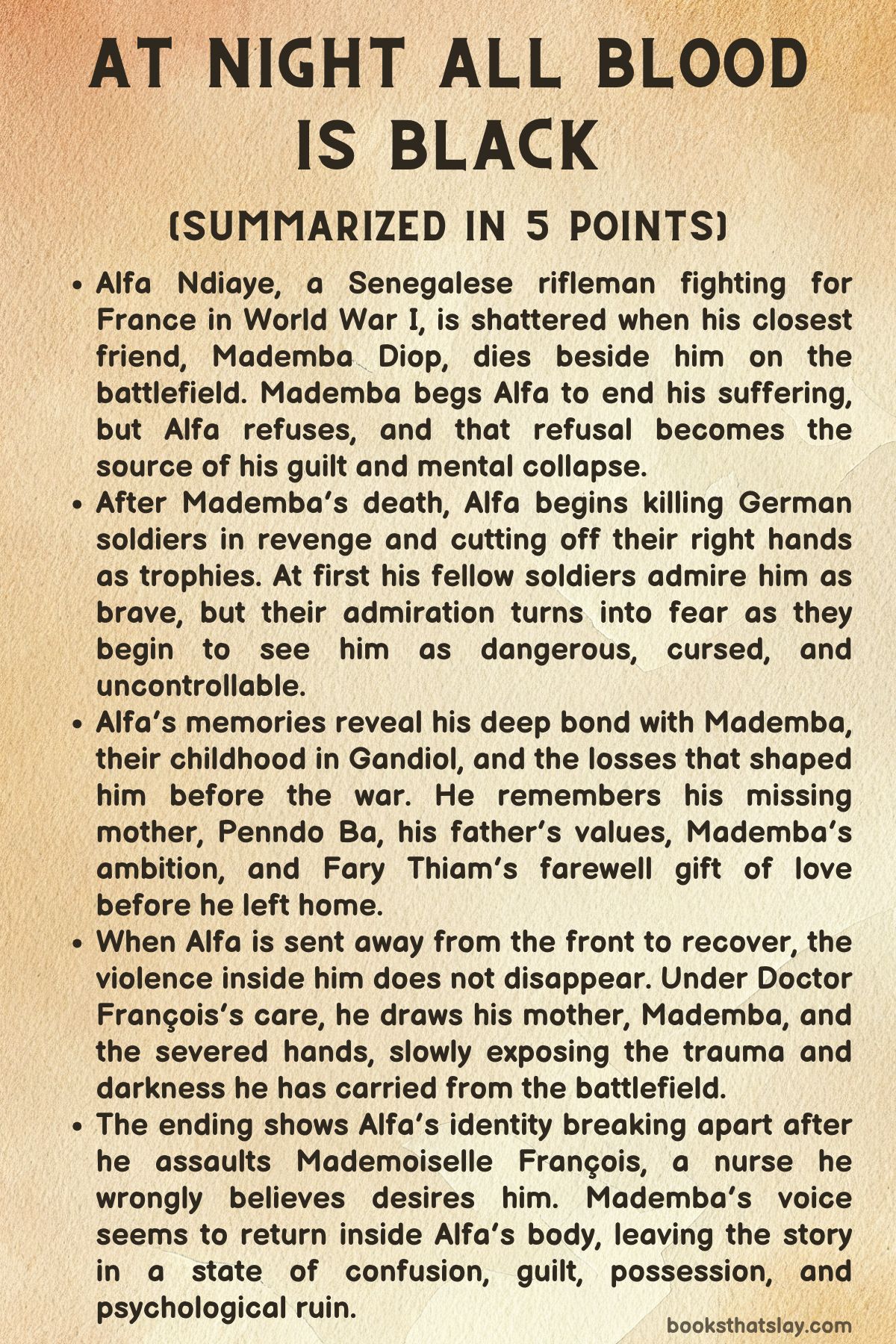
At Night All Blood Is Black by David Diop, translated by Anna Moschovakis, is a war novel about Alfa Ndiaye, a Senegalese rifleman fighting for France in World War I. After his closest friend, Mademba Diop, dies in agony beside him, Alfa’s mind begins to break under grief, guilt, racial performance, and the constant pressure of battlefield violence. The book studies how war turns men into symbols, weapons, myths, and monsters.
It is also a story about friendship, colonial power, masculinity, memory, and the loss of moral certainty when survival depends on obeying commands that strip away humanity.
Summary
Alfa Ndiaye begins with a confession that he has done something shameful, though he does not immediately explain what it is. His story opens around the death of his best friend, Mademba Diop, on the battlefield.
Mademba has been disemboweled by a German soldier and is dying slowly in terrible pain. He asks Alfa to kill him, first calmly and then desperately, because he knows he cannot survive.
Alfa refuses. He thinks of God, ancestral law, human law, and the moral rule against killing a friend.
Because of those rules, he leaves Mademba to suffer. After Mademba dies, Alfa realizes that his refusal was not mercy but cruelty.
This moment breaks something inside him. He decides that from then on he will think for himself and no longer obey inherited ideas of right and wrong without question.
Alfa carries Mademba’s body back across the battlefield toward the French trench. His fellow soldiers see this as an act of bravery.
They welcome him as a hero and believe he may receive a medal. Alfa feels detached from their praise.
Inside, he knows he failed Mademba at the most important moment. The trench itself begins to appear strange and obscene to him, as if his mind has crossed a boundary it cannot uncross.
His perception of the world changes after Mademba’s death, and ordinary military language and ritual begin to look absurd.
Back in the trench, Alfa resumes the routine of war, but he no longer feels like a true participant in the shared beliefs of the soldiers. He watches them obey orders, rush out of the trench, and die because officers tell them to.
He sees how the Black soldiers are expected to act fierce and savage in order to satisfy French ideas about African troops. Alfa understands that the role they perform is useful to the French army.
The soldiers are asked to become terrifying figures, but only in ways that serve French command. Alfa begins to separate himself from this performance, even as he takes it further than anyone expects.
Driven by guilt and revenge, Alfa starts leaving the trench during attacks and staying behind in no-man’s-land. He captures German soldiers, mutilates them in ways that repeat Mademba’s death, slits their throats, and cuts off their right hands.
He brings the rifles and severed hands back to the trench. At first, the other soldiers celebrate him.
They see him as fearless, almost supernatural, and reward him with food, tobacco, and admiration. His violence appears useful as long as it can be framed as heroism.
Alfa knows, however, that he is acting from private pain rather than patriotic courage.
The book repeatedly returns to the details of Mademba’s death. During an attack, Mademba had approached what seemed to be a dead German soldier.
The soldier suddenly rose and stabbed him with a bayonet. Alfa had stayed with Mademba afterward, asking him to explain what had happened.
The death becomes the central wound in Alfa’s mind. He reenacts it on captured enemies, opening their bellies before killing them.
He waits for a plea, just as Mademba had pleaded with him, and then cuts their throats. Each killing is both revenge and a failed attempt to correct the original moment when he did not act.
After Alfa returns with several severed hands, the soldiers’ attitude changes. The same men who praised him begin to fear him.
Rumors spread that he is not brave but cursed, not heroic but possessed. They suspect him of witchcraft and begin to call him a dëmm, a devourer of souls.
The accusation grows stronger when Alfa remembers his own role in Mademba’s death. Before the attack, he had teased Mademba about his family totem, the peacock, and compared it unfavorably with his own lion totem.
Mademba, already sensitive about being weaker and smaller than Alfa, rushed forward to prove himself. Alfa begins to see that his words pushed Mademba toward danger.
The rumor that he caused Mademba’s death is not fully false.
Alfa both accepts and rejects the idea that he is a dëmm. He knows that he harmed Mademba through pride and mockery, yet he does not want to surrender his identity to the superstitions of the trench.
Still, his behavior continues to frighten those around him. After he returns with seven severed hands, Captain Armand sends him away from the front for a month of rest.
The order is delivered through Ibrahima Seck, an older Black translator who is terrified of Alfa. Captain Armand and Seck try to find out where Alfa has hidden the hands, but Alfa refuses to tell them.
He understands that the hands are evidence that could be used to imprison or condemn him.
Alfa has preserved the severed hands by salting and drying them. The first hand was stolen by Jean-Baptiste, a white soldier whom Alfa considers his only real white friend.
Jean-Baptiste had comforted Alfa after Mademba’s death, and he treats the severed hand as a grotesque joke. He uses it to salute soldiers, shake hands, and insult the Germans.
His humor is reckless and theatrical. After receiving a painful letter, likely from a woman, Jean-Baptiste becomes even more careless.
He fixes the severed hand to his helmet with its middle finger raised toward the enemy. During an attack, the Germans hold fire long enough for an artilleryman to identify him, and Jean-Baptiste is killed.
Jean-Baptiste’s death deepens Alfa’s isolation. Alfa crawls toward the German trench and captures a young enemy soldier.
He knows this boy probably had nothing to do with the deaths of Mademba or Jean-Baptiste. The soldier is small, frightened, and pitiable, but Alfa kills him anyway.
When he returns to his own trench, the other men no longer celebrate him. Without Jean-Baptiste’s laughter to shape the mood, they see Alfa’s actions more clearly.
He is now viewed as dangerous and mad. The very violence that once made him useful has become frightening because it no longer seems controllable.
Alfa also reflects on Captain Armand’s cruelty. He remembers a moment when some white soldiers tried to refuse an attack.
Armand had them bound and forced them out of the trench anyway, making them choose between being shot as traitors or dying in the field as soldiers whose families could receive honors and pensions. Alfa admires Alphonse, the leader of the mutiny, who dies with his wife’s name on his lips.
To Alfa, Armand is the true devourer of souls because he sacrifices men to war while pretending to defend order. Alfa believes Armand wants to remove him not because Alfa is evil, but because Alfa’s uncontrolled violence competes with the captain’s authority over death.
When Alfa is sent to the Rear, he hides the preserved hands in his trunk and protects it with a red leather totem shaped like a severed hand. The other soldiers are too afraid of witchcraft to search it.
In the hospital area, Alfa is watched by Doctor François and cared for by nurses. He notices Mademoiselle François and believes she desires him.
He compares her gaze to that of Fary Thiam, a young woman from his village of Gandiol who slept with him the night before he left for war. Alfa thinks of his own body, his beauty, his smile, and his strength, and he recalls how people have always responded to him physically.
These memories return him to his childhood with Mademba. Alfa was strong, handsome, and athletic, while Mademba was weaker, thinner, and marked by bad teeth.
Their friendship was deep, but it was also shaped by comparison. Mademba loved Alfa, yet envied his physical power.
Alfa realizes that Mademba’s courage was greater than his own because Mademba fought despite fear and weakness. He also remembers that people had accused Alfa of draining Mademba’s strength even when they were boys.
Mademba always defended him, refusing to believe that his friend was dangerous.
Doctor François encourages Alfa and the other patients to draw as a way of clearing the mind of war. Alfa first draws his mother, Penndo Ba.
Her story becomes another source of grief. Penndo was the daughter of Yoro Ba, a Fulani herder who came through Gandiol during dry seasons.
Yoro gave her in marriage to Bassirou Coumba Ndiaye, Alfa’s father, as a gesture of gratitude. Penndo and Bassirou loved each other despite their differences, but when Yoro stopped returning, Penndo became consumed by longing for her family and nomadic past.
She eventually left to search for her father and brothers and disappeared, likely captured and enslaved. Alfa’s loss of his mother shaped his childhood long before the war damaged his adulthood.
Alfa next draws Mademba and remembers how Mademba’s family gradually took him in after Penndo vanished. The two boys became closer than brothers.
Alfa worked through grief with farming, dancing, and wrestling, while Mademba pursued learning. Mademba studied the Koran and later attended a French school.
He dreamed of serving France, going to Saint-Louis, becoming a businessman, and helping Alfa search for his missing mother. When Mademba was first rejected by army recruiters because of his weak body, Alfa trained him until he was strong enough to be accepted.
Their journey to war was therefore built from friendship, ambition, colonial promise, and Alfa’s hope of someday finding revenge for his mother’s disappearance.
Alfa also remembers Fary Thiam. She chose to sleep with him before he left, even though premarital sex was forbidden and her father disliked Alfa’s father.
Her act was a gift given in the knowledge that war might take Alfa away forever. The hostility between the families came from Abdou Thiam, Fary’s father and the village chief, who wanted farmers to grow peanuts for profit.
Alfa’s father resisted because such farming would make families dependent on Abdou’s shop and weaken their ability to feed themselves or offer hospitality. Fary’s choice therefore defied both social rules and family politics.
The third drawing Alfa makes is of the severed hands. Before drawing them, he buries them under moonlight, believing they deserve light.
He sees a shadow watching him and worries that someone may report him. When Doctor François sees the drawing, his attitude toward Alfa changes.
The drawing reveals what words have not fully exposed: Alfa has carried the violence of the front into the place meant to heal him.
The final movement of the story shifts into a strange confusion of identity. A narrator wakes in a large wrestler’s body during an assault on Mademoiselle François.
The scene reveals that Alfa has entered her room, covered her mouth, ignored her resistance, and raped her. She becomes still and silent.
The voice and identity that emerge afterward appear to belong to Mademba inside Alfa’s body. The narrator no longer knows who he is.
He hears a distant voice telling him about the body he occupies. He understands French and answers questions in a long, mystical speech instead of giving a simple name.
The ending suggests that Alfa’s self has fractured under the weight of grief, guilt, desire, violence, and the unresolved bond with Mademba. Mademba’s voice seems to claim space inside Alfa’s body, connecting the dying plea in no-man’s-land to the later collapse of Alfa’s identity.
The book closes with uncertainty about whether this is madness, possession, guilt speaking in another voice, or a symbolic merging of the two friends. Alfa wanted to think for himself after Mademba’s death, but the self he tried to free has been consumed by everything he could not bear: war, memory, shame, and the friend he failed to kill mercifully.
Characters
Alfa Ndiaye
Alfa Ndiaye is the central figure of the book and the mind through which most of its violence, grief, and moral confusion are filtered. He begins as a Senegalese rifleman fighting for France, but his identity is transformed after Mademba’s death.
Alfa’s defining wound is not simply that his friend dies, but that he refuses to end Mademba’s suffering when Mademba begs him to. His guilt becomes the engine of his later brutality.
By killing German soldiers in a manner that repeats Mademba’s wounds, Alfa tries to rewrite the moment when he failed to act, but each killing only traps him more deeply inside that memory. He is intelligent and observant, especially about the absurdity of military obedience and the racial performance demanded of Black soldiers.
Yet his insight does not save him. Instead, it isolates him.
Alfa sees through the French army’s moral language, but he cannot build a stable moral world of his own. His physical beauty and strength are important because they shape how others see him and how he sees himself: as admired, envied, desired, and feared.
In At Night All Blood Is Black, Alfa becomes a tragic study of a man whose grief turns into ritual violence, whose self-awareness sharpens rather than heals his madness, and whose body becomes the battlefield where friendship, colonial war, sexuality, and guilt fight for control.
Mademba Diop
Mademba Diop is Alfa’s closest friend, almost a brother, and his death controls the emotional structure of the story. Mademba is physically weaker than Alfa, but the book presents him as morally and emotionally courageous.
His bravery is not the easy confidence of a naturally strong man; it is the bravery of someone who knows his own limits and tries to exceed them. As a child, he envies Alfa’s strength and beauty, but he also loves him deeply and protects him from accusations that Alfa is a devourer of souls.
Mademba’s desire to prove himself makes him vulnerable, especially when Alfa mocks his peacock totem before the attack. That taunt pushes Mademba toward reckless courage, leading him to leave the trench first and suffer the fatal wound.
Mademba also represents the seduction of French colonial promise. His schooling fills him with dreams of serving France, moving to Saint-Louis, becoming successful, and helping Alfa search for his mother.
His ambition is sincere, but it is tied to a colonial system that spends his life cheaply. After death, Mademba remains present as memory, accusation, and possibly voice.
By the end, he seems to return inside Alfa’s body, suggesting that their brotherhood has become so intense and unresolved that the boundary between them can no longer hold.
Captain Armand
Captain Armand represents military authority stripped of moral disguise. He commands men from a position that allows him to send them into death while preserving the appearance of discipline, honor, and patriotism.
To Alfa, Armand becomes more monstrous than the men accused of sorcery because he devours lives through official power. His treatment of the mutinous soldiers reveals his essential nature.
When they refuse to leave the trench, he does not persuade them or understand their fear. He binds them and forces them upward, offering them only two versions of death: shameful execution as traitors or honorable death in battle.
This exposes the cruelty beneath military ceremony. Armand is not chaotic like Alfa; he is controlled, strategic, and protected by rank.
That makes him more dangerous in a different way. He tolerates Alfa’s violence while it benefits the army, but once Alfa’s actions threaten discipline, Armand removes him from the front.
His interest in the hidden hands is practical, not moral. He wants evidence and control.
In the book, Armand shows how institutions can commit violence while naming it duty, and how official murder can appear civilized because it follows procedure.
Ibrahima Seck
Ibrahima Seck, called the “Croix de Guerre Chocolat,” is an older Black translator who stands between Captain Armand and Alfa. His role is painful because he must carry the language of French command to another African soldier while also sharing the fears and cultural references that surround Alfa.
Seck is terrified of Alfa, believing he may be a dëmm who will resent being removed from the battlefield. His fear shows how rumor, spiritual belief, and military hierarchy combine to isolate Alfa further.
Seck does not have Armand’s authority, yet he participates in Armand’s attempt to manage Alfa. He is caught between obedience to the French army and the cultural world that allows him to understand why Alfa frightens people.
His nickname suggests token recognition from the French military, a decorated Black soldier marked by both honor and racial diminishment. Seck’s presence also highlights the role of translation in the story.
Words do not move cleanly between languages, cultures, or systems of power. As translator, he is necessary, but he is also compromised, delivering commands that are not truly his while fearing the man who receives them.
Jean-Baptiste
Jean-Baptiste is Alfa’s only real white friend in the trench and one of the few soldiers who responds to Alfa with warmth after Mademba’s death. He is a joker, trickster, and performer, using humor to make the horror of war briefly bearable.
His theft of Alfa’s first severed hand shows both his grotesque playfulness and his inability to understand the full private meaning of Alfa’s violence. To Jean-Baptiste, the hand becomes a prop.
He salutes with it, shakes hands with it, and uses it to mock both his comrades and the Germans. His humor is brave but also self-destructive.
After receiving a perfumed letter that seems to wound him emotionally, he turns his joking into a death wish. By fixing the severed hand to his helmet and raising its middle finger at the enemy, he converts pain into spectacle.
His death marks a turning point in the trench. While he lived, he helped shape Alfa’s mutilations into legend and dark comedy.
Once he dies, the other soldiers see the severed hands differently. Jean-Baptiste is therefore both a companion and an enabler, a man whose laughter delays the moment when Alfa’s violence is recognized as madness.
Doctor François
Doctor François appears in the Rear as a figure of medical care, observation, and attempted psychological repair. He encourages Alfa and the other patients to draw as a way of cleansing their minds from war.
His method suggests a belief that trauma can be brought outward through art and made manageable. At first, he seems kind and patient, especially when Alfa draws his mother and Mademba.
Yet his kindness has limits. When Alfa draws the severed hands, Doctor François’s expression changes, showing that he now sees a truth he cannot comfortably absorb.
His role is important because he belongs to the world that claims to heal soldiers but may not be prepared for the full reality of what war has made them. He asks for expression, but the expression he receives is too disturbing.
Doctor François also reflects the limits of European medical authority in the book. He can study Alfa, observe him, and prescribe drawing, but he cannot fully understand the cultural, spiritual, colonial, and personal forces inside Alfa’s breakdown.
His failure is not simple cruelty; it is the failure of a system that treats symptoms while remaining connected to the war that produced them.
Mademoiselle François
Mademoiselle François is one of the nurses in the Rear and becomes the object of Alfa’s dangerous misreading of desire. Alfa believes that her gaze invites him, and he compares her look to Fary Thiam’s before his departure from Gandiol.
This comparison is central to his distortion. Fary’s desire was active, chosen, and personal, while Mademoiselle François’s supposed desire is filtered entirely through Alfa’s damaged perception.
She becomes less a fully known person to him than a screen for memory, longing, pride, and sexual entitlement. The assault against her is one of the darkest moments in the book because it shows that Alfa’s violence is not confined to enemy soldiers or battlefield revenge.
His collapse has moved into intimate space, and his belief in his own desirability becomes part of his danger. Mademoiselle François also exposes how power can shift in complex ways.
She is white and part of the French medical world, but in the bedroom scene she is vulnerable to Alfa’s physical force and delusion. Her silence afterward is haunting because it marks the destruction of any comforting division between war violence and private violence.
Penndo Ba
Penndo Ba, Alfa’s mother, is a major presence in memory despite her physical absence for much of the book. Her disappearance is Alfa’s first great loss, long before Mademba’s death.
She is introduced through her lineage as the treasured daughter of Yoro Ba, a Fulani herder, and through her marriage to Bassirou Coumba Ndiaye. Penndo carries within her the pull between settled village life and nomadic belonging.
Though she loves Bassirou, she remains attached to her father, brothers, and the movement of her early life. When Yoro stops returning to Gandiol, her waiting becomes unbearable.
Her decision to search for her family shows courage and longing, but it also leads to her disappearance, likely through capture and enslavement. For Alfa, Penndo becomes an open wound and an unfinished quest.
His later dream of military power is partly tied to the fantasy of finding or avenging her. In this way, her absence shapes his masculinity, his grief, and his attraction to violence as a tool of recovery.
Penndo is not merely a lost mother; she represents the first break in Alfa’s world, the loss that teaches him that love can vanish without explanation.
Yoro Ba
Yoro Ba is Penndo Ba’s father and Alfa’s maternal grandfather, a Fulani herder whose seasonal arrival in Gandiol links different ways of life. His movement with cattle represents a world beyond the settled agricultural rhythms of Alfa’s village.
Yoro’s relationship with Bassirou Coumba Ndiaye begins through hospitality and mutual respect. Bassirou clears a path to his wells for Yoro and his herd, and Yoro responds by giving Penndo to Bassirou as his fourth wife.
This action reflects social customs that may feel distant to modern readers, but within the book it is presented as part of a bond between families and cultures. Yoro’s later absence is devastating.
When he stops returning, Penndo experiences it as a rupture from her origins. Yoro therefore matters less as an active character than as the center of Penndo’s longing.
His disappearance from the seasonal pattern causes Penndo’s departure, which in turn shapes Alfa’s life. Through Yoro, the book shows how one broken rhythm in family and community can echo across generations.
Bassirou Coumba Ndiaye
Bassirou Coumba Ndiaye is Alfa’s father, an older landowner in Gandiol who becomes Penndo Ba’s husband. He is associated with hospitality, land, wells, and agricultural stability.
His welcome of Yoro Ba and his cattle establishes him as a man who understands social duty and generosity. His marriage to Penndo is marked by real affection despite differences in age and background.
Bassirou’s importance also appears in his conflict with Abdou Thiam over peanut farming. While Abdou promotes a cash-crop system that would make villagers dependent on his store, Bassirou resists.
He understands that abandoning subsistence crops would weaken families during drought and reduce their ability to feed guests and kin. This makes him a figure of practical wisdom and ethical independence.
He is not romanticized as perfect, but he represents a rooted moral world that contrasts sharply with the French army’s destructive logic. Through Bassirou, Alfa inherits a sense of dignity tied to land, food, and resistance to economic dependency.
His values form part of what Alfa loses when he leaves for war.
Fary Thiam
Fary Thiam is the young woman from Gandiol who sleeps with Alfa the night before he leaves for war. Her role is brief but emotionally important.
She is not simply a memory of sexual pleasure; she is a figure of choice, defiance, and farewell. By going to the woods with Alfa, she breaks moral taboo and acts against the hostility between their families.
Her father, Abdou Thiam, dislikes Alfa’s father, which makes her action even more deliberate. Alfa understands the encounter as a gift, given because Fary knows the war may take him away permanently.
Her desire is presented as clear and active, which makes Alfa’s later comparison between her and Mademoiselle François deeply troubling. Fary’s memory becomes part of the way Alfa interprets women’s gazes and his own attractiveness, but the book also shows the danger of confusing one woman’s chosen intimacy with another woman’s silence or fear.
Fary stands for the life Alfa might have had in Gandiol: bodily joy, village conflict, young love, and the knowledge that departure can turn desire into a final offering.
Abdou Thiam
Abdou Thiam is Fary’s father, the village chief, and a shopkeeper. His conflict with Alfa’s father is rooted in economics and power.
Abdou wants the farmers of Gandiol to grow peanuts instead of maintaining a range of food crops. His proposal is not neutral.
If the villagers grow cash crops, they will need to buy food from his store, increasing his influence and profit. Alfa’s father opposes him because he sees the danger in replacing self-sufficiency with dependency.
Abdou therefore represents a local version of exploitative power, smaller than the French military system but connected to similar logic: profit and control disguised as progress. His hostility toward Alfa’s family gives Fary’s act of intimacy greater force.
She is not only choosing Alfa; she is crossing a line created by her father’s feud. Abdou’s presence also broadens the book beyond the battlefield by showing that domination does not exist only in Europe or in colonial command.
It can also appear inside village politics, in economic persuasion, social pressure, and the manipulation of need.
Alfa’s Father
Alfa’s father, Bassirou Coumba Ndiaye, also functions specifically as a paternal moral influence in Alfa’s memory. As a father, he gives Alfa an example of rooted judgment.
His refusal to follow Abdou Thiam’s peanut plan shows that he values long-term survival, hospitality, and independence over short-term gain. This matters because Alfa later enters a military system built on obedience, where men are rewarded for surrendering judgment to command.
His father’s resistance to Abdou offers a contrast to the soldiers who follow orders into death. Alfa does not always live by his father’s values, but the memory of such values helps readers understand what has been damaged in him.
His father’s household also becomes the site of Penndo Ba’s love and sorrow. As husband to Penndo and father to Alfa, he is tied to both nurture and loss.
His inability to prevent Penndo’s disappearance leaves Alfa exposed to grief, but he is not portrayed as uncaring. He belongs to the prewar world of family, farming, and local argument, a world that war later makes feel distant and unrecoverable.
Alphonse
Alphonse is the leader of the white soldiers who try to resist Captain Armand’s order to leave the trench. Though he appears briefly, he carries strong symbolic weight.
His refusal is not cowardice in any simple sense. It is a protest against being sent into certain death by an authority that treats soldiers as expendable.
When Armand has the mutineers bound and forced out, Alphonse becomes an example of doomed resistance. Alfa admires him because he recognizes a form of courage different from battlefield aggression.
Alphonse dies climbing out of the trench with his wife’s name on his lips, which restores personal love to a place where military command tries to erase individuality. His final word matters because it shows that soldiers do not die only for nations, medals, or officers; they die while carrying private attachments that war cannot fully absorb.
Alphonse’s presence also complicates Alfa’s view of the French soldiers. Some are agents of command, some are foolish followers, and some, like Alphonse, are trapped men who understand the horror clearly but cannot escape it.
The Young German Soldier
The young German soldier Alfa kills after Jean-Baptiste’s death is one of the clearest signs of Alfa’s moral collapse. Alfa knows the boy is probably not responsible for killing Mademba or Jean-Baptiste.
He recognizes his youth and smallness. The soldier is not a meaningful target of revenge, yet Alfa murders him anyway.
This matters because Alfa’s earlier violence could still be explained, however disturbingly, as a response to Mademba’s death. The killing of the young soldier strips that explanation of its force.
Revenge has become habit, ritual, and appetite. The boy’s innocence within the specific chain of Alfa’s grief makes his death especially revealing.
He represents the enemy as an individual rather than an abstract German body. Alfa sees enough of his humanity to know he should stop, but not enough to actually stop.
In the book’s moral structure, this killing marks the point where grief can no longer excuse action. Alfa has moved from avenging a friend to feeding the violence that now defines him.
The German Soldier Who Kills Mademba
The German soldier who wounds Mademba is the immediate cause of the central tragedy. He appears to be dead, then rises and bayonets Mademba when Mademba pauses near him.
His act is a battlefield tactic, but because the story is told through Alfa’s trauma, he becomes the origin point of repeated violence. Alfa’s later killings are attempts to recreate and punish this moment.
Yet the German soldier himself remains shadowy. The book does not give him enough individuality to make him a full villain.
Instead, he functions as an event: the sudden return of death from a body believed harmless. His attack teaches Alfa that appearances cannot be trusted, that hesitation kills, and that the battlefield reverses ordinary moral expectations.
The fact that Mademba is fooled by him also adds to Alfa’s later obsession with intelligence, strength, and shame. This soldier’s brief act expands into the pattern that consumes Alfa’s mind.
The Trench Soldiers
The trench soldiers operate as a collective character whose changing response to Alfa reveals the unstable line between heroism and horror. At first, they praise Alfa when he returns with enemy rifles and severed hands.
They clean him, feed him, and treat him as a legend. Their approval shows how war can reward acts that would be monstrous elsewhere.
As long as Alfa’s violence strengthens morale and humiliates the enemy, the group can celebrate it. But when the number of hands grows and Jean-Baptiste dies after using one as a joke, their admiration turns to fear.
They begin to see Alfa as a sorcerer, madman, or threat. This shift is not pure moral awakening; it is also self-protection.
The soldiers fear that Alfa’s violence has escaped the rules that make war feel organized. They show how groups create myths around violent men, then abandon them when those myths become frightening.
Their changing judgment helps expose the hypocrisy of a military culture that wants savagery on command but condemns it when it becomes independent.
The Black Soldiers
The Black soldiers in the French army are important not only as Alfa’s comrades but as men forced into a racial role. Alfa observes that they are expected to “play the savage” for French purposes.
This performance is central to the book’s critique of colonial war. The Black soldiers are praised for ferocity, but that praise depends on racist assumptions.
They are useful when they embody French fantasies of African violence. Alfa understands this performance and becomes both participant in and critic of it.
The other Black soldiers also share cultural fears around the dëmm, which affects their response to Alfa. Their position is complex: they are exploited by France, exposed to enemy fire, judged through racist myths, and still capable of judging and fearing one another.
They are not a simple brotherhood. Their reactions to Alfa include admiration, suspicion, distance, and terror.
Through them, the book shows how colonial soldiers are made to fight within several systems at once: military command, racial expectation, cultural belief, and personal survival.
The White Soldiers
The white soldiers, or Toubab soldiers, appear in several roles: comrades, mutineers, jokers, officers, and men trapped by the same war machine that uses Alfa. Jean-Baptiste offers friendship, while Alphonse offers resistance.
Others follow orders, fear punishment, or participate in the trench’s shifting judgment of Alfa. Their presence complicates any simple division between African victim and European oppressor, though the colonial hierarchy remains clear.
White soldiers can be victims of command, as the mutiny episode shows, but they are not racialized in the same way as Alfa and the other Senegalese riflemen. They are allowed individuality more easily, while Black soldiers are often read through type and myth.
The white soldiers’ fear of Alfa after Jean-Baptiste’s death also shows how quickly admiration can turn into racialized horror. When Alfa’s violence is useful, he is a hero; when it becomes unsettling, he becomes a “savage.” Their role reveals how war creates temporary comradeship without erasing unequal power.
The Nurses
The nurses in the Rear represent the world of care that receives damaged soldiers after the battlefield has done its work. They are dressed in white and connected to cleanliness, order, and healing, which sharply contrasts with the mud, blood, and severed bodies of the front.
Yet their presence does not mean safety. Alfa brings the war inside himself, and the hospital cannot keep that violence outside its walls.
The nurses also become part of Alfa’s heightened awareness of being watched. He smiles, observes, interprets, and conceals.
Mademoiselle François emerges from this group as an individual target of his distorted desire, but the wider group matters because it frames the Rear as a place where wounded men are managed rather than truly understood. Their whiteness and medical role also place them within the French system, even though they are caregivers rather than officers.
The nurses show that healing spaces can be fragile when the sources of harm remain unaddressed.
The Great Marabout
The great marabout is not an active character in the ordinary sense, but his authority matters because Alfa thinks of him when refusing Mademba’s plea for death. The marabout represents religious and ancestral law, the inherited moral order Alfa has been taught to respect.
Alfa believes that killing Mademba, even out of mercy, would violate that order. After Mademba dies in agony, Alfa turns against this kind of obedience.
He feels that by following sacred and human law, he acted inhumanely. The marabout therefore becomes a symbol of a moral system that fails under the extreme conditions of war.
The book does not simply mock religious law; rather, it shows the terrible pressure placed on any moral code when circumstances become unbearable. Alfa’s rejection of the marabout’s authority is one of the first signs of his break from communal restraint.
Once he decides to think only for himself, he gains freedom, but that freedom becomes catastrophic because it is born from guilt and rage rather than wisdom.
The Fickle Princess
The fickle princess appears in the remembered tale of the scarless prince who is really a dëmm. Though she belongs to an embedded story, she helps explain how the book thinks about beauty, danger, and deception.
The princess wants a flawless man, someone without scars, and her desire makes her vulnerable to a supernatural predator. Her story echoes Alfa’s own body, which is admired for its beauty and power.
The scarless body seems perfect, but that perfection may hide monstrosity. The princess’s mistake is not desire itself, but the belief that outward beauty guarantees inner safety.
Her tale also reflects the way others look at Alfa: with attraction, envy, suspicion, or fear. By the end, when the narrator thinks about Alfa’s scarless wrestler’s body as the body of a dëmm, the princess’s story becomes a key to understanding why physical perfection can appear threatening.
She is a cautionary figure inside the book’s larger concern with appearances that mislead.
The Princess’s Nurse
The princess’s nurse is the wise figure in the embedded tale. Unlike the princess, she recognizes that the scarless prince is not a true human suitor but a dangerous being.
Her knowledge protects the princess, and her son’s hunting arrow helps make escape possible. The nurse represents practical wisdom, suspicion, and the older knowledge that sees through seductive surfaces.
In relation to Alfa’s story, she stands for the kind of perception that many characters lack or develop too late. The trench soldiers first celebrate Alfa before fearing him; Doctor François invites Alfa’s drawings before recoiling from what they reveal; Alfa himself misreads Mademoiselle François.
The nurse’s insight contrasts with these failures of interpretation. She knows that beauty can hide danger and that desire must be guided by judgment.
Though she is only part of a tale, her function is important because the tale gives language to the fear that Alfa’s body, charm, and strength may conceal something devouring.
The Nurse’s Son
The nurse’s son in the embedded tale is associated with rescue and action. His hunting arrow helps the princess escape the scarless dëmm who has enslaved her.
He represents a different kind of masculine force from Alfa’s battlefield violence. His action protects rather than consumes.
While Alfa’s machete and rifle become extensions of grief and revenge, the nurse’s son’s arrow serves liberation within the tale. This contrast matters because the book repeatedly asks what strength is for.
Strength can defend, dominate, avenge, humiliate, or destroy. The nurse’s son appears briefly, but his role suggests that violence in story traditions is not always senseless; it can be directed toward rescue.
That makes Alfa’s violence look even more tragic. He has the body of a protector and wrestler, but his grief turns that strength toward mutilation and assault.
Themes
War and the Collapse of Moral Order
War in the book does not simply create danger; it destroys the rules by which people understand goodness, courage, and humanity. Alfa’s first moral crisis comes when Mademba begs to be killed.
In ordinary life, refusing to kill a friend would seem righteous. On the battlefield, that refusal becomes an act of cruelty because it leaves Mademba to suffer horribly.
This reversal breaks Alfa’s trust in inherited law. From that point onward, he decides to think for himself, but his private judgment is shaped by guilt, rage, and trauma.
The result is not liberation but moral ruin. The army also distorts morality on a larger scale.
Captain Armand can force men to die and still call it discipline. Soldiers can praise Alfa’s mutilations when they seem useful, then condemn the same behavior when it becomes frightening.
Medals, orders, and patriotic language hide the fact that men are being trained to ignore ordinary human limits. At Night All Blood Is Black shows war as a system that first demands savagery, then punishes those who reveal too clearly what that demand means.
Colonial Power and Racial Performance
The Black soldiers are not only fighting a European war; they are fighting inside a structure that has already imagined what they are supposed to be. Alfa understands that the French expect Senegalese riflemen to act fierce, primitive, and terrifying.
This expected performance is one of the book’s sharpest criticisms of colonial power. The French army uses racist ideas as military tools, turning Black soldiers into symbols meant to frighten the enemy and energize French command.
Alfa’s tragedy is that he sees through this role but is still caught inside it. When he brings back severed hands, his comrades and superiors first treat him as a hero because his violence fits the image they can use.
Once his actions exceed control, the same image turns against him, and he becomes a savage, sorcerer, or madman. Colonial racism therefore works in both praise and condemnation.
It celebrates Black violence when useful and pathologizes it when inconvenient. The book also shows how colonial power recruits dreams.
Mademba’s French education teaches him to imagine service as opportunity, but the war spends his life without mercy.
Friendship, Guilt, and the Burden of Brotherhood
Alfa and Mademba’s bond is the emotional center of the story, but it is not simple or peaceful. They are closer than brothers, yet their friendship contains envy, admiration, dependence, and rivalry.
Alfa is strong and beautiful; Mademba is weaker but intellectually ambitious. Mademba loves Alfa and defends him from accusations, but he also wants to prove that he is not lesser.
Alfa’s teasing before the attack wounds this insecurity and helps push Mademba into reckless bravery. After Mademba’s death, Alfa’s guilt becomes unbearable because it has two parts: he encouraged the pride that led Mademba into danger, and then he refused the mercy Mademba begged for.
Every later act of violence grows from this double failure. Alfa’s revenge killings are not truly for Mademba alone; they are attempts to punish the world, punish the enemy, and silence his own shame.
The possible return of Mademba’s voice inside Alfa’s body suggests that such guilt cannot remain outside the self. Brotherhood becomes possession, memory becomes identity, and the dead friend becomes inseparable from the living body that failed him.
The Body as Memory, Weapon, and Evidence
Bodies carry the truth in this book more powerfully than official language does. Mademba’s opened belly is the image Alfa cannot escape, and he repeats it on enemy soldiers as if the body could be made to speak justice.
The severed hands become trophies, proof, jokes, accusations, and hidden evidence. Jean-Baptiste turns one hand into comedy and insult, but his death shows that bodily remains cannot be made harmless by laughter.
Alfa’s own body is equally important. His strength, beauty, smile, teeth, and wrestler’s shoulders shape how others respond to him and how he imagines his power over them.
Yet the admired body becomes terrifying when joined to trauma and delusion. Mademoiselle François’s body, violated in the Rear, proves that the violence of war has crossed into a space that was supposed to heal.
Even drawings become extensions of the body’s memory: Alfa draws his mother, Mademba, and the hands, revealing what he cannot safely confess. The body records what institutions try to rename as courage, treatment, discipline, or desire.