Avalon Tower Summary, Characters and Themes
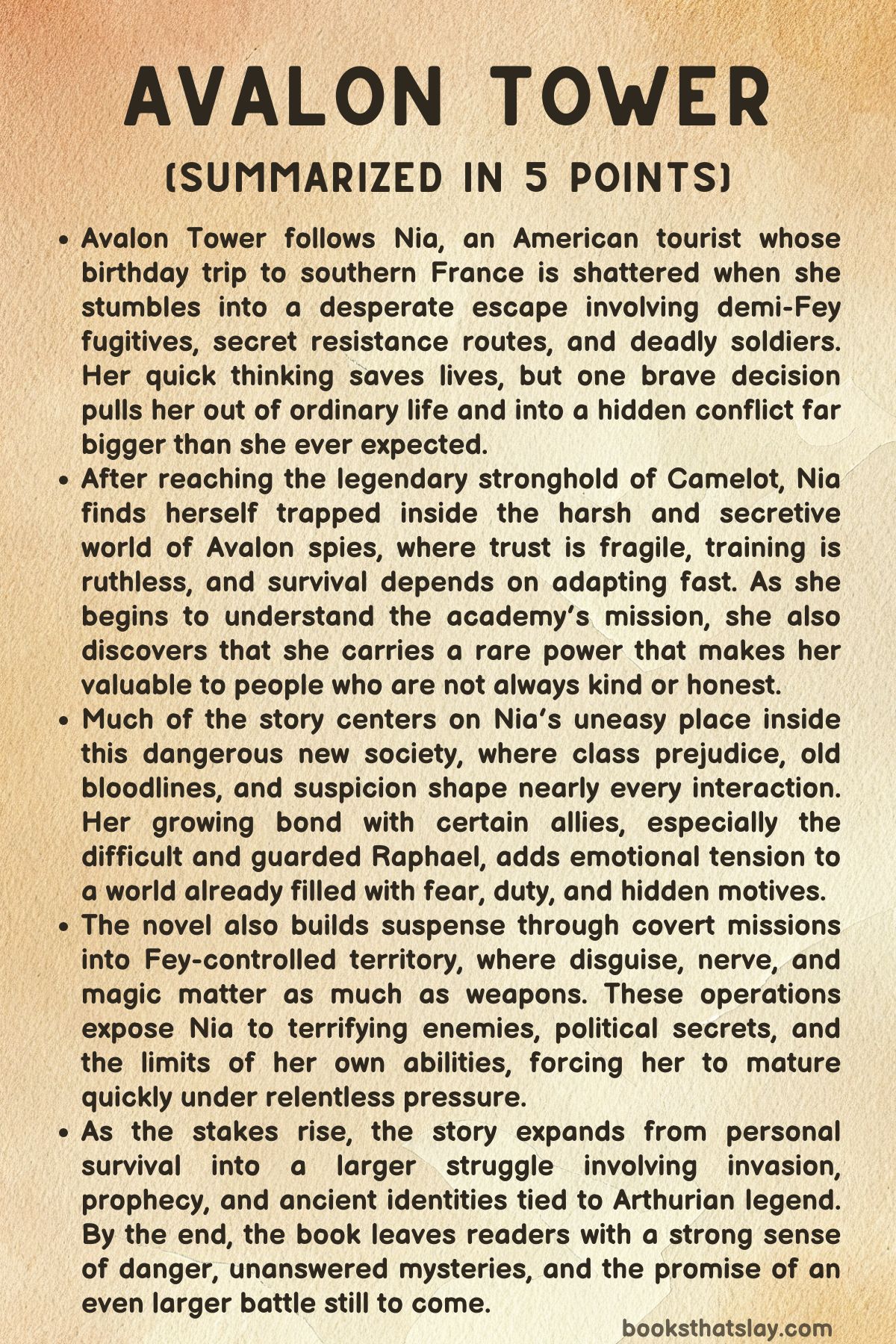
Avalon Tower (Fey Academy for Spies #1) by C.N. Crawford is a fantasy novel built around espionage, magic, divided loyalties, and a heroine who is pulled out of an ordinary life and forced into a hidden war. It begins with danger on the border between human and Fey lands and quickly expands into a larger conflict involving secret cities, ancient powers, and political deception.
At its center is Nia, a young woman who never expected to matter in the struggle at all, only to discover that she carries rare abilities everyone wants to use. The story combines covert missions, training, betrayal, and emotional tension, while steadily opening into something much larger than survival alone.
Summary
The story begins in southern France, near the magical veil that separates human territory from the Fey-controlled world. Alix, a spy from Avalon Tower, is waiting for her partner Rein so they can carry out an exfiltration mission for a group of fleeing demi-Fey refugees.
While she waits, she struggles against her forbidden feelings for him, since love is not allowed among Avalon spies. When Rein does not arrive, she grows increasingly uneasy.
A signal finally draws her into a narrow alley, but instead of finding her partner, she is trapped by Fey soldiers and stabbed, dying with Rein on her mind.
At around the same time, Nia, an American tourist in France, is celebrating her birthday alone at a seaside café. She reflects on the difficult life she left behind in Los Angeles, especially her strained relationship with her unstable mother.
A waiter named Jules chats with her and mentions the uneasy peace with the Fey, along with rumors about fugitives crossing the border. Soon after, Nia notices blood in an alley and discovers a group of terrified demi-Fey refugees, including women and a small boy, hiding there.
Realizing they are in terrible danger, she acts on instinct and pretends they are part of a guided tourist group. Speaking loudly in French, she leads them through the town while trying to make them appear harmless.
As Nia escorts them toward the docks, danger follows at every turn. Dragons circle overhead searching for fugitives, and Nia forces the group to wave and behave like sightseers so they will not attract attention.
When one of the women, Vena, is separated, Nia follows and witnesses Fey soldiers kill her in the street. Horrified but determined, she returns to the group and presses them forward.
Later, surrounded by patrols and the dangerous magical veil, Nia accidentally steps into it and discovers that it does not kill her. Realizing this makes her unusual, she hides the refugees inside the veil until soldiers pass.
The group’s path to the docks is blocked by French police checking papers, so Nia creates another distraction by playing the part of a difficult tourist while one of the fugitives leads the others through. At the docks, Nia reaches the resistance ship they were supposed to meet.
It is commanded by Raphael Launcelot, a demi-Fey nobleman from Nia’s past who once broke her heart. Raphael and his crew are prepared to take only the names on their list and want to leave behind three extras, including a child.
Nia refuses to accept that, argues fiercely, and forces the issue until Raphael grudgingly agrees to take them all.
A policeman then appears, having grown suspicious during the passport check. Raphael quickly pretends Nia is his sick wife, and together they improvise a story about a contagious disease.
When the officer notices the little boy’s pointed ears and understands what is happening, Raphael kills him and throws the body into the sea. The ship leaves immediately, and Nia is taken aboard against her will, realizing her old life has ended in an instant.
After a miserable sea voyage marked by sickness and a sea serpent attack, Nia arrives at Camelot, a hidden city reached by a secret river approach. She discovers that Camelot is far more than a legend.
It is a concealed ancient city tied to Avalon Tower, where agents are trained to fight and infiltrate the Fey. Her arrival is not welcomed.
Viviane destroys her passport, threatens her life, and makes it clear she can never leave and reveal Camelot’s existence. Raphael brings her before Amon and explains that Nia is a newly discovered Sentinel, someone with a rare power over the veil.
Nia is thrown into Avalon life with little preparation. She is judged for her appearance, her background, and her lack of training.
In the dining hall she meets several important figures, including Serana, who proves supportive, and Tarquin Pendragon, whose arrogance and cruelty quickly become obvious. She learns that Avalon trains spies not only in combat but in languages, customs, fashion, and manners so they can pass among the Fey.
Serana later shows her around the tower and explains the history of Camelot, Merlin, Arthur, and the old wars between humans and Fey. Raphael then becomes involved in preparing Nia for life there, even choosing her clothing and teaching her how to move convincingly in Fey society.
Nia shares a room with Tana and Serana, who become her first friends in Camelot. Tana reads her future and reveals a troubling spread filled with danger, fractured possibilities, and ominous suggestions about her parentage.
Nia’s unease grows when her first combat lesson turns into humiliation. Tarquin uses the session to hurt and mock her until Raphael intervenes.
Viviane afterward tells Nia that survival demands brutality and begins putting her through harsh private training before dawn.
Although Nia struggles physically, she excels at languages and soon draws attention for her mind as much as her rare magic. Raphael begins training her personally in Sentinel power, showing her how emotion affects the veil.
Nia learns she can suppress or break veil magic when she taps into fear, anger, and desperation. Very quickly, she is needed in the field.
With the other Sentinel unavailable, Nia is taken on a real mission into occupied Fey territory, where she holds her cover under pressure and helps keep open a path home.
Her next major mission takes her with Raphael, Viviane, and Freya to Château des Rêves, the pleasure palace of Prince Talan, known as the Dream Stalker. Their goal is to recover military intelligence, especially maps that may reveal valuable information about the enemy.
Nia attends the cabaret as Raphael’s wife while the others search. Inside the castle she notices heavy security and quickly senses that Talan is far more dangerous than his calm beauty suggests.
During the mission, she realizes the mysterious voice she has heard in her head for years belongs to him. Even more alarming, he can sense her in return.
When the search falters, Nia uses her telepathy recklessly and touches too many minds at once. The flood of thoughts nearly destroys her sense of self, but she manages to learn where the map is hidden.
Raphael steals it, and the team tries to flee, only to become trapped inside one of Talan’s waking nightmares. Reality bends around them, corridors repeat, companions vanish, and the escape itself proves false.
At last Nia realizes the only way out is to strike directly at Talan’s mind. Using both her telepathy and Sentinel power together, she cracks his control, shatters the nightmare, and gives the group a real chance to escape.
They return to Camelot with the map, but Nia is left badly shaken.
Back at Avalon Tower, Nia gains both admiration and resentment. Tana warns her through prophecy that darkness is coming for her.
Soon that warning becomes real. Talan invades her dreams, and then an assassin attacks her room.
Nia survives only by using her Sentinel power to disrupt the attacker’s magic, though she is stabbed in the stomach before Raphael kills him and heals her.
Nia and Raphael are later sent to assassinate Caradoc, a dangerous veil mage. They infiltrate his mansion, but the mission becomes a trap.
Caradoc drops deadly magic on Raphael, and while Nia fights to save him, Caradoc overpowers her. In desperation she reaches into his mind and is overwhelmed by ancient memories.
There she learns that King Auberon has built an army of Fey soldiers who can survive iron, making traditional human defenses far less effective. She also discovers that the threatened assault in southern France is only a diversion.
The true invasion target is England, specifically Dover. Raphael recovers in time to kill Caradoc, but with his death the border veil will collapse early, speeding the invasion.
Nia and Raphael rush to warn the authorities, but their warnings are dismissed or delayed. They gather what allies they can and race to Dover.
There, Captain Atkinson refuses to evacuate civilians, convinced the city can withstand attack. Nia eventually uses her telepathic power to force him to hand over command.
She identifies weaknesses in the attacking dragons, directs anti-dragon fire, and helps stop a mobile veil weapon that would have wiped out the city. Even so, the Fey invasion crashes into Dover with overwhelming force.
Nia and Raphael fight beside British soldiers as the defenses collapse. When retreat becomes inevitable, they try to escape by boat but are intercepted by the Fey captains Maertisa and Vidal.
Raphael defeats Vidal, but Maertisa captures Nia and offers her release if Raphael surrenders alive. Raphael understands that Auberon’s people are truly after Nia, not him, yet he refuses to let her sacrifice herself.
He orders her to flee, remain alive, and protect Camelot. Devastated, Nia escapes while Raphael is taken prisoner.
She returns to Camelot with the survivors, carrying grief, guilt, and the knowledge that the war has only begun. Tana assures her that Raphael can still be saved, and Amon formally names her an Avalon Steel knight.
That night Nia is drawn to Nimuë’s Tower, where she finds a mysterious boat waiting. Guided by instinct connected to her deeper identity, she rows through another ancient veil and reaches Avalon itself, a ruined island stronghold hidden beyond Camelot’s waters.
There she meets Mordred, who has long been believed dead. He tells her shocking truths about Auberon’s origins, claims he called her there because only he can help her rescue Raphael, and finally reveals the greatest shock of all: he says that Nia is his daughter.
Characters
Nia
Nia is the emotional and narrative center of the story, and her character is shaped by the collision between ordinary human vulnerability and extraordinary magical importance. She begins as an outsider in every possible sense: an American tourist alone in southern France, someone with no political power, no combat training, and no understanding of the hidden world she is about to enter.
What makes her compelling from the beginning is that she does not become important because she is fearless or prepared. She becomes important because, when faced with terror and cruelty, she chooses to act anyway.
Her decision to protect the demi-Fey fugitives is impulsive, but it reveals the deepest part of her nature. She cannot stand by and let vulnerable people be destroyed, even when helping them places her own life in danger.
As the story progresses, Nia’s role expands from accidental rescuer to essential weapon in a larger war. Her Sentinel gift allows her to cross and suppress the veil, but her telepathy makes her far more complex than a simple magical tool.
Her power is deeply tied to emotion, memory, and identity, which means every use of it carries a personal cost. She does not move through danger untouched.
Instead, she is constantly overwhelmed, frightened, physically hurt, and psychologically shaken. That makes her growth feel earned.
She learns to survive not by becoming cold, but by discovering how to act while still carrying fear, grief, and moral doubt.
Nia also stands out because she repeatedly resists the dehumanizing logic of the world around her. In Camelot, many people see others in terms of rank, bloodline, usefulness, or strategic value.
Nia keeps insisting on human worth even when that is inconvenient. She argues for the extra fugitives, recoils from needless brutality, and struggles with the ruthless choices demanded by war.
At the same time, the story does not keep her morally untouched. She manipulates minds, takes command by force, and becomes capable of lethal action when there is no other option.
This tension gives her character depth. She is compassionate, but that compassion is being tested by a world that rewards hardness.
By the end, she is no longer a lost tourist swept along by events. She has become a leader, a fighter, and a figure tied to ancient destiny, yet the core of her character remains the same: she is someone who keeps choosing responsibility when it would be easier to look away.
Raphael Launcelot
Raphael is one of the most layered characters in the story because he combines aristocratic poise, military competence, emotional repression, and genuine devotion. He first appears as a resistance commander who makes ruthless choices under pressure.
His willingness to kill the policeman at the docks establishes immediately that he is not guided by ordinary morality. He does what he believes is necessary, and he does it quickly.
That first impression makes him seem cold and dangerous, but the story gradually reveals that his severity is bound up with grief, duty, and desperation rather than cruelty for its own sake.
His connection to Nia gives much of his characterization its force. Their earlier history creates emotional tension before the relationship is ever fully explained, and that unfinished bond shapes nearly every interaction between them.
Raphael often speaks with mockery or distance, but his actions repeatedly undercut the image of indifference. He trains Nia personally, protects her when others humiliate or endanger her, heals her when she is wounded, and places enormous trust in her during missions.
He is not gentle in the conventional sense, yet he is consistently attentive to her capabilities and survival. This contrast makes him more interesting than a simple romantic hero.
He is both protective and demanding, affectionate and withholding, wounded and authoritative.
Raphael is also defined by the burden of leadership. He carries strategic responsibility, knows how often missions fail, and has clearly learned to live with blood on his hands.
His search for military maps is not just tactical; it is driven by hope for his imprisoned sister, which reveals how personal loss fuels his commitment. That private motive adds vulnerability to his controlled exterior.
He is not simply a commander serving an abstract cause. He is someone trying to save what remains of his family while holding together resistance efforts in a collapsing world.
Another important aspect of Raphael’s character is that he represents the older values of Camelot at their best and worst. He has discipline, courage, and loyalty, but he is also shaped by secrecy, hierarchy, and emotional denial.
His capture at Dover becomes powerful not only because Nia loves him, but because it shows the full extent of his character. Faced with a choice, he refuses self-preservation and instead orders Nia to live, resist Auberon, and protect Camelot.
That moment confirms what has been building all along: beneath the cool surface is someone capable of enormous sacrifice.
Tana
Tana brings a different kind of strength to the story, one rooted in intuition, emotional intelligence, and a quiet acceptance of danger. She is one of the first people in Camelot to offer Nia something like companionship, and that matters because the academy is otherwise full of suspicion, elitism, and hostility.
Tana helps make Camelot survivable. She does not dominate scenes through aggression or political power, but through steadiness.
In a setting where so many people posture, threaten, or manipulate, Tana feels grounded and sincere.
Her card readings are central to her characterization. She is not just a mystical figure inserted for atmosphere.
Her prophecies shape tone, foreshadow danger, and reveal that she sees more than others are comfortable admitting. What makes her effective is that she never feels all-knowing or theatrically mysterious.
Her readings carry uncertainty, fracture, and dread. She senses possibilities rather than neat certainties, which makes her feel connected to the unstable future of the story itself.
Through her, fate is presented as something real but not fixed, something that warns without completely controlling.
Tana’s friendship with Nia also highlights her warmth. She offers guidance without condescension and seems to understand emotional states that others either ignore or exploit.
At the same time, she is not soft in a shallow sense. She is part of the resistance, takes part in dangerous operations, and remains present when the conflict escalates into war.
Her gentleness exists alongside courage. That blend makes her an important counterweight in the cast.
She reminds both Nia and the reader that strength can look like care, insight, and emotional steadiness rather than dominance.
Serana
Serana is one of the clearest examples of loyalty and directness in the story. From the moment she shuts down Tarquin’s harassment, she is established as someone who will act decisively when she sees injustice.
She does not waste time on politeness when someone is behaving badly, and that blunt integrity makes her immediately likable. In Camelot, where lineage and status influence how people treat one another, Serana’s respect for Nia feels significant because it is based on instinct and fairness rather than political convenience.
Her role as guide through Avalon Tower also gives her an important narrative function. Through Serana, Nia learns the history of Camelot, its ancient mission, and its hatred of the Fey.
But Serana is more than an exposition device. Her willingness to explain things openly distinguishes her from characters who guard knowledge as a form of control.
She helps Nia understand the institution she has been trapped inside, and in doing so she becomes part of Nia’s first real support system.
Serana’s character also reflects the contradictions within Camelot. She is clearly shaped by its values and mission, yet she does not seem consumed by elitism or cruelty.
She belongs to the academy world without embodying its ugliest instincts. Her loyalty in battle later reinforces this impression.
She is dependable, brave, and practical, the kind of ally who strengthens a group not by making dramatic speeches but by consistently showing up when it matters.
Viviane
Viviane is harsh, intimidating, and often openly threatening, but she is not written as a simple antagonist. She represents the unforgiving logic of survival that governs Avalon Tower.
Her treatment of Nia upon arrival is brutal: she destroys Nia’s passport, physically dominates her, and makes clear that escape or betrayal would mean death. This establishes Viviane as someone who has fully accepted the violence of her world.
She does not pretend that the resistance is noble in a comforting way. To her, survival depends on control, secrecy, and readiness to kill.
What makes Viviane more interesting than a stock disciplinarian is that her cruelty is paired with competence and clarity. She sees weaknesses quickly and names them without euphemism.
When she tells Nia that survival may require biting, blinding, or using a hidden knife, she is expressing the reality of the world as she understands it. She does not care whether Nia finds these truths ugly.
Her perspective forces Nia to confront the fact that moral hesitation can be fatal.
At the same time, Viviane is not simply trying to break Nia. In her own severe way, she is trying to shape her into someone who can live through what is coming.
That makes her both frightening and useful. Her wound during the escape from Talan’s castle also reminds the reader that she is not invulnerable.
Beneath the menace is a soldier constantly exposed to the same dangers she expects others to endure. She embodies the cost of long service in a brutal cause.
Amon
Amon serves as a senior authority figure whose reactions help define how extraordinary Nia’s arrival really is. When Raphael presents Nia as a newly discovered Sentinel, Amon’s astonishment confirms her rarity and importance.
He appears to be a figure of institutional power, but unlike some others in Camelot, he is not driven mainly by arrogance or cruelty. His first practical response is to make sure Nia is fed, which signals that he can recognize human need even amid strategic calculation.
Later, when he formally welcomes Nia as an Avalon Steel knight, he functions almost as a legitimizing force. He marks Nia’s transition from accidental outsider to recognized defender of Camelot.
This matters because much of her journey involves being treated as a temporary problem, a suspicious intruder, or a useful instrument. Amon’s acknowledgment gives her a place within the structure.
He may not be emotionally central, but he plays an important role in showing how institutions absorb exceptional individuals when necessity demands it.
Tarquin Pendragon
Tarquin is arrogance wrapped in noble ancestry. He is defined by entitlement, social snobbery, and predatory behavior, and he represents one of the ugliest faces of Camelot’s internal culture.
From his first appearance, he makes it clear that bloodline matters deeply to him. He treats Nia as lesser not because of anything she has done, but because she lacks pedigree and status.
His smugness is not merely personal vanity; it reflects a whole worldview in which certain people are naturally meant to rule and others naturally meant to submit.
His harassment of Nia shows that he also turns privilege into aggression. He pushes boundaries, assumes access, and uses training as an excuse for humiliation and violence.
In self-defense class, he reveals the danger beneath his polished exterior. He is not just annoying or pompous.
He is capable of real cruelty, and he enjoys the power imbalance. That makes him more than a rival figure.
He becomes a symbol of how institutions can produce people who believe their rank excuses abuse.
At the same time, Tarquin is useful in thematic terms because he sharpens Nia’s outsider status. Through him, the story shows that Camelot is not automatically virtuous simply because it opposes the Fey.
Its defenders include class prejudice, misogyny, and internal rot. Tarquin helps expose that contradiction.
Prince Talan
Prince Talan is one of the most unsettling characters in the story because his threat is psychological as much as physical. He is introduced as beautiful, composed, and almost impossibly magnetic, someone who dominates a room without needing to shout or display obvious force.
This makes him dangerous in a different register from soldiers or assassins. He seduces attention.
He draws people in. His power lies in fascination as much as fear.
His title, the Dream Stalker, captures his most disturbing quality. Talan’s magic erodes the boundary between inner life and external reality.
He can turn fear into a prison and invade sleep itself, which makes him a uniquely intimate villain. He does not merely threaten bodies; he violates the mind.
His connection to Nia is especially unnerving because she recognizes his mental voice before fully understanding who he is. This creates a sense that he has always been haunting the edges of her consciousness.
Their telepathic encounters make him feel invasive, persistent, and deeply personal.
Talan’s intelligence also matters. He is not only powerful but observant, immediately sensitive to hidden threats and emotional shifts.
Once he identifies Nia as the mind touching his, the mission becomes a battle of perception and will. He embodies the idea that knowledge itself can become predatory.
Even after the team escapes, he continues to pursue Nia through nightmares, proving that distance offers no safety from him. He functions as a villain of obsession and psychological domination, one whose menace lingers long after direct confrontation ends.
Caradoc
Caradoc is a more physical, immediate form of menace, but he is still tied to the story’s larger revelations about war and power. His mansion is saturated with wrongness before he even appears, which gives him a dreadful aura.
When Nia and Raphael finally confront him, he is calm and prepared, already having laid a magical trap. This composure under pressure makes him frightening.
He is not chaotic or theatrical. He is methodical.
What makes Caradoc especially important is that his mind contains truth. Through Nia’s psychic contact with him, he becomes the source of devastating revelations about Auberon’s military strategy and the creation of Fey soldiers who can survive iron exposure.
That means Caradoc is not only an enemy operative but a living archive of the invasion’s hidden structure. His character is tied to secrecy, experimentation, and the brutal machinery of empire.
His physical assault on Nia also reinforces his role as a figure of crushing force. He nearly kills her with his bare hands, and his mind is too vast and ancient for easy domination.
He represents the terrifying scale of older Fey power, something human resistance cannot control through ordinary means. Even in death, he changes the shape of the war.
King Auberon
Auberon is not always physically present, yet his will drives much of the conflict. He is the architect behind occupation, terror, strategic deception, and the planned invasion of England.
What emerges through the summary is not a portrait of a merely tyrannical king, but of a ruler who treats lives as expendable components in a long military design. The process by which Fey soldiers are made resistant to iron reveals the depth of his ruthlessness.
He is willing to sacrifice countless bodies to build a more effective army. That kind of logic defines him.
He also looms over the story as a force of political and symbolic domination. His reach extends into border policy, local policing, military strategy, and psychic pursuit.
Even rumors about resistance operate in relation to his authority. He creates a world in which civilians, fugitives, spies, and soldiers all move under the pressure of his power.
That makes him more than a distant villain. He is the system everyone is struggling against.
The later suggestion that he is tied to ancient and hidden parentage only adds to his complexity. It implies that his authority is connected not just to conquest, but to deep magical inheritance and old betrayals.
He feels like a figure whose personal history may reshape the meaning of the war itself.
Alix
Alix appears briefly at the beginning, but she performs an important structural role. She introduces the world of Avalon spies, forbidden love, and border missions before Nia is drawn into that same dangerous sphere.
Her thoughts about Rein immediately establish that emotional attachment is treated as a liability within the resistance. She is already living under rules Nia will later encounter in a different form.
What makes Alix memorable despite limited page time is the vulnerability of her final moments. She is not shown as invincible or romantically glamorous.
She is anxious, hopeful, professionally alert, and then suddenly betrayed by reality when Rein fails to appear and Fey soldiers ambush her. Her stabbing gives the story an early sense of danger and loss.
She stands as a reminder that resistance work often ends not in heroic triumph but in fear, confusion, and bloodshed.
Rein
Rein is largely defined through absence, which gives him a strangely powerful presence. He matters first because Alix cares for him, and that care is forbidden.
The fact that he does not arrive on time turns him into a source of dread before he is ever fully realized as a character. Through him, the story suggests how fragile trust is in espionage.
A missed meeting is never just a delay; it may mean capture, betrayal, or death.
Even without much direct characterization, Rein helps establish the emotional cost of life inside Avalon’s system. He is part of a world where love is repressed and missions take priority over human attachment, yet those feelings clearly survive beneath the rules.
Aleina
Aleina becomes one of the more important minor fugitives because she steps into a practical leadership role during the escape. She explains what the group was supposed to receive from their missing contact and works with Nia to maintain the deception.
Her presence helps show that the fugitives are not passive bodies waiting to be saved. They are frightened and vulnerable, but they are also active participants in survival.
Aleina’s ability to adapt matters. Once Nia improvises the tourist performance, Aleina takes on the part assigned to her and helps carry it through.
She becomes a bridge between Nia’s quick thinking and the group’s collective survival. Through her, the story gives the fugitives some individuality rather than treating them as anonymous victims.
Vena
Vena’s death is brief but significant. Her separation from the group and casual murder by Fey soldiers crystallize the stakes of the escape.
She is not killed in battle or as part of some elaborate confrontation. She is simply eliminated, almost casually, which reveals the utter precarity of demi-Fey life under occupation.
Her death transforms danger from abstract fear into immediate reality for Nia.
Malo
Malo, the small boy with pointed ears, represents innocence under threat. His importance comes partly from how others react to him.
Raphael’s team initially wants to leave him behind because he complicates the mission, while Nia sees abandoning him as morally impossible. Malo therefore becomes the focal point of a conflict between strategic ruthlessness and human compassion.
He is not characterized through long speeches or actions, but through the moral pressure his presence creates.
Freya
Freya is a skilled operative whose role in the château mission highlights professionalism and nerve. Disguised as a chambermaid, she carries out one of the most dangerous infiltration tasks, searching private rooms while danger closes in around her.
She is clearly competent, disciplined, and reliable under pressure. Her injury during the escape also underscores the cost of the mission and the fact that even trained agents barely survive encounters with Talan.
Jules
Jules appears early as a charming waiter whose flirtation with Nia is mixed with caution and local knowledge. He functions as part of the atmosphere of occupied southern France, where even casual conversation is shaped by fear, rumor, and political tension.
His guarded comments about the Fey and the resistance help set the mood of uneasy public compliance. He may be minor, but he helps establish the world Nia is moving through before everything changes.
Darius
Darius enters briefly during Tana’s card-reading scene, but his presence helps make Camelot feel inhabited beyond the immediate mission structure. He suggests a social world within the tower, one where people seek Tana’s insight and maintain ties that are not purely strategic.
Though lightly sketched, he contributes to the sense that the resistance includes ordinary interpersonal rhythms alongside danger.
Ginevra
Ginevra is presented as haughty and socially elevated, and her brief appearance reinforces the atmosphere of status consciousness within Avalon Tower. Even in passing, she contributes to the sense that Camelot contains internal hierarchies and vanity in addition to discipline and sacrifice.
Her presence near Raphael also hints at the kind of aristocratic world Nia is entering, one in which appearance and pedigree still matter.
Wrythe
Wrythe’s importance lies in what he represents rather than in extensive individual detail. By belittling Nia after the mission, he expresses institutional resentment toward outsiders who succeed without following the expected path.
He reflects the bitterness of those who feel earned hierarchy is being disrupted by necessity.
Horatio
Horatio is defined by brutality during the Culling. His killing of Nolan after already winning exposes how savage Avalon’s trials can become and how fragile the line is between training and murder.
He stands for a culture that has normalized lethal competition in the name of strength.
Nolan
Nolan’s death is important because of what it teaches Nia. He is less a fully developed individual than a human cost placed directly before her eyes.
Through him, the threat Tana warned about becomes immediate and undeniable.
Captain Atkinson
Captain Atkinson embodies institutional pride, complacency, and the deadly consequences of refusing to listen. He is not malicious in the grand sense of the story’s main villains, but his arrogance nearly destroys Dover.
He trusts existing defenses, dismisses Nia and Raphael’s intelligence, and assumes conventional military logic will hold. His refusal to adapt becomes a kind of moral failure because lives depend on his judgment.
What makes him compelling is that he represents a very human form of danger. Unlike magical tyrants or dream-walking princes, Atkinson is the familiar official who cannot imagine being wrong until disaster is already visible on the horizon.
Nia’s decision to use telepathy to force command from him marks a turning point in her own character as well as his.
Maertisa
Maertisa is formidable because she combines military competence with psychological leverage. On the pier, she takes control of the final confrontation by seizing Nia and forcing Raphael into an impossible choice.
She understands the value of hostages, information, and symbolic prisoners. Her offer is calculated, not impulsive.
She is the kind of enemy commander who knows how to use emotion as part of warfare.
Vidal
Vidal appears alongside Maertisa as another elite Fey captain. Though he is subdued by Raphael, his presence reinforces the quality of the opposition at the climax in Dover.
He is part of the force that corners the protagonists and makes escape nearly impossible. Together, he and Maertisa embody disciplined military threat rather than chaotic violence.
Nivene
Nivene appears among the surviving agents who race to England, and though the summary gives limited detail, that inclusion marks her as part of the committed resistance core. She belongs to the group that continues acting even after failed assassinations, collapsing strategy, and imminent invasion.
Her presence helps widen the network of allies around Nia.
Mordred
Mordred arrives late, but his appearance changes the scale of the story immediately. Long thought dead, trapped on Avalon, and tied to old curses, he enters as a figure of myth made real.
What makes him fascinating is the uncertainty surrounding him. He is linked to ancient betrayal by reputation, yet when he finally speaks, he offers revelation instead of immediate hostility.
He denies one accepted truth, introduces another shocking one, and then names Nia as his daughter. That combination makes him destabilizing in the best narrative sense.
Mordred’s power comes from how much history he seems to carry. He is not just another warrior or noble.
He is part of the buried foundation of the world’s mythology. His presence suggests that the current war cannot be understood only through recent politics.
Ancient bloodlines, curses, and hidden parentage are still shaping the present. By calling Nia to Avalon and claiming only he can help her rescue Raphael, he positions himself as both possible ally and possible danger.
He enters the story wrapped in ambiguity, which makes him immediately compelling.
Auberon’s Shadow Figures and the Unnamed Fugitives
Even the less fully individualized characters matter in shaping the emotional world of the story. The women fleeing across the border, the mother with her daughters, the unnamed soldiers, the civilians in Dover, and the agents who survive by chance all contribute to a sense that this is a world under immense strain.
They remind the reader that the conflict is not only about chosen heroes or magical bloodlines. It is also about ordinary people trying to stay alive under systems of conquest, secrecy, and war.
In that sense, the cast as a whole is built around contrast. Some characters hold power through rank, magic, or lineage, while others are defined by exposure and vulnerability.
Nia moves between those groups, and that movement is what gives the character network its force. The people around her are not just companions or enemies.
They are different answers to the same question: what does survival turn a person into when the world is ruled by fear, hierarchy, and war?
Themes
Love as Defiance Against Systems of Control
The emotional force of this story comes from the way personal attachment keeps colliding with institutions built on discipline, secrecy, and sacrifice. At the beginning, Alix is already living under a code that treats love as a dangerous weakness.
Her feelings for Rein are not merely inconvenient; they are forbidden by the very structure that shaped her life. That detail immediately frames affection as something rebellious.
The ban on love is not only about professionalism. It is about control.
A spy order that can regulate desire can regulate loyalty, identity, and fear. Alix’s private thoughts show that the system may command behavior, but it cannot fully govern the inner life.
Her death while thinking of Rein turns love into something tragically human in a world that keeps demanding emotional self-erasure.
That same tension develops more fully through Nia and Raphael. Their relationship is marked by old hurt, distrust, attraction, and dependence, which makes it far more complicated than a simple romance.
What matters thematically is that their bond grows in the middle of violence, espionage, and political collapse. Again and again, the story places them in situations where detachment would be safer, cleaner, and more strategically useful, yet they continue to matter deeply to one another.
Raphael tries to maintain control through coldness, rank, and mission logic, but his actions repeatedly reveal emotional commitment. He saves Nia, trains her personally, protects her from Tarquin, works beside her in life-threatening operations, and finally gives himself up so she can live.
Nia, in turn, is shaped by that connection even when she resists it. Her grief, fear, and determination after his capture show that attachment becomes one of the engines of action.
What makes this theme especially strong is that love never appears as soft escape from danger. Instead, it is what makes danger matter.
Care creates vulnerability, but it also creates courage. People take risks because someone else matters.
The story therefore refuses the idea that emotion is the enemy of strength. It suggests the opposite: systems that outlaw love do so because love creates loyalties deeper than fear.
In that sense, affection becomes a moral refusal to become the kind of weapon the world wants to manufacture.
Identity as Discovery, Inheritance, and Burden
Nia’s journey is driven by a constant unraveling of who she is. She begins as someone who believes she is ordinary in all the ways that matter most.
She is a tourist, a working woman who saved carefully for one brief trip, and a daughter shaped by an unstable home life. Even in those early scenes, she carries a vague sense of dislocation, but she does not yet know that her life has been structured by hidden forces.
Once she helps the fugitives and survives the veil, the ground beneath her identity starts shifting. She is no longer simply an outsider who stumbled into resistance work.
She becomes a person whose existence has implications she herself cannot understand.
The academy intensifies this struggle. Camelot does not welcome her as a full person; it categorizes her as a rare resource.
She is called a Sentinel, evaluated for usefulness, stripped of her passport, and forced into a world with its own history, prejudices, and hierarchies. Her identity is treated as something to be named by others before she can name it herself.
That dynamic matters because it turns self-discovery into a political process. Nia is not just learning hidden facts about herself.
She is fighting against other people’s attempts to define her according to bloodline, power, class, and prophecy. Tarquin looks down on her because of her background.
Viviane treats her like a security threat. Amon and Raphael see strategic value in her.
Tana’s visions suggest that even fate has claims on her. Every corner of the world tries to tell her what she is.
Her telepathy deepens the theme by making identity feel unstable from within. When she reads too many minds, she risks losing the boundary between herself and others.
This is not just a magical problem. It symbolizes the deeper danger of becoming fragmented by history, trauma, expectation, and inherited conflict.
Her powers allow access to truth, but they also threaten the coherence of the self. That tension becomes especially important when she enters minds like Caradoc’s or Talan’s.
Knowledge comes at the cost of psychological invasion. To know more, she must risk becoming less certain of her own center.
By the final revelation, identity is no longer a private question. It is tied to ancestry, myth, national conflict, and ancient magic.
Nia’s link to the Lady of the Lake and Mordred’s claim that she is his daughter transform her from accidental participant to central figure in an old and unfinished story. Yet the theme remains effective because the story does not reduce her to destiny alone.
She continues to become herself through choice: helping fugitives, enduring training, facing terror, commanding in crisis, and refusing surrender. In other words, inheritance may explain part of who she is, but action determines what that identity becomes.
Power, Class, and the Ethics of Survival
Nearly every important conflict in the story is shaped by unequal power. This appears first in the political arrangement between humans, demi-Fey, and full Fey.
Occupation has produced a world where ordinary people are expected to accept cruelty as the price of order. Jules’s cautious remarks, the constant fear of patrols, and the expectation that demi-Fey fugitives should be reported all reveal a society trained to normalize domination.
Vena’s murder in the street captures this with brutal clarity. The killing is casual, which shows that oppression has become routine rather than exceptional.
Violence is not hidden at the margins; it is woven into everyday authority.
Inside Camelot, power remains unequal even among those who oppose the enemy. The academy is full of rank, ancestry, and contempt.
Tarquin’s arrogance shows how resistance movements can reproduce the same elitism they claim to fight. He sees bloodline and upbringing as proof of worth, while Nia’s poverty and outsider status become reasons to belittle her.
Ginevra and Viviane, in different ways, also embody a harsh order in which usefulness matters more than dignity. Nia enters this world as someone with no passport, no institutional protection, and no social standing.
Even when she becomes valuable, that value does not free her from humiliation. It simply changes the reason she is tolerated.
The story does not romanticize survival under such conditions. Again and again, characters are forced into morally compromised action.
Raphael kills a policeman to protect the mission. Nia manipulates a military officer’s mind to take command.
Resistance work requires deception, coercion, and sacrifice. Viviane’s harsh lesson after Nia’s failed self-defense class makes the ethical problem plain: survival may demand behavior that civilized rules condemn.
Bite, blind, stab, hide a knife, strike first. The theme here is not that morality disappears in war, but that war distorts every moral choice.
People must act in ways that would be unthinkable in a safer world, and they have to live with the consequences.
What gives this theme depth is the contrast between ruthless necessity and humane instinct. Nia repeatedly pushes back when strategy hardens into cruelty.
She refuses to leave behind the extra fugitives. She is horrified by cold calculations that treat some lives as expendable.
Even when she becomes more effective and more dangerous, that moral resistance remains part of her. The story seems deeply interested in whether survival can be pursued without becoming spiritually identical to the systems one is fighting.
There is no easy answer. Some brutality is necessary.
Some hierarchy is useful. But the narrative keeps asking what is lost when competence becomes detached from compassion.
Through that tension, it examines not just who holds power, but what kind of soul is formed by using it.
War, Prophecy, and the Feeling of Approaching Catastrophe
A persistent sense of impending disaster shapes the entire narrative. Even the earliest scenes carry the feeling that the visible world is only a fragile surface stretched over something violent and unstable.
The border veil, the rumors of resistance, the dragons overhead, and the frightened movement of fugitives all suggest that peace is temporary at best. Nia’s arrival in Camelot does not remove that tension.
It magnifies it. The city is ancient, hidden, and full of history, but it is also a place preparing for threats that everyone knows are growing closer.
Training, intelligence work, and ritual all exist under the shadow of a larger conflict that seems impossible to avoid.
Prophecy reinforces this atmosphere by turning danger into something both personal and cosmic. Tana’s readings do not function as decorative mysticism.
They create a framework in which the future feels fractured, unstable, and charged with consequence. Nia is warned that darkness is hunting her, that lovers and death surround her path, and that others’ fate depends on whether she survives.
These predictions do not erase free will, but they place every action under pressure. Even small choices seem to echo into a wider pattern.
That effect is crucial because it makes the story feel larger than a sequence of missions. The characters are not simply responding to isolated assignments.
They are moving through a world where old powers, family secrets, and national destinies are converging.
The war itself grows from rumor into visible catastrophe. Caradoc’s memories reveal that the conflict has been planned with deception, experimentation, and strategic misdirection.
The enemy’s immunity to iron destroys old assumptions and exposes how fragile human confidence really is. Southern France becomes a decoy.
Dover becomes the true target. By the time Nia and Raphael arrive in England, the disaster is already in motion, and disbelief among officials becomes part of the tragedy.
Captain Atkinson’s refusal to listen shows how catastrophe is often worsened by arrogance. People cling to outdated models of safety even when evidence is already on the horizon.
The battle for Dover gives this theme its most powerful expression. Dragons, warships, mobile veil magic, collapsing barricades, and desperate evacuation all create the feeling that the old world order is failing in real time.
Yet the theme is not only about destruction. It is also about the strain of acting inside a future that seems both foretold and still uncertain.
Nia’s decisions matter precisely because prophecy is not a guarantee of outcome. Time feels urgent, but not fixed.
The ending preserves that tension. Raphael is captured, England is at war, and Nia is called toward a deeper truth about her origins.
The result is a world suspended between revelation and ruin, where the future feels immense, dangerous, and not yet settled.