Based on a True Story Summary, Characters and Themes
Based on a True Story by Sarah Vaughan is a psychological family thriller about a celebrated author whose carefully managed public identity begins to collapse during her seventieth-birthday celebration.
Sarah Vaughan examines the power of storytelling not only as a creative act but also as a method of concealment, control and survival. Eleanor Kingman has spent decades deciding which parts of her past deserve to be remembered, yet her daughters, former associates and estranged relatives possess competing versions of her life. As professional resentments, financial emergencies and buried family secrets surface, the distinction between fiction, deception and self-protection becomes increasingly uncertain.
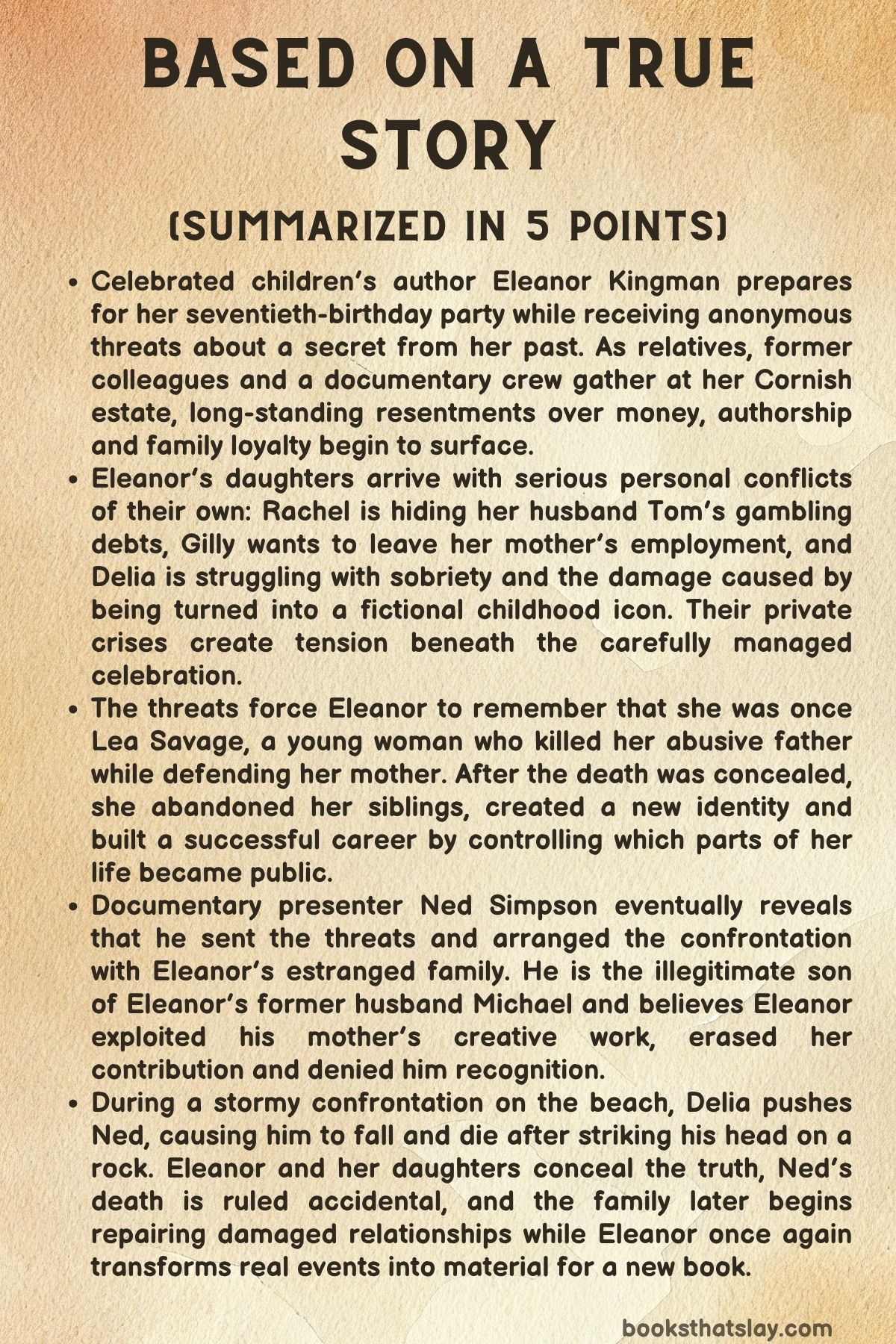
Summary
The morning after Dame Eleanor Kingman’s seventieth-birthday party, her daughter Rachel remembers descending to the beach beneath Eleanor’s Cornish estate during a violent storm. Eleanor had been missing for more than an hour, and Rachel knew that someone had recently been threatening her mother.
On the beach, Rachel heard a terrible cry and sensed that other people were nearby, although she later concealed these impressions from the police. Using her phone as a torch, she discovered a body lying beside a rock as the tide approached.
Two days before the death, Eleanor appears at a literary festival as one of Britain’s most successful children’s authors. Her confidence is disturbed when a boy named Jake accuses her of inventing everything and insists that storytellers are simply liars.
The accusation resembles a series of anonymous emails Eleanor has received over the previous six months. The sender appears to know about her early life, questions the origins of her famous stories and threatens to destroy the identity she has maintained for more than fifty years.
Eleanor has invited family members, former colleagues and professional associates to her birthday party partly because she suspects that one of them is responsible. Her newly purchased Cornish manor represents her escape from poverty and her transformation from Lea Savage into the wealthy, admired Dame Eleanor Kingman.
Her three daughters arrive carrying private grievances. Rachel, an accountant who manages Eleanor’s business finances, feels overworked, underpaid and overlooked beside her glamorous younger sister, Delia.
Rachel is also concealing a crisis involving her husband, Tom. He has developed an online gambling addiction, lost their savings, accumulated substantial credit-card debt and borrowed money from a dangerous loan shark named Ralph.
Tom owes £280,000, and the amount will double if it is not paid quickly. Ralph’s associates follow Tom to Cornwall, attach a tracking device to his car and threaten Eleanor’s dog, Edith, before approaching Tom’s children.
Gilly, Eleanor’s eldest daughter, has spent her adult life organising her mother’s career and protecting her sisters. She secretly writes but has never shown Eleanor her work, fearing both her judgement and the possibility that the family has room for only one successful author.
Gilly intends to resign after the party and create a life that is not based on solving Eleanor’s problems. Her affair with Adam, a younger cameraman working on the BBC documentary about Eleanor, strengthens her desire for independence and reveals a passionate side she has long suppressed.
Delia arrives as a successful social-media personality who has been sober for more than eighteen months. She grew up as the supposed inspiration for Jess the Detective and believes Eleanor turned her childhood identity into a commercial product while ignoring the emotional damage caused by publicity.
Delia has secretly reconnected with her estranged father, Michael, after learning that he has cancer. She plans to bring him to the party so Eleanor will be forced to acknowledge that separating her daughters from their father caused lasting pain.
The BBC documentary is presented by Ned Simpson, whose charm initially persuades Eleanor to cooperate. His questions soon become increasingly aggressive, focusing on Michael’s contribution to Eleanor’s early stories, the assistants she once employed and the hidden life of Lea Savage.
Eleanor gives polished answers about creating the Fox Hole books while raising her daughters, but the reality was harsher. She struggled with poverty, childcare and domestic labour while Michael enjoyed greater freedom, education and professional connections.
Several guests have their own disputes with Eleanor. Aiysha Johnstone, the illustrator of Tyler the Detective’s Daughter, received a fixed payment while Eleanor earned millions from the book, adaptations and merchandise.
Aiysha believes her illustrations, dialogue suggestions and plot ideas were essential to the project. When she asks for royalties, Eleanor reminds her that she accepted the original contract and offers only the uncertain possibility of better terms on a future book.
Peter, Eleanor’s former agent, may still possess the manuscript of her rejected first novel. The work contains a fictionalised version of Eleanor’s youth, including a violent death involving whisky, medication and a daughter’s attack on her father.
Carole, Eleanor’s current agent, has protected her career for decades. Although Carole suspects that Eleanor’s early fiction contains autobiographical violence, she has chosen loyalty over investigation and helps Eleanor control professional threats.
Rachel eventually tells Eleanor about Tom’s gambling debt and asks for a loan. Eleanor refuses because her own childhood was damaged by addiction, and she believes paying Tom’s debt would shield him from consequences rather than help him recover.
Rachel is furious that Eleanor can easily afford the money yet will not save her family. Using her professional access to Eleanor’s accounts, she secretly transfers money and begins sending it to Ralph.
Delia catches Rachel at the computer and recognises that her supposedly responsible sister is committing fraud. She threatens to tell Eleanor, enjoying the reversal of their usual roles, although Rachel begs her to remain silent until after the party.
Meanwhile, the anonymous emails become more direct. Eleanor notices a middle-aged man and woman near the estate whose movements seem strangely familiar, and she eventually recognises them as Joanne and Bill, the younger siblings she abandoned decades earlier.
Their appearance forces Eleanor to remember the truth about her childhood. In December 1969, eighteen-year-old Lea Savage returned home from university and found that her violent father, William, was abusing her mother, Grace, more severely than before.
When William attacked Grace, Lea struck him with a heavy iron pan. He collapsed and died, after which Grace ordered Lea to take his wages, return to London and allow her to present the death as the result of a burglary or attack by one of William’s drinking companions.
Lea obeyed, believing her mother had rejected her. Only later did she understand that Grace had forced her away to protect her from suspicion and give her the chance to escape the household.
Lea severed contact with Joanne and Bill, created a new identity and gradually came to believe the version of her past that she told publicly. Her marriage, wealth and career allowed Eleanor Kingman to replace the frightened young woman she had once been.
The party begins as a polished celebration, but several confrontations are already forming. Gilly learns that the documentary team has secretly invited Joanne and Bill, while Delia waits for Michael to approach through the grounds.
Tom discovers that Ralph’s people have spoken to his children and decides the police should be contacted. Rachel refuses because an investigation could expose the money she has stolen from Eleanor.
Tom leaves the party to confront the man who has been threatening him. The enforcer demands the doubled debt of £560,000, humiliates Tom and warns that Ralph’s people will enter his home if the payment is not made.
While fleeing, Tom slips and badly injures himself, leaving him unconscious and alone near the coast. Rachel later notices that he is missing but has no idea where he has gone.
At the party, Joanne and Bill finally confront Eleanor. Joanne angrily accuses her of abandoning the family, while Bill remains more sympathetic and believes Eleanor must have had reasons for disappearing.
Unable to tolerate their accusations and the curiosity of her guests, Eleanor retreats toward the heath. Carole follows and admits that she read the rejected manuscript years earlier and recognised that its violent scenes probably reflected Eleanor’s real childhood.
Carole helps Eleanor understand that Ned arranged the appearance of her siblings. Eleanor returns to confront him, determined to stop the documentary and defend the life she has constructed.
Before the confrontation, Delia relapses and drinks several glasses of champagne. Eleanor responds with anger and sorrow, but her attention shifts when she sees Ned observing the family’s distress with visible satisfaction.
Ned openly reveals his investigation into William Savage’s suspicious death, Eleanor’s hidden siblings and the manuscript that may contain a fictional confession. He also explains that his mother, Louisa, once worked for Eleanor and claimed that she contributed important ideas to the Fox Hole books before being dismissed and denied recognition.
Ned is Louisa’s son, and his interest is deeply personal. While interviewing Michael for the documentary, he discovered that Michael was his biological father, making Ned the half-brother of Rachel, Gilly and Delia.
Ned believes Eleanor built her career by erasing Louisa’s creative contribution, controlling Michael and silencing inconvenient people. He sent the anonymous emails and used the documentary as an instrument of revenge rather than an impartial examination of Eleanor’s career.
He also manipulated Delia after meeting her through an Alcoholics Anonymous group. By validating her anger toward Eleanor, he persuaded her to reconnect with Michael and arrange his appearance at the party without revealing their shared parentage.
Eleanor leaves the celebration and descends to the storm-darkened beach. Ned follows, while Michael, Gilly and Delia come after them.
On the beach, Eleanor reveals that Ned is Michael’s illegitimate son. Delia is horrified to realise that the man who encouraged her rebellion is her half-brother and that he used her pain to arrange Eleanor’s public destruction.
Ned insists that Delia willingly helped him and wanted her mother exposed. Enraged by his refusal to recognise the difference between seeking accountability and seeking ruin, Delia attacks him.
She pushes Ned, who slips on wet seaweed and strikes his head against a granite rock. At first, Delia assumes he is merely stunned, but he does not move and has no pulse.
Gilly attempts to revive him while Eleanor remains controlled and begins considering the approaching tide. Michael offers to tell the police that he argued with his newly discovered son and that Ned walked away afterward.
Eleanor insists that they leave the body for the water rather than summon emergency assistance. Gilly initially resists but eventually accepts that Ned is dead and helps Delia remove the blood from her hands.
Rachel reaches the beach while searching for Eleanor and the missing Tom. She discovers Ned’s body and senses that her sisters are concealing what happened.
Gilly and Delia tell her that Ned’s death was accidental and that he sent the threatening emails. A silent bargain forms between Rachel and Delia: Delia will conceal Rachel’s theft, and Rachel will support the family’s account of Ned’s death.
Four months later, the death has officially been ruled accidental. The tide carried the body away, and when it was recovered ten days later, the condition of the remains prevented investigators from obtaining useful forensic evidence.
Michael’s statement, the threatening emails and the absence of independent witnesses support the family’s story. The documentary is abandoned, and Michael spends time rebuilding his relationship with his daughters before dying from cancer.
Eleanor discovers that Rachel transferred £560,000 from her accounts, but their confrontation leads to an unusually honest discussion about money, fear and Eleanor’s failures as a mother. She forgives Rachel, pays her older daughters more fairly and begins repairing the emotional distance between them.
Tom survives his injuries, enters treatment and stops gambling. Gilly resigns, writes successful erotic fiction under a pseudonym and becomes pregnant by Adam.
Delia withdraws from social media and recommits herself to recovery. Aiysha secures a genuine partnership and a forty-percent share in the next Tyler book, while Eleanor reconnects with Joanne and Bill.
At New Year, the family burns Eleanor’s incriminating manuscript. Eleanor then begins writing crime fiction inspired partly by Tom’s encounter with the loan shark, once again turning dangerous reality into a story she can control.
Characters
Eleanor Kingman
At the centre of Based on a True Story, Eleanor is both a survivor of extreme domestic violence and a powerful woman who has learned to protect herself through control. Her transformation from Lea Savage into Dame Eleanor Kingman is not merely a career decision but a psychological strategy that allows her to escape guilt, poverty and fear.
Her greatest strength is her ability to construct convincing narratives. She understands how audiences respond to confidence, charm and emotional simplicity, so she presents her career as the achievement of a determined mother while removing the messier contributions of Michael, Louisa, assistants and collaborators.
Eleanor’s self-protection gradually becomes exploitation. She treats Aiysha’s creative work as contractually settled, underpays Rachel and Gilly, turns Delia’s childhood into a commercial identity and assumes that her own survival justifies controlling how other people are represented.
Her attitude toward money reveals the contradictions in her character. She sees her wealth as the result of discipline and refuses to become an automatic source of rescue, yet she fails to understand how her financial decisions communicate affection, approval and hierarchy within her family.
Eleanor can be cold, vain and manipulative, but she is not incapable of love. Her terror when Gilly chokes, her concern for Delia’s sobriety and her eventual forgiveness of Rachel demonstrate that genuine attachment exists beneath the demanding public personality.
Her response to Ned’s death confirms her moral complexity. She treats concealment as a practical necessity because she has already survived one killing through silence, suggesting that the lessons of 1969 have never stopped shaping her choices.
Rachel
Rachel has built her identity around reliability, financial competence and emotional restraint. She manages Eleanor’s accounts, raises two children and repeatedly absorbs the consequences of other people’s behaviour without allowing herself to appear overwhelmed.
Her resentment develops from years of unequal treatment. Eleanor relies heavily on her labour but pays her modestly, expects her to serve the family and directs most visible affection toward Delia.
Tom’s gambling crisis destroys Rachel’s belief that responsibility guarantees security. She is furious with him for lying and endangering the family, yet she also feels compelled to rescue him because the loss of their home would affect Charlie and Maisie.
Her decision to steal from Eleanor is deliberate rather than impulsive. Rachel understands the legal and professional consequences, but she convinces herself that fraud is justified because it may protect her children, husband and mother from violence and scandal.
Being discovered by Delia is especially humiliating because Rachel has spent years judging her younger sister’s addiction and dishonesty. The reversal forces Rachel to recognise that fear can drive any family member toward secrecy and destructive rationalisation.
Rachel’s final loyalty to Delia is morally compromised but emotionally significant. By helping conceal Ned’s death, she stops behaving solely as Eleanor’s employee or Tom’s rescuer and becomes part of a united bond among the three sisters.
Gilly
Gilly is the family’s organiser, mediator and invisible caretaker. Her competence allows Eleanor’s professional and domestic world to operate smoothly, but it also permits everyone around her to ignore her emotional needs.
She experiences duty as both an identity and a prison. Having protected Rachel and Delia for years, she feels guilty whenever either sister suffers, even when the situation is beyond her control.
Her secret writing represents a part of herself that has not been shaped by Eleanor’s demands. She avoids showing her work because she fears criticism and because Eleanor’s dominance has taught her that creative ambition belongs primarily to their mother.
The affair with Adam awakens Gilly’s desire for risk, pleasure and personal freedom. It gives her confidence to imagine resigning, travelling and becoming a writer rather than remaining the dependable daughter who manages other people’s lives.
Gilly retains a stronger immediate moral instinct than Eleanor after Ned’s fall. She tries to resuscitate him and initially wants emergency services contacted, showing that she has not yet adopted her mother’s automatic reliance on concealment.
Nevertheless, she ultimately joins the cover-up and instructs Delia how to remove the evidence. Her transition from rescuer to protector of a shared secret marks a darker form of family loyalty.
Delia
Delia is charismatic, impulsive and highly skilled at turning emotion into performance. Her social-media identity presents freedom, wellness and authenticity, but every image is carefully arranged to maintain attention and protect her brand.
Her childhood as the supposed model for Jess the Detective left her uncertain where the fictional girl ended and her own identity began. Eleanor’s success gave her privilege, yet it also made her feel that the profitable version of her childhood mattered more than her actual fears and needs.
Addiction is connected to Delia’s attraction to danger and dramatic release. She understands the fragility of her sobriety but repeatedly places herself near emotional and physical risks, including cliff edges, alcohol and confrontations.
Her plan to reunite Michael with the family begins as an attempt to force honesty. She wants Eleanor to admit that controlling access to their father harmed the daughters, but she underestimates Ned’s motives and allows her resentment to be directed by someone seeking revenge.
Delia’s relapse is not presented as a complete rejection of recovery. It occurs when shame, family conflict and fear overwhelm her, showing how quickly old methods of escape can return when emotional pressure becomes unbearable.
Her push causes Ned’s death, but she does not intend to kill him. The act is driven by rage at being manipulated, and its consequences force her to confront the difference between performative rebellion and irreversible violence.
Ned Simpson
Within Based on a True Story, Ned functions as an investigator, manipulator and injured son seeking recognition. His polished public manner disguises a long campaign motivated by his mother’s grievances and his discovery that Michael is his biological father.
Ned initially questions Louisa’s claims that she substantially contributed to Eleanor’s books. Even so, he believes Eleanor exploited her labour, silenced her and benefited from a system in which a successful author could absorb the ideas of less powerful people.
Discovering Michael’s identity transforms Ned’s professional investigation into a family vendetta. He sees Rachel, Gilly and Delia as the recognised children who received the status and history denied to him.
His methods expose the hypocrisy in his stated pursuit of truth. He sends threatening emails, enters Delia’s recovery space under false pretences, encourages her resentment and arranges confrontations without informed consent.
Ned does uncover genuine wrongdoing and uncomfortable questions about authorship. However, his desire for humiliation prevents him from distinguishing accountability from destruction.
His death results from the same confidence that drives his investigation. He assumes he understands Delia’s pain and can control her reaction, only to discover that the person he manipulated is capable of resisting the identity he assigned to her.
Michael Kingman
Michael is intelligent, charming and fundamentally weak when difficult choices demand courage. He contributed to the early family storytelling and supported Eleanor’s creativity, yet he also benefited from greater freedom while she handled childcare, domestic labour and poverty.
His affair with Louisa produces a son he never recognises. Whether through carelessness, self-absorption or deliberate avoidance, he leaves both Louisa and Ned without the acknowledgement they wanted.
Michael also accepts Eleanor’s money and remains distant from his daughters after the marriage ends. His claim that Eleanor forced him away contains some truth, but it does not excuse his failure to fight consistently for Rachel, Gilly and Delia.
His illness motivates a late attempt at reconciliation. He responds to Delia’s invitation because he wants contact, but his return also introduces unresolved betrayal into an already unstable gathering.
After Ned dies, Michael immediately offers to protect Delia and the family by accepting responsibility for an argument. This does not erase his earlier failures, but it gives him a final opportunity to act with courage rather than retreat.
Tom
Tom begins as a respected anaesthetist whose professional identity conceals a serious gambling addiction. Stress, early winnings and the desire to recover losses lead him into escalating wagers, secret borrowing and dangerous debt.
His shame encourages repeated concealment. He hides the scale of the problem from Rachel until financial institutions expose his actions, then continues hoping that Eleanor’s wealth can remove the consequences.
Tom is not entirely passive once Ralph’s threats reach the family. He becomes increasingly protective when the enforcer approaches Edith, tracks his car and speaks to Charlie and Maisie.
His instinct to contact the police is more responsible than Rachel’s decision to preserve secrecy. However, his attempt to confront the enforcer alone demonstrates that shame still prevents him from seeking effective assistance.
Tom’s injuries leave him physically helpless at the height of the crisis. His later entry into therapy suggests that recovery begins only when concealment and financial rescue are replaced by accountability.
Aiysha Johnstone
Aiysha represents the less powerful collaborators whose work supports famous creators without receiving equal recognition or compensation. Her illustrations help transform Tyler the Detective’s Daughter into a commercial phenomenon, yet her original contract gives her only a fixed fee.
She also contributes dialogue, corrections and an important plot suggestion. These contributions create uncertainty around where collaboration ends and authorship begins, especially when Eleanor’s name controls the marketing and profits.
Aiysha enters the party grateful for the opportunity Eleanor gave her but increasingly aware of the imbalance between them. Her hesitation reflects the professional danger faced by younger artists who depend on influential figures for future work.
Eleanor dominates their negotiation by controlling the setting and reminding Aiysha of the contract. Aiysha initially retreats, but her dissatisfaction does not disappear.
Her eventual forty-percent share in the next book shows meaningful growth. She moves from requesting generosity to securing a formal partnership that recognises both creative contribution and commercial value.
Carole Jenkins
Carole is Eleanor’s loyal agent, professional defender and long-term confidante. She understands the publishing industry well enough to recognise threats before Eleanor fully accepts them.
Her loyalty contains an ethical compromise. She suspects that Eleanor’s early work reflects real violence and knows that assistants or collaborators may have contributed ideas, yet she prioritises the protection of Eleanor’s career.
Carole’s warning to Aiysha demonstrates how influence is maintained through indirect pressure. She does not openly threaten the illustrator, but she makes clear that opposing Eleanor could damage Aiysha’s future.
At the same time, Carole is genuinely protective when Ned turns the documentary into an attack. She condemns his methods and helps Eleanor identify the source of the danger.
Carole therefore embodies the difference between professional loyalty and moral neutrality. She is an effective ally precisely because she has spent decades helping Eleanor control which truths reach the public.
Peter
Peter is Eleanor’s former agent and one of the first people to encounter the fictionalised account of her childhood. His rejection of her adult novel shapes their bitter professional relationship and leaves him with potentially dangerous knowledge.
He claims to have lost or destroyed the manuscript, but his detailed references prove that he remembers its most incriminating material. His evasiveness allows him to maintain influence without making a direct accusation.
Peter resents losing Eleanor to Carole after her commercial success. That grievance makes him a believable suspect when the threatening emails begin.
Although he is not the sender, his willingness to discuss the manuscript with Ned assists the investigation. He uses memory, ambiguity and old professional injury as forms of leverage.
Joanne and Bill
Joanne and Bill embody the family Eleanor removed from her public history. Their arrival demonstrates that reinvention cannot erase the people who remain inside the abandoned version of a life.
Joanne responds with anger because she interprets Eleanor’s disappearance as selfish desertion. She remembers being left in a violent and impoverished household while her older sister built a wealthy new existence.
Bill is more willing to believe that Eleanor had reasons for leaving. His gentler approach suggests that shared suffering does not produce identical judgements.
Their presence also challenges Eleanor’s assumption that anyone returning from her past must want money. They seek recognition and explanation more than financial reward.
Eleanor’s eventual reconciliation with them does not repair the lost decades, but it ends the absolute separation she created after William’s death. Joanne and Bill become living evidence that Lea Savage cannot be completely removed from Eleanor Kingman.
Grace Savage
Grace is a victim of prolonged domestic abuse who develops desperate and morally dangerous methods of survival. Her suggestion that she might crush pills into William’s drink shows how completely violence has narrowed her available choices.
After Lea strikes William, Grace immediately constructs a cover story and orders her daughter to leave. Her apparent coldness is actually an act of protection intended to remove Lea from suspicion.
Grace sacrifices her relationship with her eldest daughter so that Lea can escape the household. This decision saves Eleanor’s future but also teaches her that love may require secrecy, abandonment and the manipulation of truth.
William Savage
William is the source of the violence that shapes Eleanor’s personality and later relationships. His abuse controls the household, harms Grace and keeps the younger children living in fear.
His death occurs when Lea intervenes during an attack rather than through a calculated plan. Nevertheless, the need to conceal the killing becomes the foundational secret of Eleanor’s adult identity.
Even after his death, William’s influence continues through Eleanor’s distrust of addiction, refusal to feel powerless and willingness to act decisively when her family is threatened. He remains psychologically present in the methods Eleanor uses to protect herself.
Louisa
Louisa is absent from the present action but central to Ned’s understanding of the past. She worked for Eleanor, had a relationship with Michael and believed that her creative contribution to the Fox Hole stories was erased.
The truth of her authorship claim remains uncertain. She may have offered important ideas without performing the sustained work required to write the books, yet Eleanor’s treatment of other collaborators makes her grievance believable.
Louisa passes her resentment and sense of exclusion to Ned. Her life becomes the emotional foundation for his conviction that Eleanor’s success was built partly by taking ownership of other people’s stories.
Adam
Adam first appears as part of the documentary crew but becomes a source of personal transformation for Gilly. Their affair allows her to experience desire without organising it around the needs of Eleanor or her sisters.
He also demonstrates greater professional restraint than Ned. When the confrontation becomes exploitative, Adam lowers his camera at Gilly’s request rather than treating the family’s distress as material that must be captured.
His relationship with Gilly carries ethical and professional risks, but it helps her imagine a future beyond service to Eleanor. Their later child suggests that the affair develops into a lasting bond rather than remaining an act of rebellion.
Charlie and Maisie
Charlie and Maisie raise the emotional stakes of Tom’s debt because they are innocent children placed within reach of violent criminals. Their presence makes Rachel’s fear understandable even when her response becomes illegal.
Maisie is especially perceptive when the enforcer claims to know Eleanor. She notices that he uses the wrong family name for their grandmother and removes Charlie and Edith from the situation.
The children also represent the possibility of breaking the family’s inherited pattern of secrecy. Rachel repeatedly claims to act for their protection, but her dishonesty risks teaching them the same habits that damaged Eleanor and her daughters.
Ralph and His Enforcer
Ralph remains largely unseen, which makes him feel less like an individual than an expanding threat. His messages turn Tom’s private addiction into a danger affecting every member of the family.
The enforcer uses controlled politeness rather than immediate violence. By touching Edith, approaching the children and displaying a photograph of Tom’s home, he proves that Ralph can reach the people Tom loves.
Their pressure pushes Rachel toward theft and Tom toward a reckless confrontation. They demonstrate how addiction creates opportunities for exploitation long after the initial wagers have been placed.
Themes
Storytelling, Truth and the Ownership of Reality
In Based on a True Story, storytelling is never limited to novels, documentaries or social-media posts. Every major character creates a version of reality designed to protect an identity, gain power or justify an action.
Eleanor transforms Lea Savage into Dame Eleanor Kingman by removing her siblings, her father’s death and the contributions of people who supported her career. The resulting story is not entirely false, since she genuinely writes the books and survives enormous hardship, but it is arranged to make her success appear more independent and morally uncomplicated.
Ned claims to be correcting Eleanor’s false account, yet his documentary is shaped by personal resentment. He selects information that supports the role he has assigned her and manipulates Delia, Michael, Joanne and Bill to produce a confrontation rather than an honest discussion.
Rachel describes theft as temporary borrowing, Delia presents performance as authenticity and Michael explains absence as something Eleanor imposed upon him. These narratives reveal how easily people rename their actions when direct acknowledgement would produce shame.
The ending offers no final victory for objective truth. Ned’s death is officially declared accidental, Eleanor’s manuscript is burned and the family accepts a new account that protects Delia.
Reality survives only in fragments held by people who have agreed not to speak. Storytelling therefore becomes both a human necessity and a dangerous power: it can help survivors endure, but it can also deprive others of recognition.
Family Loyalty and Moral Complicity
The Kingman family repeatedly treats protection as a justification for secrecy. Grace conceals William’s death to save Lea, establishing a pattern that reappears decades later when Eleanor, Michael, Gilly, Rachel and Delia conceal the circumstances of Ned’s fall.
Each act of protection carries a moral cost. Grace saves her daughter but separates her permanently from Joanne and Bill, while Eleanor protects Delia by denying Ned any chance of medical intervention and allowing the tide to remove evidence.
Rachel’s theft follows similar reasoning. She believes she is protecting her children and husband, yet her solution risks imprisonment, professional ruin and further danger from Ralph.
The sisters become closest when they possess knowledge that could destroy one another. Delia knows about Rachel’s fraud, Rachel knows Delia caused Ned’s death and Gilly helps organise the physical concealment.
Their unity is emotionally powerful because years of rivalry give way to mutual defence. However, that unity depends on silence rather than complete honesty.
The novel does not present loyalty as automatically virtuous. Loyalty can provide safety, forgiveness and belonging, but it can also make family members participants in fraud, manipulation and the concealment of death.
The central moral question is not whether the characters love one another. It is whether love remains ethical when protecting someone requires denying justice, evidence or truth to everyone outside the family.
Authorship, Recognition and Creative Exploitation
Eleanor’s success depends on genuine talent, discipline and endurance, but the origins of her stories are repeatedly questioned. Michael, Louisa, Aiysha, Delia and the former assistants all occupy uncertain positions between inspiration, collaboration and unrecognised creative labour.
Eleanor argues that ideas do not equal authorship. From her perspective, she performed the sustained work of writing, revising, publishing and building a career, while other people merely participated in conversations or offered occasional suggestions.
That defence is reasonable but incomplete. Eleanor also controls contracts, publicity, access and the historical account of how each book was created, giving her the power to decide whose contribution counts.
Aiysha’s situation provides the clearest example of economic inequality. Her illustrations and suggestions contribute directly to a bestselling project, but the fixed payment prevents her from sharing in its continuing success.
Delia experiences a different form of appropriation. Eleanor uses her daughter’s image and personality to create Jess the Detective, turning Delia’s childhood into an enduring commercial property.
Ned’s revenge becomes dangerous because it grows from a legitimate question. Creative work rarely emerges in complete isolation, yet fame encourages audiences to attribute every element to the most visible person.
The later partnership with Aiysha offers a partial correction. Recognition becomes meaningful only when it is supported by financial participation, contractual authority and an equal voice in future work.
Reinvention, Trauma and the Cost of Survival
Eleanor’s reinvention begins as an escape from violence. Becoming a new person allows her to study, marry, write and create a life that would have been impossible within the Savage household.
The new identity provides real psychological protection. By repeating a controlled version of her past, Eleanor prevents guilt and fear from dominating every aspect of her adult life.
However, survival becomes harmful when the protective identity can no longer tolerate contradiction. Eleanor does not simply conceal William’s death; she removes Joanne, Bill, Grace, Michael, Louisa and other inconvenient people from the public story of her achievement.
Her daughters inherit similar habits. Rachel hides financial danger behind competence, Gilly conceals ambition behind service and Delia hides instability behind a public performance of freedom and recovery.
Ned also reinvents himself as an impartial presenter when he is actually an excluded son pursuing revenge. His inability to separate personal pain from professional authority makes his investigation destructive.
The return of Eleanor’s siblings demonstrates that trauma cannot be permanently managed through erasure. The abandoned past continues to exist in other people, documents, memories and patterns of behaviour.
The final burning of the manuscript appears liberating, but it is also another act of destruction. Eleanor gains freedom from physical evidence without fully surrendering her habit of controlling reality.
Her decision to turn Tom’s experiences into crime fiction shows that reinvention remains central to her identity. She survives by converting danger into narrative, even when doing so risks repeating the very patterns that caused the family’s crisis.