Beneath Still Waters Summary, Characters and Themes
Beneath Still Waters by Matthew J. Costello is a supernatural horror novel about a drowned town whose buried history returns to threaten the community built beside it. The story combines occult terror, an investigation into suppressed history, a failing dam, and the struggles of several people whose fears make them vulnerable to an ancient force.
At its centre is Dan Elliot, a troubled writer who arrives to photograph the submerged town and gradually becomes responsible for stopping the evil beneath the reservoir. The novel also examines political corruption, parental fear, childhood intuition, personal guilt, and the dangerous belief that terrible secrets can remain buried forever.
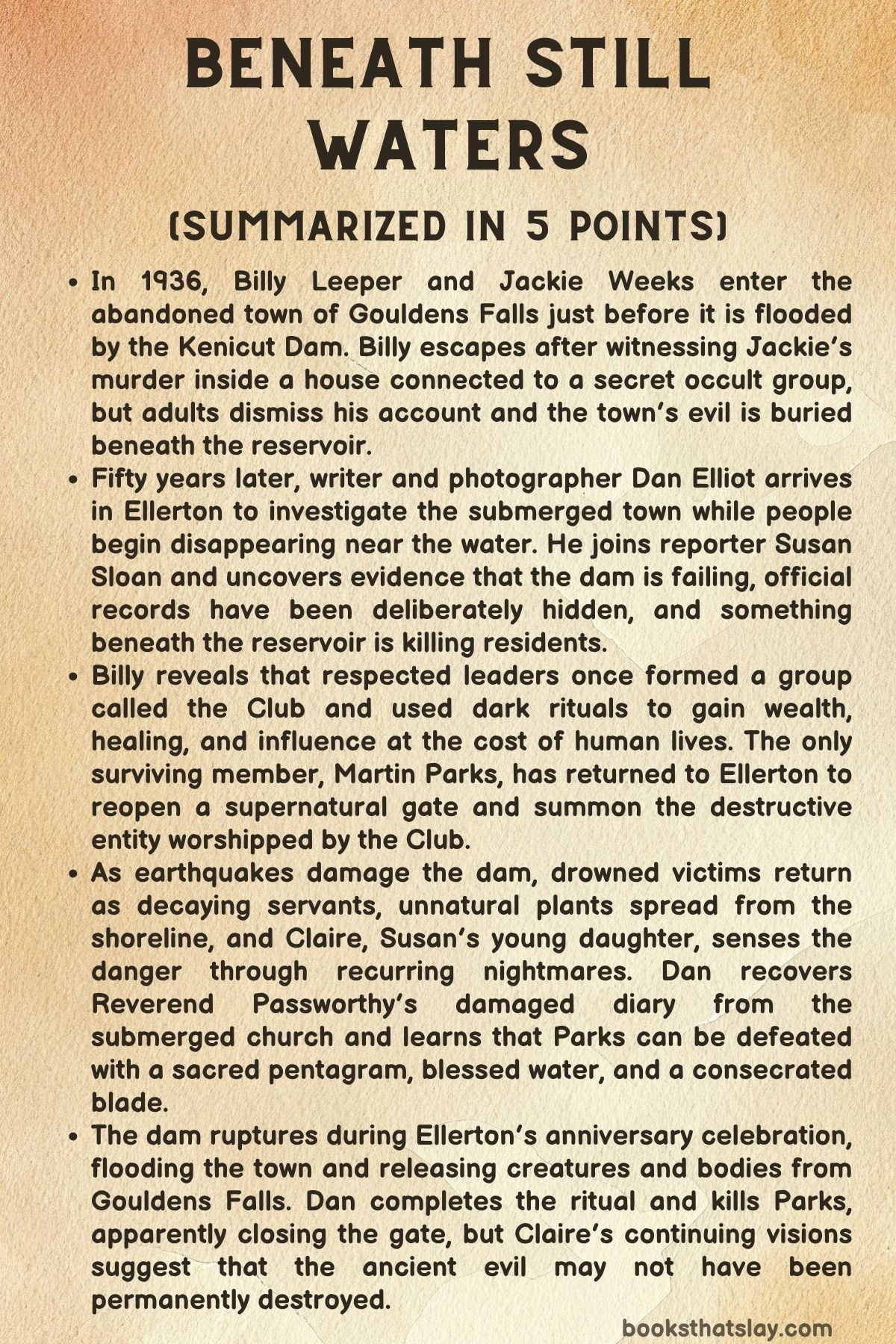
Summary
In 1936, Billy Leeper and his best friend, Jackie Weeks, secretly enter Gouldens Falls shortly before the newly constructed Kenicut Dam is scheduled to flood the abandoned town. Billy feels uneasy among the deserted streets and empty homes, but Jackie persuades him to investigate the sound of an old woman crying inside a house on Scott Street.
Jackie enters first and fails to return, forcing Billy to follow him. Inside, Billy encounters a decaying man and a gathering of strangely dressed figures who appear to be eating Jackie’s dismembered body.
Billy escapes, climbs over the town’s fence, and strikes his head on a rock. The authorities later dismiss his account as the confused imagination of an injured child, and Gouldens Falls disappears beneath the reservoir with Jackie’s body and the house’s secrets still inside it.
Fifty years later, freelance writer and photographer Dan Elliot arrives in Ellerton to research an article about the submerged town. Dan is separated from his wife, financially unstable, and troubled by alcohol, while a past automobile accident has left him terrified of bridges despite his experience as a diver.
Near the reservoir, teenager Tom Fluhr takes his girlfriend, Emily Powers, to a secluded beach. After Tom pressures Emily to have sex, she leaves him alone in the water, where rotting hands seize him and drag him beneath the surface.
Dan meets local reporter Susan Sloan, who is also investigating the approaching fiftieth anniversary of the dam. They attempt to interview site engineer Fred Massetrino, a frightened alcoholic who has begun hearing voices around the reservoir and seeing bloated faces beneath the water.
During a tour of the dam, an earthquake shakes the structure. Dan discovers a neglected crack that has been allowing water to enter for months, revealing that the dam may be in serious danger.
Mayor Max Wiley responds to the discovery by worrying about the anniversary celebration and his political career rather than public safety. He pressures officials to keep the danger quiet because he intends to use the event to support a future congressional campaign.
Susan introduces Dan to her eleven-year-old daughter, Claire. Claire is intelligent, independent, and suspicious of Dan, but she gradually accepts him after he speaks honestly about fear and the painful lessons of his own childhood.
Claire has recurring nightmares in which waterlogged figures emerge from the reservoir and drag her beneath the surface. One of these figures resembles a decaying version of Susan, causing Claire to believe that the dreams may be warnings rather than ordinary nightmares.
Dan investigates the history of the dam and discovers that its approval and construction occurred with suspicious speed. He finds few official records concerning Gouldens Falls, creating the impression that powerful individuals deliberately removed evidence about the town.
Massetrino’s terror continues to grow until a creature rises from the reservoir and pulls him into the water. His disappearance follows Tom’s, but no one yet understands that both men have become victims of the same force.
Martin Parks arrives in Ellerton after displaying supernatural power during an international flight. He appears young, elegant, and controlled, although his disturbing behaviour and unnatural calm suggest that he is far older and more dangerous than he seems.
Dan learns from Reverend Winston that Billy Leeper survived the final day in Gouldens Falls. He travels to Billy’s isolated home, where the elderly man reluctantly explains that the Scott Street house contained people who murdered and consumed Jackie.
Billy has spent fifty years collecting records about Gouldens Falls. He believes that a secret organization known as the Club controlled the town and that one unidentified member escaped before the flooding.
Police divers Tom Flaherty and Ed Raskin search the submerged streets for Tom Fluhr. They recover pieces of a body, but the remains belong to Massetrino, whose severed head and limbs prove that the deaths around the reservoir cannot be explained as ordinary drownings.
During a second dive, Tom and Ed approach the brown house on Scott Street. Ed enters first and disappears, while an unseen force drags Tom through the building’s doors, leaving both divers trapped inside the same place where Jackie died.
Billy later brings Dan the missing photograph of the Club’s fifth member. The man is Martin Parks, whose unchanged appearance proves that he has survived for half a century through supernatural means.
The Club originally consisted of respected leaders who claimed to want prosperity for Gouldens Falls. Dr. Samuel Hustis introduced the others to occult teachings that granted healings, successful harvests, financial rewards, and other apparent miracles.
Every benefit eventually produced greater suffering. Families who prospered experienced deaths, fires, illnesses, and disappearances, while the Club gained greater control by sacrificing townspeople to an ancient destructive entity called Azathoth.
Reverend Duncan Passworthy organized a resistance against the Club. He and his followers convinced government officials to flood Gouldens Falls, but Passworthy also left a diary beneath his church explaining how the evil could be defeated if it returned.
Dan secretly enters the reservoir with sonar operator Jack Russo and swims to Passworthy’s submerged church. While Dan searches for the diary, Parks confronts Billy on shore and uses supernatural power to tear his body apart.
Dan locates the diary inside a metal box beneath a stone. He nearly dies when his equipment becomes trapped and his air runs out, but he reaches the surface with the book and is arrested for entering the restricted reservoir.
Although much of the diary has decayed, document specialist Wilson Smith begins restoring its pages. The readable sections explain that the Club’s suffering and sacrifices strengthened a gate through which Azathoth could enter the human world.
Meanwhile, the reservoir’s influence spreads through Ellerton. Claire discovers unnatural plants growing beside the water, while Sharon Benny searches for her son Joshua and is killed by black tendrils after mistakenly believing he has wandered outside.
Emily returns to the beach to hold a private memorial for Tom. She becomes trapped by the vegetation and sees Tom emerging from the reservoir as a gray, decomposing figure transformed into one of the lake’s servants.
Inside the dam, inspector James Morton and the repair crew are trapped when another earthquake widens the crack. Water floods the chamber, but Wiley looks at the locked entrance and assumes that the repairs have been completed.
Claire and Susan find Samantha and Joshua alone in their house and discover Sharon’s body near the reservoir. Parks appears with two possessed police officers, forcing Susan to lead the children through the woods in search of safety.
The restored diary reveals that Passworthy and his supporters performed a White Mass against the Club. They used the Pentagram of Solomon, sacred names, blessed knives, and holy symbols to kill the members, but the ritual remained incomplete because Parks escaped.
The dead Club members and their victims were buried beneath the Scott Street house before the dam sealed the town. Because Parks survived, the gate was never permanently closed, allowing him to return decades later and continue the ceremony.
Reverend Winston reconstructs a missing section of the pentagram and blesses a vial of water for Dan. Dan prepares his diving knife and the completed symbol while trying unsuccessfully to contact Susan and Claire.
At the anniversary costume ball, Parks reveals part of his power to Wiley. The mayor’s devil costume becomes physically attached to his body, leaving him in agony while the other guests assume that he is suffering a mental breakdown.
The dam finally ruptures, releasing a huge wall of water into Ellerton. Residents gathered nearby are swept away, while drowned bodies and unnatural beings emerge from the exposed remains of Gouldens Falls and attack survivors.
Parks captures Claire near the cave where she has been protecting Samantha and Joshua. He admits that Claire’s awareness and mental strength make her dangerous because she can sense his control and resist the illusions affecting other people.
As Parks opens the gate, the temperature falls and frost spreads across the woods. A massive presence approaches from another world while the decreasing reservoir reveals the rooftops of the town that was meant to remain hidden.
Dan and Susan arrive before the entity fully enters. Dan draws the completed Pentagram of Solomon, marks it with the necessary symbols, pours the blessed water, and begins the ritual while Susan physically fights Parks to stop him from interfering.
Once Parks is trapped inside the design, Dan drives the blessed knife into his heart. Parks dies, the approaching entity disappears, the possessed officers collapse, and the children are released from supernatural control.
Several months later, Dan, Susan, and Claire live together in rural Pennsylvania. They are beginning to form a family, although the Ellerton disaster has killed or displaced hundreds of people and caused enormous destruction.
Officials blame the catastrophe on structural failure and mass hysteria. Dan and Susan know that the explanation conceals the truth, but they believe that Parks’s death has finally closed the gate.
Claire remains unconvinced. Her dreams continue, and she begins seeing not only the past of Gouldens Falls but also a possible future in which its evil returns, leaving the final victory uncertain.
Characters
The characters in Beneath Still Waters are connected by fear, secrecy, responsibility, and the consequences of refusing to confront danger. Some become stronger when forced to face the truth, while others allow ambition, denial, addiction, or selfishness to make them useful to the evil beneath the reservoir.
Dan Elliot
Dan Elliot is the central investigator and reluctant hero of the book. He arrives in Ellerton seeking a compelling article, but his professional curiosity gradually develops into a personal responsibility to protect Susan, Claire, and the entire community.
Within Beneath Still Waters, Dan is introduced as a damaged and imperfect man rather than a conventional heroic figure. His marriage has failed because of unstable finances, long absences, drinking, and his inability to provide the dependable life his wife expected.
Dan’s fear of bridges comes from an accident in which his vehicle broke through a railing and sank. Although his diving experience saved him, the incident left him with a lasting fear of losing control and becoming trapped.
This history makes his later decision to enter the reservoir especially significant. He does not approach the submerged town without fear, but he acts despite that fear because the danger to others has become more important than his own safety.
Dan initially treats Gouldens Falls as an unusual subject that might revive his career. His interest contains an element of opportunism, since the disappearances and official secrecy make his proposed article more valuable.
His attitude changes as he meets Billy and studies the evidence. Once he understands that the deaths are connected to a deliberate occult history, he stops behaving like an observer and accepts that reporting the story will not be enough.
Dan’s relationship with Susan encourages this development. He respects her intelligence and independence, although his attempts to protect her sometimes become controlling because he fears losing another person after his earlier failures.
His bond with Claire is equally important. Dan earns her trust by speaking honestly about childhood fear instead of dismissing her concerns, making him one of the few adults capable of understanding why her instincts deserve attention.
By entering the submerged church, recovering the diary, reconstructing the ritual, and confronting Parks, Dan completes the work begun by Passworthy. His heroism comes from his willingness to accept evidence that appears impossible and to act before certainty can be established.
Dan’s final life with Susan and Claire suggests that he has gained a second opportunity to become dependable. However, his assurance that the evil has ended may reveal that he still underestimates forces that cannot be fully controlled.
Susan Sloan
Susan Sloan is a determined local reporter, a protective mother, and Dan’s closest partner in the investigation. She provides knowledge of Ellerton and approaches the dam’s problems through evidence, official records, interviews, and direct observation.
Susan’s professional ambition does not make her careless. She understands the importance of reporting the disappearances and the structural danger, but she also recognizes that local authorities may hide information to protect themselves.
Her failed marriage has made her cautious about trusting another man. Her former husband abandoned her after Claire’s birth, leaving Susan to carry most of the emotional and practical responsibilities of parenthood.
This experience explains why Susan responds strongly when Dan warns her away from the dam. She does not want concern to become another form of male authority, and she refuses to surrender her judgment simply because Dan believes he is protecting her.
Susan initially interprets Claire’s nightmares and warnings as emotional reactions to divorce, isolation, and fear. Her scepticism is understandable, but it also reflects the adult tendency to classify a child’s perception as imagination when it does not fit ordinary explanations.
Her development becomes clear when she sees the unnatural growths, Sharon’s body, the transformed police officers, and Parks. Once the evidence becomes undeniable, she trusts Claire without hesitation and allows her daughter’s instincts to guide their escape.
Susan demonstrates physical courage during the final confrontation. She attacks Parks even though she possesses no supernatural power, creating the time Dan needs to complete the pentagram and kill him.
Her relationship with Dan is built through shared danger rather than simple attraction. Each recognizes the other’s weaknesses, and their decision to live together suggests that both are willing to create a more stable family for Claire.
Claire Sloan
Claire Sloan is the child whose awareness allows her to perceive the reservoir’s influence before most adults can recognize it. Her intelligence, imagination, isolation, and recurring dreams make her especially sensitive to the supernatural events surrounding Gouldens Falls.
Claire fears that Dan will hurt or abandon Susan, which explains her initial suspicion of him. Her protectiveness has developed from her father’s limited involvement and from watching her mother manage the consequences of a failed marriage.
Her nightmares first appear to be expressions of anxiety. However, their repeated images of the lake, decaying figures, unnatural plants, and Susan’s death correspond closely to events that later occur.
Claire’s awareness is not presented as effortless power. The dreams terrify and embarrass her, particularly when she wets the bed, yet she continues trying to warn adults even when she expects not to be believed.
Her concern for Joshua and Samantha shows unusual moral courage. She refuses to remain safe while believing that the younger children are in danger, and she later refuses to abandon them in the cave when Susan goes for help.
Parks identifies Claire as the only person he truly fears. Her resistance threatens him because his influence depends on confusion, denial, emotional weakness, and the surrender of individual judgment.
Claire can recognize when possessed people are no longer themselves. This ability saves Susan and the children when Parks arrives with the transformed police officers, and it allows her to briefly interfere with Sharon’s supernatural control.
Her final dreams prevent the ending from becoming entirely reassuring. While Dan and Susan want to believe that the threat has passed, Claire understands that defeating one servant may not destroy the larger force that created him.
Billy Leeper
Billy Leeper is the survivor whose childhood trauma preserves the truth about Gouldens Falls. For fifty years, he carries the memory of Jackie’s murder while living with the knowledge that the adults around him dismissed his testimony.
Billy’s life demonstrates the lasting damage caused when a truthful witness is treated as confused or unreliable. The injury to his head gives the authorities a convenient excuse to reject his account, allowing the town’s official history to replace what actually happened.
His decision to live in isolation near the sea reflects both fear and preparation. He expects the surviving Club member to return and believes that distance may protect him from being discovered.
Billy spends decades collecting reports, photographs, names, and examples of disasters connected to the Club. His research transforms him from a frightened child into the unofficial guardian of a history that others deliberately erased.
His unwillingness to speak publicly is not simple cowardice. Billy knows that Parks remains alive, and his fear is confirmed when Parks eventually finds and kills him without physically touching him.
Billy’s relationship with Dan is based on reluctant trust. He initially refuses to reopen his memories, but the recent deaths convince him that silence now poses a greater danger than exposure.
By identifying Parks and directing Dan to Passworthy’s diary, Billy gives the younger man the information required to resist the returning evil. Although he dies before seeing the result, his lifelong work makes the final ritual possible.
Martin Parks
Martin Parks is the principal human antagonist and the surviving member of the Club. His youthful appearance after fifty years immediately separates him from ordinary humanity and suggests that his life has been extended through occult power.
Parks is calm, charming, wealthy, and socially confident. These qualities allow him to enter Ellerton without suspicion and to manipulate ambitious or corrupt people such as Wiley.
His behaviour toward the flight attendant reveals his enjoyment of domination. He does not merely possess power but takes pleasure in making others aware that they cannot resist him.
Parks understands human weakness and uses it effectively. He offers Wiley money and political opportunity because he recognizes that the mayor’s ambition will make him cooperate without asking serious questions.
His control extends beyond bribery. He influences the dead, possesses living people, alters physical reality, summons unnatural creatures, changes the weather, and manipulates the dam’s destruction.
Parks’s interest in Claire exposes the limits of his authority. He fears her because she remains mentally independent and can distinguish his servants from ordinary people.
His apparent elegance conceals total contempt for human life. The suffering of Ellerton’s residents is not an unfortunate consequence of his plan but the energy required to strengthen the gate and summon Azathoth.
Parks also represents unfinished evil. Because he escaped Passworthy’s original ritual, the Club’s defeat remained incomplete, proving that even one surviving participant can preserve a destructive system across generations.
Mayor Max Wiley
Mayor Max Wiley represents political ambition without moral responsibility. He repeatedly receives evidence that the dam is unsafe, yet he evaluates every warning according to its possible effect on the anniversary celebration and his future campaign.
Wiley is not initially a supernatural servant. His failures arise from ordinary selfishness, making him an example of how human corruption can assist evil without fully understanding it.
His affair with Jamie Collins reveals the difference between his public image and private conduct. He values respectability as a political tool rather than as a genuine standard of behaviour.
Wiley’s acceptance of Parks’s money makes his moral weakness explicit. He realizes that Parks knows private information about his plans, but greed and ambition overcome his suspicion.
The mayor’s decision to continue the celebration contributes directly to the scale of the disaster. Crowds remain near the dam because he refuses to allow evacuation or cancellation to damage his reputation.
His transformation at the costume ball is a cruel punishment that reflects his hypocrisy. The devil costume he wears for entertainment becomes part of his body, making his concealed corruption physically visible.
Wiley survives long enough to recognize that he has helped create a catastrophe, but his realization comes too late. His character shows that authority becomes dangerous when public safety is treated as less important than personal advancement.
Paddy Rogers
Police Chief Paddy Rogers is a practical authority figure placed between official pressure and growing evidence of the impossible. He begins by treating the disappearances as police matters that require searches, divers, and physical evidence.
Rogers resents Wiley’s interference because he understands that an investigation cannot be guided by political convenience. However, he still operates within normal procedures and is slow to accept Dan’s supernatural explanation.
His scepticism is reasonable rather than foolish. Dan’s claims depend on an elderly survivor’s story, occult records, and a damaged diary recovered through an unauthorized dive.
Rogers demonstrates flexibility when the evidence changes. He delays charging Dan, contacts Wilson Smith, studies the restored diary, and allows the investigation to move beyond conventional assumptions.
His decision to go to the reservoir after his officers stop responding shows his sense of duty. Unlike Wiley, he does not remain protected while others face the danger.
Rogers is eventually overpowered because courage alone cannot protect him from an enemy he does not fully understand. His fate reinforces the difficulty of applying ordinary law-enforcement methods to a force that controls bodies, perceptions, and natural events.
Fred Massetrino
Fred Massetrino is the dam’s site engineer and one of the earliest adults to recognize that something is wrong with the reservoir. Unfortunately, alcohol, fear, and professional neglect prevent him from responding effectively.
Massetrino hears voices calling his name and sees faces beneath the surface. His experiences isolate him because he expects others to dismiss him and because admitting the truth would require explaining his failure to inspect the dam properly.
His alcoholism functions as both an escape and a cause of further vulnerability. Drinking allows him to avoid his terror temporarily, but it also weakens his judgment and gives others a reason to doubt him.
The algae around the crack proves that Massetrino has neglected a serious structural problem for months. His failure connects personal deterioration with public danger, since the hidden leak threatens everyone living below the dam.
Massetrino’s death is especially cruel because he already knows that the water is dangerous. When he finally looks into the reservoir, the force he has feared rises and pulls him inside.
His dismembered remains provide the first undeniable evidence that the disappearances involve violence. Even in death, he becomes part of the warning that the authorities struggle to interpret.
Tom Fluhr
Tom Fluhr is the first modern victim of the reservoir. He is a confident teenager, a champion swimmer, and the privileged son of a man wealthy enough to own the expensive car Tom borrows.
His treatment of Emily reveals immaturity and entitlement. He arranges the private outing partly to pressure her into sex despite her repeated insistence that she is not ready.
Tom’s swimming ability makes his disappearance difficult to explain as an accident. His physical confidence becomes useless when a supernatural force prevents him from reaching shore and pulls him underwater.
After his death, Tom is transformed into one of the reservoir’s decaying servants. His return during Emily’s memorial turns her hope into horror and demonstrates that Parks’s victims can be used against the people who loved them.
Tom is not presented as deserving his fate. His selfish behaviour creates the argument that separates him from Emily, but the punishment imposed by the reservoir is far beyond any human wrongdoing.
Emily Powers
Emily Powers is defined by her attempt to maintain personal boundaries in her relationship with Tom. She refuses to surrender to his pressure, even though leaving him alone later fills her with guilt.
Emily does not witness Tom’s actual abduction. This uncertainty causes her to question whether remaining at the beach might have saved him.
Her private memorial is an act of grief and self-punishment. She returns to the place where they argued because she wants to honour Tom and confront the memory she has been avoiding.
The reservoir exploits her guilt by sending Tom’s transformed body toward her. Emily’s death shows how the evil uses emotional attachment to draw victims closer rather than relying only on physical force.
Tom Flaherty and Ed Raskin
Tom Flaherty and Ed Raskin are experienced police divers whose confidence is gradually replaced by fear. Their professional training allows them to enter the submerged town, but it cannot prepare them for buildings that seem inhabited by unseen forces.
Their discovery of Massetrino’s remains changes the nature of the investigation. What began as a search for a missing teenager becomes evidence of mutilation and possible murder.
During the second dive, Ed enters the Scott Street house while Tom remains outside. Tom’s refusal to follow reflects instinctive terror rather than disloyalty, but the house draws him inside regardless of his choice.
The two divers illustrate the limitations of courage and expertise. They understand underwater danger, equipment, currents, and recovery procedures, yet they cannot defend themselves against a force that controls the environment itself.
Jack Russo
Jack Russo is the sonar operator who assists the police divers and later helps Dan enter the reservoir. He is practical, observant, and willing to take risks when he believes another search might rescue the missing men.
Russo detects moving shapes near the divers before anyone knows what they are. His equipment provides indirect evidence that the submerged town contains active presences.
Dan deceives Russo about the real purpose of the unauthorized dive. Even so, Russo’s cooperation makes the recovery of Passworthy’s diary possible.
His character represents the ordinary people whose technical skills become essential during extraordinary events. He does not understand the full supernatural history, but his willingness to act supports those who do.
Reverend Winston
Reverend Winston is a historian, religious authority, and important source of knowledge. His collection preserves information that has disappeared from official archives, including records about Jackie Weeks and Billy Leeper.
Winston does not initially understand the complete occult history. However, his familiarity with religious texts allows him to identify the incomplete pentagram and reconstruct its missing section.
His blessing of the water gives Dan one of the tools needed for the final confrontation. Winston therefore connects historical research with spiritual resistance.
He also contrasts with the Club’s misuse of ritual. While the Club uses belief to gain power through suffering, Winston uses religious knowledge to protect others without seeking reward.
Reverend Duncan Passworthy
Reverend Duncan Passworthy is the leader of the original resistance against the Club. Although he is dead during the main events, his decisions shape nearly every part of the later conflict.
Passworthy recognizes that the Club’s miracles are connected to sacrifice and destruction. He organizes followers, performs the White Mass, and helps persuade the authorities to flood Gouldens Falls.
His plan is both courageous and morally difficult. Flooding the town conceals the evil, but it also replaces public truth with secrecy and leaves future generations unaware of what remains beneath the water.
Passworthy understands that Parks’s escape prevents the ritual from being complete. His diary is therefore designed as a message to whoever must continue the struggle.
By hiding the book beneath the church, he preserves the knowledge needed to finish the ritual. His character represents resistance across generations, since Dan’s victory depends on actions Passworthy prepared fifty years earlier.
Sharon Benny
Sharon Benny is the mother of Samantha and Joshua. Her death begins with an ordinary parental fear when she mistakenly believes that Joshua has wandered toward the reservoir.
Her panic prevents her from checking his room carefully. Joshua is actually asleep on the floor in a sleeping bag, but Sharon runs into the woods and crawls beneath the fence.
The black growths immobilize and suffocate her, turning her protective instinct into the means of her destruction. The reservoir later uses her body to threaten her own children.
Her transformation is especially disturbing because Samantha continues to recognize her as a mother. Sharon’s appearance forces the children to confront the fact that familiar bodies can become instruments of something hostile.
Samantha Benny
Samantha Benny is a young child forced to experience the disappearance and transformation of her mother. Her innocence prevents her from immediately understanding why Sharon’s body is dangerous.
When Samantha uncovers Sharon’s face, she hopes that her mother may still be alive. The supernatural growths take advantage of this hope by wrapping around her feet.
Samantha depends on Susan and Claire for protection, but she also endures fear, physical exhaustion, and confusion without completely collapsing. Her survival gives emotional importance to the final rescue.
Dan’s effort to comfort her after Sharon’s death shows that defeating Parks cannot undo every loss. Samantha survives, but she must live with a trauma that no official explanation can adequately describe.
Joshua Benny
Joshua Benny is curious, impulsive, and too young to understand the danger around the reservoir. His movement toward the woods causes Claire to recognize how strongly the lake is attracting children.
Joshua’s disappearance from his bed is only an error of perception, yet it sends Sharon to her death. This accident shows how fear can create real consequences even before supernatural influence is fully understood.
Claire becomes especially protective of Joshua because she has already prevented him from approaching the water once. His vulnerability strengthens her determination to remain in the cave rather than abandon the younger children.
Joshua’s survival depends on the courage of Claire, Susan, and Dan. He represents the innocent lives placed at risk by decisions made decades before his birth.
James Morton
James Morton is the state inspector who recognizes the seriousness of the dam’s structural damage. Unlike Wiley, he responds to the evidence by recommending closure, repairs, and emergency preparations.
Morton understands that the crack may still be controlled if officials act quickly. His practical judgment makes Wiley’s decision to continue the anniversary events appear even more reckless.
During the repair attempt, Morton becomes trapped as the crack widens and the chamber floods. His suffering demonstrates that competent action may still fail when corruption has caused dangerous delays.
Morton represents professional responsibility without political power. He can identify the threat and recommend solutions, but he cannot force the mayor to treat those warnings with the urgency they require.
Wilson Smith
Wilson Smith is the document specialist responsible for restoring Passworthy’s damaged diary. His work transforms an apparently useless object into the most important source of information available to Dan and Rogers.
Smith’s contribution is quiet but essential. Without his ability to separate and preserve the pages, the nature of Azathoth, the Club’s rituals, and the method of resistance would remain unknown.
His character demonstrates the importance of specialized knowledge. Physical bravery alone cannot defeat Parks; the final victory also depends on patient technical work performed away from the immediate danger.
Jackie Weeks
Jackie Weeks is Billy’s daring childhood friend and the first known victim shown in the story. His desire to explore Gouldens Falls brings the boys into the Scott Street house shortly before the town is flooded.
Jackie is more adventurous than Billy and appears less sensitive to danger. His confidence causes him to enter the house alone when he hears what sounds like an elderly woman crying.
His murder becomes the defining event of Billy’s life. Although Jackie appears only briefly, his death motivates Billy’s investigation and ultimately contributes to Parks’s defeat.
Jackie also represents the children sacrificed by adult corruption. The Club’s members present themselves as respectable leaders, yet their prosperity depends on the suffering of people such as him.
Dr. Samuel Hustis and the Club
Dr. Samuel Hustis, Thomas Raine, Jonathan Reynolds, and Wallace Pfister are respected members of the community who form the Club with Parks. Their public status allows them to hide occult activity behind professional authority and social influence.
Hustis introduces teachings associated with Aleister Crowley and discovers rituals that appear to heal injuries and create prosperity. The others accept these methods because the immediate rewards make them willing to ignore the suffering that follows.
The Club’s members gradually move from experimentation to control. They eliminate opponents, manipulate the town, and treat disappearances as acceptable sacrifices for power.
Their behaviour shows how collective wrongdoing weakens individual responsibility. Each man can view himself as only one participant, even though the group’s success depends on their continued cooperation.
Their deaths during the White Mass do not erase the consequences of their actions. Because Parks escapes, their victims remain trapped beneath Gouldens Falls and the system they created survives for another fifty years.
Themes
The Persistence of Buried Evil
In Beneath Still Waters, the flooding of Gouldens Falls is intended to end the Club’s power by physically covering the town, its victims, and its ritual centre. Instead, the reservoir preserves the buildings, bodies, memories, and supernatural gate in a cold environment where they remain hidden but active.
The story repeatedly shows that concealment is not the same as destruction. The authorities remove records, dismiss Billy’s testimony, and allow the public to believe that Gouldens Falls disappeared for ordinary reasons, but this manufactured silence prevents later generations from recognizing the danger.
The dam becomes a physical symbol of repression. Its massive walls separate Ellerton from the past, yet cracks slowly form because the structure cannot permanently contain what has been denied.
Parks’s survival gives the buried evil a human connection to the present. As long as one Club member remains alive, the old system retains the knowledge and intention required to begin again.
The ending continues this idea through Claire’s dreams. Parks has been killed and the gate appears closed, but Claire senses that the force behind him may exist beyond a single location, ritual, or servant.
The novel therefore treats evil as something that must be understood and confronted openly. Secrecy may delay its return, but suppressed truth eventually reappears through damaged structures, repeated violence, inherited fear, and the testimony of those who refuse to forget.
Fear as Weakness and Protection
Fear affects nearly every important character, but it does not produce the same response in each person. For some, it becomes a warning that encourages preparation, while for others it leads to denial, addiction, selfishness, or paralysis.
Billy’s fear preserves his life in childhood and motivates decades of research. Although it isolates him, it also prevents him from accepting the official version of events and allows him to prepare evidence for the day Parks returns.
Massetrino responds differently. He recognizes the reservoir’s danger but attempts to escape through alcohol, secrecy, and neglected responsibilities, allowing both the supernatural threat and the physical damage to grow.
Dan’s development depends on learning to act while afraid. His bridge trauma, memories of his violent father, and discomfort underwater remain present, but he eventually treats fear as information rather than as a command to retreat.
Claire’s fear is especially protective because she pays attention to it. Her nightmares, suspicion of possessed adults, and concern for the Benny children repeatedly guide her toward the truth.
Wiley fears political embarrassment more than death or structural collapse. Because he assigns importance to the wrong danger, his decisions expose the entire town to catastrophe.
The story does not suggest that courage requires the absence of fear. Genuine courage appears when characters acknowledge what frightens them, judge the threat honestly, and choose to protect others despite personal risk.
Corruption Behind Respectability
The Club’s members are not presented as obvious social outcasts. They are doctors, leaders, businessmen, and influential citizens whose respected positions allow them to control Gouldens Falls while concealing the source of its prosperity.
Their apparent miracles make corruption attractive. Healing, financial success, good harvests, and community improvement create the impression that harmful methods may be justified by beneficial results.
The hidden cost exposes the moral dishonesty of that argument. Every reward produces greater suffering, and the Club continues only because its members decide that other people’s lives are acceptable payment for their own power.
Wiley repeats the same pattern without initially participating in the supernatural rituals. He presents himself as a public servant while conducting an affair, accepting a bribe, hiding safety information, and placing political ambition above the lives of residents.
Parks recognizes Wiley as an easy ally because corruption does not require complete knowledge. The mayor does not need to understand Azathoth or the Club’s history; he only needs to choose personal advantage whenever duty conflicts with ambition.
The authorities who dismiss Billy and erase records also contribute to the pattern. Their decisions protect social order in the immediate moment, but they leave the deeper injustice untouched.
Respectability therefore becomes a disguise rather than evidence of goodness. The novel asks readers to judge institutions and leaders by the human consequences of their decisions, not by titles, appearances, public ceremonies, or promises of prosperity.
Children as Witnesses to Denied Truth
Billy and Claire occupy different generations, yet both perceive truths that adults initially reject. Their experiences show how children can recognize danger clearly while lacking the authority, language, and social power required to make others listen.
Billy witnesses Jackie’s murder and reports what he saw, but his head injury allows adults to classify his testimony as hysteria. The official rejection does not change the truth; it only forces Billy to carry it alone for fifty years.
Claire’s nightmares are similarly treated as emotional symptoms. Susan interprets them through divorce, anxiety, loneliness, and imagination because those explanations fit ordinary experience more comfortably than supernatural warnings.
Both children suffer because adults protect their own understanding of reality. Billy becomes isolated and obsessed with the past, while Claire feels ashamed of her nightmares and uncertain about whether she can trust her own perceptions.
Their awareness eventually becomes necessary for survival. Billy’s records identify Parks and locate the diary, while Claire recognizes transformed people, protects the Benny children, and resists Parks’s influence.
The story does not present childhood innocence as ignorance. Billy and Claire understand the moral reality of events because they have not yet learned to excuse danger through political convenience, professional reputation, or social denial.
Their roles also create a warning about responsibility. When adults refuse to listen to children, they do not protect them from frightening truths; they leave them alone with dangers that have already entered their lives.