Daughters of the Sun and Moon Summary, Characters and Themes
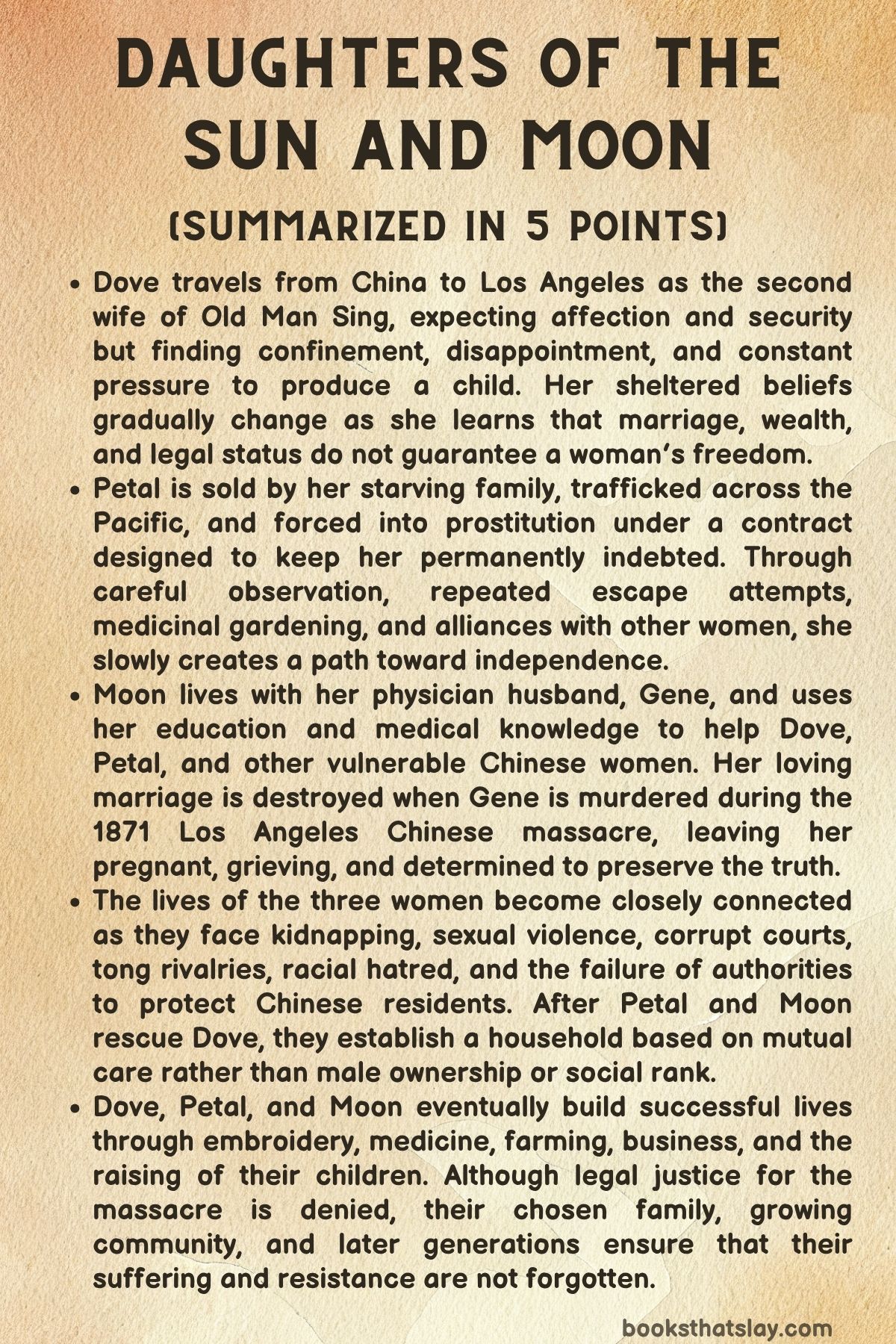
Daughters of the Sun and Moon by Lisa See is a historical novel about three Chinese immigrant women whose lives meet in Los Angeles during the 1870s.
Dove arrives as the sheltered second wife of a wealthy merchant, Petal is trafficked into sexual slavery, and Moon works beside her physician husband while longing for a child. Their individual struggles unfold within a society shaped by racial exclusion, corrupt institutions, organized crime, and violence against women. As their hopes are repeatedly challenged, the three form a chosen family that gives them the courage, knowledge, and practical support needed to survive and rebuild their futures.
Summary
On her seventeenth birthday, Yut Ho, known as Dove, receives a marriage proposal from Old Man Sing, a wealthy Chinese merchant living in Los Angeles. Although he already has a wife and children in China, he wants a second wife to provide companionship in America.
Dove’s struggling father accepts the generous bride price, and the agreement also allows her brother, Ah Guey, to travel with her. Imagining Old Man Sing as young, handsome, and romantic, Dove leaves Canton believing she is beginning a privileged life filled with love.
Elsewhere, eighteen-year-old Sing Yee lives with her starving family in the drought-stricken village of Moon Pond. Her father takes her to Canton under false pretences, accepts money from a broker, and abandons her aboard a ship.
Renamed Petal, she discovers that she has been sold to the Hip Yee Tong. She is confined belowdecks with more than two hundred women and girls being transported to America, most of whom are intended for forced prostitution.
Dove travels in relative comfort while Petal endures filth, hunger, fear, and confinement in the ship’s hold. After a trafficked girl jumps overboard, Dove deliberately turns away from the suffering beneath her, still believing that her own respectable marriage protects her from such a fate.
In San Francisco, trafficked women are stripped and auctioned before male buyers. Headman Sam, leader of the Nin Yung Tong, purchases Petal and takes her toward Los Angeles, while Dove is placed under his protection for the final part of her journey.
Dove soon encounters Headman Yo, the leader of a rival tong. The hostility between Sam and Yo reveals that the Chinese community is divided by competition over gambling, businesses, protection payments, and ownership of women.
When Dove reaches Los Angeles, the impressive city she imagined is replaced by dusty streets, saloons, animals, gambling houses, and crowded buildings. Old Man Sing is much older and less attractive than she expected, but she tries to accept him dutifully and hopes affection will grow.
Moon, an educated Chinese woman fluent in English, lives nearby with her husband, Doctor Chee Long “Gene” Tong. Moon assists Gene in treating Chinese and white patients, but she privately grieves because they have been unable to conceive a child.
Dove is taken to Gene so that Old Man Sing can receive medical proof of her virginity. At almost the same moment, Petal is brought into Moon’s home after being injured while resisting Headman Sam’s men, bringing the three women together for the first time.
Moon reads the document Petal was forced to mark with her thumbprint. The supposed labor contract requires her to repay her purchase price, transportation, food, clothing, lodging, medical care, and interest, making freedom almost impossible.
Petal decides to survive by “painting a dragon,” presenting an obedient appearance while secretly watching, learning, and planning her escape. She recognizes that Dove’s respectable marriage does not necessarily make her free, while Moon begins questioning how effectively marriage, contracts, or social position can protect any woman.
Dove begins married life in comfortable confinement. Old Man Sing gives her clothing, food, servants, jewelry, and gifts, but forbids her from appearing publicly and expects her to become pregnant quickly.
Petal is forced to work in Headman Sam’s brothel, the Midnight Garden. During the day she performs sewing work, and at night she receives customer after customer while every expense is added to her debt.
Petal listens to conversations, learns English, studies the streets, and saves whatever she can. Her first escape attempt ends when Three-Finger Lee finds and sexually assaults her before returning her to the brothel.
Later, Petal is kidnapped by men associated with Headman Yo’s interests. She is beaten, burned, whipped, and left dangerously ill before lawmen return her to Headman Sam under the false claim that she stole from him.
Moon and Gene treat Petal as a suffering human being rather than damaged property. Moon comforts her with the story of Hop Path, an isolated Chinese woman whose despair might have been changed by companionship.
After recovering, Petal resumes working while gathering clothing, money, directions, and information. She refuses to accept suffering as inevitable, but she also learns that courage without preparation cannot defeat a system supported by tong leaders, customers, policemen, judges, and employers.
Meanwhile, violence in Los Angeles becomes increasingly public. When Michel Lachenais murders a neighbor and citizens lose confidence in the courts, a vigilante crowd seizes and hangs him while treating his death as entertainment.
Old Man Sing takes Dove to witness the execution, displaying her as evidence of his prosperity. Dove enjoys her first broad view of the city and open sky, but the crowd’s excitement teaches her how easily ordinary people can participate in cruelty.
Petal uses the event as an opportunity to escape in men’s clothing. She travels toward the coast and briefly experiences freedom, but she is betrayed, arrested, and returned after Judge Gray concludes that he cannot protect her without testimony she is too frightened to give.
Back in Moon’s home, the women consider writing to Petal’s family and helping her financially. Dove wants to assist her but hesitates to sell the jewelry that represents her own uncertain security, exposing the class differences that remain between them.
Petal discovers a new source of strength through medicinal gardening. Her knowledge of cultivation helps Gene grow Chinese herbs in California, and she becomes involved in providing better medical care for the Midnight Garden women.
Dove also begins changing. While continuing to appear modest and obedient, she secretly collects fallen coins and studies money, entrances, visitors, and conversations, adopting Petal’s method of protecting a private self beneath outward submission.
The women occasionally experience community during celebrations such as Chinese New Year. Wives, brothel workers, servants, and tong associates gather together, briefly creating a space where women divided by class and reputation can speak and support one another.
That fragile peace ends when Three-Finger Lee kidnaps Dove and forces her into an American marriage ceremony. Although Judge Gray later hears her denial and orders her returned to Old Man Sing, Lee’s allies abduct her again during the confusion.
Headman Yo and his wife, Silver Shimmer, intend to use Dove to produce a son. Because Silver Shimmer cannot conceive, Dove is imprisoned in a house near Poundcake Hill and threatened with sale to a mining camp if she refuses.
Newspapers transform the kidnapping into entertainment and describe Dove as the willing subject of a romantic dispute. Her true wishes disappear beneath stories created by men, officials, and reporters.
Dove initially waits for Old Man Sing, Ah Guey, or Headman Sam to rescue her. As the months pass, however, she learns to study Three-Finger Lee’s possessiveness and encourages him to believe that she depends on him.
She persuades Lee to obtain embroidery materials and sends him to Petal for specially colored thread. The request quietly confirms that Dove is alive and allows Petal to gather clues about where she is being held.
Dove miscarries a child conceived with Old Man Sing, though her captors do not understand the pregnancy’s timing. The loss leaves her isolated and grieving, but it also strengthens her awareness that no man’s claim over her body is based on genuine care.
During the autumn of 1871, hostility between the Nin Yung and Hong Chow Tongs intensifies. Headman Sam hires assassins against Headman Yo, armed men appear in court, and the authorities treat the conflict as an internal Chinese problem.
On October 24, gunfire erupts near the Forever Prosperous store. A police officer is wounded, and a white rancher named Robert Thompson is fatally shot, allowing rumors to spread that Chinese residents are attacking white people.
A mob forms from saloons, businesses, homes, and streets. Longstanding accusations that Chinese workers steal jobs, threaten white women, spread disease, and do not belong in America turn a tong dispute into an attack on an entire racial community.
Chinese residents hide inside shops and apartments while attackers break through roofs, fire into buildings, loot property, and drag men into the streets. Police officers are unable or unwilling to restore order.
Moon and Gene shelter in their home until attackers force their way inside. Gene, his brother Gim, Chang Wan, and Moon are dragged toward Tomlinson’s Corral, where Chinese victims are being tortured and hanged.
Among the mob are Lorette Grascy and her son Jack, even though Gene had compassionately treated Lorette when other doctors failed her. The attackers strip Gene, search him for valuables, shoot him in the mouth, and hang him while Moon watches helplessly.
Petal sees her brother Ah Loo seized with Wan Foo and Tong Won. She risks her life trying to follow them, but her efforts cannot prevent Ah Loo from being murdered only days after reaching America.
From her prison near Poundcake Hill, Dove watches Chinese victims being dragged toward the hanging site. Three-Finger Lee returns and offers to escape with her, but when she remains concerned about Old Man Sing, he rapes her.
The massacre kills at least eighteen Chinese people, though the actual total may be higher. Headman Sam, Headman Yo, and many armed followers escape, while workers, shopkeepers, physicians, and young men with little involvement in the tong dispute are killed.
In the chaos, Auntie Fong reveals where Headman Sam keeps money and records. She and Petal take what they regard as unpaid compensation for years of forced labor and prepare to destroy or purchase the surviving women’s contracts.
Petal finds Moon beside Gene’s body and leads her away. Moon has recently discovered that she is pregnant, making Gene’s death even more painful because he will never meet their child.
After identifying Ah Loo’s body and helping arrange burial rituals, Petal returns to Moon. She reveals that she has contracted plum-blossom disease and believes she cannot safely marry or bear children.
Newspapers blame Dove’s disputed marriages for the massacre, reducing years of racism, corruption, exploitation, and vigilante tradition to a convenient story about one imprisoned woman. Angered by this distortion, Moon files a complaint against Headman Yo and uses the legal pressure to demand Dove’s release.
Moon and Petal confront Headman Yo and Silver Shimmer at the house near Poundcake Hill. Faced with possible arrest and unwanted attention, Yo leaves, and Silver Shimmer finally allows Petal to unlock Dove’s room.
Dove is alive but deeply traumatized. At first she cannot step outdoors, even though the open sky was once her strongest wish, and she depends on Moon and Petal to wash, feed, dress, and comfort her.
It becomes clear that Dove is pregnant as a result of Lee’s assault. Moon and Petal accept her and the unborn child without judgment, allowing the three women to create a home based on care rather than ownership.
Auntie Fong and several surviving brothel workers use Headman Sam’s money to secure their contracts and leave for San Francisco. Petal later confronts Sam, pays the legitimate portion of her debt, purchases freedom for other women, and tears up her own contract.
Several men are convicted of manslaughter for the massacre, giving survivors brief hope that the courts may provide justice. Ten months later, the California Supreme Court overturns the convictions because the indictment was improperly worded, and all remaining cases are dismissed.
Moon gives birth to a son named Gene, while Dove gives birth to a daughter named Pearl. Their arrivals bring joy without erasing the deaths of Gene, Ah Loo, and the other victims.
Over the following years, Moon, Dove, and Petal build a shared household on Cayetano Apablasa’s property. Moon operates the medical practice, Petal manages the herb garden and outside business, and Dove earns money through embroidery while learning practical skills that once seemed impossible for a sheltered wife.
The women gather plants across California, travel with their children, and adapt Chinese medical knowledge to their new environment. Dove finally experiences open fields, mountains, meadows, and valleys without being displayed or guarded by a man.
By 1926, Moon is eighty-two and completing the record of their lives. Her medical practice has expanded into a successful network of businesses, while her son, Dove’s daughter, and later generations receive opportunities denied to the first Chinese immigrants.
Petal lives for approximately forty more years despite her illness, cultivating herbs, protecting vulnerable girls, and becoming a respected mentor. Dove, now blind after decades of embroidery, remains beside Moon as a lifelong sister.
Their garden continues growing from plants descended from Petal’s first cultivation. The women cannot undo the massacre, exploitation, or personal losses they endured, but they preserve the victims’ memory and create a family whose future is determined by solidarity rather than by the men who once claimed ownership over them.
Characters
Dove, or Yut Ho
Dove begins as a sheltered seventeen-year-old whose understanding of marriage comes from romantic imagination, traditional expectations, and the carefully controlled world of her scholar’s family. She assumes that beauty, bound feet, obedience, embroidery, and respectable birth will guarantee affection and protection.
Her early innocence is partly sustained by privilege. Although she notices signs of suffering aboard the ship, she distances herself from the trafficked women because acknowledging their fate would threaten her belief that her own journey is safe and honorable.
Arriving in Los Angeles forces Dove to confront the difference between fantasy and possession. Old Man Sing provides comfort and status, yet he restricts her movements, subjects her to a virginity examination, values her fertility, and treats her as an object through which he can display wealth.
Dove initially responds by trying harder to please him. Her obedience is not simple weakness, because she has been trained to believe that a dutiful wife can gradually earn love, security, and influence.
The death of her caged bird becomes an important reflection of her condition. Like the bird, she possesses beautiful surroundings but lacks the freedom to move through the world beyond them.
Her development in Daughters of the Sun and Moon depends on learning to separate outward conduct from inner identity. Watching Petal teaches her that submission can be performed while private plans, resources, and hopes remain protected.
She begins collecting coins and using Old Man Sing’s vanity to gain limited access to the outside world. These small actions prepare her for the more difficult strategies she later uses during captivity.
Dove’s repeated kidnappings expose the emptiness of male promises. Old Man Sing, Headman Sam, Judge Gray, and legal officials all claim some form of authority over her, but none can protect her when powerful men decide that her body is valuable.
Her imprisonment by Headman Yo, Silver Shimmer, and Three-Finger Lee forces her to become observant, patient, and psychologically resourceful. She manipulates Lee’s desire for affection, uses embroidery supplies to communicate, and stops waiting passively for rescue.
The miscarriage and later rape confront Dove with forms of suffering that cannot be resolved through obedience. Lee’s assault finally destroys any belief that possessive tenderness can be mistaken for love.
After her rescue, Dove’s fear of the outdoors shows the lasting effects of trauma. The open sky once represented freedom, but months of captivity make even unguarded space frightening.
Her recovery is gradual rather than immediate. Moon and Petal allow her to rest, depend on them, and regain control without demanding that she quickly become the person she once was.
Motherhood does not restore Dove’s innocence, but it gives her an opportunity to create a different childhood for Pearl. She raises her daughter within a household where women contribute economically, make decisions, travel, and protect one another.
By the later years, Dove is practical, skilled, and financially productive. Embroidery, once a symbol of feminine obedience, becomes a source of income, while cooking, farming, shooting, and gathering medicines reveal how far she has moved beyond the decorative role assigned to her.
Petal, or Sing Yee
Petal enters the story as a poor but capable village girl whose family calls her Worthless Girl. Her skill at growing food already suggests the patience, intelligence, and closeness to the earth that later become central to her survival.
Being sold by her father destroys her trust in family and fate. Unlike Dove, she reaches America knowing that respectable promises can conceal betrayal, although she still hopes that returning to China might restore the life taken from her.
Petal’s greatest strength is observation. On ships, roads, in brothels, courtrooms, fields, and medical rooms, she memorizes names, routes, habits, plants, prices, English words, and weaknesses.
Her strategy of “painting a dragon” defines much of her character. She recognizes that direct resistance often brings punishment, so she creates the appearance of obedience while protecting her plans and identity.
Her repeated escape attempts demonstrate courage but also force her to become more disciplined. Each failure teaches her that freedom requires knowledge, allies, money, and protection from legal institutions that support her enslaver.
Petal’s anger remains powerful without making her indifferent to others. She grieves Pearl, cares for the Midnight Garden women, tries to protect newcomers, and accepts responsibility for Ah Loo even though his arrival increases her vulnerability.
In Daughters of the Sun and Moon, Petal’s transformation from captive to healer and organizer is closely connected to gardening. Cultivating medicinal plants gives her work that restores life rather than serving the appetites of men.
Her relationship with Moon allows her to experience care without a hidden demand for repayment. Gene and Moon treat her wounds, listen to her knowledge, and gradually include her in meaningful medical work.
Petal’s friendship with Dove develops through conflict as well as sympathy. She initially resents Dove’s beauty, education, silk clothing, and apparent protection, while Dove sometimes fails to understand what genuine deprivation requires.
Their eventual bond becomes stronger because it crosses those differences rather than pretending they do not exist. Petal becomes the person who locates Dove, enters her prison, and opens the locked door.
The arrival and death of Ah Loo intensify Petal’s sense of responsibility. She has saved for his passage and imagined rebuilding part of her family, only to watch American racial violence destroy that hope almost immediately.
Her diagnosis with plum-blossom disease changes her view of the future. Believing that marriage and motherhood may no longer be possible, she invests more heavily in protecting women, cultivating medicine, and creating forms of legacy not based on biological children.
Petal’s actions during and after the massacre reveal her as the household’s practical leader. She secures Headman Sam’s money, protects the brothel women’s contracts, finds Moon, identifies the dead, confronts powerful men, and organizes survival.
Her final confrontation with Headman Sam gives material form to her freedom. By paying only the legitimate debt, purchasing the release of others, and tearing up her contract, she rejects both his inflated accounting and his claim to own her.
Petal ultimately becomes a mentor, grower, businesswoman, and guardian of vulnerable girls. Although she never forgets betrayal or violence, she ensures that suffering does not become the only meaning of her life.
Moon
Moon begins as the most educated, socially mobile, and outwardly secure of the three women. She speaks English, understands Chinese medicine, interprets legal language, and works beside her respected husband, Gene.
Her physical disability has shaped her sense of vulnerability from childhood. Although Gene loves her, Moon fears that her damaged foot and inability to conceive could reduce her standing as a wife.
Moon’s desire for motherhood is therefore connected to both love and insecurity. She genuinely longs for a child with Gene, but she also understands that wives who do not produce heirs may be replaced or required to accept another woman into the household.
Her education gives her power, yet the book continually shows its limits. Moon can read Petal’s contract, interpret for Dove, speak in court, and negotiate with men, but she cannot automatically defeat corruption, violence, or racial exclusion.
Moon’s medical work develops her compassion and moral clarity. She observes that illness often reflects poverty, grief, exploitation, or fear, and she refuses to treat women merely as profitable bodies requiring repair.
Her home becomes a place where Dove and Petal receive knowledge, care, and temporary safety. By offering this refuge, Moon gradually moves beyond the restricted social role of a physician’s wife.
Moon’s friendship with Dove is shaped by shared marital pressures. She understands Dove’s fear of sexual duty, pregnancy, reputation, and replacement, even though her own marriage is far more loving.
Her relationship with Petal challenges class boundaries more directly. Moon initially holds the authority of healer and educated interpreter, but she increasingly respects Petal’s agricultural knowledge, determination, and understanding of the brothel women’s needs.
Gene’s murder destroys the emotional and practical structure of Moon’s life. Watching a compassionate healer tortured and killed by people he served leaves her with grief, anger, and a shattered belief that honorable conduct will necessarily earn protection.
Her pregnancy deepens the contradiction between loss and hope. The child is a continuation of Gene’s life, yet every stage of motherhood reminds Moon that her husband was denied the chance to meet his son.
After the massacre, Moon turns grief into action by attending proceedings, translating information, filing charges, and confronting Headman Yo. She knows the legal system is unreliable, but she uses every available procedure as leverage to rescue Dove.
The reversal of care is essential to Moon’s development. After spending months helping Dove and Petal, she must accept food, protection, practical leadership, and comfort from them.
By the end of the novel, Moon has transformed Gene’s practice into a substantial medical and commercial enterprise. She becomes a historian of the family and community, preserving events that officials, newspapers, and courts distorted or neglected.
Moon’s final narration reflects her understanding that survival is collective. She remains deeply marked by Gene’s death, but Dove, Petal, their children, and later generations prevent that loss from becoming the conclusion of her life.
Doctor Chee Long “Gene” Tong
Gene is a skilled physician whose medical practice crosses racial and social boundaries. He treats Chinese laborers, poor white families, and wealthier patients, often helping immigrants with employment, remittances, and legal problems in addition to illness.
His marriage to Moon is one of the few relationships based on genuine affection and respect. He values her intelligence, includes her in medical work, and repeatedly assures her that childlessness will not diminish his love.
Gene nevertheless works within cultural structures that limit women. He performs Dove’s virginity examination because refusing could damage her reputation, and he negotiates with Headman Sam because direct opposition may prevent him from helping the Midnight Garden women.
His willingness to compromise is practical rather than cowardly. He understands that access to patients sometimes depends on persuading exploitative men that healthier women will remain financially useful.
Gene’s treatment of Petal gives her a connection to healing and cultivation. By taking her knowledge seriously, he helps transform a skill developed in poverty into a source of dignity and community value.
His death exposes the irrational power of racism. Years of healing white residents do not protect him when the mob decides that every Chinese person is an enemy.
The cruelty directed at his body has symbolic importance because the attackers destroy the mouth through which he communicated, diagnosed, reassured, and defended others. His murder deprives Los Angeles of a healer while revealing how hatred can erase gratitude, evidence, and personal knowledge.
Gene’s influence continues through Moon’s medical work and their son. His physical life ends during the massacre, but the ethical model he created remains central to the household the women build.
Old Man Sing
Old Man Sing is a wealthy merchant who arranges for Dove to become his second wife while his first wife and children remain in China. He views the marriage as a legitimate cultural arrangement and expects Dove to provide companionship, sexual access, prestige, and children.
He is not presented as uniformly brutal. He gives Dove material comforts, occasionally shows practical kindness, and sends food to Moon after the massacre.
However, his kindness is inseparable from ownership. He requires proof of Dove’s virginity, confines her, monitors her fertility, displays her publicly, and measures threats against her partly through the damage they cause to his reputation.
His response to Dove’s kidnapping reveals the limitations of possessive protection. He spends money and seeks legal assistance, but his efforts are motivated by his rights as a husband as much as by concern for Dove’s emotional wellbeing.
Old Man Sing’s decision to bring another young bride to Los Angeles while Dove is missing is especially revealing. It shows how easily a wife can be replaced when marriage is treated as an arrangement for service and reproduction.
Dove eventually continues selling embroidery through his shop, suggesting that their later relationship becomes more practical and distant. He remains part of her economic world, but he is no longer the center of her identity.
Ah Guey
Ah Guey is Dove’s brother and the one member of her natal family whose affection appears sincere. He accompanies her across the Pacific because the marriage contract gives him an opportunity to work in America.
His story of the Spinning Maid and the Cowherd expresses his sadness about their coming separation. By describing himself as a star watching over Dove, he offers emotional reassurance during a journey otherwise controlled by commercial and marital arrangements.
Ah Guey’s promise to come if Dove needs him becomes painful because he cannot rescue her during her captivity. His absence reinforces the reality that loving intentions are not always enough when people are divided by distance, poverty, and restrictive systems.
He also represents the different opportunities available to Chinese men and women. The same contract that directs Dove into a confined marriage gives Ah Guey access to employment and mobility.
Ah Loo
Ah Loo is Petal’s younger brother and the focus of her remaining hope in her biological family. She saves money for his passage because she imagines that bringing him to America may repair some of the damage caused when their father sold her.
His arrival gives Petal a brief sense of pride and purpose. She shows him the herb garden and tries to present herself as capable rather than allowing him to see only the humiliations of her captivity.
Ah Loo remains a frightened boy despite crossing the ocean. His vulnerability becomes clear when violence begins and he seeks Petal rather than behaving like the independent worker others expect him to become.
His murder during the massacre destroys Petal’s attempt to rebuild her family through sacrifice and planning. The speed with which his future disappears demonstrates how racial violence targets possibility as well as life.
Headman Sam
Headman Sam leads the Nin Yung Tong and presents himself as a protector of Chinese immigrants. He escorts Dove, supports Old Man Sing, manages businesses, employs armed men, and claims authority within a community excluded from many American institutions.
His protection is always tied to profit and obedience. He purchases Petal, controls the Midnight Garden, inflates women’s debts, uses false theft accusations, and treats medical care as maintenance for valuable property.
Sam’s rivalry with Headman Yo drives much of the escalating violence. Competition over women, gambling, influence, and protection eventually leads him to hire assassins, contributing to the crisis that precedes the massacre.
He is politically intelligent and understands how to use lawyers, bonds, interpreters, and officials. His ability to survive the Night of Horrors while less powerful Chinese residents are killed reveals the unequal distribution of danger within the community.
Sam’s return after the massacre shows his confidence that old systems of control can be restored. Petal’s decision to pay only the legitimate debt and tear up her contract directly challenges that assumption.
He represents a contradiction produced by exclusion. Tongs can provide assistance and organization when Chinese immigrants lack legal protection, but leaders such as Sam reproduce exploitation within the very community they claim to defend.
Headman Yo
Headman Yo leads the Hong Chow Tong and serves as Headman Sam’s rival. He is charming when it benefits him, but his conduct is driven by power, pride, competition, and the desire to control valuable women.
His interest in Dove is partly strategic. Taking her humiliates Old Man Sing and Headman Sam, while using her to produce an heir would strengthen his household and resolve his refusal to accept possible infertility.
Yo manipulates American law through the false marriage involving Three-Finger Lee. Rather than operating outside official institutions, he demonstrates how criminal power can use courts, interpreters, lawyers, and paperwork to authorize coercion.
His relationship with Silver Shimmer is shaped by blame. He assumes that their childlessness must be her failure, forcing her to participate in the search for another woman instead of examining his own fertility.
Yo’s departure when Moon threatens legal action reveals that his power depends on avoiding sustained scrutiny. He is dangerous but not invulnerable when knowledgeable women combine evidence, legal pressure, and courage.
His eventual murder with a hatchet offers no meaningful justice for the women or massacre victims. It merely continues the cycle of violence through which powerful men settle conflicts.
Three-Finger Lee
Three-Finger Lee is an enforcer whose behavior combines intimidation, opportunism, and possessive desire. He first reveals his cruelty when he discovers Petal’s escape attempt and demands sexual access in exchange for silence.
His role in Dove’s kidnapping places him between servant and claimant. Although he acts for Headman Yo, he also becomes personally attached to Dove and imagines that forced proximity may turn into marriage.
Lee’s tenderness is never separate from control. He brings food and medicine, obtains embroidery supplies, and tends to Dove when she is ill, but he also locks her room, controls her movements, and participates in a plan to use her body.
Dove learns to exploit his need to feel loved. Her stories, questions, and requests encourage him to imagine mutual attachment, allowing her to send information through the embroidery thread.
When Dove remains concerned about Old Man Sing during the massacre, Lee’s possessiveness turns into rape. The assault proves that what he calls love is a demand for gratitude, obedience, and exclusive ownership.
Lee illustrates how abusers may combine care with violence without becoming morally complicated in a way that excuses them. His moments of gentleness serve his fantasy of possession and disappear when Dove asserts an independent loyalty.
Silver Shimmer
Silver Shimmer is Headman Yo’s wife, admired for her beauty, clothing, and social position but also constrained by physical disability and childlessness. Her insecurity resembles Moon’s fear of being replaced, though Silver Shimmer responds in a far more destructive manner.
She participates in Dove’s captivity because she believes an heir is necessary to preserve her marriage and status. By monitoring Dove’s menstrual cycle and supervising the reproductive plan, she becomes an active participant in another woman’s violation.
Silver Shimmer is also perceptive enough to suspect that Headman Yo may be infertile. Her inability to confront him shows how male pride forces women to carry blame and then compete against one another for survival.
Her conduct cannot be excused by her own oppression. She threatens Dove, considers her a reproductive resource, and helps maintain the locked household.
However, her decision to allow Petal to reach Dove suggests that fear, exhaustion, and recognition of injustice finally weaken her loyalty to Yo’s plan. This act helps end the captivity, even though it does not erase her responsibility.
Auntie Fong
Auntie Fong initially appears to be an older woman who helps operate Headman Sam’s trafficking system. She enforces brothel rules, supervises younger women, and participates in a structure that profits from their suffering.
Her position is more precarious than it first seems. She also lives under Sam’s authority and hopes to purchase her own freedom, meaning that some of her harshness functions as survival within a hierarchy she did not create.
Auntie Fong gradually becomes Petal’s ally. She defends Petal when she is dangerously ill, allows the medicinal plants to survive, and accepts the argument that healthier women will gain at least some relief.
During the massacre, she tackles Petal to protect her from gunfire and then helps her find a possible escape route. Her willingness to risk herself reveals the maternal loyalty hidden beneath her role as brothel supervisor.
After Sam flees, Auntie Fong identifies his hidden money and records. Her decision to use them to free the women transforms secret knowledge accumulated through submission into a weapon against the system.
She later helps create the Palace of Four Seasons in San Francisco. Although the exact nature of that establishment remains complicated, it represents an attempt by former captives to control their work and future rather than remain property.
Wife One
Wife One is Old Man Sing’s first wife, who remains in China with their children. She prepares Dove for marriage by explaining her husband’s habits, sexual expectations, and preferences.
Her participation in arranging the second marriage reflects the limited choices available within the household. Accepting Dove may protect Wife One’s own status and ensure that Old Man Sing does not permanently abandon his Chinese family.
She treats Dove more as a junior household member than as a romantic rival. Nevertheless, the instructions she provides normalize the belief that a young wife’s purpose is to satisfy a husband whose needs take priority over her fear or desire.
Wife One’s distant presence reminds Dove that she has joined an existing family structure rather than begun the exclusive love story she imagined. She also represents the women whose survival depends on managing patriarchal arrangements rather than openly rejecting them.
Judge Gray
Judge Gray is one of the few officials who occasionally attempts to hear Chinese women as individuals. He orders a dishonest customer to pay a Chinese laundry worker and later questions the truth of Headman Sam’s theft accusations against Petal.
His limitations are as important as his fairer instincts. When Petal is too frightened to testify openly, he releases her back into Sam’s custody despite recognizing that the accusation may be false.
He briefly restores Dove to Old Man Sing after hearing her denial of the marriage to Lee. Yet the court cannot protect her from immediate violence, and another judge later uses legal language to return her to Lee.
Judge Gray represents the difference between individual decency and institutional justice. A sympathetic official may recognize wrongdoing, but laws, intimidation, racial restrictions, and corrupt procedures can still determine the outcome.
Cayetano Apablasa
Cayetano Apablasa is a local landowner who first encounters Dove when her carriage wheel breaks. His offer of assistance contrasts with the hostility and exploitation she later experiences.
His property eventually becomes essential to the women’s survival. Petal establishes her herb garden there, and Moon, Petal, and Dove move into a modest house on the land after the massacre.
Apablasa’s support is practical rather than controlling. He provides space and opportunity without attempting to own the women’s work, bodies, or decisions.
His land later becomes part of Los Angeles’s first Chinatown. This development connects the women’s private recovery with the creation of a more permanent Chinese community.
Lorette Grascy
Lorette Grascy is a poor white widow who seeks Gene’s medical help after other treatments fail. Her illness, grief, and financial hardship make her vulnerable, but she responds to insecurity by repeating accusations against Chinese workers.
Gene treats her patiently despite her prejudice. His care demonstrates that compassion can cross racial divisions, though it cannot guarantee that the recipient will reject hatred.
Lorette’s later participation in the mob is therefore especially disturbing. She chooses collective racial loyalty and resentment over gratitude toward the man who relieved her suffering.
Her character shows that personal contact does not automatically destroy prejudice. People may accept help from those they despise while preserving beliefs that justify exclusion and violence.
Jack Grascy
Jack is Lorette Grascy’s son and displays more open hostility toward Chinese people than his mother does during their early visit. His resentment appears connected to poverty, social anger, and a culture that teaches white workers to blame Chinese immigrants.
During the massacre, Jack participates directly in humiliating and abusing the victims. He kicks bodies and assists the crowd rather than remembering Gene as the physician who helped his family.
Jack represents how prejudice is transmitted and intensified across generations. Economic hardship does not force him to become violent, but racial ideology gives him targets against whom he can express frustration without questioning more powerful social structures.
Michel Lachenais
Michel Lachenais is a violent Frenchman with connections to criminal interests and law enforcement. His repeated ability to avoid punishment encourages the belief that official justice serves men with influence.
His murder of Jacob Bell produces a vigilante response. Los Angeles residents seize and hang him, establishing public violence as an accepted method of correcting legal failure.
The spectacle of his death prepares the town psychologically for the massacre. Once citizens have celebrated one extrajudicial hanging, it becomes easier for them to repeat the act against Chinese victims.
Lachenais therefore remains important even after his death. The location, crowd behavior, and language surrounding his lynching return during the Night of Horrors on a much larger scale.
Lily
Lily is one of the women imprisoned in the Midnight Garden. She continues hoping that completion of her contract will allow her to return to China, marry a merchant, and recover respectability.
Her worsening illness exposes the cruelty of the debt system. Even as she coughs blood, she resists treatment because any medical expense may increase what she supposedly owes.
Lily dies before earning freedom. Her village soil and unfulfilled plans show how trafficked women preserve emotional ties to home even when exploitation makes return impossible.
Orchid
Orchid appears less powerful than Petal but proves exceptionally resourceful. She secretly gathers clothing and valuables before successfully escaping the Midnight Garden.
Her ability to remain free while the tong searches several towns for her gives Petal evidence that escape is possible. Orchid becomes a symbol of practical preparation rather than reckless flight.
Her absence also changes the emotional atmosphere among the women. She leaves behind hope, but her silence means they cannot know whether freedom has brought safety.
Peony
Peony is another woman held in the Midnight Garden. After learning that she is pregnant, she dies by suicide rather than face the future created by exploitation, illness, debt, and forced motherhood.
Her death demonstrates that pregnancy is not automatically a source of hope. Under conditions where women cannot control sexual access or protect a child, it can become another form of captivity.
Peony’s fate contrasts with Moon’s longed-for pregnancy and Dove’s complicated motherhood. The difference lies not in the moral value of the women but in whether they possess support, choice, and a viable future.
Butterfly
Butterfly is one of the newer women whom Petal tries to guide and protect. During the massacre, she runs into the street and is supposedly taken to jail for safety.
She is never seen again, leaving her fate uncertain. Her disappearance suggests that women could be kidnapped, assaulted, killed, or trafficked under cover of public disorder without appearing in official death counts.
Butterfly’s absence is part of the reason Moon distrusts the recorded number of massacre victims. Missing women can vanish from both community memory and formal history unless survivors continue naming them.
Swallow and Oriole
Swallow and Oriole arrive at the Midnight Garden with Butterfly and are named among the Friends of the Flowers. They represent the continuing supply of young women brought into the brothel to replace those who die or escape.
Petal takes on an older-sister role by teaching them about debts, medicines, customers, dangers, and rules. Her guidance cannot free them immediately, but it reduces the isolation that once made her own arrival unbearable.
The two women also demonstrate the scale of the trafficking system. Individual suffering continues because every lost worker can be replaced by another vulnerable girl.
Pearl, the Trafficked Child
Pearl is the silent young girl Petal befriends aboard the Great Republic. Her age and silence reveal that trafficking reaches children who cannot fully understand the contracts, destinations, or dangers imposed on them.
Petal cannot save Pearl when the girl is placed on the auction block and advertised as a cheap servant who may later be used sexually. This helplessness becomes one of Petal’s earliest emotional wounds in America.
The child’s fate remains unknown. Dove later names her own daughter Pearl, transforming the name into an act of remembrance for girls whose lives disappeared from public record.
Pearl, Dove’s Daughter
Dove’s daughter Pearl is conceived through violence but welcomed without shame by Moon and Petal. Their acceptance prevents the child from being treated as evidence of her mother’s supposed dishonor.
Pearl grows within a household where women earn money, practice medicine, cultivate land, travel, and share responsibility. Her upbringing contrasts sharply with Dove’s training in obedience and decorative accomplishment.
Her later marriage and family demonstrate that the circumstances of her conception do not determine her worth. Through Pearl, Dove converts a legacy of assault into a future defined by love and freedom.
Young Gene
Young Gene is Moon and Doctor Tong’s son, born after his father’s murder. His name preserves the connection between the child and the healer he never meets.
His birth brings Moon joy while intensifying her grief. Every achievement confirms the future Gene wanted, but also reminds her that the mob denied him the chance to witness it.
Young Gene eventually studies Chinese medicine and continues his father’s work. His life represents cultural transmission that racial violence fails to end.
Ah Wing
Ah Wing is a Chinese worker whom Gene previously helped. During the massacre, he appears carrying a hatchet and strikes out amid panic, confusion, and terror.
The mob surrounds, beats, stabs, and drags him toward the hanging site. When the first rope fails, the crowd laughs and hangs him again.
His death reveals how frightened self-defence can be used to justify disproportionate collective punishment. Rather than arresting and investigating him, the crowd turns his terror into entertainment.
Gim and Chang Wan
Gim, Gene’s brother, and Chang Wan are among the men seized when the mob enters Moon and Gene’s home. They are dragged toward Tomlinson’s Corral with Gene.
Their deaths show that family connection, occupation, and individual conduct become irrelevant once the crowd classifies every Chinese man as a legitimate target. They are absorbed into the massacre’s collective suffering despite having no meaningful role in the tong conflict.
Wan Foo and Tong Won
Wan Foo and Tong Won are assigned to help Ah Loo adjust to work and life in Los Angeles. They represent the informal networks through which Chinese immigrants assist new arrivals.
During the massacre, they are seized alongside Ah Loo and dragged away. Their inability to protect him reflects how quickly communal support becomes powerless when the broader society turns violently hostile.
Policeman Bilderrain
Bilderrain enters the Forever Prosperous store during the tong crisis and is wounded when shots are exchanged. His injury helps transform a confused local conflict into a wider story that Chinese residents are attacking the police.
His role demonstrates how incomplete information can accelerate racial panic. Once news of a wounded officer spreads, the actions of particular armed men are attributed to the entire Chinese population.
Robert Thompson
Robert Thompson is a white rancher who becomes involved in the confrontation and is fatally wounded. His death provides the immediate emotional justification used by the mob.
Rather than identifying the person responsible, townspeople treat his death as proof of collective Chinese guilt. Thompson’s individual tragedy is therefore manipulated into permission for mass violence.
Themes
Female Ownership, Bodily Control, and the Search for Autonomy
Women’s bodies are repeatedly treated as resources that can be purchased, inspected, confined, impregnated, displayed, or exchanged. Petal is sold by her father, auctioned to Headman Sam, assaulted by customers and enforcers, and trapped by a contract designed to convert every necessity into additional debt.
Dove’s marriage offers higher status but rests on a similar assumption of male entitlement. Old Man Sing demands proof of virginity and pregnancy, while Headman Yo, Silver Shimmer, and Three-Finger Lee attempt to use her body to produce an heir.
Moon appears more secure because Gene loves and respects her, yet even she fears that infertility could justify her replacement. Her anxiety demonstrates that bodily control does not operate only through open violence; it also works through reputation, marriage expectations, inheritance, and internalized fear.
In Daughters of the Sun and Moon, autonomy develops through practical control rather than a single declaration of independence. Petal saves money, studies routes, grows medicine, and destroys contracts, while Dove hides coins, manipulates Lee’s expectations, earns income, and raises her daughter outside a possessive marriage.
The women’s chosen household becomes the clearest alternative to ownership. Pregnancy, illness, disability, sexual history, and economic contribution do not determine whether someone deserves care, allowing their bodies to become their own rather than instruments of male status.
Chosen Family and the Transforming Power of Female Solidarity
Dove, Petal, and Moon begin with little reason to trust one another. They differ in class, education, physical freedom, marital status, and experience, and their early interactions include envy, misunderstanding, hesitation, and unequal power.
Their relationship becomes meaningful because it develops through action. Moon treats Petal’s injuries, explains contracts, guides Dove through marriage, and uses her education to interpret legal proceedings.
Petal later reverses the direction of care. She protects Moon after Gene’s death, locates Dove’s prison, manages money, confronts Headman Sam, and becomes the household’s representative in courts and public business.
Dove’s contribution is quieter during the immediate crisis but no less important. She sits beside Moon in grief, welcomes her child without allowing shame to control her life, produces income through embroidery, and creates emotional warmth within the shared home.
Their solidarity does not erase their differences. Dove sometimes hesitates to sacrifice her jewelry, Petal resents Dove’s privilege, and Moon occasionally assumes that education gives her the clearest understanding of what others need.
The strength of their family lies in surviving such tensions without returning to isolation. Each woman possesses knowledge the others lack, making dependence a source of strength rather than humiliation.
The children complete this new family structure. Young Gene and Pearl grow up connected by shared care, allowing the women to replace inherited patterns of ownership and abandonment with cooperation, memory, and mutual responsibility.
Racism, Legal Failure, and Collective Violence
The Chinese residents of Los Angeles live under laws that deny them ownership, voting rights, interracial marriage, equal testimony, and reliable protection. Their labor and medical knowledge are accepted when useful, but their presence is treated as temporary, suspicious, and morally threatening.
This contradiction appears clearly in Gene’s relationship with white patients. Residents who depend on his skill can still participate in or tolerate a movement that regards every Chinese person as an enemy.
Courts occasionally recognize individual injustice, but recognition rarely produces safety. Judge Gray questions false accusations and listens to Dove, yet Petal is returned to Headman Sam and Dove is repeatedly handed to men using coerced documents.
The Night of Horrors develops from years of normalized prejudice rather than from one sudden misunderstanding. Economic resentment, sensational rumors, vigilante traditions, tong violence, corrupt policing, and exclusionary laws create conditions in which a white man’s death becomes an excuse to attack an entire community.
The massacre trials continue the injustice. Initial convictions offer a temporary sense that the legal system may acknowledge the murders, but technical wording allows the California Supreme Court to overturn the verdicts and dismiss the remaining cases.
Official failure extends beyond the courtroom. Newspapers romanticize Dove’s kidnapping, witnesses deny what they saw, missing women disappear from records, and the leaders most responsible for the tong conflict escape.
Moon’s final account therefore becomes an alternative form of justice. By naming victims, explaining causes, and preserving the survivors’ experiences, she resists a public history that minimizes the violence or blames those who suffered.
Survival, Memory, and Reclaiming the Future
Survival in the novel is not presented as simple victory. Petal gains freedom but loses Ah Loo, Moon receives the child she longed for after Gene is murdered, and Dove raises a beloved daughter whose conception remains connected to assault.
These contradictions explain the idea of deep sadness existing within happiness. Joy does not cancel grief, and grief does not make future joy dishonest.
The women survive by adapting abilities that were once used to restrict them. Dove turns embroidery from proof of feminine obedience into communication and income, Petal transforms agricultural labor into medical expertise, and Moon expands the work she once performed as a physician’s assistant into an independent practice and business network.
Memory is equally important. The massacre victims receive little lasting justice from courts, while official accounts undercount the dead and distort the causes.
Moon’s narration ensures that Gene, Ah Loo, Ah Wing, Butterfly, and the other victims remain connected to individual lives rather than being reduced to a number. Her testimony also records the contributions Chinese residents made to medicine, agriculture, commerce, and the development of Los Angeles.
The garden offers a living expression of that memory. Plants descended from Petal’s first cultivation continue growing long after the systems that imprisoned her have weakened.
Later generations enter professions, receive education, create families, and continue medical traditions. Their lives do not erase what happened, but they prove that the destinies assigned to Dove, Petal, and Moon were not permanent.