Beyond the Wand Summary and Analysis
Beyond the Wand: The Magic and Mayhem of Growing Up a Wizard by Tom Felton is a deeply personal memoir that offers readers a behind-the-scenes look into the life of Tom Felton, best known for his iconic role as Draco Malfoy in the Harry Potter films. Felton reflects on his early life, career, and the evolution of his acting journey, providing candid insights into the challenges and triumphs he faced while growing up in the public eye.
From his childhood in a loving, chaotic family to his rise to fame as part of the Harry Potter franchise, Felton delves into both the highs and lows of his career. His story reveals the pressures of fame, his battles with self-identity, and the grounding influence of his family. Throughout the memoir, Felton shares how his experiences shaped him, both professionally and personally, and ultimately led him to find peace and self-discovery after the end of the Harry Potter series.
Summary
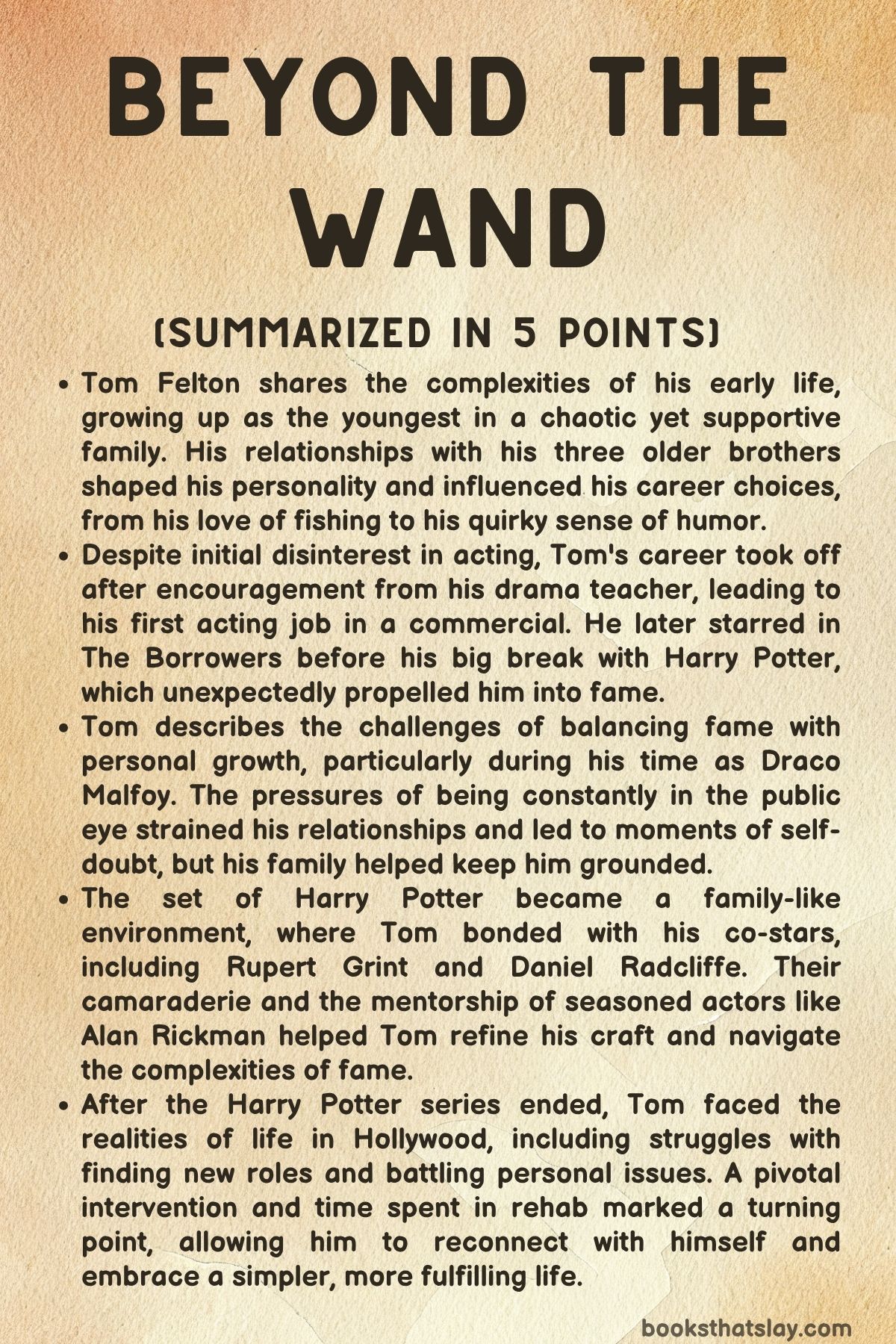
Tom Felton’s journey to becoming a household name began in his chaotic but supportive childhood. Raised as the youngest of four brothers, Felton was accustomed to playful teasing, but his family, especially his mother, always supported his ambitions.
He was introduced to the arts by his older brother, Jink, who had a profound impact on him. Fishing with his other brother, Chris, and enjoying his brother Ash’s quirky humor helped him develop close relationships, which remained a foundation of support throughout his life.
Felton wasn’t initially a standout actor, but his interests extended to music and drama, with a notable involvement in his church choir and a local drama club. His career took an unexpected turn when a teacher encouraged him to explore acting more seriously, and his mother took him to London to seek representation.
Felton landed his first acting job in a commercial for an insurance company, and soon after, he was cast as Peagreen in The Borrowers, which was his first significant acting role. It was here that he began learning the craft of acting.
As a child actor, balancing schoolwork and the demands of acting was challenging. Felton recalls an awkward and embarrassing moment in his teenage years when he was caught trying to shoplift a DVD.
This moment of shame taught him a valuable lesson about personal responsibility and the effects of fame. Throughout his career, his mother remained a constant source of support, helping him stay grounded despite the pressures of the public eye.
His father, though initially uncertain about his son’s acting career, eventually came to accept and support Tom’s choices.
The pivotal moment in Felton’s career came when he auditioned for the role of Draco Malfoy in Harry Potter and the Philosopher’s Stone. At first, he didn’t see himself as a good fit for the character, but after several auditions, he was cast as Draco, a decision that changed the course of his life.
Despite initial hesitation, Felton started to embrace the role, and with the guidance of the film’s crew and fellow actors, his portrayal of Draco Malfoy became iconic.
Felton’s experience on the Harry Potter set was transformative. He recalls the camaraderie shared with his fellow young actors, which helped him navigate the intense scrutiny of fame.
Despite Draco Malfoy’s antagonistic nature, Felton developed strong relationships with his co-stars, including Daniel Radcliffe (Harry Potter), Rupert Grint (Ron Weasley), and Emma Watson (Hermione Granger). Their interactions on and off set helped him cope with the challenges of fame, particularly as his character became widely disliked by fans.
He learned to appreciate the importance of his role in the lives of Harry Potter fans, especially children, while also acknowledging the difficulty of being constantly recognized as his character.
Felton’s relationship with his co-stars continued to grow over the course of the films. He recalls working closely with actors like Robbie Coltrane (Hagrid) and Matthew Lewis (Neville Longbottom), who provided support and light-heartedness on set.
He learned valuable lessons from these actors, particularly the professionalism of Alan Rickman, who played Severus Snape, and his generosity off-screen. Felton was deeply intimidated by Rickman’s intense presence but admired his work ethic and attention to detail.
Another key mentor was Jason Isaacs, who played Lucius Malfoy. Isaacs helped Felton develop his acting skills, especially in portraying a complex character like Draco.
Through his years on the Harry Potter set, Felton also grew as an individual. He developed a strong bond with his brothers, who kept him grounded despite his fame.
He shared moments of personal growth and understanding, especially when filming the later Harry Potter movies, where Draco Malfoy’s character was given more depth. The influence of adult actors, including Ralph Fiennes (Voldemort), helped Felton mature both as an actor and a person.
Despite the success and fame of Harry Potter, Felton faced challenges as the films came to a close. He recalls the emotional difficulty of finishing the final film, The Deathly Hallows.
The end of the series marked the end of an era for Felton, and he struggled with the idea of change and the loss of the familiar set and colleagues. While others were eager for the end of the filming process, Felton felt a profound sadness, especially at the thought of not seeing his colleagues daily.
After the conclusion of the Harry Potter films, Felton took on smaller roles, including a part in Rise of the Planet of the Apes. However, he struggled to replicate the success of Harry Potter in subsequent projects.
Despite the recognition he continued to receive for his portrayal of Draco Malfoy, Felton realized that fame was not as fulfilling as he had once thought. He longed for more authentic experiences and a simpler life.
His relationship with his girlfriend, Jade, played a key role in helping him rediscover his passion for acting, as she encouraged him to continue auditioning and eventually land a role in the series Labyrinth.
Felton’s personal life was marked by struggles with alcohol and substance use, which led to an intervention from his friends and family. Initially resistant to the idea, Felton eventually checked into a rehab facility, where he began to confront his issues.
His time in rehab and his interactions with kind strangers helped him grow, leading him to reevaluate his life. He eventually found peace in a simpler, more fulfilling existence, moving into a small apartment, adopting a dog, and finding joy in hobbies like fishing.
This journey of self-discovery was marked by pivotal moments of clarity, support from loved ones, and a deeper understanding of who he was beyond the fame and recognition.
Felton’s memoir offers readers a candid look at the life of a child star who grew up in the public eye. His reflections on his career, fame, and personal struggles provide valuable insights into the complexities of growing up in the entertainment industry and the importance of family, self-discovery, and staying grounded.
Key People
Tom Felton
Tom Felton, the author of Beyond the Wand, emerges as a deeply reflective and multifaceted individual throughout the memoir. Growing up in a supportive yet chaotic family, Tom is portrayed as someone who found both love and rivalry among his siblings.
The strong influence of his mother and the guidance from his brothers shaped his character, from developing a love for the arts with Jink to learning humor from Ash and fishing from Chris. Tom’s childhood, marked by a blend of humor, support, and occasional teasing, forms the foundation of his ability to navigate the highs and lows of fame.
As the youngest in the family, he initially faced playful teasing, but he never lacked the support that kept him grounded. His transition from a relatively unknown actor to Draco Malfoy was not something Tom sought, but he embraced it, with his portrayal of the character eventually becoming an iconic part of his career.
His personal growth is evident as he learns to balance the pressures of fame with a sense of humility, largely due to his family’s unwavering support. Throughout the memoir, Tom grapples with the challenges fame brings, especially the difficulties of growing up in the public eye.
He also reflects on how his relationships, particularly with his family, kept him grounded and human, despite the chaos of the Harry Potter franchise.
Tom’s Family
Tom’s family is a key influence in his life, offering him a solid foundation that helped him navigate his career. His parents, especially his mother, were constant supporters, encouraging his early forays into acting without pushing him too hard.
His brothers each played a distinct role in his life, from Jink’s introduction to the arts to Ash’s humor and Chris’s love of fishing. Their interactions, filled with playful teasing and deep support, created a healthy dynamic that allowed Tom to thrive.
Even when fame began to take its toll, his family’s ability to maintain normalcy helped him stay grounded. In particular, Tom credits his family with teaching him the importance of staying true to oneself, despite the pressures of fame and public scrutiny.
The love and humor they shared, despite their unconventional career, proved to be the anchor that kept him sane throughout his time in the limelight.
Chris Felton
Chris, Tom’s older brother, stands out as a figure of adventure and rebelliousness. Not the most professional in terms of career, Chris shared a love for cars and helped Tom develop a sense of independence and personal freedom.
Together, they bonded over trips, exploring their shared passions. One memorable moment that stands out is when Tom bought Chris a BMW, a gesture that marked a significant milestone in their relationship.
Though Chris may not have been the most conventional figure in Tom’s life, his influence in providing emotional support and pushing the boundaries of adventure had a lasting impact on Tom’s personal growth. Chris’s laid-back, adventurous approach to life stood in contrast to the more serious pressures of fame and acting, reminding Tom of the importance of living authentically.
Daniel Radcliffe
Despite playing bitter enemies on-screen, Tom’s relationship with Daniel Radcliffe, who portrayed Harry Potter, was one of mutual respect and camaraderie. As Tom reflects on their shared experiences on set, he acknowledges Daniel’s professionalism and his growing acting skills, which provided a model for Tom to follow.
Daniel’s approach to fame, which seemed unaffected and grounded, served as a source of inspiration for Tom, especially as Daniel navigated the pressures of being thrust into international stardom. Their relationship, both on and off-screen, was built on mutual admiration, and Tom was able to learn much from Daniel, particularly in how to handle the complexities of being part of such an iconic franchise.
Rupert Grint
Rupert Grint, who portrayed Ron Weasley, is another key figure in Tom’s life during the Harry Potter films. Known for his humor and kindness, Rupert brought a sense of lightness to the set that helped balance the intense atmosphere of working on such a massive production.
Tom admired Rupert’s grounded nature, particularly how he remained unaffected by fame, even using his earnings to purchase an ice cream van, which he would drive to work, delighting kids on set. Rupert’s kindness also extended to charity work, demonstrating a genuine concern for others.
As a friend, Rupert offered moments of levity and camaraderie, making him a beloved and respected figure in Tom’s life. Their shared humor and mutual respect allowed Tom to appreciate the value of staying true to oneself in the face of overwhelming fame.
Emma Watson
Emma Watson, who portrayed Hermione Granger, was a significant figure on set, particularly during the filming of Harry Potter and the Chamber of Secrets, where the iconic scene of Hermione slapping Draco took place. Tom reflects on a humorous moment where he and Emma practiced the slap, though it turned into an accidental real slap.
This incident illustrates Emma’s dedication to her craft, as well as her on-set professionalism. Beyond this moment, Tom describes Emma as someone who helped create a fun and supportive atmosphere, despite the challenges of filming.
Emma’s maturity and poise, even at a young age, made her a standout performer, and Tom came to admire her both as an actress and as a person.
Alan Rickman
Alan Rickman, the legendary actor who portrayed Severus Snape, is one of the most influential figures in Tom’s life as an actor. Tom describes Rickman as both intimidating and deeply kind, a contrast that Tom found fascinating.
Rickman’s perfectionism, particularly in his costume and acting, served as a lesson for Tom, showing him the importance of attention to detail and dedication to the craft. However, it was Rickman’s generosity off-screen that had the most lasting impact.
Despite his serious demeanor on set, Rickman was supportive of Tom’s development as an actor, offering him valuable advice and moments of humor. Tom’s admiration for Rickman grew not only for his acting skills but also for his ability to balance professionalism with kindness.
Jason Isaacs
Jason Isaacs, who portrayed Lucius Malfoy, became a mentor figure to Tom during the filming of the later Harry Potter movies. Tom admired Jason’s ability to seamlessly switch between his menacing on-screen persona and his warm, personable self off-screen.
This contrast between the two sides of Jason’s character helped Tom understand the complexities of acting and how to navigate different aspects of a character. Jason’s guidance, both on and off the set, proved to be instrumental in Tom’s development as an actor, and their shared moments of camaraderie during filming were some of the most valuable experiences Tom had while playing Draco Malfoy.
Matthew Lewis
Matthew Lewis, who portrayed Neville Longbottom, was another actor who became close to Tom during the Harry Potter films. Known for his kindness and grounded nature, Matthew played a key role in helping Tom navigate the pressures of being part of such a massive franchise.
His ability to maintain a sense of humor and lightness, even in the most demanding scenes, was something that Tom admired. Like many of his fellow castmates, Matthew’s professionalism and support played a crucial role in Tom’s growth, both as an actor and as an individual.
Richard Harris
Richard Harris, who portrayed Dumbledore in the first two Harry Potter films, left a lasting impression on Tom. Harris’s gravitas, combined with his kindness and humility, helped guide the younger cast members, including Tom.
Tom reflects fondly on Harris’s ability to balance his legendary acting talent with a down-to-earth attitude, which helped him feel comfortable and supported on set. Harris’s influence, though brief due to his passing, played a pivotal role in shaping Tom’s perspective on acting and life in the public eye.
Michael Gambon
Michael Gambon, who took over the role of Dumbledore after Richard Harris’s passing, also served as a source of support and guidance for Tom and the other young actors. Tom recalls Gambon’s professionalism and generosity, which helped the younger cast members feel comfortable and supported, even as they faced the challenges of growing up in the public eye.
Gambon’s influence on set was significant, as he provided not only guidance for the actors but also a model of humility and professionalism, reinforcing the values that Tom continues to carry with him throughout his career.
Themes
Family and Support Systems
Tom Felton’s memoir, Beyond the Wand, vividly emphasizes the importance of family and personal relationships in shaping his life and career. Growing up in a chaotic, close-knit family with three older brothers, Tom was never short of support, guidance, and love.
His brothers each contributed to his development in different ways, offering him diverse perspectives and enriching his life with their individual traits and interests. Whether it was his brother Jink, who introduced him to the world of the arts, or Ash, who shared his quirky sense of humor, Tom’s brothers formed a significant part of his emotional and mental stability throughout his childhood and teenage years.
His mother’s unwavering support provided the backbone he needed, especially when the pressure of fame started to mount. Through her encouragement, Tom was able to stay grounded and focused on his passions, without losing touch with the everyday world outside of Hollywood’s glare.
This nurturing environment not only made his early acting experiences manageable but also helped him navigate the struggles that came with growing fame, all while maintaining a sense of family unity. This theme of familial support is interwoven with Tom’s experiences of fame, showing that despite the allure and distractions of the entertainment industry, it is the solid foundation of family that often acts as the most reliable anchor in moments of uncertainty and self-doubt.
Fame and Its Complexities
Fame is another central theme, and Tom Felton provides an insightful, candid look at how fame affected his personal life, self-identity, and relationships. From the moment he was cast as Draco Malfoy in the Harry Potter series, Tom’s life was forever changed.
While his early experiences on set were marked by excitement and the thrill of being part of such a massive global phenomenon, the reality of being constantly in the public eye soon became overwhelming. He describes moments of discomfort with fame, especially as he was often confused with his on-screen persona, Draco Malfoy.
The challenges of maintaining personal relationships while dealing with public expectations and scrutiny are highlighted throughout his memoir. As he grew older, Tom became more aware of the pressures fame placed on him, particularly when it came to balancing personal privacy with the public’s insatiable curiosity.
He struggled to find a sense of identity beyond his character and often felt trapped by the public’s perception of him. However, through the support of his family and his own moments of introspection, Tom learned to come to terms with fame, understanding both its perks and its inherent challenges.
Ultimately, his reflections on fame offer a nuanced perspective on its complexities, illustrating how it can be both an exhilarating and isolating experience.
Personal Growth and Self-Discovery
Throughout his memoir, Tom reflects on his personal journey of growth and self-discovery, particularly after the conclusion of the Harry Potter films. Following the end of the franchise, Tom faced significant challenges in finding his place in a world that no longer revolved around the magical world of Hogwarts.
He struggled with his career, often finding it difficult to replicate the success of his Draco Malfoy role in other projects. However, the period after the Harry Potter films allowed Tom to explore new avenues in both his professional and personal life.
He took on smaller, more intimate projects, such as The Disappeared, where he found a deeper, more immersive form of acting. These experiences helped him develop new skills and broaden his understanding of his craft.
On a personal level, Tom also went through profound changes, particularly as he confronted his own struggles with substance abuse. The memoir chronicles his journey to rehab, where he faced difficult truths about himself and his life.
The support from friends, family, and even strangers helped him through this period of transformation, allowing him to reconnect with his true self and rediscover what truly mattered to him. Tom’s exploration of personal growth reveals the complex process of evolving, both as an individual and as a professional, and how the journey of self-discovery can be marked by both setbacks and moments of clarity.
Mentorship and Professional Development
Tom Felton emphasizes the significance of mentorship and the relationships he formed with more experienced actors throughout his career. On the set of the Harry Potter films, Tom had the opportunity to learn from some of the most talented and respected actors in the industry.
Actors like Alan Rickman, Richard Harris, and Michael Gambon became not only colleagues but also mentors who provided Tom with invaluable lessons in acting and professionalism. Tom speaks fondly of Rickman’s generosity and perfectionism, noting how Rickman’s ability to balance his serious on-screen persona with a warm, approachable off-screen demeanor was something he admired and learned from.
Similarly, Michael Gambon’s calm, guiding presence helped the young actors feel supported as they navigated the complexities of fame and acting. The camaraderie and wisdom of these seasoned professionals gave Tom a framework to approach his craft, which extended beyond the technical aspects of acting.
These mentoring relationships were crucial in shaping Tom’s understanding of what it means to be a true professional, and they allowed him to maintain his humility despite his fame. The importance of mentorship is not only evident on set but also in Tom’s life beyond Hollywood.
His relationships with people like Jason Isaacs and his brother Chris were instrumental in shaping his personal development, showing that mentorship can come from unexpected places and that it’s a vital part of both professional and personal growth.
The Impact of Childhood on Adulthood
Tom Felton’s reflections on his childhood and the way it shaped his adulthood are central to understanding his journey. The book highlights the profound influence his early experiences had on his character and his approach to both life and work.
Growing up in a lively, chaotic household with three older brothers allowed Tom to develop a strong sense of independence while also learning the value of family bonds. His childhood was a mix of lighthearted teasing and deep support, a combination that prepared him for the pressures of fame.
The skills and interests he acquired early on, from his love for fishing to his appreciation for music and the arts, remained integral to his identity throughout his life. His relationship with his family, particularly his mother, also provided a sense of stability that would continue to serve him during the tumultuous years of his acting career.
As Tom transitioned into adulthood, the challenges of fame, self-doubt, and finding his true identity often stemmed from the early experiences he had as a child. His journey of self-discovery, though marked by ups and downs, can be traced back to the values and lessons instilled in him during his formative years.
Ultimately, Tom’s memoir illustrates how the foundations laid in childhood, from family interactions to personal experiences, play a crucial role in shaping an individual’s future.