Black Ties and White Lies Summary, Characters and Themes
Black Ties and White Lies by Kat Singleton is a contemporary romance that blends passion, ambition, and deception into a tale of love found under the most unlikely circumstances. At its heart is Margo, an aspiring artist whose life takes an unexpected turn when Beck Sinclair—her ex-boyfriend’s older brother and a notorious billionaire playboy—suddenly becomes her boss.
What begins as a scheme to restore Beck’s public image evolves into a story about trust, ambition, and vulnerability. With themes of second chances, unspoken desire, and blurred boundaries between truth and pretense, Singleton’s novel explores how love can grow in the midst of manipulation and high stakes.
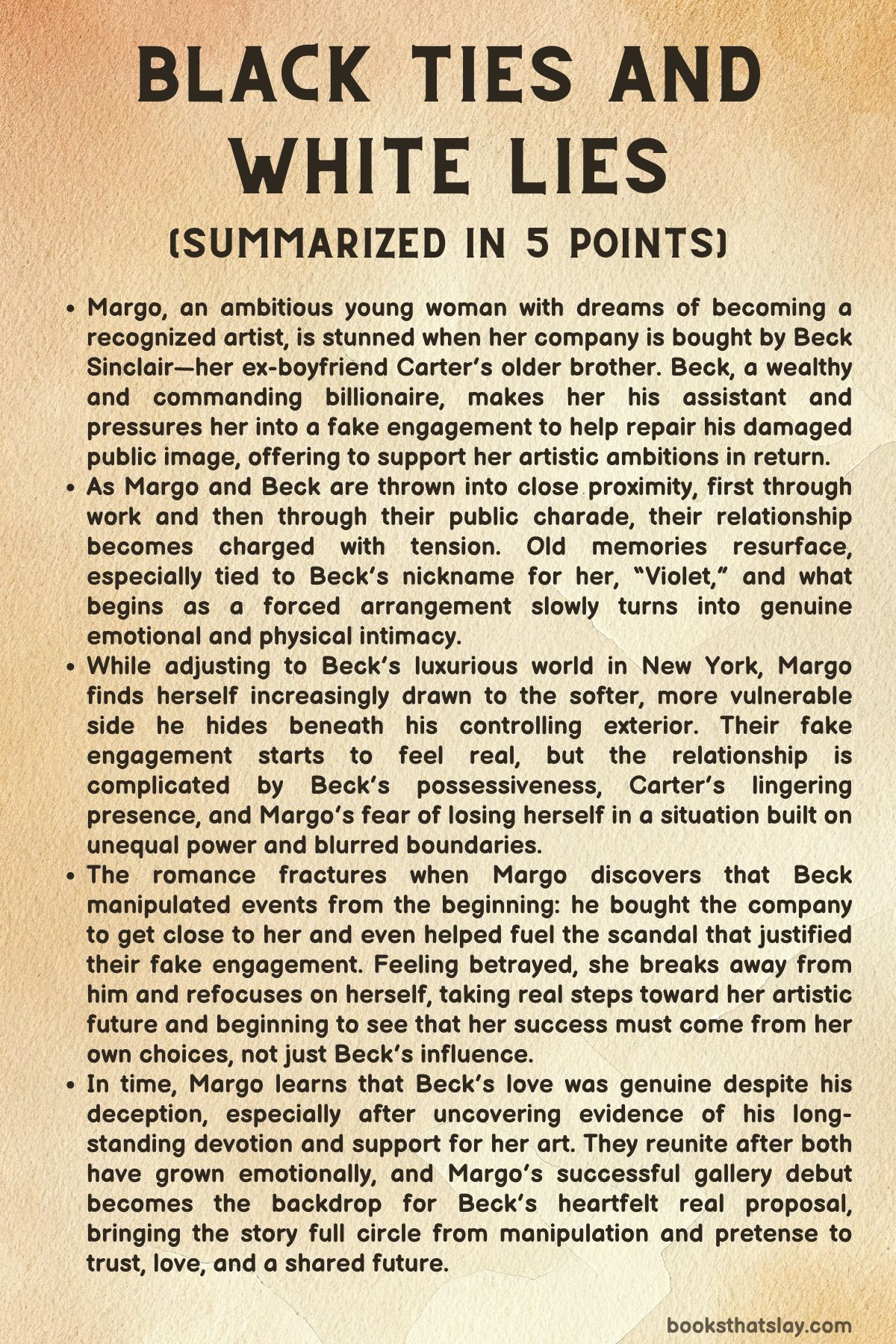
Summary
Margo’s life shifts dramatically the day she is called into a meeting with her company’s new owner. To her shock, the man waiting for her is Beck Sinclair, the older brother of her ex-boyfriend, Carter.
Years ago, Beck had been distant and disapproving, but now he has returned in full force—commanding, wealthy, and intent on forcing Margo into his world. He admits to buying the company partly to secure her attention, and without much warning, he announces her new role: his assistant.
Even more surprising, he insists she must pose as his fiancée to repair his reputation with the company’s board. Margo initially resists, but Beck tempts her with promises of helping her pursue her dream of becoming a recognized artist.
Despite her misgivings, she agrees under strict conditions—no public humiliation, exclusivity, and boundaries she hopes they can maintain.
From the start, their relationship brims with tension. Beck is controlling and relentless, while Margo pushes back with wit and determination.
He whisks her away from her job, takes her to New York, and begins shaping her new life as both his assistant and his supposed partner. Their arrangement leads to constant clashes, with Beck’s possessive nature clashing against Margo’s independent spirit.
Yet beneath the arguments, attraction simmers. When Beck calls her “Violet,” a nickname tied to a shared summer night from their past, their buried history rises to the surface.
Slowly, the charade begins to blur with reality.
In New York, Beck introduces Margo to his penthouse, his offices, and his opulent lifestyle. Their banter often drifts into charged moments—near kisses in the kitchen, lingering stares, and a growing awareness of how deeply connected they already are.
Shopping trips and work obligations only bring them closer, and despite Margo’s insistence on boundaries, they finally give in to their passion. Their first night together breaks the rules of their arrangement, with Beck taking control and Margo surrendering to emotions she cannot deny.
Their intimacy reveals not only raw desire but also a tenderness Beck rarely shows anyone. For the first time, Margo sees past his reputation to the man who has secretly loved her for years.
As their engagement plays out in public, personal complications intrude. At their engagement party, a confrontation with Carter unsettles Margo.
Later, she discovers that Beck orchestrated the very scandal he had used as an excuse to bind her to him. His confession—that he leaked the article and even bought the company to keep her close—shatters her trust.
Hurt and furious, Margo accuses him of manipulation. Though Beck insists his love is genuine, she removes her ring and demands space.
Their arrangement collapses under the weight of his lies.
While Beck gives her time, Margo focuses on her own dreams. She takes the bold step of approaching Camden Hunter, a respected gallery owner, and finally earns the chance to showcase her art.
In Beck’s absence, she discovers his hidden studio filled with art supplies and even a sketch of herself that she once drew, proving his affection has been real all along. This discovery begins to soften her anger, making her reconsider whether his manipulations were driven by malice or desperation for her love.
Meanwhile, Beck confronts Carter, ensuring he will no longer interfere in Margo’s life. When Beck returns to New York, he finds Margo painting a large canvas depicting both the moment they first met and a vision of their wedding day.
She admits she created it for him and confesses her love, finally embracing the truth that she wants him despite his flaws. Beck is deeply moved, and their reunion rekindles both their passion and their commitment to one another.
In the months that follow, Margo prepares for her first gallery exhibition. Beck, always protective, ensures her reputation remains untarnished by arranging positive press coverage.
On the night of the show, her work is a resounding success, with every piece sold. The centerpiece painting—the imagined wedding of her and Beck—is bought by none other than Beck himself, a gesture that proves his devotion.
Afterward, he surprises her with a proper proposal in Central Park, offering his grandmother’s ring and a promise of a real future together. Margo accepts, finally certain that their relationship is no longer built on pretense but on love, trust, and the dreams they share.
By the end, Black Ties and White Lies comes full circle: what began as a forced arrangement evolves into a romance that thrives on honesty, passion, and the willingness to risk everything for love. Beck and Margo step into their future not as a façade for the world, but as partners ready to build a life on their own terms.
Characters
Margo
Margo is the central figure of Black Ties and White Lies, a woman caught between ambition, love, and vulnerability. At the start, she is a dedicated professional with a hidden artistic passion, yearning for recognition in the art world.
Her independence and wit shape her character, making her both skeptical and resilient in the face of Beck’s outrageous proposal. However, beneath her sarcasm and defiance lies an unfulfilled desire for stability, passion, and validation.
Her journey with Beck forces her to confront her deepest fears—of betrayal, manipulation, and lost identity—while also awakening a stronger, more assertive self. Margo transitions from being controlled by circumstances to taking charge of her dreams, proving her strength by securing her own art exhibition without relying entirely on Beck.
Her character embodies the tension between self-preservation and surrender to love, ultimately finding empowerment in embracing both her career and her relationship on her own terms.
Beck Sinclair
Beck Sinclair is a complex blend of dominance, vulnerability, and unwavering desire. Introduced as a ruthless businessman and notorious playboy, his initial actions—buying the company to get close to Margo and forcing her into a fake engagement—paint him as manipulative and controlling.
Yet, beneath this power-driven exterior lies a man deeply wounded by his past and obsessed with Margo long before their arrangement began. Beck’s intensity manifests in both possessive jealousy and tender devotion, making him unpredictable but magnetic.
He struggles with the blurred line between his manipulations and genuine love, constantly battling the fear that his controlling nature might destroy what he wants most. As the story progresses, Beck reveals layers of loyalty, vulnerability, and care, such as cherishing Margo’s old sketches and creating a private art studio for her.
His arc evolves from a man who controls to a man who learns to cherish, marking him as one of the most multi-dimensional figures in the book.
Emma
Emma, Margo’s best friend, provides both levity and grounding in the novel. Her teasing remarks and playful observations highlight the chemistry between Margo and Beck, while her presence ensures that Margo never loses sight of her own worth.
Emma represents loyalty and sisterhood, reminding Margo of her identity beyond her entanglement with Beck. While her role may seem secondary, she anchors Margo emotionally, offering a voice of reason when the intensity of the romance threatens to overwhelm her.
Ezra
Ezra, Beck’s driver and confidant, is a quiet but pivotal presence. His subtle humor, such as laughing at Margo’s NDA joke, shows a softer side to the otherwise intimidating world Beck inhabits.
Ezra’s steady presence offers Margo a form of reassurance, grounding her in moments when Beck’s overwhelming personality becomes too much. He reflects the loyalty Beck inspires in those closest to him, showing that beneath his ruthless exterior, Beck surrounds himself with people he trusts deeply.
Ezra also humanizes Beck, offering readers glimpses of the man beyond the billionaire image.
Carter Sinclair
Carter, Beck’s younger brother and Margo’s ex-boyfriend, embodies betrayal, weakness, and the shadow of unresolved past wounds. His destructive behavior, including gambling debts and his treatment of Margo, contrasts sharply with Beck’s intensity.
Carter serves as both a foil to Beck and a lingering source of pain for Margo, embodying the toxic remnants of her past. While Carter attempts to manipulate her perception of Beck by sowing doubts about his motives, his own flaws—recklessness, irresponsibility, and moral weakness—reveal him as unworthy of her.
Ultimately, Carter represents the obstacle both Margo and Beck must overcome to truly commit to one another, symbolizing the lies and doubts that haunt their relationship.
Camden Hunter
Camden Hunter, the art gallery owner, represents Margo’s dream and independence. Unlike Beck, Camden’s interest in Margo is purely professional, rooted in her talent and potential as an artist.
His validation of her work signifies her breakthrough moment, proving that her ambitions are not dependent on her romantic entanglement. Camden plays the role of the enabler of her dreams, affirming her identity as more than Beck’s fiancée.
His presence underlines one of the novel’s central themes: that love and career can coexist when both partners support each other’s ambitions.
Ruby
Ruby, the reporter, symbolizes the consequences of lies, manipulation, and media scrutiny in Beck’s world. Initially, she is tied to Beck’s scheme, unwittingly fueling the drama between him and Margo by publishing the article that forces their fake engagement.
However, her later role in redirecting the narrative to celebrate Margo’s art demonstrates redemption and the possibility of rewriting damaging stories. Ruby’s arc underscores the novel’s broader theme that truth, once revealed, can heal rather than harm when framed honestly.
Themes
Power and Control
Throughout Black Ties and White Lies, the dynamics of power and control shape nearly every interaction between Beck and Margo. From the moment Beck purchases the company and positions himself as Margo’s boss, the relationship is established under an imbalance of authority.
His decision to make her his assistant and his insistence that she pose as his fiancée are not requests but commands, demonstrating his need to orchestrate outcomes to his advantage. This control extends into personal spaces as well—knowing her address without her telling him, dictating how she should travel, and even criticizing her wardrobe.
Beck’s dominance is not merely professional but deeply personal, as he continuously asserts himself over her choices and her sense of independence. Yet, the novel does not depict this control as one-dimensional.
There are moments where Beck’s dominance transforms into a kind of protective possession, framed by his belief that he knows what is best for Margo, even when she resists. The tension between Margo’s desire for autonomy and Beck’s relentless grip over circumstances becomes a recurring conflict, reflecting broader questions about love, agency, and the ethics of control in relationships.
Over time, this theme evolves as Margo pushes back, negotiating boundaries and asserting her voice, showing that even within an unequal power structure, resistance and self-assertion are possible. Their eventual reconciliation hinges on Beck relinquishing some of this control and Margo choosing, on her own terms, to embrace a future with him.
Love, Desire, and Obsession
The relationship between Beck and Margo is saturated with passion, but it also blurs the line between genuine love and obsessive desire. Beck’s pursuit of Margo is rooted not only in affection but in a long-standing fixation that began when she was with his brother, Carter.
His decision to manipulate circumstances—buying her company, forcing her into proximity, and fabricating the engagement—reveals the depth of his obsession. At the same time, their physical encounters are charged with intensity, oscillating between tenderness and raw hunger, demonstrating that their bond is not casual attraction but something that consumes them both.
Margo herself is torn between resisting Beck’s overwhelming presence and succumbing to the pull she has always felt toward him. The constant repetition of his pet name for her, “Violet,” underscores his inability to separate the present from the memory of when his desire first took root.
As the story unfolds, what begins as a power-driven, almost manipulative passion shifts into a more balanced recognition of love, marked by Beck’s vulnerability in confessing his feelings and Margo’s acceptance of them. The theme ultimately raises questions about whether love born out of obsession can mature into something lasting and whether passion that begins with possession can transform into partnership.
Deception and Truth
At its core, the novel is structured around lies—both the deliberate fabrications of the engagement and the deeper personal deceptions Beck weaves to secure Margo’s presence in his life. The arrangement is based on a façade for the public, but the dishonesty extends far beyond appearances.
Beck hides his manipulations, including leaking an article to the press, and justifies them as necessary acts of love. For Margo, these revelations strike at the heart of her trust, making her question whether her role in his life is authentic or simply the product of schemes.
Yet deception also works as a protective mechanism for both characters. Margo deceives herself by insisting she can maintain boundaries with Beck, denying the strength of her feelings until she is forced to confront them.
Similarly, Beck masks his vulnerabilities behind his carefully controlled lies, afraid that honesty will strip him of the power he has built. The eventual unraveling of these lies becomes a critical turning point.
It is only when the truth is exposed—about Beck’s motives, his long-standing love for Margo, and her own suppressed desires—that their relationship gains genuine footing. The theme emphasizes that while lies may create proximity, only truth can sustain intimacy and build trust.
Ambition and Self-Discovery
Margo’s personal ambition and her journey of self-discovery form a vital counterpoint to the romance. She begins the story as someone struggling for recognition in the art world, caught between her job and her creative aspirations.
Beck leverages this vulnerability by offering her access to Camden Hunter, effectively turning her dream into a bargaining chip. Yet what begins as dependence gradually transforms into agency.
Margo does not merely wait for opportunities provided by Beck; she actively disguises herself and approaches Camden on her own, proving her determination to succeed on her own merit. Her discovery of Beck’s hidden art studio, where he preserved her sketch and provided her with tools, reflects the duality of her journey—while Beck supports her art, the recognition she craves ultimately comes from her own boldness.
By the time her gallery showcase arrives, Margo has claimed her place as an artist, showing that her self-worth cannot solely be defined by her relationship. This theme highlights how ambition and love can coexist but must remain distinct.
Margo’s fulfillment lies not only in Beck’s affection but in her ability to stand on her own as an artist, suggesting that personal identity cannot be sacrificed even in the face of overwhelming romance.
Redemption and Forgiveness
The story repeatedly confronts betrayal and the question of whether redemption is possible after manipulation and lies. Beck’s actions—buying the company, orchestrating the engagement, leaking the article, and threatening Carter—paint him as a man who bends morality for personal gain.
For Margo, his betrayal is profound because it undermines the foundation of their connection. Yet the narrative positions his redemption not through grand gestures of control but through honesty, vulnerability, and genuine support for her dreams.
His willingness to confront Carter, not for revenge but to protect her, marks a shift in his character from obsession to devotion. Margo’s forgiveness is not immediate; it comes through her own process of discovery, realizing that despite his methods, Beck’s love was always rooted in something deeper than manipulation.
Their reconciliation is therefore framed not as a dismissal of past wrongs but as an acknowledgment of growth, where both must face their flaws and choose to move forward together. The theme underscores the complexity of forgiveness—not as erasure of harm but as a conscious decision to believe in the possibility of change and to build a future that is no longer bound by lies.