Blood and Steel Summary, Characters and Themes
Blood and Steel by Helen Scheuerer is a fast-paced epic fantasy that introduces readers to a dark, dangerous world where fate, prophecy, and forbidden power shape every choice. At its heart is Althea Zoltaire, a young woman bound by a fate stone that predicts her death at twenty-seven.
In a realm where women are forbidden from wielding steel, Thea dares to defy tradition, pursuing her dream of becoming a warrior despite the risks. With the Veil weakening and monsters breaching into their lands, her rebellion pushes her into the politics, battles, and secrets of Thezmarr, where love and loyalty are as perilous as steel. It’s the first book in the Legends of Thezmarr series.
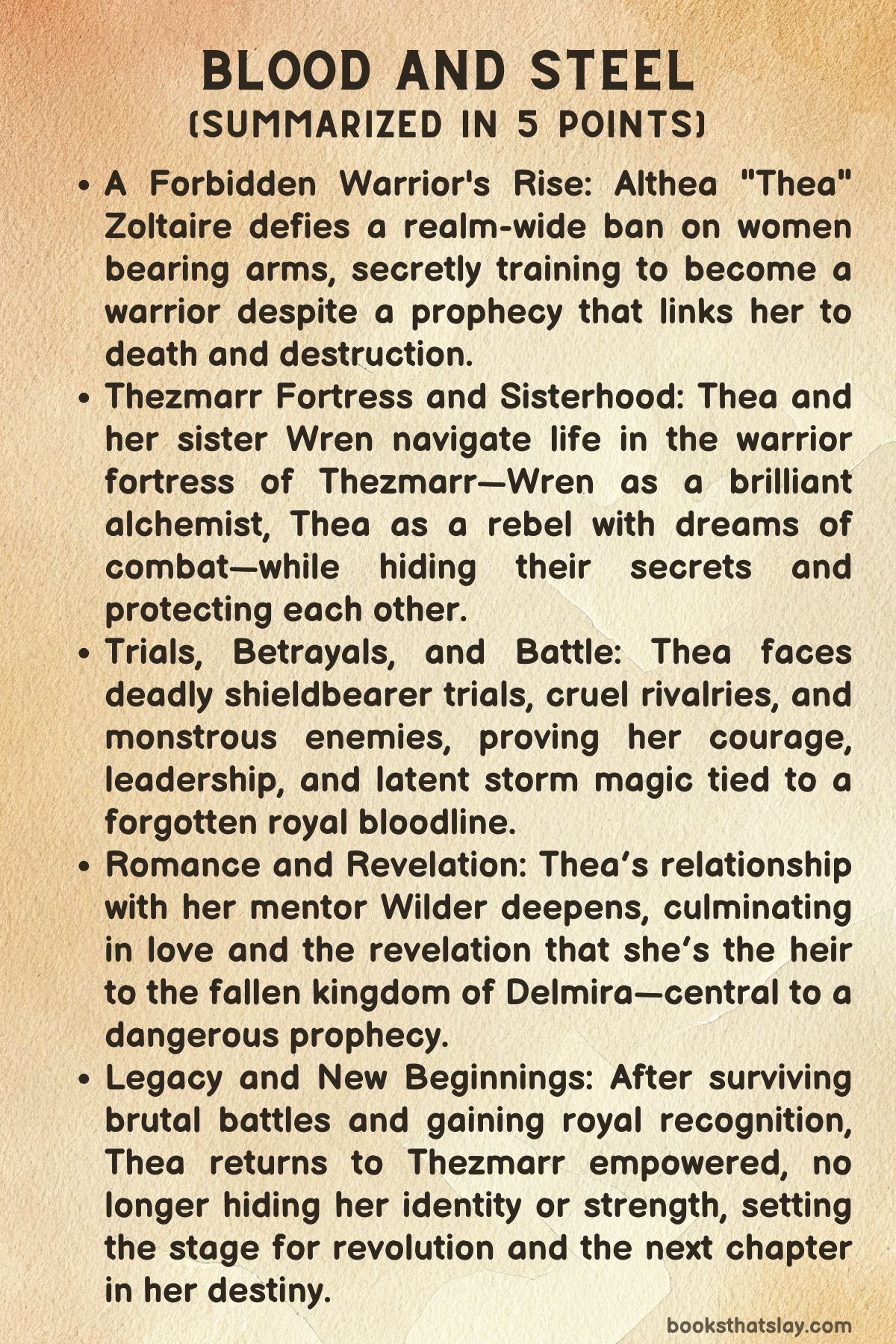
Summary
Althea Zoltaire has always lived under the shadow of her fate stone, which foretells her death at twenty-seven. Restless and unwilling to spend her short life hidden away, she watches the Warswords, Thezmarr’s elite fighters, from the cliffs.
Among them is Wilder Hawthorne, the infamous “Hand of Death,” who returns victorious from battle against shadow wraiths, hinting at the Veil’s growing weakness. A brief, intense exchange of glances with Wilder leaves Thea shaken but intrigued.
Back at the fortress, her sister Wren warns her against reckless behavior. The two share a close yet strained bond: Wren has embraced her role as an alchemist, while Thea secretly trains with a forbidden steel dagger, yearning to prove herself despite laws barring women from weapons.
This dagger was entrusted to her by Malik, a retired Warsword. When she loses the weapon in the Bloodwoods, Wilder discovers it and confronts her.
Brought before the council, Thea narrowly escapes banishment when Audra, the fortress librarian, argues for her right to train, invoking ancient laws that allow any capable soul to bear arms in desperate times. Thea is ordered to petition the rulers of the midrealms at Harenth.
Escorted reluctantly by Wilder, who opposes her cause, Thea embarks on a dangerous journey. Their relationship is fraught with tension, but their travels reveal glimpses of mutual respect and unspoken attraction.
In Harenth, Thea’s plea to train is initially rejected. However, when she thwarts an assassination attempt on King Artos by exposing poisoned wine, her bravery sways the rulers to grant her the right to become a shieldbearer.
Returning to Thezmarr, Thea begins rigorous training under the Warswords. The drills are brutal, pushing her body and spirit to their limits.
Despite her determination, she struggles to match seasoned fighters like Sebastos Barlowe, who mocks and bullies her. Her resolve hardens after she endures a vicious assault during training, only surviving thanks to her resilience and the quiet care of Wilder, whose concern for her grows despite his attempts to distance himself.
Their attraction intensifies, culminating in a passionate kiss that leaves both conflicted.
As weeks pass, Thea builds bonds with fellow recruits like Cal and Kipp, finding companionship and loyalty in their shared struggles. Meanwhile, her relationship with Wren falters as her sister accuses her of being consumed by her ambitions.
Their fractured bond weighs heavily on Thea, even as her skills sharpen.
The ultimate test comes in the initiation trial at the Chained Islands, where candidates must secure Guardian totems or be dismissed. The trial proves deadly, with many recruits falling during a perilous cliff jump and others turning on each other in the chaos.
Thea, Cal, and Kipp fight together, overcoming traps, venomous vipers, and rival shieldbearers. Each secures a totem, and though they clash with Seb, Thea insists on sparing his life, proving her strength is not in cruelty but in control.
Her triumph is short-lived. In the Bloodwoods, she is ambushed by a monstrous rheguld reaper.
Fighting desperately, Thea unleashes a hidden lightning power, destroying the creature with Wilder’s aid. This terrifying new ability shocks her as much as those around her.
When she presents the reaper’s heart before the council, she is acknowledged as a Guardian. But Osiris, the Guild Master, seizes the moment to bind her fate to Wilder, naming her his apprentice.
Though Wilder suggests rejecting the appointment so they can remain together, Thea refuses—becoming his apprentice is her only path to achieving her dream. She finally confesses her looming fate of death at twenty-seven, leaving Wilder devastated.
Determined to prepare her for survival, he resolves to sever their romance and harden himself into her mentor.
Thea’s world unravels further when she learns that Wren has been suppressing her magic with alchemy for years, fearful of the prophecy that foretold doom from a daughter of darkness. Betrayed, Thea rips off her fate stone and unleashes her lightning in a storm of fury.
On the cliffs, Wilder finds her and assures her that she is not alone. He names her a storm wielder, heir to Delmira, and his apprentice.
Though her path is perilous and her future uncertain, Thea has stepped fully into her power, with Wilder bound to her as both mentor and reluctant protector.
Blood and Steel: The Legends of Thezmarr Book 1 closes with Thea standing at the threshold of transformation—from a girl bound by fate to a warrior whose storm-born powers may change the destiny of Thezmarr forever.
Characters
Althea Zoltaire
Althea is the heart of Blood and Steel: The Legends of Thezmarr. She is introduced as a restless young woman fated to die at twenty-seven, which gives her character both urgency and defiance.
Though the fortress realm’s laws forbid women from bearing arms due to an ancient prophecy, Althea refuses to be confined by her gender or her fate. She harbors dreams of becoming a shieldbearer, secretly training with a dagger gifted to her by Malik.
Her recklessness and fierce ambition often put her in conflict with authority, yet these same qualities reveal her courage and unwillingness to accept powerlessness. Althea’s bond with her sister Wren is tender but fraught—Wren represents duty, intellect, and safety, while Althea embodies rebellion and danger.
As the story unfolds, she grows from a dreamer to a fighter, enduring brutal trials, betrayal, and bloodshed. The discovery of her storm-wielding powers complicates her identity, forcing her to question whether she is destined for greatness or doom.
Despite everything, Althea stands as a character of resilience—flawed, vulnerable, but deeply determined to carve out her legend.
Wilder Hawthorne
Wilder, feared as the “Hand of Death,” is a Warsword whose reputation precedes him. Ruthless and uncompromising, he is a man molded by the violence and duty of his order.
His return to Thezmarr with the hearts of slain wraiths immediately marks him as a figure of dread and admiration. Yet beneath his cold exterior lies conflict.
Wilder is drawn to Althea, though he resists her at every turn, believing her to be reckless and a danger to herself. His mentorship of her is reluctant, his harshness a mask for the fear of losing her in a world where death is nearly certain.
His scarred body and haunted demeanor hint at a past filled with loss, while his brief acts of kindness—a cloak lent, a wound tended—betray the depth of his feelings. Wilder’s struggle is one of control: torn between desire and duty, he tries to remain her protector by becoming her strictest judge.
In truth, his character is a mirror to Thea’s—both are defined by defiance, isolation, and a longing for connection amid brutality.
Elwren (Wren) Zoltaire
Wren, Althea’s sister, serves as both her grounding force and a source of conflict. An alchemist of talent and ambition, she thrives in a role that is both respected and dangerous.
Unlike Thea, Wren chooses safety and intellect over combat, though her inventiveness often borders on the lethal, as shown in her creation of weapons disguised as everyday objects. Her protective nature toward Thea stems from deep love but also fear—fear of the prophecy, of losing her sister, and of the chaos Thea invites into their lives.
Wren’s eventual revelation that she suppressed Thea’s magic creates a painful rupture between them, showcasing her flaw: her tendency to control under the guise of care. Still, she is not villainous; her actions are borne from love twisted by desperation.
Wren’s complexity lies in her duality—nurturer and betrayer, sister and guardian, the one who both empowers and restrains Althea.
Audra
Audra, the stern librarian and Thea’s unexpected champion, embodies wisdom, pragmatism, and courage. At first, she seems a rigid authority figure, but she quickly reveals herself to be the story’s voice of reason and justice.
Unlike others in power, Audra sees potential where others see only danger. She believes in knowledge as a weapon as powerful as steel, and her decision to advocate for Thea alters the course of the girl’s destiny.
Audra’s mentorship is subtle yet firm—she pushes Thea toward self-discovery and survival while preparing her for the burdens of leadership. Her defense of Thea before the council, as well as her guiding hand on the road, mark her as one of the few adults who place hope in the younger generation.
She is a reminder that strength is not always found in the blade but also in the clarity of vision and the courage to defy fear-driven tradition.
Malik
Malik, the retired Warsword, is one of the gentlest figures in Althea’s life. Scarred and aged by war, he carries the weight of survival, having endured wounds that should have killed him.
His gift of the Naarvian steel dagger to Thea is not merely an act of generosity but a symbolic passing of the torch. Though mocked and bullied by younger warriors like Sebastos, Malik’s quiet dignity and compassion reveal another side of warriorhood—one of endurance, humility, and wisdom.
To Thea, he is both mentor and father figure, offering her the recognition that others deny her. Malik’s presence underscores the contrast between cruelty and compassion within Thezmarr’s warrior culture.
Sebastos Barlowe
Sebastos, often referred to as Seb, is a foil to Althea’s growth. Arrogant, cruel, and favored by certain Warswords, he thrives on belittling others, particularly women and weaker recruits.
His bullying of Malik and his brutal assault on Thea during training mark him as a figure of unchecked privilege and sadism. Yet his importance lies not just in his antagonism but in how Thea chooses to confront him.
She refuses to be broken by his violence, finding strength in endurance rather than vengeance. Seb embodies the corruption of Thezmarr’s traditions—favoritism, cruelty, and toxic masculinity unchecked by justice.
His character is essential for sharpening Thea’s defiance and her understanding that true strength lies not in cruelty but in resilience and mercy.
Cal and Kipp
Cal and Kipp represent camaraderie and loyalty within the shieldbearer ranks. Unlike Seb, they treat Thea with respect, gradually growing from skeptics to allies.
Kipp’s ingenuity and humor provide levity amid the darkness of training and trials, while Cal’s protective instincts and courage help sustain their fragile fellowship. Their friendship with Thea becomes a lifeline, proving that kinship forged in hardship can be as strong as blood ties.
They remind Thea—and the reader—that her struggle is not endured alone. Together, they show how bonds of trust can help individuals endure even the most harrowing ordeals.
Osiris
Osiris, the Guild Master, stands as the voice of tradition, law, and prophecy. He is rigid, cautious, and often antagonistic toward Thea’s ambitions, seeing in her only the potential for doom.
His authority is absolute within Thezmarr, yet his reliance on prophecy and fear blinds him to the realities of the weakening Veil and the need for adaptability. To him, Thea is both a threat and a burden, and his decision to bind her as Wilder’s apprentice is an act of control rather than support.
Osiris represents the oppressive weight of tradition that characters like Audra and Thea must resist in order to bring about change.
Princess Jasira
Though her role is smaller, Princess Jasira of Harenth offers an important counterbalance to the severity of rulers like King Artos. Open-minded, curious, and sympathetic, she treats Thea with dignity during the royal feast, seeing her as more than a lawbreaker or anomaly.
Her kindness and intrigue highlight the possibility of allies among the powerful and foreshadow a broader acceptance of change in the realms beyond Thezmarr.
Themes
Fate and Choice
Throughout Blood and Steel: The Legends of Thezmarr Book 1, fate looms as a shadow over every action Althea Zoltaire takes, beginning with her fate stone that predicts her death at twenty-seven. This knowledge marks her life with urgency and defiance, shaping her pursuit of greatness.
The tension between accepting fate and choosing one’s path becomes central to her identity. Rather than surrendering to inevitability, Thea seizes the prophecy as motivation to forge her own legacy, even when it pits her against tradition, law, and entrenched power.
Her decision to fight for a place among the Warswords—despite women being forbidden to bear arms—reveals how choice can become an act of rebellion against destiny. The prophecy of the “daughter of darkness” also complicates this theme, as Thea must confront not only her mortality but also the suspicion that her very existence may bring ruin.
Yet instead of cowering, she reshapes her fate into a narrative of determination, testing whether destiny is absolute or if willpower can alter its course. Wilder’s presence heightens this theme, as he too grapples with choices between duty and desire, reinforcing the notion that fate may set boundaries, but choice determines how one lives within them.
Gender and Power
The prohibition against women bearing arms defines much of Thea’s struggle, revealing a society structured on fear of prophecy rather than merit. The ban stems from a centuries-old event, where a girl’s cursed blade summoned monsters, cementing women’s exclusion from martial ranks.
Against this backdrop, Thea’s determination to train becomes both personal ambition and political resistance. Her skill with weapons, hidden yet undeniable, challenges rigid power structures that marginalize her gender.
The council’s debates about her right to fight expose the fragility of tradition when confronted with necessity, particularly as the Veil weakens and Thezmarr faces existential threats. Thea’s eventual recognition as a shieldbearer represents more than her triumph—it symbolizes the cracks forming in oppressive systems.
Yet the prejudice she continues to endure, from rivals like Sebastos or overseers like Vernich, underscores how entrenched these barriers remain. Gender and power are not merely abstract issues here; they manifest in blood, bruises, and the daily fight to prove worth in a world determined to suppress it.
Sisterhood and Betrayal
The bond between Thea and her sister Wren serves as both anchor and wound throughout the story. Orphaned together, their relationship is marked by devotion, rivalry, and unspoken resentments.
Wren, skilled in alchemy, embraces societal expectations while Thea chafes against them, creating friction that deepens as Thea pursues forbidden dreams. Their dynamic takes a devastating turn when Thea learns Wren suppressed her lightning powers with alchemy, effectively denying her true identity for years.
This act of betrayal fractures their bond, reframing sisterhood as something complex and volatile, capable of nurturing love while breeding mistrust. Yet even amid betrayal, there remains an undercurrent of loyalty, as seen when Wren tends to Thea’s wounds or warns her of Hawthorne’s darker nature.
Their relationship reflects the tension between family ties and individual destiny—whether loyalty can survive the revelations of deception, and whether betrayal can ever be reconciled with love.
Violence and Survival
The world of Thezmarr is one steeped in violence, from the brutality of shieldbearer training to the relentless assaults of monsters breaching the Veil. Violence here is not a choice but a condition of survival.
Thea’s initiation on the Chained Islands exemplifies this reality, where candidates are forced to risk death for a mere chance at advancement, and where betrayal among peers becomes as dangerous as the trials themselves. The acts of cruelty by figures like Sebastos and Vernich highlight how violence is also a tool of power and control, used to humiliate and dominate.
Yet Thea’s response to violence—her refusal to give Seb the satisfaction of her defeat, her choice to show mercy even when vengeance is within reach—marks her distinction as a warrior who does not lose her humanity in bloodshed. Wilder embodies a similar duality: celebrated as the Hand of Death, yet torn between his ruthless reputation and his protective instincts toward Thea.
The narrative suggests that survival demands violence, but the manner in which one wields it defines whether survival hardens or redeems the soul.
Love and Conflict
The simmering relationship between Thea and Wilder adds emotional depth to the larger battles of fate and survival. Their bond grows not in ease but in friction—through sharp words, tense journeys, and moments of unexpected vulnerability.
Wilder’s role as both adversary and protector makes their connection inherently conflicted. His opposition to her training clashes with his recognition of her strength, and his feelings for her war with his duty as mentor.
For Thea, attraction to Wilder carries equal danger, blurring lines between dependence and autonomy, trust and mistrust. Their love becomes another battlefield, one where desire must contend with the harsh realities of prophecy, mortality, and war.
The tension between them underscores a larger theme: relationships forged in fire may carry passion, but they also risk destruction if not tempered by choice and sacrifice.
Identity and Transformation
At its core, Blood and Steel: The Legends of Thezmarr Book 1 charts Thea’s transformation from a restless orphan into a warrior and storm wielder. Her journey is defined not only by physical training but also by the discovery of her hidden power, suppressed by those closest to her.
This revelation forces her to reconsider who she truly is—fated victim, warrior, or heir to something greater. Transformation here is both external, through grueling combat and recognition by rulers, and internal, through acceptance of her magic and the courage to embrace it.
Identity in this story is not static; it is forged through struggle, betrayal, resilience, and the willingness to stand against both enemies and destiny itself. Thea’s transformation encapsulates the essence of the novel: survival alone is insufficient; to live fully, one must become more than what the world expects or fears.