Blue Sisters by Coco Mellors Summary, Characters and Themes
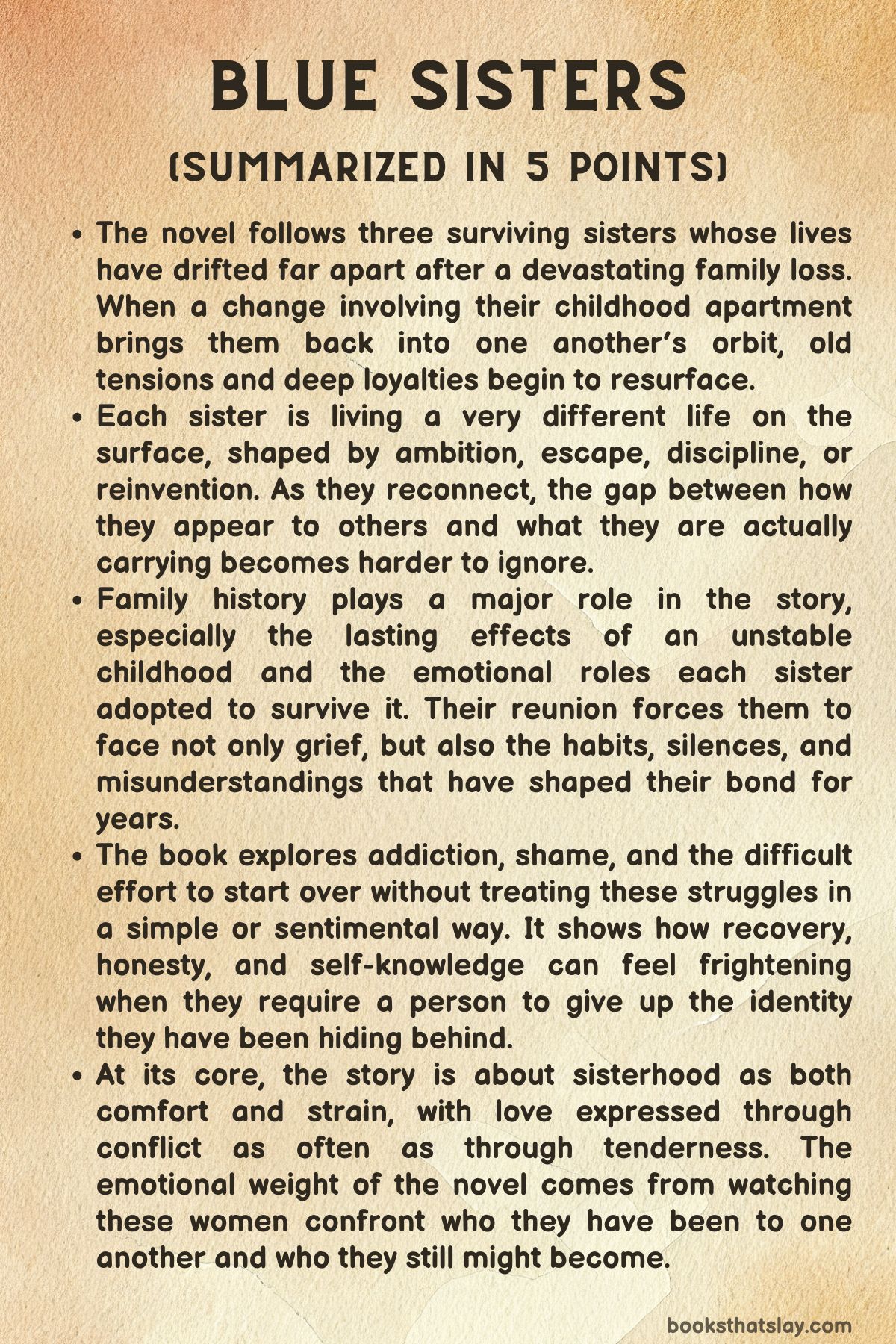
Blue Sisters by Coco Mellors is a contemporary family novel about grief, addiction, memory, and the difficult bond between siblings who know one another too well. At its center are three surviving sisters trying to make sense of life after the death of their fourth sister, Nicky.
Each of them has built a life that looks different on the surface, yet all are carrying old wounds from childhood and private forms of loneliness. The novel follows their return to New York, where the family apartment becomes a place of reckoning. It is a story about loss, survival, and the slow, imperfect work of choosing life again.
Summary
The novel opens with the Blue sisters defined both by love and by damage. They grew up in a home shaped by emotional neglect and instability.
Their mother was distant and hard to reach, while their father’s alcoholism often turned the household tense and frightening. Out of that environment, the four sisters formed a bond that was intense, protective, and complicated.
Avery, the oldest, learned to act like a parent long before she should have had to. Bonnie built herself through discipline and physical strength.
Lucky escaped into beauty, glamour, and movement. Nicky, the sister whose death hangs over the entire story, remained in New York and lived closest to the life they had all come from.
A year after Nicky’s death, the surviving sisters are scattered across the world and struggling in private ways. Avery lives in London, where she has built a polished life as a successful lawyer.
She is married to Chiti, and from the outside she appears stable, wealthy, and fully in control. Yet grief has unsettled her.
She is a former heroin addict and still lives with the knowledge that addiction is never fully behind her. In the wake of Nicky’s death, she has begun acting out in small but revealing ways, and the strain in her marriage is becoming harder to ignore.
Bonnie is in California, living far below her potential. Once a gifted boxer with serious ambition, she has abandoned the sport after a devastating loss and now works as a bouncer.
Her life has narrowed. She keeps herself apart, moves through her days with a kind of blunt endurance, and carries unresolved guilt about the last days of Nicky’s life.
Bonnie had been preparing for a major fight when Nicky called asking for illegal painkillers. Bonnie refused.
Soon after, she found Nicky dying from an overdose caused by fentanyl-laced pills obtained elsewhere. That memory has cut deeply into her sense of self.
Lucky, the youngest, is living in Paris and working as a famous model. Her life is full of attention, parties, expensive clothes, and glamorous surfaces, but underneath she is adrift.
She drinks heavily, uses drugs, and lives with a constant sense of emptiness. On the first anniversary of Nicky’s death, she wakes from another night of excess, rushes to a fashion fitting, gets drunk before it begins, and humiliates herself by vomiting while wearing couture.
Her public life is beginning to crack, but even more important is the fact that she no longer seems able to imagine a future she actually wants.
The sisters are pulled back toward one another when their mother announces that the New York apartment where they grew up is being sold. The apartment matters to all of them, but especially to Bonnie and Avery.
It is filled with memory, grief, and Nicky’s untouched belongings. Avery wants to resist the sale.
Bonnie is more resigned, though she feels the pull of the place deeply. The apartment becomes the emotional center of the story, the location where the sisters will have to confront not only Nicky’s absence but also themselves.
Lucky travels first to London, where Avery and Chiti receive her. Avery is already worried about her younger sister’s drinking and recklessness, and their reunion quickly turns tense.
Lucky continues to spiral, going out to parties, taking more substances, and returning home barely conscious. At one of these nights out, a stranger calls her “Nicky’s baby,” a phrase that unsettles her and seems to suggest a hidden part of Nicky’s life.
Lucky becomes obsessed with understanding what he meant, but in her condition she cannot fully pursue the mystery. Her confusion, shame, and grief keep feeding one another.
Avery, meanwhile, is dealing with pressures of her own. Chiti wants them to start trying for a child, and Avery agrees outwardly even though she is unsure.
At the same time, she has formed a connection with Charlie, a man she knows through recovery meetings. Their bond grows from shared experience and emotional honesty, and Avery crosses a line by sleeping with him.
For Avery, this is not simply an affair. It is another sign that grief has disrupted the life she built and exposed truths she has been trying not to face, especially her uncertainty about motherhood and about who she is becoming.
Back in California, Bonnie gets into trouble after a violent incident at work and decides to leave town for a while. She goes to New York and returns to the apartment.
Being there brings everything back: her childhood, her years living there with Nicky, and the night she found her sister’s body. Bonnie also starts thinking about boxing again and reconnects with Pavel, the trainer who shaped her career and for whom she has long had deep feelings.
The possibility of returning to the gym offers her a path back to herself, though it also means facing the pain attached to her last fight and the life she abandoned.
Lucky soon joins Bonnie in New York after fleeing London. The apartment becomes a temporary refuge.
Bonnie helps Lucky through withdrawal, sitting with her through the physical and emotional misery of early sobriety. In these scenes, the sisters begin to care for one another more honestly.
Bonnie, who often appears hard and unexpressive, becomes protective and tender. Lucky, stripped of glamour and intoxication, starts to reveal how frightened and lost she really is.
She admits that she does not want to keep living as she has been living, though she has no clear idea what should replace it.
Avery eventually arrives in New York too, claiming that she has come to help clear out Nicky’s things. In truth, her marriage is in crisis after Chiti discovers evidence of her affair.
Now all three sisters are together in the apartment, which produces both moments of closeness and explosive conflict. As they sort through Nicky’s belongings, long-suppressed truths come out.
Lucky reveals that Bonnie is in love with Pavel. Bonnie reveals that Lucky has been trying to get clean.
Lucky then exposes Avery’s affair. The argument becomes brutal, fueled by grief, resentment, and the old family habit of wounding one another exactly where it hurts most.
At the worst point, Avery tells Lucky that she should have died instead of Nicky, a sentence so cruel that it shocks them all.
The fight sends each sister back into her own pain. Lucky leaves and relapses into drinking, spending time with people who barely know her and nearly falling back into destructive patterns completely.
Yet this low point also becomes a turning point. She admits aloud that she needs sobriety and begins attending AA meetings.
For someone as self-conscious and scattered as Lucky, even reading aloud in a meeting becomes a meaningful act of courage. She also starts to imagine a different future for herself, one rooted in music rather than modeling.
This emerging creative life gives her a sense of direction that she has long lacked.
Bonnie throws herself back into boxing. Her return to the gym is difficult at first, especially because Pavel is wary and emotionally guarded.
Over time they speak more openly about the past, including the fight that took place in the immediate aftermath of Nicky’s death. Bonnie had felt abandoned by his decisions then; he had believed he was protecting her.
In facing those memories, Bonnie regains confidence in herself as an athlete. She takes on a challenging fight and proves that her talent remains.
She and Pavel also finally admit their feelings for one another and begin a relationship, despite the age difference and Bonnie’s fears about what such a future might mean.
Avery takes a different route toward change. She visits her parents upstate and at last begins to speak honestly with her mother.
In one of the novel’s most important developments, her mother acknowledges truths she has long kept buried: that motherhood did not come naturally to her, that she struggled after having children, and that she felt trapped in her marriage. Avery also learns that the apartment is being sold to help pay for her father’s rehab, since his drinking has seriously damaged his health.
These conversations do not erase the past, but they break a pattern of silence. Avery is finally able to see her parents as flawed people rather than fixed forces in her life, and she begins to let go of her belief that she alone should have saved everyone.
When Avery returns to the city, the sisters gradually reconcile. Bonnie confesses her guilt over refusing Nicky’s request for pills.
Lucky shares that she wants sobriety to be real and lasting. Avery admits that she does not want to have a child, even though telling Chiti will almost certainly end her marriage.
Her sisters encourage her to be honest. In the end, Avery returns to London, tells Chiti the truth, and loses the marriage, but the decision is also a step toward living more truthfully.
The epilogue jumps ahead ten years. Time has not erased pain, but it has made room for new life.
The sisters are all in New York again. Their father has died.
Their mother remains part of their lives. Avery is in a stable relationship and at peace with the choices that once seemed unbearable.
Lucky has become a successful musician, though sobriety remains an ongoing struggle and she is in treatment at the time of the epilogue. Bonnie had a strong boxing career before retiring and has just had a baby with Pavel.
The child is named Nicole, honoring Nicky. By ending with the sisters coming together to welcome a new member of the family, the novel closes on renewal rather than closure.
Nicky is still absent, still loved, and still central to their lives, but her sisters have found ways to keep living.
Characters
Avery Blue
Avery is the eldest sister and the one who has spent most of her life trying to convert chaos into order. She is intelligent, disciplined, accomplished, and outwardly secure, yet much of that strength has been built in response to fear.
Growing up in an unstable home, she stepped into a protective role long before adulthood, acting less like a sister and more like a second mother. That history explains both her competence and her rigidity.
She is used to managing crises, anticipating damage, and carrying responsibility for other people’s survival. Her success as a lawyer and her carefully arranged life in London are not simply signs of ambition; they are also evidence of someone who has tried to build a life so controlled that pain cannot get in.
The tragedy is that grief does get in, and when it does, her polished exterior starts to crack.
Her character is shaped by the tension between discipline and self-destruction. Avery has already survived heroin addiction, and although she appears to have moved far beyond that period, the novel makes clear that sobriety does not erase the emotional structures that once fed addiction.
In grief, she returns to behaviors that carry secrecy, shame, and risk. Even before her affair, her private smoking, shoplifting, and emotional withdrawal suggest someone seeking small acts of collapse beneath the image of control.
Her betrayal of Chiti is therefore not only a moral failure within the marriage but also part of a larger pattern in which Avery damages the very life she has worked hardest to build. What makes her compelling is that she understands this about herself.
She is perceptive enough to recognize her own contradictions, but insight does not spare her from acting against her better judgment.
Avery’s relationship to Nicky’s death is especially important because it reveals how deeply guilt organizes her inner life. As the oldest, she believes protection is her duty, and so Nicky’s death becomes, in her mind, a kind of personal failure.
She does not merely mourn her sister; she carries the conviction that she should somehow have prevented the loss. That burden helps explain why she is so volatile with Lucky and Bonnie.
Her anger often looks like judgment, but underneath it lies terror. She sees addiction, drift, and risk in her younger sisters and reacts harshly because she cannot bear the possibility of another loss.
Her cruelty at key moments comes from this fear, though it is still cruelty. One of the strongest aspects of her characterization is that the novel never lets her intelligence excuse the damage she causes.
Her marriage to Chiti brings out another side of her. With Chiti, Avery has found warmth, stability, and genuine love, yet the relationship also forces her to confront questions she cannot solve through competence alone.
Chiti wants a child, and Avery’s uncertainty about motherhood becomes one of the novel’s most revealing conflicts. The issue is not simple reluctance.
It is bound up with Avery’s childhood, her fear of repeating old patterns, and her need to define a life on her own terms rather than by obligation. For someone who has always been driven by duty, admitting that she does not want motherhood is an act of honesty that costs her dearly.
In this sense, Avery’s arc is not about becoming kinder or softer in any simple way. It is about becoming more truthful, even when truth destroys the structure she has been trying to preserve.
By the end, Avery emerges as a character who has not conquered her flaws so much as stopped hiding behind them. She does not receive an easy redemption.
Instead, she gains a clearer understanding of herself, her family, and the limits of what one person can carry. Her reconciliation with her sisters matters because it loosens the old identity she has lived inside for years.
She is no longer only the protector, the achiever, or the one who must keep everything from falling apart. In Blue Sisters, Avery represents the cost of overfunctioning in a damaged family and the painful freedom that comes from finally admitting that love is not the same as control.
Bonnie Blue
Bonnie is the sister most associated with force, stamina, and physical discipline, but beneath that hard surface she is one of the most emotionally exposed characters in the novel. She has built her identity through boxing, through bodily effort, through the clear logic of training and endurance.
Unlike Avery, who survives by mastering appearance and structure, Bonnie survives by turning herself into someone who can absorb punishment and keep going. Her physical life gives her a language for pain that feels more manageable than emotional speech.
She is not naturally articulate about her feelings, and much of her character comes from what she suppresses or leaves unsaid. This makes her presence seem blunt at first, yet her silence contains an enormous amount of grief, guilt, and longing.
Nicky’s death affects Bonnie in an especially brutal way because she is the one who discovered her and because she cannot stop revisiting the final request she refused. Her decision not to get painkillers was rational, even necessary, but grief has little respect for reason.
Bonnie turns this moment over in her mind as proof that she failed her sister. This guilt becomes tangled with the collapse of her boxing career.
The devastating fight that follows Nicky’s death is not just a professional defeat; it marks the moment when Bonnie can no longer trust the self she had built through sport. She leaves New York, gives up boxing, and settles into a diminished life in California, where she works as a bouncer rather than as the athlete she was meant to be.
That retreat is an expression of mourning, but it is also a form of self-punishment. Bonnie has stopped asking anything ambitious of herself because part of her believes she no longer deserves it.
What makes Bonnie especially moving is the contrast between her power and her vulnerability. She is capable of violence, directness, and intimidation, but she is also deeply tender, especially with her sisters.
When Lucky arrives in New York in withdrawal, Bonnie takes on the work of care without ceremony. She does not dramatize her concern or ask to be praised for it.
She simply stays, watches, supports, and protects. This practical tenderness fits her character perfectly.
Bonnie is rarely expressive in a conventional sense, yet she shows love through labor, through staying present, through using her body as a shield when needed. That instinct links her to Avery, though Bonnie’s version of caregiving is less controlling and more instinctive.
Her relationship with Pavel adds another dimension to her character. For years, Bonnie’s romantic feelings for him remained private, partly because of the age difference and partly because boxing itself defined the terms of their bond.
Pavel is connected to her sense of purpose, discipline, and possibility, so desire and ambition are closely joined in her feelings for him. When she returns to the gym, she is not just returning to a man she loves but to the self she once believed in.
Their eventual honesty with one another matters because it comes after Bonnie has regained some inner authority. She does not enter the relationship as a lost or dependent figure.
She enters it after facing her own grief, her own interrupted career, and her own fear of wanting too much.
Bonnie’s arc is one of reclamation. She does not become a radically different person by the end, nor does she suddenly turn emotionally fluent.
Instead, she recovers what grief and guilt had pushed underground. She returns to training, competes again, and allows herself both professional and personal hope.
Her growth lies in understanding that love for Nicky does not have to take the form of permanent self-denial. She can mourn and still want a future.
She can carry guilt without allowing it to define the rest of her life. Among the sisters, Bonnie may be the least verbally expressive, but she is one of the clearest examples of endurance transformed into renewal.
Lucky Blue
Lucky is the youngest sister and, in many ways, the one most visibly at risk when the novel begins. She is beautiful, famous, socially magnetic, and surrounded by the spectacle of fashion and nightlife, but her public life is built on disconnection.
She is looked at constantly without being truly seen. Modeling has made her image valuable while leaving her personhood underdeveloped, and the result is a character who seems both glamorous and deeply lonely.
She lives through performance, impulse, and appetite, moving from one city, party, and encounter to the next without any stable sense of self. Her addiction is not presented as simple recklessness.
It grows out of alienation, objectification, and a life in which pleasure has become detached from meaning.
Lucky’s emotional life is marked by vulnerability that is often hidden behind charm or excess. She drinks and uses drugs heavily, but these habits are tied to older injuries, including the sexual exploitation she experienced when she first entered the modeling world.
That history matters because it helps explain why Lucky so often seems absent from herself. She has learned to detach, to float above experience, to let the body move through spaces that the mind has not fully accepted.
This dissociation is part of what makes her scenes of partying so painful. She is not simply carefree.
She is often only half-present, acting from damage and drift rather than desire. The world around her mistakes this for freedom.
Her relationship to Nicky is one of the emotional anchors of her character. Nicky believed Lucky should pursue a life with more substance and more joy than modeling had offered her, and after Nicky’s death that belief lingers in Lucky’s mind as both comfort and challenge.
Lucky’s grief is not as organized or articulate as Avery’s, nor as guilt-ridden as Bonnie’s, but it is perhaps the most existential. Nicky’s death leaves her asking what living is for.
If the person who saw her most clearly is gone, what remains beneath the image she sells to the world? This question becomes central to her arc.
She reaches a point where she understands that survival itself is no longer enough; she must find a reason to participate in her own life.
One of the strongest aspects of Lucky’s characterization is the way the novel refuses to reduce her to either victimhood or wildness. She is impulsive, selfish, funny, wounded, and perceptive all at once.
She can be careless with herself and with others, yet she is also capable of striking moments of honesty. Her early attempts at sobriety are messy, inconsistent, and frightening, which gives them emotional credibility.
She does not suddenly become serene or wise. She relapses, panics, and doubts her own ability to change.
Even going to a meeting and reading aloud becomes a real achievement because it requires her to stand inside herself rather than escape from herself. That fragile effort toward presence is one of the most meaningful shifts in the novel.
Lucky’s movement toward music is also significant. It offers her a creative identity that depends on expression rather than display.
Modeling has made her a surface for other people’s fantasies, whereas music allows her to make something from within. This change does not magically solve her life, but it gives her a direction that feels chosen rather than imposed.
By the epilogue, her sobriety is still precarious, which is an important and honest detail. Recovery is not presented as a neat conclusion.
Still, Lucky’s path shows genuine transformation. She begins as someone scattered across parties, substances, and other people’s attention, and she becomes someone slowly learning how to inhabit her own voice.
Nicky Blue
Although Nicky is dead before the main action begins, she remains one of the most powerful presences in the novel. In many family stories, the dead character becomes a symbol more than a person, but Nicky is rendered with enough specificity that she feels fully alive in memory.
She was the sister who stayed closest to home, the one who remained in New York, taught high school English, and tried to build an ordinary life despite chronic physical pain. Her life was less visibly dramatic than Lucky’s or Avery’s, yet the novel gradually reveals how much she was carrying.
She suffered from endometriosis, endured years of pain and medical dismissal, and turned to narcotic painkillers in part because the institutions meant to help her failed her. Her death is not presented as an isolated bad choice.
It sits at the intersection of bodily suffering, inadequate care, addiction, and despair.
Nicky’s character is defined by a mix of steadiness and thwarted possibility. She seems to have been the sister most rooted in everyday tenderness.
She encouraged Bonnie’s boxing, offered emotional understanding, and remained deeply connected to the family apartment as a lived space rather than just a symbol. At the same time, she had her own dreams, including the desire for children, which shaped her refusal of a hysterectomy despite severe pain.
This detail reveals how much future she still imagined for herself, even while suffering. It also adds to the tragedy of her death.
She did not move toward oblivion because she had given up on life entirely. She was trying, within terrible constraints, to preserve a future that mattered to her.
For the surviving sisters, Nicky functions as mirror, wound, and moral pressure all at once. Avery experiences her death as proof that protection can fail.
Bonnie experiences it as guilt. Lucky experiences it as the loss of the person who most clearly wanted something better for her.
Because each sister relates to Nicky differently, the novel is able to use her absence to reveal their inner lives. Yet Nicky is not only important as someone others miss.
She also stands for the forms of suffering that families often do not know how to name in time: chronic pain, dependency, isolation, and the exhaustion of not being believed. Her story widens the novel’s understanding of addiction by showing that it does not arise only from pleasure-seeking or rebellion.
Sometimes it begins in pain and in the desire to function.
Nicky also serves as a measure of the sisters’ remaining love for one another. Their fights are often really arguments about her, about what she needed, who failed her, and how her memory should be carried.
But as the story moves forward, it becomes clear that the best way to honor Nicky is not endless self-punishment. It is the effort to live more honestly.
Her memory keeps pressing the others toward change. Even the naming of Bonnie’s child in the epilogue suggests that Nicky’s place in the family has not been closed off by death.
She remains part of the living structure of their world, not as a saintly abstraction but as a beloved, complicated sister whose loss altered everyone.
Chiti
Chiti is crucial because she offers one of the clearest contrasts to the emotional habits of the Blue family. She is warm, mature, perceptive, and professionally trained to listen, which makes her presence in Avery’s life especially meaningful.
She represents stability, care, and the possibility of a relationship not ruled by chaos. In another novel, a character like Chiti might serve only as the wronged spouse, but here she is drawn with enough clarity to feel like a real counterforce.
She has her own desires, especially her clear wish to become a mother, and she does not hide them. Her openness about what she wants stands in contrast to Avery’s more evasive relationship to her own inner life.
Chiti wants clarity, intimacy, and forward movement, while Avery is increasingly governed by avoidance.
The strain between them grows not simply because of Avery’s affair but because the marriage has become the place where unspoken truths can no longer remain unspoken. Chiti recognizes that grief has changed Avery, but she also sees that something deeper is wrong.
Her discovery of the emergency contraception forces hidden realities into the open. What makes her response compelling is that it is not portrayed as hysterical or simplistic.
She is hurt, angry, and direct, but also lucid. She understands that the problem is larger than one betrayal.
The marriage has arrived at a point where the future they imagined together is no longer mutually desired.
Chiti’s longing for motherhood is especially important to her characterization because it is not treated as a generic domestic wish. It is central to the life she wants, and she is honest enough to insist on that truth.
This insistence is part of what makes the end of the marriage so painful and so necessary. Avery cannot truthfully give Chiti the future she wants, and Chiti cannot reduce her own desires just to preserve the relationship’s surface.
In that sense, Chiti embodies emotional adulthood. She is willing to face loss rather than live inside denial.
Even after the relationship ends, Chiti remains significant because the novel does not turn her into a discarded figure. The epilogue shows that she moved forward and built the life she wanted, which reinforces the sense that she was always a full person rather than only a function in Avery’s story.
Her continued amicable bond with Avery suggests that while love was not enough to keep them together, honesty eventually allowed a different kind of respect to survive. Chiti’s role is therefore essential to Avery’s development: she is the person before whom Avery can no longer perform certainty.
Pavel
Pavel is one of the most grounded figures in the novel, a man associated with rigor, endurance, and earned authority. As Bonnie’s longtime trainer, he is deeply tied to her sense of identity.
He helped shape her into a boxer, but more than that, he gave form to her ambition. For Bonnie, the gym is one of the few places where life made clear sense, and Pavel stands at the center of that world.
This gives him symbolic importance as well as emotional significance. He represents discipline without glamour, care expressed through demanding work, and the possibility of structure that is not controlling in the way family can be.
At first, Pavel appears emotionally distant, especially when Bonnie returns after a long absence and finds him cold. That reserve reflects not indifference but caution and guilt.
He too has been marked by the disastrous fight that followed Nicky’s death, and he understands that Bonnie’s trust in him was damaged. Their eventual conversation about that past is one of the more mature exchanges in the novel because it allows both of them to admit fault, pain, and desire without collapsing into melodrama.
Pavel’s strength lies in his seriousness. He does not romanticize Bonnie’s return or flatter her into believing everything can resume easily.
He makes her earn her way back, and in doing so he helps restore her self-respect.
The romantic dimension of his relationship with Bonnie is handled with restraint, which suits both characters. The age difference between them matters, and Pavel is conscious of it, but his hesitation is not only about age.
He fears becoming a burden, a limitation, or an inappropriate answer to Bonnie’s vulnerability. That concern reveals his decency.
He does not rush to claim what he may have wanted for years. When they finally acknowledge their feelings, it comes after Bonnie has already begun reclaiming her career and her agency.
This timing matters because it prevents their romance from feeling like rescue. Instead, it feels like recognition between two people who have known each other through discipline, failure, and silence.
Pavel’s presence also deepens the novel’s portrait of love by showing a form of intimacy built not on confession alone but on shared practice. He and Bonnie understand one another through movement, endurance, and repeated effort.
Their connection is less verbally elaborate than some of the novel’s other relationships, but it is emotionally convincing because it has been forged over years. He is not a flashy or transformative figure in a dramatic sense.
His value lies in steadiness, patience, and the ability to meet Bonnie where she actually is.
The Mother
The sisters’ mother is a difficult and quietly devastating character because she embodies the emotional absence around which much of the family was shaped. She is not cruel in an overt or theatrical way.
Instead, she is remote, subdued, and hard to reach, which can be just as damaging within a household already destabilized by the father’s alcoholism. For much of the novel, she appears as a figure defined by withholding.
She has kept conversations on the surface, avoided painful truths, and left her daughters to form themselves in the spaces her emotional presence should have filled. Her distance is one reason Avery became prematurely maternal and why the sisters leaned so heavily on one another.
What makes her more than a simple portrait of neglect is the later revelation of her own internal history. When she finally begins to speak more honestly with Avery, she admits that she was not sure she wanted children and that she struggled with postpartum depression.
These admissions do not erase the harm she caused, but they complicate it. She becomes visible not only as a mother who failed to give enough but as a woman who was herself trapped, uncertain, and unprepared for the life she entered.
This does not invite easy absolution. Instead, it shifts the emotional frame from blame alone to understanding.
The silence in the family did not come from nowhere; it was part of a larger inheritance of repression, fear, and emotional incapacity.
Her decision to sell the apartment initially seems callous, as if she is trying to erase family history or move on from Nicky too quickly. Later, the practical reasons for the sale emerge, tied to the father’s rehab and declining health.
Even here, though, the deeper issue is communication. She makes major decisions without first inviting emotional conversation, which is characteristic of the role she has played throughout the family’s life.
She acts, manages, continues, but does not easily name. That habit leaves her daughters feeling abandoned even when she is not entirely absent.
By the end, the mother becomes one of the novel’s clearest examples of imperfect late understanding. She cannot return to the past and become the mother her daughters needed, yet she does begin to speak more truthfully.
Her conversation with Avery is especially important because it offers a rare interruption in the family pattern of silence. She remains a flawed figure, but no longer an unknowable one.
Her complexity strengthens the novel’s interest in how damage passes through generations without always taking the same form.
The Father
The father exerts a strong influence on the novel even when he is physically absent because his alcoholism shaped the emotional weather of the sisters’ childhood. He is remembered less as a fully individuated presence than as a force: angry, unstable, threatening, and unpredictable.
For Avery in particular, he is central to the childhood sense that someone always had to be ready for danger. His alcohol-fueled rages helped create the family roles the sisters would later inhabit.
Avery became vigilant. Bonnie learned toughness.
The younger sisters adapted in their own ways to a home where safety could not be assumed. In that sense, the father’s character matters not because the novel spends the most time inside his mind, but because his behavior left lasting architecture inside everyone else.
His addiction also broadens the novel’s treatment of substance dependence by showing that it cuts across generations and appears in different forms. The sisters are not merely coping with isolated personal struggles; they are living within a family system in which addiction has repeatedly shaped reality.
Avery recognizes this and wants it named, while the mother initially resists such naming. The father’s rehab later in the story confirms that the family’s old patterns remain active even after the daughters have grown and dispersed.
His health has deteriorated, and the family must once again organize itself around the consequences of his drinking.
What is striking is that the novel does not stage a large sentimental reckoning with him. There is no grand confession that resolves the past.
This restraint feels right. Some damage is not answered by eloquent apology.
The father remains, to a large extent, a figure whose failures must be lived with rather than repaired. His eventual death in the epilogue closes his life but not the effects of his presence.
What matters more is that the sisters have learned to understand part of themselves in relation to the household he helped create.
As a character, then, the father functions less as a site of emotional intimacy and more as a source of inheritance. He is one of the reasons the sisters grew up hyperaware of instability, one of the reasons care became distorted into management and silence, and one of the reasons addiction appears in the family as both threat and familiarity.
His importance lies in the long shadow he casts.
Charlie
Charlie plays a relatively limited role in terms of page time, but he is important because he reveals a vulnerable and unstable side of Avery that few others can access. Their connection grows in the context of recovery, where honesty and mutual recognition can happen with unusual speed.
He understands addiction not as an abstract problem but as lived experience, and that shared knowledge gives Avery a form of intimacy she is struggling to find elsewhere. The attraction between them is not based on novelty alone.
It is tied to confession, recognition, and the dangerous comfort of being seen at a low point.
Charlie is less significant as an independent personality than as a catalyst. Through him, Avery acts on impulses she has been trying to contain, and the affair forces latent truths into the open.
He is part of Avery’s self-destructive turn, but he is not written as a seducer or villain. That matters.
The moral responsibility for Avery’s choices remains with Avery. Charlie’s role is to expose the emotional conditions under which those choices become possible: loneliness, grief, sexual uncertainty, and the desire to break out of a life that suddenly feels false.
He also complicates Avery’s sense of identity. Her attraction to him does not rewrite her history or reduce her to a simple contradiction.
Instead, it places her in confrontation with a self that cannot be neatly summarized by past patterns. This is one reason his presence matters even after the affair ends.
He is part of the pressure that forces Avery to stop pretending that she can continue as before.
Charlie therefore functions as a turning-point character. He is not the answer to Avery’s unhappiness, and the novel does not romanticize what happens between them.
Instead, he helps bring a crisis into visibility. Sometimes a secondary character matters less for who he becomes and more for what he reveals, and that is true here.
Riley
Riley appears late, but he serves an important purpose in Lucky’s development. He enters the story at a moment when Lucky is close to losing herself again, and his presence offers a rare kind of gentleness that is not exploitative.
Given Lucky’s history in a world where attention often comes with selfishness or objectification, Riley stands out because he does not take advantage of her vulnerability. When she is drunk and erratic, he does not turn the situation into an opportunity.
Instead, he protects her and responds to her with patience and basic care. That decency is quietly significant because it gives Lucky an encounter with someone who sees her distress rather than merely her desirability.
Riley also matters because he helps move Lucky toward honesty. The morning after, Lucky is able to say plainly that she thinks she needs sobriety but has no idea how to achieve it.
This admission is one of the clearest moments in her arc because it strips away performance. Riley does not solve the problem for her, but he responds with belief rather than judgment.
In a novel filled with family history and long emotional entanglements, a brief encounter like this can still matter greatly. Sometimes a stranger’s simple refusal to exploit pain becomes a turning point.
As a character, Riley is not deeply elaborated, nor does he need to be. His narrative value lies in contrast.
He stands against the chaos of the party world Lucky inhabits and against the many experiences in which her body has been treated as public property. He represents a possibility of ordinary respect, which is something Lucky has encountered too little of.
That is enough to make him memorable.
Peachy
Peachy is a smaller but effective supporting character because she sheds light on Bonnie’s life in California and on the fact that even in retreat Bonnie had not become entirely isolated from human connection. As Bonnie’s former boss, Peachy understands that Bonnie is carrying more than she says.
Her concern is practical rather than sentimental, which suits the novel’s style. She urges Bonnie to get out of town after the incident at the bar, and later her reappearance in New York provides Bonnie with companionship at a moment of social unease.
What Peachy adds is a sense that Bonnie inspires loyalty even when she is withdrawn. She is one of the few people outside the family who sees Bonnie with some clarity and responds without demanding emotional explanation.
That matters because Bonnie is not a character who opens easily. Peachy’s steady support suggests that Bonnie’s strength is legible to others, even when Bonnie herself has lost faith in her direction.
Though she remains a secondary figure, Peachy helps round out Bonnie’s world. She prevents Bonnie’s California life from seeming like total emptiness and shows that care in the novel often arrives through ordinary acts of presence rather than grand emotional speeches.
Troll Doll
Troll Doll is a useful character because she embodies the emptiness and danger of Lucky’s party-centered world. She exists within a culture of surface, stimulation, blurred boundaries, and performative intimacy.
Her friendship with Lucky is shallow, driven more by nightlife than by real understanding, and this is exactly the point. Through her, the novel shows how people can appear socially surrounded while remaining profoundly unsupported.
Troll Doll is less a true friend than a symptom of the environment Lucky has been living in.
Her behavior, especially the violation of taking a photograph without Lucky’s consent, highlights how little respect this social world has for privacy or personhood. The incident is not the largest act of harm in the novel, but it is revealing.
It captures the casual exploitation built into the spaces Lucky moves through, where even moments of vulnerability can become content, gossip, or spectacle. Troll Doll therefore helps define the kind of life Lucky is beginning to reject.
She is not developed with much depth, but that thinness is meaningful. Lucky has spent years among people who know her image better than her mind.
Troll Doll belongs to that realm of disposable intimacy, and the emptiness of the connection helps explain why Lucky’s movement toward sobriety and music feels like a movement toward substance.
Nicole
Nicole, Bonnie’s newborn daughter in the epilogue, has no developed personality on the page, yet she carries strong symbolic significance. Named in honor of Nicky, she represents continuity without repetition.
The family has not erased the dead sister, but neither has it allowed grief to close off the future. The child’s arrival creates a final image of renewal grounded in kinship rather than fantasy.
Avery and Lucky rushing to meet their niece suggests that despite everything the sisters have endured, they are still capable of gathering around life with joy and love.
Nicole also marks a generational shift. The sisters, who were shaped by instability, neglect, addiction, and loss, now stand in relation to a new child whose existence opens the possibility of a different inheritance.
The novel does not claim that pain disappears or that family damage is easily repaired. Lucky is still struggling with sobriety, and the past remains part of them all.
But Nicole’s presence suggests that history does not have to repeat itself in identical form. That is a modest but meaningful kind of hope.
Themes
Grief as a Force That Reshapes Identity
Grief in Blue Sisters is not treated as a single emotional event but as a condition that alters the way each surviving sister understands herself. Nicky’s death does not simply leave sadness behind; it changes the structure of daily life, memory, decision-making, and self-worth.
Each sister carries her loss in a different register, and that difference is central to the novel’s emotional depth. Avery turns grief into pressure and control, trying to hold everyone together while privately falling apart.
Bonnie turns it inward as guilt, attaching her sister’s death to the moment she refused to get the pills Nicky asked for. Lucky experiences grief as disorientation, as if the loss has removed one of the few people who truly saw her beyond her public image.
This variation matters because the novel refuses a single model of mourning. It shows that the death of one person can produce very different inner worlds in those left behind.
The apartment in New York becomes the clearest physical expression of this theme. It is not just a setting filled with memories; it is a place where grief has been suspended in material form.
Nicky’s belongings remain there, untouched, and the effort to sort through them becomes emotionally overwhelming because it forces the sisters to face what death means in practice. Grief is not abstract when it lives in clothing, books, rooms, and objects that still seem to wait for a person who will never return.
The apartment also exposes how mourning can hold people in place. Avery keeps paying the mortgage not only because she values the home, but because she is trying to preserve a moment before total loss becomes undeniable.
The desire to stop time becomes one of grief’s most painful illusions.
The novel is also deeply interested in the cruelty grief can produce. The sisters do not only comfort one another in their shared loss; they wound one another with astonishing precision.
Because grief has sharpened old vulnerabilities, their arguments become full of accusation, projection, and blame. One of the hardest truths the novel presents is that mourning does not automatically make people gentler.
It can make them harsher, more possessive, more frightened, and more desperate to assign responsibility. The sisters often use Nicky’s death to attack themselves and one another because grief has made every old family role feel heavier and more dangerous.
At the same time, the novel does not leave grief as pure destruction. Over time, the sisters begin to understand that loving Nicky cannot mean freezing their own lives in the shape of her absence.
They do not stop missing her, and the epilogue makes clear that her loss remains part of the family’s emotional life even after many years. What changes is their relation to that loss.
Grief becomes something they carry rather than something that entirely controls them. The naming of Bonnie’s daughter after Nicky makes this especially clear.
Memory is not erased, but it is brought into a future context rather than locked in the past. In that sense, the novel presents grief as both rupture and continuation: a force that breaks identity apart, but also one that can lead people toward a more honest understanding of love, responsibility, and survival.
Addiction, Compulsion, and the Inheritance of Escape
Addiction in this novel is presented as both personal and generational, shaped by biology, pain, trauma, and family history. It is never reduced to a simple weakness or a moral flaw.
Instead, the story shows how different forms of dependency emerge from different kinds of suffering, even while they remain connected by the same underlying desire to escape what feels unbearable. The Blue family is marked by addiction across generations.
The father’s alcoholism creates an unstable childhood environment that teaches the sisters early on that chaos can arrive without warning. Later, Avery’s heroin addiction, Lucky’s dependence on alcohol and drugs, and Nicky’s addiction to painkillers all reveal how deeply the impulse toward relief runs through the family.
Yet the novel is careful to show that these addictions are not identical. Nicky’s dependence grows out of severe physical pain and medical neglect.
Lucky’s is tied to loneliness, objectification, and a life built on performance. Avery’s emerges from a complex mix of pressure, emotional suppression, and self-destructive instinct.
One of the strongest aspects of this theme is that addiction is shown not only through substances but also through behavior. Avery may be sober from heroin, but her actions after Nicky’s death suggest that compulsion is still part of how she manages distress.
Her smoking, shoplifting, and affair all carry the same logic of secrecy, risk, and temporary relief. This broadens the theme in an important way.
The novel suggests that addiction is not always about a single substance; it can also be about the repeated turn toward anything that interrupts pain for a moment. In this sense, sobriety is not presented as a simple cure.
Recovery involves learning how to remain present when escape is no longer available.
The novel also pays close attention to the social conditions surrounding addiction. Nicky’s death is especially devastating because it reveals how structural failure can shape personal catastrophe.
She suffers from a chronic condition, struggles to be taken seriously, and faces medical options that do not honor the life she wants. Her addiction is therefore linked to a larger world that has failed to care for women’s pain adequately.
Lucky’s story makes a similar point in a different register. Her dependence grows within an industry and social scene built on surfaces, excess, and emotional emptiness.
The substances around her are normalized, even glamorous, until the consequences become impossible to ignore. Through both sisters, the novel shows that addiction often flourishes in environments where pain is minimized and harmful behavior is made to seem ordinary.
Recovery in the novel is equally complex. It is messy, partial, and ongoing.
Lucky’s movement toward AA is full of hesitation and relapse, which makes it feel emotionally true. Avery’s presence in recovery meetings shows that even the most outwardly high-functioning person remains vulnerable.
The father’s late rehab reminds the reader that addiction continues to shape family life long after childhood has ended. By refusing a neat resolution, the novel treats recovery as a practice of honesty rather than a final state.
People may improve, fail, begin again, and continue struggling. That refusal of simplification gives the theme much of its force.
Addiction here is both inherited and immediate, both intimate and systemic, and the fight against it is shown as one of the central labors of being alive.
Sisterhood as Love, Burden, and Emotional Memory
The relationship among the sisters forms the emotional center of the novel, and it is presented with unusual complexity. Their bond is loving, but it is also full of resentment, projection, rivalry, and dependency.
They know one another at a depth few people ever achieve, and that knowledge is both a source of comfort and a weapon. Because they grew up in a home where safety and emotional support were inconsistent, the sisters became one another’s primary emotional world.
That closeness gave them strength, but it also trapped them in roles established during childhood. Avery became the responsible one, Bonnie the strong one, Lucky the vulnerable one, and Nicky, in memory, the lost center around which everyone else still turns.
These identities are not natural facts about who they are. They are survival strategies formed inside a damaged household.
What makes the theme of sisterhood so powerful is that the novel does not romanticize family closeness. The sisters can be generous and deeply protective, but they can also be ruthless.
Their arguments are painful because they are rooted in real intimacy. A stranger can insult you, but only a sibling often knows exactly which fear, guilt, or shame will land hardest.
That is why their conflicts feel so explosive. When they fight, they are not only disagreeing about present circumstances.
They are reactivating years of old pain, unequal responsibility, and unspoken memory. Much of their anger comes from the fact that each sister carries a private understanding of what the family required from her, and those understandings do not always match.
Avery believes she had to protect everyone. Bonnie believes she had to endure.
Lucky feels both judged and unseen. These internal histories shape every reunion.
At the same time, the novel insists that sisterhood is not only a site of damage. It is also the place where healing becomes possible, however imperfectly.
Bonnie caring for Lucky through withdrawal is one of the clearest examples of love expressed through physical presence rather than speech. Avery’s eventual honesty with her sisters about her marriage shows that even the most defended person among them still seeks recognition from the family bond.
Their reconciliations matter because they are earned through confrontation rather than sentimentality. The sisters do not arrive at harmony by pretending the past was easier than it was.
They move toward one another by saying things that have long been buried, even when those truths are painful.
The novel also presents sisterhood as a form of emotional memory. The sisters remember one another not only through stories but through embodied knowledge of who each of them has been at her worst and most vulnerable.
That memory can feel suffocating, since it makes reinvention difficult. Yet it also provides continuity in a life otherwise fragmented by addiction, distance, and loss.
Even when they are estranged, each sister remains part of how the others understand themselves. By the end, their bond is not purified into something simple.
It remains messy, sharp, and demanding. But it becomes more honest.
The novel suggests that family love is not valuable because it is easy or inherently noble. Its value comes from the fact that it can survive truth and still remain love.
The Search for a Self Beyond Performance and Duty
A major concern running through the novel is the struggle to separate the self from the role one has been trained to perform. Each sister has built an identity that appears legible from the outside, yet each of those identities is under strain because it no longer fits the life being lived.
Avery has become the successful lawyer, the composed adult, the capable protector. Bonnie has become the disciplined fighter whose body expresses what words cannot.
Lucky has become the beautiful model whose value lies in being seen. These roles provide structure, but they also narrow the sisters into versions of themselves created in response to expectation, fear, or external reward.
The novel repeatedly asks what remains when those performances begin to fail.
Avery’s story makes this theme especially vivid through the conflict between competence and authenticity. She has built a life around being reliable, accomplished, and controlled, but grief exposes how unstable that identity really is.
Her affair, her smaller acts of risk, and her uncertainty about motherhood all reveal that the life she has created may not fully express who she is. Her marriage becomes the site where this conflict can no longer be postponed.
She is forced to admit that duty alone cannot define a meaningful future. Saying that she does not want a child is painful because it threatens the image of the stable, generous partner, yet it is also necessary because continuing to perform agreement would mean living falsely.
In her case, the search for self requires the loss of a life that looked successful from the outside.
Lucky’s version of this theme is tied to visibility and objectification. Modeling has made her image central while leaving her inner life neglected.
She has become highly legible as a face and body, but barely legible to herself. Her addiction deepens that gap because it allows her to keep drifting through a life that demands appearance without asking for presence.
Her movement toward music is therefore significant far beyond career change. Music offers a mode of expression that comes from within rather than from display.
It gives her a chance to make something instead of merely being looked at. This shift marks an important reclaiming of subjectivity.
She is no longer only the object in other people’s stories.
Bonnie’s struggle is different but related. After Nicky’s death and her disastrous fight, she stops inhabiting the identity that once gave her purpose.
Without boxing, she becomes disconnected from a self built through effort, talent, and bodily discipline. Yet returning to boxing is not just about recovering an old career.
It is about deciding whether she still believes she has the right to want things for herself. Guilt had pushed her into a smaller life, one defined by retreat rather than possibility.
Her return to training and competition becomes a way of resisting that shrinking.
Across all three arcs, the novel suggests that selfhood is not discovered through abstract reflection alone. It is built through difficult acts of truth.
To become more fully oneself may require ending a marriage, leaving a profession, entering recovery, or giving up the role that once won approval. The search is painful because performance often feels safer than honesty.
Still, the novel argues that a life organized entirely around duty, image, or survival cannot sustain a person forever. What the sisters move toward, however imperfectly, is not freedom from pain but freedom from false versions of themselves.