Bluets by Maggie Nelson Summary and Analysis
Bluets by Maggie Nelson is a groundbreaking hybrid work—part lyric essay, part prose poetry, part philosophical meditation, and part memoir. It consists of 240 numbered, short prose fragments (often called “propositions”) that circle obsessively around the color blue while weaving in deeply personal experiences of heartbreak, grief, desire, and existential solitude.
Rather than telling a conventional story, the book moves through numbered reflections, memories, quotations, and observations. Blue becomes a way for Nelson’s speaker to think about love, loneliness, art, sex, depression, friendship, and pain. The book follows two emotional centers: the end of a difficult love affair and the life-altering injury of a close friend. Through these experiences, Bluets asks what beauty can offer when suffering has no clear explanation and longing has no easy cure.
Summary
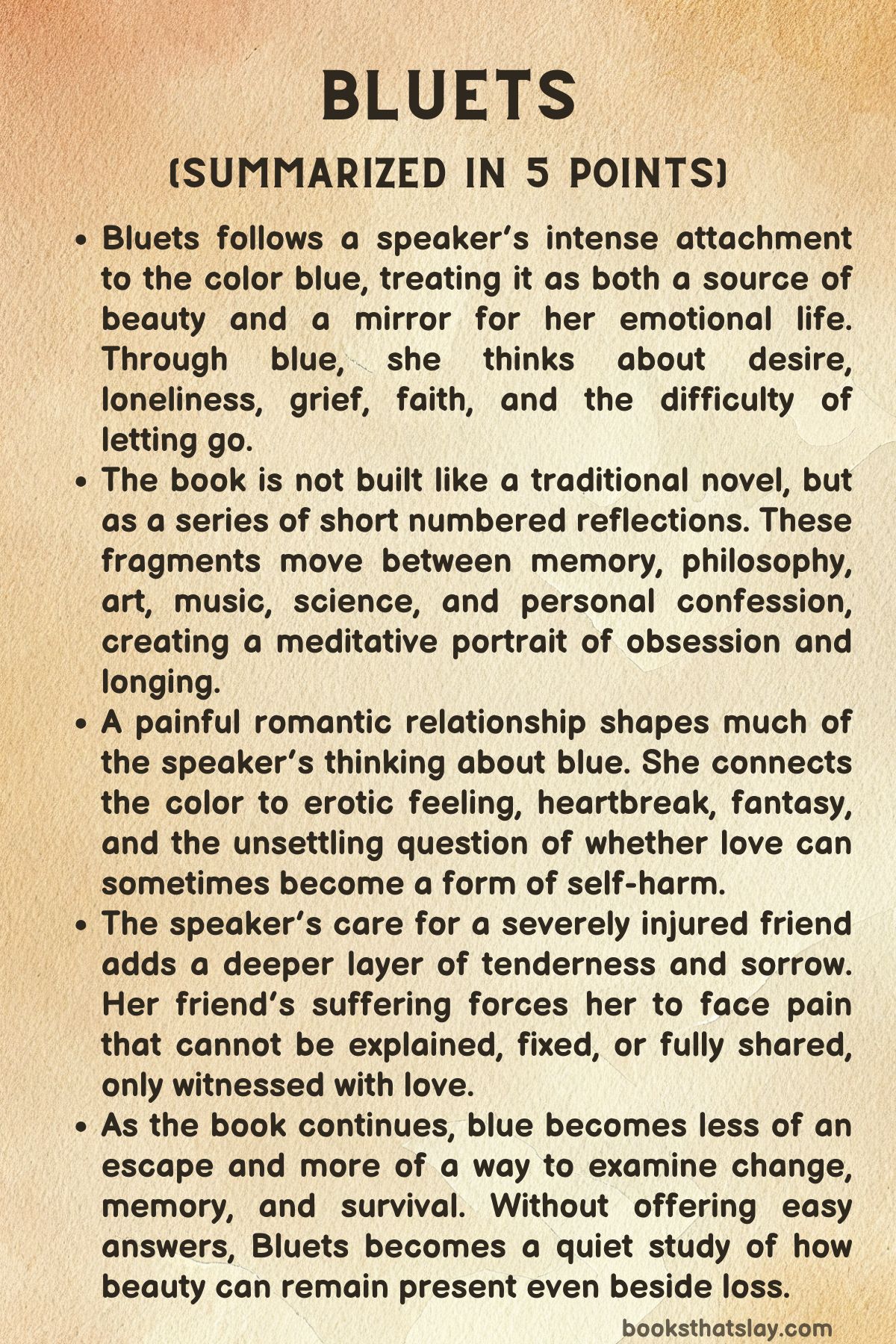
Bluets is not a traditional novel with a straight plot. It is a meditative work built from short fragments in which the speaker thinks about the color blue and the many feelings, memories, and ideas it gathers around itself.
At first, blue appears almost like a secret beloved. The speaker describes her devotion to it as if admitting to an obsession.
She is drawn to blue in oceans, stones, clothing, paint, paper, music, film, and the sky. Yet her love of blue is never only about beauty.
It is bound to loneliness, sexual desire, grief, worship, sadness, and the wish to be released from wanting someone who is gone.
The speaker remembers seeing an intensely blue ocean from a mountain and feeling stunned by the fact that such a color could exist. That moment makes life feel briefly extraordinary.
But she resists turning blue into a simple symbol of peace or spiritual comfort. For her, blue can be radiant, but it can also be hungry, painful, and restless.
It reflects the contradictions inside her: the desire to be healed and the desire to remain close to what hurts.
For a long time, she has told people she is writing a book about blue, even before she has truly begun writing it. This announcement changes how others relate to her.
Friends and strangers send her blue things, blue facts, and blue stories. She calls them her blue correspondents.
They bring her pigments, stones, postcards, dyes, candy, ink, and strange details about people who also loved or studied blue. These gifts create a scattered archive.
The speaker collects blue as if collecting evidence, but the evidence does not lead to one final answer. Instead, each blue object opens another question about attachment, meaning, and memory.
Running beside this devotion to blue is the memory of an affair with a man she calls the prince of blue. Their relationship is passionate, physical, and emotionally damaging.
She remembers meeting him in New York and being with him at the Chelsea Hotel. After sex, she notices a blue tarp moving outside the window, and the color becomes fused with the body, desire, and disappointment.
The man becomes part of her blue obsession, but he is not simply romanticized. He causes her pain, and she knows he has hurt her.
Still, she cannot stop thinking about him. She wonders whether what she felt was love, delusion, addiction, or a form of loyalty to her own longing.
As the relationship breaks down, the speaker’s desire becomes mixed with humiliation and grief. She dreams about the lover, remembers small details about him, and continues to measure her emotional life against his absence.
He eventually becomes attached to another woman. One especially painful memory centers on a pale blue shirt.
He wears it when he sees the speaker, and later she sees him in a photograph with the other woman wearing the same shirt. The image wounds her because it makes intimacy feel transferable.
What once seemed marked by private meaning now appears shared, repeated, and removed from her.
A second major event reshapes the speaker’s life: a close friend suffers a terrible accident and breaks her spine. The injury leaves the friend severely paralyzed.
This event changes the emotional scale of the book. The speaker’s heartbreak over the lost lover remains real, but it now exists beside a form of suffering that is bodily, ongoing, and severe.
In the hospital, the speaker notices blue with even greater sharpness: blue paint, blue water, and especially her friend’s pale blue eyes. The color no longer belongs only to private desire.
It is now linked to care, helplessness, physical pain, and the limits of what one person can do for another.
The speaker becomes one of her friend’s caretakers. She helps with transfers in and out of the wheelchair and witnesses the friend’s spasms, nerve pain, exhaustion, grief, and daily struggle with paralysis.
These scenes are among the book’s most grounded moments. They show care as intimate, practical, and difficult.
The speaker cannot feel her friend’s pain directly, and she does not pretend that she can. Yet by staying near, helping, watching, and listening, she comes as close as possible to another person’s suffering.
The book refuses easy comfort here. It does not claim that pain makes people nobler or that tragedy produces a clear moral lesson.
Throughout Bluets, the speaker turns to art, literature, philosophy, religion, science, and music to understand why blue has such power over her. She thinks about Goethe’s ideas about color, Wittgenstein’s writings on color and language, Mallarmé’s poem about the azure, Joni Mitchell’s album Blue, Leonard Cohen’s “Famous Blue Raincoat,” Billie Holiday and the blues tradition, Yves Klein’s International Klein Blue, Andy Warhol’s Blue Movie, and Joseph Cornell’s blue-tinted film Rose Hobart.
These references do not build a usual plot. Instead, they show the mind at work, searching across culture for companions in obsession.
The speaker’s study of blue becomes a way to study language itself. She wonders whether words can hold experience or whether they slowly replace it.
When she writes down a memory, does she preserve it, or does the written version begin to stand in for what actually happened? This worry applies to her memories of blue objects, her memories of the lover, and even her sense of her own grief.
She wants to record what matters, but she fears that recording can flatten or distort it.
Her blue collection also begins to change. Objects fade in sunlight.
A note from an old lover, stitched with blue paper, loses some of its color. This fading becomes a quiet image for the book’s larger concerns.
Love fades, memory changes, bodies alter, and even objects meant to preserve feeling cannot remain untouched by time. Blue is beautiful, but it is not permanent.
It cannot keep the lover present, cure the injured friend, or protect the speaker from loss.
The speaker discusses her heartbreak with her injured friend, whose responses are sharp and honest. The friend calls the situation with the lover ghastly and later says the love has “a morbid heart.” This judgment matters because it comes from someone who knows pain intimately and can see the speaker’s attachment with clarity.
The speaker slowly understands that she must give up the lover, though understanding does not immediately end desire. She continues to miss him and continues to struggle against hope.
Near the end of Bluets, the speaker moves toward a quieter acceptance. She stops counting the days of suffering.
She does not discover a grand reason for her friend’s injury or a final cure for her heartbreak. The book does not turn pain into wisdom in a simple way.
Instead, it accepts that some losses remain unexplained and that healing may not mean forgetting. The speaker remembers that she once would have chosen the lost lover over all the blue in the world.
But by the end, her devotion shifts. She no longer wants to be only a student of longing.
She wants to be a student of light.
Key Figures
The Speaker
The speaker is the central consciousness of Bluets, and her character is defined by intensity: intensity of observation, desire, grief, thought, and emotional attachment. She does not simply like the color blue; she builds a private world around it, treating blue as a language through which she can examine loneliness, beauty, sexuality, memory, depression, and spiritual longing.
Her love of blue reveals her need to give shape to feelings that are otherwise difficult to contain. Blue becomes a way for her to confess what she wants, what she misses, what she fears, and what she cannot repair.
She is highly self-aware, but her self-awareness does not protect her from suffering. In fact, it often makes her pain sharper because she keeps examining her own longing from every possible angle.
The speaker’s relationship with blue also shows her hunger for meaning. She collects stories, objects, artistic references, philosophical ideas, and personal memories connected to the color, as though gathering enough fragments might finally explain why certain things wound or enchant her so deeply.
She is intellectual, but never cold. Her thinking is emotional, embodied, and restless.
She moves between art, music, philosophy, religion, and science not to display knowledge, but to survive feeling. Her mind is always searching for a pattern that can hold together love, loss, beauty, and pain.
Her affair with the man she calls the prince of blue exposes the most vulnerable and conflicted parts of her character. She desires him deeply, but she also recognizes that the attachment has become painful and possibly destructive.
She questions whether the relationship was love, fantasy, obsession, or a form of emotional dependence. This uncertainty makes her character morally and psychologically complex.
She is not presented as someone who simply suffers because another person hurts her; she also investigates her own participation in longing. She knows that desire can distort judgment, and yet she cannot easily free herself from it.
Her honesty about this makes her both fragile and courageous.
The speaker’s role as a caretaker for her injured friend reveals another side of her character: devotion, tenderness, helplessness, and ethical attention. She cannot enter her friend’s pain completely, but she refuses to look away from it.
She witnesses the physical and emotional realities of paralysis, including pain, spasms, dependency, grief, and the exhausting routines of care. Through this relationship, the speaker becomes more grounded in the reality of another person’s suffering.
Her obsession with blue may begin as personal and aesthetic, but her friend’s injury forces it into contact with the body, disability, mortality, and the limits of empathy.
By the end of the story, the speaker has not solved grief, desire, or suffering. Her growth lies in her willingness to give up the demand for a clear lesson.
She understands that pain may not have a reason and that heartbreak may not offer wisdom in any simple way. Her final movement from longing toward light suggests a quiet transformation.
She does not abandon intensity, but she begins to redirect it. She remains a student of beauty, but she no longer wants beauty to be only a mirror for desire.
Her character is therefore shaped by the struggle to move from obsession toward attention, from possession toward acceptance, and from longing toward illumination.
The Prince of Blue
The prince of blue is the speaker’s lost lover and one of the most emotionally powerful figures in the book, even though he is mostly seen through the speaker’s memory, desire, dreams, and pain. He is less a fully independent presence than a charged figure within the speaker’s inner life.
His name connects him directly to blue, making him part of the speaker’s larger obsession with the color. He becomes a human version of blue’s contradictions: beautiful and painful, seductive and distant, intimate and unreachable.
Through him, blue becomes erotic, disappointing, and emotionally dangerous.
His relationship with the speaker is marked by intensity, sexuality, and instability. Their encounters carry a sense of enchantment, but that enchantment is never separate from hurt.
The speaker remembers moments of physical closeness with him, yet these memories are haunted by absence and emotional imbalance. He represents the kind of love that becomes more powerful because it is not secure.
The speaker keeps returning to him mentally because the relationship remains unresolved, and this unresolved quality allows him to grow larger in memory than he may have been in life.
The prince of blue also functions as a test of the speaker’s perception. Because she loves or desires him so strongly, she must ask whether she is seeing him clearly.
He becomes attached to another woman, and this deepens the speaker’s humiliation and grief. The pale blue shirt he wears becomes especially painful because it links intimacy, memory, betrayal, and replacement.
An ordinary object becomes emotionally unbearable because it seems to move from the speaker’s private world into another woman’s possession. This shows how the prince of blue’s significance is not limited to his actions; it also lies in how the speaker’s mind transforms every trace of him into evidence of loss.
He is not portrayed as purely villainous, but he is associated with emotional harm. The speaker’s injured friend describes the love as having a morbid heart, and that phrase captures the atmosphere around him.
He is connected to a form of attachment that feeds on pain, repetition, and impossibility. His presence in the story reveals how longing can become self-consuming when the beloved person is no longer truly available.
The prince of blue matters because he helps expose the speaker’s struggle to distinguish love from fixation and beauty from damage.
The Injured Friend
The injured friend is one of the most important characters in Bluets because she brings the speaker’s reflections on beauty, suffering, and longing into direct contact with bodily reality. After her accident, she becomes severely paralyzed, and her life is transformed by pain, dependence, and the daily difficulty of surviving in a changed body.
Her character is not simply a symbol of suffering, however. She is a person whose injury forces the speaker to confront the limits of language, sympathy, and imagination.
The speaker can witness her pain, help care for her, and love her, but she cannot fully experience what her friend experiences.
The friend’s pale blue eyes in the hospital room become one of the most striking images associated with her. Through this detail, the speaker’s obsession with blue is altered.
Blue is no longer only the color of erotic longing, art, sea, sky, music, or private melancholy. It becomes tied to the hospital, paralysis, vulnerability, and the terrifying nearness of another person’s pain.
The friend’s body changes the meaning of blue by placing it beside injury and endurance. In this sense, she deepens the emotional and moral seriousness of the book.
Her relationship with the speaker is marked by care, intimacy, honesty, and strain. The speaker helps her with difficult physical tasks, including transfers in and out of the wheelchair, and witnesses the realities of nerve pain, spasms, and grief.
These acts of care reveal the speaker’s devotion, but they also reveal the friend’s immense vulnerability. The friend must live with a condition that has no easy solution, and the speaker must face the fact that love cannot undo the damage.
Their bond is therefore tender but painful, because it is built around both closeness and helplessness.
The injured friend also serves as a voice of clarity in the speaker’s romantic suffering. When the speaker describes the lost lover and his attachment to another woman, the friend responds with sharp emotional intelligence.
Her description of the love as having a morbid heart suggests that she sees something unhealthy in the speaker’s attachment. Because the friend is herself enduring a much more literal and irreversible form of suffering, her judgment carries weight.
She is not dismissive of the speaker’s heartbreak, but she recognizes its destructive quality.
Her character broadens the story beyond the speaker’s private obsession. Through her, the book asks what it means to accompany someone in pain without pretending to understand it completely.
She represents the fact that suffering does not always teach a lesson, ennoble the sufferer, or produce clarity. Her presence resists any easy transformation of pain into beauty.
She is central because she forces the speaker, and the reader, to remain with the unresolved reality of damage, care, love, and survival.
The Other Woman
The other woman is a secondary but emotionally significant figure because she represents replacement, exclusion, and the speaker’s painful awareness that the prince of blue has moved beyond her. She is not developed in great personal detail, yet her role in the story is powerful because of what she means to the speaker.
She becomes the person who occupies the place the speaker still longs for, and this makes her presence feel almost unbearable.
Her importance is especially clear in the image of the prince of blue wearing the same pale blue shirt with her that he had worn to see the speaker. This detail turns the other woman into part of a painful emotional triangle.
The shirt becomes a symbol of repetition and transfer, as though something once charged with private meaning has been carried into another relationship. The speaker’s pain comes not only from jealousy but from the feeling that her memories have been contaminated or overwritten.
The other woman’s presence suggests that what felt singular to the speaker may not have been singular to the lover.
The other woman is not portrayed as cruel or responsible for the speaker’s suffering. Instead, she functions as a reminder of the speaker’s lack of control.
The speaker cannot keep the lover, cannot preserve the past unchanged, and cannot prevent symbols from changing meaning. In this way, the other woman helps reveal one of the story’s central emotional truths: longing often continues even after the beloved person has turned elsewhere.
Her character matters because she intensifies the speaker’s recognition that love cannot be sustained by memory alone.
The Blue Correspondents
The blue correspondents are the people who send the speaker blue objects, stories, images, facts, and fragments after hearing that she is writing about blue. They are not major individual characters, but collectively they form an important social presence in the book.
They show how the speaker’s private obsession becomes something others recognize, feed, and participate in. Through them, blue stops being only a solitary fixation and becomes a shared network of offerings.
Their gifts include pigments, stones, inks, dyes, postcards, candies, and strange stories about people who are also drawn to blue. These offerings suggest that human beings often try to connect through symbols.
The correspondents may not fully understand the speaker’s grief or longing, but they understand that blue matters to her, and so they send pieces of the world that seem to belong to her obsession. Their gestures are small acts of attention.
They help build the book’s atmosphere of accumulation, where every blue object becomes another attempt to approach an emotional truth.
The blue correspondents also reveal something about the speaker herself. Because she has told people for a long time that she is writing about blue, even before truly doing so, she has created an identity around this color.
Others respond to that identity and help sustain it. This suggests that the speaker’s obsession is both inward and outward: it belongs to her private emotional life, but it also becomes a role she occupies in relation to other people.
The correspondents therefore help show how an obsession can become a form of communication, even when its deepest meanings remain personal and difficult to explain.
The Old Lover
The old lover appears through the fading note with stitched blue paper, and although this character is only briefly present, the figure carries emotional importance. The old lover belongs to the speaker’s past and is connected to the larger theme of memory’s instability.
The note once held feeling, intimacy, and personal history, but over time it fades in sunlight. This fading becomes a quiet image of how love objects change, how memory weakens, and how even cherished traces lose their original force.
The old lover is different from the prince of blue because this figure seems less actively painful and more ghostly. The old lover belongs to the archive of the speaker’s emotional life.
The note is not just a keepsake; it is evidence of how the speaker has tried to preserve love through objects. Yet the object does not remain stable.
Its blue fades, suggesting that memory cannot be perfectly protected. Even when the speaker saves something, time continues to alter it.
This character’s importance lies in the way the old lover expands the story’s treatment of desire beyond one relationship. The speaker’s longing is not isolated to a single man; it is part of a broader pattern of attachment, preservation, and loss.
The old lover helps show that love leaves material traces, but those traces are fragile. The fading blue note becomes a miniature version of the book’s larger concern: what happens when the things meant to preserve feeling begin to disappear?
Blue (not a human character)
Blue is not a human character, but it functions almost like one because it has presence, movement, contradiction, and emotional force throughout the story. Blue is the speaker’s beloved color, her obsession, her wound, her consolation, and her method of inquiry.
It appears in oceans, eyes, shirts, tarps, paintings, music, films, notes, objects, and memories. Each appearance changes its meaning slightly.
Sometimes blue is divine and beautiful; sometimes it is erotic; sometimes it is cold, lonely, or grief-stricken. It is never only decorative.
Blue’s complexity comes from the fact that it holds opposites together. It can suggest transcendence, but also depression.
It can stand for beauty, but also hunger. It can soothe the speaker, but it can also intensify her sense of absence.
When she sees a turquoise ocean from a mountain, blue makes life feel remarkable. When she thinks of the lost lover, blue becomes tied to longing and sexual pain.
When she sees her injured friend’s pale blue eyes, blue becomes connected to the body’s suffering and the helplessness of care. The color changes according to the emotional situation in which it appears.
Blue also gives the book its unusual structure. Rather than following a traditional plot, the story moves through associations, fragments, memories, quotations, and reflections connected by the color.
Blue becomes the thread that allows the speaker to move between private experience and larger cultural history. Through blue, she thinks about art, philosophy, music, religion, science, and literature.
The color is therefore both subject and method. It gives her a way to think when ordinary narrative feels inadequate.
As a presence in the story, blue is powerful because it cannot finally be mastered. The speaker studies it, collects it, writes about it, and surrounds herself with it, but it remains mysterious.
It does not cure her heartbreak or explain her friend’s suffering. It does not stop loss.
Yet it keeps offering moments of attention and light. Blue is therefore the book’s most haunting nonhuman presence: a color that becomes a companion, a question, and a form of devotion.
Themes
Obsession, Color, and Emotional Need
In Bluets, blue is not treated as a simple favorite color but as a force that the speaker uses to organize her inner life. Her attraction to blue carries the weight of confession, prayer, desire, and self-examination.
The color becomes a way for her to name feelings that are otherwise difficult to control: loneliness, erotic hunger, spiritual wonder, grief, and the wish to be released from longing. When she remembers the sight of a turquoise ocean from a mountain, the experience feels almost sacred, as if beauty alone can justify existence.
Yet she refuses to let blue become only a symbol of peace or purity. It is also bodily, restless, and tied to craving.
Her collection of blue objects shows how obsession can become a private language. Each blue thing seems to promise meaning, but none can fully explain why she is drawn to it.
Blue becomes both comfort and trap, giving shape to suffering while also keeping her close to it.
Love, Loss, and the Pain of Attachment
The speaker’s affair with the man she calls the prince of blue reveals how love can become mixed with fantasy, humiliation, and self-harm. Her desire for him is intense, but the relationship does not bring stability or peace.
Instead, it leaves her searching for signs, replaying memories, and asking whether what she felt was genuine love or an attachment to pain. The pale blue shirt he wears becomes painful because it links private intimacy with public replacement when he later appears with another woman.
This small detail shows how heartbreak often survives through objects, images, and repeated mental scenes. The speaker knows she must give him up, yet knowledge does not immediately free her.
Her friend’s phrase that the love has “a morbid heart” captures the emotional sickness at the center of the attachment. The theme is not simply failed romance; it is the difficulty of separating love from longing when the beloved has become part of one’s imagination, habits, and sense of self.
Suffering, Care, and Witness
The friend’s paralysis brings the speaker into contact with a form of suffering that cannot be romanticized or solved through language. The injury changes daily life into a series of painful, exhausting tasks: transfers, spasms, nerve pain, hospital rooms, and the repeated struggle to live inside a changed body.
The speaker cannot feel her friend’s pain directly, and this limitation matters. Care does not erase distance; it only asks the witness to remain present despite that distance.
Her attention to the friend’s pale blue eyes in the hospital room connects beauty with helplessness, showing how color can appear even in scenes where there is no comfort. This theme challenges the idea that pain must teach a lesson or lead to moral growth.
The speaker slowly accepts that some suffering has no clear reason and no redemptive explanation. What remains is the difficult dignity of care: staying near another person’s pain without pretending to understand it completely or turn it into something easier.
Memory, Writing, and Fading
Writing becomes a way to preserve experience, but it also raises the fear that preservation may change what it saves. In Bluets, the speaker worries that recording memories of blue objects, lovers, and grief may replace the original moments with written versions of them.
This anxiety gives the work much of its emotional force. Memory is shown as unstable, selective, and vulnerable to time, much like the blue objects that fade in sunlight.
The fading note from an old lover suggests that even cherished things cannot remain fixed. Love fades, grief changes shape, and objects lose the intensity they once carried.
Yet writing still matters because it gives temporary form to what is passing away. The speaker does not arrive at a neat cure for heartbreak or suffering.
Instead, she moves from being a student of longing toward being a student of light. That shift suggests a quiet acceptance: not forgetting pain, but learning to see beyond the need to possess it.