Boneshaker Summary, Characters and Themes
Boneshaker by Cherie Priest is a steampunk science fiction novel set in an alternate version of Seattle during the Civil War era. The story imagines a city ruined by invention, sealed behind walls, and haunted by toxic gas, rotters, and old guilt.
At its center are Briar Wilkes and her son Zeke, two people living under the shadow of Leviticus Blue, the inventor blamed for Seattle’s destruction. The novel combines airships, masks, underground communities, political fear, and family secrets, but its strongest focus is on truth: what gets hidden, what gets inherited, and what love can survive. It’s the 1st book of the Clockwork Century series.
Summary
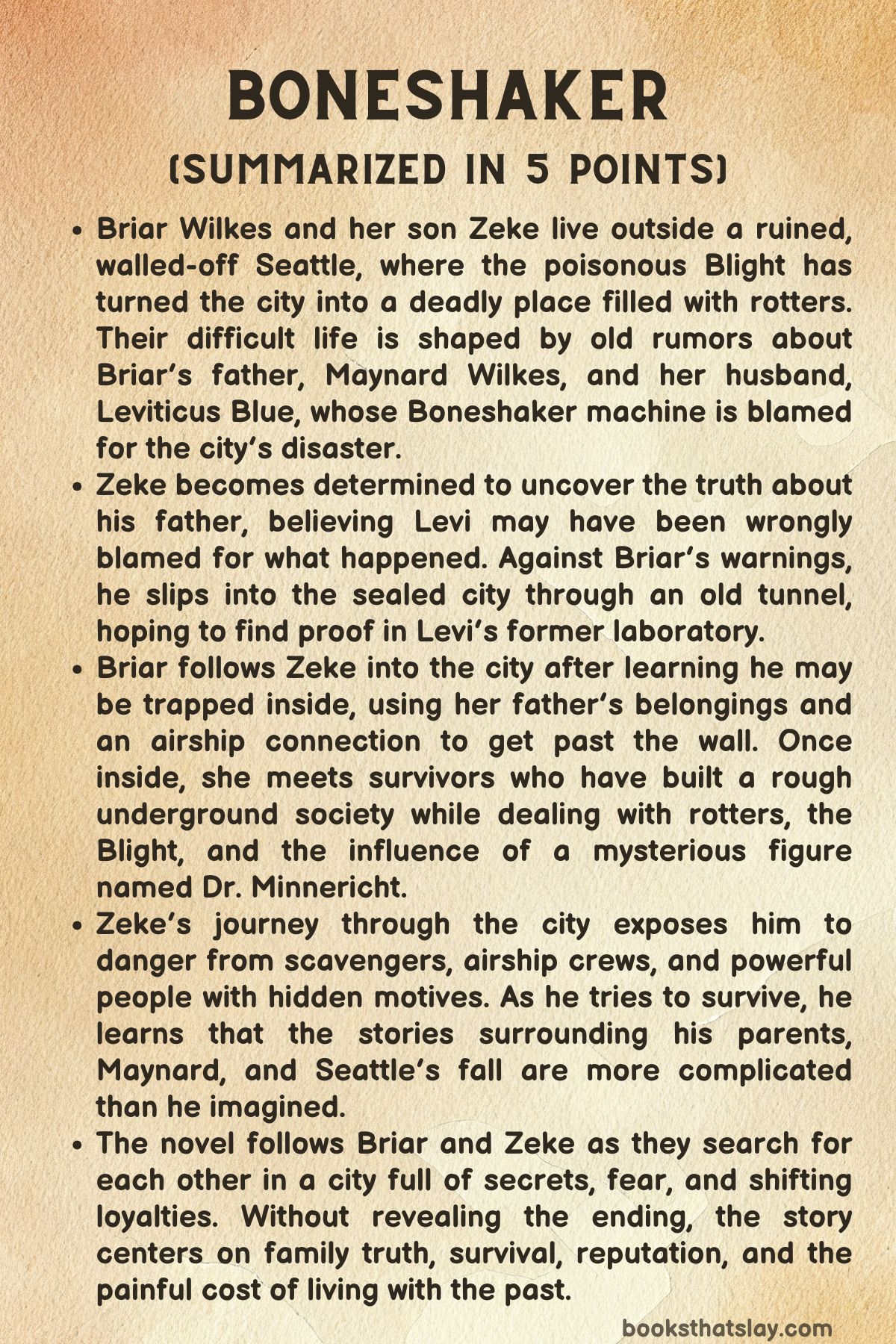
In Boneshaker, Seattle has become a ruined and dangerous city after a terrible invention changes its future forever. Years earlier, rumors of gold in the Klondike led Russian investors to hire Leviticus Blue, an inventor, to build a powerful drilling machine.
The machine, known as the Boneshaker, was meant to cut through ice and earth for mining. Instead, it tore through Seattle’s underground, destroyed large parts of the city, and released a poisonous gas called the Blight.
The Blight killed many people who breathed it. Others became rotters, zombie-like creatures who now move through the sealed city in packs.
To contain the gas, a massive wall was built around the damaged part of Seattle. Over time, the city inside the wall became a place of rumor, fear, and death.
Outside the wall, people tried to continue their lives, but the disaster never disappeared from memory.
Sixteen years later, Briar Wilkes lives in the Outskirts with her teenage son, Zeke. Briar is the widow of Leviticus Blue, and she has spent years carrying the shame attached to his name.
She works hard at a difficult job cleaning water and does what she can to keep herself and Zeke alive. She also tries to keep the past buried.
To Briar, silence seems safer than reopening old wounds.
Zeke does not feel the same way. He has grown up hearing stories about his father and grandfather, and he wants to know what really happened.
Some people say Leviticus Blue destroyed Seattle on purpose. Others believe there is more to the story.
Zeke also hears about his grandfather, Maynard Wilkes, who is remembered by some as a criminal and by others as a hero. Briar gives him few answers, which only makes him more determined.
When a writer named Hale Quarter comes asking questions about Maynard, Briar offers a careful version of the past. Zeke later speaks to Hale himself and insists that Maynard was not a villain.
He believes Maynard helped save prisoners trapped in a jail during the early Blight disaster. Afterward, Zeke argues with Briar, convinced that she has hidden the truth about both his grandfather and his father.
Zeke decides to enter the walled city and search for proof that Leviticus Blue was innocent, or at least not the monster people claim he was. He leaves home with old contaminated papers and a note explaining his plan.
When Briar realizes what he has done, she is terrified. She learns that Zeke used an old runoff tunnel to get inside Seattle.
She waits near the tunnel, hoping he will return, but an earthquake collapses the passage. With no safe route left, Briar gathers Maynard’s old coat, badge, rifle, ammunition, mask, goggles, and money.
Then she searches for an airship captain who can take her over the wall.
Inside the city, Zeke quickly learns that Seattle is not empty. It is ruined, poisoned, and filled with rotters, but people still live there.
He meets Rudy, a scavenger who claims he can guide him to Denny Hill and the old Blue house. Rudy seems useful at first, but his real interest is loot, and his behavior grows more threatening.
As they move through rooftops, sealed buildings, tunnels, and streets, Zeke sees how harsh life inside the wall has become.
Meanwhile, Briar finds help from Captain Crog Hainey, who directs her to Captain Andan Cly of the Naamah Darling. Cly recognizes Maynard’s belongings and remembers that Maynard once saved him and his brother from jail during the disaster.
Because of that old debt, Cly agrees to fly Briar into Seattle. After she enters the city, she is chased by rotters and forced away from her planned path.
She survives by escaping underground, where Jeremiah Swakhammer finds her and takes her into the hidden world beneath the streets.
Swakhammer brings Briar to Maynard’s, a tavern named after her father. There she meets Lucy O’Gunning, a barkeeper with a mechanical arm, and learns that the city has its own underground order.
Survivors live in tunnels, sealed rooms, vaults, and protected stations. Supplies, clean air, movement, and drugs are controlled by powerful people.
One of the most feared is Dr. Minnericht, a masked inventor who rules through influence and intimidation. Some believe Minnericht may actually be Leviticus Blue, still alive after all these years.
Briar rejects that idea, but it troubles her because she knows Zeke might believe it. The rumor gives Minnericht power, especially over people who want answers about the past.
While Briar searches for her son, Zeke becomes separated from Rudy and is helped by Angeline, an older Native woman who knows the city well. She warns him not to trust Rudy and tries to help him leave aboard the damaged airship Clementine.
That escape fails when another airship attacks, revealing that the Clementine has been stolen. In the chaos, Zeke falls, is saved by Captain Cly, and later ends up back in the dangerous streets.
Yaozu, one of Minnericht’s men, captures him and takes him to Minnericht’s underground station.
Minnericht’s station is unlike the rest of the city. It is clean, bright, and well supplied.
Zeke is given a room, but his mask is taken, making escape harder. Minnericht tries to gain Zeke’s trust by speaking about his parents and his father’s legacy.
He hints that he may be Leviticus Blue. Zeke wants to believe he has found answers, but he senses that the doctor is hiding something.
Briar’s search becomes more dangerous when rotters attack Maynard’s. She, Lucy, Swakhammer, and others flee through tunnels and streets.
During the escape, one man breathes the Blight after his mask slips and changes into a rotter with shocking speed. Briar shoots him to protect the group.
She later learns that Minnericht may have sent the rotters to Maynard’s and marked the tavern with his black hand.
Briar decides she must face Minnericht because he may know where Zeke is. At his station, she meets the masked doctor.
He repairs Lucy’s damaged mechanical arm and sends her away with a message. Alone with Briar, Minnericht claims that he is Leviticus Blue.
Briar does not believe him. She knows the real Levi would understand things this man does not.
When Minnericht admits that Zeke is with him and suggests that he intends to keep both mother and son, Briar tries to bargain. She offers to confirm his false identity in public if he lets them go.
Instead, he knocks her unconscious.
Zeke grows more suspicious and searches for a way out. Soon Briar wakes, reunites with him, and the station falls into violence.
With help from Angeline, Lucy, Swakhammer, Cly, and others, Briar and Zeke fight through Minnericht’s men and the rotters breaking into the station. The truth is revealed: Minnericht is not Leviticus Blue.
He is a fraud who used masks, machines, fear, and rumor to build power. Angeline kills him in revenge for the harm he caused her family.
After the fighting, the survivors escape to the fort, where Captain Cly and the airmen prepare the Naamah Darling for departure. Before Briar and Zeke leave Seattle, Briar asks to visit the old Blue house.
There she finally tells Zeke the truth she has spent years avoiding. Leviticus Blue was not innocent.
He used the Boneshaker to rob banks, and the disaster that released the Blight came from his crime. Briar also admits that she killed Levi when he tried to escape and that she survived partly by taking stolen money after the catastrophe.
Zeke is shaken by the truth, but he does not reject his mother. He understands that the past is uglier than he wanted it to be, yet it does not erase Briar’s love for him or her efforts to protect him.
Together, they recover what remains from the ruined house and prepare to return home. By the end of Boneshaker, Briar and Zeke no longer live under comforting lies.
They leave Seattle with painful knowledge, but also with a stronger bond built on honesty.
Characters
Briar Wilkes
Briar Wilkes is the emotional center of Boneshaker, a hardened mother whose life has been shaped by disaster, poverty, public shame, and the need to protect her son from a past that refuses to stay buried. She lives in the Outskirts of Seattle with Zeke and carries the burden of being connected to Leviticus Blue, the man blamed for creating the Boneshaker machine and unleashing the Blight.
Briar is guarded, practical, and emotionally restrained because survival has taught her to reveal as little as possible. Her early conversations with Hale Quarter and Zeke show that she is not simply hiding facts out of cruelty; she is trying to keep painful truths from destroying what little stability remains in her life.
Her refusal to romanticize Levi also shows her moral clarity. She knows that some parts of the past cannot be redeemed just because a child wants them to be.
Briar’s journey into the walled city reveals the depth of her courage. She does not enter Seattle for glory, curiosity, or revenge; she goes because Zeke is trapped inside, and that maternal drive overrides every danger.
Her decision to gather Maynard’s coat, badge, rifle, mask, and other belongings shows how she uses the past as armor, even when that past hurts her. Inside the city, Briar proves resourceful and tough, surviving rotters, tunnels, collapsing routes, armed factions, and Minnericht’s manipulation.
Yet her strength is not emotionless. She is frightened, exhausted, guilty, and angry, but she continues moving because love for Zeke gives her purpose.
Her final honesty with her son marks one of her most important moments. By telling Zeke the truth about Levi, the stolen money, and her own survival, Briar stops trying to protect him through silence and begins protecting him through trust.
Ezekiel “Zeke” Wilkes
Zeke Wilkes is a restless, wounded, and determined teenager whose journey begins with a desperate desire to prove that his family history is not as shameful as everyone says. He has grown up under the shadow of Leviticus Blue’s reputation and Maynard Wilkes’s half-buried legend, and this leaves him vulnerable to romantic ideas about heroism, innocence, and hidden truth.
Zeke does not enter the walled city because he is foolish in a simple way; he enters because he wants an identity that is not built entirely on disgrace. His belief that Levi may have been innocent shows how badly he wants to reclaim his father, even though he barely understands the danger of what he is seeking.
Inside the city, Zeke’s innocence is repeatedly tested. His encounters with Rudy, Angeline, Brink’s crew, Yaozu, and Minnericht expose him to different forms of deception and survival.
At first, he depends too easily on strangers because he lacks experience, but he gradually becomes more cautious and observant. Rudy teaches him that not every guide is trustworthy, the Clementine teaches him that escape may hide another trap, and Minnericht teaches him that family stories can be used as weapons.
Zeke’s growth lies in his movement from blind belief toward painful understanding. By the end of the book, he is forced to accept that Levi was not the misunderstood hero he hoped for.
His acceptance of Briar after learning the truth shows maturity. He does not get the heroic father he wanted, but he keeps the mother who risked everything for him.
Leviticus Blue
Leviticus Blue is one of the most important absent figures in the story, because his actions shape nearly every part of Briar and Zeke’s lives. Though he is not physically present in the main events, his invention of the Boneshaker machine and his attempted bank robbery created the catastrophe that ruined Seattle, released the Blight, and turned his family name into a curse.
To the public, Levi represents reckless ambition and technological arrogance. To Zeke, however, he initially represents a mystery that might be solved and a father who might still be redeemed.
This difference between public guilt and private longing gives Levi’s character a powerful influence over the book even in absence.
Levi’s importance lies in the emotional damage he leaves behind. Briar remembers him not as a noble inventor but as a man whose choices caused death, destruction, and permanent shame.
Zeke wants to believe that the story is incomplete, but Briar knows that not every scandal hides innocence. Levi’s legacy also becomes useful to Minnericht, who tries to claim his identity for power and legitimacy.
In that sense, Levi becomes more than a person; he becomes a symbol that other characters fight over. To Zeke, he is the lost father.
To Briar, he is the source of ruin. To Minnericht, he is a mask worth stealing.
The final truth about Levi forces the characters to separate fantasy from reality.
Maynard Wilkes
Maynard Wilkes is another absent but deeply influential figure, remembered as both a father and a local legend. He died during the early Blight disaster after helping prisoners escape from a jail during the evacuation, and his act of courage continues to shape how others see Briar’s family.
Unlike Levi, Maynard’s legacy is rooted in sacrifice rather than destruction. His coat, badge, rifle, and reputation become tools Briar carries into the city, almost as if she is borrowing his authority and protection.
The fact that Captain Cly and others remember Maynard with gratitude shows that his heroism was real and meaningful.
Maynard also gives the story a contrast between earned honor and false reputation. Zeke is eager to defend both his grandfather and his father, but the book gradually shows that Maynard’s heroism and Levi’s guilt are not equal mysteries.
Maynard saved people when the city was falling apart, and the loyalty he inspires years later proves the lasting value of his actions. The tavern named after him shows that, inside the ruined city, memory matters.
Maynard’s name gives people a place to gather, a symbol of resistance, and a reminder that decency survived even when Seattle did not.
Dr. Minnericht
Dr. Minnericht is the main manipulative force inside the walled city, a masked inventor and power broker who rules through fear, technology, secrecy, and control of the Blight-drug trade. He presents himself as brilliant, theatrical, and almost untouchable, surrounding himself with luxury while others struggle in tunnels, taverns, and sealed passages.
His mask is central to his character because it reflects his larger pattern of concealment. He hides his true identity, performs authority, and uses mystery to make people believe he is more powerful than he may actually be.
His claim to be Leviticus Blue is not only a personal lie but a political strategy, because Levi’s name gives him a terrifying kind of symbolic power.
Minnericht’s treatment of Briar and Zeke reveals his cruelty and insecurity. He tries to manipulate Zeke through stories about family and legacy, knowing that the boy wants answers about his father.
With Briar, he tries a different strategy, mixing intimidation with false familiarity. He wants her public confirmation because he understands that identity is a form of control.
If Briar accepted him as Levi, his false authority would become much stronger. Yet his performance collapses because he cannot answer the emotional truth of Briar’s past.
Angeline’s revelation that he is actually her son strips away his invented identity. His death at Angeline’s hand completes his exposure: beneath the mask and machinery, he is not the legendary Levi Blue, but a dangerous impostor who built power from lies.
Princess Angeline
Princess Angeline is a wise, formidable, and mysterious older woman who becomes one of Zeke’s most important protectors inside the city. She rescues him from rubble and immediately understands more about his danger than he does.
Her age and experience make her a figure of authority, but her authority is different from Minnericht’s. She does not rely on luxury, fear, or spectacle.
Instead, she relies on knowledge, toughness, and an ability to move through the broken city with confidence. Her guidance helps Zeke survive when he is injured, confused, and surrounded by people who may exploit him.
Angeline’s importance grows even stronger when her connection to Minnericht is revealed. As his mother, she carries a tragic burden: she understands what he is and what he has become.
Her decision to shoot him is not casual violence but a painful act of responsibility. She ends the threat that her own son has become, and in doing so she protects Briar, Zeke, and the city’s fragile underground community.
Angeline represents hard wisdom rather than comforting wisdom. She knows that survival sometimes requires terrible choices, and she makes those choices with clear eyes.
Lucy O’Gunning
Lucy O’Gunning is one of the strongest figures in the underground society, a barkeeper with a mechanical arm and a sharp understanding of the city’s dangers. She runs Maynard’s, a tavern named after Briar’s father, and her position makes her both a community figure and a survivor of constant threat.
Lucy is practical, direct, and tough, but she is also compassionate enough to help Briar navigate the city’s hidden world. Her mechanical arm reflects both injury and adaptation.
She has been damaged by life inside the wall, but she has also rebuilt herself into someone capable of fighting, working, and leading.
Lucy’s relationship with Minnericht is especially important because he made her mechanical arm and uses that connection to exert pressure over her. The arm is therefore both a gift and a chain.
It gives her strength, but it also ties her to a man she distrusts. When it is damaged, her vulnerability becomes visible, yet she never becomes helpless.
Lucy helps Briar understand the Blight, Minnericht, the rotter attacks, and the city’s internal politics. She represents the ordinary people who did not escape the disaster but built a functioning life in its ruins.
Jeremiah Swakhammer
Jeremiah Swakhammer is a capable and steady survivor who rescues Briar after she enters the city and becomes one of her main guides through its underground world. He understands the tunnels, the dangers, the factions, and the practical rules of staying alive.
His role is important because Briar is brave but unfamiliar with the current city; Swakhammer bridges that gap. He is not sentimental, but he is dependable, and that dependability matters in a place where many people are desperate, dishonest, or dangerous.
Swakhammer also helps show that the walled city is not simply a dead zone filled with rotters. Through him, Briar sees that there is an entire society beneath the ruins, with routes, shelters, alliances, habits, and codes of survival.
He is a man shaped by danger but not consumed by selfishness. His willingness to help Briar and later stand with the others against Minnericht shows that he values loyalty and community.
In a broken city, Swakhammer represents the kind of practical courage that keeps people alive day after day.
Captain Andan Cly
Captain Andan Cly is an airship captain whose rough exterior hides a strong sense of debt, loyalty, and honor. When Briar seeks a way into Seattle, Cly becomes crucial because he recognizes Maynard’s belongings and reveals that Maynard once saved him and his brother.
This old debt motivates him to help Briar when others might refuse. Cly is not a polished hero; he belongs to a dangerous world of airships, risky flights, and hard bargains.
Yet his actions show that he has a personal code, and he honors that code even when it places him in danger.
Cly’s role expands when he becomes involved in the conflict around the Clementine and later helps repair the Naamah Darling to fly Briar and Zeke out. He functions as a bridge between the outside world and the sealed city.
Unlike Zeke, he understands danger; unlike Minnericht, he does not use power merely to dominate. His respect for Maynard also reinforces the importance of remembered goodness.
Cly helps because someone once helped him, and that chain of loyalty becomes one of the story’s quiet moral strengths.
Captain Crog Hainey
Captain Crog Hainey is a forceful airship captain connected to the conflict over the Clementine. He first appears as someone Briar seeks out for help, and although he directs her to Cly rather than personally carrying her into the city, his presence remains important in the airship world surrounding the main action.
Later, he is part of the group that attacks Brink’s crew and claims that Brink has stolen his ship. This makes Hainey a figure of pursuit, ownership, and rough justice.
Hainey’s character belongs to the wider steampunk frontier atmosphere of the story, where airship captains operate according to personal loyalties and hard-earned claims. He is not developed through inner reflection as much as through decisive action.
His pursuit of the stolen ship shows that the world outside and above Seattle has its own conflicts, separate from the rotters and underground politics. Through Hainey, the book broadens beyond Briar and Zeke’s family story and shows a larger world of pilots, crews, theft, rivalry, and survival.
Fang
Fang is a member of Cly’s airship crew and contributes to the sense that the airmen are a tightly functioning, dangerous, and experienced group. Though not as emotionally central as Briar, Zeke, or Cly, Fang helps create the atmosphere of the airship world.
The crew’s work requires trust, speed, and discipline, especially during the attack on the Clementine and the dangerous flights around the walled city. Fang’s presence shows that Cly does not operate alone; he depends on people who can handle violence, machinery, and crisis.
Fang’s role is mainly practical, but that practicality matters. In a book filled with collapsing tunnels, poisoned air, rotters, and armed factions, survival often depends on people who know their jobs and act quickly.
Fang helps represent that kind of competence. The character also adds to the diversity of alliances that form around Briar and Zeke.
Their escape is not achieved by one hero alone but by many people performing necessary roles under pressure.
Houjin
Houjin is another member of Cly’s crew and, like Fang, helps define the airship community that becomes essential to Briar and Zeke’s survival. His presence aboard the Naamah Darling gives the ship a sense of lived-in teamwork.
Airships in the story are not just machines; they are moving communities that depend on coordination and trust. Houjin’s role supports this idea, showing how each crew member contributes to the success or failure of a dangerous mission.
Houjin also helps connect the city’s ground-level dangers with the aerial world above the wall. Briar’s search for Zeke depends on people like him because entering and leaving the sealed city is nearly impossible without skilled airmen.
Though he does not dominate the emotional arc, he belongs to the network of helpers who make rescue possible. His character strengthens the sense that survival depends on cooperation across different groups.
Hale Quarter
Hale Quarter is the writer whose visit helps trigger the conflict between Briar and Zeke. He comes to Briar asking about Maynard Wilkes, and his questions reopen old wounds that Briar has tried to keep contained.
Hale is important because he represents the power of stories and public memory. He is interested in what happened during the early Blight disaster, but his curiosity has consequences.
By speaking with Zeke, he helps intensify the boy’s belief that the family past has been hidden or distorted.
Hale is not a villain, but he is a catalyst. His presence shows how dangerous incomplete history can be, especially to a young person hungry for meaning.
Zeke’s secret conversation with him strengthens Zeke’s determination to go into the city and prove something about his father. Hale’s role also raises a question that runs throughout the story: who gets to tell the truth about the past?
Briar tells the story from pain and survival, Zeke imagines it through hope, and Hale approaches it as a writer searching for material.
Rector
Rector is Zeke’s friend and a seller of lemon sap, a drug made from Blight residue. He represents the damage the Blight has caused beyond the walls, because even outside Seattle its poison has become part of an underground economy.
Rector is not simply a bad influence, but he is morally compromised. He knows more than he first admits, and Briar has to pressure him before he reveals that Zeke entered the city through an old runoff tunnel.
His involvement shows how Zeke’s plan did not happen in isolation; it was made possible by a network of desperate, reckless, or frightened people.
Rector’s character also shows the vulnerability of young people living in the shadow of disaster. He moves around the edges of crime and addiction, and his connection to lemon sap ties him to the same contaminated world that Minnericht later exploits more powerfully.
Rector lacks the strength or clarity of Briar, but he is still part of the social landscape that shaped Zeke. His fear when confronted by Briar suggests that he understands the seriousness of what has happened, even if he was not strong enough to prevent it.
Rudy
Rudy is one of the first people Zeke encounters inside the dead city, and he quickly becomes a lesson in misplaced trust. At first, he appears almost absurd, pretending to hold Zeke at gunpoint with a bottle, but his behavior soon becomes more threatening.
He agrees to guide Zeke toward Denny Hill and the Blue house, yet his real interest lies in looting and self-preservation. Rudy’s drunkenness, unpredictability, and violence make him a dangerous companion, especially for a boy who has entered the city with more determination than experience.
Rudy’s importance lies in how he changes Zeke’s understanding of the city. Before meeting him, Zeke imagines the journey mainly as a search for truth.
Rudy shows him that the city is full of people with their own motives, and not all of them can be trusted. When Rudy kills a man in Chinatown, Zeke sees that human danger can be as frightening as rotters or Blight.
Rudy is not the grand villain of the story, but he is an early embodiment of moral decay inside the ruins.
Yaozu
Yaozu is a controlled, intimidating figure who brings Zeke into Minnericht’s underground station. He appears after Zeke escapes into the Blight-filled city, and his capture of the boy shifts Zeke from physical danger into psychological danger.
Yaozu’s calm authority makes him frightening in a different way from Rudy. Rudy is chaotic and crude, while Yaozu is disciplined and connected to organized power.
By taking Zeke’s mask and placing him in Minnericht’s complex, Yaozu helps create the sense that the boy has been absorbed into a carefully managed trap.
Yaozu’s role also reveals the reach of Minnericht’s authority. The doctor does not rule alone; he has people who enforce his will, control movement, and manage prisoners or guests.
Yaozu’s behavior suggests a system beneath the surface luxury of the station. He is part servant, part guard, and part representative of Minnericht’s power.
His presence deepens the atmosphere of unease because he treats captivity with politeness and procedure, making the danger feel even more deliberate.
Captain Brink
Captain Brink is the captain of the Clementine, the damaged airship that Angeline arranges for Zeke to board. At first, he appears to offer a possible escape from the walled city, but Zeke quickly senses that the crew is nervous and secretive.
Brink’s ship seems less like an ordinary cargo vessel and more like something connected to conflict, theft, or war. This uncertainty makes Brink a suspicious figure from the start.
He represents another version of false safety, where rescue may become a new danger.
Brink’s importance comes from the way his storyline throws Zeke into the larger airship conflict. The attack on the Clementine reveals that Brink may have stolen Hainey’s ship, and the attempted escape collapses into violence.
Brink is not explored as deeply as the main family characters, but he serves an important structural role. He shows that outside Minnericht’s tunnels and the rotter-filled streets, there are still human schemes, betrayals, and power struggles happening in the skies above the ruined city.
Hank
Hank is a member of the group fleeing Maynard’s after the rotters overrun it, and his death demonstrates the terrifying speed and cruelty of the Blight. When his mask slips and he breathes the poisoned gas, he turns into a rotter with shocking quickness.
This moment is important because it makes the Blight feel immediate rather than abstract. The danger is not only that the city contains undead creatures; the danger is that any living person can become one if exposed.
Hank’s transformation also forces Briar into a brutal act of mercy and survival when she shoots him. His character does not receive long development, but his fate has emotional and thematic weight.
He shows how fragile human life is inside the wall and how quickly companionship can turn into horror. Through Hank, the book emphasizes that the Blight is not a distant disaster from the past; it is still active, worsening, and capable of claiming anyone.
Huey
Huey is a practical helper in the underground community, especially shown through his temporary repair of Lucy’s mechanical arm. His role may be smaller than Lucy’s or Swakhammer’s, but it is meaningful because it shows how survival inside the city depends on technical skill and mutual aid.
In a place where formal systems have collapsed, people like Huey keep others functioning through repair, improvisation, and knowledge.
Huey’s connection to Lucy also shows why Minnericht’s influence is so threatening. When Minnericht pressures Lucy about bringing Huey to him, it suggests that skilled people are valuable and vulnerable in the underground power structure.
Huey represents useful intelligence without the grandiosity of Minnericht. He repairs because repair is needed, not because he wants control.
This makes him part of the quieter moral fabric of the survivor community.
Squiddy
Squiddy is one of the underground survivors who helps Briar search the ruined bank blocks near the path of the Boneshaker machine. His role is practical, guiding and assisting her as she looks for signs of Zeke.
Though he is not one of the central emotional figures, Squiddy contributes to the sense that the underground community is made up of many people with local knowledge and specific functions. Briar’s search would be far more difficult without such guides.
Squiddy also helps show how the city’s ruins have become mapped by those who remain inside. To outsiders, the walled city is a place of death and confusion, but to survivors like Squiddy, it is a dangerous but navigable environment.
His presence reinforces the idea that community survives even in extreme conditions. He is part of the collective effort that eventually allows Briar and Zeke to escape.
Themes
The Burden of Family Legacy
In Boneshaker, family history is not something Briar and Zeke can quietly leave behind; it shapes how others judge them and how they judge themselves. Zeke grows up under the shadow of Leviticus Blue’s crime, yet he has never been given the full truth, so he fills the silence with hope.
His journey into the ruined city is driven by the need to rescue his father’s name and, by extension, his own. Briar carries the same legacy differently.
She knows more than Zeke does, but her silence comes from pain, shame, and a desire to protect him from a truth that could wound him. The conflict between mother and son shows how buried family secrets do not disappear; they become heavier with time.
By the end, Zeke’s acceptance of Briar matters more than clearing Levi’s reputation. The story suggests that a person cannot choose the past they inherit, but they can choose whether to repeat it, deny it, or face it honestly.
Truth, Myth, and Reputation
Reputation becomes a powerful force because the ruined city is built on stories as much as on disaster. Maynard Wilkes is remembered by some as a hero, while Leviticus Blue is remembered as a criminal, and Minnericht survives by turning rumor into authority.
These public versions of people are often incomplete, yet they strongly affect the living. Zeke’s belief that his father may have been innocent shows how badly people need a story that gives dignity to their origins.
Briar, however, understands that truth is rarely comforting. Her refusal to romanticize Levi separates her from those who would rather live inside convenient myths.
Minnericht’s false claim to be Levi proves how dangerous reputation can become when someone uses it for control. He does not need to be Levi in reality; he only needs others to believe the mask.
The novel treats truth as painful but necessary, because false stories may offer comfort at first, but they also trap people inside lies.
Survival in a Broken World
The sealed city presents survival as a constant moral and physical test. People inside the wall do not live in a normal society; they survive through masks, tunnels, weapons, alliances, and difficult compromises.
The Blight and the rotters make danger immediate, but the human threats are often just as serious. Briar’s search for Zeke shows survival as an act of love rather than mere self-preservation.
She enters a place most people fear because motherhood gives her a purpose stronger than fear. Zeke’s survival is different: he must learn quickly that bravery without judgment can become recklessness.
The city teaches him that not every helper is safe, not every official power is legitimate, and not every story is true. Characters such as Lucy, Swakhammer, Angeline, and the airmen show that survival also depends on community.
In Boneshaker, staying alive requires courage, but it also requires trust, caution, and the ability to adapt when the world has lost its old rules.
Motherhood, Protection, and Honesty
Briar’s love for Zeke is fierce, but it is complicated by secrecy. She tries to protect him from Levi’s shame and from the dangers connected to his father’s name, yet her silence leaves him vulnerable to fantasy and manipulation.
Her mistake is not that she loves him too little, but that she underestimates his need for the truth. Zeke’s journey begins because he feels excluded from his own history.
This makes motherhood one of the story’s most emotionally complex themes: protection can save a child, but it can also limit him if it becomes control. Briar’s decision to go after Zeke shows that her love is active, brave, and self-sacrificing.
Still, the most important act of motherhood comes when she finally tells him the truth about Levi and the stolen money. That honesty allows their relationship to mature.
Zeke no longer needs a perfect father or a flawless mother; he needs a parent who trusts him enough to be truthful.