Bodies of Magic Summary, Characters and Themes
Bodies of Magic by Freya Marske is a fantasy murder mystery built around a medical academy where healing magic is both a prestigious gift and a social obligation.
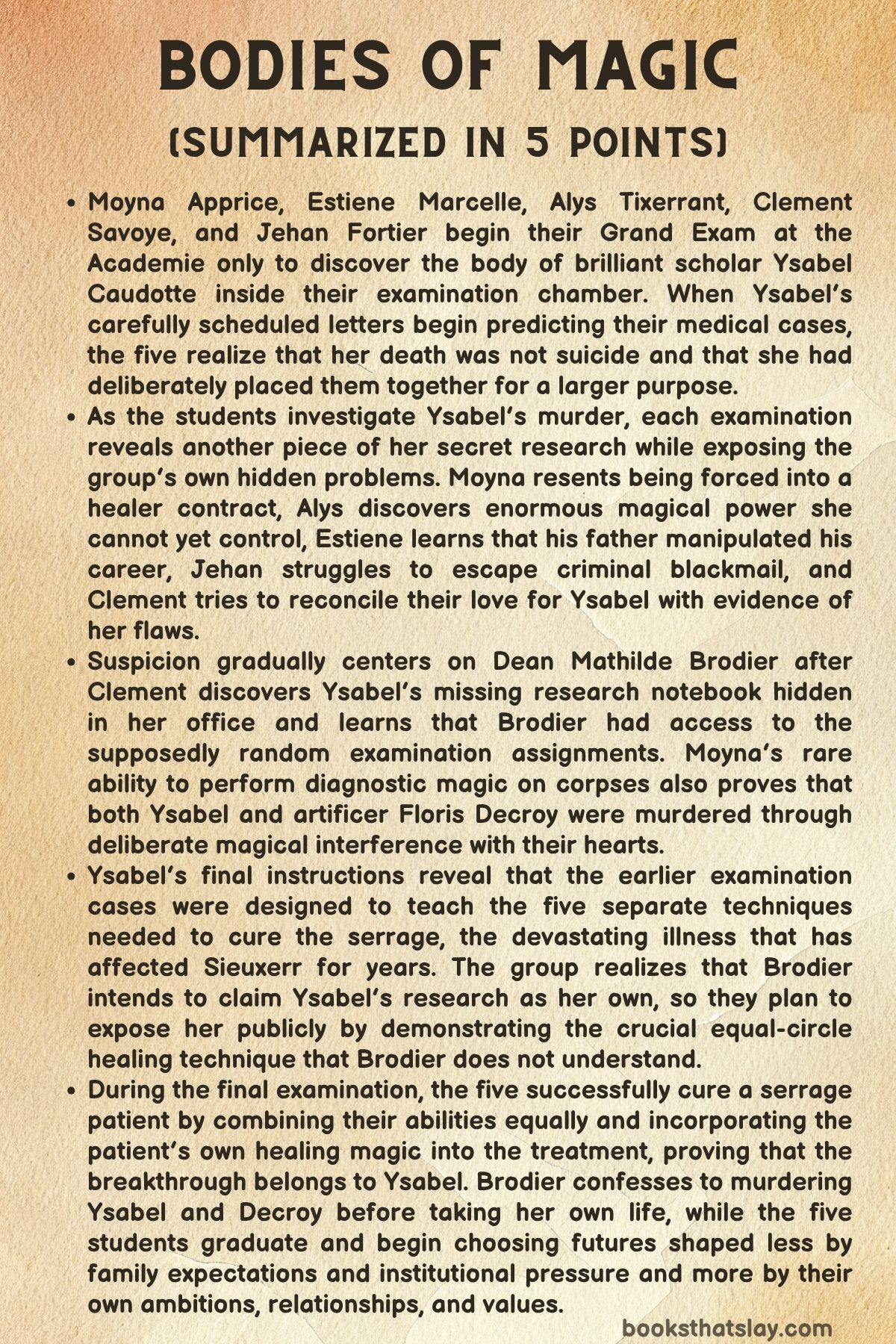
Five graduating scholars enter their Grand Exam expecting professional competition and instead discover the corpse of brilliant classmate Ysabel Caudotte. Her death connects academic politics, institutional corruption, medical ethics, romantic secrets, and experimental research into the devastating serrage illness. As the students investigate, the examination itself becomes part of Ysabel’s unfinished plan, forcing them to reconsider what healing means when talent, duty, ambition, and personal freedom are constantly placed in conflict.
Summary
Moyna Apprice begins Grand Exam week already dreading the future that graduation will make unavoidable. Raised in Sieuxerr by Camarran parents who deliberately settled there so their children might develop healing magic, Moyna has already been contracted to work in Greteford, and her excellence as a scholar only makes the unwanted future more certain.
Her examination group consists of ambitious Estiene Marcelle, wealthy but insecure Alys Tixerrant, reserved Clement Savoye, charismatic Jehan Fortier, and Moyna herself. Their first examination changes completely when they discover Ysabel Caudotte, the scholar expected to rank first in the graduating class, lying dead inside their examination chamber.
Because the chamber is magically sealed for the examination hour, the five must continue treating their assigned patient with Ysabel’s body nearby. Jehan identifies the patient’s illness as hare fever, and the group completes the treatment despite shock, arguments, and Estiene’s frustration at being outperformed.
When authorities finally arrive, a magical proctor geas prevents the students from discussing the examination freely until the entire Grand Exam has ended. The gendarmes initially lean toward suicide, but Clement refuses to accept that explanation, particularly after Dean Mathilde Brodier reveals that Ysabel had been conducting secret research.
The mystery deepens when Jehan receives a letter written by Ysabel before her death. The letter accurately predicts the medical problem their group has just faced and sends them to a prearranged meeting place, demonstrating that Ysabel knew details of the supposedly randomized examinations in advance.
The five begin investigating independently while continuing their examinations. Their search also exposes their own secrets, including the hidden relationship between Jehan and Estiene, the institutional pressure surrounding healer careers, and the unequal status of healers and ordinary medical professionals.
Clement, who had been Ysabel’s closest friend since childhood, searches desperately for her missing yellow research notebook. Their grief is complicated by memories of how Ysabel helped them escape a restrictive upbringing and recognize that healing magic could offer a life beyond the expectations of their family.
Alys, meanwhile, is revealed to be far less confident than her wealthy public image suggests. She barely qualified as a healer after childhood illness and years of magical treatment, and her unreliable relationship with magic has persuaded her that she is destined for a safe private practice rather than demanding work at the Hospital.
Estiene also discovers that his privileged position is less secure than he believed. His father, Head Healer Jourdain Marcelle, secretly pressured the Chancellor to guarantee Estiene a sufficiently high ranking to obtain a coveted Hospital position, leaving Estiene unsure how much of his success belongs to him.
Moyna has the opposite problem: she knows she is capable but does not want the career everyone assumes she should accept. She even admits privately that she recognized the first examination diagnosis before Jehan but stayed silent because failing would have delayed her graduation and therefore delayed her forced departure to Greteford.
The second examination involves Luisa, a young woman whose badly healed ankle requires painful reconstruction. Jehan uses an experimental technique called half-under to reduce her awareness without fully suppressing her bodily responses, while the rest of the group manages the difficult procedure successfully.
A second letter from Ysabel arrives immediately afterward and describes the same solution, including Jehan’s technique. The letters are now unmistakably intentional, and the group learns that Ysabel personally arranged their delayed delivery before she died.
Investigation into the Academie reveals that Brodier had access to the examination assignments before they were supposedly randomized. Alys and Estiene also learn that the institution is under severe financial pressure, faculty positions are being reduced, and wealthy families routinely influence academic decisions.
Alys reveals that Dean Saige once propositioned her under the guise of private tutoring and later allowed damaging rumors about her to spread when she rejected him. This disclosure forces Estiene to reconsider his assumptions about her and shows how easily institutional authority can shape a scholar’s reputation.
Clement and Moyna investigate artificer Floris Decroy, who was working near the examination area on the night Ysabel died. His guarded answers suggest that he knows more than he admits, while the building’s illusion curtains and incomplete nighttime security establish that someone could have killed Ysabel without being seen.
The group also learns that Ysabel was secretly involved with Crespin Thumery, a married senior diagnostician whose wife is pregnant. His affair supplies a possible motive, while tensions between Brodier and Saige introduce professional rivalry as another possibility.
Estiene then discovers Jehan’s most dangerous secret. Jehan has been participating in illegal fights controlled by Guion Blavot, who originally gained power over him because Jehan stole medical supplies while trying to repay debts created by his education.
Blavot eventually forced Jehan into fighting and illegal magical work by threatening to expose him. Ysabel discovered Jehan’s involvement before her death, giving her knowledge that could have destroyed his career, while Jehan hopes graduation and his contract in Mostau will finally place him beyond Blavot’s control.
The third examination reveals another part of Ysabel’s larger design. Alys attempts to treat a severe case of vermeil fever and pneumonia and discovers that she possesses extraordinary magical reserves, far greater than anyone had realized.
Her lack of control nearly causes catastrophic burnout, and Clement must forcibly interrupt the healing. Ysabel’s next letter confirms that she intentionally placed Alys in this examination group because she knew Alys’s hidden power would eventually be necessary.
Moyna then reveals an unusual talent she has concealed for years: unlike most healers, she can perform diagnostic magic on corpses without being overwhelmed by the sensation of death. This ability offers a possible way to determine whether magic contributed to Ysabel’s death.
At the same time, Konrad Omeyer explains that Ysabel previously manipulated him into participating in dangerous experimental healing, almost causing him to burn out. His account forces Clement to accept that the friend they loved was brilliant and generous but also capable of exploiting other people when scientific discovery mattered more to her than caution.
Moyna’s personal crisis becomes more severe when her family celebrates the very future she fears. Her parents see the Greteford contract as proof that their sacrifices have succeeded, while Moyna sees it as evidence that she has never been permitted to determine what her own life should become.
She confesses her deliberate silence during the first examination to Jehan, who reacts angrily because his own escape from Blavot depends on graduating. Before the group can fully resolve the betrayal, they learn that Estiene has been arrested for murder.
Estiene has been lured into a locked room where Floris Decroy sits dead with his throat cut. A bloody knife and the circumstances place Estiene directly beside the apparent murder weapon, creating an almost perfect frame.
The group concludes that Decroy may have witnessed something when Ysabel died and later tried to blackmail the killer. His murder would therefore remove a witness while placing suspicion on Estiene, whose family influence makes him an especially useful political target.
Further investigation weakens several alternative theories. Crespin admits the affair but has evidence placing him elsewhere when Decroy died, while Konrad eventually receives an alibi for the night of Ysabel’s death.
Attention increasingly turns toward Brodier. Clement notices her bitterness about professional hierarchy and later discovers Ysabel’s missing yellow notebook hidden inside Brodier’s locked desk, proving that the dean has lied about the research.
Moyna’s examination of Ysabel’s body produces a crucial breakthrough. She detects residual healing magic around Ysabel’s heart, suggesting that someone deliberately interfered with its rhythm before the fatal fall.
Decroy’s corpse contains an almost identical magical pattern even though his throat was visibly cut. Comparing both bodies with a genuine burnout victim confirms that the two deaths share a hidden method and were almost certainly committed by a healer.
Captain Thoury recognizes the importance of Moyna’s talent and offers her a possible career examining suspicious deaths for the gendarmerie. For the first time, Moyna can imagine using healing magic in a way she has freely chosen rather than simply fulfilling a contract designed by other people.
Alys also begins redefining her future. After learning more about Ysabel’s experimental group-healing techniques, she starts considering Hospital work and free-clinic shifts instead of automatically accepting the comfortable private practice expected by her family.
The fourth examination teaches the group another crucial technique. Treating a complicated traitor illness requires Estiene to direct shared magic while Jehan learns to surrender some control and support another healer’s lead.
Afterward, they open Ysabel’s largest letter. It reveals that the first four examination cases were deliberately chosen as lessons preparing them for the final challenge: developing a cure for the serrage.
Ysabel’s research combines everything the group has learned: identifying diffuse illness, using Jehan’s half-under technique, drawing upon Alys’s enormous magical reserves, overcoming resistant spasms, and working through an unconventional healing array in which authority is distributed equally. The group realizes that Brodier possesses most of the research and could claim the cure after Ysabel’s death, but the missing notebook page contains a crucial component Brodier may not understand.
Clement therefore proposes turning the final examination into a public trap. They will allow Brodier to claim ownership and then demonstrate the missing technique, proving that the work belonged to Ysabel rather than her supervisor.
During Lantern Night, the five finally begin functioning not merely as assigned classmates but as genuine friends. They talk about everything they would change within the healer system, including forced service, inequality, exhaustion, and the expectation that gifted healers should sacrifice themselves indefinitely for everyone else.
Jehan and Estiene also confront the misunderstanding that destroyed their relationship. Each believed the other considered their intimacy temporary, only to discover that both have been in love for years.
Their reconciliation is interrupted when Blavot has Jehan abducted to prevent him from attending the final examination. Because missing the exam could force the entire group to repeat the year, Blavot intends to keep Jehan trapped in Sieuxerr and dependent on him.
Estiene turns to the influence he once resented, asking Jourdain and his grandmother Marguerite to help. They bluff Blavot into believing Jehan has secretly been working with powerful authorities, destroying the criminal’s leverage and securing Jehan’s release, although Estiene promises his father greater cooperation in exchange.
The final examination takes place publicly in the Teaching Theatre. Their patient Perrin suffers from chronic serrage symptoms, and the first version of the cure initially seems successful before the illness rapidly returns.
Brodier responds by claiming the serrage treatment as her own research and ordering the students to try again. Clement has been waiting for exactly this moment.
During the second attempt, the five use Ysabel’s missing technique. Instead of arranging themselves in a hierarchy, they form an equal circle, perform every part of the working together, and eventually incorporate Perrin’s own healing magic into the treatment.
The cure succeeds. Brodier cannot explain the missing element because she never understood it, and Clement publicly exposes the difference between possessing Ysabel’s notes and actually creating the research.
Confronted by the evidence and by Ysabel’s mother Adala, Brodier finally confesses. She wanted recognition for the serrage cure, believed years of sacrifice entitled her to share the discovery, and killed Ysabel after Ysabel refused to give her authorship.
Decroy had learned enough to threaten her, so Brodier murdered him as well and attempted to frame Estiene. Rather than submit to arrest, she uses healing magic against herself and destroys her own heart.
The five scholars are ultimately declared to have passed the Grand Exam. Their success does not merely qualify them as healers; it allows each of them to reconsider futures that once seemed fixed.
Alys receives an opportunity to train for complex Hospital work, Moyna may exchange her Greteford contract for forensic service with Thoury, Clement plans to continue Ysabel’s research while working as a generalist, and Jehan and Estiene have finally acknowledged the life they want together. Clement and Alys also admit their growing feelings for each other, and the story closes as the graduating scholars join the feast-day concert with a new understanding that professional duty does not have to erase love, friendship, or choice.
Characters
Moyna Apprice
Moyna is one of the clearest examples of the conflict between ability and desire in Bodies of Magic. She is exceptionally competent at healing, quick enough to recognize the first examination diagnosis before Jehan, yet her talent has become a source of confinement because everyone around her treats it as a social resource rather than something belonging to her.
Her decision to remain silent about hare fever is morally serious because she risks the futures of her classmates in an attempt to delay her own graduation. Yet the action also shows how desperate she has become after years of being told that the sacrifice of her parents, the needs of Camar, and her contractual obligations matter more than her own wishes.
Moyna’s unusual ability to diagnose the dead eventually gives her a different relationship with healing. Captain Thoury’s job offer matters because it is the first professional possibility that feels chosen rather than assigned, transforming an ability she once hid into a potential source of independence.
Estiene Marcelle
Estiene begins Bodies of Magic with immense confidence in his intelligence, social position, and expected career, but that certainty collapses when he learns his father has interfered with his academic ranking. His crisis is therefore not simply fear of failure; it is the more disturbing possibility that even genuine talent can become impossible to distinguish from inherited privilege.
His skill remains real, as shown when he identifies the internal bleed at the Hospital and successfully contributes to difficult examination treatments. The more important development is that Estiene slowly learns to judge himself according to what he actually does rather than according to the Marcelle name.
His love for Jehan also forces him to question the future his family has designed. By the end, Estiene understands that wanting diagnostics and professional excellence does not require surrendering every personal relationship or allowing Jourdain to determine the shape of his adult life.
Alys Tixerrant
Alys’s development in Bodies of Magic is built around the difference between how other people perceive her and what she privately believes about herself. Wealth, beauty, social polish, and damaging sexual rumors make her appear privileged and confident, while years of magical instability have convinced her that she is barely competent enough to qualify as a healer.
The discovery that she actually possesses extraordinary magical reserves destroys the explanation she has used for years to understand her struggles. Her problem is not lack of power but lack of control, training, and confidence, all intensified by childhood illness and the institutional failure to understand what happened to her magic.
Alys’s near-burnout is frightening, but it ultimately expands rather than reduces her ambitions. She begins considering Hospital work, free-clinic service, and complex interventions, making her ending a rejection of the comfortable but limited role her family assumed she would accept.
Clement Savoye
Clement functions as the emotional and ethical center of Bodies of Magic because their loyalty to Ysabel drives much of the investigation while their growing understanding of her flaws prevents that loyalty from becoming blind idealization. Ysabel once gave Clement friendship, confidence, and an alternative to the restrictive Ferue environment of their childhood.
Her death therefore feels like the destruction of one of the foundations on which Clement built their adult identity. Their grief includes dissociation and a brief return to self-harming behavior, showing that old wounds remain close beneath the competent healer Clement has become.
Clement’s greatest development comes from accepting that Ysabel could be both loving and dangerously manipulative. That recognition allows them to defend her work without pretending she was perfect, and their final confrontation with Brodier becomes an act of justice based on evidence rather than idealized devotion.
Jehan Fortier
Jehan is among the most complicated figures in Bodies of Magic because charm, medical creativity, violence, secrecy, and deep loyalty coexist within him. His half-under technique shows genuine originality, while his illegal fighting reveals how fascinated he is by the physical limits of bodies and the possibilities of magical repair.
His involvement with Guion Blavot began through financial vulnerability rather than simple thrill-seeking. Trying to protect his family from educational debt leads to theft, which gives Blavot the leverage needed to trap him in progressively more dangerous work.
Jehan’s relationship with Estiene exposes his emotional insecurity beneath his confidence. He has loved Estiene for years yet assumes that someone from the Marcelle family could never build a serious future around him, so their eventual reconciliation depends on both men abandoning the assumptions they have substituted for honest conversation.
Ysabel Caudotte
Ysabel remains central despite dying before the main investigation begins. Her intelligence, ambition, foresight, and extraordinary research ability shape nearly every examination case, while her scheduled letters allow her intentions to continue affecting the group after her death.
She is neither an uncomplicated victim nor a flawless genius. Konrad’s account demonstrates that she could manipulate others and accept dangerous risks when discovery mattered to her, while her decision to use the Grand Exam as the proving ground for an experimental serrage cure places enormous responsibility on classmates who never agreed to participate.
At the same time, her research has the potential to transform countless lives. Her refusal to surrender authorship to Brodier ultimately costs her life, making her death inseparable from questions about intellectual ownership, mentorship, ambition, and the price institutions can place on recognition.
Mathilde Brodier
Brodier is effective as an antagonist because her corruption develops from qualities that initially appear admirable. She is hardworking, medically competent, devoted to healing, and accustomed to continuing through exhaustion because patients still need treatment.
Her tragedy lies in allowing sacrifice to become entitlement. After years of overwork and professional frustration, she convinces herself that seniority and suffering give her a moral claim over Ysabel’s discovery, even though Ysabel created the crucial research.
Her murder of Ysabel turns professional resentment into an irreversible moral failure, while Decroy’s murder shows that the first crime is not an isolated loss of control. Her suicide by deliberately destroying her own heart is a final misuse of the same healing knowledge to which she devoted her life.
Jourdain Marcelle
Jourdain embodies the destructive side of parental ambition and institutional influence. He genuinely wants Estiene to succeed, but his concept of love is so closely tied to control that he manipulates rankings, pressures officials, and arranges professional outcomes without considering what those actions do to his son’s confidence.
His behavior after Estiene’s arrest makes the problem especially clear. Instead of beginning with emotional concern, he concentrates on reputation, political protection, and preventing professional consequences.
Yet Jourdain is not presented as entirely without loyalty. When Estiene asks for help rescuing Jehan, Jourdain uses his power effectively, showing that influence itself is not the moral problem; the issue is whether it is used to dominate another person’s life or protect someone from exploitation.
Alys and Clement’s Relationship
Alys and Clement develop intimacy through attention rather than dramatic declarations. Clement sees beyond the sexual rumors surrounding Alys, while Alys recognizes in Clement a person whose gentleness does not require her to perform social confidence.
Their connection deepens after Alys’s near-burnout, when Clement helps her recover without treating her fear as weakness. The final kiss is therefore the culmination of trust built through medical care, music, shared investigation, and the gradual discovery that both can be known without being judged by the roles others imposed upon them.
Guion Blavot
Blavot represents exploitation operating outside respectable institutions while taking advantage of the vulnerabilities those institutions create. Jehan becomes useful to him because Academie education is expensive, healer labor is tightly regulated, and punishment for misconduct could destroy Jehan’s freedom.
Blavot’s control depends less on physical force than on accumulated leverage. He understands that Jehan’s fear of exposure, delayed graduation, and extended bonded service can be more effective than chains.
His attempt to prevent Jehan from attending the final examination demonstrates how well he understands bureaucratic rules. He weaponizes the Academie’s rigidity against a scholar who is already trapped by debt and professional regulation.
Captain Augustin Thoury
Thoury initially appears hostile because of his distrust of the Marcelle family and his willingness to treat Estiene as a convenient suspect. His attitude creates legitimate concern that prejudice against privilege may distort the investigation as easily as privilege itself can.
His response to Moyna’s evidence, however, reveals professional flexibility. Once she demonstrates that Ysabel and Decroy share the same hidden magical injuries, he recognizes the value of her expertise instead of dismissing an unconventional method.
His offer of gendarmerie work also becomes crucial to Moyna’s future. By seeing a professional use for an ability other institutions never valued, Thoury helps create a path in which her magical talent and personal choice can coexist.
Konrad Omeyer
Konrad demonstrates the dangers of academic ambition pushed beyond safe limits. His previous near-burnout gives the story a living example of what happens when healers are encouraged to treat their bodies as expendable instruments.
His resentment toward Ysabel is justified by the fact that she manipulated him into a dangerous experiment. At the same time, he is capable of helping Alys recover by sharing what he learned from his own suffering.
Konrad therefore complicates the investigation rather than serving merely as a suspect. His history forces the group, especially Clement, to acknowledge that a person can be harmed by someone they loved without making either relationship entirely false.
Floris Decroy
Floris initially seems suspicious because of his evasiveness about working near the Rondelle on the night Ysabel died. His resentment toward healers also reflects a broader social divide between magically privileged medical workers and artificers who remain overworked, underpaid, and comparatively powerless.
His eventual death reveals that secrecy does not necessarily indicate guilt. The evidence suggests that Floris probably witnessed or discovered something connected to Ysabel’s murder and attempted to use that knowledge against the killer.
His murder also becomes the mechanism through which Estiene is framed. Floris therefore changes from apparent suspect to secondary victim, emphasizing how quickly incomplete information can distort judgment.
Crespin Thumery
Crespin provides one of the investigation’s most obvious motives because his affair with Ysabel could have destroyed his marriage and reputation. Ysabel’s threat to reveal the relationship makes him a credible suspect from Clement’s perspective.
His eventual alibi demonstrates the danger of equating immoral behavior with murder. Crespin has betrayed his wife and accepted a secret relationship with a student, but those failures do not make him responsible for Ysabel’s death.
Rogier Saige
Saige represents another form of institutional corruption. His proposition to Alys and the damaging rumors that followed her rejection show how a senior academic can use status to punish a student who refuses him.
Professionally, he is politically skilled, well connected, and confident that his broad network will secure the consolidated dean position. His success within the system contrasts with Brodier’s resentment, helping explain why she feels increasingly invisible despite years of work.
Secretary Lefer
Lefer provides the students with a clearer understanding of the Academie’s financial and political reality. Through her, they learn about funding problems, faculty restructuring, pressure from influential families, and Brodier’s access to supposedly randomized examination assignments.
She functions as an important source of institutional knowledge. Her information helps transform the students’ suspicions from personal speculation into a broader understanding of how easily administrative systems can be manipulated.
Colette Fortier
Colette is important to Jehan’s background because her position as a senior medic places her inside the medical system without giving her the magical status enjoyed by healers. Her professional tension with Jourdain illustrates the unequal hierarchy between medical knowledge and magical healing.
Her financial limitations also help explain Jehan’s vulnerability. The money borrowed for his education becomes part of the chain of circumstances that eventually brings him under Blavot’s control.
Jammetta Tixerrant
Jammetta represents the comfortable social expectations surrounding Alys. She assumes her daughter will use healing magic within an affluent private practice while continuing the social responsibilities associated with the Tixerrant family.
Her inability to understand why Alys might prefer Hospital or clinic work reveals the distance between charitable respectability and direct service. Alys’s growing independence therefore requires challenging not cruelty from her mother, but a limited vision of what a privileged daughter should want.
Adala Caudotte
Adala carries the long-term consequences of the serrage in her own body. Chronic spasms and the difficulty of treating a healer whose magic interferes with outside healing make her suffering personally connected to Ysabel’s research.
Her decision to return to the Academie for the final demonstration carries enormous emotional significance. She is not only witnessing her daughter’s scientific achievement but confronting the woman who killed her.
Adala also gives Clement an important warning about professional isolation. Her belief that family and love must be consciously protected challenges the healer culture that treats endless work as the highest form of devotion.
Tiphaine Caudotte
Tiphaine is less prominent than Adala but remains part of the family context that shaped Ysabel. Her grief reminds Clement that the murder has consequences beyond academic competition and scientific ownership.
Together, Ysabel’s mothers prevent the investigation from reducing her death to an institutional problem. Ysabel was a researcher and scholar, but she was also a daughter whose absence permanently alters a family.
Symon Apprice
Symon provides an important contrast to Moyna because he genuinely wants the healer future that she resents. His enthusiasm demonstrates that the profession itself is not inherently oppressive; the central problem is the removal of meaningful choice.
His support at the end is equally important. When Moyna considers defying the plans her parents made for her, Symon does not interpret her rejection of Greteford as an attack on his own ambitions.
Ellyn Apprice
Ellyn represents the freedom Moyna associates with failing to manifest healing magic. Because Ellyn did not qualify as a healer, she escaped the contracts and social obligations imposed on her siblings.
Moyna’s envy of her is deliberately ironic. In a society that treats healing magic as a gift and privilege, the person without that gift may possess greater control over her own future.
Marguerite Marcelle
Marguerite embodies the formidable authority of the Marcelle family without being tied as directly as Jourdain to Estiene’s daily control. Her participation in Jehan’s rescue shows how social power can be redirected toward protection.
Her command that Jehan and Estiene return to the Academie and pass the examination is both practical and revealing. She accepts the immediate reality more efficiently than Jourdain, helping resolve a crisis without turning the moment into another argument about reputation.
Chancellor Morant
Morant represents the upper level of an institution vulnerable to private pressure. Jourdain’s ability to influence him demonstrates that official academic procedures cannot be assumed to be fair merely because they appear formal.
His role contributes to Estiene’s crisis of confidence. The possibility that administrative decisions were adjusted for the Marcelle family makes even legitimate achievement feel contaminated.
Lysande Coran
Lysande initially appears relevant because she is another strong contender for Dux Scolaris and could theoretically benefit from removing Ysabel. The investigation quickly establishes her alibi, removing her as a serious suspect.
Her brief role nevertheless demonstrates how competitive academic structures encourage suspicion. When success is organized around rankings, another scholar’s death can immediately be interpreted in terms of who gains professionally.
Genevieve Balenne
Genevieve and her study group preserve an important piece of Ysabel’s experimental work. Their recollection of an equal, synchronized healing technique helps prove that Ysabel’s real research extended far beyond the echo-headache project Brodier claimed she was conducting.
For Alys, Genevieve also represents the friendship she largely missed during her own years at the Academie. Observing the younger students’ closeness makes Alys understand more clearly how isolated she has allowed herself to become.
Anero
Anero assists Clement in the final stages of the investigation by providing information about Floris and access to Brodier’s office. Her willingness to lend a master key demonstrates that dissatisfaction among artificers does not prevent individual cooperation with healers.
She also helps expose the missing notebook. Without access to Brodier’s office, Clement would not obtain the strongest evidence that the dean lied about Ysabel’s research.
Girard
Girard is the first Grand Exam patient and the person through whom the students demonstrate that they can still function medically while facing extreme psychological shock. His hare fever case also becomes the first building block in Ysabel’s larger plan.
His presence is especially important to Moyna’s moral conflict. Her deliberate decision not to reveal the diagnosis shows how badly she wants to escape her predetermined future.
Luisa
Luisa’s damaged ankle creates the problem that allows Jehan’s half-under technique to become central to the examinations. Her successful treatment proves that experimental methods can have immediate practical value when applied carefully.
The case later becomes one of the components of the serrage cure. What initially appears to be an isolated orthopedic challenge is eventually revealed as deliberate preparation for something much larger.
Madame Alietta
Alietta’s severe illness exposes Alys’s hidden magical strength. Treating her pushes Alys beyond the limits of her control and nearly causes burnout.
The case therefore functions as both failure and discovery. The patient is not completely cured, but the experience reveals a capacity that changes how Alys understands herself.
Urzula
Urzula’s complicated traitor illness teaches the group how to confront a body that aggressively preserves a harmful physical state. Her case also requires collaborative healing in which Estiene leads and Jehan learns to support rather than control the working.
That lesson becomes essential to the final serrage treatment. The medical challenge therefore contributes both technical knowledge and interpersonal preparation.
Perrin
Perrin is the final examination patient and the person on whom Ysabel’s research is publicly tested. As a healer suffering from chronic serrage symptoms, Perrin embodies the population Ysabel hoped to help.
The temporary failure of the first treatment and complete success of the equal-circle technique turn Perrin’s body into the decisive evidence in the confrontation with Brodier. The cure succeeds not because of one extraordinary healer but because several healers and the patient participate together.
Themes
Freedom, Obligation, and the Right to Choose
Healing magic creates extraordinary possibilities while also allowing society to claim ownership over the people who possess it. In Bodies of Magic, characters repeatedly discover that being gifted does not necessarily make them free: Moyna is contracted to Greteford, Jehan fears extended bonded service, Alys is pushed toward a socially approved private practice, and Estiene is expected to follow the Marcelle career path whether or not it matches the rest of the life he wants.
Moyna expresses this conflict most directly because she does not lack ability, compassion, or intelligence. What she rejects is the assumption that those qualities give other people the right to determine where she lives, whom she serves, and what profession must define her entire adulthood.
The novel does not argue that obligation has no value. The characters repeatedly choose to treat patients, protect one another, complete the serrage cure, and accept difficult responsibilities, but those choices become meaningful precisely because they are increasingly voluntary.
By the ending, professional purpose becomes healthiest when separated from coercion. Moyna may use healing in forensic investigation, Alys chooses more difficult medical work, Clement chooses to continue Ysabel’s research, and Estiene begins separating genuine ambition from the future arranged by his father.
Institutional Power and the Cost of Hierarchy
The Academie and Hospital are not portrayed as simply corrupt organizations. They save lives, educate healers, preserve knowledge, and support important research, yet their structures also reward status, secrecy, endurance, political influence, and social privilege.
Jourdain can pressure administrators because of his position, Saige can damage Alys after she rejects him, and Brodier can hide Ysabel’s notebook because supervisors possess authority over scholars. Artificers meanwhile work under poorer conditions despite supporting the same institutions, while nonmagical medical staff remain professionally subordinate to healers.
The final healing method provides a direct alternative to this hierarchy. Ysabel’s crucial innovation requires the healers to abandon a structure in which one person directs everyone else and instead work as equals while including the patient’s own magic.
That technique carries symbolic force beyond medicine. The system that produces Brodier’s resentment is obsessed with rank, seniority, authorship, prestige, and sacrifice, while the successful cure depends on shared authority and mutual participation.
The story therefore connects institutional reform with medical innovation. Better healing becomes possible when the characters stop reproducing the hierarchy that trained them.
Ambition, Recognition, and Intellectual Ownership
Ambition drives both extraordinary achievement and destructive behavior throughout Bodies of Magic. Ysabel wants to create something revolutionary, Estiene wants to prove his diagnostic ability, Alys gradually rediscovers ambitions she had abandoned, and Brodier believes years of sacrifice should finally produce professional recognition.
The conflict between Ysabel and Brodier becomes dangerous because mentorship and authorship are not the same thing. Brodier may have supervised the research, provided access, and built a long career in healing, but those contributions do not automatically make Ysabel’s discovery hers.
Brodier’s bitterness becomes morally catastrophic when she begins treating sacrifice as a form of ownership. She believes that because she has worked longer, endured more, and faces professional displacement, she deserves part of Ysabel’s achievement regardless of what Ysabel wants.
Ysabel herself is not free from dangerous ambition. Her treatment of Konrad and her decision to construct an elaborate Grand Exam experiment show that she can also prioritize discovery over other people’s safety.
The difference is ultimately one of boundaries. Ambition becomes productive when it motivates disciplined work and discovery, but it becomes destructive when people begin regarding colleagues, students, patients, or research as things they are entitled to control.
Healing, Vulnerability, and Mutual Dependence
Healing initially appears to be an individual magical skill, but the story gradually redefines it as an act that depends on trust, cooperation, and recognition of limits. Alys nearly destroys herself because possessing extraordinary power is not the same as knowing how to use it safely, while Konrad’s history demonstrates what happens when institutional culture glorifies pushing beyond physical limits.
The group succeeds when its members begin compensating for one another rather than competing over who is strongest. Clement grounds Alys during burnout, Moyna uses a diagnostic ability others lack, Jehan contributes an experimental technique, Estiene learns when to lead, and every member eventually participates equally in the final cure.
Emotional healing follows the same pattern. Jehan and Estiene cannot repair their relationship until they admit vulnerability, Alys begins overcoming isolation through Clement and the group, and Moyna can imagine a different future only after telling others what she actually wants.
Ysabel’s final technique makes this principle literal by incorporating Perrin’s own healing magic into the cure. The patient is no longer a passive body acted upon by experts but an active participant in recovery.
The book ultimately presents dependence not as weakness but as a necessary condition of sustainable care. People become stronger when responsibility is shared, limits are respected, and healing includes the humanity of both the person receiving care and the person providing it.