Bones by K. L. Speer Summary, Characters and Themes
Bones by K. L. Speer is a post-apocalyptic fantasy centered on a young healer whose extraordinary ability has repeatedly turned her into property in the eyes of powerful people.
After surviving childhood exile, years of abuse, captivity, and exploitation, Bones enters a new settlement where kindness and coercion exist side by side. Her story is as much about learning the meaning of choice, trust, family, and self-worth as it is about supernatural power. Through her relationships with Trey, Mac, and the people of the Vault, she slowly begins questioning the survival rules that have controlled her life since childhood.
Summary
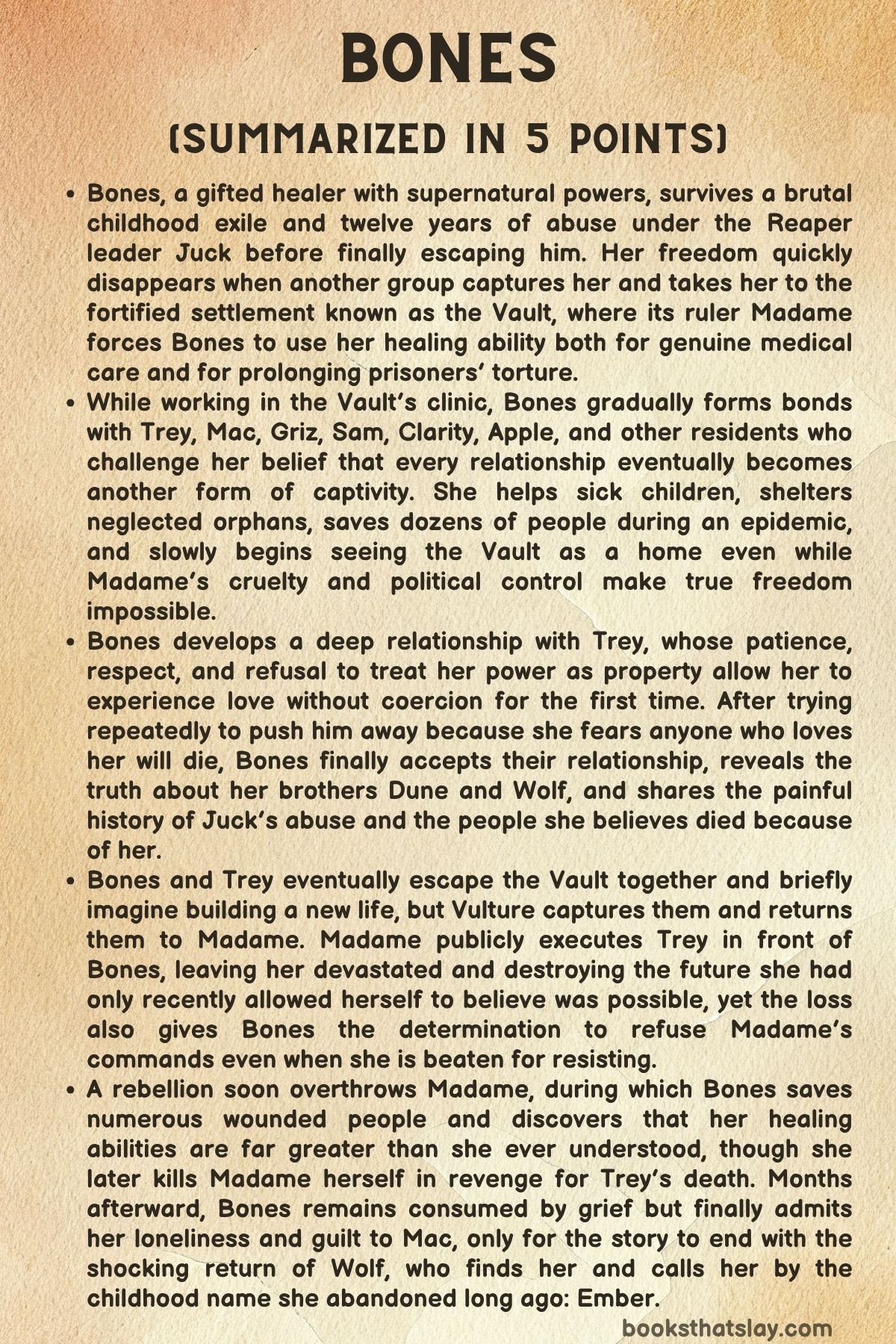
Bones’s life as Bones begins when she is ten years old, starving and wounded in the desert after fleeing the home she once knew. Three members of a violent gang called the Reapers discover her, and their leader, Juck, immediately tests her claim that she can heal by shooting one of his own men and ordering the girl to save him; when she succeeds through supernatural means, Juck takes possession of her and gives her the name Bones, beginning twelve years of exploitation.
At twenty-two, Bones has finally escaped Juck, but freedom lasts only briefly before mercenaries capture her. Another armed group attacks the building where she is imprisoned, and Bones meets Trey, who is fatally wounded while trying to help her; despite her instinct to trust no one, she heals him completely, revealing the secret that makes her valuable to everyone who learns it.
Trey’s companions take Bones to the Vault, a fortified mountain settlement ruled by Madame. Bones quickly discovers that her new environment offers better food, medical work, and occasional kindness, but Madame also regards her ability as a resource and proves this by repeatedly forcing Bones to heal prisoners during torture so their suffering can continue.
The experience confirms Bones’s fear that she has merely exchanged one captor for another. She decides to cooperate long enough to learn the Vault’s routines and eventually escape, even as Mac’s crew—Trey, Griz, Sam, Raven, Jax, and others—gradually complicates her belief that everyone who controls her circumstances must necessarily wish to harm her.
Working in the clinic gives Bones something she was rarely allowed to experience under Juck: the freedom to heal ordinary people simply because they need help. She treats sick children, injured workers, brothel employees, and residents who would otherwise receive little care, and she begins forming relationships with people who respond to her compassion with gratitude rather than demands.
Her growing sense of safety is shattered when guards Dale and Pike attack her after Lana deliberately abandons her post. Mac and Trey intervene, and the offenders are exiled, yet the assault reinforces Bones’s conviction that safety is temporary and that promises of protection cannot prevent violence.
Trey nevertheless remains close without forcing intimacy upon her. He asks permission before touching her, sleeps outside the clinic when she is afraid, gives her practical protection without treating her as property, and slowly teaches Bones that care can exist without a hidden price.
The Vault itself becomes increasingly important to Bones. She learns its social divisions, meets neglected children, becomes close to Apple, and eventually negotiates a system in which the orphans can work as clinic messengers in exchange for food and shelter; what begins as a practical arrangement slowly forms a household around her.
When disease spreads through the settlement, Bones works nearly without rest. She heals the wealthy and poor alike, repeatedly drives herself into magical exhaustion, saves Clarity and many others, and earns genuine respect from residents who had previously viewed her with suspicion or fear.
Her relationship with Mac also changes during the epidemic. He admits that bringing her to the Vault was the price he paid to stop Madame from executing Trey, allowing Bones to recognize that Mac, too, has made terrible choices under coercion and that his apparent authority has always existed within Madame’s larger system of control.
Bones’s relationship with Trey grows more intimate, but her fear of losing him becomes almost as powerful as her affection. Convinced that people who care for her eventually die, she deliberately wounds him emotionally, becomes involved with Zip, and tries to make Trey believe their connection means nothing.
Her attempts at distance fail because Trey understands that fear is driving her actions. When Zip later becomes violent toward Apple and Bones, Trey intervenes, while Bones’s own instinct to protect a condemned teenage girl named Sky leads her into Madame’s execution pit, where she nearly dies fighting Brimstone.
The confrontation reveals important changes in Bones’s abilities. She discovers that she can channel healing through another person, heal herself under extreme conditions, and even project her power across a distance, suggesting that years of fear and imposed limitations have prevented her from understanding what she can truly do.
Madame punishes Bones by locking her in total darkness beneath the watchtower. Nearly a week of cold, thirst, hunger, and isolation breaks through her defensive control, but Mac secretly visits her and encourages her to stop treating emotional collapse as weakness; when Madame eventually releases her and orders Mac whipped instead, Bones insists on receiving his punishment herself.
After the whipping, another threat from Bones’s past becomes impossible to ignore. A mysterious powered man can invade her mind when she is drugged, has discovered where she lives, and has seen Trey through her memories, convincing Bones that remaining at the Vault will eventually bring disaster to everyone she loves.
She plans an escape, but Trey secretly joins her when she hides inside a logging sleigh. Once they are beyond the settlement, Zip discovers them and attempts to force Bones back to Madame; Trey kills him, then confronts Bones about her constant willingness to trade her own safety for other people’s lives.
During their journey through the mountains, Trey finally tells Bones directly that he loves her. Bones responds by revealing the truth about the powerful figure pursuing her, and Trey refuses to leave despite the danger, insisting that she must stop taking everyone else’s choices away simply because she believes sacrifice is the safest solution.
Their time alone allows Bones to experience ordinary intimacy for perhaps the first time. Trey asks about her favorite foods, colors, animals, and memories, treating details of her personality as valuable in themselves, and Bones eventually stops denying her attraction and accepts that she wants a life with him.
Bones then begins telling Trey the history she has concealed. Her eldest brother Wolf raised her after their mother died, while her other brother Dune encouraged her supernatural ability; when Dune deliberately injured himself so Bones would heal him, something went catastrophically wrong and her power appeared to kill him instead.
Wolf believed Bones had murdered Dune, and her father expelled her into the desert at only ten years old. Bones also tells Trey about Juck’s repeated sexual violence, the death of Rally after a failed childhood escape attempt, and the guilt that has convinced her for years that everyone who becomes involved with her suffers.
Trey becomes the first person to accept the full story without reducing Bones either to a victim or a monster. He does not deny that some of her decisions have harmed people, but he distinguishes choices made under terror and coercion from deliberate cruelty and repeatedly reminds her that her instinct has always been to preserve life whenever she is free to choose.
At a remote trading post, Bones and Trey briefly live under false names and experience a peaceful version of the future they want. Bones heals the owner’s chronically ill son Roe despite the danger of revealing herself, while Trey again emphasizes that her gift belongs to her and that even he has no right to dictate how she uses it.
Their attempt to continue west ends when wolves attack near a dam and an armed group rescues them. The group is led by Vulture, Juck’s former lieutenant, who survived Bones’s earlier abandonment and has tracked her because Madame placed a bounty on her.
Vulture returns Bones and Trey to the Vault. Before the gathered community, Madame forces Trey to his knees and executes him with a gunshot to the head despite Bones offering anything in exchange for his life; Bones desperately attempts to heal him, but her power cannot restore someone who is already dead.
Trey’s murder destroys the emotional progress Bones has made. Chained inside the clinic, she stops caring whether she lives, until Madame again orders her to participate in torture; this time Bones refuses repeatedly, enduring a beating without surrendering and finally promising Madame that she will never use her gift for her again.
The resistance soon launches an uprising. Griz kills Vulture, Bones returns to the fighting as a healer, and even in the middle of civil conflict she continues making individual decisions about whom she will save rather than allowing either side to claim ownership of her power.
When Griz and Jax are simultaneously dying, Bones heals both at once and releases an enormous burst of golden energy that also saves numerous other people nearby. After awakening days later, she learns that Madame has been overthrown, Nemo now leads the Vault, the children are safe, and her final act healed fifteen people at once.
None of these victories removes Bones’s grief. She enters Madame’s cell alone and fulfills her earlier promise by cutting her throat, refusing to heal her and watching her die; although the community had already decided Madame would be executed, Bones’s private act shows how profoundly Trey’s death has changed her relationship with violence.
The Vault begins reforming under Nemo, with food and housing becoming more fairly distributed. Bones learns that her medical work, defense of Sky, survival of Madame’s punishments, and refusal to treat poor residents as disposable had made her an unintended symbol of resistance, while Trey himself had secretly supported the rebellion.
Months later, emotional numbness gives way to rage and open grief. At Trey’s grave, Bones finally accepts that he will not return, and Mac helps her admit that she feels responsible for his death, resents him for making her love him, and fears that vengeance has transformed her into someone like Madame.
Mac refuses to let Bones isolate herself and assures her that she still belongs to a family that chooses to remain with her. The fragile possibility of recovery is interrupted immediately afterward when a stranger grabs her in the dark, calls her by her forgotten childhood name, Ember, and reveals himself through familiar green eyes as Wolf—the brother Bones believed lost to her for twelve years.
Characters
Bones
Bones, whose original name is Ember, is the emotional and moral center of the book. In Bones, her healing power functions almost like a curse for much of her life because other people repeatedly treat her ability as more important than her humanity.
Her defining instinct is preservation: she saves Trey after barely meeting him, treats strangers without discrimination, protects children, heals enemies during the uprising, and repeatedly harms herself rather than permit another person to suffer. That compassion is genuine, but it has been distorted by guilt until self-sacrifice becomes almost compulsive.
Bones also survives by controlling information, anticipating danger, manipulating people, and concealing vulnerability. These habits helped her endure Juck, but they damage her later relationships because she often assumes she has the right to decide what dangers other people may accept on her behalf.
Her development is therefore not simply about learning to trust others. It is about learning that love requires respecting another person’s agency just as strongly as she demands control over her own.
Trey’s death temporarily destroys that progress, and killing Madame reveals a darker side of Bones that she herself fears. Yet the ending does not present her as permanently consumed by vengeance, because her breakdown with Mac proves she can still admit fear, anger, guilt, and loneliness rather than burying them behind survival instincts.
Trey
Trey represents the possibility of intimacy without ownership, making him one of the most important forces in Bones. From the beginning, his behavior repeatedly contradicts Bones’s expectation that kindness is merely another method of gaining power over her.
He treats her wounds, brings food she can tolerate, respects physical boundaries, sleeps near the clinic when she is afraid, and refuses to exploit what she reveals while delirious. His patience is particularly important because Bones has spent years learning that vulnerability invites violence.
Trey is not simply a romantic rescuer. He challenges Bones directly when she manipulates him, uses Zip to create emotional distance, or offers herself as payment for his safety, because he understands that her self-sacrifice can become another form of controlling everyone around her.
His love gives Bones an experience of being wanted independently of her supernatural value. His execution is therefore devastating not only because she loses a lover but because the future he represented—a life based on choice rather than fear—is apparently destroyed in front of her.
Mac
Mac begins as a morally ambiguous captor but develops into one of Bones’s strongest familial relationships. His role in Bones demonstrates how people trapped inside oppressive systems can make compromises that are both understandable and harmful.
He brings Bones to the Vault knowing Madame wants her ability because retrieving Juck’s secret weapon is the condition that saves Trey from execution. Bones has every reason to resent him, yet the epidemic eventually reveals the guilt beneath his authority and allows her to see that his decisions were made under coercion rather than indifference.
Mac gradually stops treating protection as a command and begins offering emotional support. His visit during solitary confinement is particularly important because he allows Bones to collapse without demanding strength from her, and his later conversation at Trey’s grave helps her recognize that grief is shared rather than uniquely hers.
By the end, Mac effectively becomes the older-brother figure Bones has lacked since childhood. His promise that she is both crew and friend gives the word belonging a meaning very different from possession.
Madame
Madame is the clearest institutional antagonist in Bones, exercising control through dependence, fear, punishment, and carefully staged cruelty. Unlike Juck’s chaotic brutality, her violence is tied to government, law, economic hierarchy, and public authority.
Her treatment of Bones reveals her worldview particularly well. She does not need to hate Bones personally; she simply regards a useful human being as an asset whose body and ability may be commanded whenever the community’s ruler decides they are necessary.
Madame’s torture sessions also transform healing into an instrument of suffering. By forcing Bones to repair prisoners so they can be harmed again, she corrupts an ability associated with mercy and attempts to make Bones morally complicit in her regime.
Her execution by Bones is therefore both revenge and the final destruction of Madame’s personal power over her. Still, Bones’s emotional emptiness afterward prevents the killing from functioning as a clean victory.
Wolf
Wolf exists through most of Bones as memory, imagined voice, lost brother, and internal survival instructor. Bones has carried his lessons so deeply that she initially experiences his critical voice almost as if he remains physically present beside her.
As her relationships with the Vault community become stronger, that imagined voice weakens. This suggests that Wolf has served psychologically as both protection and imprisonment, keeping Bones alive while reinforcing the belief that vulnerability and attachment are dangerous.
His importance becomes even greater after Bones reveals what happened to Dune. Wolf believed she had killed their brother, meaning that the person whose survival lessons sustain her is also associated with one of her greatest fears: rejection by the family member she trusted most.
The ending radically changes his role by revealing that Wolf is alive and has located her. His use of the name Ember immediately reconnects Bones with an identity she believed had died in childhood.
Juck
Juck is the person who converts Bones’s childhood vulnerability into years of captivity. He gives her the name by which she comes to know herself, controls when she may use her healing ability, starves her as punishment, sexually assaults her, brands her, and interprets her gift through his religious obsession.
His most damaging influence is psychological. Bones learns from him that affection carries conditions, power determines morality, and anyone who discovers her ability will eventually try to possess it.
Even after his death, Juck therefore continues shaping her behavior. She compares other leaders to him, expects generosity to conceal demands, fears emotional closeness, and interprets protection through the language of ownership.
Bones killing Juck allows her physical escape but does not end his power over her thinking. Much of her later development involves separating the lessons she needed to survive him from the beliefs that prevent her from actually living.
Vulture
Vulture begins as the teenager who helps give Bones her new identity and eventually becomes a complicated link between her Reaper past and the life she tries to build afterward. He knows about her ability, becomes involved in Juck’s internal power struggle, and later exposes the secret that contributes to the destruction of the gang.
Bones feels guilt toward Vulture because she manipulated him and ultimately left him wounded during her escape. That guilt makes their later reunion more complicated than a simple confrontation with an enemy.
Yet Vulture’s decision to capture Bones for Madame and allow Trey to be taken back to the Vault destroys whatever claim he might have had upon her sympathy. His death during the rebellion mirrors the first time Bones abandoned him, except she now consciously refuses to save him.
Griz
Griz develops into one of Bones’s most dependable allies. Initially part of the group that captures her, he gradually becomes a steady presence in the clinic, during dangerous missions, and throughout the uprising.
His loyalty is practical rather than sentimental. He protects Bones, carries information, accepts her unusual decisions, and later risks his life fighting beside her when the resistance finally moves against Madame.
When Griz and Jax are both mortally wounded, Bones’s attempt to heal them simultaneously leads to one of the greatest expansions of her power. His survival consequently becomes connected to the moment when she realizes her abilities are far greater than anyone, including herself, understood.
Sam
Sam offers Bones another version of uncomplicated loyalty. He rushes to help when nightmares make him believe she is being attacked, treats the clinic as a safe place, jokes with the crew, and becomes part of the informal family she initially refuses to admit she wants.
His most important role comes when Bones accidentally channels healing through him to save herself. Sam is severely weakened, and the event reminds her that even her power can endanger someone she cares about.
His later anger at her emotional withdrawal after Trey’s death is rooted in attachment rather than judgment. By returning, embracing her, and refusing to let her disappear inside grief, Sam reinforces the idea that family can remain present even when Bones cannot offer anything in return.
Raven
Raven is initially one of the more openly skeptical members of Mac’s crew. She resents how much attention and manpower must be devoted to guarding Bones and later criticizes Bones for the way she treats Trey.
Her harshness often makes her uncomfortable for Bones to deal with, but it also differentiates genuine community from unquestioning devotion. Raven does not need to idealize Bones in order to become loyal to her.
Later, Raven helps care for Bones after Madame’s whipping and remains concerned about her after the rebellion. Her development demonstrates how trust within the crew is earned through shared experience rather than demanded by authority.
Apple
Apple is one of the neglected children who gathers around Bones’s clinic. Her attachment to Bones transforms the clinic from a workplace into something resembling a family home.
Apple also becomes an important moral mirror. When she defends Bones against Zip and is struck for doing so, Bones responds by cruelly driving her away because she believes emotional rejection will keep the child physically safe.
Trey later points out that Apple is learning from Bones’s behavior. If Bones continually demonstrates that loving someone means sacrificing herself without limit, Apple may absorb the same destructive lesson.
After Trey’s death, Apple quietly returns to the clinic and attempts to help in the ways Trey once did. Her presence reminds Bones that grief has not erased the relationships she created.
Clarity
Clarity is Trey’s half-sister and one of the first women to offer Bones intimate care without judgment. She provides a place for Bones to recover after magical burnout and later becomes an important source of information about Trey’s history and family.
Her life at the brothel complicates Bones’s instinct to divide people into those who need rescue and those who perform the rescuing. Clarity has suffered economic coercion, yet she has also formed relationships and a community she considers meaningful.
Bones’s offer to provide medical care to the brothel workers strengthens their bond. Clarity later seems unusually perceptive about Bones’s intentions, recognizing her plan to leave the Vault before others fully understand it.
Nemo
Nemo initially occupies a position within the Vault’s leadership but is eventually revealed as an important figure in the resistance. His willingness to endure torture without betraying others contrasts sharply with Madame’s use of pain as a governing method.
After the uprising, Nemo assumes leadership and immediately begins changing material conditions. Food becomes more accessible, poorer residents receive better housing, and reconstruction suggests a movement away from Madame’s rigid hierarchy.
Nemo also tells Bones that she had become a symbol of resistance without consciously joining it. His explanation helps reveal that moral influence can exist independently of formal political ambition.
Zip
Zip initially appears as one of Bones’s patients and later becomes a tool she uses to distance herself from Trey. Their sexual relationship is based less on genuine intimacy than on Bones’s attempt to sabotage a connection that frightens her.
Zip eventually reveals a possessive and violent character. He strikes Apple, grabs Bones, forcibly kisses her, punches her, and later follows Bones and Trey during their escape in hopes of returning her for a reward.
His death at Trey’s hands ends the immediate threat but also produces an important confrontation. Trey forces Bones to recognize how quickly she offers her body and life as bargaining tools whenever someone she loves is endangered.
Lana
Lana’s hostility toward Bones originates in grief over her brother Exo, who dies during the confrontation that leads to Bones’s capture. She interprets Bones as responsible and demands blood in return.
Her grief becomes morally indefensible when she deliberately abandons her guard duty so Dale and Pike can attack Bones. The resulting exile demonstrates that Mac’s crew and the Vault retain at least some boundaries Madame does not control completely.
Lana therefore represents the danger of allowing grief to become justification for revenge against a convenient target. Her actions anticipate later questions about Bones’s own response to Trey’s death.
Jax
Jax is one of the younger members of Mac’s group and participates in the developing network of companionship around Bones. His presence contributes to the ordinary joking, fighting, and mutual protection that slowly makes the crew resemble a family.
During the uprising, Jax receives a potentially fatal neck wound at the same time Griz is shot in the abdomen. Bones’s refusal to choose which one deserves survival leads her to heal both simultaneously, triggering the largest demonstration of her power up to that point.
Sky
Sky is a teenage girl sentenced to face Brimstone in the Vault’s execution pit. Bones barely knows her when she chooses to jump into the pit and risk death rather than watch a frightened child be killed.
This decision captures both the nobility and danger of Bones’s moral instincts. She cannot remain passive before suffering, even when intervention may bring punishment upon herself and everyone connected to her.
Sky later helps care for Bones after the whipping. Her survival becomes one of the events that helps undermine Madame’s moral authority in the eyes of the Vault.
Mist
Mist is one of the resistance-linked prisoners whose torture forces Bones into direct participation in Madame’s cruelty. Madame repeatedly mutilates her while Bones repairs enough damage for the suffering to continue.
Mist’s presence creates one of Bones’s most severe moral conflicts because healing, ordinarily her way of opposing death, becomes the mechanism that prolongs agony. Bones can restore some injuries but cannot undo everything Madame takes from her.
Through Mist, the story asks whether an action normally considered merciful remains merciful when it is performed under coercion for an evil purpose.
Dune
Dune is Bones’s brother and the source of her deepest childhood guilt. He knows about her healing power and encourages her to strengthen it, but his decision to stab himself in order to force her to practice ends catastrophically.
Instead of healing Dune, Bones believes her power worsens his injury and causes his death. Because Wolf arrives to see her covered in Dune’s blood, Bones grows up believing that even her own family sees her as a murderer.
Dune’s death explains much of her compulsive need to save others. Every successful healing becomes, at least partly, an attempt to prove that the defining failure of her childhood does not represent who she truly is.
Rally
Rally is a boy Bones manipulates into helping her escape the Reapers when she is fourteen. Their plan fails, and Juck tortures Rally to death in front of her.
Bones considers his death proof that attachment to her is fatal. She also believes the manipulation makes her morally responsible, even though she was a terrified child trying to escape prolonged abuse.
Trey’s response to the story is important because he refuses both easy absolution and cruel condemnation. He helps Bones see that responsibility can exist without accepting the belief that she is fundamentally evil.
Exo
Exo is Lana’s brother and dies during the violent confrontation surrounding Bones’s capture. Although he receives little direct development, his death has significant consequences because Lana makes Bones the focus of her grief.
His absence therefore continues influencing events through another character. The resulting conflict demonstrates how casualties produced by wider violence can create new cycles of resentment among survivors.
Hojo
Hojo is the prisoner Madame repeatedly tortures when testing the limits of Bones’s power. Bones is forced to repair him again and again until her ability fails and he eventually dies.
His treatment destroys any illusion that Madame wants Bones merely as a community physician. Through Hojo, Bones learns that her healing can be transformed into an instrument of prolonged cruelty whenever someone else controls when and why she uses it.
Zana
Zana is associated with the Vault’s ruling structure and participates in the questioning of Bones about Juck and the destruction of the Reapers. Her presence helps establish how closely information and power are controlled around Madame.
After the uprising, Zana disappears along with Sax. Her disappearance marks the collapse of the old political order and leaves uncertainty about what becomes of some of Madame’s former associates.
Sax
Sax functions as one of Madame’s direct instruments of control. He brings Bones into underground confinement and later knocks her unconscious after she refuses Madame’s command to heal Nemo.
His obedience makes him significant even without the personal sadism displayed by several other antagonists. He represents the people who enable authoritarian violence by carrying out orders rather than originating them.
Lem
Lem first appears as a man whose behavior toward Bones causes concern, but he later prevents Brimstone from killing her because Madame considers the healer too valuable to lose. His intervention saves Bones without necessarily being motivated by compassion.
During the uprising, Lem is wounded and begs Bones for treatment. She refuses him, demonstrating that despite her broad commitment to healing, she does retain moral limits regarding people who have participated directly in her abuse.
Dale and Pike
Dale and Pike are guards who exploit the moment when Bones is left unprotected and attempt to sexually assault her. Their violence confirms some of her darkest expectations about men and authority.
Their exile after Mac and Trey intervene distinguishes the crew’s moral code from Juck’s world, where abuse was protected by leadership. Even so, the attack leaves lasting psychological damage because Bones understands that punishment after violence cannot erase what nearly happened.
Leda
Leda represents the ordinary kindness that gradually changes Bones’s perception of the Vault. She brings food in gratitude, helps organize supplies for the clinic children, and pays attention to Bones’s developing relationship with Trey.
Her actions are small compared with the political struggles surrounding Madame, but that is precisely why they matter. Leda shows Bones that community is often created through routine generosity rather than dramatic rescue.
Blaze
Blaze arrives at the clinic after a violent fight and becomes aggressive while Bones treats him. Rather than reacting with panic, she uses conventional medical knowledge and medication to incapacitate him safely enough to finish the procedure.
His brief role demonstrates that Bones is more than a supernatural healer. Years of being prevented from freely using her gift forced her to learn practical medicine, and that knowledge remains valuable even when magic is unnecessary or dangerous.
Brimstone
Brimstone is the gigantic executioner used in the Vault’s sentencing pit. His function is less that of an independently developed villain than a physical embodiment of Madame’s public system of terror.
Bones’s decision to fight him for Sky nearly kills her. The encounter exposes both the extremity of Madame’s punishments and Bones’s inability to watch vulnerable people be destroyed simply because intervention is dangerous.
Hawk
Hawk is chained near Mist during one of Madame’s torture sessions and is forced to watch her suffering. He initially looks toward Bones with hope before understanding that her healing is being used to keep Mist alive for further abuse.
His reaction captures the moral horror of Bones’s position. To someone who does not understand the coercion controlling her, the healer can briefly appear to be another participant in the torture.
Zeke
Zeke owns the remote trading post where Bones and Trey briefly find peace. His kindness gives them food, shelter, hot water, privacy, and one of their first chances to behave like ordinary partners rather than fugitives.
His advice about valuing time becomes especially painful in retrospect because Trey dies soon afterward. Zeke also entrusts Bones with his sick son Roe, creating another moment when she freely chooses whether to use her gift.
Roe
Roe is Zeke’s ten-year-old son, who has suffered from a severe lifelong illness. Bones recognizes that healing him could expose her identity but cannot bring herself to leave a child suffering when she possesses the ability to help.
Successfully restoring Roe demonstrates the extraordinary precision her power has developed. More importantly, the decision is entirely her own, making the healing fundamentally different from the acts demanded by Juck or Madame.
Ana
Ana is Trey and Clarity’s mother and also becomes a maternal figure for Mac after taking him into the family. Although she died before the central events, stories about her explain the unusually strong family bond linking Trey, Mac, and Clarity.
Her loving presence in their past contrasts with Bones’s own childhood experience of parental loss and rejection. Learning about Ana helps Bones understand why Trey and Mac define loyalty through care rather than possession.
Sara
Sara is Bones’s mother, who died giving birth to her. Bones grows up without maternal protection, while her emotionally distant father leaves Wolf to carry much of the responsibility for raising her and Dune.
Bones later uses Sara’s name as an alias while traveling with Trey. The choice quietly reconnects her with a family identity that existed before exile, Juck, and the creation of the name Bones.
Bones’s Father
Bones’s father responds to Dune’s death by rejecting his surviving daughter rather than investigating what happened. He drags ten-year-old Bones from the community, strikes her, warns that Wolf intends to kill her, and sends her into the desert alone.
His actions shape the abandonment wound beneath many of Bones’s later relationships. Long before Juck teaches her that power makes people disposable, her own father has already taught her that family protection can disappear when she becomes frightening or inconvenient.
Themes
Freedom, Ownership, and Personal Choice
Freedom in Bones is not presented as simply escaping a locked room or defeating a captor. Bones leaves Juck only to be captured by mercenaries, taken to the Vault, placed under guards, commanded by Madame, punished when she disobeys, and repeatedly reminded that extraordinary usefulness can create a prison even when the surroundings appear safer.
The deeper conflict concerns who has the right to decide what happens to Bones’s body and supernatural gift. Juck treats her power as personal property, Madame treats it as a state resource, and even Bones sometimes reproduces the same controlling logic in reverse by deciding what risks Trey or others should be permitted to take.
Trey’s insistence that her gift belongs entirely to her becomes revolutionary because it separates love from authority. He protects Bones while still allowing her to refuse him, and he argues that respecting another person means accepting decisions one may dislike.
Bones’s eventual refusal to heal for Madame is consequently more significant than physical escape alone. She accepts pain rather than surrender the right to determine the moral purpose of her own ability, finally asserting that possession of power does not create an obligation to obey whoever happens to control her circumstances.
Trauma, Survival, and the Cost of Defensive Habits
Bones survives because she becomes extraordinarily alert to danger. She reads motives, hides information, controls emotional reactions, keeps escape plans ready, expects betrayal, and imagines Wolf’s voice constantly reminding her that mistakes can be fatal.
Those habits are effective in dangerous environments, yet they become harmful when circumstances change. Trey’s kindness frightens her because she has learned to search generosity for hidden conditions, while affection becomes threatening because Rally, Dune, and others are connected in her mind with guilt and loss.
Her relationship with Trey repeatedly exposes this conflict. Bones does not merely fear being hurt by him; she fears that caring for him will cause his death, so she attempts to destroy the relationship herself before outside violence can do it.
Trey’s eventual murder makes this fear appear tragically justified, which deepens the complexity of her recovery. The story nevertheless suggests that survival without vulnerability is incomplete, because Bones’s greatest emotional progress occurs when she admits fear to Mac, accepts comfort, tells the truth about her past, and allows other people to remain beside her despite risks she cannot control.
Healing, Violence, and Moral Responsibility
Healing in Bones is never treated as automatically virtuous. The same power can rescue a dying child, prolong a torture victim’s suffering, restore a wounded friend, preserve an enemy, or create political value that encourages powerful people to imprison the healer.
Madame understands this contradiction and deliberately exploits it. By forcing Bones to repeatedly repair prisoners, she converts mercy into part of the machinery of torture, leaving Bones physically responsible for keeping victims alive even though she has no meaningful choice.
The rebellion makes the moral question even harder. Bones heals people from both sides because she believes medical aid should not automatically depend on political allegiance, yet one young fighter she saves immediately attempts to kill her, proving that preserving a life does not give her control over what that person later chooses to do.
Her refusal to heal Vulture, Lem, and especially Madame reveals that her ethics are not limitless. Bones gradually learns that compassion does not require surrendering moral judgment, and possessing the ability to prevent death does not make her responsible for every death she chooses not to prevent.
Love, Family, and the Meaning of Belonging
Bones begins the story with belonging associated with danger. Her birth family rejects her after Dune’s death, Juck treats possession as affection, and people who become close to her repeatedly suffer, creating the belief that isolation is safer for everyone.
The Vault slowly gives her a different model. Mac’s crew argues, criticizes, jokes, protects one another, disobeys authority for each other, and continues returning even when Bones behaves badly or withdraws emotionally.
The orphaned children deepen this transformation because Bones creates a home almost accidentally while trying to solve the practical problem of feeding them. Apple, in particular, shows that belonging is reciprocal: Bones thinks she is protecting the children, yet they eventually become part of the structure that gives her a reason to remain connected to life.
Trey offers the most complete challenge to her old understanding of love by refusing both ownership and abandonment. Even after his death, his final instruction to “let them in” survives through Mac, Sam, Apple, Griz, Raven, and the others, turning love from a private romance into a broader lesson about allowing community to share fear, responsibility, and grief.