Bonfire and Bliss Bookstore Summary, Characters and Themes
Bonfire and Bliss Bookstore by Brittanée Nicole is a small-town romance centered on childhood best friends Jake “Monty” Montgomery and Penny Darling, who reunite in Hope Harbor after years of distance.
Monty returns home with a damaged writing career and a deep distrust of lasting love, while Penny is struggling to protect the bookstore she built in memory of her father. A fake-dating agreement meant to solve practical problems soon forces both of them to confront old feelings, personal insecurities, family wounds, and fears about the future. Their relationship grows alongside the close-knit community, autumn traditions, and bookstore that shape their shared history. It’s the 2nd book in the Hope Harbor series.
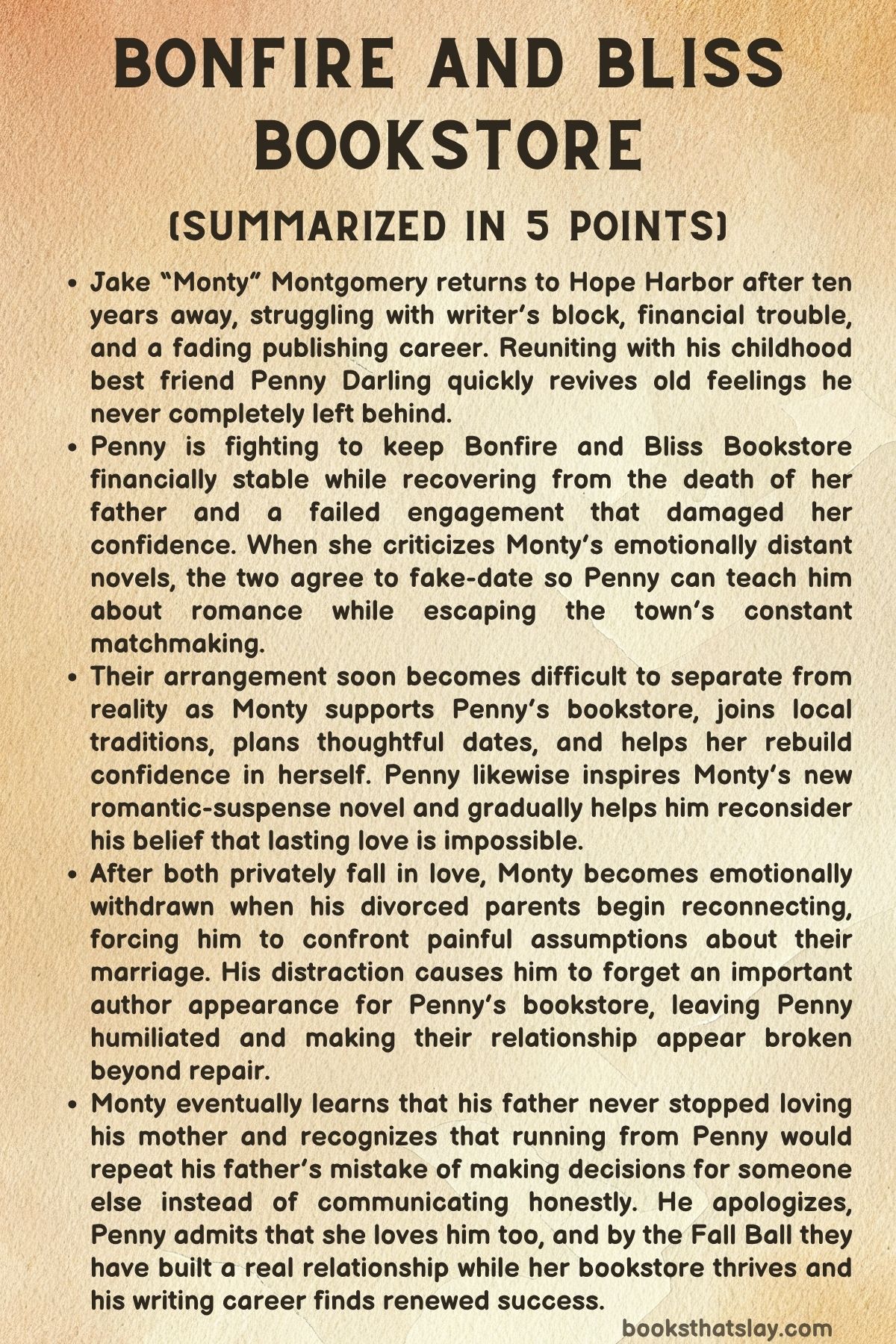
Summary
Jake “Monty” Montgomery returns to Hope Harbor after spending ten years in New York, but his homecoming is driven more by necessity than choice. His latest novel has failed to meet expectations, his finances are uncertain, his living arrangement has ended, and a serious case of writer’s block threatens the career he once built as a bestselling author.
Even before arriving, Monty finds himself thinking constantly about Penny Darling, his childhood best friend. They recently resumed communicating through text messages after years apart, and Monty realizes that the attraction he felt toward her as a teenager never entirely disappeared.
Penny has remained in Hope Harbor and built Bonfire and Bliss Bookstore, fulfilling a dream she once shared with her late father. The store means almost everything to her, but poor sales have placed it in financial danger, and she has concealed how serious the problem has become from much of her family.
Penny is also recovering from her broken engagement to Richard, who wanted her to sell the bookstore and move to California with him. His criticism of her interests, appearance, and ambitions left Penny uncertain about herself even after the relationship ended.
Monty and Penny’s reunion begins in spectacularly embarrassing fashion when Penny visits his grandmother Ana and accidentally spills tea on herself. Ana sends her upstairs to borrow one of Monty’s old shirts, and Monty arrives home just in time to find Penny partially undressed in his childhood bedroom.
The incident immediately becomes material for Hope Harbor gossip, especially after Monty’s father also accidentally sees Penny. Rather than allowing the embarrassment to create distance between them, however, Monty and Penny quickly rediscover the natural friendship that once connected them.
Monty learns that Penny has read all of his novels and asks why she believes his newest work is struggling. Penny tells him that the male protagonist lacks emotional depth and that his stories often contain the ingredients of romance without allowing the relationships to develop fully.
She suggests that Monty could strengthen his writing by learning how romantic tension, longing, and emotional intimacy actually work. Monty responds by demonstrating that he understands attraction more than she assumes, moving close enough to Penny to make her believe he is about to kiss her before stopping at the last moment.
Inspired partly by Eli Davis’s joking offer to serve as Penny’s fake boyfriend, Monty makes his own proposal. He suggests that he and Penny pretend to date so that the town’s persistent matchmakers will leave her alone, while Penny can teach him about romance for the book he now intends to write.
Penny hesitates because Monty has already left Hope Harbor once, and she fears becoming emotionally attached only to watch him leave again. Still, she agrees because the arrangement seems safe enough on paper and might allow her to experience a relationship without sacrificing the parts of herself that Richard tried to diminish.
Their fake relationship becomes public during a chaotic town meeting about the Maple Festival. When residents suggest turning Penny into the subject of a public dating fundraiser, Monty instinctively declares that nobody else will be dating her because she is with him.
They establish rules and agree that the arrangement will continue through the Fall Ball. Monty expects to return to New York once his writing career improves, while Penny promises to teach him what makes fictional romance satisfying.
Their lessons begin at football games, bonfires, bookstore meetings, and festival activities. Penny explains that successful romance depends on small gestures, physical awareness, vulnerability, longing, and the sense that two people notice things about one another that everyone else overlooks.
The problem is that Monty already notices nearly everything about Penny. He remembers her preferences, becomes jealous whenever Eli appears, knows when social situations overwhelm her, cooks for her, uses an affectionate Portuguese nickname from their teenage years, and instinctively reaches for her even when nobody is watching.
Monty also becomes increasingly involved in Hope Harbor life. He helps with the Maple Festival, attends family gatherings, spends time at Darling Daffodils Farm, participates in local traditions, and begins reconnecting with a community he once assumed he had permanently left behind.
Penny’s life is changing as well. Her social-media posts about her “book boyfriend” gain attention, and that attention begins translating into bookstore sales, giving her hope that the business might finally become sustainable.
For their first planned date, Monty takes Penny to Boston and surprises her with a visit to a romance bookstore. The date proves how carefully he listens to her, and their conversations reveal that neither of them has ever completely forgotten the connection they shared as teenagers.
They finally kiss, supposedly as part of Monty’s romantic research. The kiss immediately destroys the illusion that their attraction is merely academic, and further kisses make it even harder to maintain clear emotional boundaries.
As their relationship grows more physical, Penny begins reclaiming parts of herself that Richard taught her to criticize. Monty repeatedly reassures her about her body, encourages her to state what she wants, and treats her desires with attention rather than judgment.
Penny and Monty eventually agree to expand the relationship beyond kissing, even while continuing to label it temporary. Their physical connection becomes another source of emotional intimacy because they communicate openly, trust one another, and increasingly behave like partners rather than two friends following an agreement.
Monty’s writing improves at the same time. His new romantic-suspense novel begins flowing easily, and his mother Rebecca is enthusiastic about the emotional depth and chemistry in the manuscript.
Penny becomes equally important to his creative confidence. She reveals that she still owns the teenage romance manuscript he gave her at graduation and rereads it every year, proving that she believed in his ability as a writer long before his professional success.
Their bond is also rooted in shared memories. Monty has a tattoo depicting a maple tree and bonfire because the evenings spent with Penny beneath the tree were among the happiest moments of his youth, while Penny named her bookstore from essentially the same memories.
By October, both have privately recognized that they are falling in love. Penny sees how naturally Monty fits into the life she wants, while Monty realizes that Hope Harbor no longer feels like a temporary refuge from professional failure.
Monty’s greatest obstacle is his parents’ divorce. He has spent years believing that their once-happy marriage proves romantic love eventually collapses, and seeing Rebecca reconnect with his father brings those old fears back with unexpected force.
During the revived haunted hayride at Darling Daffodils Farm, Monty honors Penny’s late father by telling the spooky stories Peter once told. The gesture deeply moves Penny, but the evening changes when Monty’s parents arrive together and their obvious affection unsettles him.
Monty withdraws from Penny and later discovers his parents kissing. Unable to process the possibility that they still love one another, he asks Penny for space and becomes so distracted by his family crisis that he forgets to confirm a promised appearance by popular author Julie Rose at Penny’s Books and Brews event.
The mistake has serious consequences because Penny has ordered books, advertised the appearance, and relied on Monty’s promise. Feeling abandoned at the moment she most needed him, she tells her friends that their relationship originally began as a fake arrangement, only to realize that the Liberty Ladies and her mother have overheard the confession.
Monty is horrified by the damage he has caused. He initially thinks Penny might be better without him, but a conversation with Joe, an elderly pianist who remained devoted to his late wife, makes him question the belief that avoiding love can protect him from loss.
He finally confronts his father about the divorce and learns that his understanding of his parents’ marriage was incomplete. His father never stopped loving Rebecca but believed divorcing her would free her to reclaim the professional dreams she had sacrificed after pregnancy, loss, and family responsibilities changed their lives.
Monty immediately recognizes the flaw in his father’s decision. By choosing for Rebecca instead of honestly discussing the future with her, his father caused years of pain, and Monty realizes he has been preparing to make a similar mistake with Penny by deciding that leaving would somehow protect her.
Penny, meanwhile, is hurt but still unable to dismiss everything genuine that occurred between them. Her friends remind her that Monty’s mistake does not erase the many ways he demonstrated real love through his actions.
Monty eventually appears beneath Penny’s apartment window with an old boom box and openly apologizes. He admits that he has spent years trying to control relationships by imagining their endings, but Penny has made him understand that fear of future pain is not a reason to reject present love.
He tells Penny that she is his best friend, his heart, and the love of his life. Penny forgives him, admits that she loves him too, and the relationship that began as an arrangement finally becomes openly real.
Their reconciliation also gives them a chance to explain what the bonfire and maple tree mean to each of them. Both independently preserved the same childhood memories because those nights represented safety, friendship, happiness, and an affection neither of them fully understood at the time.
Two weeks later, their lives have settled into a genuine partnership. Monty works on his manuscript while spending his evenings with Penny, the bookstore continues benefiting from its growing audience, and Rebecca remains in Hope Harbor while cautiously rebuilding her relationship with Monty’s father.
At another town meeting, Hope Harbor reveals that the Maple Festival raised enough money to buy Penny a new laptop for the rapidly expanding bookstore. Monty publicly confirms that he loves Penny and declares that he intends to marry her someday.
His father follows with his own confession, publicly acknowledging that pushing Rebecca away rather than communicating honestly was the greatest mistake of his life. Rebecca accepts the possibility of reconciliation, allowing Monty to see a different ending to the relationship that shaped his fear of love.
By the Fall Ball in November, Monty’s romantic-suspense manuscript has been submitted and well received by his publishing team, with early interest even developing around possible film rights. He effectively lives with Penny above the bookstore, while his parents continue rebuilding their relationship.
As Joe plays music at the celebration, Monty asks Penny to dance. Penny recognizes that the extraordinary love she once searched for only in books has become part of her own life, completing a journey that began with childhood friendship and ended with both of them finally choosing the future they had been afraid to claim.
Characters
Jake “Monty” Montgomery
Monty is the central male character in Bonfire and Bliss Bookstore, and much of his emotional development comes from the conflict between what he feels and what he has trained himself to believe. He returns to Hope Harbor convinced that romantic permanence is unreliable, largely because he interpreted his parents’ divorce as proof that even apparently ideal relationships eventually fail.
His professional crisis reinforces this emotional uncertainty because he has lost confidence in the one area where he once felt successful. Penny’s criticism of his fiction becomes important because she identifies the same weakness in his books that exists in his personal life: Monty understands attraction and suspense, but he avoids sustained emotional vulnerability.
His behavior toward Penny repeatedly contradicts his declared beliefs. He becomes jealous of Eli, remembers Penny’s preferences, protects her without treating her as helpless, supports her bookstore, honors her father, helps with her work, cooks for her, and seeks her company even when nobody is present to witness their supposed relationship.
Monty’s greatest failure occurs when family anxiety causes him to withdraw and forget the Julie Rose commitment. His mistake matters because it demonstrates that love alone does not make him a reliable partner; he must learn to communicate when frightened rather than disappear into himself.
The truth about his parents finally exposes the pattern he is in danger of repeating. Once Monty understands that his father caused pain by deciding what was best for Rebecca without including her in the decision, he recognizes that leaving Penny “for her own good” would be another form of emotional avoidance.
His final declaration therefore represents more than a romantic confession. Monty chooses uncertainty, communication, commitment, and the possibility of future loss rather than continuing to organize his life around fear.
Penny Darling
Penny stands at the emotional center of Bonfire and Bliss Bookstore, combining optimism, independence, insecurity, loyalty, and a powerful attachment to the people and traditions that shaped her. Her bookstore is not simply a business; it represents her ambitions, her relationship with her late father, and her determination to build a life according to her own values.
Richard’s treatment damaged Penny’s confidence because he repeatedly suggested that her body, interests, professional dreams, and personality needed adjustment. Her relationship with Monty becomes restorative not because he rescues her, but because his acceptance helps Penny recognize how much of herself she had been trained to suppress.
Her knowledge of romance fiction also gives her an unusual role in Monty’s development. She becomes his teacher about emotional tension and relationships, yet the lessons gradually force Penny to examine whether she follows the same standards in her own life that she expects from fictional characters.
Penny’s struggle with the bookstore reveals another side of her personality. She is deeply responsible and hardworking, but she sometimes carries pressure privately because she feels that failure would dishonor the faith her father placed in her.
Her growing online success proves that she possesses genuine business instincts. Once the Bookstagram attention produces sales, Penny begins imagining a future in which the store can support itself and perhaps even expand.
Emotionally, Penny’s most important development is learning that independence does not require avoiding vulnerability. Loving Monty creates the possibility of being hurt again, but she eventually accepts that protecting herself from every emotional risk would also prevent her from experiencing the partnership she actually wants.
Ana Montgomery
Ana brings humor, warmth, interference, and emotional continuity to Bonfire and Bliss Bookstore. As Monty’s grandmother, she represents the family life he remembers from childhood, particularly the years when music, dancing, affection, and gatherings made the Montgomery home feel secure.
She is also an unapologetic matchmaker who creates opportunities for Penny and Monty to encounter one another. Sending Penny into Monty’s bedroom, manipulating Monty into attending town responsibilities, and repeatedly encouraging proximity between them demonstrate that Ana recognizes their attachment long before they openly acknowledge it.
Her friendship with Penny is significant because it exists independently of Monty. Penny delivers books to her, talks with her, and treats her as part of her own extended family, making Penny’s eventual relationship with Monty feel connected to years of shared community rather than a sudden attraction.
Ana’s enthusiasm for romance novels also gives the story additional humor. Beneath that comic energy, however, she symbolizes a generation that has experienced love, loss, family disruption, and continued connection without concluding that attachment should therefore be avoided.
Monty’s Father
Monty’s father plays a crucial role in Bonfire and Bliss Bookstore because his choices created the misunderstanding that shaped Monty’s adult beliefs about love. For years, Monty assumes that his father destroyed a happy marriage and therefore treats him with resentment and emotional distance.
The truth is more complicated. Monty’s father continued loving Rebecca but believed that staying married would prevent her from recovering professional dreams she had previously sacrificed, especially after family responsibilities and the death of Monty’s grandfather made leaving Hope Harbor difficult.
His intentions do not excuse his actions. By demanding a divorce without giving Rebecca the complete truth, he denied her the opportunity to participate in one of the most important decisions of her life.
This mistake becomes a warning for Monty. Father and son share the same dangerous tendency to interpret withdrawal as sacrifice, and Monty’s confrontation with him exposes how easily supposedly protective decisions can become controlling when honest communication is removed.
His later public apology to Rebecca demonstrates growth. He admits that the divorce was a terrible mistake, stops hiding behind his original reasoning, and finally gives Rebecca the choice he should have offered years earlier.
Rebecca Montgomery
Rebecca is Monty’s mother and a successful publishing professional whose history gradually reveals why the Montgomery marriage ended. Her earlier life involved complicated sacrifices, including giving up plans connected to a publishing career in New York after becoming pregnant and building a family in Hope Harbor.
Her enthusiasm for Monty’s new manuscript gives him professional reassurance at a moment when he doubts himself. She recognizes that the romance and emotional intensity have strengthened his writing, indirectly confirming Penny’s influence on his creative development.
Rebecca’s return to Hope Harbor also forces Monty to confront the past rather than maintaining the simplified story he has carried for years. Her obvious affection for his father initially frightens Monty because he sees renewed intimacy as another opportunity for disaster.
Yet Rebecca is not treated merely as someone waiting for reconciliation. Her earlier ambitions and sacrifices are essential to understanding why her husband’s unilateral decision was so damaging, because his attempt to “free” her again prevented her from making her own choice.
Her willingness to consider rebuilding the relationship comes only after the truth is acknowledged. That distinction emphasizes that reconciliation becomes meaningful when both people finally possess the information and agency required to decide for themselves.
Tally Darling
Tally is Penny’s sister and one of the strongest sources of comic energy and family support in the novel. Her extravagant decisions, especially buying Walker a miniature Highland cow named Daisy Darling, reflect a personality that acts enthusiastically first and handles the resulting chaos afterward.
Beneath the comedy, Tally is fiercely loyal to Penny. She participates in bookstore events, supports the revival of family traditions, questions Penny about Monty, and refuses to let her sister retreat completely into self-blame when the relationship temporarily falls apart.
Her candle ritual is also revealing. By choosing an old culinary-school acceptance letter, Tally acknowledges that she does not need an institution or abandoned possibility to prove that her talent has value.
Her relationship with the Darling family traditions connects her to the wider subject of grief. Like Penny, she is learning how to preserve their father’s influence without freezing the family in the past.
Billie
Billie becomes one of Penny’s most trusted friends because she combines humor with unusually clear observation. When Penny finally admits that the relationship with Monty began as an arrangement, Billie is surprised precisely because everything she has witnessed suggests genuine attachment.
She becomes the person who calmly lists the evidence Penny has been trying to dismiss. Monty’s jealousy, attention, private affection, remembered details, and constant desire to spend time with Penny make it obvious to Billie that the relationship stopped being pretend long before either participant admitted it.
Billie’s candle choice provides insight into her own internal conflict. Using part of Quinn’s baby blanket represents her need to remember that being a mother is important without allowing motherhood to become the total definition of her identity.
Her later inclusion in Penny, Tally, and Rosie’s closest friendship circle confirms her increasing importance within the community. Hints involving Billie and Eli also suggest that her own emotional story may continue beyond the events presented here.
Eli Davis
Eli begins as a playful alternative to Monty when he jokingly offers to become Penny’s fake boyfriend. His presence becomes especially useful because Monty’s reactions to Eli reveal feelings that Monty is still attempting to deny.
Rather than functioning as a serious romantic rival, Eli gradually becomes one of the people willing to challenge Monty’s fear. During their conversation before the planned bowling night, Monty admits that he has never felt this strongly about anyone, allowing Eli to question whether avoiding Penny would actually protect him.
Eli’s own family history gives his advice additional weight. His father’s abandonment could easily have given him the same cynicism Monty carries, yet Eli refuses to treat one painful experience as proof that every relationship must fail.
He therefore acts as a contrast to Monty’s defensive worldview. Eli understands that loss and abandonment are real possibilities, but he does not believe fear should automatically determine whether someone accepts love.
Rosie
Rosie is part of Penny’s intimate social circle and contributes significantly to Hope Harbor’s energetic community life. Her brewery becomes an important gathering place and later hosts the Books and Brews event intended to strengthen Penny’s business.
Her interactions with Fletcher initially appear argumentative, but the story gradually suggests that their hostility has a deeper history. Fletcher’s acknowledgment that Rosie has legitimate reasons to be angry prevents their conflict from being reduced to simple comic bickering.
Rosie’s interaction with Henry is particularly revealing. Her ability to communicate with Fletcher’s deaf son through sign language exposes a patient and caring side that is less visible during her confrontations with Fletcher.
Like many supporting characters, Rosie helps make Penny and Monty’s romance part of a larger network of relationships. She is not merely an observer of their story but someone whose own unresolved emotional connections continue alongside theirs.
Fletcher
Fletcher occupies a secondary role, but his relationship with Rosie adds another example of incomplete communication and unresolved hurt. His willingness to admit that Rosie has reasons for her anger suggests that he understands their conflict cannot be dismissed as simple personality differences.
His son Henry also allows other characters to reveal gentler sides of themselves. Rosie’s easy communication with Henry creates a moment of emotional connection that changes how her relationship with Fletcher can be viewed.
Fletcher’s presence contributes to the sense that Hope Harbor contains many stories developing simultaneously. The town is not simply a background for Penny and Monty but a community in which friendships, rivalries, family relationships, and possible romances constantly affect one another.
Gail Darling
Gail is Penny and Tally’s mother and provides a quieter form of emotional guidance. She sees that Penny remains affected by Richard and encourages her not to interpret one failed engagement as proof that she should permanently close herself off from another relationship.
Her own history with Peter gives this advice credibility because she understands both the value of deep love and the grief created when that love is lost. She does not suggest that pain makes love meaningless.
Gail’s candle ritual captures this maturity particularly well. Choosing one of Peter’s stray LEGO pieces allows her to acknowledge that continuing to love her late husband does not require pretending that every habit or memory associated with him was perfect.
She therefore models a balanced relationship with memory. Gail preserves Peter’s importance while still participating in family traditions, community life, and the changing futures of her daughters.
Peter Darling
Peter is already dead when the story begins, but his influence remains present in Penny’s decisions, the family farm, the Maple Festival, and the revived haunted hayride. Penny’s determination to protect the bookstore is inseparable from the dream she shared with him.
His influence also extends to Monty. Peter encouraged Monty’s writing, remembered his ambitions, and even owned a signed copy of Monty’s first published book.
Monty’s decision to retell Peter’s traditional spooky stories becomes one of his most meaningful gestures toward Penny. He is not simply attempting to impress her; he is preserving something belonging to a man who mattered deeply to both of them.
Peter’s continuing presence demonstrates how memory can remain active without preventing change. Penny honors him most successfully when she allows the dreams and traditions associated with him to develop rather than treating them as objects that must remain untouched.
Richard
Richard never dominates the present action, yet his influence remains central to Penny’s development in Bonfire and Bliss Bookstore. He represents a relationship in which partnership slowly became pressure for Penny to reduce herself in order to fit someone else’s expectations.
He wanted her to sell the bookstore, move to California, and organize her future around his plans. His criticism of her body, reading habits, love of autumn, and enthusiasm for the bookstore damaged her confidence because the judgment came from someone who was supposed to love her.
Penny initially interprets some of her insecurity as personal weakness, but her experiences with Monty reveal how strongly Richard conditioned her to anticipate criticism. Moments involving trust, physical intimacy, and even access to Monty’s phone expose how deeply Richard’s behavior affected her expectations.
His function in the story is therefore less about creating a romantic triangle and more about establishing what Penny refuses to accept again. Her growth becomes visible whenever she chooses her bookstore, preferences, body, desires, friendships, or ambitions without apologizing for them.
Joe
Joe, the elderly airport pianist, appears only briefly compared with the central characters, but he becomes essential at Monty’s lowest emotional point. Monty meets him while struggling with the sight of his parents reconnecting and asks whether decades of love were worth the pain of eventually losing Joe’s wife.
Joe’s answer gives Monty a model of love completely different from the one he constructed from his parents’ divorce. For Joe, grief does not invalidate the marriage because the possibility of loss was inseparable from the value of the life he shared with his wife.
This idea directly challenges Monty’s belief that avoiding commitment can protect him. Joe demonstrates that emotional pain can exist alongside gratitude rather than proving that love itself was a mistake.
His appearance again at the Fall Ball gives his role a satisfying completion. The man who helped Monty reconsider his fear of attachment provides the music while Monty and Penny openly celebrate the relationship Monty nearly abandoned.
Themes
Love, Fear, and the Risk of Loss
Fear of loss shapes nearly every stage of the central relationship in Bonfire and Bliss Bookstore. Monty does not reject love because he feels nothing; he rejects it because his feelings are powerful enough to frighten him, and his parents’ divorce convinced him that attachment eventually creates pain that cannot be controlled.
His solution is emotional limitation. By treating relationships as temporary, expecting to return to New York, and establishing boundaries around Penny, he believes he can enjoy closeness without giving another person enough power to seriously hurt him.
Joe’s marriage challenges that reasoning because it presents grief as the consequence of having possessed something valuable rather than evidence that the relationship should never have existed. Monty’s father provides the opposite lesson when his effort to prevent Rebecca from sacrificing herself causes years of unnecessary separation.
Penny faces a related choice after Richard. She could interpret humiliation and rejection as reasons to remain emotionally guarded, but doing so would allow a failed engagement to continue controlling her future.
Both characters eventually accept that security cannot come from guaranteeing a painless ending. Their relationship becomes real only when they stop trying to calculate how much feeling is safe and choose to participate fully despite having no certainty about what the future may bring.
Identity Within Romantic Relationships
Penny’s experience with Richard establishes the danger of confusing partnership with self-erasure. He did not simply want a shared future; he expected Penny’s bookstore, interests, location, body, and behavior to become negotiable whenever they conflicted with his preferences.
As a result, Penny enters her arrangement with Monty determined to learn whether she can date someone without disappearing into the relationship. The fake-dating structure initially appears useful because it gives her emotional distance and allows her to retain control.
Her development shows that the real issue was never romance itself. The problem was a relationship model in which acceptance depended on becoming easier for another person to manage.
Monty’s treatment of her provides a contrast because he is attracted to qualities Richard criticized. Penny’s enthusiasm for books, love of fall, nervous talking, body, business ambitions, loyalty to family, and attachment to Hope Harbor become reasons Monty loves her rather than obstacles he expects her to remove.
The same theme appears in Rebecca’s history. Monty’s father assumes he must end their marriage so she can reclaim her professional ambitions, but his decision again treats love and individual identity as mutually exclusive choices.
The story ultimately presents healthy partnership as something that should make room for two complete people. Commitment gains value when neither person’s dreams, preferences, or identity must be surrendered as the price of being loved.
Communication Versus Protective Silence
Silence repeatedly causes more damage than difficult truth in Bonfire and Bliss Bookstore. Monty’s father creates the defining wound of his son’s childhood not because he stopped loving Rebecca, but because he decides that withholding his reasons and forcing a divorce will somehow make her life better.
Monty inherits the same pattern. Whenever emotional situations become frightening, he withdraws, processes privately, and assumes that distance prevents him from burdening others.
His behavior after seeing his parents together demonstrates the consequences. Penny does not need him to have immediate answers, but she needs communication, and his disappearance reminds her of the ways Richard once made her feel unimportant.
The forgotten Julie Rose appearance therefore represents more than an organizational mistake. It is the practical result of Monty’s emotional withdrawal, showing how private fear can damage another person even when no harm is intended.
Penny also learns the importance of speaking directly. Her growing comfort with discussing attraction, insecurity, business pressures, and physical desires allows her relationship with Monty to become healthier than her engagement to Richard.
The eventual reconciliation succeeds because Monty stops managing Penny’s feelings from a distance. He explains his fear, acknowledges his failure, states what he wants, and gives Penny the information necessary to decide whether she still wants him.
Home, Memory, and Choosing a Future
Hope Harbor is filled with places and traditions that connect the characters to earlier versions of themselves. The maple tree, bonfires, Darling Daffodils Farm, the Montgomery house, the bookstore, the Maple Festival, and the haunted hayride all carry memories that influence present choices.
For Penny, these memories are especially connected to her father. Protecting the bookstore and reviving autumn traditions allow her to maintain a relationship with what he taught her, but she gradually learns that honoring the past does not require refusing change.
Monty initially experiences home differently. Hope Harbor reminds him of the family happiness he believes was destroyed, so returning forces him to confront memories he spent years avoiding in New York.
His relationship with Penny slowly changes the meaning of those memories. The maple tree and bonfire no longer represent a happiness that existed only before everything went wrong; they become the foundation of something he can carry forward.
The same shift occurs when music returns to the Montgomery house and his parents begin reconsidering their relationship. The past cannot be restored exactly as it was, but unresolved pain can be understood differently when the truth becomes available.
By the Fall Ball, both Penny and Monty are no longer living primarily in memory. They retain the people, stories, places, and traditions that formed them while choosing a future that creates new meaning from those earlier experiences.