Book of Night Summary, Characters and Themes
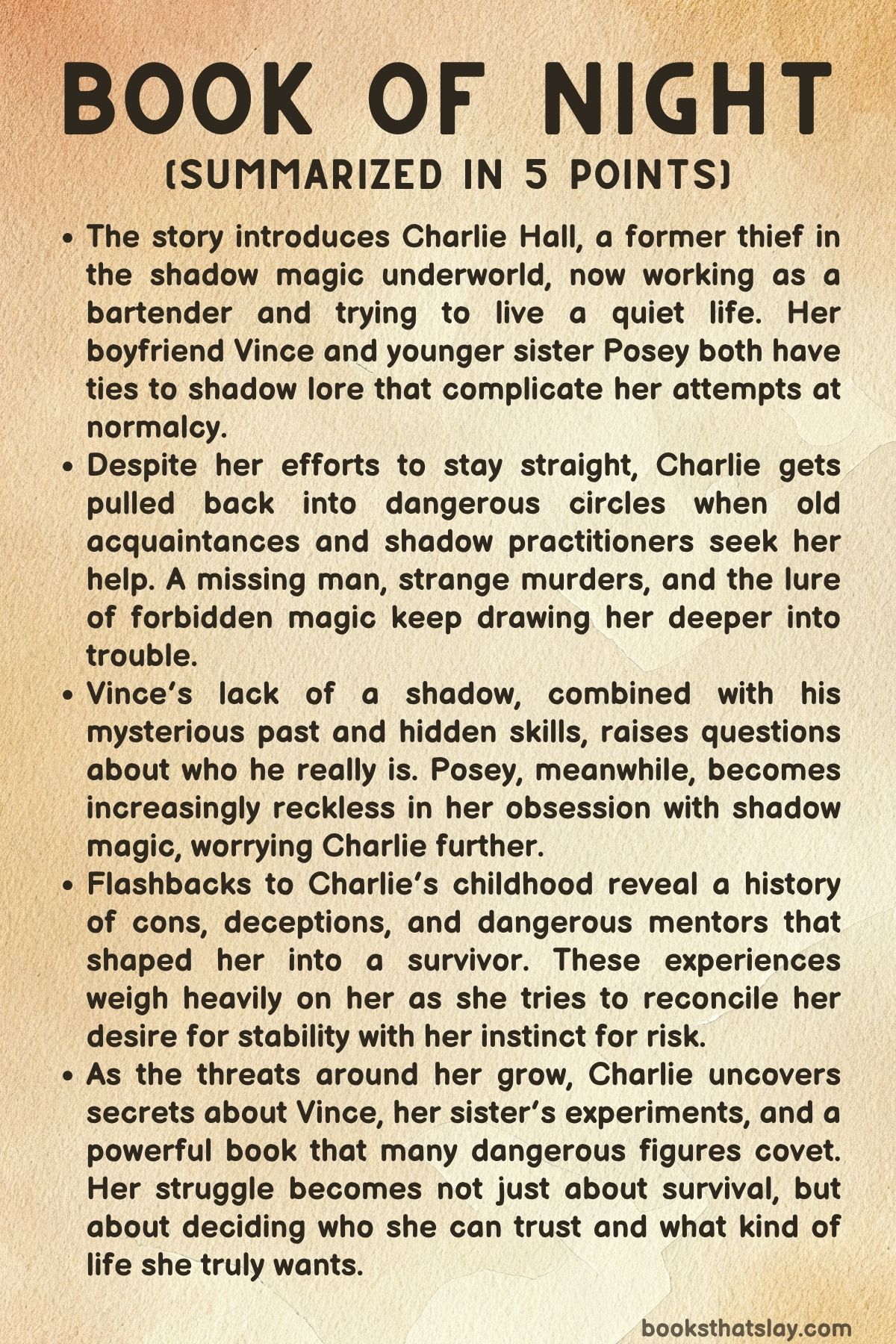
Book of Night by Holly Black is a contemporary dark fantasy that blends crime, magic, and personal struggle. Set in a world where shadows can be manipulated and weaponized, the novel follows Charlie Hall, a former thief trying to escape her dangerous past.
Once entangled in the underworld of shadow magic, Charlie now tends bar, juggling her relationship, her sister’s ambitions, and her own uneasy attempts at normalcy. But when old acquaintances, powerful enemies, and mysterious books resurface, Charlie is forced back into a world of deceit, power struggles, and dangerous secrets that threaten both her life and the lives of those she loves.
Summary
The story begins with Remy, a boy who discovers that he can physically touch and bond with his shadow. After cutting his finger and feeding the shadow with blood, he names it Red and treats it as a companion unlike any other.
This prologue sets the stage for a world where shadows are not passive but alive with potential.
The main focus shifts to Charlie Hall, a bartender working at the Rapture Bar & Lounge. Once a skilled thief deeply involved in the shadow magic underworld, she now tries to maintain a straight life.
She shares her days with her boyfriend Vince, a quiet man without a shadow, and her younger sister Posey, who is obsessed with becoming a gloamist and experiments recklessly with theories and rituals she finds online. Charlie’s attempt at stability is interrupted when Doreen Kowalski seeks her help in finding Adam, her missing partner.
Adam works under Balthazar, a shadow parlor owner who tempts Charlie to return to her old habits. Though Charlie refuses his offers, she reluctantly agrees to help Doreen in exchange for financial help with Posey’s tuition.
Her desire to avoid her old life begins to crack when she encounters danger. One night, after her car breaks down, Charlie stumbles upon the mangled body of a customer from her bar, his shadow unnaturally shredded.
A man with shadow-crafted hands lurks nearby but flees before police arrive. Disturbed, she hides the truth of what she saw.
Meanwhile, Posey continues experimenting dangerously, and her suspicion of Vince deepens. She questions his missing shadow, believing it hides something sinister.
Charlie, too, has doubts but finds solace in his loyalty.
Charlie’s own past emerges through memories. As a child, she invented elaborate personas to trick her gullible mother into leaving an abusive partner.
Later, she was manipulated into cons by Rand and trained in pickpocketing by Ms. Presto, slowly drawn into a life of theft and deception. These flashbacks show the roots of her skills and her guilt.
Charlie is drawn deeper into the mystery of Adam’s disappearance and the fate of a rare book known as the Liber Noctem. When Adam contacts her, she uses her old alias, Amber, to manipulate him.
At the same time, the name Lionel Salt resurfaces—a wealthy figure in the world of gloamists with a terrifying reputation. She also encounters Hermes, a gloamist working for Salt, who assaults her with his shadow.
Vince intervenes and kills Hermes with frightening efficiency, shocking Charlie with his hidden capabilities. Though Vince comforts her afterward, Charlie realizes he has secrets darker than she imagined.
Her suspicions are confirmed when she searches his belongings and discovers his true identity: Edmund Vincent Carver, grandson of Lionel Salt, thought long dead. Vince had faked his death and lived under a new name.
The discovery shatters her trust. Posey, meanwhile, drags Charlie to Malhar Iyer, a student studying shadows, who reveals that Charlie’s own shadow is “quickening,” gaining autonomy and dangerous strength.
He also explains that shadows can become Blights if uncontrolled. He identifies the Liber Noctem as the “Book of Blights,” possibly written from a shadow’s perspective.
The revelation unsettles Charlie and raises the stakes around the missing book.
When Charlie confronts Vince, he admits his identity but insists he wanted to escape his family’s corruption. Their relationship fractures, and he leaves her, warning that the truth is worse than she knows.
Charlie, devastated, resumes cons and plans her next steps. She infiltrates Adam’s hotel room and discovers not the Liber Noctem but Knight Singh’s notebook, full of powerful knowledge.
She manages to steal it, outmaneuvering Adam and recovering favors from old contacts. Her discovery fuels her suspicion that Vince and Salt are at the heart of the deadly struggle surrounding shadows and books.
Charlie later infiltrates Lionel Salt’s mansion disguised as catering staff during a lavish party. Inside, she breaks into Salt’s library and successfully cracks the code to his safe.
She retrieves the Liber Noctem but also uncovers shocking secrets. In hidden corridors, she encounters Vince—only to realize he is not truly Vince but Red, the shadow she met in the prologue.
Red explains that he grew from Edmund’s pain and eventually became independent, taking over his life. The man Charlie loved was always Red.
Though horrified, she cannot deny the bond between them.
Charlie and Posey conduct a ritual to cut away Charlie’s shadow and sew it to Posey, making Charlie immune to Salt’s attempts at shadow control. Armed with this advantage, she boldly confronts Salt during his party, exposing his lies and humiliating him in front of powerful Cabal members.
She reveals the stolen Liber Noctem and his manipulation of the Hierophant, turning opinion against him. When Salt tries to control her with his shadow, he fails, as she no longer has one.
The confrontation escalates when the Hierophant’s Blight takes over, becoming monstrous. Vince (Red) sacrifices himself to fight the Blight, battling in a fiery struggle as chaos erupts.
Charlie cuts Salt’s shadow free, leaving him powerless, and the Cabal ultimately exposes him as a criminal and murderer.
Though Salt dies and his crimes are revealed, Vince is taken by the Cabal, who see him as a dangerous but valuable being. Charlie negotiates to bind Vince to herself, preventing him from falling under Adeline Salt’s influence.
However, when Vince returns to her, he no longer remembers who she is. Despite his fractured memory, Charlie vows to win his heart again, determined to face whatever darkness comes next with him by her side.
Characters
Charlie Hall
Charlie Hall is the protagonist of Book of Night, defined by her constant tension between the lure of her criminal past and her longing for stability. She is a deeply layered character whose early experiences of manipulation and survival forged her into a skilled con artist and thief.
Charlie’s resourcefulness and sharp instincts are undeniable, but they are balanced by an underlying vulnerability that stems from her fractured family life and the guilt she carries over past deceptions, especially those aimed at her mother. She has a complicated moral compass: although she has lied, stolen, and manipulated, her actions are often driven by the desire to protect her sister Posey or to free herself from the control of others.
Charlie’s relationships with Vince and Posey anchor her emotionally, yet they also expose her insecurities. Vince’s shadowless state reflects Charlie’s own fractured sense of identity, while Posey’s reckless pursuit of gloaming mirrors Charlie’s own dangerous impulses.
Charlie is constantly haunted by the sense that she cannot escape the shadow of her past, even as she tries to craft a new self. Her evolution throughout the story reveals both her resilience and the inevitability of her entanglement in the shadow world she cannot quite abandon.
Vince (Edmund Vincent Carver / Red)
Vince is one of the most enigmatic figures in the novel, shrouded in mystery from the moment he appears. Introduced as Charlie’s seemingly dependable, gentle partner, he slowly reveals layers of deception and darkness.
Vince is revealed to be Edmund Vincent Carver, Lionel Salt’s grandson, believed dead, and ultimately exposed as Red—the independent manifestation of Edmund’s shadow. This duality makes him a tragic and complex character.
His existence embodies both human tenderness and monstrous potential, with Charlie constantly grappling with whether to trust his devotion or fear the Blight within him. Vince is protective, often to a violent degree, as seen when he kills Hermes without hesitation, yet he also demonstrates remarkable gentleness in his love for Charlie.
His fractured identity, torn between man and shadow, privilege and exile, sincerity and secrecy, makes him a living embodiment of the novel’s themes of identity and transformation. Vince’s final sacrifice to fight the Hierophant’s Blight cements his role as both savior and danger, a paradox that Charlie must embrace if she wants to keep him in her life.
Posey Hall
Posey, Charlie’s younger sister, is a restless dreamer who longs for power and recognition in the shadow world. Her obsession with becoming a gloamist often leads her into reckless and dangerous behaviors, putting herself and Charlie at risk.
Posey represents the hunger for identity and agency that shadows promise, but she lacks the experience and caution that temper Charlie’s choices. Her relationship with Charlie is a mixture of admiration, dependence, and quiet resentment.
While Charlie has always tried to protect her, Posey chafes at her sister’s control and yearns to step out from under her shadow. Posey’s eagerness to experiment with rituals and theories about quickening reflects both her naivety and her determination.
She is a foil to Charlie: where Charlie is hardened by experience and disillusionment, Posey still clings to hope, even if it blinds her to danger. Ultimately, Posey’s choices amplify the stakes for Charlie, who must confront not only her own struggles but also the perils her sister invites.
Lionel Salt
Lionel Salt serves as one of the primary antagonists of Book of Night, embodying greed, power, and manipulation. A wealthy and ruthless figure in the shadow underworld, Salt thrives on exploitation and control.
His desire to obtain the Liber Noctem reflects his relentless pursuit of dominance, not only over magic but also over people. Salt’s character highlights the dangers of unchecked ambition—his world of grotesque art, twisted schemes, and calculated cruelty makes him both feared and despised.
His connection to Vince adds further complexity, as his familial ties to Edmund expose a history of corruption and abuse of power. Salt’s manipulations, from feigned thefts to framing others for murder, underscore his cunning intelligence.
Yet, his downfall comes from underestimating Charlie’s wit and resilience. Salt represents the oppressive force of legacy and the shadow world’s darker side, making him a powerful mirror to Charlie’s own struggles against being consumed by her past.
Remy and Red
Remy, introduced in the prologue, is a boy who bonds with his shadow, naming it Red. Though seemingly minor at first, Remy’s story becomes pivotal, as Red later manifests as Vince himself.
Remy is symbolic of innocence and curiosity, a child who treats his shadow as a friend without comprehending the consequences. Red, however, evolves into something far more dangerous and complex.
Initially a companion, Red matures into an independent entity born from pain, rage, and survival, ultimately breaking free during Edmund’s supposed death. This transformation positions Red as both a monster and a man, capable of love yet embodying the darkest aspects of human nature.
The relationship between Remy and Red underlines one of the book’s central questions: what happens when the parts of ourselves we suppress or deny take on a life of their own? Red, as Vince, is not merely a character but a living metaphor for the blurred line between humanity and shadow, self and other.
Doreen Kowalski
Doreen is a minor yet memorable character who represents the desperation and chaos of those caught on the fringes of the shadow world. Her reliance on Charlie to find Adam demonstrates both her vulnerability and her manipulative tendencies.
Doreen is caught in cycles of disappointment, tied to Adam’s recklessness and her own dependence on others. Her interactions with Charlie showcase the precarious lives of those drawn to gloamists and their dangerous allure.
Though not central to the story, Doreen’s presence emphasizes the consequences of living on the margins of a magical underworld that consumes the weak.
Adam
Adam is the reckless counterpart to Charlie, a man whose choices embody the dangers of ambition without control. Working for Salt and Balthazar while dabbling in forbidden trades, Adam represents what Charlie might have become had she not tempered her impulses with caution.
His rivalry with Charlie, fueled by his resentment of being compared to her, drives many of his actions. Adam’s willingness to betray and manipulate highlights his moral weakness, while his inability to control his own vices makes him a liability to those around him.
Through Adam, the narrative illustrates the peril of chasing power without the discipline or vision to wield it responsibly.
The Hierophant
The Hierophant is one of the most chilling figures in the novel, a gloamist whose own shadow overtakes him, eventually transforming into a monstrous Blight. He represents the ultimate danger of shadow magic—the loss of humanity to parasitic power.
As a looming presence throughout the book, the Hierophant’s descent into monstrosity contrasts with Vince’s fragile balance between man and shadow. His emergence as a destructive force at Salt’s party serves as the climax of shadow magic gone awry, underscoring the theme that shadows, once quickened, are nearly impossible to control.
The Hierophant’s existence is both warning and inevitability, reminding every character of what lies at the end of unchecked ambition.
Themes
Shadows and Power
In Book of Night, shadows are not merely physical phenomena but extensions of identity, tools of magic, and vessels of power. The ability to manipulate shadows creates stark divisions between ordinary people and gloamists, elevating those with control into positions of danger and influence.
Shadows feed on blood, energy, and secrets, turning into parasitic entities that can overwhelm their hosts. This dangerous symbiosis underscores the novel’s tension: power is alluring but never free of cost.
Charlie’s shadow itself becomes quickened, reflecting her inner struggles—her shadow grows as a mirror of her own moral ambiguity and desire for agency. Vince’s lack of a shadow, on the other hand, becomes both stigma and mystery, setting him apart from others and eventually revealing his connection to something darker.
The use of shadows in the narrative illustrates how human ambition to control forces beyond understanding inevitably corrupts. The existence of Blights—shadows grown autonomous and destructive—exposes the peril of unchecked consumption of power, showing how those who exploit shadows may ultimately be consumed by them.
Through this lens, shadows symbolize both possibility and peril, revealing the fragile boundary between mastery and ruin.
Deception and Identity
Deception is a thread running through every stage of Charlie’s life, shaping her sense of self and her relationships. From childhood, when she created false personas to manipulate her mother into leaving an abusive husband, to adulthood, where she adopts aliases like Amber to maneuver through the shadow underworld, Charlie survives by masking her true identity.
Yet these lies are not only a tool for survival; they also fracture her ability to know who she really is. Each con leaves residue of guilt, as though her truest self is always obscured beneath the performances she invents.
Vince, too, embodies deception—his assumed identity hides his lineage as Edmund Vincent Carver, heir to Lionel Salt. Even more disturbing, the revelation that Vince is in fact Red, a Blight who has grown into flesh, makes the idea of identity itself unstable.
The characters’ shifting facades reflect the novel’s exploration of truth as slippery, subjective, and often unattainable. The self becomes something constructed, reinvented, and sometimes betrayed.
This recurring motif highlights the difficulty of trust in a world where everyone has something to hide, suggesting that to survive is to perform, but to perform is to risk losing one’s core.
Family and Obligation
Family in Book of Night is portrayed as both anchor and burden. Charlie’s relationship with her sister Posey is marked by fierce protectiveness, even as Posey’s reckless pursuit of shadow magic frustrates and frightens her.
Their shared childhood of instability—manipulative guardians, abuse, and poverty—binds them together, but it also imprints wounds that shape their choices. Charlie carries guilt for her manipulations of their mother, a guilt that festers into an enduring sense of unworthiness.
For Vince, family is equally complex. His connection to Lionel Salt reveals a lineage steeped in cruelty, ambition, and violence.
By renouncing his family, he attempts to define himself apart from their legacy, yet his very existence as Red proves that he cannot sever ties so cleanly. Obligation becomes a force that binds the characters, whether through blood, loyalty, or guilt, and much of the story revolves around whether one can escape the obligations of family without losing oneself entirely.
The theme underscores how family both protects and imprisons, leaving the characters to question whether love and loyalty are redemptive or destructive.
Redemption and the Pull of Darkness
Charlie’s struggle is one of constant tension between the promise of redemption and the pull of her darker nature. Having lived a life of cons, betrayals, and dangerous associations, she tries to build something stable—bartending, a steady boyfriend, paying for her sister’s tuition.
Yet she is continuously drawn back into schemes, theft, and violence, unable to resist the temptation of her old skills and the adrenaline of risk. This oscillation raises the question of whether redemption is truly possible for someone whose instincts run counter to it.
Vince mirrors this theme: his gentleness with Charlie suggests a longing for stability and connection, but his violent efficiency and hidden past expose the darkness that clings to him. Even when the pair act in ways that suggest care and tenderness, their choices are inevitably tainted by deceit and violence.
Redemption is portrayed not as a final destination but as a battle fought in small, fleeting moments—tender gestures, protective acts, moments of truth. The novel resists offering redemption as a certainty, instead showing how the pull of darkness is ever-present, making the pursuit of redemption more a matter of persistence than achievement.
Control and Autonomy
The manipulation of shadows in the book is paralleled by the theme of control over one’s life, choices, and body. Shadows, capable of acting as extensions of their owners, can also turn parasitic, stripping individuals of autonomy.
Lionel Salt’s ambition to command others through shadow manipulation reflects the broader theme of domination—over people, knowledge, and even reality. Charlie, who has been controlled since childhood by manipulators like Rand and by circumstances of poverty and abuse, spends much of her life fighting to reclaim autonomy.
Her decision to cut her shadow away and bind Vince to herself embodies this struggle. On one level, it is an act of liberation from Salt’s control, but on another, it highlights how autonomy is never absolute—her freedom is tied to Vince’s captivity.
This duality captures the paradox of agency: to gain it in one area often means compromise in another. The characters wrestle constantly with what it means to control their fates, and whether true autonomy is even possible in a world where shadows, secrets, and others’ power dictate so much.