Brimstone Hollow Summary, Characters and Themes
Brimstone Hollow by Archer Sullivan is a mystery centered on private investigator Annie Gore, whose search for answers about a dead Kentucky preacher develops into an investigation involving staged death, narcotics trafficking, murder, religious devotion, and decades of hidden resentment.
Annie arrives in Mount Zion expecting to determine whether Ezra King truly died from snakebites, but each discovery makes the official explanation less convincing. The case also becomes intensely personal because Katie May’s complicated relationship with her father mirrors Annie’s unresolved feelings about her own family, forcing her to confront the difference between loving someone and excusing the damage they cause. It’s the 2nd book of the Annie Gore series.
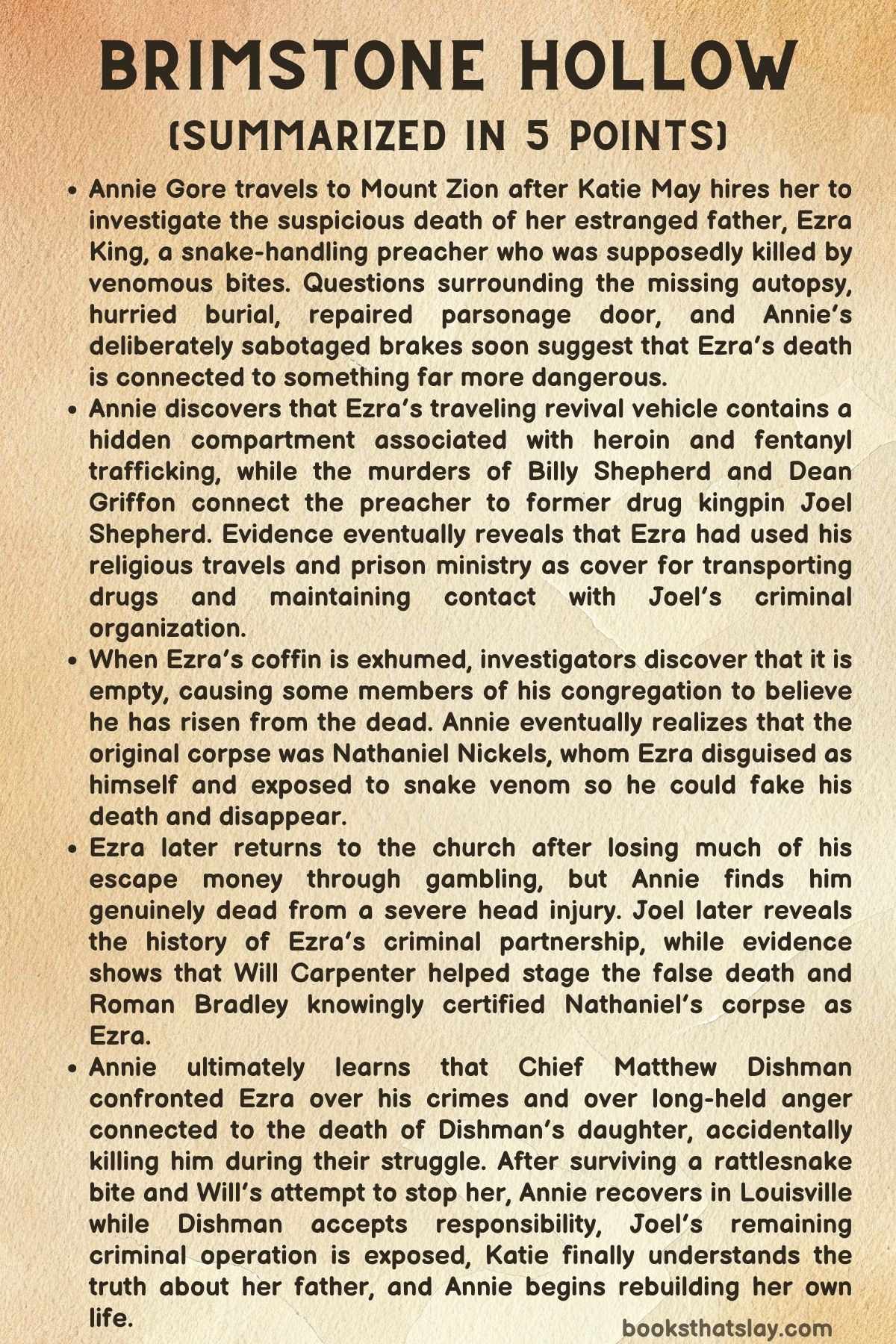
Summary
Private investigator Annie Gore is working through a hot Memorial Day weekend in Louisville when Katie May arrives with an unusual request. Katie’s biological father, Ezra King, was a snake-handling preacher in Mount Zion, Kentucky, and although Katie has barely known him since childhood, she has just learned that he died after supposedly being bitten repeatedly by venomous snakes.
Katie is troubled by several things surrounding Ezra’s death, including the absence of an autopsy and the speed with which he was buried. She is also disturbed by a vivid dream and waking vision involving Ezra, snakes, blood, locusts, and a supernatural message announcing judgment upon “the king,” so Annie agrees to investigate despite being skeptical of any supernatural explanation.
Driving her restored Datsun, Honey, Annie travels to Mount Zion and begins questioning local officials. Police Chief Matthew Dishman tells her that Ezra had openly handled snakes for years and shows her photographs of the corpse, which was badly swollen and discolored from several apparent bites to the face and neck.
The county coroner, Roman Bradley, authorized burial without an autopsy and repeatedly avoids Annie’s questions. Annie also visits Ezra’s isolated Church of the Healing Redeemer and discovers that his death has left the congregation struggling to understand how a preacher who placed such confidence in divine protection could have died from the very snakes associated with his ministry.
Will Carpenter, Ezra’s intended successor, explains that Ezra alone handled snakes publicly while the two men maintained the animals more carefully in private. They also extracted and sold venom, and Will speaks about Ezra with deep loyalty because the preacher helped him through a troubled adolescence and became an important father figure.
Soon afterward, Annie’s investigation becomes dangerous. While driving through Brimstone Hollow, Honey’s brakes fail, forcing Annie to escape moments before the car crashes down the mountainside.
Tina, Annie’s longtime friend and the person who helped restore Honey, later examines the wreck and discovers that the brake line was deliberately filed through. Annie remembers seeing a black Ford F-150 speeding away after the crash, and the vehicle is traced to Dean Griffon, a man connected with Ezra’s traveling revival operation.
Before Annie can question Dean, however, she and Dishman find him murdered in his garage beside Ezra’s revival RV. Examination of the vehicle reveals a hidden compartment and traces of heroin and fentanyl, transforming the case from a suspicious religious death into a possible narcotics investigation.
Another man, Billy Shepherd, had also died on the same Friday night as Ezra. Billy had been viciously beaten before his house was burned, and one of his fingers had been cut off.
Billy belongs to the family of Joel Shepherd, an elderly former marijuana kingpin whose organization Dishman helped dismantle years earlier. Dean had worked as Billy’s mechanic, while another violent associate of the Shepherd network, Nathaniel Nickels, disappeared that same weekend.
Annie becomes convinced that the apparently separate deaths are connected. Her suspicions deepen when she notices recently replaced locks and repaired wood around Ezra’s parsonage door, suggesting that someone broke in and later concealed the damage.
Blood is eventually discovered beneath a kitchen table inside the parsonage, despite attempts to clean it away. Fingerprints belonging to Nathaniel are also found there, proving that the missing man was present around the time Ezra supposedly died.
Annie searches for financial records that might connect Ezra’s revival operation with the Shepherd organization. Although she cannot locate the missing ledger, she discovers old photographs showing Ezra visiting Joel Shepherd in prison under the supposed cover of religious ministry.
Joel admits knowing Ezra but minimizes their relationship. Annie nevertheless realizes that Ezra’s traveling revival ministry provided an excellent method for transporting contraband while maintaining the public appearance of a preacher performing religious work.
With the evidence surrounding the parsonage becoming increasingly suspicious, authorities finally exhume Ezra’s coffin. Instead of finding evidence confirming or disproving the snakebite theory, they discover that the coffin is completely empty.
Members of Ezra’s congregation begin treating the disappearance as possible evidence that their preacher has risen from the dead. Annie and Dishman instead search for somewhere a body might have been hidden, including the sulfur-filled Hell Hole in Brimstone Hollow, but their first search produces no trace of Ezra.
The mystery grows stranger when Crystal, Dean’s girlfriend, announces that Ezra appeared to her in a vision and will return at dawn on Galilee Hill. Crystal has experienced visions and sleep-paralysis episodes since childhood, and Ezra had treated her experiences seriously when others dismissed them.
Through Crystal and local gossip, Annie learns that Ezra and Crystal shared an emotional attraction that angered Dean. She begins forming a theory that Dean may have discovered Ezra’s criminal activities and reported them to Joel Shepherd, placing several men in danger.
Annie eventually recognizes the central trick behind the original death scene. Nathaniel and Ezra had similar builds, and severe swelling caused by snake venom could make a corpse difficult to identify, meaning Ezra might have used Nathaniel’s body to stage his own death.
Realizing that Crystal’s predicted resurrection may have been designed to draw everyone away from the church, Annie races back to the building. There she discovers the real Ezra, who survived his supposed death but has now genuinely been killed by a fatal head injury.
The truth becomes clearer: Nathaniel confronted Ezra at the parsonage, but Nathaniel died during the encounter. Ezra then disguised Nathaniel’s body in his own clothing, exposed it to snake venom to create the appearance of a fatal attack, and disappeared while Mount Zion believed its preacher had been buried.
Annie later returns to the Hell Hole and finds Nathaniel’s body wrapped and concealed there. Because the corpse was not present during the earlier search, Annie knows that someone else participated in Ezra’s deception and moved Nathaniel after the coffin had been exhumed.
Suspicion turns toward Roman Bradley, whose willingness to certify the original corpse as Ezra made the entire scheme possible. Annie follows Dishman to Roman’s remote fishing cabin and finds the coroner holding the police chief at gunpoint.
Roman clearly participated in the deception and believes exposure will destroy him, but he never gives Annie a clear confession to Ezra’s murder. Overwhelmed by fear and shame, Roman kills himself, leaving everyone with an apparently convenient explanation that Annie does not fully trust.
Evidence recovered from Ezra’s recently acquired vehicle reveals that after staging his death, he intended to escape with money. Instead, his old gambling addiction resurfaced, and he lost much of what he possessed before returning to Mount Zion.
A conversation with Zelda then gives Annie an important reason to question Dishman. Years earlier, Dishman’s daughter Janey-Beth had developed leukemia, and Ezra’s influence had encouraged religious faith in healing during a period when medical treatment offered another possibility.
Janey-Beth died, leaving Dishman with years of grief and anger toward Ezra. Annie now realizes that the chief had a personal motive he had never fully disclosed.
Joel Shepherd eventually reveals the history behind the drug operation. Ezra had once been involved in illegal gambling, and after Joel entered prison, Joel’s son recruited him to transport marijuana in his revival vehicle while using prison ministry as cover for carrying information to Joel.
Later, Ezra and Billy began trafficking heroin and fentanyl for themselves and stealing from Joel. Dean discovered the betrayal and informed Joel, who sent Nathaniel to recover stolen assets and frighten the men responsible.
Nathaniel brutally attacked Billy, cut off one of his fingers because access to Billy’s cryptocurrency required a fingerprint, and burned the house after believing Billy was dead. Nathaniel then went to Ezra’s parsonage, where the confrontation ultimately ended with Nathaniel becoming the corpse used in Ezra’s false death.
Joel also reveals that Ezra contacted him again after disappearing. Having gambled away much of his money, Ezra offered to exchange Billy’s hidden severed finger for additional funds, and Bart Casada later saw Ezra return to the church with another man following him inside.
That man was Dishman.
Before the investigation can fully conclude, Annie searches the church altar after learning that it contains an old hidden cavity. She finds Nathaniel’s clothing and Billy’s severed finger, but she also encounters a timber rattlesnake concealed there and is bitten on the wrist.
Will reveals himself as another participant in Ezra’s scheme. Ezra had manipulated knowledge of Will’s painful history with Roman, who had sexually involved himself with Will while Will was underage, and Will used that history to pressure Roman into falsely certifying Nathaniel’s body as Ezra.
Will also removed Nathaniel’s body from the grave and later placed it in the Hell Hole. Believing Annie has destroyed the congregation and everything Ezra represented, Will intends to leave her fate to divine judgment.
When Officer Gavin Alvey intervenes, Will shoots him. Annie, already suffering from the snake venom, manages to shoot and wound Will before Dishman arrives and races both Annie and Gavin toward medical care.
During the desperate drive, Dishman finally admits what happened to Ezra. He followed the preacher into the church and confronted him over his criminal deception and over the lingering anger associated with Janey-Beth’s death.
The argument became physical, and Dishman struck Ezra once. Ezra fell backward, suffered the fatal head injury, and died, making Dishman responsible for his death even though he had not entered the building intending to kill him.
Annie survives the rattlesnake bite, Gavin survives his gunshot wound, and Will survives Annie’s shot before confessing his role in the staged death and the concealment of Nathaniel’s corpse. Dishman eventually turns himself in rather than allowing Roman’s death to continue shielding him.
While recovering, Annie makes one last connection after noticing sulfur on Bart Casada. She realizes the smell may come from Mount Zion’s underground cave system rather than the Hell Hole, and Bart’s unusually high electricity use points authorities toward concealed marijuana-growing caves.
Police uncover the operation, and Joel Shepherd is sent back to prison. Katie attends Ezra’s real funeral and develops a friendship with Zelda, creating a connection to her childhood that no longer depends entirely upon her father.
Annie returns to Louisville with lasting injuries but a clearer understanding of herself. Tina eventually brings her to see Honey, which has been repaired enough to run again, and the sound of the restored engine becomes a quiet sign that Annie, like the car, has survived severe damage and is moving toward recovery.
Characters
Annie Gore
Annie Gore is the central investigator and emotional anchor of Brimstone Hollow, combining professional persistence with a powerful personal attraction to dangerous situations. Her decision to accept Katie’s case initially comes from empathy as much as professional curiosity because Katie’s unresolved relationship with Ezra reminds Annie of her own painful relationship with her father.
Her investigative strength lies in noticing details that others dismiss, including the repaired parsonage door, hidden blood, financial inconsistencies, the significance of the prison photograph, and the possibility that the swollen corpse identified as Ezra belonged to another man. She repeatedly rejects easy conclusions, particularly after Roman’s suicide appears to provide a convenient answer to Ezra’s murder.
Annie’s courage is inseparable from recklessness. She secretly searches the church, descends into the Hell Hole twice, enters Roman’s dangerous confrontation with Dishman, and later returns to the church alone despite knowing that several people have already died.
Her memories gradually show that risk has shaped Annie since childhood. She spends much of the story viewing danger as something her unstable parents brought into her life, but her final recovered memory makes her recognize that she also has an instinct to move toward danger rather than away from it.
That realization does not reduce Annie to her parents. Instead, she understands that inherited patterns or learned behavior do not dictate every future choice, and her recovery after the snakebite leaves her with greater awareness of both her resilience and her limitations.
Ezra King
Ezra King is the dead man, missing man, criminal conspirator, spiritual leader, and eventual murder victim around whom Brimstone Hollow revolves. Nearly every person in Mount Zion possesses a different version of Ezra, making him impossible to understand through a single reputation.
To Will, he is a rescuer and substitute father. To Katie, he is the estranged parent whose religious extremism drove away her mother, while members of the congregation remember a charismatic preacher whose snake handling seemed to demonstrate extraordinary faith.
Behind that image, Ezra has always been attracted to danger. His earlier gambling addiction develops into increasingly extreme religious demonstrations and eventually exists alongside his involvement in drug transportation and trafficking.
Ezra’s religious work also gives him practical protection. His revival vehicle allows him to transport narcotics, while his prison ministry provides legitimate-looking access to Joel Shepherd, demonstrating how effectively he uses respectable appearances to conceal criminal activity.
His most audacious act is the staging of his own death. After Nathaniel dies during their confrontation, Ezra turns the situation into an escape plan by disguising Nathaniel as himself and using snake venom to make identification difficult.
The deception exposes Ezra’s willingness to exploit the beliefs of people who trust him most. He knows his followers will interpret his apparent death through the language of faith, and their devotion becomes another tool that assists his disappearance.
His return to the church ultimately destroys the escape he created. By coming back for Billy’s severed finger, he encounters Dishman and dies during their confrontation, ending a life defined by charisma, risk, concealment, and repeated attempts to control how other people understood him.
Katie May
Katie May provides the emotional reason the investigation begins and gives Brimstone Hollow much of its concern with parents, memory, and identity. She approaches Annie not because she has a simple loving relationship with Ezra but because she needs to understand a father who has remained psychologically important despite decades of separation.
Her childhood was shaped by Ezra’s increasing religious extremism. Maggie finally left after Ezra brought a copperhead into their home, and Katie’s later encounter with him at a snake-handling service confirms how thoroughly his religious identity had replaced ordinary family intimacy.
Katie’s unusual dream and vision could easily have made her seem interested only in proving something supernatural, but her actual motivation is more practical. She wants the truth even when Annie warns that the truth may reveal criminal behavior and serious moral failures.
That willingness distinguishes Katie from many of Ezra’s followers. She is emotionally affected by each new revelation, yet she never asks Annie to protect the comforting version of Ezra.
By the end, Katie can attend her father’s genuine funeral knowing far more about him than she did when the investigation began. Her emerging friendship with Zelda also gives her a connection to Mount Zion that is based on her own identity rather than exclusively on being Ezra King’s daughter.
Chief Matthew Dishman
Chief Matthew Dishman is one of the most complicated figures in Brimstone Hollow because he serves simultaneously as Annie’s investigative partner and as the man responsible for Ezra’s final death. For most of the story, he behaves like a cautious police officer who insists that evidence must support Annie’s suspicions before he changes the official interpretation of the case.
He repeatedly helps Annie despite being concerned about her methods and safety. He investigates Honey’s sabotage, follows the drug evidence, reopens scrutiny of the parsonage, assists with the exhumation, searches the Hell Hole, and becomes increasingly willing to recognize that Ezra’s original death scene was fraudulent.
His hidden connection to Ezra comes through Janey-Beth. Dishman believes Ezra’s influence helped encourage faith in divine healing during his daughter’s leukemia, and her death leaves him carrying anger that survives beneath his professional conduct.
When he encounters the supposedly dead Ezra inside the church, accumulated grief combines with the shock of learning that Ezra is both alive and deeply involved in criminal deception. Dishman strikes him during the confrontation, causing the fatal fall.
His later concealment compromises the principles he spent his career enforcing. Yet his eventual confession and surrender show that he ultimately accepts responsibility rather than continuing to allow Roman’s suicide to provide a false solution.
Will Carpenter
Will Carpenter is among the most damaged and dangerous characters in Brimstone Hollow because his devotion to Ezra is rooted in genuine gratitude, emotional dependence, manipulation, and unresolved trauma. Ezra entered Will’s life when he was troubled and vulnerable, giving him purpose and becoming the father figure around whom Will constructed much of his adult identity.
That loyalty makes Will resistant to any evidence that threatens Ezra’s reputation. Annie repeatedly encounters his defensiveness when asking about the parsonage, financial records, the church, and Ezra’s private activities.
Will’s connection to Roman explains an additional source of his vulnerability. Roman had sexually involved himself with Will while Will was underage, and Ezra later uses knowledge of that history as part of the pressure that draws Roman into falsifying the identification of Nathaniel’s corpse.
Will becomes an active participant rather than merely a manipulated follower. He helps maintain the false death, removes Nathaniel from the grave, dumps the corpse in the Hell Hole, conceals evidence, and ultimately creates the snake trap that nearly kills Annie.
His confrontation with Annie reveals the extent to which he has confused loyalty to Ezra with loyalty to God. By treating Annie’s survival or death as divine judgment, he avoids acknowledging that he himself deliberately created the deadly situation.
Roman Bradley
Roman Bradley initially appears suspicious because of his extraordinary handling of Ezra’s supposed death. He skips an autopsy, personally oversees the body, permits an unusually rapid burial, and avoids Annie whenever she tries to question him.
His actions eventually prove central to the false death. Roman knowingly identifies Nathaniel’s swollen corpse as Ezra, allowing the deception to pass through the very official process that should have exposed it.
Roman’s involvement, however, comes from a darker history involving Will. His past sexual conduct with the underage Will gives others leverage over him, and fear of exposure becomes a powerful force controlling his decisions.
His final confrontation with Dishman and Annie shows a man overwhelmed by shame and terror rather than a calculating mastermind. His suicide leaves behind enough guilt to make him appear responsible for Ezra’s final murder, which temporarily hides Dishman’s involvement.
Dean Griffon
Dean Griffon begins as a likely threat because evidence strongly suggests that he sabotaged Annie’s brakes after learning she was investigating Ezra. His truck is seen near the crash, and information on his phone confirms that he had been researching Annie.
His murder changes his role from potential attacker to another victim of the wider conspiracy. Dean had long struggled with drugs and had once benefited from Ezra’s help, eventually becoming connected with the traveling revival operation.
Dean discovers that Ezra and Billy are stealing from Joel Shepherd through their fentanyl and heroin dealings. By informing Joel, Dean unintentionally starts the chain of retaliation that leads to several deaths.
His jealousy surrounding Ezra and Crystal adds another personal conflict to his relationship with the preacher. Dean therefore stands at the meeting point between the story’s criminal and emotional conflicts.
Billy Shepherd
Billy Shepherd represents the newer generation of the Shepherd criminal network and the escalation from the region’s older marijuana business into far more dangerous narcotics. His secret partnership with Ezra involves heroin and fentanyl, along with theft from Joel’s organization.
His death is particularly brutal. Nathaniel beats him, removes a finger because access to cryptocurrency apparently requires his fingerprint, and burns his house after believing the attack has killed him.
Billy’s severed finger becomes one of the strangest but most important physical objects in the investigation. Ezra later hides it at the church because he hopes to use it as leverage for obtaining money from Joel.
Even after Billy dies, the financial consequences of his crimes continue shaping the behavior of Ezra, Joel, Bart, and Annie. His death shows how quickly greed turns an existing criminal operation against its own participants.
Nathaniel Nickels
Nathaniel Nickels functions as Joel Shepherd’s violent enforcer. His reputation makes him an obvious suspect once Annie discovers that several events surrounding Ezra involve the old Shepherd organization.
Nathaniel is sent first to Billy, where his violence produces the beating, fire, and severed finger. He is then sent to confront Ezra and recover money, but that encounter ends with Nathaniel himself dead.
His body becomes essential to Ezra’s escape plan because his physical build is close enough to Ezra’s for the substitution to work once venom causes severe swelling. Nathaniel therefore becomes both victim and evidence after spending much of his life as an instrument of violence.
The later discovery of his fingerprints in Ezra’s kitchen and his body in the Hell Hole allows Annie to reconstruct the deception. His disappearance is the hidden event connecting Ezra’s false death to the larger narcotics conflict.
Joel Shepherd
Joel Shepherd remains dangerous despite age, physical frailty, oxygen dependence, and electronic monitoring. His power comes less from direct physical action than from old relationships, information, loyalty, and the ability to command others.
He represents a criminal structure that survived his imprisonment. Ezra’s prison visits allow communication between Joel and outside associates, while people such as Nathaniel and Bart continue carrying out tasks connected to his interests.
Joel is also the person who finally provides Annie with the history necessary to understand the entire conspiracy. He explains Ezra’s early involvement in gambling, the revival vehicle’s use for marijuana transportation, Billy and Ezra’s later betrayal, and Nathaniel’s assignments.
His desire to recover Billy’s severed finger reveals that financial self-interest remains his primary concern even after multiple deaths. The later discovery of the underground marijuana operation confirms that his organization was never as inactive as it appeared.
Tina
Tina is one of Annie’s most important sources of stability. Their friendship dates back to their Air Force years, and the restoration of Honey gives their relationship a physical symbol that remains present throughout the book.
She identifies the deliberate damage to Annie’s brake line, converting what might have looked like an accident into clear evidence of attempted murder. Her technical competence therefore changes the investigation at a crucial moment.
Tina also understands Annie personally enough to recognize when a case has become emotionally connected to her childhood. She worries about Annie’s instinct to face danger alone and repeatedly reminds her that independence does not require isolation.
Her appearance at the hospital and later restoration of Honey provide a strong contrast with the destructive relationships Annie has been remembering. Tina represents loyalty that supports Annie without controlling her.
Crystal
Crystal initially enters the story through her connection with Dean, but her relationship with Ezra and her unusual experiences make her increasingly important. Since childhood, she has experienced visions and episodes resembling sleep paralysis, and Ezra earned her trust by taking those experiences seriously.
Her announcement that Ezra will return on Galilee Hill appears supernatural to the congregation. Whether Crystal interprets her experience religiously or psychologically, the effect is the same: the church empties as people rush to witness the promised return.
Crystal also provides Annie with information about Dean’s past and movements. Her emotional attraction to Ezra adds another layer to Dean’s resentment and helps Annie understand why Dean may have become suspicious enough to discover Ezra’s criminal activities.
Gavin Alvey
Officer Gavin Alvey begins as a comparatively minor member of the Mount Zion police but becomes increasingly involved as the case expands. He assists Dishman throughout the investigation and remains connected with the evidence surrounding Nathaniel, Ezra, and the church.
His most significant moment occurs during Annie’s confrontation with Will. Gavin awakens and intervenes when Annie is already suffering from the rattlesnake bite, and Will shoots him.
Gavin survives serious damage to his lung and later faces a different emotional injury when Dishman turns himself in. The fall of the chief forces Gavin to confront the uncomfortable fact that someone he respected could perform both admirable and seriously wrongful acts.
Thelma Worley
Thelma Worley provides Annie with important historical knowledge about Ezra and his congregation. As the person who originally discovered the supposed corpse, she is closely connected to the official beginning of the mystery even though she is unaware that the body is Nathaniel’s.
She remembers Ezra’s earlier survival of a venomous bite and explains how incidents like that strengthened his authority among believers. She also describes his growing role in the church and the devotion he inspired in Will.
Thelma’s loyalty does not make her completely uncritical. Through her, Annie gains information about Ezra’s plans, relationships, and the evolution of his ministry that helps distinguish the public preacher from the concealed criminal.
Hollis Patton
Hollis Patton, the proprietor of the Mount Zion Motel, provides Annie with practical help and local information throughout the investigation. His curiosity and talkative personality give Annie access to community gossip that formal interviews might never uncover.
He loans Annie his old Ford Bronco after Honey is destroyed, allowing her investigation to continue. The gesture also reveals genuine concern beneath his humor and fascination with Annie’s work.
Hollis becomes one of several local relationships that prevent Annie from being completely isolated in Mount Zion. His support helps balance the hostility and danger generated by people who want her investigation stopped.
Zelda
Zelda initially appears as a source of local history through her work at the Cherry Dairy, where she remembers Katie and Maggie. Her knowledge eventually becomes crucial to Annie’s understanding of both Ezra and Dishman.
She tells Annie about the distrust surrounding Ezra, the rumors involving Crystal, and finally the history of Janey-Beth’s illness. That final revelation supplies the personal motive Annie had been missing when considering Dishman’s possible involvement.
Zelda’s later friendship with Katie has additional significance. She offers Katie a relationship with someone connected to her childhood that does not depend upon Ezra’s mythology or crimes.
Frankie
Frankie is enthusiastic about Annie because she recognizes her from media coverage of an earlier investigation. Her excitement causes her to announce Annie’s identity and purpose publicly at the Cherry Dairy.
That mistake destroys Annie’s ability to investigate quietly and may help alert Dean that she is examining Ezra’s death. Frankie therefore influences events despite having no criminal intentions.
She also contributes useful gossip about Ezra and Crystal. Her observations become another small piece of information Annie later incorporates into the larger explanation.
Bart Casada
Bart Casada is a former participant in Joel Shepherd’s marijuana organization who appears to have become a helpful local farmer. His Tennessee alibi initially places him away from the violence committed during the crucial weekend.
Bart later becomes important as Joel’s intermediary. He carries messages, watches the church, and sees Dishman follow Ezra inside shortly before Ezra’s real death.
His final hospital visit also gives Annie the clue that exposes the concealed marijuana-growing caves. The strong sulfur smell on Bart, combined with unusual electricity use at his property, leads Annie to recognize that the underground spring and cave system provides another hidden space for Joel’s organization.
Leo
Leo is connected to Annie’s earlier investigative life and remains a trusted person she contacts when she needs outside help. After the crash, he immediately considers the possibility that Honey’s brake failure was deliberate and uses his contacts to identify Dean’s truck.
He also understands that the case is affecting Annie beyond the professional level. His observations repeatedly connect Katie’s questions about Ezra with Annie’s continuing struggle to understand her own father.
Leo functions as an outside perspective when Annie becomes consumed by Mount Zion. He recognizes both the logic of her investigation and the emotional forces pushing her forward.
Maggie
Maggie, Katie’s mother, appears mainly through remembered history, yet her decision to leave Ezra has lasting consequences. She tolerated Ezra’s increasing religious intensity until he brought a copperhead into the family home, crossing a boundary she was unwilling to accept.
Her decision removes Katie from the dangerous environment surrounding Ezra. Later discoveries about his gambling, criminal connections, and capacity for deception make Maggie’s distrust appear increasingly justified.
Maggie also represents a different response to Ezra from that of his congregation. Rather than interpreting his dangerous behavior as proof of faith, she recognizes the threat it poses to ordinary family safety.
Scarlett Nickels
Scarlett is Nathaniel Nickels’s wife and provides investigators with information about his disappearance. Nathaniel frequently vanished for periods of time, so his failure to return initially makes Scarlett angry rather than immediately frightened.
Her reaction demonstrates how instability and violence have become normalized around Nathaniel. She does not know the larger criminal events in which he is involved, but her account helps establish his movements and the unusual length of his absence.
Janey-Beth Dishman
Janey-Beth never participates directly in the present-day events, yet her death exerts enormous influence on the climax. Her leukemia and the circumstances surrounding her treatment become inseparable from her father’s anger toward Ezra.
For Dishman, Ezra represents more than a criminal who fooled the town. He is connected to one of the most painful losses of Dishman’s life and to the belief that faith influenced decisions made while Janey-Beth was desperately ill.
Her memory therefore becomes the hidden emotional force behind Dishman’s confrontation with Ezra. The tragedy demonstrates how actions taken years earlier can continue shaping choices long after the original event has ended.
Themes
Faith, Belief, and the Need for Certainty
Faith in Brimstone Hollow is presented as a powerful force that can provide comfort and meaning while also becoming vulnerable to manipulation. Ezra’s congregation sees his snake handling as evidence of extraordinary spiritual commitment, so his supposed death from snakebites creates a crisis that threatens not merely their opinion of one man but their understanding of divine protection.
The empty coffin intensifies that desire for certainty. Rather than beginning with criminal explanations, some followers immediately understand the absence of the body as resurrection, demonstrating how people interpret unexplained events through beliefs they already possess.
Crystal’s vision of Ezra returning on Galilee Hill shows the same process. Her personal experience may be completely sincere, yet once it reaches the congregation it becomes collective certainty, and dozens of people act upon a claim for which they possess no physical evidence.
The book does not treat every form of faith as foolish. Instead, it repeatedly distinguishes private belief from the dangerous moment when belief becomes a substitute for questioning, evidence, responsibility, or medical judgment.
Dishman’s history with Janey-Beth gives that conflict its most painful form. Faith in healing becomes connected with decisions made during a child’s serious illness, leaving Dishman with years of unresolved anger after her death.
Annie occupies the opposite investigative position because she insists on evidence even while experiencing dreams, visions, and sleep-paralysis episodes of her own. Her approach allows room for experiences she cannot immediately explain without allowing those experiences to determine factual conclusions.
Fathers, Children, and Inherited Damage
The relationship between parents and children connects Katie’s search for Ezra with Annie’s memories of her own father. Neither woman can reduce her father to a simple category of loving or harmful because affection exists alongside fear, disappointment, instability, and behavior that shaped each daughter long after childhood.
Katie begins the investigation because physical distance has never resolved her emotional uncertainty about Ezra. She does not need Annie to prove that he was secretly good; she needs enough truth to understand who he actually was and how much authority his memory should continue to possess in her life.
Annie’s childhood recollections create a parallel conflict. Her parents lived with volatility and danger, and Annie initially experiences those memories as something done to her, yet the final recovered memory forces her to recognize that she also possessed an attraction to reckless behavior.
That recognition changes the question from whether children inherit their parents’ flaws to what they do once they recognize those patterns. Annie may have learned or inherited a willingness to court danger, but awareness allows her to decide whether that quality will control her choices.
Will presents a darker version of the parent-child pattern even though Ezra is not his biological father. He treats Ezra as the father who saved him, making criticism of Ezra feel like an attack on the foundation of his identity.
Dishman’s relationship with Janey-Beth reverses the direction of the theme. Instead of a child carrying the consequences of a father’s actions, a father spends years shaped by the loss of his daughter, showing how family bonds can continue influencing behavior long after death.
Public Identity and Hidden Truth
Nearly every major mystery depends upon the difference between the person someone appears to be and the life that person actually leads. Ezra is publicly known as a preacher willing to risk his life as evidence of faith, yet behind the revival ministry he has a gambling problem, a long relationship with an organized criminal network, and direct involvement in narcotics trafficking.
His revival vehicle perfectly represents that contradiction. What appears to be transportation for religious outreach contains a hidden compartment used to move illegal drugs, allowing the visible identity of the ministry to conceal its opposite.
The false death takes the same principle further. Ezra does not simply run away; he constructs an entire physical performance in which clothing, venom, a substituted corpse, official certification, and the expectations of his followers combine to manufacture a believable reality.
Roman also possesses a divided identity. As county coroner, he is responsible for ensuring that deaths are properly examined, yet fear of his own concealed history makes him cooperate in falsifying the most important death investigation in the story.
Dishman presents an even more morally difficult version of the conflict because his public identity is not entirely false. He genuinely investigates crimes and repeatedly tries to protect Annie, but he also hides his responsibility for Ezra’s death once the confrontation becomes fatal.
The story therefore avoids suggesting that hidden wrongdoing automatically makes every visible virtue meaningless. Instead, it shows that people can contain contradictory actions and motives, which is why Annie must rely on evidence rather than simple reputations.
Risk, Responsibility, and the Consequences of Choice
Risk appears throughout Brimstone Hollow in religious, criminal, emotional, and personal forms. Ezra gambles, handles venomous snakes, traffics drugs, deceives criminals, stages his own death, and eventually returns to the very place where discovery is most dangerous.
What initially looks like religious courage gradually appears connected to a much broader attraction to danger. Ezra does not eliminate his gambling impulse when he becomes a preacher; he appears to transfer that appetite for uncertainty into other areas of life.
Annie possesses a related tendency, although she uses it differently. She pursues leads alone, conducts unauthorized searches, repeatedly enters dangerous locations, and continues investigating even after someone sabotages her brakes.
Her final childhood realization is therefore important because it removes the comforting idea that only other people introduced danger into her life. Annie recognizes her own willingness to seek dangerous situations, creating the possibility that she can become more deliberate about the risks she accepts.
Responsibility becomes the essential distinction between courage and recklessness. Dishman may not intend to kill Ezra when he confronts him, but the accidental nature of the fatal blow does not remove his obligation to acknowledge what he did.
Will makes the opposite choice by treating his deliberate snake trap as divine judgment rather than personal action. By pretending the outcome belongs to God, he attempts to escape responsibility for creating the circumstances that nearly kill Annie.
The book ultimately treats choice as more important than purity. Annie, Dishman, Katie, Gavin, and others cannot undo the damage surrounding them, but they can decide whether to acknowledge the truth, accept consequences, and act differently once that truth becomes impossible to ignore.