But I Hate Him Summary, Characters and Themes
But I Hate Him by Page Powars is a young adult rivals-to-romance story centered on Rory Prince, a brilliant trans teenager whose life has been organized around academic achievement, public reputation, and his parents’ tutoring empire.
After one disastrous act destroys his carefully planned summer, Rory enters an elite science camp where he unexpectedly encounters Luca Melendez, the rival who has defeated him for years. What begins as another attempt to beat Luca gradually becomes a story about attraction, friendship, family pressure, competition, accountability, and self-definition. Rory must decide whether success matters more than becoming a person who can choose his own future.
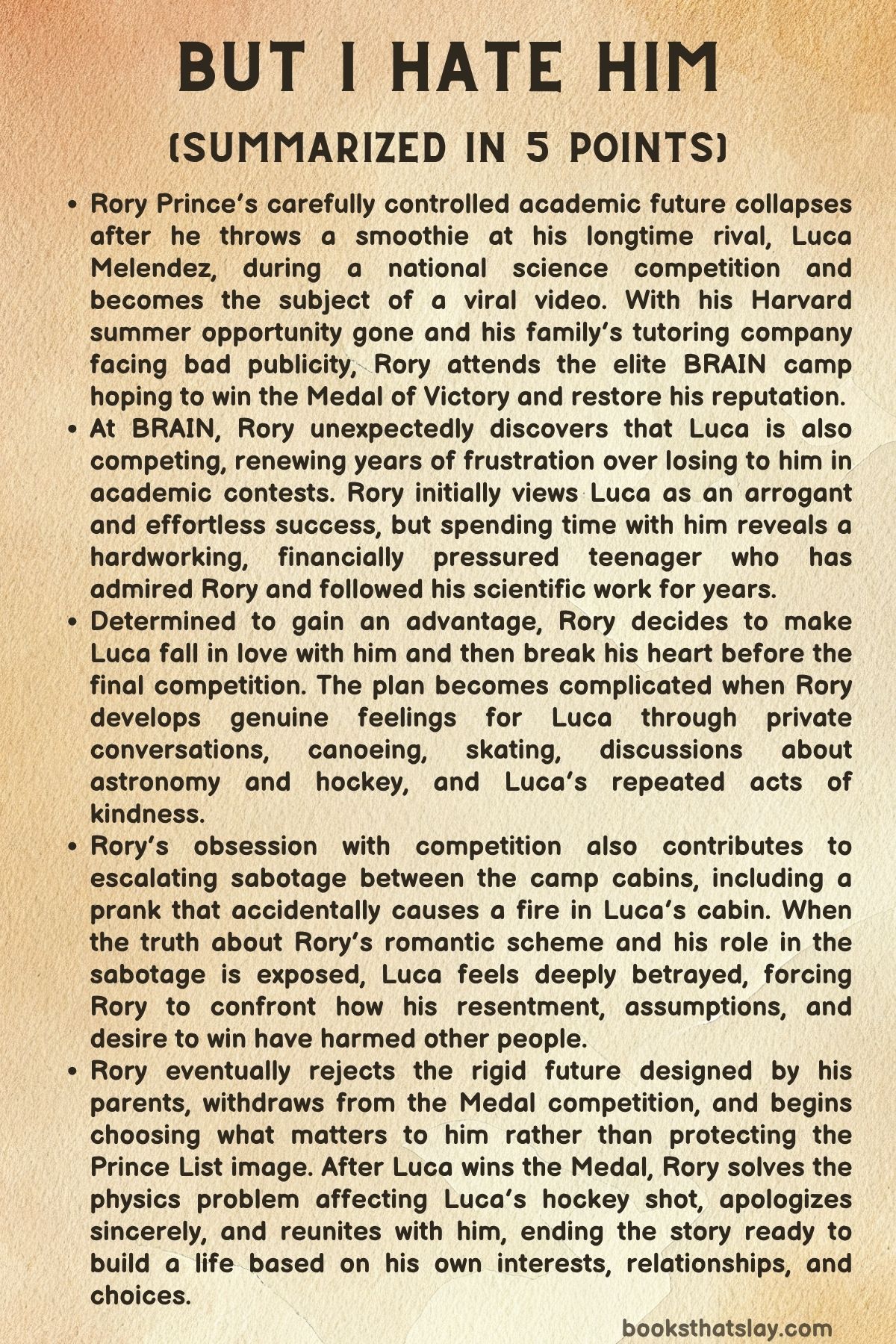
Summary
Rory Prince has spent most of his life following a plan created around exceptional academic achievement. As the public face of Prince List, his parents’ international tutoring company, he is expected to excel constantly, eventually attend Harvard, and maintain the polished image that has helped make the family business successful.
His greatest frustration is Luca Melendez, another gifted student who has defeated him thirty-five times in academic competitions. At the Junior Science and Humanities Symposium, Rory presents sophisticated machine-learning research identifying thirteen possible extragalactic planets, but Professor Hiller reacts far more enthusiastically to Luca’s energetic presentation about professional hockey.
When Hiller tells Rory that his work lacks the passion Luca displays, years of frustration erupt. Rory throws his smoothie at Luca in front of an audience, the incident is recorded, the video becomes viral, and Rory is disqualified from the competition as well as the prestigious Harvard summer opportunity he had expected to receive.
The scandal damages both Rory’s personal reputation and Prince List. His parents scramble to protect the company and his college prospects, eventually finding one remaining summer option: BRAIN, an elite program on Bachelor Island where gifted students compete in teams before selected finalists battle for the Medal of Victory, a prize offering Ivy League admission support, financial assistance, and access to an influential alumni network.
Rory reluctantly accepts because the Medal could repair much of the damage caused by the viral video. At BRAIN, he is assigned to Cabin Omega with Christiana Garza Sada, Jade, and Benedict Darlingtonshire, and for a short time he enjoys being around people who do not immediately recognize the Prince List celebrity.
That relief disappears when Rory discovers Luca is also attending the camp. Instead of going to the Harvard program he won, Luca voluntarily declined it, meaning Rory would have received the position if he had not been disqualified for the smoothie incident.
Rory therefore realizes that Luca did not truly take Harvard away from him. Rory’s own impulsive behavior did, although accepting that truth is far harder than continuing to treat Luca as the source of his problems.
Competition at BRAIN proves more complicated than Rory expects because success depends on teamwork. Rory is accustomed to trusting his own intelligence and controlling every variable, but Omega is badly divided: Benedict resents Rory because their families operate competing tutoring businesses, Jade follows her own impulses, and Christiana has interests and priorities Rory does not initially understand.
Their first competition ends badly while Luca’s Cabin Gamma succeeds. Rory responds by introducing strict study rules modeled on the restrictive principles his parents have used throughout his life, but his teammates resist being managed as if they are extensions of Rory’s personal ambition.
When Jade organizes a secret party, Rory initially views it as another dangerous distraction. He changes his mind after realizing Luca might attend, deciding he can encourage Luca to drink heavily and weaken his performance before the next competition.
The scheme takes an unexpected direction when Rory and Luca become partners in a party game built around intimate questions. Rory learns about Luca’s family, hockey ambitions, emotional life, and attraction to men, while Luca reveals that he remembers Rory’s scientific work in surprising detail.
Rory had convinced himself that Luca barely noticed him during years of competition. Discovering that Luca remembers his projects and has actually paid attention to him destabilizes the resentment Rory has carefully maintained.
Rory becomes far more intoxicated than Luca and finally tells him how much the symposium interruption hurt him. Luca apologizes, explaining that he never intended to humiliate Rory, but Rory’s intoxicated mind also produces a new strategy: he will make Luca fall in love with him, break his heart, and use the resulting emotional distraction to defeat him.
The plan immediately proves ridiculous because Rory’s first attempt at expressing interest is interpreted by Luca as a declaration of friendship. Nevertheless, Rory continues pursuing the idea even as Luca repeatedly behaves with generosity rather than hostility.
Omega loses another laboratory competition, leaving Rory terrified that his path to the Medal is disappearing. Luca comforts him rather than celebrating and offers to help Rory understand why Omega cannot cooperate successfully.
Their private study meeting becomes more personal than academic. Luca brings hot chocolate and cookies, explains that calling Rory “Prince Charming” was intended affectionately rather than mockingly, and displays the same intelligence Rory has always regarded as threatening.
Rory invites Luca canoeing as another supposed step in his manipulation. During the outing, Luca explains that Rory has intimidated him for years because of his fame, academic ability, and controlled public image, revealing that their relationship has never matched the one-sided rivalry Rory constructed in his imagination.
Luca also describes his financial circumstances. He lives with his mother, helps care for his siblings, and hopes the BRAIN prize will allow him to attend Cornell while pursuing Division I hockey, making the Medal much more financially important to him than Rory initially realizes.
Meanwhile, sabotage and pranks among the BRAIN cabins intensify. When Benedict presents evidence that appears to show Gamma stole Omega’s bedsheets, Rory eagerly accepts the accusation and helps organize retaliation involving a chemiluminescent substance that will cover Gamma’s cabin and interfere with their sleep.
Rory’s task is to keep Luca occupied at a disco-skating event while Omega carries out the operation. Luca teaches Rory how to skate, and their conversation becomes increasingly intimate as Rory admits how manufactured much of his Prince List life has been.
Rory also becomes interested in Luca’s weakened hockey slap shot following a shoulder injury. Although helping Luca offers Rory no competitive advantage, he begins applying physics to the problem because Luca cares about it, providing one of the clearest indications that Rory’s supposed romantic manipulation is becoming genuine affection.
During the skating event, Luca denies that Gamma stole Omega’s sheets and speaks sincerely enough that Rory believes him. Horrified by the possibility that he has authorized retaliation against innocent people, Rory runs toward Gamma’s cabin to stop the prank.
He arrives too late. Candles accidentally ignite spilled chemicals, transforming the glowing prank into a genuine fire that damages Gamma’s cabin and belongings.
The next morning, Gamma is exhausted and displaced during another competition. Omega finally works effectively as a team and wins, but Rory cannot enjoy defeating Luca because he knows the circumstances resulted partly from his own actions.
Rory’s guilt increases when he realizes Luca had honestly helped predict the subject of the competition. The person Rory keeps treating as a manipulative enemy has repeatedly acted like someone who genuinely wants him to succeed.
Christiana eventually forces Rory to confront what he is doing. After Rory confesses that his original intention was to make Luca fall in love and then deliberately hurt him, Christiana tells him that damaging property is one kind of wrongdoing, while intentionally exploiting another person’s emotions is far more personal.
Rory nevertheless postpones telling Luca the truth. He wants to preserve the growing connection between them even though he knows that connection now rests partly on information Luca does not have.
A major turning point comes when Benedict admits Gamma never stole Omega’s bedsheets. Benedict had accidentally caused the misunderstanding and allowed Omega to continue believing Gamma was responsible because their shared hostility had finally united the cabin.
Rory therefore discovers that the revenge operation leading to the fire was based on a false accusation. His readiness to believe the worst about Luca had helped transform harmless camp rivalry into actual harm.
Soon afterward, Luca takes Rory to a secluded cliff beneath the stars. Luca explains the financial obstacles preventing him from attending Cornell and reveals that he has been attracted to Rory for years.
Rory learns that Luca rejected other romantic possibilities at camp because he was interested in him. The comments Rory interpreted as mockery were often clumsy attempts at flirting, and the rival Rory imagined as indifferent had actually been watching and admiring him for a long time.
They kiss, making Rory confront the fact that his own feelings are equally real. Instead of enjoying the relationship, however, Rory is consumed by guilt because Luca still does not know that the relationship began as a revenge strategy.
During the final team challenge, Omega has changed enough to function even when Rory cannot lead effectively. Jade takes control, Christiana and Benedict contribute, and Rory sees that his belief that he must personally control every outcome has been wrong.
The truth finally comes out after Gamma retaliates against Omega for the cabin fire. Christiana reveals Omega’s responsibility for the earlier sabotage and exposes Rory’s plan to make Luca fall in love before breaking his heart.
Luca directly asks Rory whether the accusation is true, and Rory admits everything. He tries to explain that the original manipulation became genuine love, but Luca is devastated because feelings he believed were trustworthy were connected to a plan designed specifically to exploit him.
After Luca leaves, Rory stops pretending he still hates him. He also begins questioning whether winning the Medal should continue to control his choices.
Omega’s members recognize that the prize has different importance for Luca because he truly needs its financial support. Rory offers to abandon his own project and help Luca, but Luca refuses to accept pity or allow Rory to erase his own ambitions simply to compensate for his guilt.
Their confrontation becomes important for reasons beyond romance. Rory explains that he has lived for years under intense pressure from his parents, Prince List customers, and strangers who may interpret every mistake harshly, with his visibility as a trans teenager making public judgment feel even more dangerous.
Luca challenges Rory’s assumption that he must personally protect the family company from every possible embarrassment. He points out that adults around Rory are allowed to make mistakes while Rory has been expected to behave as an almost perfect corporate symbol.
Benedict later provides Rory with another example of choosing independence. He reveals that he intends to reject the acting and modeling future his family planned for him, and he also admits that he has romantic feelings for Rory.
Rory cannot return Benedict’s feelings because he loves Luca, but the confession strengthens their friendship. Benedict encourages Rory to stop assuming that Luca can never forgive him and instead take responsibility for repairing whatever can still be repaired.
On the morning of the Medal competition, Rory’s parents arrive expecting him to complete his redemption by winning. Rory finally tells his mother that he is exhausted from carrying Prince List’s reputation and asks whether losing would actually change his parents’ love for him.
Backstage, Rory looks at the project he prepared and realizes that competing solely because his parents expect him to win would mean repeating the same pattern he wants to escape. He destroys his presentation material and voluntarily withdraws.
Luca gives his presentation about the physics of his post-injury hockey performance. Although he has not solved the problem completely, he has eliminated two accepted explanations, demonstrating that meaningful scientific work can involve discovering what is not responsible for an outcome.
Luca later finds Rory’s ruined presentation board and understands why he withdrew. He tells Rory that he is proud of him for choosing failure on his own terms, but Rory remains so overwhelmed by guilt that he walks away rather than fully accepting the possibility of reconciliation.
Back at Omega, Rory learns that Luca has won the Medal. Christiana, Jade, and Benedict refuse to let Rory continue punishing himself indefinitely and encourage him to approach Luca not as the carefully managed Prince List prodigy but as the ordinary person they have come to know.
Without the usual pressure to perform perfectly, Rory suddenly solves Luca’s hockey problem. The lower-flex stick Luca has been using bends excessively under his increased force, preventing energy from transferring efficiently into the shot.
Rory races to the rink and explains his discovery to Luca. More importantly, he tells Luca that he continued researching the problem simply because Luca cared about it, showing that his attention was no longer motivated by rivalry, manipulation, or competition.
Luca kisses him and reveals that he has already forgiven him. Rory apologizes, promises not to intentionally hurt him again, and openly says that he loves him.
When Rory’s parents appear, his father stops Rory’s mother from interfering and leads her away, suggesting that the family dynamic may also begin changing. Rory ends the summer no longer defining himself through Luca’s victories, Harvard, Prince List, or the rigid Plan created for him, but through the possibility of becoming simply Rory and making choices because they belong to him.
Characters
Rory Prince
Rory is the central character of But I Hate Him, and nearly every major conflict in the book originates from the distance between the person he genuinely is and the person he believes he must perform. He is exceptionally intelligent, ambitious, observant, and disciplined, but those strengths have been shaped by years of pressure until achievement has become inseparable from his sense of personal safety.
His parents have made him the public face of Prince List, meaning ordinary teenage mistakes carry consequences that appear much larger than Rory himself. He therefore treats failure not simply as disappointment but as a threat to his future, his family’s company, and the identity that has been built around his academic success.
Rory’s rivalry with Luca exposes his most serious flaws. He is jealous, suspicious, controlling, and so focused on Luca that he repeatedly interprets ambiguous behavior as deliberate hostility, allowing resentment to become a convenient explanation for disappointments that often have more complicated causes.
His decision to make Luca fall in love with him is especially revealing because Rory transforms emotional intimacy into another competitive strategy. What begins as an attempt to gain control ultimately teaches him that people cannot be treated as variables inside a problem he expects to solve.
His development also depends on learning to separate responsibility from perfection. Rory must accept responsibility for the sabotage, deception, and pain he causes without concluding that one mistake permanently defines him or that he deserves endless punishment.
His identity as a trans boy is presented as one element of his broader experience rather than the sole source of his conflict. His parents supported his transition, yet even that personal process became connected to branding, advertisements, and public presentation, reinforcing his belief that every part of himself must somehow serve Prince List.
By the conclusion, Rory changes most significantly in his understanding of success. Destroying his own Medal presentation is not laziness or surrender; it is his first major decision to reject an achievement because he recognizes that pursuing it for someone else would continue the very system that has made him miserable.
Luca Melendez
Luca initially appears through Rory’s distorted perspective as the impossibly successful rival at the center of But I Hate Him. Rory imagines him as effortlessly brilliant, universally popular, athletically gifted, socially confident, and largely unaware of how frequently his victories have humiliated the people around him.
The real Luca is far more grounded. His academic ability and hockey talent are genuine, but they coexist with financial uncertainty, family responsibility, physical vulnerability after his shoulder injury, and anxiety about whether he belongs among wealthy and influential BRAIN students.
Luca’s relationship with Rory is built on a major contrast between perception and reality. Rory believes Luca barely noticed him, while Luca has actually watched Rory for years, remembered his projects, found him intimidating, and developed a romantic attraction long before they arrived on Bachelor Island.
His kindness is particularly important because it repeatedly contradicts Rory’s expectations. Luca offers study help after beating Omega, teaches Rory to skate, takes his scientific interests seriously, comforts him after failure, and approaches competition without needing Rory to fail personally.
Luca is not emotionally invulnerable, however. Learning that Rory deliberately intended to make him fall in love and break his heart causes genuine pain because it turns moments Luca considered sincere into experiences he must suddenly reconsider.
His eventual forgiveness does not erase Rory’s behavior. Instead, it reflects Luca’s ability to distinguish between the cruel intention Rory once had and the genuine affection Rory later developed, while still requiring Rory to admit what he did rather than hiding behind excuses.
Christiana Garza Sada
Christiana becomes one of Rory’s most important moral counterweights in But I Hate Him. She is intelligent, perceptive, ambitious, and influenced by her own powerful family, but she does not allow competitive pressure to completely override her concern for other people.
Her early relationship with Rory is complicated by the fact that she once admired him from previous competitions while Rory hardly remembers her. This revelation forces Rory to recognize that the same kind of invisibility he resents experiencing around Luca is something he has unknowingly imposed on others.
Christiana also develops a romantic relationship with Jade, creating a parallel to Rory and Luca. Unlike Rory, however, she increasingly recognizes that competition cannot justify treating affection as something disposable once individual interests come into conflict.
Her most important act is revealing the truth about Omega’s sabotage and Rory’s manipulation. The decision creates anger inside the cabin, but Christiana concludes that loyalty does not require protecting friends from the consequences of behavior that seriously hurt other people.
She therefore represents accountability without cruelty. Christiana can care about Rory while still telling him that his plan was wrong, and her disappointment becomes more effective than simple punishment because Rory respects her judgment.
Jade
Jade initially seems chaotic, rebellious, and much less disciplined than Rory. Her pet rat, Big Papa Huge Time, secret alcohol supply, enthusiasm for pranks, and resistance to Rory’s rigid rules make her appear to represent everything he has been trained to classify as a distraction.
Yet Jade gradually proves that unconventional behavior does not mean lack of intelligence or loyalty. She contributes significantly to Omega’s later success and takes control during the final cabin challenge when Rory is too emotionally overwhelmed to function at his usual level.
Her relationship with Christiana also reveals a more protective side of her personality. Their attraction creates uncertainty because both are competitors, but Jade ultimately becomes fiercely supportive of Christiana, particularly when conflict develops inside Omega after the sabotage is exposed.
Jade helps undermine Rory’s belief that competence has one recognizable appearance. Someone can be messy, funny, impulsive, socially bold, and still become dependable when the situation requires responsibility.
Benedict Darlingtonshire
Benedict is one of the most revealing secondary characters in But I Hate Him because his life resembles Rory’s in ways neither initially wants to acknowledge. Their families operate competing businesses, and Benedict begins the camp treating Rory as a representative of Prince List rather than as an individual person.
Like Rory, Benedict is trapped inside expectations created by a wealthy and influential family. Acting, modeling, public image, and the Darlingtonshire name have already produced a future for him, even though it is not the future he wants.
His decision to abandon his characteristic gloves and confront his parents symbolizes his growing willingness to exist without carefully maintaining the version of himself others prefer. By deciding to reject the career planned for him, Benedict provides Rory with evidence that parental expectations can actually be challenged.
Benedict is also responsible for allowing the misunderstanding about Omega’s missing sheets to continue. He sees that believing Gamma is the enemy makes Omega cooperate and therefore permits a false assumption to become the foundation for increasingly serious retaliation.
His romantic feelings for Rory explain some of his earlier jealousy toward Luca, but his eventual confession is handled with unusual maturity. When Rory cannot return his feelings, Benedict accepts the answer and values their friendship rather than turning rejection into resentment.
He becomes especially important near the end because he refuses to support Rory’s self-punishment. Benedict understands that accountability requires repair, not endless misery, and pushes Rory toward confronting Luca rather than deciding on Luca’s behalf that forgiveness is impossible.
Rory’s Mother
Rory’s mother is one of the strongest sources of pressure in But I Hate Him, though she is not presented simply as someone who does not care about her son. She supports Rory materially and accepted his transition, yet she repeatedly evaluates events according to their effect on Prince List, Rory’s academic future, and the family’s public reputation.
Her parenting philosophy has transformed ordinary adolescence into risk management. Dating, vulnerability, parties, inadequate sleep, junk food, social media, and other common experiences are treated as threats capable of interfering with a carefully constructed path toward elite success.
This creates a painful contradiction for Rory. He knows his parents love him, but he has difficulty separating their love from their expectations because approval, branding, academic performance, and family business interests have occupied the same space for so long.
Her reaction when Rory confronts her shows that she does not immediately understand the damage the system has caused. She assumes the permanence of family should answer Rory’s concerns, while Rory is asking something more complicated: whether he is allowed to fail without becoming a problem that must be repaired.
Rory’s Father
Rory’s father participates in the same achievement-oriented environment as Rory’s mother, particularly through the development of Rory’s academic abilities and the long-term Plan. His relationship with Rory, however, also contains some of Rory’s warmest memories, especially childhood stargazing trips that helped transform mathematics into something connected to wonder rather than competition.
Those memories matter because they reveal that Rory’s love of science originally came from curiosity. The later system of rankings, programs, competitions, publicity, and college expectations gradually obscured that simpler relationship with learning.
Rory’s father is quieter than his mother during many confrontations, which can make him seem passive in maintaining the family system. His silence does not remove responsibility, but the ending suggests that he has begun recognizing Rory’s need for independence.
When he prevents Rory’s mother from interrupting Rory and Luca, the gesture is small but significant. For once, he protects Rory’s right to have a private emotional life instead of immediately treating the moment as something to supervise or manage.
Felix
Felix is Rory’s eccentric BRAIN mentor and provides a contrast to the carefully managed adults who dominate Rory’s normal life. His failure to immediately recognize Rory’s fame is especially important because it gives Rory the rare experience of meeting an adult who sees him without the Prince List identity arriving first.
Felix is not a major authority figure in Rory’s emotional development, but his presence contributes to the camp’s unusual atmosphere. He allows Rory enough independence to make mistakes, develop friendships, and experience consequences without every action immediately becoming a public-relations emergency.
Near the end, Felix finds Rory avoiding the Medal presentations but does not force him back into competition. That response quietly supports Rory’s growing understanding that adults do not always need to control a young person’s decisions.
Jameson
Jameson is the mentor committee leader who repeatedly warns campers about escalating pranks while also becoming absorbed in stories about the Bachelor Island Ghost. His presence adds humor to the camp, but he also demonstrates how adults can misunderstand the seriousness of conflicts developing among the students.
The candles associated with his ghost concerns accidentally contribute to the Gamma cabin fire when they come into contact with the chemicals used in Omega’s prank. Although Jameson does not cause the sabotage, the accident shows how quickly supposedly harmless games can produce consequences nobody planned.
He later reports Rory and Luca for violating quiet hours, resulting in their laboratory-cleaning punishment. Ironically, that minor disciplinary action gives the two boys another opportunity to interact honestly after their relationship has become emotionally complicated.
Samuel, Eleanor, and Cindy
Samuel, Eleanor, and Cindy are members of Gamma whose experiences help show that Rory’s conflict with Luca affects people beyond the central romance. Their belongings and living space are damaged by Omega’s sabotage even though Rory’s anger is directed primarily toward Luca.
Later, they retaliate by destroying Omega’s possessions at the lake. Their actions are also wrong, but they illustrate how retaliation reproduces itself once each group begins treating previous harm as permission for the next act.
Their involvement widens the consequences of Rory’s decisions. What begins as one boy’s obsession with defeating a rival eventually contributes to conflict between entire groups of students.
Professor Hiller
Professor Hiller appears early in the story but has enormous influence on Rory’s actions. By praising Luca’s passion while dismissing Rory’s technically impressive astronomy research as emotionally lacking, Hiller attacks an insecurity Rory has spent years trying to conceal.
The criticism does not justify Rory throwing the smoothie, but it explains why the rejection feels greater than losing one competition. Rory has built his identity around doing everything correctly, only to discover that flawless technical performance cannot guarantee admiration or victory.
Hiller therefore indirectly introduces one of Rory’s central problems: intelligence without personal connection no longer satisfies him. The rest of the story gradually returns Rory to the genuine excitement about science that Hiller believed was missing from his presentation.
Dr. Li, Professor Moustafa, and Dr. Gupta
The BRAIN faculty members structure the competitive environment in which Rory’s development occurs. Dr. Li’s robotics challenge exposes Omega’s inability to communicate, while Professor Moustafa’s later challenge demonstrates Luca’s ability to anticipate scientific questions by understanding the interests of the person designing them.
Dr. Gupta represents institutional authority when Rory and Luca are caught outside after quiet hours. Rory expects catastrophic consequences, but the punishment is simply laboratory cleaning, emphasizing how distorted Rory’s expectations about mistakes have become after years of believing that every rule violation could destroy his future.
Together, these adults help separate genuine academic challenge from the extreme emotional meaning Rory attaches to achievement. The camp demands intelligence and effort, but Rory eventually realizes that he is the one turning every result into a judgment on his worth.
Ophelia
Ophelia has a relatively small role, but her attraction to Luca helps expose Rory’s jealousy before he is ready to admit that his feelings have become genuine. Rory initially treats Luca’s romantic popularity as another potential weakness he can exploit.
Luca’s lack of interest in pursuing Ophelia becomes significant later when Rory discovers that Luca had already been attracted to him. The moment contributes to the gradual dismantling of Rory’s belief that he understands Luca better than he actually does.
Themes
Achievement, Perfection, and the Cost of External Expectations
Success in But I Hate Him is initially presented through Rory’s belief that achievement can eventually purchase freedom. His parents’ Plan promises that if he studies hard enough, protects his reputation, reaches Harvard, and continues serving Prince List, he will someday earn enough independence to begin living according to his own preferences.
The problem is that the promised freedom always exists in the future. Every current desire can therefore be sacrificed because another competition, application, business concern, or public appearance supposedly matters more.
Rory has internalized this system so completely that he reproduces it at BRAIN. When Omega performs badly, he creates restrictive rules for his teammates that resemble the rules his parents created for him, showing that people can repeat controlling systems even while privately resenting them.
Benedict provides a parallel example through his resistance to the Darlingtonshire family’s plans for modeling and acting. Both boys must recognize that privilege does not eliminate control when wealth, reputation, and family ambition determine which choices are considered acceptable.
Rory’s decision to destroy his Medal project becomes the clearest rejection of performance-based identity. He knowingly gives up an opportunity that could restore his prestige because winning for his parents would confirm that their definition of success still governs him.
The choice does not mean ambition itself is harmful. Rory remains intellectually curious and capable, but he begins separating achievement motivated by genuine interest from achievement pursued because failure feels emotionally unsafe.
Perception, Misunderstanding, and Manufactured Rivalry
Rory’s hatred of Luca depends less on Luca’s actual behavior than on the story Rory has constructed from years of defeat. He sees Luca as careless, arrogant, effortlessly successful, socially perfect, and indifferent to everyone he defeats because those assumptions make repeated losses easier to explain.
Almost every stage of their relationship challenges one of those beliefs. Luca remembers Rory’s scientific work, has been intimidated by him, has admired him from a distance, struggles financially, worries about belonging at BRAIN, experiences physical limitations after injury, and needs the Medal for reasons far more practical than prestige.
The missing bedsheets become the clearest example of how assumptions produce consequences. Rory accepts Gamma’s guilt because the accusation confirms what he already believes, and that certainty helps justify retaliation that eventually results in a cabin fire.
Luca’s presence near Cabin Delta is similarly misinterpreted. Rory assumes Luca must be connected to a prank, only to discover much later that Luca was nearby because he had seen Rory arrive and was too nervous to approach him.
These misunderstandings demonstrate how rivalry can become self-sustaining. Once Rory decides Luca is an enemy, neutral events become suspicious, kindness appears manipulative, and contradictory evidence is repeatedly explained away.
The eventual romance becomes possible only when Rory begins replacing the imagined Luca with the real one. Knowing another person requires curiosity rather than certainty, and much of Rory’s growth comes from admitting how confidently wrong he has been.
Accountability, Forgiveness, and Repair
The story refuses to treat good intentions as sufficient once harm has occurred. Rory eventually loves Luca genuinely, but that does not erase the fact that their closeness began with a deliberate plan to manipulate Luca’s emotions and weaken his competitive performance.
The cabin fire creates a similar distinction between intention and consequence. Omega never plans to burn Gamma’s cabin, but the fact that the destruction is accidental does not make the decision to enter another group’s living space and spread chemicals harmless.
Christiana becomes particularly important because she rejects the idea that friendship requires silence. By exposing what Omega did, she accepts the possibility that her own teammates will resent her rather than continuing to protect behavior she considers morally indefensible.
Rory’s response develops gradually from guilt into accountability. At first he wants to withdraw from competition, help Luca win, and punish himself, but Luca refuses to accept sacrifice as a substitute for honesty.
This distinction matters because self-punishment can still center Rory’s feelings rather than Luca’s injury. Genuine repair requires Rory to admit what happened, respect Luca’s anger, change his behavior, and allow Luca to decide whether reconciliation is possible.
Luca’s forgiveness therefore gains meaning because it is freely given rather than demanded. Rory cannot earn forgiveness through a calculation, and Luca is not obligated to provide it simply because Rory regrets what he did.
Identity, Freedom, and Becoming “Just Rory”
The deepest transformation in But I Hate Him concerns Rory’s attempt to discover an identity that exists outside competition and Prince List. He has spent so long functioning as a prodigy, advertisement, future Harvard student, model child, and public representative that ordinary preferences can feel almost unfamiliar.
His transition reveals the complexity of that problem. Rory’s parents support his gender identity, yet their immediate concern with how his changed appearance will affect branding demonstrates that acceptance and control can exist at the same time.
At BRAIN, Rory begins encountering versions of himself that have nothing to do with the company. He laughs uncontrollably with Luca, struggles while canoeing and skating, becomes fascinated by a hockey problem simply because someone he loves cares about it, and reconnects with astronomy as a source of personal wonder.
His friendships contribute to this change as much as the romance does. Christiana, Jade, and Benedict experience Rory at his messiest and most morally flawed, yet they still care about him while demanding that he take responsibility for his choices.
Benedict’s decision to resist his own family becomes especially important because it proves that inherited plans are not permanent obligations. Rory can respect his parents without allowing their expectations to determine every significant choice.
By the conclusion, “Just Rory” represents neither failure nor rejection of his intelligence. It represents a person whose abilities, gender, relationships, mistakes, ambitions, and interests belong to him rather than functioning primarily as evidence for someone else’s idea of who he should become.