Celestial Lights Summary, Characters and Themes
Celestial Lights by Cecile Pin is a literary science-fiction novel about ambition, love, sacrifice, and the cost of chasing greatness beyond Earth. The story follows Oliver Ines, known as Ollie, from his childhood in a quiet English village to his rise as an engineer, submariner, astronaut, husband, and father.
His life is shaped by early longing, professional hunger, and a growing desire to prove himself through extraordinary achievement. At its center, Celestial Lights asks whether the search for discovery is worth the human lives and relationships left behind.
Summary
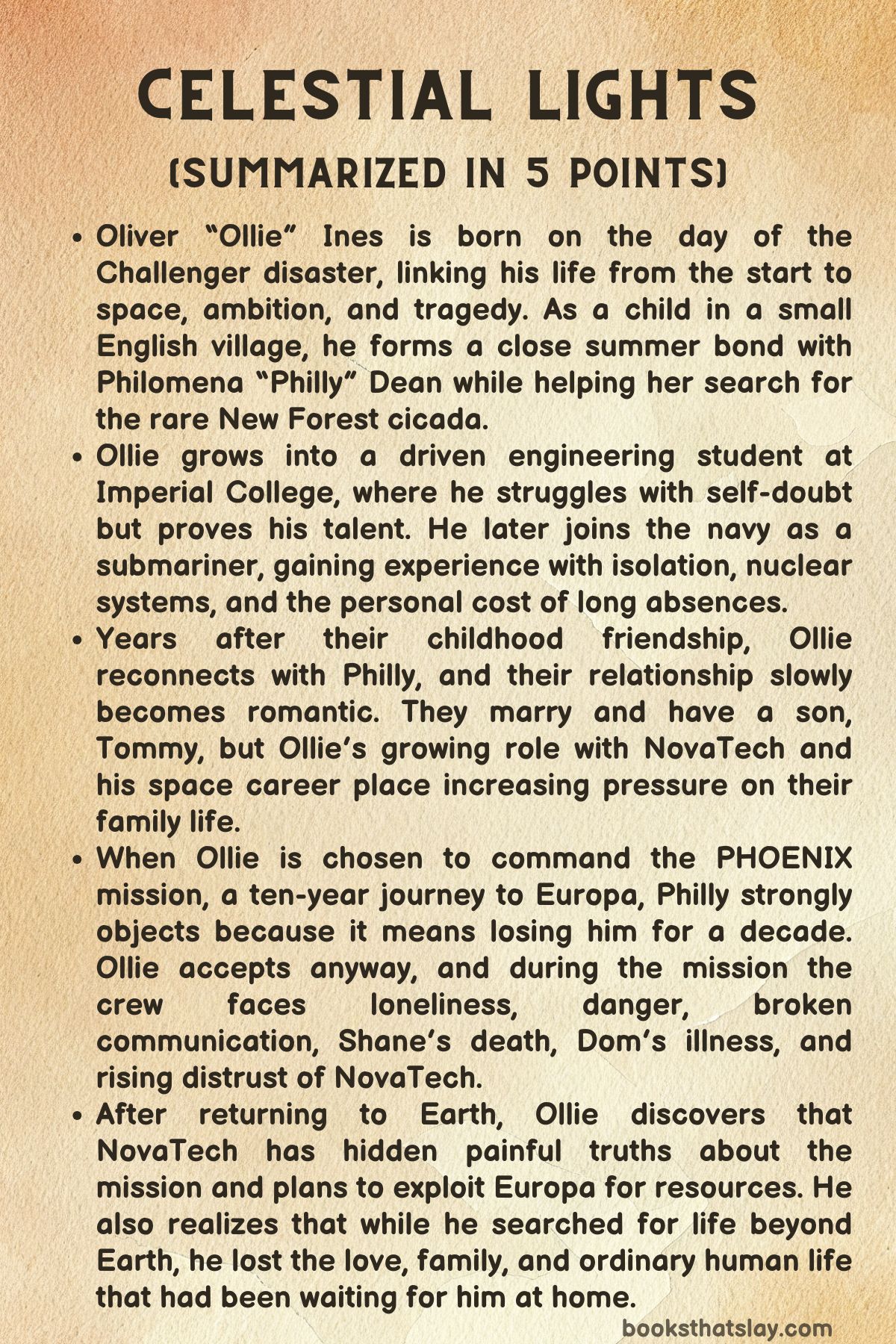
Oliver Ines is born on the day of the Challenger disaster, an event that quietly shadows the course of his life. From the beginning, his existence is linked with the dream and danger of space travel.
As a child, Ollie grows up in a small English village, surrounded by ordinary routines, family ties, and the quiet limits of rural life. His world changes during the summer of 1995, when he meets Philomena Dean, a girl staying with her aunt and looking for the rare New Forest cicada.
Ollie first encounters her while delivering plums to Mrs. Tan. Philly, as she is called, is curious, sharp, and absorbed in her search for the elusive insect.
Ollie joins her, and their days become filled with walks, waiting, observation, and private talk. Mrs. Tan’s garden becomes the center of their friendship, a place where childhood wonder and first affection take shape.
Philly eventually reveals her full name to Ollie in a note, and this simple gesture matters deeply to him. Over that summer, his feelings grow stronger, though they remain shaped by youth, uncertainty, and the shortness of the time they have together.
When Philly leaves, Ollie is left with absence and memory. Mrs. Tan later sells her property, and the garden where he and Philly spent so much time is destroyed.
The loss of the garden marks the end of that brief childhood bond. For Ollie, it becomes one of the first lessons that places, people, and moments can vanish before they are fully understood.
As he grows older, Ollie becomes determined to build a life beyond the limits of his village. He studies mechanical engineering at Imperial College, where he often feels out of place.
Surrounded by wealthier, more confident students, he doubts himself, but he also works with great discipline. His ability begins to stand out.
He becomes an excellent student, pushing himself harder and harder, partly from talent and partly from fear of being left behind.
His friend Jimmy Lovett chooses a different path, giving up further study and returning to farm life. Jimmy’s decision indirectly opens a door for Ollie, who wins the Ormond Scholarship.
This success strengthens his belief that ambition requires sacrifice. Professor Whitley, one of his mentors, encourages him and tells him that serious achievement often demands ruthlessness.
Ollie absorbs this idea, even if he does not yet fully understand what it will cost him.
After university, Ollie joins the navy as a submariner. He works with nuclear reactors aboard HMS Valiant, learning to live and function in confined spaces under extreme pressure.
The submarine environment trains him for isolation, discipline, and obedience to systems larger than himself. Long periods underwater separate him from normal life.
He misses family moments and returns from sea to news he should have received earlier, including the fact that his mother has cancer. His career teaches him endurance, but it also begins the pattern of absence that will shape his personal life.
Ollie later reconnects with Philly at a university party hosted by Shane, a fellow engineer whose own future will become tied to space travel. The reunion brings back old feelings, though their relationship does not immediately become romantic.
They stay in touch through messages, visits, and years of uneven closeness. Slowly, friendship turns into love.
Their shared past gives them a rare intimacy, and their adult relationship carries both the charm of rediscovery and the weight of everything that has changed since childhood.
In 2017, Ollie and Philly marry in the village. For a time, it seems possible that Ollie can have both love and ambition.
Yet his professional life is becoming more demanding. Mark Massey, the powerful head of NovaTech, recruits him to work on Cilix, a probe mission to Europa, one of Jupiter’s moons.
The project gives Ollie access to the world he has long wanted to enter: high-level aerospace engineering, planetary exploration, and the promise of being part of history.
Ollie later applies to become a NovaTech astronaut. Philly supports him, but the decision brings strain.
Training, missions, and preparation pull him away from home. He travels to the International Space Station, gaining status and experience, while Philly carries the emotional weight of his absence.
During one of his periods away, she is pregnant. Their son, Tommy, is born after Ollie returns, and fatherhood briefly offers him a chance to root himself in family life.
Still, the pull of space remains powerful.
NovaTech and the European Space Agency eventually announce the PHOENIX mission, a ten-year journey to Europa aboard the spacecraft Talos. Ollie is offered command.
The opportunity is enormous, but the price is clear. Accepting the mission would mean leaving Philly and Tommy for a decade.
Philly is furious and devastated that he would even consider it. To her, the mission is not only a professional choice but a rejection of the family they have built.
Ollie struggles with the decision, but his desire for significance wins. He tells himself that the mission matters, that exploration justifies sacrifice, and that he is uniquely prepared for the role.
Philly sees something colder in his choice. Their marriage collapses under the pressure.
She tells him they are finished, and Ollie leaves Earth with Shane, Lucia, and Dom as part of the Talos crew.
The journey to Europa is long and punishing. The crew faces isolation, homesickness, fading morale, and the slow erosion of connection with Earth.
Ollie records personal logs and reflects on his past, including his childhood with Philly, his family, his career, and the choices that brought him aboard Talos. As commander, he tries to maintain order and purpose, but the distance from Earth makes every regret louder.
The mission that once seemed grand begins to feel haunted by all that has been left behind.
Midway through the voyage, Talos detects wreckage that appears to belong to Pegasus, the spacecraft from the failed HEPHA mission led by Masuda. Ollie wants to investigate, driven by curiosity, responsibility, and perhaps the need to prove the mission’s importance.
Lucia objects, aware of the danger and suspicious of the forces guiding them from Earth. Ollie pushes forward.
Soon after, a micrometeorite impact damages the spacecraft and forces an EVA to inspect the engine deck. Ollie and Shane go outside.
During the operation, Shane’s suit malfunctions and begins filling with water. Ollie tries desperately to save him, but he cannot.
Shane drowns inside his helmet, a horrifying death made worse by the helplessness of space. The loss breaks something in the mission and in Ollie.
He remains commander, but Shane’s death becomes a burden he cannot escape.
The surviving crew continues toward Europa. Dom becomes seriously ill from radiation exposure, and Lucia’s anger grows.
She blames NovaTech, the mission’s hidden risks, and Ollie’s decisions. Trust weakens among the remaining crew members.
What was presented as a noble scientific mission now feels shaped by secrecy, corporate ambition, and human expendability.
Talos finally lands on Europa. Ollie, Lucia, and Dom collect samples from the icy surface and from beneath it.
The scientific achievement is immense, but it is drained of triumph by everything that has happened. Ollie is increasingly haunted by Shane’s death and by the knowledge that the mission has demanded more than any public story will admit.
Europa, once a symbol of wonder, becomes linked in his mind with grief, guilt, and exploitation.
After the return journey, Talos lands back on Earth. NovaTech controls the public version of events.
At the press conference, the mission is presented as heroic, successful, and historic. The darker truths are hidden or softened: Shane’s death, Dom’s suffering, the Pegasus discovery, and the full scale of the risk.
Mark Massey then reveals that Europa will be mined for resources. Ollie understands, with growing horror, that his mission has helped open the door not simply to discovery but to extraction.
The search for life and knowledge has become part of a corporate plan to claim and use another world.
Back on Earth, Ollie faces the life he abandoned. He visits his aging father and learns that his mother has died.
He sees Shane’s partner, Liv, and must face the human cost of a death that public language has turned into sacrifice. Finally, he meets Philly again.
Their relationship is over. The years he spent away cannot be restored, and the family life he might have had has moved on without him.
Philly gives him a letter she wrote during his absence. In it, she describes visiting his mother’s grave with Tommy.
Her words reveal not hatred but sorrow. She feels sorry for Ollie because he missed the love, life, and ordinary human meaning that were waiting for him on Earth.
While he searched for life elsewhere, he failed to protect and cherish the life already around him.
By the end, Celestial Lights becomes the story of a man who reaches farther than almost anyone else but loses the things that might have saved him. Ollie’s achievements are real, but they are marked by absence, grief, and moral compromise.
The novel leaves him standing in the aftermath of success, forced to understand that greatness can become a kind of loneliness when it is pursued at the expense of love.
Characters
The characters in Celestial Lights are shaped by longing, ambition, loss, distance, and the painful difference between dreaming of something extraordinary and living faithfully with the ordinary love already present. The book uses Ollie’s life to show how personal relationships can be strained by the pursuit of greatness, while the surrounding characters reveal different responses to love, sacrifice, duty, grief, and moral compromise.
Oliver Ines
Oliver Ines, often called Ollie, is the central figure of the book and one of its most emotionally layered characters. His life begins under the shadow of the Challenger disaster, which immediately connects his existence to space exploration, danger, and human ambition.
As a child, Ollie is sensitive, curious, and capable of deep attachment, especially during the summer he spends with Philly in Mrs. Tan’s garden. His childhood bond with her reveals a gentler side of him: he is imaginative, loyal, and deeply affected by beauty, discovery, and companionship.
The destruction of the garden and Philly’s departure become early emotional losses that prepare the reader for the larger losses he experiences later in life.
As Ollie grows older, his ambition becomes one of his defining qualities. At Imperial College, he feels insecure among other talented students, but this insecurity pushes him to work harder and prove himself.
His success is not effortless; it comes from discipline, endurance, and a growing willingness to place achievement above comfort. His time in the navy strengthens this side of him, teaching him to survive isolation and function under pressure.
However, this same training also makes him emotionally distant. He becomes accustomed to absence, to missing family moments, and to accepting separation as the cost of duty.
This is especially painful when he learns about his mother’s illness only after returning from sea, showing how his career repeatedly pulls him away from the people who need him.
Ollie’s relationship with Philly is one of the emotional centers of the story. He truly loves her, but his love is constantly in conflict with his hunger for exploration and distinction.
He wants both family and greatness, but he fails to understand that some choices cannot coexist without damage. His decision to command the PHOENIX mission exposes the deepest flaw in his character: he can recognize the pain his absence will cause, yet he still chooses the mission.
He does not act out of cruelty, but out of a powerful belief that the mission gives his life meaning. This makes him tragic rather than simply selfish.
He is capable of love, guilt, and tenderness, but he is also capable of justifying abandonment when it is attached to a grand purpose.
By the end of the book, Ollie becomes a man forced to confront the true cost of his ambition. Shane’s death, Dom’s suffering, the hidden dangers of the mission, and Mark Massey’s plan to exploit Europa all destroy the heroic story Ollie once believed he was part of.
His return to Earth does not feel triumphant because he comes back to a life that has moved on without him. Philly’s letter makes his failure painfully clear: while he searched for life far away, he missed the love and life that were already waiting for him at home.
Ollie’s character is therefore a study of ambition without balance. He reaches farther than most people ever could, but his achievement leaves him isolated, guilty, and emotionally diminished.
Philomena Dean
Philomena Dean, known as Philly, is one of the most important emotional forces in the book. As a child, she is curious, intelligent, observant, and independent.
Her search for the rare New Forest cicada gives her an air of wonder and purpose, and it also becomes the reason Ollie is drawn into her world. Philly’s childhood presence is connected with nature, mystery, and discovery, but unlike Ollie’s later form of discovery, hers is intimate and earthly.
She looks closely at the world around her, valuing small signs of life rather than distant conquest. This contrast becomes important because Philly’s way of seeing the world later challenges Ollie’s obsession with space.
As an adult, Philly is loving but not passive. She supports Ollie through important parts of his career, including his decision to apply to become a NovaTech astronaut, but her support has limits.
She understands sacrifice, yet she also understands that love requires presence. Her opposition to the ten-year mission is not narrow-mindedness or lack of imagination; it is a clear moral and emotional response to the reality of abandonment.
She knows that Ollie’s choice would leave her to raise Tommy alone and would remove him from the daily responsibilities of family life. Through Philly, the book argues that devotion cannot survive on admiration alone.
Love must also be lived through ordinary acts of care, time, and shared burden.
Philly’s strength becomes most visible when her marriage breaks down. She does not beg Ollie to stay once she realizes that he has already chosen the mission in his heart.
Instead, she draws a boundary and tells him they are finished. This moment shows her dignity and self-respect.
She refuses to let Ollie’s dream define the rest of her life. Even though she is hurt, she remains emotionally honest.
Her later letter is not written with simple bitterness; it carries sorrow, understanding, and a devastating clarity. She feels sorry for Ollie because she recognizes that he has misunderstood what truly mattered.
Philly is also important because she represents the life Ollie could have chosen. She is connected to childhood, home, nature, marriage, parenthood, and memory.
Her presence reminds the reader that wonder is not only found in space or scientific achievement. It can also be found in a garden, in a child, in a marriage, and in the act of staying.
By the end of the story, Philly emerges as one of the most morally grounded characters. She suffers because of Ollie’s choices, but she does not allow that suffering to erase her judgment, compassion, or independence.
Mrs. Tan
Mrs. Tan plays a smaller but deeply symbolic role in the book. She is connected to the garden where Ollie and Philly’s childhood friendship develops, and that garden becomes a place of innocence, discovery, and emotional awakening.
Through Mrs. Tan’s home and surroundings, the children are given a temporary world where curiosity and affection can grow naturally. Her garden is not just a setting; it represents a fragile space where beauty, nature, and human connection briefly exist together.
When Mrs. Tan sells her property and the garden is destroyed, the event marks one of the first major losses in Ollie’s life. The destruction of the garden shows how easily places of memory can disappear.
It also foreshadows the larger pattern of the story, where things that seem precious and alive are damaged by change, ambition, and human priorities. Mrs. Tan’s role therefore reaches beyond her direct actions.
She is part of the emotional architecture of Ollie’s childhood, and her garden becomes a symbol of the earthly life that Ollie later fails to fully value.
Mrs. Tan also helps establish the contrast between natural discovery and technological ambition. The children’s search for the cicada is quiet, patient, and rooted in attention to the living world.
Later, Ollie’s search for life on Europa is massive, expensive, dangerous, and tied to corporate power. Mrs. Tan’s garden belongs to the first kind of discovery, where wonder is local and intimate.
Its loss suggests that Ollie’s later life may be shaped by an unresolved grief for a vanished world he never truly recovers.
Jimmy Lovett
Jimmy Lovett is an important character because he provides a contrast to Ollie’s ambition. At Imperial College, Jimmy is part of Ollie’s academic world, but he eventually gives up on further study and returns to farm life.
This decision might appear like surrender when seen through Ollie’s ambitious perspective, but the book treats it as a different kind of choice. Jimmy chooses a life rooted in place, practicality, and continuity rather than one defined by prestige or extraordinary achievement.
Jimmy’s decision indirectly helps Ollie because Ollie wins the Ormond Scholarship after Jimmy steps away. This moment is significant because it shows how Ollie’s rise is connected to the choices and sacrifices of others.
Jimmy does not become a major public figure, but his presence raises an important question: what counts as success? In contrast to Ollie, Jimmy accepts limits and returns to a familiar life.
He is not presented as weak; rather, he represents a path Ollie might never be able to choose because Ollie is driven by restlessness and the need to prove himself.
Through Jimmy, the book suggests that ordinary life may contain a wisdom that ambitious people overlook. Farming, family, and local belonging may seem smaller than engineering, submarines, or spaceflight, but they offer a form of groundedness that Ollie lacks.
Jimmy’s character therefore serves as a quiet counterpoint. He reminds the reader that leaving is not always braver than staying, and that ambition is not the only measure of a meaningful life.
Professor Whitley
Professor Whitley is a key influence on Ollie’s developing ambition. As a mentor figure, he recognizes Ollie’s potential and encourages him to pursue greatness.
However, his advice carries a harsh moral edge. When he tells Ollie that great achievement requires ruthlessness, he gives language and authority to a belief that later shapes Ollie’s life.
Whitley does not simply encourage excellence; he encourages a willingness to cut away whatever interferes with success.
This makes Professor Whitley an important but troubling figure in the book. He represents the academic and professional culture that rewards brilliance while often ignoring emotional cost.
His influence helps Ollie become more confident and ambitious, but it also pushes him toward a worldview in which personal sacrifice, even the sacrifice of relationships, can be justified by achievement. Whitley’s philosophy becomes dangerous because Ollie internalizes it.
The idea of ruthlessness follows him into adulthood, where it appears in his decisions about career, space travel, and family.
Professor Whitley is not necessarily cruel, but he is limited. He sees the value of accomplishment more clearly than the value of tenderness.
In this way, he helps form the version of Ollie who can command a deep-space mission but cannot preserve his marriage. Whitley’s role shows how mentors can shape not only talent but also moral priorities.
His character adds depth to Ollie’s development by showing that ambition is not born in isolation; it is taught, praised, and rewarded.
Shane
Shane is one of the most significant characters connected to Ollie’s professional life. He is a fellow engineer, a future astronaut, and part of the world that draws Ollie toward space exploration.
Shane’s university party becomes the place where Ollie reconnects with Philly, meaning Shane is indirectly linked to both Ollie’s romantic life and his professional destiny. He belongs to the same ambitious, high-achieving environment as Ollie, and his presence helps establish the community of people willing to risk their lives for exploration.
As a member of the PHOENIX mission, Shane becomes more than a colleague. He is part of the small human world inside Talos, where isolation makes every relationship more intense.
During the journey, the crew members depend on each other not only for technical survival but also for emotional endurance. Shane’s death during the EVA is one of the most devastating events in the book.
The image of him drowning inside his helmet is horrifying because it turns advanced technology into a trap. Space exploration, often imagined as noble and controlled, becomes intimate, physical, and terrifying.
Shane’s death permanently changes Ollie. Ollie tries to save him but fails, and that failure becomes a source of guilt and haunting memory.
Shane becomes the human cost that cannot be hidden behind heroic language. His death also exposes the gap between public narratives and private truth.
NovaTech later presents the mission as heroic while concealing the full reality of what happened, but Shane’s death cannot be morally erased for those who lived through it. His character therefore represents the price paid by individuals when institutions turn danger into glory.
Shane is also important because he leaves behind Liv, reminding the reader that every astronaut’s death extends beyond the mission. It creates grief on Earth, among people who loved them and waited for them.
Through Shane, the book makes space tragedy personal rather than abstract. He is not only a lost crew member; he is a partner, friend, and human being whose death reveals the cruelty of turning exploration into propaganda.
Mark Massey
Mark Massey is one of the most morally disturbing characters in Celestial Lights. As the powerful head of NovaTech, he represents corporate ambition, technological power, and the ability to control public narratives.
At first, Mark appears as someone who can offer Ollie extraordinary opportunity. He recruits Ollie to work on Cilix and later becomes central to the mission that takes Ollie to Europa.
To Ollie, Mark’s world seems to promise significance, discovery, and a place in history.
However, Mark’s true priorities become clearer as the story progresses. He is not driven purely by scientific wonder or human curiosity.
His interest in Europa is tied to extraction, profit, and control. The revelation that Europa will be mined for resources changes the meaning of the entire mission.
What appeared to be a search for life becomes part of a larger project of exploitation. Mark’s character therefore exposes the corruption behind noble language.
He knows how to speak in terms of progress and heroism, but beneath that language is a willingness to use people, planets, and public belief for corporate gain.
Mark is especially important because he helps reveal Ollie’s complicity. Ollie may not share Mark’s coldness or greed, but by accepting the mission and serving NovaTech’s goals, he becomes part of Mark’s system.
Mark does not need to be emotionally complex in the same way Ollie is; his function is to embody the institutional forces that turn human dreams into instruments of power. He is dangerous because he can transform sacrifice into marketing and discovery into ownership.
By the end of the book, Mark stands as a critique of unchecked corporate space exploration. He shows that the future can be sold as inspiring while hiding exploitation underneath.
His character forces the reader to question who benefits from grand missions and who pays the cost. In relation to Ollie, Mark is both a benefactor and a corrupter, giving him the opportunity of a lifetime while drawing him into a morally compromised enterprise.
Tommy
Tommy, Ollie and Philly’s son, is central to the emotional stakes of the book even though he is not as active as the adult characters. His birth represents the life Ollie has on Earth and the future he is responsible for as a father.
Tommy’s existence changes the meaning of Ollie’s choices. Before Tommy, Ollie’s absences damage primarily his marriage and family bonds; after Tommy, they also become failures of fatherhood.
The decision to leave for a ten-year mission is therefore not only a professional choice but a deeply personal abandonment.
Tommy represents ordinary love, dependence, and continuity. He needs presence rather than heroic achievement.
Ollie may believe that his mission will make history, but Tommy needs a father in daily life. This contrast makes Ollie’s absence especially painful.
The tragedy is not only that Ollie misses years of Tommy’s childhood, but that he chooses to miss them while believing the sacrifice is justified. Tommy becomes a measure of what Ollie fails to understand: that being remembered by the world is not the same as being present for one’s child.
Philly’s letter deepens Tommy’s significance. Her description of visiting Ollie’s mother’s grave with Tommy shows that the child becomes connected to family memory in Ollie’s absence.
Tommy participates in the life Ollie has left behind, growing within a network of grief, love, and history that Ollie is not there to share. Tommy therefore represents the most innocent consequence of Ollie’s ambition.
He does not choose the mission, yet he must live with its emotional cost.
Lucia
Lucia is one of the crew members on Talos and an important voice of resistance within the mission. She is intelligent, capable, and alert to danger, especially when Talos detects wreckage that appears to be Pegasus.
Her objections to investigating the wreckage show that she is not reckless and that she understands the risks of allowing curiosity or command authority to override caution. In this way, Lucia often functions as a counterbalance to Ollie, questioning decisions that he is inclined to pursue.
As the mission worsens, Lucia’s anger grows, particularly toward NovaTech and Ollie. Her anger is not irrational; it comes from witnessing the physical and emotional damage caused by the mission.
Shane dies, Dom becomes seriously ill, communication with Earth disappears, morale collapses, and the crew is forced to continue under unbearable pressure. Lucia sees more clearly than Ollie that the mission is not simply heroic.
It is also exploitative, dangerous, and shaped by decisions made far away by people who do not share the crew’s suffering.
Lucia’s character adds moral tension to the space journey. She refuses to let the mission’s official purpose silence her judgment.
Her anger makes her one of the clearest critics of the forces that have placed the crew in danger. She is also important because she challenges Ollie’s authority.
As commander, Ollie must keep the mission functioning, but Lucia forces the reader to ask whether leadership is still admirable when it serves a compromised system.
Through Lucia, the book gives voice to disillusionment. She begins as part of the mission but increasingly recognizes the betrayal beneath it.
Her role is crucial because she shows that survival is not only physical; it is also moral. The crew must survive space, but they must also survive the knowledge that their courage may have been used for purposes they did not fully understand.
Dom
Dom is another member of the Talos crew, and his suffering reveals the bodily cost of the mission. While Ollie’s pain is often psychological and emotional, Dom’s illness from radiation exposure makes the danger of deep-space travel painfully physical.
His decline shows that the mission does not merely test courage; it damages human bodies. Dom becomes a reminder that exploration is carried out not by symbols or heroes, but by vulnerable people made of flesh.
Dom’s illness also increases the pressure on the remaining crew. His condition adds fear, grief, and helplessness to an already strained environment.
The crew cannot simply escape the mission or return quickly to safety. They must continue while one of them deteriorates.
This makes Dom’s role deeply tragic. He is part of a mission presented as a triumph of human capability, yet his suffering exposes the limits of that capability.
Dom also contributes to the book’s criticism of institutions like NovaTech. If the risks were minimized, hidden, or accepted too easily by those in power, then Dom’s suffering becomes part of a larger moral failure.
He is not only unlucky; he is a casualty of decisions made in pursuit of prestige, discovery, and profit. His character helps strip away the glamour from the mission.
Through Dom, the reader sees the cost of ambition written directly onto the human body.
Masuda
Masuda is connected to the failed HEPHA mission and the wreckage believed to be Pegasus. Although Masuda is not present in the same direct way as the Talos crew, the character’s importance lies in the shadow cast over the PHOENIX mission.
Masuda represents an earlier failure, one that has not been properly understood or publicly confronted. The possible discovery of Pegasus suggests that the past has returned in physical form, forcing the crew to face what was lost before them.
Masuda’s role creates a sense of warning. The failed mission shows that Talos is not the first attempt to reach into dangerous territory, and it suggests that the institutions behind these missions may have a history of concealing or mismanaging disaster.
For Ollie, the Pegasus wreckage becomes a temptation because it offers answers, but for Lucia, it represents risk. This difference in response reveals how Masuda’s legacy affects the living crew.
The dead are not simply gone; their unresolved story shapes the choices of those who follow.
As a character, Masuda represents the hidden human history behind space exploration. Every mission is built on previous missions, including failed ones, and every failure leaves behind ethical questions.
What was known? What was hidden?
Who was blamed? Who was forgotten?
Masuda’s presence in the book, even indirectly, helps deepen the atmosphere of danger and secrecy. The character reminds the reader that heroic progress often depends on buried catastrophe.
Ollie’s Mother
Ollie’s mother is a deeply important figure because she represents the family life Ollie repeatedly misses. Her cancer becomes one of the clearest examples of how Ollie’s professional commitments separate him from intimate human realities.
When he learns about her illness only after returning from sea, the emotional damage is immediate. The moment shows that absence has consequences that cannot be repaired simply by coming home later.
Her death during Ollie’s long journey intensifies the tragedy of his choices. While he is away searching for life beyond Earth, his own mother’s life ends without him there.
This contrast is one of the most painful ironies in the story. Ollie’s mission is directed toward discovery, but it requires him to miss the most personal and irreversible events of ordinary life.
His mother therefore becomes a symbol of mortality, family, and the time that ambition cannot recover.
Ollie’s mother also matters because she remains connected to Philly and Tommy after Ollie leaves. Philly’s letter describes visiting her grave with Tommy, showing that the family continues to honor and remember her without Ollie’s presence.
This detail makes Ollie’s absence even more devastating. He is not only missing events; he is being gradually removed from the shared emotional life of his family.
His mother’s character, though not dominant in action, is central to the book’s meditation on what it means to be absent from those who love us.
Ollie’s Father
Ollie’s father represents age, family continuity, and the quiet aftermath of loss. When Ollie returns and visits him, the meeting carries the weight of everything that has changed while Ollie was away.
His father has aged, his mother has died, and the family home has been altered by time and grief. Through his father, Ollie is forced to confront the fact that Earth did not pause for him.
Life continued, people suffered, and relationships changed without his participation.
Ollie’s father is important because he embodies the ordinary passage of time. Unlike the mission, which is framed in grand historical terms, his father’s life is marked by aging, bereavement, and endurance.
He does not represent spectacle; he represents reality. His presence after Ollie’s return makes the cost of the ten-year absence visible in a quiet but powerful way.
The relationship between Ollie and his father also highlights Ollie’s emotional distance. Ollie has become someone trained to survive isolation and command extraordinary missions, but he struggles with the simple human consequences of being gone.
His father’s aging is not dramatic in the same way as Shane’s death or Dom’s illness, but it is equally meaningful. It shows that time is the one force Ollie cannot command, engineer, or outrun.
Liv
Liv, Shane’s partner, is important because she represents the grief left behind by the mission. Shane’s death is experienced by Ollie as guilt and trauma, but Liv experiences it as personal loss.
Her presence reminds the reader that every disaster in space creates suffering on Earth. The dead crew member is not only part of a mission report; he is someone loved by a person who must continue living after him.
Liv’s role also exposes the cruelty of NovaTech’s controlled public narrative. If the full truth about Shane’s death is concealed or softened, then Liv’s grief exists in tension with institutional dishonesty.
She is left to mourn within a world that may not fully acknowledge what happened. This makes her character morally significant even if she appears briefly.
She stands for the people who are expected to accept official stories while carrying private pain.
In relation to Ollie, Liv also intensifies his guilt. Seeing her after the mission forces him to face Shane not as a crew member lost during operations, but as a man who belonged to someone.
Liv makes Shane’s death relational rather than technical. Through her, the book shows that the consequences of ambition spread outward, touching people who never chose the danger but must live with its results.
Themes
Ambition and the Cost of Achievement
In Celestial Lights, ambition is shown as a force that gives Ollie direction but also takes away much of what makes his life meaningful. From his early academic success to his naval career and later space missions, Ollie keeps moving toward larger goals, often believing that sacrifice is necessary for greatness.
Professor Whitley’s idea that achievement requires ruthlessness stays with him and quietly shapes many of his choices. Ollie’s ambition is not shallow; he genuinely wants to contribute to science and human discovery.
However, the problem lies in how completely he allows ambition to define him. Each step upward demands emotional distance from others, whether it is his family, Philly, Tommy, or even his crew.
By accepting the Europa mission, he chooses a dream that removes him from his own life for ten years. His success becomes painful because it is built on absence, loss, and regret.
The theme suggests that achievement without emotional responsibility can become hollow, especially when the person reaching for the stars loses sight of the people waiting on Earth.
Love, Absence, and Emotional Distance
Love in the story is often shaped by separation rather than closeness. Ollie and Philly’s childhood bond begins with wonder, shared curiosity, and quiet affection, but it is broken by distance and time.
When they reconnect as adults, their relationship carries the memory of that first closeness, yet Ollie’s career repeatedly pulls him away. Philly supports him for a long time, but her love is tested by the constant demand that she wait, endure, and understand.
Their marriage does not fail because love disappears suddenly; it fails because Ollie keeps choosing missions that require her to live with absence. Tommy’s birth makes this theme even more painful because Ollie’s choices no longer affect only a romantic partner, but also a child who needs his presence.
The letter Philly writes at the end makes the emotional cost clear. While Ollie searched for life beyond Earth, he missed the living relationships already around him.
The theme shows that love cannot survive on memory and intention alone; it needs time, presence, and shared responsibility.
Exploration, Discovery, and Moral Responsibility
The story presents exploration as both inspiring and morally dangerous. Ollie’s journey to Europa begins as a mission of scientific hope, driven by the possibility of discovering life beyond Earth.
This goal seems noble because it speaks to human curiosity and the desire to understand the universe. Yet the mission gradually reveals that discovery is not innocent when controlled by powerful institutions.
NovaTech presents itself as a force for progress, but its hidden motives become clearer after the crew returns. The risks faced by Shane, Dom, Lucia, and Ollie are shaped not only by space itself but also by corporate ambition and secrecy.
When Mark reveals plans to mine Europa, Ollie understands that the mission has opened the door to exploitation rather than pure knowledge. This realization changes the meaning of everything he has sacrificed.
The theme questions whether humanity has the right to reach new worlds if it carries the same greed and carelessness that damage Earth. Exploration becomes meaningful only when it is guided by honesty, humility, and ethical responsibility.
Isolation, Memory, and Regret
Isolation affects Ollie long before he leaves Earth. His time as a submariner trains him to accept enclosed spaces, silence, and long absences, but it also teaches him to suppress emotional needs.
This habit follows him into space, where physical distance becomes emotional and psychological distance as well. During the Europa mission, the crew’s isolation grows heavier as communication with Earth weakens and morale fades.
Ollie survives by turning inward, recording logs and revisiting memories from childhood, family life, and his relationship with Philly. These memories are not simple comforts; they become reminders of what he has lost or failed to protect.
Shane’s death deepens Ollie’s guilt, while Dom’s illness and Lucia’s anger force him to confront the human cost of command. When Ollie returns, Earth is no longer the home he left.
His mother is gone, his marriage is over, and his son has grown without him. The theme shows that regret often arrives too late, when a person finally understands that the past cannot be recovered through success, fame, or apology.