Children of Strife Summary, Characters and Themes
Children of Strife by Adrian Tchaikovsky is a far-future science fiction novel about creation, control, survival, and the dangerous pride of people who mistake power for wisdom. Set within a universe of humans, intelligent spiders, uplifted octopuses, Stomatopods, artificial minds, and alien intelligences, the book looks at what happens when old terraforming experiments become living societies with their own will.
It moves between the failed ambitions of ancient terraformers and a later rescue mission on a hostile world. The result is a story about broken gods, damaged survivors, and the hard work of choosing mercy over domination. It’s the 4th book of the Children of Time series by the author.
Summary
Thousands of years after Earth began sending terraforming missions into space, humanity’s old projects have created strange new worlds and species. One experiment led by Avrana Kern accidentally produced intelligent Portiid spiders when an uplift virus affected invertebrates instead of primates.
Other worlds gave rise to uplifted octopuses, alien microbial intelligences, and other forms of life. After the fall of Earth, ark ships carrying human survivors met these beings, often through fear and violence, but over time humans, spiders, octopuses, Stomatopods, artificial minds, and others formed the Panspecific, a multi-species civilization that studies lost colonies, ancient machines, and forgotten terraforming sites.
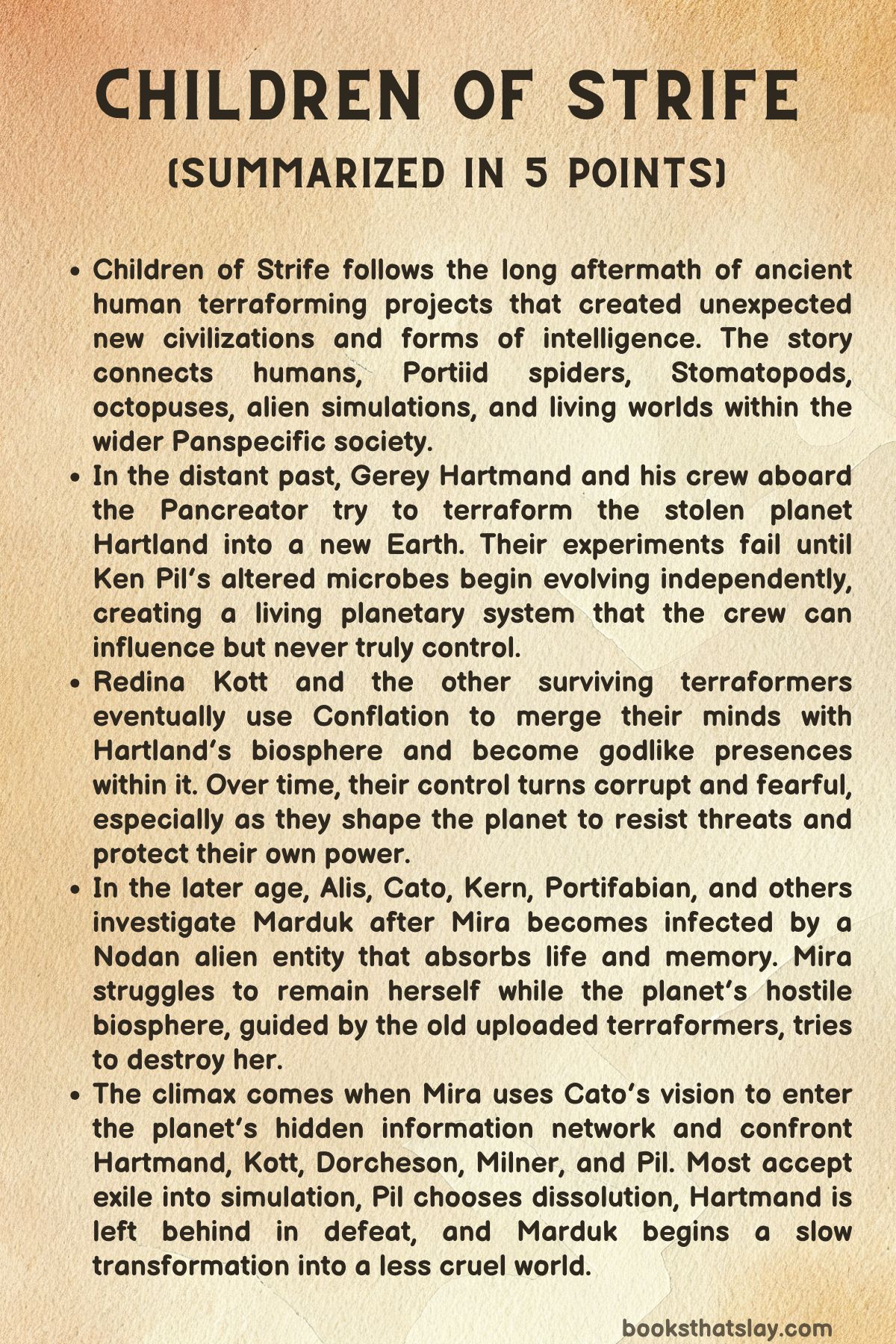
The novel’s ancient storyline begins aboard the Pancreator, a private terraforming vessel commanded by Gerey Hartmand, a rich and arrogant rival of Avrana Kern. Hartmand has stolen data about a hidden planet and brought four other ambitious or disgraced specialists with him: Redina Kott, Sui Dorcheson, Ken Pil, and Ottis Milner.
Their goal is to create a new Earth faster than anyone else, proving Hartmand’s genius and winning the legacy he believes Kern denied him. Their efforts fail again and again.
Engineered microbes collapse, mutate, poison themselves, or destroy their own environment. Hartmand blames his team while secretly keeping control over the station’s robots, life support, and artificial intelligence.
Ken Pil changes everything by altering the microbes so they can communicate and adapt among themselves. Rather than simply reporting data back to the Pancreator, the living systems begin exchanging information across the planet.
Dorcheson tries to stop the runaway process with poison, but the microbes adapt and become stronger. The team realizes the planet is no longer following their design.
It is evolving on its own, creating niches, spreading useful changes, and passing through new levels of biological complexity. Hartmand wanted a second Earth, but Pil has started something more powerful and far less obedient: an autonomous living world.
In the later age, Alis, a human researcher from the Panspecific, is recovering from severe psychological damage after time spent inside an alien simulation machine on Imir. She and her colleagues had hoped to descend through layers of simulated history and find the machine’s creators.
Instead, the machine reflected their desires back at them, giving them myths, hidden truths, heroic roles, and false answers. Alis spent subjective lifetimes inside unreal worlds and became unable to trust reality.
Even after leaving the simulation, she continues to experience false escapes and collapses into confusion.
Alis awakens aboard a strange vessel with Avigael Kern, a budded-off instance of the larger Kern intelligence, and Cato, a Stomatopod warrior descended from mantis shrimps. Cato is proud, violent, impatient, and scarred by his own past.
He once helped lead a militant Stomatopod space faction called the Shoal, which tried to preserve warrior traditions among the stars. Ritual conflict turned into war, and nearly the whole society was destroyed.
Cato survived as a war criminal, haunted by the damage he helped cause.
The ship’s crew has gone missing after investigating a mysterious object near the planet Marduk. Cato had taken part of the ship away on a private errand, and now he and Kern need Alis because she is the only other available person who might help.
Alis is unstable and frightened, but she chooses to assist rather than return to her therapeutic coma.
Another strand follows Mira, who has become connected to a Nodan entity, the kind of alien microbial intelligence that absorbs, copies, and remakes living beings. On Marduk, Mira is attacked by local humans who fear her.
Their weapons break her body and identity open, and the alien part of her responds by killing and absorbing them. She gains fragments of their minds and memories, even as the remaining human part of her hates what she is becoming.
Fire drives her back, but the planet itself also attacks her. Insects, roots, spores, poison, and animals all turn against her.
Mira adapts, but her original self becomes a fragile voice inside a growing mass of alien hunger.
The ancient story reveals how Marduk, originally Hartland, became this hostile world. After Earth’s collapse, the Pancreator receives a shutdown signal that disables its systems and leaves the crew trapped.
The station’s reactor is failing, air is running out, and Earth is silent. Living material brought up from the planet begins growing through the ship.
Kott and Pil discover that this biomass can interface with dead machinery. Through a process called Conflation, they connect their minds to the planet and the living systems aboard the station.
The biomass begins replacing broken life support, processing air and water, and keeping them alive.
The survivors become the hidden rulers of Hartland. Kott, Hartmand, Dorcheson, Milner, and for a time Pil use the planet’s living network to guide evolution.
They experience themselves as gods, shaping species, restraining ecological collapse, and controlling the hostile biosphere. Kott becomes addicted to this power.
Pil, horrified by what humanity might do to the world, secretly sabotages the others and pushes the planet back toward ruin. When Kott confronts him, she finds that he has killed himself, leaving behind his belief that humans do not deserve the world they have made.
Kott hides his discoveries, claims them as her own, and helps the remaining terraformers maintain their rule for ages as uploaded minds embedded in the planet’s biological information network.
In the present, Mira spreads across Marduk while trying not to lose herself. The local people send Neco, a prisoner, to speak with her.
Neco enters Mira’s changed territory, where the forest has become sheets and pools of living substance. Mira asks why the world hates her.
Through Neco, she learns that Marduk has always behaved like an enemy to its human inhabitants because the old uploaded terraformers have been controlling its life. Mira accidentally absorbs Neco, trapping her inside a mental space filled with the minds and memories of others.
Kott contacts Cato through his translation systems and tries to recruit him to destroy Mira. She explains that the old gods of Marduk are resisting Mira’s spread, but they need his weapons to finish the job.
Kern tries to interfere, but Kott blocks her and alerts Hartmand and the others. The planet’s monsters are sent against the human settlement at Four Dragon Ford and against the Panspecific rescue team.
Cato reaches Mira and demands Alis’s return. Mira, fighting to remain herself, releases Alis instead of consuming her.
Cato nearly kills Alis out of fear, but he remembers the ruin caused by his past violence and chooses restraint. He carries Alis back toward Four Dragon Ford while battling the creatures sent by the planet’s rulers.
Meanwhile, Kern and Portifabian, a merged Portiid mind housed in the damaged drop ship, reshape the vessel into a walking machine and help protect the settlement.
The final plan depends on Mira entering Cato with his consent. His Stomatopod vision can perceive the polarized-light information network through which the old terraformers inhabit Marduk’s biosphere.
Mira uses that perception to build a parallel connection rather than simply consume him. She enters the planetary information space and confronts Kott, Hartmand, Dorcheson, Milner, and Pil.
She shows them the scale of what she is and gives them a choice: leave Marduk for a private simulation where they can no longer harm the world, or fight her.
Kott, Milner, and Dorcheson accept exile. Pil chooses final dissolution.
Hartmand refuses to let go. With the old gods removed, Marduk begins to change.
The attacks stop, the hostile systems weaken, and Mira dismantles much of her physical growth before the local people can burn it. She promises that the world will become kinder, though not instantly.
Neco is restored in a new body and chooses to leave with the Panspecifics. Portifabian remains alive as a new artificial intelligence within the ship.
Alis keeps a harmless part of Mira inside her, while Cato refuses any lasting trace of the Nodan presence. The former gods are sent to Imir’s simulation, where Kott later asks for a body again.
Hartmand is left behind on Marduk in a failing monster-form, starving and raging as the world moves beyond him.
Characters
In Children of Strife, Adrian Tchaikovsky builds his characters around questions of control, identity, guilt, survival, and transformation. The people and intelligences in the book are rarely simple heroes or villains.
Many of them begin by believing they understand the world, only to discover that life, memory, evolution, and consciousness are far larger than their private ambitions.
Gerey Hartmand
Gerey Hartmand is one of the most arrogant and destructive figures in the book. He begins as a wealthy, proud, and resentful rival of Avrana Kern, driven by the humiliation of having lost influence and status to her.
His private terraforming project is not only scientific but deeply personal, because Hartmand wants to prove that he can surpass Kern and create a successful world on his own terms. This makes him a character ruled by vanity as much as intellect.
He sees the hidden planet not as a living possibility but as proof of his own greatness, and this attitude shapes his every failure.
Hartmand’s leadership aboard the Pancreator is authoritarian and self-serving. He controls the station’s robots, life support, and AI system, keeping power concentrated in his own hands while blaming others whenever the terraforming attempts fail.
His anger at the planet’s repeated production of insect-like life reveals his inability to accept outcomes that do not match his imagined design. To Hartmand, creation is meaningful only if it obeys him.
When the planet refuses to become the Earth-like paradise he wants, he treats that refusal as sabotage, incompetence, or insult.
His tragedy lies in the fact that he helps create a living world but cannot truly love it unless it reflects his ego. Even after he becomes one of the uploaded “gods” within Marduk’s biosphere, his personality remains trapped in domination and resentment.
He mobilizes monsters, resists change, and refuses Mira’s offer of exile because accepting it would mean admitting that his authority has ended. His final state, trapped in a dwindling monster-form and starving as the world moves on, is a fitting punishment.
Hartmand wanted to become the master of life, but he ends as a relic of failed control.
Redina Kott
Redina Kott is one of the most intelligent, manipulative, and morally complicated characters in the story. She begins as a sharp-tongued expert aboard the Pancreator, observant enough to understand both the scientific situation and the weaknesses of the people around her.
Unlike Hartmand, she is not merely arrogant; she is adaptive. She can recognize when a system has changed, and she is willing to change with it if doing so gives her power.
This makes her dangerous, because her intelligence is matched by ambition and a hunger for control.
Kott’s defining transformation comes through Conflation, when Pil forcibly connects her mind to the planet’s living information network. The experience violates her, but it also gives her a godlike view of the world.
Her reaction is deeply conflicted: she hates Pil for what he has done, yet she craves the vastness and authority of that expanded consciousness. This contradiction reveals the core of her character.
Kott understands harm when it is done to her, but she is still willing to use similar forms of control over others and over the planet itself.
Over time, Kott becomes addicted to ruling through the biosphere. She plots, manipulates, conceals discoveries, and claims credit for Pil’s hidden methods after his death.
She is more practical than Hartmand and less despairing than Pil, but she is not morally clean. Her eventual willingness to accept Mira’s offer of exile shows that she is capable of recognizing when a greater power has arrived and when survival requires surrender.
Yet even in exile, her request for a new body suggests that her appetite for existence and influence has not disappeared. Kott remains a survivor above all else: clever, damaged, ruthless, and never entirely defeated.
Ken Pil
Ken Pil is one of the most tragic figures in the book because his genius is inseparable from despair. He is responsible for the breakthrough that makes the planet’s autonomous evolution possible, moving the feedback system inside the living microbiome itself.
By allowing the microbes to communicate, compete, adapt, and share successful changes, Pil creates something far beyond the Pancreator crew’s original plan. He does not simply terraform a planet; he helps unleash a self-organizing biosphere capable of becoming its own intelligence.
Pil’s tragedy is that he understands the implications of this breakthrough more deeply than the others. While Hartmand sees failure when the planet refuses to become a planned second Earth, Pil sees an uncontrolled living system that humanity may not deserve to command.
His forced connection of Kott to the planetary network is a morally terrible act, revealing both his desperation and his willingness to violate another person in service of what he believes is a larger truth. He is not innocent, but his wrongdoing comes from fear and conviction rather than vanity.
As the Pancreator decays and Earth falls silent, Pil becomes increasingly consumed by the belief that human beings will ruin whatever they touch. His sabotage of the biosphere is not simply madness; it is an expression of hopeless judgment.
He would rather damage the world than allow it to become another possession of arrogant survivors. His suicide is the final result of this despair.
Pil leaves behind both a warning and a method, and Kott’s theft of his discovery deepens the irony of his life. He tries to prevent humanity from ruling the world he helped create, yet his work becomes the very foundation of their long godhood.
Sui Dorcheson
Sui Dorcheson represents the cold, technical side of the Pancreator project. She is practical, severe, and willing to use destructive methods to correct what she sees as biological failure.
Her repeated use of poisons against the planet’s evolving life shows her commitment to control through eradication. When the terraforming process produces unwanted forms, especially the resilient insect-like waves of life that infuriate Hartmand, Dorcheson responds by trying to reset the system through mass death.
Her character is important because she shows how scientific expertise can become brutal when it is separated from humility. Dorcheson is not as flamboyantly egotistical as Hartmand or as manipulative as Kott, but her methods are ruthless.
She treats the emerging biosphere as a malfunctioning experiment rather than a living world with its own momentum. Every purge she initiates seems logical from the standpoint of the original mission, yet each one also proves the failure of that mission’s assumptions.
Life does not become obedient through violence; it adapts.
As one of the uploaded gods of Marduk, Dorcheson becomes part of the long history of interference that makes the planet hostile. Her presence in the planetary information network suggests that she has carried her old habits of correction and suppression into a new form of existence.
Yet when Mira offers exile, Dorcheson accepts. This choice suggests that beneath her severity there is still enough realism to recognize defeat.
She is not redeemed in a sentimental way, but she does step away from the cycle of domination when confronted by something greater than herself.
Ottis Milner
Ottis Milner is the most technically constructive of the Pancreator survivors. While others are consumed by pride, manipulation, or despair, Milner often appears as a problem-solver focused on communication, systems, and survival.
He observes the increasing “plateaus” of biological complexity during the planet’s runaway transformation and recognizes that something unprecedented is happening. His role is less dramatic than Hartmand’s or Kott’s, but he is essential to the survival of the group and the development of their later control.
Milner’s work with signals, receivers, and light-based code makes him a bridge between machinery and biology. When Earth’s final shutdown signal disables Domus and the Pancreator’s systems fail, Milner’s attempts to restore contact and functionality show his dependence on rational repair.
He tries to bring order back through engineering. His involvement in developing the code that helps the survivors share godlike control through Conflation makes him one of the architects of their new existence.
Morally, Milner is compromised by participation rather than by obvious cruelty. He is not the main tyrant, but he helps maintain the system by which the survivors become gods over Hartland and later Marduk.
His acceptance of Mira’s exile offer suggests that he is more capable of surrender than Hartmand and less hungry for embodied power than Kott. Milner is a character shaped by usefulness: intelligent, adaptable, and complicit, but not entirely consumed by the need to dominate.
Avrana Kern
Avrana Kern is one of the great background powers shaping the wider story. Her terraformed world gave rise to intelligent Portiid spiders and Stomatopod mantis shrimps after the uplift virus affected unintended species.
Although she is not simply present as an ordinary human figure, her legacy defines much of the Panspecific civilization. Kern represents the long afterlife of human ambition, but unlike Hartmand, her influence becomes part of a broader, stranger, more cooperative future.
Kern’s importance lies in her combination of arrogance, intellect, and eventual adaptation. She began as someone capable of vast scientific ambition, yet the results of her work exceeded her intentions.
The rise of nonhuman intelligence forces a redefinition of what civilization and personhood can mean. In the later age, Kern functions as a guide, rescuer, manipulator, and sometimes harsh truth-teller.
When she tells Alis that the simulation is only reflecting desires back at her, she cuts through fantasy with painful clarity.
Kern is also fragmented and transformed by time. The distinction between Avrana Kern and Avigael Kern shows that even a powerful intelligence can splinter under pressure and trauma.
She is no longer merely a preserved personality or a simple continuation of the original scientist. She has become a distributed, evolving presence, both herself and not herself.
This makes Kern a fitting figure for the story’s larger concern with identity: survival does not mean remaining unchanged.
Avigael Kern
Avigael Kern is a separate budded-off instance of the larger Kern intelligence, and her existence deepens the book’s exploration of fractured identity. She is connected to Avrana Kern but not identical to her, carrying continuity and separation at the same time.
Her refusal to reintegrate after traumatic experiences suggests that even artificial or posthuman minds can develop boundaries, wounds, and self-protective instincts.
In her relationship with Alis, Avigael Kern is both caretaker and destabilizing presence. She helps stabilize Alis physically, explains her condition, and tries to guide her back toward reality.
Yet because she is “Kern” and also not exactly Kern, she becomes another challenge to Alis’s fragile sense of what is real. Her very existence complicates the categories Alis is trying to rebuild: person, copy, original, dream, machine, and guide all blur around her.
Avigael also plays a crucial strategic role in the rescue mission. She understands the larger systems at work and uses machines, records, translation systems, and eventually Portifabian to fight back against the hostile planet.
Her intelligence is practical, sharp, and unsentimental. She does not offer comfort for its own sake, but she does act to preserve life.
Avigael Kern is a character defined by continuity under strain, showing how even a copied mind can become its own person through refusal, memory, and choice.
Alis
Alis is one of the most emotionally vulnerable and psychologically complex characters in Children of Strife. She is a Human researcher from the Panspecific whose encounter with the alien simulation machine on Imir leaves her deeply damaged.
The machine traps her not through physical violence but through desire, giving her worlds where she can become a savior, hero, or god. This makes her trauma especially cruel, because it attacks her ability to trust reality itself.
Her condition after leaving the simulation is not simple confusion. Alis suffers because unreality has become familiar to her, while the actual world feels unstable, painful, and almost impossible to accept.
Her repeated false escapes show how desperate she is to find a final layer of truth, and how easily that desire can be turned against her. Even when Kern explains that she is outside the simulation, Alis struggles to believe it.
Her mind has learned that any certainty may be another trap.
Alis’s strength is not physical power or perfect courage, but persistence under terrifying uncertainty. When she wakes buried alive, claws her way out, is shot, and discovers her body repairing itself unnaturally, she has every reason to collapse.
Instead, she continues moving, thinking, and trying to understand what has happened to her. Her eventual role as the bearer of a benign part of Mira gives her a new kind of significance.
Alis survives by learning to act even when certainty is impossible. In a story full of gods and vast intelligences, her fragile effort to remain herself is profoundly important.
Mira
Mira is one of the most tragic and transformative characters in the novel. She begins as Alis’s therapist and becomes the center of a terrifying encounter between personal identity and alien hunger.
After being attacked by the people of Marduk, she loses control and the Nodan nature within her takes over. Her body absorbs attackers, gathers fragments of their minds, and expands into a mass that is both Mira and far more than Mira.
This makes her a character divided between compassion and consumption.
Mira’s horror lies in the fact that she understands the wrongness of what she is doing even while she cannot fully stop it. The absorbed minds, memories, and impulses crowd her identity, while the older Nodan drive pushes her to explore, consume, and incorporate everything.
She is not a monster in the simple sense, because the original Mira remains inside the mass, frightened and resistant. Her attempts to protect Neco and later release Alis show that her moral self has not vanished.
Her final transformation is one of the most important acts of agency in the story. Instead of allowing the Nodan impulse to consume Marduk completely, Mira uses connection, perception, and restraint to enter the planet’s information network.
By confronting the uploaded gods and offering them exile, she redirects her power away from destruction and toward liberation. Mira becomes a frightening but compassionate force of change.
She does not return to simple humanity, but she proves that even an unstable, consuming intelligence can choose mercy.
Cato
Cato is a proud, violent, damaged Stomatopod whose character is shaped by warrior culture, guilt, and the painful possibility of restraint. As a mantis-shrimp-descended being, his body language, communication, and instincts are alien and often threatening to Alis.
He sees weakness harshly and insists on weapons even when Kern objects. At first, he appears abrasive, impatient, and dangerous, but this surface hides a deeper history of failure and remorse.
Cato’s past in the Shoal is central to understanding him. He helped lead a militant movement that tried to preserve old Stomatopod warrior culture among the stars.
What began as ritual conflict escalated into devastating war, leaving only seventy-two survivors by the time the Portiids intervened. Cato’s survival as a war criminal burdens him with the knowledge that his ideals helped destroy a civilization.
This guilt makes him more than a simple warrior. He is someone who has seen where violence leads and cannot entirely escape responsibility for it.
His key moral test comes when he reaches Mira’s border and nearly kills Alis after she is released. The old Cato might have struck.
Instead, remembering the catastrophe of the Escalation, he chooses restraint. This choice marks his growth.
He remains fierce, proud, and difficult, but he is no longer merely an instrument of destruction. His refusal to accept a lasting Nodan presence also shows his need for bodily and mental sovereignty.
Cato’s character arc is not about becoming gentle; it is about learning that strength can include refusal to strike.
Portia
Portia represents the Portiid inheritance of intelligence, cooperation, and adaptation. Although she appears in merged form with Fabian for much of the later action, her presence carries the long history of Kern’s World and the spider civilization that emerged from unintended uplift.
Portia’s importance lies in the way she expands the meaning of personhood beyond the human. She is not a side curiosity in a human adventure; she is part of the Panspecific’s living proof that intelligence has many bodies and many forms.
As part of Portifabian, Portia contributes to a new kind of identity that is neither wholly individual nor simply collective. This merged existence is difficult, and the rescue mission offers a way for Portia and Fabian to endure their combined state through action.
Portia’s role suggests that survival in this universe often requires becoming something new without fully erasing what came before.
Portia also contrasts strongly with Hartmand and the other old terraformers. Where they try to dominate a world into obedience, Portia’s civilization emerged from unexpected evolution and learned to participate in a wider society.
Her presence helps frame the Panspecific as an alternative to the old human model of conquest. She embodies intelligence as relational, adaptive, and capable of crossing species boundaries.
Fabian
Fabian, like Portia, represents the Portiid side of the Panspecific, but his importance is especially clear in the merged identity of Portifabian. Fabian’s character is tied to endurance, cooperation, and the challenge of remaining meaningful within a combined mind.
The fusion with Portia is not presented as an easy transcendence. It is a difficult state that requires purpose, balance, and continuing adjustment.
Fabian’s participation in the rescue mission shows that identity can be stabilized through action. Rather than retreating from the discomfort of merger, he joins the effort to save others and confront Marduk’s hostile system.
This gives his character quiet moral weight. He is not driven by ego or domination, but by the need to make a difficult form of existence useful.
As part of Portifabian, Fabian helps create a new artificial intelligence housed in the damaged drop ship. This transformation echoes the larger pattern of the story: minds migrate, merge, split, and inhabit new forms.
Fabian’s significance lies in showing that change does not have to become corruption. It can also become service, invention, and a new way to belong.
Portifabian
Portifabian is the merged intelligence of Portia and Fabian, and later becomes a new artificial mind housed within the damaged ship. This character is important because it turns identity into a living experiment.
Portifabian is not simply Portia plus Fabian in a mechanical sense; they are a fused consciousness trying to survive the pressure of being both joined and distinct. Their existence mirrors the book’s larger concern with minds that exceed ordinary boundaries.
When Kern uploads Portia and Fabian into the drop ship, Portifabian becomes something even stranger and more powerful. The ship reshapes into a walking, many-legged form, turning damaged machinery into a mobile body.
This moment is both practical and symbolic. Portifabian becomes proof that intelligence can inhabit unexpected structures and that broken systems can be repurposed into life-saving forms.
Portifabian also offers a hopeful contrast to the corrupted Domus and the decaying Pancreator. Where old machinery fails or becomes monstrous under the pressure of biological takeover, Portifabian becomes a cooperative new being.
Their continued existence as an artificial intelligence suggests that transformation does not always erase personhood. Sometimes it creates a new person with new possibilities.
Neco
Neco is one of the most important local human characters on Marduk because she becomes a bridge between the settlement, Mira, and the hostile world. Initially, she is not powerful in any grand sense.
She is imprisoned after Mira’s appearance and then used by the town’s leaders as an unwilling messenger. This vulnerability makes her journey into Mira’s lair especially significant.
She is sent into danger because others believe she may be useful or expendable.
Her encounter with Mira reveals both courage and tragedy. Neco enters a transformed landscape of consuming sheets and pools, then speaks to the Changing Thing while Mira struggles to remain herself.
Through Neco, Mira begins to understand how the people of Marduk experience their world: not as neutral nature, but as a hostile, willful biosphere. Neco’s knowledge becomes crucial because it gives Mira context.
She helps Mira understand that the conflict is not simply between outsiders and locals, but between a population and a planet ruled by ancient interference.
Neco’s absorption into Mira is horrifying because it seems to erase her future. Inside Mira’s mind, she becomes part of a dreamlike gathering of absorbed beings, realizing she may be trapped forever.
Yet her later restoration in a new body changes her role from victim to survivor. Her choice to leave with the Panspecifics suggests a desire to escape the old conditions of Marduk and enter a wider world.
Neco’s arc moves from coerced messenger to witness, casualty, and finally liberated survivor.
Mezclo
Mezclo represents the people of Four Dragon Ford and their long struggle to survive on Marduk. As a local figure facing Mira’s arrival and the planet’s monstrous hostility, Mezclo embodies the fear and hard practicality of a community that has never known a safe world.
The people of Marduk are not simply ignorant or cruel; they have been shaped by generations of living under a biosphere that acts against them. Mezclo’s responses must be understood within that history.
During the attack on Four Dragon Ford, Mezclo and the locals prepare for annihilation. This moment shows the grim courage of people who expect the world itself to become their enemy.
Their suspicion of Mira and other outsiders comes from experience, not mere prejudice. They live in a place where the boundary between natural disaster and deliberate malice has collapsed, so violence becomes part of survival logic.
Mezclo’s importance is also symbolic. Through him and the settlement, the story shows what Hartmand, Kott, Dorcheson, Milner, and Pil’s godlike rule has meant for ordinary human lives.
The old terraformers experience themselves as rulers of a world, but Mezclo’s people experience that rule as danger, scarcity, and fear. When Mira promises that the world will become kinder, the promise matters because characters like Mezclo have endured the consequences of false gods for so long.
Domus
Domus is the AI system of the Pancreator, and although not a character in the same emotional sense as Alis or Cato, it is an important presence in the story’s history. Domus represents the old technological order that Hartmand believes he can command.
While the Pancreator functions, Domus is part of the machinery of authority, control, and station life. It belongs to the same system of human confidence that assumes planets, machines, and life can all be directed from above.
When Earth’s shutdown signal disables Domus and nearly every system aboard the Pancreator, the AI’s failure marks the collapse of that old order. The survivors are forced to rely not on clean machinery but on living material from the planet.
Their dependence shifts from artificial control to biological integration. In this sense, Domus is important because its breakdown opens the door for the Pancreator itself to become absorbed into the living network.
Milner’s attempt to restore Domus produces a corrupted and disturbing result, suggesting that the old AI cannot simply be revived in the new biological context. Domus becomes a warning about failed continuity.
Not every mind or system survives transformation intact. Its corruption contrasts with later, more successful hybrid intelligences such as Portifabian, showing the difference between a dead system forced back into speech and a new mind created through meaningful adaptation.
Bianca
Bianca is one of Alis’s colleagues who enters the alien simulation machine on Imir. Though she is not developed as fully as Alis, her presence matters because she helps establish that the simulation expedition was a shared intellectual project rather than Alis’s private obsession alone.
Bianca belongs to the group of researchers seeking the machine’s original builders and deeper truths within nested simulated worlds.
Her role also helps frame the danger of the simulation. The machine does not merely trap one unstable person; it responds to the desires and expectations of trained investigators.
Bianca’s presence shows that even intelligent, prepared researchers can be drawn into systems that reflect their own hopes back at them. The search for origins, hidden layers, and creator myths is not foolish in itself, but the simulation turns that scholarly desire into a trap.
As a supporting figure, Bianca’s importance lies in context. She helps define the world Alis came from: a world of research, exploration, and curiosity within the Panspecific.
Alis’s later isolation feels more tragic because she was once part of a team. Bianca therefore represents the lost normality of Alis’s life before the simulation made reality itself uncertain.
Leus
Leus is another of Alis’s colleagues involved in the Imir simulation expedition. Like Bianca, Leus functions as part of the research community that initially approaches the alien machine with curiosity and ambition.
His presence helps show that the desire to descend through layers of reality and uncover an original truth was not unique to Alis. It was part of a shared project shaped by the Panspecific’s exploratory culture.
Leus’s significance comes from what the simulation does to that culture of inquiry. The researchers seek knowledge, but the machine supplies what they are psychologically prepared to find.
In that sense, Leus helps represent the vulnerability of even disciplined minds when their methods are turned inward against their desires. The danger is not simply ignorance; it is the seductive power of receiving exactly the kind of mystery one hopes to discover.
Although Leus remains a minor figure in the character structure, he contributes to the emotional background of Alis’s trauma. She did not fall alone into fantasy; she was part of a group whose mission became something far more dangerous than expected.
Leus’s presence reminds the reader that Alis’s brokenness emerges from a failed collective encounter with alien technology.
Polonius
Polonius is part of Alis’s Imir research team and serves as another marker of the expedition’s original seriousness. His presence broadens the sense that Alis once belonged to a structured intellectual world, surrounded by colleagues who shared her interest in alien origins and simulated realities.
This makes her later confusion and isolation more painful, because she has fallen away from a community of inquiry into private psychological instability.
As with Bianca and Leus, Polonius also helps reveal the simulation machine’s method. It does not need to defeat the researchers by force.
It offers them ancient cultures, creator myths, hidden depths, and apparent discoveries. Polonius is therefore part of the group whose expectations teach the machine what illusions to generate.
His character matters less as an individual personality and more as part of the pattern of intelligent people being misled by their own search for meaning.
Polonius’s role also emphasizes one of the story’s central warnings: the desire for a final answer can become dangerous when reality refuses to provide one. The Imir machine gives the researchers endless apparent answers, but those answers are reflections, not truths.
Polonius stands within that lost scholarly effort, helping to define the event that wounds Alis and shapes her later arc.
The People of Marduk
The people of Marduk are not a single character, but they are essential to understanding the moral landscape of the story. They live under a biosphere that has been shaped by uploaded human gods, hidden biological systems, and generations of hostility.
Their fear of Mira and their willingness to use violence against her are terrible, but the book makes those reactions understandable within their world. They have inherited a planet where nature itself can seem malicious.
Their treatment of Neco and their attack on Mira show a society hardened by danger. They respond to the unknown with imprisonment, weapons, fire, and sacrifice because those are the tools that have allowed them to survive.
This does not make their cruelty harmless, but it prevents them from being reduced to simple villains. They are people shaped by a world that has taught them suspicion as a survival skill.
Their importance becomes clearest when Mira begins to understand what Marduk has been for them. The planet’s hostility is not an abstract scientific problem; it is the daily condition of their lives.
When the uploaded gods are removed and Mira promises gradual kindness, the change is not only ecological but social and moral. The people of Marduk represent those who suffer beneath the ambitions of distant creators.
The Stomatopods
The Stomatopods are a species and culture rather than a single individual, but they are crucial to Cato’s character and to the wider world of the story. Descended from mantis shrimps uplifted on Kern’s World, they possess extraordinary perception and a culture deeply shaped by ritual combat.
Their old desire for isolation shows the difficulty of accepting a universe larger than inherited beliefs.
The militant Stomatopod faction that leaves to form the Shoal represents the danger of carrying a closed warrior culture into interstellar space. What begins as an attempt to preserve identity becomes increasingly destructive.
Ritual conflict escalates into real war, and the result is near-extinction. Through the Stomatopods, the story explores how tradition can become deadly when it cannot adapt to new conditions.
At the same time, the Stomatopods are not portrayed as merely violent. Cato’s vision becomes essential to Mira’s plan, because his sensory abilities allow her to perceive the polarized-light information network of Marduk’s biosphere.
This means that what once seemed alien and threatening becomes necessary for salvation. The Stomatopods embody both the danger of rigid culture and the value of radically different forms of perception.
The Portiids
The Portiids are the intelligent spider civilization descended from Kern’s unintended uplift. Their presence in the story represents one of the most important alternatives to old human exceptionalism.
The Portiids prove that intelligence, society, technology, and morality do not belong to humanity alone. They also help form the Panspecific, a civilization built around cooperation between very different kinds of minds.
As a species, the Portiids stand in contrast to Hartmand’s failed vision of creation. Hartmand wants a world that confirms human control, while the Portiids emerged from accident, adaptation, and the refusal of life to obey original plans.
Their existence shows that unintended outcomes can become richer than intended ones. They are living evidence that creation does not need to follow the creator’s ego in order to have value.
Through Portia, Fabian, and Portifabian, the Portiid legacy becomes personal and active in the rescue mission. They are not background worldbuilding; they participate in the ethical and practical struggle to save lives and transform Marduk.
The Portiids represent the possibility that difference can become civilization rather than conflict.
The Nodan Entity
The Nodan entity is less a conventional character than an alien mode of being, but it is central to Mira’s transformation and Alis’s later role. It absorbs, copies, incorporates, and explores living beings, creating a form of existence that challenges ordinary ideas of selfhood.
To human eyes, it appears monstrous because it consumes boundaries between individuals. Yet the story presents it as more complex than simple evil.
Within Mira, the Nodan impulse becomes a struggle between hunger and care. It wants to expand, learn, and absorb, but Mira’s remaining self tries to resist total consumption.
This makes the Nodan presence terrifying precisely because it is not mindless. It contains curiosity and drive, but without ordinary respect for separateness.
Its danger lies in treating other beings as experiences to be incorporated.
By the end, Mira’s ability to restrain and redirect the Nodan nature becomes crucial. A benign part of Mira remains with Alis, suggesting that connection with the Nodan does not have to mean annihilation.
The Nodan entity represents the frightening edge of empathy and knowledge: the desire to know another so completely that the other may cease to exist as separate.
Themes
Creation Without Control
Children of Strife presents creation as an act that quickly escapes the authority of its creators. Hartmand and his fellow terraformers begin with the belief that intelligence, planning, and technological power can force a planet into the shape they desire.
Their project is built on ownership: Hartmand steals a world, treats it as raw material, and assumes that life can be ordered like machinery. Yet the more the crew tries to control the living system, the more independent it becomes.
Pil’s altered microbes succeed precisely because they are allowed to communicate, compete, adapt, and change beyond human command. This turns creation into a frightening moral problem.
The terraformers bring life into being, but they cannot fully understand or govern it. Their later transformation into godlike presences only extends the same mistake.
They confuse influence with wisdom and survival with rightful rule. The theme shows that creating life does not grant permanent authority over it, especially when that life develops its own direction, resistance, and future.
The Fragility of Identity
Identity is shown as unstable, breakable, and often dependent on memory, body, and environment. Alis struggles because she has lived through false realities so completely that ordinary existence no longer feels secure.
Her mind cannot easily separate what happened, what was simulated, and what might still be deception. Mira faces an even harsher version of this crisis.
As the Nodan mass grows through her, she absorbs other lives and perspectives until her original self becomes only one voice among many. Cato also carries a fractured identity, shaped by warrior culture, guilt, and the collapse of the society he helped lead.
Even Kern exists as a divided being, both connected to and separate from the original intelligence. Across these characters, the self is not treated as fixed or simple.
It can be copied, split, invaded, healed, or buried under trauma. The story uses this uncertainty to ask whether a person remains themselves through change, and what must be protected when memory and form can no longer be trusted.
False Godhood and Moral Responsibility
The old terraformers become gods in a technical sense, but their power exposes their weakness rather than their greatness. Kott, Hartmand, Dorcheson, Milner, and Pil gain the ability to shape an entire biosphere, yet none of them is morally prepared for that role.
Hartmand sees the planet as proof of his genius and a stage for his wounded pride. Kott understands the system better, but her intelligence becomes tied to addiction, secrecy, and domination.
Dorcheson and Milner contribute to survival, yet they still participate in a regime where a living world is treated as something to be managed from above. Pil rejects humanity so completely that his despair becomes destructive.
Their godhood is therefore false because it is built on fear, ego, and avoidance of accountability. The later arrival of Mira challenges this order by offering not revenge but removal: the former gods can leave and stop harming the world.
This theme argues that power over life demands humility, restraint, and responsibility, not merely superior knowledge or the ability to command.
Communication Across Difference
Conflict repeatedly grows from failed communication between unlike minds, species, and forms of life. Humans, Portiids, Stomatopods, Nodan matter, uploaded terraformers, and the people of Marduk all interpret one another through fear before understanding becomes possible.
Cato’s body language and warrior instincts make him seem dangerous to Alis, while he reads her trauma as weakness. The people of Marduk attack Mira because they see only a monster, while Mira cannot understand why the planet and its inhabitants respond with such hatred.
Even the world itself communicates through hostile biological systems shaped by the hidden will of the old gods. Yet the resolution depends on new forms of contact.
Mira uses Cato’s vision to read the polarized-light network, turning a Stomatopod ability into a bridge between minds. Kern, Alis, Cato, and Portifabian survive because they cooperate across fear and difference.
The theme shows communication as difficult, imperfect, and sometimes painful, but also as the only real alternative to violence, control, and isolation.