Code Blue Summary, Characters and Themes
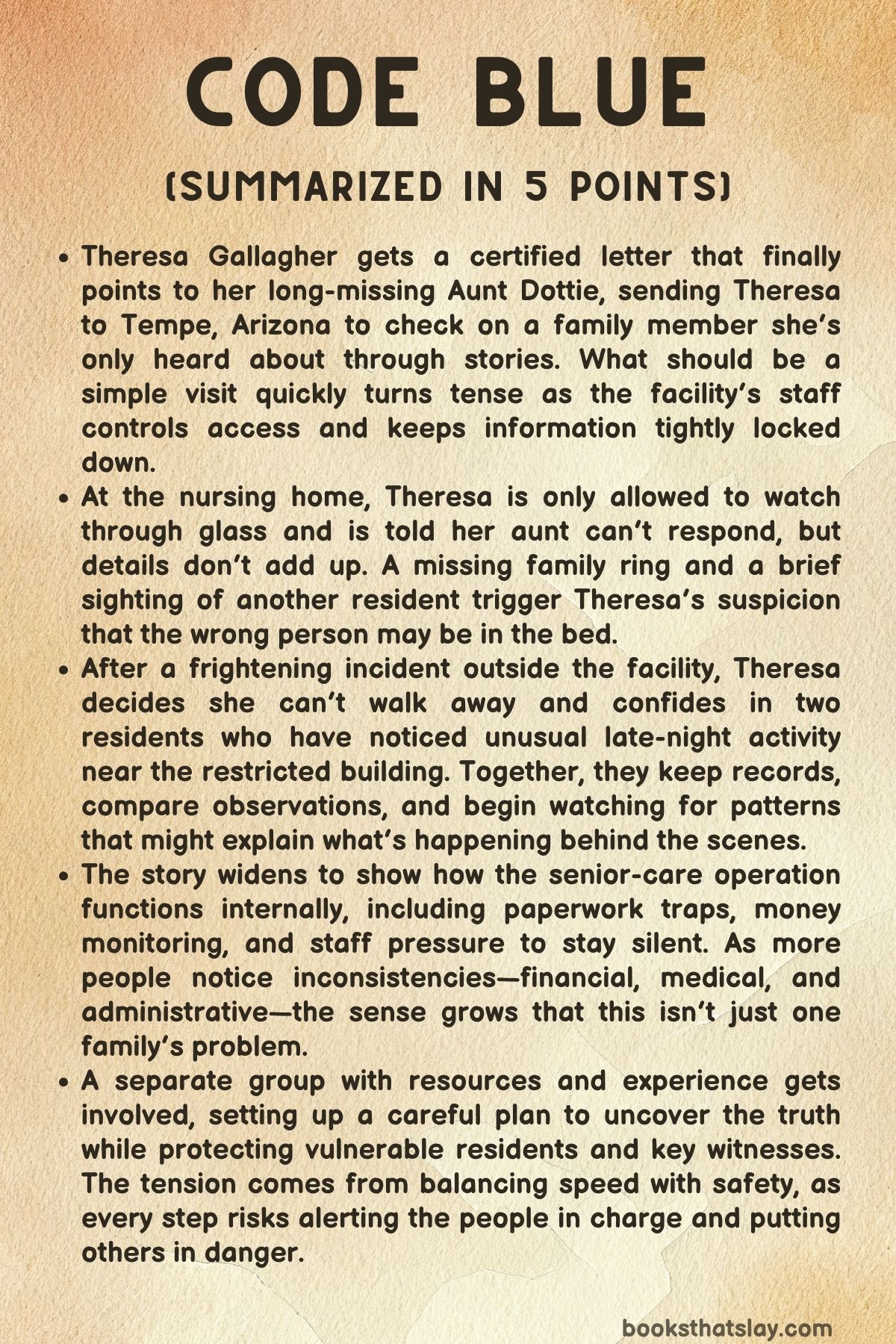
Code Blue by Fern Michaels is a fast-moving crime novel that follows Theresa Gallagher after she learns her long-missing Aunt Dottie is in a nursing facility in Tempe, Arizona. Theresa expects an awkward reunion and instead walks into a locked-down long-term care wing where residents are kept behind glass, staff refuse basic answers, and her aunt’s signature ring has vanished.
When the facility announces Dottie’s sudden death, Theresa begins to suspect the wrong woman died. Her worries draw in a highly capable group of women with resources, contacts, and a taste for direct justice, setting off an investigation into a polished senior-living brand that may be hiding fraud, theft, and bodies. It’s
Summary
Theresa Gallagher’s quiet life is interrupted by a registered letter from Tempe, Arizona. The writer is a neighbor of Dorothy “Dottie” Carpenter—Theresa’s mother’s older sister—saying Dottie is in a nursing home called Sunnydale and has no family listed.
The name lands hard. Dottie has been a family mystery for decades: the rebellious teen who shoplifted, skipped school, fought with her parents Agnes and Floyd, and left home at sixteen or seventeen with a note about needing to find herself.
After that, there were scattered postcards and Christmas cards from the Southwest, never enough detail to track her down. Theresa’s mother, JoAnne, is gone now, and Theresa and her sister Margaret are the only close relatives left.
Margaret wants no part of reopening old wounds, but Theresa can’t ignore the letter and flies to Phoenix.
Before she leaves, Theresa searches the attic and finds a steamer trunk packed with photos and old mail. One picture catches her eye: her teenage mother beside a slightly older girl labeled “Ditzy Dottie and Me.” In the photo, Dottie wears an art deco ring on her left hand, a family item Theresa remembers her mother mentioning with certainty—Dottie always said she would never take it off.
Theresa looks up Sunnydale online and is struck by the marketing: a resort-like senior community with manicured grounds, upbeat testimonials, and multiple buildings—assisted living, clinic and rehab, and a long-term care unit set apart behind landscaping and a road. It looks expensive, and Theresa can’t imagine how her aunt could pay for it.
The next morning, she drives to the gated entrance and is refused entry without an appointment. She is told to call the head nurse, Janet Turner.
Turner is brisk to the point of hostile. She claims Dottie is in poor condition, says there is no family information on file, and orders Theresa to return the next day at ten.
With time to kill in intense heat, Theresa tries to sightsee but ends up overwhelmed and retreating to her hotel, rattled by how hard it is to simply see a relative. When she returns to Sunnydale, she is directed not to the pleasant main campus but to the long-term care building.
Inside, the atmosphere is stark and controlled. The lobby is small and stripped down, divided by plexiglass, with a receptionist whose smile never changes.
Theresa is told she cannot visit directly. Dottie has been in a coma for weeks, and Theresa may only observe through a viewing room window.
An orderly leads her down a corridor lined with glass-fronted rooms like display cases. At the door marked “DOROTHY CARPENTER,” Theresa peers through the window and sees an elderly woman on life support with tubes and machines.
The woman’s face is swollen and unfamiliar, and she does not respond when Theresa speaks into a wall speaker. Worse, Theresa notices something concrete: the distinctive ring is missing, and there is no mark where it should have been.
As Theresa leaves, she spots a different resident in a wheelchair behind another glass window—alert, upright, and wearing a ring that looks exactly like Dottie’s. Theresa points it out to the receptionist.
The mood shifts. Nurse Turner arrives quickly, dismisses Theresa’s concern, and insists Dottie never had jewelry.
When they return to the window, the wheelchair woman is gone and the room is empty, as if Theresa imagined it.
Theresa tries to talk herself down. She’s overheated, tired, and confronting a stressful situation.
But as she drives away, a dump truck sideswipes her car and slams her into a telephone pole. The truck keeps going.
Theresa calls 911, gets checked at the hospital, and returns to her hotel bruised and shaken. The timing feels wrong, but she has no proof.
The next day she takes a cab back to Sunnydale. Inside the long-term care wing, she again sees the comatose woman, who now looks worse—ashen, close to death.
Theresa rushes for help. In the confusion she sees the wheelchair woman again, still wearing the ring.
An alarm sounds over the facility speakers: “Code Blue.” Staff hurry past. Moments later, Nurse Turner tells Theresa that Aunt Dottie has died.
Theresa is allowed one last look. An orderly pulls a sheet over the body.
Turner claims Dottie signed paperwork giving Sunnydale full responsibility, and that Dottie had no surviving relatives on record. If Theresa wants to challenge anything, Turner suggests she get a lawyer.
Theresa’s disbelief hardens into suspicion. As she is escorted out, she stages a small distraction by dropping her phone near the wheelchair woman’s viewing window.
From that angle, she gets a clear look. The resemblance to her mother is strong, and the ring is unmistakable.
Theresa snaps a secret photo before Turner blocks her view.
Outside, Theresa cuts through the hedges and meets two residents sitting under a gazebo, Henry Pushkin and Frida Larsen. They offer water and shade, and Theresa—still reeling—tells them everything: the viewing rooms, the missing ring, the wheelchair woman who vanishes on command, and Sunnydale’s sudden announcement of death.
Henry and Frida do not laugh it off. Henry admits he has noticed odd late-night traffic: black vehicles arriving around three in the morning at the long-term care area and leaving about an hour later.
He has been logging dates and times. Theresa calls her friend Lizzie Cricket in Washington, D.C., asking for help researching Sunnydale, but Theresa doesn’t wait for long-distance reassurance.
With Henry and Frida, she plans a stakeout.
The story widens to show what Theresa has stumbled into. At Sunnydale, an elderly stroke patient named Michael Lowery is admitted with limited sight and hearing.
With no family present, staff guide his hand to sign paperwork. Only after he signs does he learn what it means: Sunnydale will control his finances and manage his estate while he stays.
In the administrative office, a young employee, Regina, monitors streams of Social Security and pension deposits for residents. She believes she has a good job with generous bonuses.
She does not realize that some payments continue under residents’ names after those residents are dead, or that shell companies and offshore structures are being used to hide the flow of money.
In the pharmacy, Jeremy Sykes notices shipments of opioids repeatedly coming up short—OxyContin, Vicodin, codeine, morphine. He reports it and is abruptly fired under the excuse of “automation.” He signs an exit nondisclosure agreement to get out clean, but his suspicion is immediate.
Soon after, Jeremy is nearly killed in a hit-and-run involving a dump truck that matches Theresa’s experience. In the hospital, Jeremy wakes to find himself handcuffed to the bed because morphine has been “found” in his wrecked car.
The hit-and-run has become a setup, designed to discredit him and keep him contained while the story is rewritten around him.
Lizzie takes Theresa’s call seriously and brings the problem to Myra Rutledge and her circle, a private group with money, skills, and a history of handling predators who slip past normal systems. They research Sunnydale and notice how polished the public face is, while ownership and leadership details are hard to pin down.
They see a pattern beginning: vulnerable seniors being pushed into signing control of assets, staff controlled by surveillance and legal threats, and a facility that reacts aggressively to anyone who asks the wrong questions.
Theresa, Henry, and Frida carry out their stakeout near the long-term care building. Late at night, they watch a black vehicle arrive via a hidden service road.
Theresa recognizes Nurse Turner as she escorts a gurney carrying a long black bag and loads it into the vehicle. The sight confirms for Theresa that Sunnydale is moving bodies—or something meant to look like bodies—out of view.
She contacts Lizzie again, and the larger team commits to infiltration.
The plan becomes multi-state. Team members pose as wealthy prospective residents, new residents arriving for trial stays, and employees in administration and facilities.
In Florida, Izzie is hired into an office role and quickly sees constant surveillance and strict access controls. Regina confides that Jeremy’s file seems to have vanished and that staff were warned not to contact him.
Yoko starts in facilities under a manager who runs the warehouse with intimidation and secrecy. She sees dump trucks, heavy camera coverage, and even surveillance in places that should be private.
The team slips into a fenced construction yard at night to photograph dump trucks and gather evidence that connects the vehicles to the hit-and-runs.
With technical support from allies, they exploit a brief security glitch to pull data from Sunnydale’s systems. They discover internal ties that connect key personnel: Edith Clayton in Florida is related to Janet Turner in Arizona, and both connect to Senator Spencer Gerber.
At the top sits Maxwell Hawthorne, a strategist who helped build the Sunnydale network through layered LLCs, offshore accounts, government funding streams, and careful legal insulation. Their business model is clear: target isolated seniors, pressure them into signing over control, continue collecting benefits after death, and keep the system quiet through nondisclosure agreements, intimidation, and staged “accidents.”
The team confirms the physical horror behind the financial theft. In Florida, they break into a locked interior area and find a frigid room lined with stainless-steel mortuary drawers, empty at that moment but ready for use.
In Arizona, Annie and Kathryn penetrate deeper and find a concealed route leading to a basement with an elevator sized for gurneys and a vault of drawers—this one holding cadavers. The evidence shows that deaths are being managed out of public view to extend payments and control timing, while the facility maintains its smiling brand above ground.
With proof in hand, they move to rescue and disruption. They arrange for Jeremy to be removed from the hospital and relocated for safety, with a new job and housing.
Regina and a facilities worker named Danny are guided out as well, along with Danny’s girlfriend, so they can start over away from Sunnydale’s reach. In Arizona, with Theresa’s help and the timing coordinated down to the minute, they neutralize Janet Turner and extract the real Aunt Dottie from the facility, wheeling her through the hidden basement route and getting her to an airport for immediate transport with medical care.
At the same time, they set a trap for the leadership. Senator Gerber and Maxwell Hawthorne are lured into a meeting with a supposed wealthy investor.
They are drugged, taken, and held long enough for the team to confront them with the scope of what they have done: fraud, theft, neglect, and the controlled disappearance of residents. The operation collapses from multiple angles.
Public scrutiny grows. Sunnydale’s licensing issues surface.
Financial trails are exposed, and assets are seized. Victims are compensated as the fraud becomes undeniable.
Theresa returns home with Aunt Dottie alive, and the family mystery shifts into something real: Dottie had been targeted, likely because of lottery winnings and the lack of close family on paper, making her easy to isolate and relabel. With Dottie safe, Theresa uses resources to secure proper care and repair what can be repaired.
Survivors who were almost destroyed by the scheme—like Jeremy and Regina—find stability and a future together. The people who built Sunnydale’s system lose control of their empire, and the polished brand that hid exploitation is finally forced into the light.
Characters
Theresa Gallagher
Theresa is the emotional and investigative engine of Code Blue. Her defining traits are persistence and moral clarity: even when her sister refuses involvement, Theresa treats Aunt Dottie’s situation as a family obligation and a basic matter of human dignity.
She is observant in a practical, lived-in way—she notices the missing ring, the unnatural cheer of staff, the “prison-like” layout, the timing of events, and the pattern of intimidation that culminates in a hit-and-run. What makes Theresa compelling is that she is not a trained operative; she is an ordinary person whose instincts sharpen under pressure.
Her fear is real, but it doesn’t override her sense that something is wrong. That blend of vulnerability and grit gives the story its credibility: she keeps going because she cannot live with the idea that she looked away.
Dorothy “Dottie” Carpenter
Dottie functions as both a person and a mystery. In the family’s remembered version of her, she is the “problem” child—rebellious, defiant, and unwilling to accept the suffocating expectations of her parents’ respectability.
That early characterization matters because it explains why she disappears so thoroughly: she has practiced escape as survival since adolescence. In the present-day plot, Dottie becomes a symbol of how institutions can erase an individual—through paperwork, isolation, and identity manipulation—until a living woman can be treated like an inconvenience or a commodity.
The ring is not just a clue; it represents continuity of self across decades, and its disappearance signals the theft of her autonomy. When she is finally rescued and recognizes family, Dottie shifts from being a rumor and a case file back into a human being with memory, fear, and dignity.
Margaret “Maggie” Gallagher
Margaret is the counterpoint to Theresa’s urgency. Where Theresa leans into responsibility, Margaret defaults to distance, self-protection, and risk avoidance—she would rather do nothing than open a door to messy family history.
Even her compromise (paying half the airfare) is a way to contribute without exposure. This doesn’t make her cruel; it makes her realistic about how many families handle long-estranged relatives: with discomfort and denial.
Margaret’s role highlights Theresa’s courage by contrast, and it also underscores one of the book’s darker truths: institutions like Sunnydale thrive because relatives often hesitate, delay, or decide that “it’s not our business.”
JoAnne Carpenter Gallagher
Though she is absent in the present timeline, Theresa’s mother shapes the entire emotional landscape. JoAnne is the keeper of partial truths: she preserves fragments—postcards, stories, the old photo—yet the family never truly knows what happened to Dottie.
Her silence and the family’s long estrangement suggest a life spent balancing loyalty to her parents with unresolved grief for her sister. JoAnne’s legacy is the archive Theresa later relies on, which implies that even if JoAnne could not repair the past, she unconsciously left a trail for someone else to follow.
She represents the generation that endured dysfunction quietly, leaving the next generation to confront what was buried.
Agnes Carpenter
Agnes embodies a conflicted, traditional form of motherhood—capable of concern but constrained by the norms of her time. She interprets Dottie’s rebellion as attention-seeking rather than desperation, which reveals both a limited emotional vocabulary and a fear of social judgment.
Agnes’s response to Dottie is not purely punitive; it is also anxious and controlling, as if managing behavior could prevent family shame. Her presence in the backstory explains why Dottie’s departure feels inevitable: the home environment cannot accommodate a young woman who refuses to be shaped into compliance.
Floyd Carpenter
Floyd represents the harshest edge of reputational pressure. His obsession with how the family appears—especially tied to business standing—turns Dottie’s adolescence into a threat that must be contained.
The intention to “send her away” signals a worldview where inconvenience is solved through removal rather than understanding. Floyd’s long-term impact is the fracture that lingers after Agnes’s death: the family’s emotional damage isn’t an accident; it is the predictable outcome of prioritizing image over relationship.
He is important because he shows how private authoritarianism inside a family can echo later in institutional authoritarianism at Sunnydale.
Janet Turner
Janet Turner is the face of Sunnydale’s cruelty: cold, procedural, and skilled at weaponizing policy to isolate and intimidate. She understands that controlling access controls reality—appointments, “observation only,” plexiglass barriers, harsh phone calls, and manufactured urgency all keep outsiders off balance.
Her denials about the ring and her aggressive management of Theresa’s presence suggest not merely indifference but active participation in deception. Turner’s power doesn’t come from charisma; it comes from certainty and institutional backing.
She is a portrait of how harm can be delivered without overt violence: through rules, tone, and the confidence that no one will successfully challenge the system.
Regina
Regina begins as a well-paid employee who assumes legitimacy because the workplace rewards her and normalizes secrecy. Her moral arc is built on delayed recognition: she is close enough to the money flow to see patterns, but far enough from decision-making to be kept naïve.
When she learns about Jeremy’s termination and then sees him framed and restrained, her worldview cracks—she realizes the organization doesn’t merely exploit residents, it destroys anyone who threatens operations. Regina’s courage is quieter than Theresa’s; it’s the courage of someone trapped inside a system who decides to stop cooperating.
Her eventual new life is meaningful because it doesn’t erase complicity, but it shows repair is possible when a person chooses truth over comfort.
Jeremy Sykes
Jeremy is the story’s whistleblower figure, punished precisely because he behaves like a responsible professional. He notices opioid shortages, follows protocol, and expects accountability—then discovers the system is designed to eliminate accountability.
His firing, forced nondisclosure, and subsequent hit-and-run demonstrate how Sunnydale’s corruption extends beyond finances into coercion and retaliation. The morphine planted in his car is especially revealing: it’s not enough to silence him; they need to discredit him, too.
Jeremy’s experience highlights the vulnerability of ethical workers inside corrupt institutions, and his rescue represents the book’s belief that exposure and solidarity can interrupt that cycle.
Myra Rutledge
Myra is the strategic commander of the response, projecting calm authority while running a disciplined, mission-driven operation. She is defined by competence: research, infiltration planning, role assignment, contingency thinking, and coordinated execution.
Yet she is not merely a tactician; she is emotionally anchored by a protective instinct toward victims who have no defenders. Myra’s willingness to go undercover as a wealthy prospect shows how she leverages social performance as a tool, mirroring Sunnydale’s own reliance on appearances—but for the opposite purpose.
She embodies the book’s vigilante ethics: when formal systems are compromised, she chooses direct intervention over waiting for permission.
Annie de Silva
Annie is the most adaptable operative, capable of charm, deception, and physical risk without losing sight of the mission’s moral center. Her dinner with Turner and key-card swap show her psychological intelligence—she reads people, creates openings, and uses their confidence against them.
Annie’s role also carries an emotional weight because she becomes one of the closest agents to Dottie’s immediate danger, moving from investigation to rescue. She represents controlled audacity: she takes risks, but they are calculated risks that serve a defined objective—save the vulnerable, document the crimes, and stop the machinery.
Lizzie Fox
Lizzie bridges two worlds: the legitimacy of legal power and the urgency of extralegal action. As Theresa’s friend, she validates Theresa’s instincts and gives them traction, translating a frightened civilian’s observations into a case worthy of a larger operation.
Lizzie’s strength is her ability to mobilize resources quickly—contacts, research, coordination—while understanding that formal channels may be compromised or slow. She also functions as a moral amplifier: she refuses to treat Theresa’s experience as paranoia and instead treats it as testimony.
In doing so, Lizzie turns an isolated suspicion into a collective mission.
Charles
Charles is the infrastructure behind the mission—intelligence gathering, technical support, document forging, and tactical planning. His background as a former intelligence professional shows in how he treats details as decisive: cameras, timing “glitches,” cover identities, and layered financial trails.
He provides the steadiness that allows others to act boldly, because boldness without logistics becomes recklessness. Charles also reflects the book’s theme that corruption can be fought with the same sophistication that enables it; the difference lies in motive and target.
Fergus
Fergus functions as a precision enabler: passports, licenses, and identity scaffolding that make infiltration possible. His presence emphasizes that the team’s success is not just bravery; it is preparation.
He is less visible than the frontline characters, but his contribution is essential because Sunnydale is protected by bureaucracy, and bureaucracy is best countered by equally competent maneuvering through documents and systems.
Kathryn
Kathryn represents persistence under institutional rejection. Being turned away from an Arizona job start doesn’t end her usefulness; it redirects her into other high-risk tasks, including infiltration support and operational execution.
She is the kind of character who absorbs setbacks without ego and returns with another path forward. When it’s time to neutralize Turner, Kathryn’s readiness shows she is both trusted and capable of acting decisively—someone whose courage is expressed through follow-through.
Henry Pushkin
Henry is the narrative proof that “ordinary” residents notice far more than institutions assume. He is observant, methodical, and quietly brave—keeping a log of suspicious late-night vehicles and sharing it when it becomes dangerous to do so.
Henry also serves as a moral witness: he confirms to Theresa that she is not imagining things, and he chooses to help even though he lives under the very system being investigated. His decency shows that community can form in the most controlled environments, and that older residents are not merely victims but potential allies.
Frida Larsen
Frida brings emotional warmth and human immediacy to the investigation. Where Henry is methodical, Frida is openly responsive—concerned, curious, and energized by the pursuit of truth.
Her willingness to join the stakeout reflects a refusal to be reduced to passive old age. Frida’s role matters because she reinforces that the residents are not background scenery; they are people with agency, humor, fear, and resolve, and their participation undermines Sunnydale’s assumption that isolation guarantees silence.
Maxwell Hawthorne
Maxwell is the “business” face of corruption: anxious, calculating, and primarily motivated by money and survival. He is not portrayed as a mastermind with perfect control; he is portrayed as someone whose scheme is beginning to collapse under audits, licensing problems, and cash pressure.
That panic is revealing—he understands the operation is criminal, but he wants reassurance and protection rather than accountability. Max functions as a portrait of corrupt pragmatism: he will do harm at scale and then treat consequences as an inconvenience that needs management.
Senator Spencer Gerber
Gerber is the institutional shield that makes Sunnydale possible. He is the character who demonstrates how corruption becomes durable when it is connected to political power, government funding channels, and influence over local enforcement.
Gerber’s confidence rests on the belief that he can redirect scrutiny, starve audits, and intimidate threats without personal exposure. He is dangerous not because he personally administers cruelty, but because he architected the environment where cruelty becomes profitable and protected.
His downfall is crucial thematically: it signals that the book’s target is not just one bad facility, but the systemic collusion that allows predation to masquerade as care.
Edith Clayton
Edith Clayton is the polished predator—professional, persuasive, and socially skilled. She can sound compassionate while pushing enormous deposits and restrictive paperwork, and she understands how luxury presentation disarms suspicion.
Her sharp reaction to “glitches,” strict control of staff communication, and reliance on surveillance show an obsession with containment. Edith is also a connector figure: her family linkage to Turner and Gerber implies a network where personal loyalty reinforces institutional secrecy.
She illustrates how evil often arrives with a smile, a brochure, and a signature line.
Sasha
Sasha is the field intelligence specialist who turns suspicion into actionable proof. By tracking cars, photographing meetings, and mapping relationships, she converts the villains’ private movements into patterns the team can exploit.
Her role emphasizes that the enemy’s strength is secrecy, and secrecy can be broken by patient observation. Sasha also shows that the mission is not only about rescue; it is about building a case that connects individuals to systems.
Nikki Quinn
Nikki is the bait and the performance: she weaponizes credibility by presenting as a wealthy investor, triggering the villains’ greed and urgency. Her effectiveness depends on understanding what corrupt people cannot resist—money and access—then offering it in a controlled setting.
Nikki’s role highlights a central irony of the story: Sunnydale relies on appearances to trap victims, and the team uses appearances to trap Sunnydale’s leadership.
Izzie
Izzie is an embedded operative whose strength lies in composure under surveillance. Working in a monitored administrative environment, she navigates read-only access, controlled authorization tools, and constant camera presence without tipping her hand.
Her ability to be socially functional—bonding with Regina, handling Edith’s suspicion, and playing the “employee” role convincingly—makes her effective. Izzie’s arc shows how resistance sometimes looks like patience: waiting for a four-minute gap, downloading what matters, and leaving no obvious trace until the right moment.
Yoko
Yoko is the practical, risk-aware infiltrator who reads physical spaces the way others read documents. Her work in facilities and landscaping exposes the bones of the operation—dump trucks, construction zones, camera placement, and hidden surveillance even in bathrooms.
She is proactive in generating evidence, proposing night missions, and documenting the machinery of intimidation. Yoko’s presence reinforces that Sunnydale’s crimes are not abstract; they are operational, logistical, and daily—and stopping them requires someone who can move through those spaces without being absorbed by them.
Danny
Danny is a morally complicated but essential witness from the labor side of Sunnydale. His criminal record and acceptance of the job underline how the organization recruits people who may feel they have limited options, then folds them into an environment of secrecy.
Yet Danny is not portrayed as inherently bad; he is portrayed as someone who hears rumors, notices patterns, and can be redirected toward safer work once the truth is named. His trajectory suggests that “the system” uses vulnerable workers as much as it uses vulnerable residents, and that rescue can include offering an exit rather than a punishment.
Pearl
Pearl represents the team’s darkest instrument: the person tasked with neutralizing threats and handling the consequences the team does not want public, procedural, or slow. Her presence clarifies the moral texture of the story’s vigilante framework—this group is not simply investigating; they are imposing control on people who abused control first.
Pearl’s role is deliberately unsettling, serving as a reminder that the team’s justice is swift and personal, operating outside courts and corrections.
Karen Hawthorne
Karen functions as the personal fallout of the conspiracy—an intimate link between political power and criminal enterprise. Her relationship with Gerber exposes the scheme’s culture of entitlement: rules are for other people, while insiders treat public resources and private lives as playthings.
Her eventual arrest and conviction provide narrative closure by showing consequences reaching beyond the immediate facility operators into the people who benefited, enabled, or entangled themselves with the wrongdoing.
Themes
Predatory Care and the Commodification of the Elderly
In Code Blue the Sunnydale brand markets comfort, dignity, and high-end support, yet the machinery beneath it treats aging bodies as revenue streams that can be managed, delayed, and disposed of. The long-term care wing’s architecture and rules make the moral argument without preaching: no chairs in the lobby, plexiglass barriers, glass viewing rooms, and the insistence that family can only “observe.” Those choices reduce residents to objects of policy rather than people with relationships, histories, and rights.
The fraud isn’t limited to money; it is a full conversion of human life into paperwork. Intake practices target impairment—poor hearing, poor sight, post-stroke confusion—and turn consent into a technicality.
The estate-custody fine print Michael Lowery signs is not an accident of bureaucracy; it is a business model built around vulnerability, isolation, and time. Even death becomes a transaction to be scheduled for maximum payout, with benefits kept flowing after residents have already died and with bodies handled in ways designed to avoid questions.
Dottie’s supposed coma and sudden “death,” paired with Theresa’s observation that the ring has vanished and that a different woman appears behind glass, pushes the theme from financial exploitation into existential theft: identity itself can be reassigned when the institution controls records, access, and witnesses. By showing staff members who are compartmentalized—Regina believing the deposits are legitimate, pharmacy shipments going short, nondisclosure agreements used like duct tape—the story also criticizes how predatory systems survive by distributing small moral blind spots across many people.
The comfort surfaces of Sunnydale are not a backdrop; they are part of the mechanism, a designed distraction that helps normalize control while turning the elderly into assets on a ledger rather than citizens with agency.
Family Estrangement, Inherited Silence, and the Work of Repair
Theresa’s trip begins as a response to a letter, but it quickly becomes a confrontation with what families choose not to know. Dottie’s disappearance has hardened into folklore—rebellious teenager, shame to the household, a father anxious about reputation, a mother framing behavior as attention-seeking—until those narratives function as a substitute for truth.
The attic trunk and the labeled photo expose how memory is curated: a nickname like “Ditzy Dottie” can domesticate pain, turning a complicated girl into a punchline that is easier to store away. The ring is important not because it is a clue in a mystery plot, but because it represents continuity across generations: a grandmother’s gift, a young woman’s vow, a tangible sign that someone once belonged.
When Theresa sees that continuity severed—no ring, no mark, no acknowledgement—her instinct is not simply suspicion; it is grief for how easily a person can be erased when the family record is already fragmented. Margaret’s refusal to go underscores another family truth: relatives can disagree not just on facts but on obligations, and distance can masquerade as pragmatism.
Theresa’s insistence on showing up becomes a kind of repair work, an attempt to restore family responsibility after the older generation’s conflicts froze it. The theme deepens when Theresa finds community with Henry and Frida, who supply the care and belief that her own family initially withholds.
That shift suggests that “family” in Code Blue is not only blood; it is also the network of people willing to witness, corroborate, and act. The eventual rescue of Dottie does not magically undo decades of silence, but it reframes the past: Dottie’s story is no longer an embarrassing footnote; it becomes a cause that demands accountability.
Repair, here, is not sentimental reconciliation. It is a decision to treat a missing relative as a person worth the risk of discomfort, conflict, and exposure.
Institutional Power, Secrecy, and the Engineering of Fear
Sunnydale’s control depends on designing an environment where ordinary resistance feels impossible. The strongest form of intimidation in Code Blue is not a shouted threat; it is the calm certainty of systems that expect compliance.
Janet Turner’s phone call sets the tone—harsh, dismissive, confident that Theresa’s questions are a nuisance rather than a right. Inside the facility, secrecy is enforced through protocols that are framed as safety or privacy, yet consistently serve the organization’s interests.
The glass rooms create one-way vulnerability: visitors can see suffering but cannot touch, verify, or advocate in real time. Surveillance is omnipresent for staff and outsiders, but selectively absent when evidence would harm the institution, as suggested by the “overheated transformer” explanation and missing interior footage.
That asymmetry is the point: visibility becomes a weapon, not a safeguard. The hit-and-run pattern extends this control into the public world, turning roads into another tool of discipline.
Jeremy’s firing after reporting drug discrepancies, followed by a crash and then a morphine setup that leaves him handcuffed to a hospital bed, shows how fear works best when it is paired with plausible deniability. Nobody has to say, “Stop asking questions,” because consequences appear to arrive on their own—accidents, job loss, legal trouble, erased employee records.
Nondisclosure agreements function like privatized gag orders, exploiting people’s need for income and stability. Even well-meaning employees become cautious once they learn that curiosity carries personal risk.
The theme argues that corruption persists not only through high-level conspirators but through the everyday management of uncertainty: if you cannot prove what you saw, if official paperwork denies your experience, if authorities offer sanitized reports, then silence becomes the safest option. Theresa’s confusion after the first visit—wondering if heat and jet lag explain what she noticed—captures how such institutions rely on self-doubt as a form of control.
Power is not just exercised; it is staged so that victims question their own perceptions before they ever question the system.
Corruption, Political Protection, and the Failure of Formal Justice
The Sunnydale operation is not portrayed as a lone bad administrator skimming funds; it is a layered structure that assumes protection from above. Government grants, shell companies, offshore accounts, and political ties create a pipeline where public money and private estates can be redirected with minimal scrutiny.
The story’s inclusion of a senator as architect and protector is crucial because it connects exploitation inside a care facility to decisions made in offices, restaurants, and legislative spaces. When police provide a “sanitized” accident report and casually acknowledge Sunnydale’s donations, Code Blue shows how accountability can be negotiated away long before any courtroom appears.
The corruption is practical rather than theatrical: expired licenses, audits delayed, complaints minimized, and intimidation used to keep investigations from forming. This matters thematically because it challenges a comforting belief that the system will eventually correct itself if citizens file the right forms.
Theresa follows ordinary channels—calling the facility, showing up, seeking clarity—and is met with procedural walls that are clearly designed to exhaust her. Even when she considers legal recourse, the institution’s claim that Dottie has “no surviving relatives” illustrates how documentation can be shaped to preempt challenge.
The narrative treats “reputation” as a currency that corrupt actors understand well: just as Floyd once worried about his reputation and tried to contain family scandal, Sunnydale protects its public image with luxury branding and stellar reviews while hiding the mechanisms that fund that image. Corruption is therefore social as well as legal; it depends on community trust in appearances and on the reluctance of outsiders to suspect a place that looks respectable.
By the time the Sisters intervene, the theme has made a case that formal justice is not merely slow; it is structurally discouraged by networks of influence. The eventual exposure and asset seizure offer resolution, but the larger argument remains: when political insulation and institutional money meet vulnerable populations, wrongdoing can persist for years because the channels meant to protect people are the same channels being managed by those who profit.
Vigilantism, Moral Boundaries, and the Price of Taking Action
The Sisters’ response raises an uneasy question that Code Blue refuses to treat as simple: what is justified when official routes are blocked or compromised? The group’s planning is careful, professional, and oriented toward rescue—extract Dottie, protect whistleblowers like Jeremy, relocate staff who might be harmed, and gather evidence.
That purpose gives their actions a moral clarity that contrasts with Sunnydale’s cruelty. Yet the methods also test boundaries: infiltration under false identities, hacking timed to a CCTV glitch, trespassing into restricted areas, and ultimately kidnapping and drugging perpetrators.
The decision to punish with pesticide-induced paralysis and send criminals to brutal camps signals that the group is not merely assisting law enforcement; it is replacing it. The theme lives in that tension.
On one side is the reality the story has demonstrated—paper trails can be falsified, police can be bought, witnesses can be scared into silence. On the other side is the danger of becoming a private justice system accountable only to its own moral confidence.
The narrative builds empathy for the Sisters by pairing their harshness with protective instincts: they do not abandon victims after the immediate crisis, and they work to restore lives, jobs, and safety for people caught in the machinery. Theresa’s role helps ground the theme, because she is not a trained operative; she is a family member pushed into extraordinary choices by extraordinary obstruction.
Her willingness to act, even when frightened, highlights how vigilantism can begin as a desperate extension of care when care is denied. At the same time, the story keeps the moral cost visible: secrecy, deception, and coercion are not portrayed as “clean,” even when directed at villains.
The reader is left to consider whether the group’s effectiveness excuses the precedent it sets, and whether the satisfaction of retribution risks overshadowing the ethical commitment to human dignity that motivated the rescue in the first place. In this way, Code Blue treats vigilantism less as a power fantasy and more as a symptom of institutional failure—an extreme answer that feels necessary precisely because the normal answers have been systematically neutralized.