The God of the Woods Summary, Characters and Themes
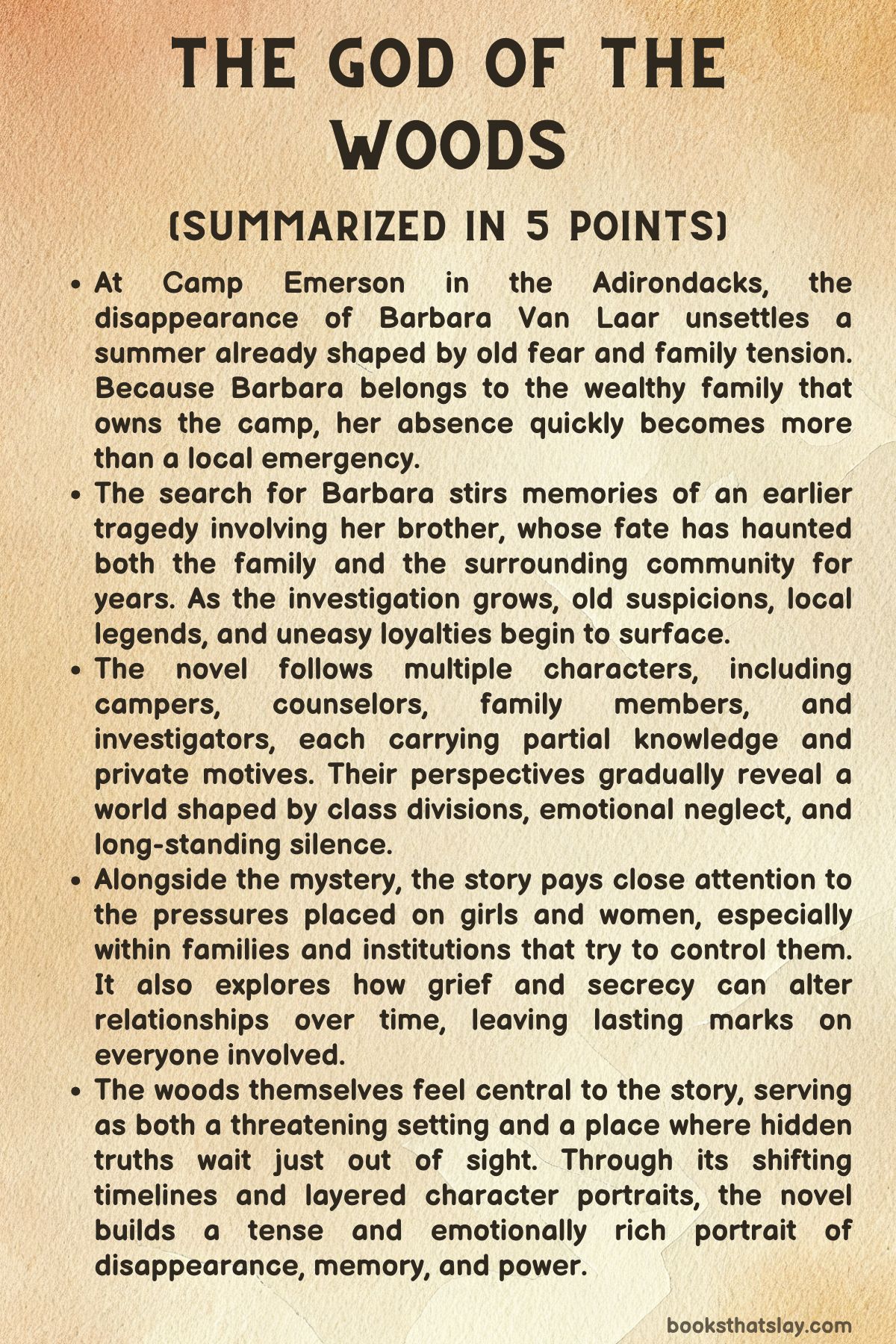
The God of the Woods by Liz Moore is a literary mystery set around a wealthy family’s summer camp in the Adirondacks, where an old tragedy casts a long shadow over a new disappearance. The novel opens with the vanishing of Barbara Van Laar, a difficult, watchful teenager from the family that owns Camp Emerson.
From there, the story moves across different years and points of view, slowly exposing class tension, family control, buried violence, and the damage done by secrecy. It is both a suspense story and a portrait of people shaped by privilege, fear, desire, and the stories a community tells itself when the truth is too dangerous to face.
Summary
In the summer of 1975, Camp Emerson wakes to a crisis: thirteen-year-old Barbara Van Laar has vanished from her cabin. Her disappearance is shocking not only because she is a camper, but because she is the daughter of the wealthy Van Laar family, who own the camp and the surrounding preserve.
The camp is already marked by old fear because years earlier Barbara’s older brother, Bear, disappeared from the same property and was never found. Barbara’s case quickly becomes more than a missing-person search.
It stirs up long-buried memories, local resentments, and suspicions that have waited for years beneath the surface.
The immediate search begins with Louise, a young counselor who discovers Barbara is gone. Louise is hiding troubles of her own.
She has been involved with John Paul McLellan, a volatile young man tied closely to the Van Laars, and on the night Barbara vanished, Louise slipped away to meet Lee Towson, a kitchen worker she has been drawn to. John Paul, drunk and possessive, found them together and attacked Lee.
By morning, Barbara was missing, and Louise’s lies about her own movements leave her exposed to police suspicion. When drugs and a bloody camp uniform are later connected to John Paul, both he and Louise are pulled into the investigation.
Before the disappearance, camp life had already established the novel’s key relationships. Tracy Jewell, a shy and observant girl sent unwillingly to camp, arrives as an outsider and gradually becomes close to Barbara.
Tracy admires Barbara’s confidence, boldness, and disregard for the usual camp hierarchy. Barbara is both privileged and lonely, admired by the other girls but emotionally separate from them.
She confides in Tracy more than anyone expects, letting her glimpse her secret restlessness and her private rebellions. Barbara sneaks out at night, uses an abandoned observer’s cabin in the woods, and speaks about things she cannot bear at home.
Barbara’s home life is central to the mystery. Her mother, Alice Van Laar, lives in a state of fragility shaped by years of repression, heavy medication, and grief.
Alice never recovered from Bear’s disappearance. Her marriage to Peter Van Laar is cold, controlling, and built on long habits of silence.
Barbara herself has grown up in the ruins of that earlier loss. She senses that Bear’s absence defines the family more than her presence ever could.
She is treated as difficult, inconvenient, and embarrassing, especially after incidents at boarding school. Peter has already decided to send her to a harsh reform school, though Barbara does not yet fully know what is coming.
Her rage, secrecy, and desperation make more sense once it becomes clear that she feels trapped by her parents and by the role assigned to her in a house built around money and denial.
As the search expands, a young investigator named Judyta Luptack becomes one of the first people to look at the case without automatically accepting the Van Laars’ version of reality. Judy is new, underestimated, and often dismissed by older men, but she listens carefully and notices what others overlook.
She learns about Barbara’s painted-over bedroom mural, her secret movements, and her emotional closeness to TJ Hewitt, the camp director. Judy also hears stories that connect the current disappearance to the older case of Bear.
The Van Laars and their circle have long shaped the public story, but Judy begins to see that power has kept certain people protected and others blamed.
The novel then turns back to the 1950s and early 1960s, revealing Alice’s marriage into the Van Laar family. As a young woman, Alice is drawn into their world of wealth, performance, and rules.
She becomes increasingly isolated at Self-Reliance, the family estate. Her husband teaches her how to behave, what to suppress, even how to drink.
Her life narrows until Bear becomes her emotional center. She adores him completely.
When he disappears during a family gathering in 1961, the event destroys what little stability she had left. In the aftermath, Alice insists in various ways that Bear is still alive, while those around her use medication, confinement, and manipulation to silence her.
Her grief is treated as illness, and her memory is made to seem unreliable.
For years, the official assumption around Bear’s disappearance has been shaped by class prejudice and convenience. Jacob Sluiter, later known as a serial killer who escaped from prison in 1975, hovers over the story as a sinister possibility.
Because he knows the woods and because rumor is easier than truth, many are willing to connect him to both missing children. Yet the closer Judy gets to the facts, the clearer it becomes that the real story lies not with a monster from outside but within the preserve’s own history.
At the same time, Judy uncovers the tangled loyalties around the camp staff and the Hewitt family. TJ Hewitt has long cared deeply for Barbara, often more tenderly than Barbara’s parents ever did.
She watched Barbara grow up neglected and frightened and became a secret source of comfort and protection. This relationship attracts suspicion, especially in a town eager for simple answers, but the truth is more complicated.
TJ has been planning an escape for Barbara, not an attack on her. She has taught Barbara survival skills and prepared a remote island cabin where Barbara could live hidden from her family until she turns eighteen.
The mystery of Bear is finally solved through a combination of Judy’s persistence, old local knowledge, and testimony drawn from Jacob Sluiter after his capture. Sluiter reveals that he knows where Bear’s remains are buried, though he did not kill him.
The remains are recovered from a cavern, and attention shifts to Victor Hewitt, TJ’s father. Under pressure, the truth emerges.
In 1961, Alice had taken a boat onto the lake in a storm after discovering her husband’s affair with her sister. Bear followed after her and drowned.
Instead of admitting what happened, Peter Van Laar Sr., Peter Van Laar Jr., and Victor conspired to hide the body. Alice, injured, confused, and already treated as unstable, was secluded and drugged.
The powerful men around her buried the truth to avoid scandal. Carl Stoddard, an innocent local man, carried suspicion for years because it was easier for the family and the authorities to let blame fall elsewhere.
This revelation transforms the meaning of Barbara’s disappearance. The Van Laars are shown as a family that has protected reputation over truth for decades.
The old cover-up explains the atmosphere Barbara grew up in: a household ruled by secrecy, emotional cruelty, and distorted memory. Judy also uncovers another important detail from Barbara’s restored mural: the initials linking Barbara romantically to John Paul McLellan.
John Paul’s involvement is real but not in the way police first imagine. He is dangerous, entitled, and abusive, but he did not murder Barbara.
The bloody uniform found in his car was planted, and the blood came from an injury Barbara suffered earlier during a camp survival exercise.
In the final movement of the story, the focus returns to Barbara herself. On the night she vanished, she met TJ, who gave her supplies and set the plan in motion.
Barbara chose to disappear. Rather than submit to her parents’ control and the future arranged for her, she escaped to the hidden island cabin.
There she begins a rough, self-directed life shaped by everything TJ has taught her. When Judy eventually tracks her down in September, Barbara confirms that she wants to remain hidden.
She is not asking to be rescued. She is claiming the first real measure of freedom she has ever had.
By the end, the novel resolves the central mysteries while leaving behind a powerful sense of what secrecy costs. Bear’s death was covered up by men protecting status.
Barbara’s disappearance exposes that history and breaks the family’s public image apart. Louise starts to separate herself from John Paul and the future she had imagined with him.
Judy proves herself by trusting evidence over inherited stories. And Barbara, the girl everyone thought they understood, becomes the one character who fully rejects the system built to contain her.
The woods hold the family’s worst lies, but they also become the place where those lies finally lose their power.
Characters
Barbara Van Laar
Barbara is the emotional center of the novel because her disappearance sets the story in motion, yet her importance goes far beyond the mystery itself. She is a teenager shaped by neglect, surveillance, and the burden of family history.
As the daughter of a wealthy and prominent family, she is constantly watched, judged, and managed, but she is not genuinely cared for in the way a child needs. Her anger, secrecy, and unpredictable behavior come from a life in which she has learned that adults often make decisions about her without listening to her.
She resists that control through secrecy, defiance, and private plans.
She is also defined by the shadow of her missing brother, Bear. Barbara seems to understand that in her family, she is living in the space created by his absence.
She believes that if he had lived, the family would have been different and perhaps she would not even have mattered. That belief gives her a painful self-awareness.
She does not simply feel unloved; she feels structurally secondary, as though she exists in a household built around grief for someone else. This is one reason she can seem abrasive or emotionally distant.
She is defending herself against a world that has already told her she is a disappointment.
At camp, Barbara shows another side of herself. She is capable, charismatic, and commanding.
She knows how to move through the woods, take charge of a group, and create loyalty in others, especially Tracy. She attracts admiration because she combines boldness with vulnerability.
Her private meetings, hidden supplies, and eventual decision to disappear reveal that she is not passive. She is planning for a life outside the one chosen for her.
By the end, she becomes one of the strongest characters in The God of the Woods, not because she solves the mystery, but because she refuses to be trapped inside the role her family created for her.
Alice Van Laar
Alice is one of the most tragic figures in the story because her life is shaped by dependency, silencing, and grief. She enters the Van Laar family as a young woman who is unsure of herself and gradually becomes a wife whose world grows smaller and smaller.
Her marriage to Peter is built less on intimacy than on control. He instructs her on how to act, how to fit in, and even how much to drink.
Over time, she loses confidence in her own instincts. Her life at Self-Reliance becomes socially grand but emotionally barren.
Her love for Bear gives her life real meaning, which is why his disappearance becomes the central fracture in her identity. After he is gone, Alice is treated not as a grieving mother whose questions deserve answers, but as a problem to be managed.
Her fear, intuition, and refusal to accept easy explanations are all dismissed as instability. Medication and institutionalization are used to weaken her authority over her own story.
This makes her character especially powerful because she is not simply fragile; she is a woman whose perception has been systematically discredited.
Alice’s relationship with Barbara is painful and complicated. She does not know how to mother Barbara freely because she has never recovered from Bear’s loss and because her own life has taught her to retreat inward.
She can see Barbara’s pain, but she cannot consistently protect or understand her. That failure does not come from indifference alone; it comes from damage.
Alice is a portrait of what happens when a woman’s emotional life is controlled for so long that even her love becomes tangled with fear, guilt, and withdrawal.
Judyta Luptack
Judyta is the moral and investigative force of the novel. She enters as a young, inexperienced officer, but what sets her apart is not authority or confidence; it is attention.
She notices what others dismiss, listens when others assume, and keeps working even when older men try to limit her role. She is underestimated because of her age and gender, but that underestimation becomes one of her advantages.
People speak more freely around her, and she is willing to ask questions that others avoid because those questions threaten local hierarchies.
Her character represents a challenge to inherited power. The investigation around the Van Laars has long been shaped by wealth, male influence, and accepted local myths.
Judy refuses to take those as facts. She is suspicious of polished stories, alert to emotional details, and interested in people at the margins rather than only those at the center of power.
That allows her to see patterns connecting Barbara’s case with Bear’s disappearance. She does not accept the first convincing suspect, and she is careful not to confuse probability with truth.
Judy is also personally compelling because she is building a self at the same time she is solving the case. Her work pushes her to step away from her parents’ control and define adulthood on her own terms.
Her exhaustion, determination, and occasional isolation make her feel human rather than heroic in a simple way. She earns her authority through persistence.
By the end, she stands as the clearest counterweight to the family’s culture of concealment.
Louise
Louise is one of the novel’s most emotionally layered characters because she exists between aspiration and entrapment. She is intelligent, observant, and more capable than many people around her acknowledge, yet she has tied herself to John Paul, whose violence and manipulation keep her unstable.
Her dream of marriage, safety, and a future home for herself and her younger brother Jesse shows how deeply she wants order and belonging. That desire explains why she remains in a damaging relationship longer than she should.
She is not foolish; she is trying to build security from very limited choices.
Her role in the story is especially interesting because she begins under suspicion. She lies about the night Barbara disappeared, hides information, and is connected to drugs and scandal.
This makes her look guilty in the eyes of investigators. But the more the story unfolds, the more clear it becomes that Louise is not a predator but someone caught in the orbit of more powerful and reckless people.
Her involvement with Lee, her attraction to TJ, and her complicated bond with John Paul all reveal a woman pulled in different emotional directions, trying to decide who she really is.
Louise also carries a strong sense of responsibility toward Jesse, and that responsibility helps explain her choices. She often thinks less about personal happiness than about survival and caretaking.
Even when she imagines a better life, that life includes making room for her brother. This instinct makes her sympathetic and grounds her morally.
Her eventual movement away from John Paul suggests growth, but what matters most is that she slowly begins to recognize that love without safety is not salvation.
Tracy Jewell
Tracy is the witness character whose quiet presence gives the novel much of its emotional texture. She arrives at camp as an outsider, awkward and unprepared for its hierarchies, and this position makes her especially perceptive.
Because she is not powerful, not glamorous, and not fully included, she notices things others miss. She watches Barbara closely, admires her intensely, and gradually becomes the keeper of small but crucial truths.
Tracy’s loneliness sharpens her sensitivity, and that makes her central to the reader’s understanding of camp life.
Her attachment to Barbara is partly friendship and partly fascination. Barbara represents confidence, danger, freedom, and emotional intensity, all things Tracy lacks or longs for.
Tracy’s feelings are heightened by her own insecurity, especially in relation to Lowell. She wants closeness, recognition, and the thrill of being chosen.
This emotional openness makes her vulnerable, but it also makes her honest. She sees Barbara’s fear and sadness beneath the surface in a way many adults do not.
Tracy’s time lost in the woods is also important symbolically. It places her inside the camp’s central lesson about survival and fear.
Her experience is frightening, but it also marks a movement from passive observation to direct contact with the mystery. She is one of the few characters whose belief in Barbara’s survival lasts beyond the immediate investigation.
That instinct reflects her deep emotional understanding of Barbara as someone who might run not out of madness, but out of will.
TJ Hewitt
TJ is one of the most complex characters in the novel because she combines discipline, secrecy, protectiveness, and transgression. As camp director, she is competent, practical, and commanding.
She understands the woods, the routines of camp, and the vulnerabilities of the children under her care. She is respected, feared, and watched.
Her history with the Van Laars and her position within the preserve place her inside a world structured by old resentments and class divisions, and she has spent years learning how to survive within that system.
Her relationship with Barbara is the most delicate and morally complicated bond in the story. TJ genuinely cares for Barbara and seems to understand her in ways Barbara’s parents never do.
She provides emotional attention, practical help, and eventually a path of escape. At the same time, her closeness to Barbara raises serious questions because she moves beyond the boundaries expected of an adult caretaker.
The novel keeps this tension alive instead of flattening it. TJ is neither simply villain nor pure rescuer.
She is someone whose love and protection are mixed with secrecy, possessiveness, and the belief that she alone knows what is best.
TJ’s silence about the past also matters. She carries knowledge tied to Bear’s disappearance and to her father’s complicity.
That history shapes her distrust of the Van Laars and her willingness to act outside legal or social norms. Her decision to help Barbara vanish is partly an act of love and partly an act of rebellion against a family whose power has already destroyed lives.
She is a deeply ambiguous figure, and that ambiguity is exactly what makes her memorable.
Bear Van Laar
Bear functions both as a lost child and as a symbol around which the family organizes memory, grief, and denial. Though he disappears long before the main events, his absence shapes nearly every major character.
For Alice, he is the beloved son whose loss breaks her life in two. For Barbara, he is the ghost sibling whose place can never be filled.
For the Van Laars, he is both tragedy and scandal. For the town, he becomes the center of rumor, suspicion, and myth.
What makes Bear important as a character is that he is remembered differently by different people. He is not just idealized innocence.
He is a real child with preferences, fears, and attachments, especially in his bond with Carl Stoddard and TJ. The fact that he feared his grandfather and followed his mother out of concern gives his death a painful emotional logic.
He was not simply lost in the woods by chance. He was a child caught in the emotional failures of the adults around him.
Once the truth comes out, Bear’s role changes from mystery object to moral accusation. His hidden body represents the choice powerful men made to protect themselves rather than honor a child’s life.
In that sense, he remains central even in death. He is the measure of the family’s corruption.
Peter Van Laar
Peter is cold, controlling, and deeply invested in appearances. As Alice’s husband and Barbara’s father, he represents the respectable face of privilege, but behind that face is emotional negligence and moral cowardice.
He shapes the domestic world through commands rather than care. He manages problems, suppresses discomfort, and expects obedience.
His treatment of Alice reveals this clearly. Rather than support her grief or trust her instincts, he uses authority and distance to contain her.
As a father, Peter fails in different ways with both children. His handling of Bear’s death is defined by concealment, and his handling of Barbara’s life is defined by control.
He treats Barbara as an embarrassment to be redirected, disciplined, or removed. His decision to send her to a brutal reform institution shows that he sees her less as a child in distress than as a problem to be solved.
This makes him one of the clearest embodiments of inherited power without emotional accountability.
Peter’s affair with Delphine also exposes his hypocrisy. He depends on order and propriety in public, yet privately he undermines the family from within.
He is not dramatic in the way John Paul is; his damage is quieter, more socially protected, and therefore in some ways more destructive. He represents a kind of cruelty that thrives behind polished manners.
Peter Van Laar Sr.
The elder Peter is in many ways the darkest figure in the family’s history because he acts with a sense of entitlement that places reputation above life. He carries the old patriarchal authority of the family and uses it to shape events after Bear’s death.
Rather than tell the truth, he directs others into silence and concealment. His power comes not just from wealth, but from the assumption that he has the right to decide what reality will be for everyone else.
He is also associated with fear. Bear himself seems uneasy around him, and others defer to him even when his decisions are morally terrible.
The cover-up of Bear’s death becomes possible because he can command obedience from men whose livelihoods depend on the family. He understands that class power can outlast truth if the right people stay silent.
His character is important because he shows how family legacy becomes institutional. He is not simply one bad man.
He is the source of a culture in which others learn to bury, deny, and distort. The crimes of the next generation grow in soil he helped prepare.
John Paul McLellan Jr.
John Paul is dangerous not because he is the novel’s ultimate villain, but because he embodies entitlement, instability, and male violence in a more intimate form. He is charming enough to keep people close, socially connected enough to move within elite circles, and reckless enough to turn any emotional scene into a threat.
His relationship with Louise is marked by jealousy, manipulation, and physical abuse. He uses apology and vulnerability strategically, offering promises of reform when he fears losing control.
His involvement with Barbara is another expression of that selfishness. The restored mural makes clear that Barbara had a romantic connection with him, which casts his behavior in an even more troubling light.
He is drawn to girls and young women he can influence, deceive, or dominate. His affair with Annabel adds to this pattern.
Even when he is not guilty of murder, he is still morally corrupt and harmful.
What makes John Paul effective as a character is that he is plausible. He is not a distant monster but a socially protected young man whose violence is often minimized by status and family connections.
He becomes an easy suspect because he is capable of real harm. The fact that he is not the full answer does not lessen his menace; it shows that several forms of male power are operating at once.
Victor Hewitt
Victor is a tragic figure trapped between duty, fear, and complicity. He is not the architect of the central crimes, but he becomes essential to their survival.
As a working man dependent on the Van Laars, he understands the cost of disobedience. When Bear dies, Victor helps hide the body and protect the family secret.
That choice stains the rest of his life. He becomes one of the keepers of the lie, carrying guilt while continuing to live in the same landscape where it happened.
His motives are not simple. He acts partly out of fear for his livelihood and partly out of concern for his daughter’s future.
That does not excuse him, but it complicates him. He is morally weak rather than purely monstrous.
He knows the truth is wrong to bury, yet he lacks the freedom or courage to resist men with greater social power. The result is decades of silence that damage many lives, including his own.
Victor’s final role in revealing the truth matters because it suggests that guilt has worn him down. He is a man who has lived too long under the burden of what he allowed.
His character shows how systems of class power do not only produce victims and rulers; they also produce accomplices who become morally deformed by dependence.
Carl Stoddard
Carl represents decency, practical knowledge, and the vulnerability of ordinary people in the presence of wealth. He is close to the land, skilled, and kind to Bear.
His relationship with the boy is one of the few clearly warm and honest connections in the backstory. Because of that closeness, he also becomes vulnerable when Bear disappears.
Suspicion falls easily on him, not because evidence points strongly in his direction, but because he is socially easier to blame than the Van Laars.
His collapse during the search and the later fears about his arrest reveal how quickly innocence can be threatened when powerful people need a substitute answer. Carl understands things others do not, especially Bear’s fear of his grandfather, but he does not have the status needed to shape the official story.
In death as in life, he remains vulnerable to distortion.
Carl’s importance also lies in the legacy of that injustice. His family continues to live with the damage done to his name.
Through him, the novel shows that the cost of the Van Laars’ secrecy extends beyond their own family and poisons the wider community.
Maryanne Stoddard
Maryanne is persistence in human form. After Carl’s death, she refuses to let the accepted version of events settle into permanence.
She continues searching the woods, following traces, carrying grief, and living with a reputation shaped by injustice. Over time she becomes a local legend, the so-called frightening woman in the woods, but that legend hides a far more serious truth: she is one of the few people who never stopped treating the past as unfinished.
Her decision to help Louise is especially important because it links the two major mysteries across generations. Maryanne recognizes the pattern of scapegoating at once.
She understands what happens when powerful families need a convenient target. By posting bail for Louise, she acts against the machinery that once helped ruin her own husband.
Maryanne brings moral endurance to the story. She is not glamorous, central, or institutionally powerful, but she carries memory longer than almost anyone else.
In a novel full of people who bury facts, she keeps faith with the idea that truth still matters even after years of silence.
Jacob Sluiter
Jacob operates first as myth, then as threat, and finally as a destabilizing witness. Within camp culture and local rumor, he is transformed into a nightmare figure, someone children use to explain fear in the woods.
His criminal history makes that fear understandable, and his prison escape adds urgency to the present-day investigation. He stands for the kind of external evil communities find easy to imagine.
Yet the novel uses him in a more interesting way than simple villainy. Although he is clearly dangerous and deeply disturbing, he is not responsible for every horror attached to his name.
His presence exposes the town’s habit of using a monstrous outsider to avoid harder truths closer to home. He becomes a screen onto which people project their worst assumptions.
His revelation about Bear is crucial because it breaks that pattern. He did not kill Bear, but he witnessed enough to challenge the false narrative.
Even as a killer, he is not the source of this family’s deepest corruption. That distinction matters.
His character shows that real evil can exist both outside and inside respectable society, and that the second kind is often harder for people to confront.
Lee Towson
Lee serves as a contrast to John Paul and as a test of Louise’s judgment. He is rougher, less polished, and marked by a criminal past, which makes him easy for others to dismiss.
Yet in his interactions with Louise, he often appears more direct and less manipulative than the wealthy men around her. He is not idealized, and the revelation about his past complicates any easy reading of him as a safe alternative.
Still, he exposes how class prejudice shapes suspicion.
His attraction to Louise carries the possibility of escape, movement, and reinvention. He offers her a different life, one outside the orbit of the Van Laars and John Paul.
But that possibility is unstable because Lee himself is not free of moral ambiguity. The story does not present him as a perfect answer to Louise’s pain.
Lee matters because he forces both Louise and the reader to question how trust is formed. Respectable backgrounds do not guarantee safety, and criminal records do not contain a whole person.
He stands in that uncertain space between opportunity and risk.
Annabel
Annabel may seem secondary at first, but she plays an important role in showing how carelessness, privilege, and sexual exploitation move through camp culture. As a counselor-in-training, she is immature, irresponsible, and compromised from the beginning.
Her drinking, secrecy, and connections to John Paul make her part of the web of deception surrounding Barbara’s disappearance.
She is also significant because of how easily she is manipulated. Her involvement with John Paul reveals his pattern and shows how young women around the camp are drawn into his orbit.
Annabel is not presented as deeply reflective or morally strong, but she is also not the architect of events. She is one more person exposed to the carelessness of adults and older youths who treat consequences as someone else’s problem.
In structural terms, Annabel helps reveal how instability at the edges of camp life creates openings for disaster. She is one of the many people who know fragments of the truth but are too compromised, frightened, or immature to act clearly.
Delphine
Delphine represents an alternative life Alice might have had. She is more outspoken, more intellectually curious, and more willing to question the assumptions of class and gender around her.
Early on, she pushes Alice to imagine a life shaped by education and self-definition rather than marriage and status. That gives her a liberating quality in contrast with the suffocating atmosphere of Self-Reliance.
At the same time, Delphine is also part of Alice’s deepest wound because of her affair with Peter. This betrayal makes her morally compromised and prevents her from becoming a simple figure of freedom.
She can diagnose Peter’s control and the emptiness of Alice’s life, yet she still becomes involved with him. That contradiction makes her painfully human.
Delphine’s role is important because she shows that insight does not always produce integrity. She understands the damage around her more clearly than many characters do, but she still contributes to it.
Through her, the novel refuses easy categories of victim and betrayer.
Jesse
Jesse is not central to the mystery, but he is essential to understanding Louise. He is the younger brother she worries about, plans around, and imagines rescuing.
His instability and neglect at home help explain Louise’s longing for structure and permanence. She does not dream only for herself; she dreams as someone already practicing a parental kind of love.
He also complicates Louise’s self-image. Jesse resists being treated as helpless and urges her to think about her own future rather than only sacrifice.
In doing so, he becomes a small but meaningful voice against the pattern of caretaking that keeps Louise stuck. He sees that her life has narrowed and wants more for her.
Jesse’s presence keeps the emotional stakes grounded. Amid disappearances, old scandals, and wealthy family secrets, he reminds the reader that survival can also be ordinary: food, housing, school, and the hope of a better life.
Themes
Inherited Power and the Corruption of Truth
The world of The God of the Woods is organized by money, lineage, and the confidence that social status can shape reality itself. The Van Laars do not simply possess wealth; they possess the ability to influence what others are willing to say, suspect, and record as fact.
That power affects the investigation into both Bear’s death and Barbara’s disappearance. In each case, truth does not emerge naturally from evidence.
It is delayed, bent, and buried by people who understand that public reputation often matters more than private morality. This gives the novel one of its most disturbing ideas: the truth is not always hidden because no one knows it, but because the wrong people benefit from keeping it buried.
The cover-up after Bear’s death makes this theme especially sharp. A child dies, and instead of mourning him honestly, powerful men turn immediately toward damage control.
They decide what Alice will be told, what the town will suspect, and who will be allowed to carry the blame. Their first instinct is not compassion but preservation of the family name.
That choice poisons the next fourteen years. An innocent man’s reputation is damaged, a mother is treated as unstable, and the entire community is encouraged to accept a false narrative because it is more convenient than the truth.
The novel shows that power can make lies feel official, and once that happens, those lies begin to structure other lives.
This same pattern appears again in the reaction to Barbara. The search unfolds inside a social order already shaped by deference to the Van Laars.
Certain people are protected by class, while others become easy suspects. Louise can be cornered, Carl can be blamed, and local rumor can be directed toward outsiders, all because the deeper structure of power remains intact.
The novel is deeply interested in the way privilege creates distance between consequence and responsibility. The people with the most influence are often the people least forced to answer plainly for what they have done.
That is why the eventual exposure of the truth matters so much. It is not only the solving of a mystery.
It is the breaking of a long-standing arrangement in which wealth has been allowed to stand in for innocence.
The Damage Done by Family Silence
Silence in this novel is not peaceful or dignified. It is active, strategic, and destructive.
Families withhold information from one another in the name of protection, but what they are really protecting is order, authority, and emotional convenience. The result is that children grow up inside gaps they do not understand, women are denied the right to interpret their own lives, and pain hardens into permanent estrangement.
What makes this theme so effective is that silence is rarely presented as one dramatic decision. It appears as a habit, a style of living, a way of refusing difficult truths until that refusal becomes part of the household itself.
Alice’s life shows this with painful clarity. She is not told the truth in ways that would allow her to remain whole.
Instead, information is rationed, her perceptions are doubted, and medication is used to dull her resistance. Her marriage is built on omissions as much as commands.
She is expected to accept atmospheres rather than explanations, moods rather than honesty. After Bear’s death, this pattern becomes even harsher.
Her grief is isolated rather than shared. Her questions are treated as symptoms.
The silence around her is so complete that it begins to erode her own trust in memory. This is one of the novel’s most unsettling achievements: it shows how secrecy can become a form of psychological control.
Barbara inherits the consequences of this silence. She grows up in a house where everyone is responding to an old wound no one will name honestly.
She can feel the pressure of what is unsaid, and that pressure shapes her identity. She understands that Bear matters in ways she can never compete with, but she is not given language or tenderness that would help her live with that reality.
Instead, she is labeled difficult, watched for signs of trouble, and threatened with further institutional control. Her secrecy becomes a distorted mirror of the family’s own.
She hides because hiding is what this family has always done, only she uses it not to preserve power but to survive it.
The silence extends beyond the Van Laars into the wider community. People know fragments, suspect parts of the truth, or feel that something is wrong, yet old loyalties and fear keep them quiet.
This means that what begins as family dysfunction becomes a social condition. No one speaks freely because everyone understands the hierarchy.
By the time the truth begins to surface, the silence has already damaged multiple generations. The novel makes clear that what is unspoken does not disappear.
It settles into behavior, memory, and inheritance.
Girlhood, Control, and the Fight for Selfhood
Barbara, Tracy, Louise, and even Alice at an earlier stage of life are all shown in relation to systems that try to define who they are before they can do it for themselves. This gives the novel a rich and often painful study of female selfhood under pressure.
The girls and women in the story are watched closely, corrected quickly, and valued according to how well they fit roles chosen by others. Some are expected to be obedient daughters, some graceful wives, some respectable girlfriends, some harmless campers.
What gives the novel its force is that it pays close attention to the anger produced by these roles. The problem is not simply that the female characters are constrained.
It is that they are expected to accept those constraints as natural.
Barbara’s struggle is the clearest expression of this theme. Her parents read her distress as misconduct rather than a response to emotional abandonment.
They decide where she will go, what kind of institution will discipline her, and what future she will be allowed to have. Her rebellion is therefore not a matter of teenage moodiness alone.
It is a defense of personhood. She wants room to choose, to move, to disappear from systems that classify her as a problem.
Her practical survival skills matter symbolically here. The woods offer her a form of competence and autonomy that domestic life denies.
She is most herself when she is acting rather than being managed.
Tracy offers another version of girlhood under pressure. She begins from insecurity, social awkwardness, and longing.
At camp, she learns how quickly female identity can become tied to desirability, hierarchy, and male attention. Her closeness to Barbara also reflects a search for a more intense, less scripted form of connection.
She is trying to understand who she is in relation to admiration, shame, and belonging. Her perspective captures the emotional confusion of adolescence without belittling it.
Louise extends this theme into young adulthood. She has more freedom than the campers, but she is still living inside expectations shaped by romance, class aspiration, and caretaking.
Her relationship with John Paul exposes how easily the dream of stability can trap a woman inside abuse. Even Alice’s earlier life fits the same pattern.
As a young woman, she enters marriage before she has built an independent self, and the cost is severe. Across generations, the novel argues that female selfhood is not merely discovered; it must often be defended against families, lovers, and institutions that prefer compliance to complexity.
The Woods as a Space of Fear, Memory, and Freedom
The natural setting carries far more meaning than background atmosphere. The woods surrounding the camp and estate hold the novel’s fears, rumors, and buried histories, but they also offer a rare space outside domestic and social control.
This double meaning is crucial. The forest is where children go missing, where stories of killers circulate, and where bodies and secrets can be hidden for years.
At the same time, it is where certain characters experience competence, escape, and forms of life unavailable inside houses, institutions, and family structures. The same landscape that frightens the community also reveals how artificial many of its social arrangements are.
The fear attached to the woods is partly cultural. Camp rules, ghost stories, and the legend of Jacob Sluiter all teach children to think of the forest as the place where order breaks down.
Once someone is lost among the trees, ordinary protections seem to disappear. This fear is not irrational, since real harm has happened there, but the novel also shows how the woods become a screen for collective projection.
Communities place terror in the wilderness because it is easier than admitting that much of the real danger begins in homes, parties, marriages, and family secrets. The woods can hide a body, but they did not create the lie that put it there.
For Barbara and TJ, however, the forest has another meaning. It is a place of knowledge and preparation.
Survival training, hidden cabins, and off-map routes turn the wilderness into a field of agency. Barbara is not simply running into danger when she disappears; she is moving toward the one environment where she has been taught to rely on her own abilities.
This makes her disappearance morally and symbolically different from Bear’s death. Bear is lost because adults fail him.
Barbara survives because she rejects the adult world built around her. The setting helps express that contrast.
The woods also hold memory in a literal way. They keep traces of the past long after official narratives have hardened into false certainty.
Bones remain. Paths remain.
Old structures remain. People like Maryanne keep walking those spaces because they believe the land remembers what people refuse to say.
In that sense, the forest stands outside social convenience. Human beings may cover up, deny, and rearrange stories, but the landscape is less easily managed.
It waits. That is why the final revelations feel so rooted in place.
The truth has not vanished. It has been resting where power hoped no one would look closely enough.