The Wedding People Summary, Characters and Themes
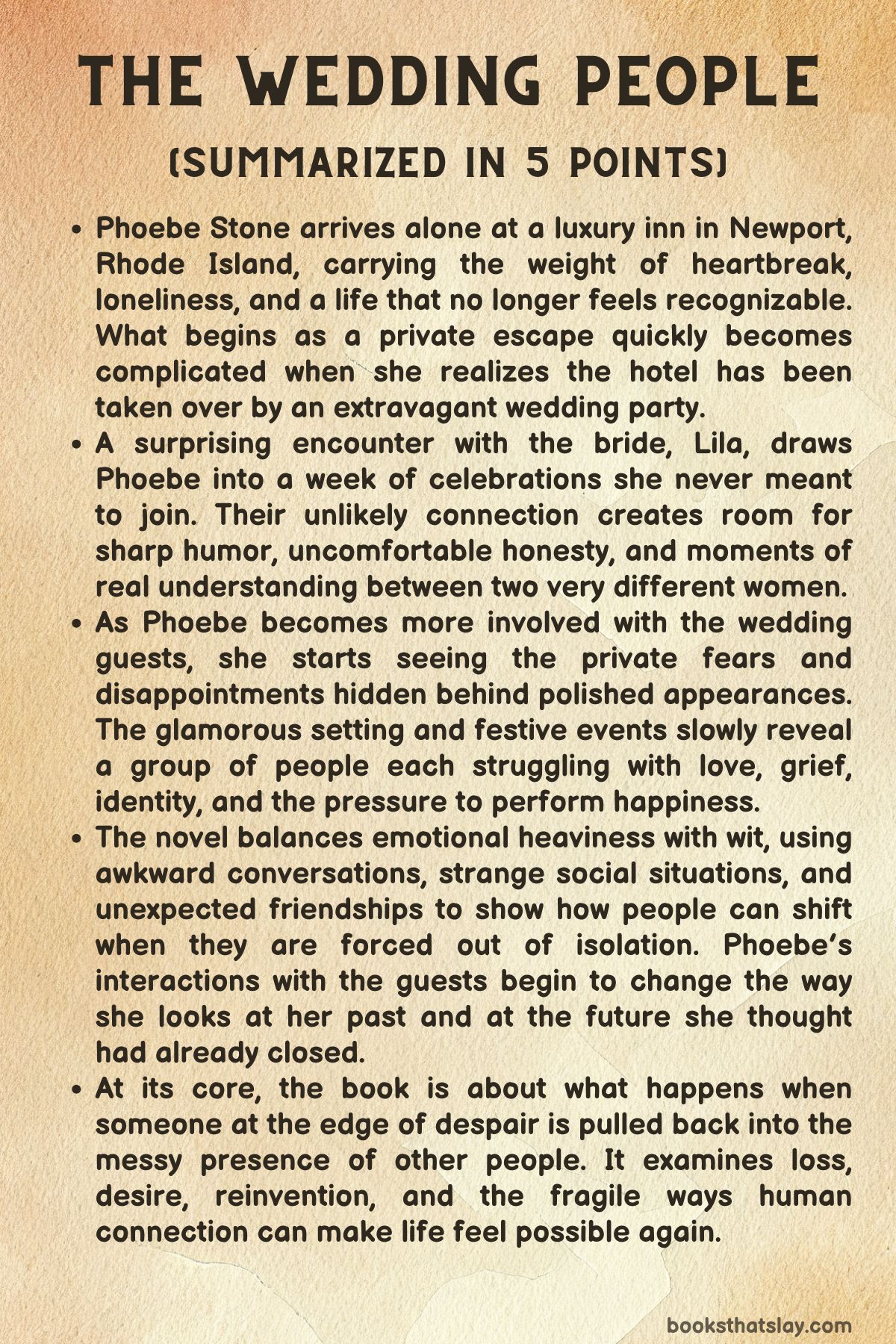
The Wedding People by Alison Espach is a sharp, funny, and emotionally alert novel about a woman who arrives at a luxury hotel carrying more pain than luggage and ends up pulled into a stranger’s wedding week. At its center is Phoebe Stone, a literature professor whose marriage, career confidence, and hopes for motherhood have all come apart.
What begins as a private escape turns into an unexpected collision with a loud, demanding bride and a whole cast of complicated people. The novel balances sadness with wit, showing how chance encounters, uncomfortable honesty, and human mess can open a path back toward life.
Summary
Phoebe Stone arrives alone at the Cornwall Inn in Newport, Rhode Island, after leaving her life in St. Louis behind with almost no planning. She is emotionally wrecked after a divorce from her husband, Matt, and after years marked by infertility treatment, pregnancy loss, professional disappointment, and loneliness.
The hotel is filled with guests gathered for the wedding of Lila Rossi-Winthrop and Gary, and Phoebe quickly realizes she is the only person there who is not connected to the celebration.
At check-in, Lila mistakes Phoebe for one of her guests and welcomes her warmly, giving her a wedding gift basket and a hug. That brief kindness affects Phoebe more than she expects.
Soon after, Lila discovers that Phoebe is not part of the wedding at all, and Phoebe bluntly admits that she came to the inn planning to end her life. Lila, shocked and offended, argues that Phoebe cannot possibly do such a thing during her wedding week.
Their first exchange is absurd, tense, and strangely revealing, setting the tone for the connection that grows between them.
Phoebe’s despair has deep roots. In the years before this trip, she and Matt struggled through failed fertility treatments and a miscarriage.
She felt stuck in an adjunct position at the university while Matt advanced in his career with greater ease and recognition. Their marriage, once full of intimacy and intellectual companionship, thinned out under grief, resentment, and silence.
During the pandemic, their isolation exposed everything that was already broken. Matt eventually left Phoebe and confessed that he was in love with Mia, a colleague and former friend of Phoebe’s.
After that, Phoebe drifted through work and home life in a numb haze. The final blow came when her cat, Harry, died, and in that state of exhaustion and grief, she decided to go to the Cornwall Inn and die there.
Her first night at the hotel goes badly even in practical terms. The ocean does not give her the feeling she expected.
Room service is unavailable. Her cigarette makes her cough.
Even the mechanics of her planned death refuse to become graceful or meaningful. Meanwhile, Lila keeps reappearing, first to demand that Phoebe postpone her death, then to talk, complain, gossip, and unload her own anxieties.
Lila is beautiful, dramatic, controlling, and exhausting, but she is also honest in ways Phoebe has not encountered in a long time. The two women end up talking on Phoebe’s balcony while spying on the wedding guests, and their conversation moves from petty observations to art, family, death, and disappointment.
For the first time in ages, Phoebe laughs hard and feels a spark of connection.
Later that night, Phoebe makes another suicide attempt by swallowing Harry’s pain pills, but Patricia, Lila’s mother, begins giving an embarrassing speech downstairs, and Phoebe delays long enough to hear how it ends. That interruption, silly and humiliating as it is, pushes her to save herself.
She forces herself to vomit and survives. From there, the novel shifts.
Phoebe is not suddenly healed, but she starts moving through the next day one choice at a time.
In the middle of the night, unable to sleep, Phoebe goes to the hot tub and meets a flirtatious stranger. She speaks with unusual candor, telling him about her pain and her recent desire to die.
He responds without panic or pity. Their conversation is playful, intimate, and surprisingly comforting.
Phoebe, feeling alive in a way she has not in years, invites him upstairs, only to learn that he is not available. The encounter still matters.
It restores her sense that she is a person with a body, a mind, and a future not yet fully closed off.
The next morning she learns that the man is Gary, the groom. This discovery comes during a sailing outing with the wedding party, where Phoebe, now drawn into Lila’s orbit, is introduced as a friend.
She meets Gary’s daughter, Mel, known as Juice, a sharp and wounded child still grieving her late mother, Wendy. Phoebe connects with Juice almost immediately.
When Juice’s virtual pet dies, Phoebe helps her hold a small funeral on the boat. The moment becomes unexpectedly moving, bringing Phoebe face to face with her grief over Harry, her lost marriage, and the child she never had.
As the wedding events continue, Phoebe becomes more deeply entangled with everyone around her. She observes the tensions between Lila and Gary, the quiet hostility from Gary’s sister Marla, the unease in Patricia, and the odd closeness between Gary and his best man Jim.
Lila, despite all her controlling habits and surface polish, starts confiding in Phoebe. She admits that she often feels fake in her own life and that she cannot be fully honest with the people closest to her.
In a burst of impulse and need, she asks Phoebe to be her maid of honor. Phoebe accepts, partly because the role gives her something to do and partly because being needed feels good.
Phoebe spends time with Juice in town, shopping for wedding things and clothes. Their day together deepens Phoebe’s understanding of Juice’s resentment toward Lila.
Juice misses Wendy and feels that nobody wants to talk about her. Phoebe listens instead of correcting, and that simple act becomes a kind of care both she and Juice need.
The day ends with Phoebe half-jokingly agreeing to adopt a dog Juice likes at a shelter, another sign that Phoebe’s relationship to the future is quietly shifting.
At the bachelorette party, Lila’s nerves begin to crack open. The festivities are both ridiculous and revealing: spa treatments, a sex lecture, dinner, drinks, tarot cards, and dancing.
Beneath the expensive fun, Lila’s uncertainty becomes harder to ignore. Late that night she drunkenly tells Phoebe that she is strongly attracted to Jim and does not want to marry Gary.
Phoebe tries to stop her from making a reckless middle-of-the-night decision, but the confession changes everything.
Soon after, Gary also opens up to Phoebe. He admits that he may have rushed into this marriage because he was still lost in grief after Wendy’s death.
He wanted happiness to return, and he thought Lila might carry him toward it. His conversations with Phoebe become increasingly charged, not just with attraction but with recognition.
With Phoebe he is more candid than he is with anyone else. Phoebe feels herself drawn toward him too, and that frightens her because it suggests she is still capable of wanting a life.
By the rehearsal dinner, the wedding week is vibrating with suppressed truths. Jim gives a speech that accidentally reveals how deeply he once cared for Lila.
Juice drinks too much wine and becomes sick. Phoebe takes care of her with tenderness and calm, thinking that she would have been a good mother.
Then Matt suddenly appears at the inn, having tracked Phoebe down. He claims he has realized he made a terrible mistake, that his life with Mia is wrong, and that he wants Phoebe back.
He talks about starting over and even about adopting children together. Phoebe sees his selfishness more clearly than before, but she is still vulnerable to the familiarity of him.
They end up sleeping together, a choice that leaves Phoebe unsettled rather than comforted.
The next day, on the morning of the wedding, the final collapse arrives. Lila is already fraying when a replacement car fails to meet her standards.
Underneath the complaint is the real truth: she does not love Gary in the way she wants to, and she knows Gary does not love her in that way either. She finally says it aloud and calls off the wedding.
Phoebe steps into action, helping Lila retreat, arranging practical details, and then going to the ceremony site to tell the guests.
After the cancellation, Phoebe makes her own decision clear. She tells Matt she is not returning to her old life with him.
She plans to stay in Newport, take leave from work, sell her house, and accept a job as winter keeper at a mansion. She wants space to write and to live differently.
This is not a grand triumphant ending but a choice made with fresh clarity. She is no longer willing to live trapped in the same patterns.
In the final stretch, Phoebe spends time with Gary, Juice, and Marla after the non-wedding. Gary admits that Lila did the brave thing by ending it, and he recognizes that what he had with Wendy was not something he could replace by simply attaching himself to another life.
Phoebe shares her own plans for the future. She is scared, but now the fear comes with energy instead of emptiness.
When she leaves the Cornwall Inn, Phoebe is still uncertain, still grieving, and still carrying many unfinished feelings. But she is alive, attentive, and willing to choose what comes next.
That change is the real resolution of the novel. It is not about a perfect romance or a neat recovery.
It is about a woman stepping out of the life that nearly closed around her and walking toward one she has finally chosen for herself.
Characters
Phoebe Stone
Phoebe is the emotional center of the novel and the character through whom its darkest and most hopeful ideas are tested. At the beginning, she is living in the aftermath of multiple losses that have hollowed out her sense of self: her marriage has ended, her hopes for motherhood have been damaged by infertility and pregnancy loss, her career feels stalled, and her daily life has become lonely and shapeless.
What makes her especially compelling is that her pain is not presented as simple sadness. It is mixed with anger, dry humor, intellectual sharpness, self-consciousness, jealousy, and a long habit of turning disappointment inward.
She has spent years explaining herself through failure, measuring herself against other women, and assuming that if her life has narrowed, she must be the cause. Her instinct is to interpret events through literature, memory, and private irony, which gives her perspective but also keeps her at a distance from direct feeling.
Phoebe’s great movement as a character is from emotional paralysis toward choice. She arrives at the hotel intending to end her life, and the narrative does not treat that desire lightly, but it also shows how unstable that wish becomes once she is forced back into the presence of other people.
Again and again, she is interrupted by the needs, absurdities, and confessions of those around her. These interruptions matter because they reattach her to the ordinary world.
Phoebe begins the story believing that her life is already over in every way that counts. By the end, she has not solved her grief, but she has recovered a capacity for curiosity, attraction, laughter, care, and decision.
That shift is crucial. She does not become a different person; she becomes more fully herself, except now without the deadening commitment to self-erasure.
One of Phoebe’s most interesting traits is the contrast between how passive she has been in her own life and how capable she is when responding to others. She is perceptive, witty, practical, and often very good in moments of emotional crisis.
She notices what other people fail to notice, whether that means a social slight, an uncomfortable truth, or a hidden longing. This makes her a natural interpreter of the wedding people around her.
It also highlights the tragedy of her earlier life: much of her intelligence and sensitivity has gone unused on her own behalf. As she becomes involved with Lila, Gary, and Juice, Phoebe starts exercising those abilities in ways that revive her.
She comforts, mediates, observes, protects, jokes, and improvises. In doing so, she rediscovers not just competence but desire.
Her final decisions come from this rediscovered aliveness.
Phoebe also embodies one of the novel’s strongest ideas: that despair can shrink a life until a person mistakes that shrunken space for reality. She has been living inside a narrative of abandonment and inadequacy for so long that she no longer imagines other futures.
Her time at the inn does not erase what happened to her, nor does it turn suffering into something noble. Instead, it allows her to see that one terrible story about herself is not the only story available.
That is why her ending feels earned. She does not leave with certainty.
She leaves with agency.
Lila Rossi-Winthrop
In The Wedding People, Lila first appears as the kind of woman Phoebe is prepared to dislike on sight: beautiful, rich, highly managed, socially fluent, and deeply invested in the perfection of her wedding. At first, she seems almost comically self-centered, especially when she responds to Phoebe’s suicidal confession by insisting that such an act would be unacceptable during her wedding week.
Yet one of the novel’s major achievements is that it never leaves Lila in the role of a shallow foil. Beneath her controlling behavior is a frightened, pressured, emotionally overextended woman trying to stage a life that feels more certain than the one she is actually living.
Lila is obsessed with details because details are where she feels power. Her father’s death, the money he left, the delayed wedding, the expectations attached to this event, and her own need to make meaning out of loss have all fused into one giant performance.
She is not merely planning a celebration; she is trying to justify grief, loyalty, class position, and family history through flawless execution. That makes her exhausting, but it also makes her sympathetic.
She is carrying far more than flowers, schedules, and seating plans. She is trying to prove that love, money, memory, and sacrifice can be converted into a beautiful and coherent public event.
The problem is that her feelings do not fit the script.
What gives Lila depth is the gap between her confidence and her confusion. She talks constantly, directs everyone, and has strong opinions about everything from hotel rooms to speech timing, yet she is one of the least settled people in the story.
She struggles to be honest with her friends, her mother, her fiancé, and even herself. Her attraction to Jim, her dissatisfaction with her job, her fear of death, her complicated feelings about her parents, and her uncertainty about Gary all exist beneath the polished surface she presents.
Phoebe becomes important to her because Phoebe is outside the established social order of the wedding and therefore able to receive the truths Lila cannot say elsewhere. Lila’s request that Phoebe become maid of honor is impulsive, but it also reveals a real hunger for emotional recognition.
Lila’s cancellation of the wedding is the clearest sign of her moral growth. For much of the novel, she appears committed to appearance above all else.
When she finally refuses the marriage, she acts against the enormous force of money, logistics, embarrassment, family pressure, and public spectacle. That decision shows that beneath her vanity and theatricality, she does possess courage.
She has spent days trying to force reality into a beautiful shape. In the end, she chooses honesty over display.
This does not suddenly make her easy, warm, or selfless, but it makes her real. She becomes a character whose flaws are inseparable from her vitality.
Gary
In The Wedding People, Gary initially seems composed, considerate, and perhaps a little passive, especially when placed next to Lila’s intensity. He is older, widowed, and burdened by grief that has not fully settled into the past.
His first major function in the story is surprise: the flirtatious stranger from the hot tub turns out to be the groom. That reveal changes the emotional atmosphere because it immediately complicates Phoebe’s place in the wedding and introduces a connection based not on social obligation but on accidental honesty.
With Gary, Phoebe can speak in a way she cannot with most people, and the same is true for him.
Gary’s defining feature is that he is a man who has not recovered from losing Wendy. His engagement is not built on settled readiness but on a kind of exhausted longing for structure, companionship, and forward motion.
He seems to have drifted toward Lila partly because she is active where he is passive. She organizes, decides, arranges, and propels.
For a man worn down by grief and responsibility, that can feel like rescue. Yet the novel makes clear that dependence is not the same as love.
Gary appreciates what Lila does for him, but his bond with her lacks the depth and spontaneity that marked his marriage to Wendy. He wants peace, not necessarily partnership, and he confuses those desires until the wedding begins to collapse.
Gary is also marked by gentleness. He is attentive to Juice, patient under stress, and often embarrassed by the more aggressive or absurd energies around him.
That softness makes him attractive to Phoebe, but the novel does not idealize him. He has allowed events to carry him rather than speaking hard truths early enough.
He has accepted a future with Lila without honestly facing what he does and does not feel. In that sense, he is another version of someone living passively inside a life that has already stopped fitting.
His attraction to Phoebe matters because she gives him a glimpse of a more alert and truthful self. Around her, he becomes more openly reflective and less rehearsed.
Gary’s best quality is his capacity for tenderness without performance. His care for Juice, his memories of Wendy, and his conversations with Phoebe all show a man who feels deeply even when he does not know how to act decisively.
By the end, he understands that Lila’s cancellation of the wedding is an act of liberation for both of them. He recognizes that he was prepared to let himself be carried through life rather than actively choosing it.
That realization aligns him with Phoebe. Both characters emerge from the week with pain still intact, but with a renewed relationship to truth.
Matt Stone
In The Wedding People, Matt is one of the novel’s most painful portraits because he is not a monster. He is selfish, evasive, and deeply disappointing, but he is also recognizably human in ways that make the damage he causes feel more believable.
In Phoebe’s memories, he begins as a companion in graduate school, someone intellectually compatible and emotionally reassuring. Their early relationship has the closeness of shared ambition and mutual recognition.
This history matters because it prevents him from becoming a flat villain. Phoebe did not marry foolishly.
She married someone who once genuinely fit her life.
What changes is not only that Matt falls in love with someone else, but that he gradually stops fully seeing Phoebe while continuing to occupy the center of her emotional world. His professional success advances while hers stagnates.
His desires become easier for him to acknowledge than hers. Even before the affair, there is a widening gap in how each of them experiences the marriage.
Phoebe is carrying grief, bodily disappointment, sexual frustration, and professional insecurity, while Matt seems to move through these shared circumstances with less visible internal cost. That imbalance is part of what makes his eventual betrayal so devastating.
He is not simply leaving; he is leaving from a position of relative freedom while Phoebe is already weakened.
Matt’s late arrival at the hotel reveals another key part of his character: he often acts most forcefully when his own emotional needs become undeniable. He tracks Phoebe down, declares that he wants her back, and speaks as if his realization should transform the meaning of everything that happened before.
He frames his return as passionate clarity, but Phoebe sees the narcissism in it. He did not come when she was quietly suffering nearby.
He came when he could no longer bear his own regret. This does not mean he feels nothing genuine.
It means his sincerity is inseparable from self-interest.
As a character, Matt represents the seduction of the familiar and the danger of confusing memory with possibility. When Phoebe sleeps with him again, the moment is not romantic restoration but emotional disorientation.
She is confronting the fact that intimacy with someone known so deeply can still be empty of trust, future, or self-respect. His function in the novel is not only to explain Phoebe’s past hurt but to test whether she will return to the old story.
When she refuses him in the end, she is refusing not just Matt as a person but the version of herself that would let someone else’s late regret define her future.
Juice
Juice is one of the clearest emotional truth-tellers in the The Wedding People. As a child grieving her mother while being pulled into a new family arrangement she did not choose, she speaks and reacts with a directness the adults often lack.
Her behavior can seem difficult, rude, or resistant, but the novel makes clear that much of her sharpness comes from pain, displacement, and the fear that Wendy is being erased. She does not trust Lila, resents the wedding machinery around her, and feels that her father is no longer fully accessible to her.
In this sense, Juice is not merely a child character adding charm or disorder. She is the living reminder of unresolved grief at the center of Gary’s life.
What makes Juice so effective in the story is her refusal to pretend. Adults around her smooth over tension, redirect awkwardness, and avoid uncomfortable subjects.
Juice does the opposite. She says when she dislikes someone.
She complains when something feels false. She continues to care about the dead in ways that disrupt the happy forward motion of the wedding.
Her attachment to Wendy is still active, not politely memorialized, and Phoebe is one of the few adults willing to meet her there. Their connection grows because Phoebe does not patronize her.
She jokes with her, answers her questions seriously, and gives emotional legitimacy to the things the adults would rather manage away.
Juice also becomes deeply important to Phoebe’s self-understanding. Through caring for her, Phoebe is forced into contact with the maternal self she never got to express in the way she imagined.
This is not a simple substitute for the child she did not have, nor does the novel sentimentalize it. Instead, Juice allows Phoebe to experience her own capacity for steady care, patience, and protectiveness.
When Phoebe tends to Juice after the rehearsal dinner, the scene carries enormous emotional weight because it allows Phoebe to feel, not abstractly but physically, that she would have been good at mothering. That realization does not erase her grief, but it changes its shape.
Juice is also a measure of the adults around her. How they respond to her reveals their character.
Gary loves her but sometimes fails to grasp the full pressure she is under. Lila often seems irritated or defensive.
Marla alternates between family loyalty and avoidance. Phoebe, by contrast, listens.
Through Juice, the novel explores how children absorb emotional weather long before adults admit that a storm is happening.
Jim
Jim begins as a somewhat comic presence, the best man whom Lila suspects may cause trouble, but he gradually emerges as one of the story’s more revealing figures. He is informal where others are formal, impulsive where others are rehearsed, and often more emotionally transparent than the people around him.
There is something slightly chaotic about him, and yet his chaos is often a way of cutting through pretense. He does not fit neatly into the ceremony and decorum of the wedding, which is part of why he becomes important as the week progresses.
His confession that he had feelings for Lila before Gary did adds an entirely new dimension to his role. Jim is not just comic relief or background family color; he is someone living with his own version of missed timing and emotional displacement.
He believes that, in some ways, he and Lila might have been a more natural match. Whether or not that is fully true matters less than the sincerity of his belief.
It means he has been standing near a life he might have wanted, watching someone else step into it. This gives his interactions with both Gary and Lila a quiet ache beneath the banter.
Jim’s connection with Phoebe works because both of them are somewhat outside the central social arrangement, even while standing close to it. They are not the bride and groom, not the official emotional center, and not fully committed to the performances everyone else is upholding.
They can therefore speak with a freedom that others cannot. Jim’s time with Phoebe, including their conversations about Gary and Lila, helps crystallize what is wrong with the coming marriage.
He sees that Gary becomes more himself around Phoebe. He also senses the emotional mismatch at the heart of the wedding long before anyone says it publicly.
At the same time, Jim is not portrayed as a perfect truth teller. He can be tactless, immature, and driven by his own resentments.
His rehearsal dinner speech is emotionally honest but socially explosive. That combination makes him useful in the novel.
He is one of the characters least able to keep the lid on things, which means he becomes an instrument through which buried truths rise to the surface. His final connection with Phoebe suggests the possibility of continued friendship, but more importantly, he stands as another example of a person whose emotional life never fit the neat script everyone else was trying to preserve.
Patricia
Patricia is one of the novel’s most complicated older women, a mother whose glamour, unhappiness, vanity, and longing make her far more than a source of parental pressure. At first, she appears as an embarrassment to Lila: dramatic, inappropriate, liable to speak when not asked and turn private feeling into public performance.
But once she begins talking with Phoebe, Patricia becomes a figure through whom the novel explores aging, female selfhood, desire, and the cost of having one’s individuality constantly judged by family.
Her marriage to Henry has shaped her, but not in ways that settle her completely. She carries wealth, history, and social polish, yet she is still full of restlessness.
Her story in The Wedding People about commissioning a nude portrait late in life is especially important because it reveals the way she thinks about beauty and time. Patricia understands, painfully, that women are trained to experience their own bodies as belated objects of regret.
She looks back and realizes she wasted years failing to value what she had, and she refuses to surrender the right to self-expression simply because others might see it as ridiculous, disloyal, or excessive. This makes her a strong thematic counterpart to Phoebe, who is also learning to see her own life as still inhabitable rather than already spoiled.
Patricia’s conflict with Lila is rooted in more than ordinary mother-daughter friction. Lila sees her as embarrassing and unstable, while Patricia sees Lila as controlling and unforgiving.
Each woman judges the other for failing to perform femininity in the right way. Their tension reveals how mothers and daughters can become mirrors that reflect not comfort but accusation.
Patricia is worried that Lila is making mistakes like her own, yet she is also defensive about the life she has actually lived. Her warnings are mixed with projection, loneliness, and unresolved self-justification.
For Phoebe, Patricia offers an unexpected model of survival. She is messy, self-involved, often absurd, but she is not erased.
She still wants, still complains, still remembers, still demands room for herself. In a novel full of women struggling against the stories assigned to them, Patricia represents a later-life version of that struggle, one in which dignity and ridiculousness are inseparable.
Marla
In The Wedding People, Marla serves as one of the novel’s sharpest examples of social abrasion masking deeper dissatisfaction. She is blunt, critical, and often hostile, especially toward Lila.
At first glance, she appears to be the unpleasant in-law figure who takes pleasure in puncturing other people’s moods. Yet as with so many characters here, her harshness covers emotional complication.
She is entangled in her own marriage, carrying on an affair, exchanging explicit messages, and navigating the strange split between desire, boredom, guilt, and performance. Her skepticism toward the wedding is not just cruelty.
It comes from being someone who understands, firsthand, how unstable marriages can be beneath their respectable surfaces.
Marla’s relationship with Gary reveals another side of her. As his sister, she is protective in a way that often comes out sideways.
Her criticisms of Lila are partly grounded in the sense that the marriage is not right for him, even if she lacks the grace to say so usefully. She sees through the performative aspect of the couple’s dynamic and resists the effort to coat everything in wedding gloss.
That does not make her pleasant, but it does make her perceptive.
Her conversations with Phoebe are especially important because they broaden the novel’s understanding of infidelity. Through Marla, Phoebe is forced to consider cheating not just as an abstract evil committed by men like Matt, but as something that can emerge from complex emotional and bodily dissatisfactions within marriage.
This does not excuse betrayal, but it complicates Phoebe’s view of what happened to her. Marla becomes one of the channels through which the novel refuses easy moral simplification.
Marla also helps maintain the book’s refusal to divide women into likable and unlikable camps. She is often difficult, sometimes selfish, and socially unpleasant, yet she is also intelligent, observant, and trapped in her own forms of unhappiness.
Like many of the wedding guests, she is performing stability while privately living something else.
Pauline
In The Wedding People, Pauline might seem secondary because she is not part of the family drama, but she quietly plays an important structural and emotional role. As the relatively new hotel employee trying to manage understaffing and high-maintenance guests, she stands slightly outside the wedding’s emotional storms.
Her presence brings a note of grounded competence and ordinary kindness. She is young, recent out of college, and excited about her new professional role, which creates an interesting contrast with Phoebe, who feels worn down and professionally diminished.
Pauline represents a stage of life still organized by possibility.
What matters most about Pauline is that she treats Phoebe with respect without demanding a performance from her. Their interactions are not dramatic, but they are humane.
She is polite, attentive, and responsive without becoming intrusive. In a novel where many characters are absorbed in their own emotional crises, Pauline’s steadiness helps create an atmosphere in which Phoebe can remain tethered to the practical world.
Even small gestures, such as checking on her or helping with arrangements, matter because they reinforce the idea that care does not always arrive in grand declarations. Sometimes it is simply competent presence.
Pauline also contributes to the hotel’s symbolic role. The inn is a place where lives temporarily overlap, and Pauline is one of the people who keeps that temporary world functioning.
She is part witness, part facilitator, and part reminder that while the wedding feels all-consuming to its guests, it is still one event among many passing through a larger world. That perspective helps prevent the story from becoming emotionally claustrophobic.
Wendy
Although Wendy is dead before the present action begins, her presence is felt throughout the novel, especially through Gary and Juice. She represents not only a lost wife and mother but also a standard of love, family life, and artistic openness against which the present is measured.
Wendy is remembered as someone who helped Gary see beauty in ordinary life, which is a significant detail because it suggests that their marriage was not simply loving but expansive. She altered his way of being in the world.
That is why Gary’s grief remains so active. He has not merely lost a partner; he has lost a mode of living.
For Juice, Wendy is still immediate and emotionally necessary. The adults may wish to handle memory in a controlled way, but Juice’s attachment keeps Wendy from becoming a decorative absence.
Her continued importance in The Wedding People, exposes the emotional incompleteness of Gary’s attempt to build a new future before fully integrating the old one. Wendy’s memory is not the obstacle to moving on; rather, the failure to honor that memory honestly becomes the obstacle.
Wendy also functions as an unseen contrast to Lila. Where Lila organizes, directs, and manages, Wendy seems to have inspired receptivity and perception.
This contrast is not designed to diminish Lila into mere inadequacy, but it does explain why Gary’s relationship with her cannot simply replace what he had before. Wendy’s lingering presence forces the novel to acknowledge that some loves shape the self so deeply that later relationships must reckon with them rather than try to overwrite them.
Henry Rossi-Winthrop
Henry is another absent but powerful figure. His death hangs over the wedding because the event has been shaped partly as an answer to his final wishes and to the money he left behind.
He is central to Lila’s pressure, Patricia’s grief, and even Gary’s guilt, since Gary was his doctor and could not save him. In this way, Henry is not just a beloved dead father.
He is part of the emotional architecture of the entire week.
What makes Henry interesting is that his legacy is double-edged. His financial gift enables grandeur, but it also becomes a burden.
Lila feels obligated to justify his faith in her by creating something exquisite. His deathbed role in the family story turns the wedding into a monument as much as a celebration.
This distorts the event because it becomes difficult for anyone, especially Lila, to separate genuine desire from inherited expectation.
Henry’s late confession that he did not even like modern art also matters because it undercuts the image of perfect shared values that his family may have built around him. Even in memory, he contains hidden contradictions.
That detail supports one of the novel’s broader themes: people are often much less coherent than the stories told about them, especially after they die. Henry remains deeply loved, but he is not idealized into simplicity.
Mia
In The Wedding People, Mia is not physically central to the wedding plot, yet she is essential to understanding Phoebe’s wounds. As a colleague, friend, mother, and later Matt’s partner, she embodies several things Phoebe feels she has lost or never attained.
She is professionally further along, socially at ease, and able to move within the domestic sphere that Phoebe once wanted for herself. This makes Mia a potent object of jealousy long before the affair becomes explicit.
What matters about Mia is that she is not constructed purely as a rival. Phoebe’s resentment toward her includes real injury, but it is also tangled up with broader feelings about motherhood, career advancement, and female comparison.
Mia becomes the face of a life Phoebe thinks she has been denied. When Mia insists that the marriage had already ended before the affair began, the statement is cruelly clarifying.
It does not excuse what happened, but it forces Phoebe to face the fact that the collapse was not caused by one stolen moment alone.
Mia’s role in the story is therefore diagnostic. Through her, the novel examines how women can become symbols in each other’s private narratives, carrying meanings larger than their actual selves.
Phoebe’s eventual movement forward requires loosening the hold of that symbolic rivalry.
Harry
Harry, Phoebe’s cat, might seem too minor to count among the major characters, but his significance is considerable. He is one of the last living links to Phoebe’s old domestic life with Matt, and his death becomes one of the final events that pushes her toward the trip.
Because animals witness private life without judgment, Harry comes to represent continuity through years of marriage, hope, disappointment, and decline. Phoebe thinks of all he has seen, and in doing so she acknowledges the full span of her own suffering.
Harry also matters because grief for him is not socially grand enough to attract much public recognition, which mirrors Phoebe’s broader experience of invisible pain. His death is devastating not only because she loved him, but because it leaves her even more alone inside a life that has already shed so much.
Later, when she helps Juice mourn a virtual pet and privately thinks of Harry, that emotional connection becomes a small ritual of honoring losses that others might dismiss. In that sense, Harry is part of the novel’s insistence that grief is cumulative and that even seemingly small attachments can hold a life together.
Carlson and Ryun
Carlson and Ryun are smaller figures, but each helps reinforce the social and emotional environment of the hotel. Carlson, the butler, moves through the wedding world as part of the machinery making it all possible, and his presence underscores how carefully managed the setting is meant to feel.
Ryun, the hotel employee who flirts with Lila, contributes to the sense that attraction, performance, and possibility are always circulating just beneath the official structure of the wedding. Neither character is deeply developed, but both add texture to the atmosphere in which so many emotional boundaries begin to blur.
Themes
Grief as a Condition That Rearranges Everyday Life
Grief in The Wedding People is not treated as a single dramatic event with a clear beginning and end. It is shown as a condition that quietly changes how a person moves through ordinary life, how they see themselves, and how they imagine the future.
Phoebe’s losses are multiple and layered: the end of her marriage, infertility, pregnancy loss, professional disappointment, the death of her cat, and the long isolating aftermath of the pandemic. What matters is not only that these things happened, but that together they have narrowed her world so severely that she arrives at the hotel believing there is no real life left for her.
Her grief is not loud all the time. Often it appears as numbness, irritation, exhaustion, self-criticism, and the inability to imagine that anything new could still happen.
That is one of the novel’s most perceptive ideas: deep sorrow often works by shrinking possibility before a person even notices it has done so.
The same theme appears in Gary and Juice through the continuing absence of Wendy. Gary has not fully rebuilt his emotional life after losing his wife.
Instead, he has drifted toward a relationship that offers structure and momentum rather than real renewal. Juice, meanwhile, is still actively mourning her mother in a way the adults around her find inconvenient.
She does not want Wendy reduced to a respectful silence. Through these characters, the novel shows that grief remains present when it has not been given room to be spoken honestly.
It survives in awkwardness, displacement, defensiveness, and failed attempts to move on too quickly.
What makes this theme especially strong is the refusal to turn grief into something noble or uplifting by itself. Suffering does not automatically make the characters wise.
It can make them selfish, passive, brittle, and hard to reach. Lila’s wedding plans are also shaped by grief, particularly her father’s death and the pressure of his final gift.
She tries to transform mourning into spectacle, hoping perfection will produce emotional meaning. Instead, the strain becomes unbearable.
Across these lives, the novel argues that grief cannot be solved by silence, logistics, romance, or performance. It has to be acknowledged as part of reality.
Only once the characters begin doing that do they become capable of making clearer choices. Grief remains, but it stops ruling them through disguise.
The Gap Between Performance and Truth
Much of the novel’s tension comes from the distance between the polished version of life that characters present and the messier truth they are privately living. The wedding is the clearest expression of this theme because weddings are public events built around confidence, beauty, and emotional certainty.
The entire setting pushes people toward display. Clothes, speeches, schedules, photographs, curated experiences, and carefully managed rituals all suggest that love can be made visible through successful organization.
Yet nearly every important character is failing to match the role they are meant to perform. Lila is supposed to be a glowing bride, but beneath the precision and glamour she is anxious, angry, doubtful, and attracted to someone else.
Gary is supposed to be the ready groom, but he is still living in the shadow of his first marriage and moving forward more from passivity than conviction. Even Phoebe, who begins outside the official celebration, is pulled into performing as a friend, a maid of honor, and eventually a spokesperson for other people’s emotional emergencies.
The novel is especially good at showing how performance is not always insincere in a simple way. The characters are not merely lying.
Often they are trying to live up to versions of themselves that once seemed plausible. Lila wants to be the kind of woman who can carry off this wedding and make it mean something.
Gary wants to be the kind of man who can start again and offer stability. Matt wants to cast himself as the man who has finally realized the truth of his feelings.
These performances have emotional content, but they are still performances because they depend on leaving too much unsaid. The problem is not image alone.
The problem is the strain created when image becomes more protected than truth.
Phoebe’s role in the story is crucial because she becomes an accidental disruptor of these polished surfaces. Her emotional openness, even when alarming, changes the social field around her.
People tell her things they are not saying to the people closest to them. That pattern reveals a deep hunger within the novel’s world.
Many of these characters are trapped not because they lack feeling, but because they lack settings in which feeling can be spoken without immediately being converted into a role. The collapse of the wedding is therefore not simply a disaster.
It is the inevitable end point of a structure that has become more committed to appearance than to honesty. Once the public version fails, more truthful lives become possible.
The novel suggests that false order may look impressive, but it is emotionally fragile. Truth is messier, but it can actually be lived.
Female Identity Beyond Marriage, Motherhood, and Approval
One of the novel’s strongest concerns is the question of how women build a sense of self when the roles they expected to occupy either fail, disappear, or begin to feel false. Phoebe’s story gives this theme its sharpest edge.
She has long measured herself against familiar standards: a successful marriage, motherhood, professional recognition, and the ability to appear composed in the lives of others. When those things collapse or remain unattained, she does not merely feel sad.
She begins to feel illegible to herself. Her crisis is not only that she has lost Matt or failed to have a child.
It is that the version of adulthood she had counted on no longer explains who she is. The novel takes that problem seriously.
It shows how easily women are trained to see their worth through care roles, relational stability, bodily outcomes, and public adequacy.
Lila offers a different variation of the same struggle. She appears to possess beauty, money, social confidence, and a major life event designed to confirm her desirability and success.
Yet she is profoundly uncertain beneath that surface. She dislikes her work, feels disconnected from her friends, cannot fully tell the truth in her relationship, and is constantly trying to manage herself through style, planning, and approval.
Her wedding becomes a project in self-definition, but it fails precisely because no event, however expensive or elaborate, can solve the question of identity on its own. Patricia adds yet another dimension.
As an older woman, she speaks to the cost of being seen mainly through marriage, age, propriety, and family judgment. Her reflections on beauty, freedom, and the right to want things for herself show that this issue does not vanish later in life.
It simply changes form.
Motherhood is handled with similar complexity. Phoebe’s grief around not becoming a mother is real and devastating, but the novel refuses to reduce womanhood to biological success.
Her connection with Juice shows another route into care, responsibility, and emotional depth. This does not replace what she lost, and the book is careful not to sentimentalize that pain away.
Instead, it allows Phoebe to recognize that her capacity to nurture, protect, and understand has not vanished simply because her life did not take the expected shape. That is a crucial distinction.
The novel is not arguing that every wound hides a substitute blessing. It is arguing that identity can survive the collapse of its original script.
By the end, female selfhood emerges not as a fixed achievement but as something reclaimed through honesty, desire, work, embodiment, and the refusal to let one failed life plan become the whole definition of a life.
Choice, Agency, and the Possibility of Beginning Again
Running through the novel is a deep concern with what it means to recover the ability to choose after a long period of drift, passivity, or emotional shutdown. Phoebe arrives at the inn believing that her future has effectively ended.
Her decision to die appears to her as the last available act of control in a life where everything meaningful has already been taken or spoiled. Yet over the course of the story, the meaning of agency changes.
It stops being tied to finality and starts becoming connected to openness. Small decisions begin to matter: staying alive for one more night, getting into the hot tub, speaking honestly to a stranger, accepting breakfast, going on an outing, taking care of Juice, writing again, imagining work in a new place.
None of these choices looks grand on its own, but together they rebuild a self capable of movement.
The novel is careful to show that lack of agency does not always look like obvious imprisonment. Sometimes it looks like accommodation.
Gary has slipped into a life where he is ready to let someone else make decisions for him, not because he is weak in a simple sense, but because grief has exhausted his appetite for active living. Lila, despite her commanding manner, is also trapped by the expectations attached to family money, appearance, and the idea of what this wedding is supposed to mean.
Matt’s return demonstrates another false version of agency: dramatic declaration without real accountability. He wants to restart the past as if wanting strongly enough should be enough.
The novel rejects that idea. Real agency requires truthful recognition of what has already happened.
This is why the ending feels meaningful. Phoebe’s final direction is uncertain, but it is hers.
She does not leave with every problem solved, and she does not secure emotional safety before making her decision. Instead, she accepts the discomfort of freedom.
She chooses Newport, time away from her old routines, a new job, and the possibility of writing again. These choices are important not because they guarantee happiness, but because they represent participation in her own life after a long period of absence.
The book repeatedly suggests that renewal rarely arrives as a dramatic revelation. More often, it appears when a person becomes willing to make imperfect decisions without total assurance.
Beginning again is frightening because it removes the shelter of old stories, even painful ones. But the novel insists that a future does not have to be fully known in order to be worth entering.
That idea gives the ending its emotional force: life becomes possible again not when certainty returns, but when choice does.