Cold Zero by Brad Thor Summary, Characters and Themes
Cold Zero by Brad Thor is a high-stakes espionage thriller built around a technological secret powerful enough to alter the balance of modern warfare.
The novel combines intelligence operations, aviation disaster, Arctic survival, cyberwarfare, and military confrontation as several nations race to control a prototype called Sky Fire. At its center are CIA officer Kasey Sheridan, Chinese scientist Dr. Chen Li, and pilot Brett Sharpe, whose lives become connected after a covert defection ends in catastrophe. What begins as an intelligence extraction develops into a struggle involving the United States, China, and Russia across one of the most dangerous environments on Earth.
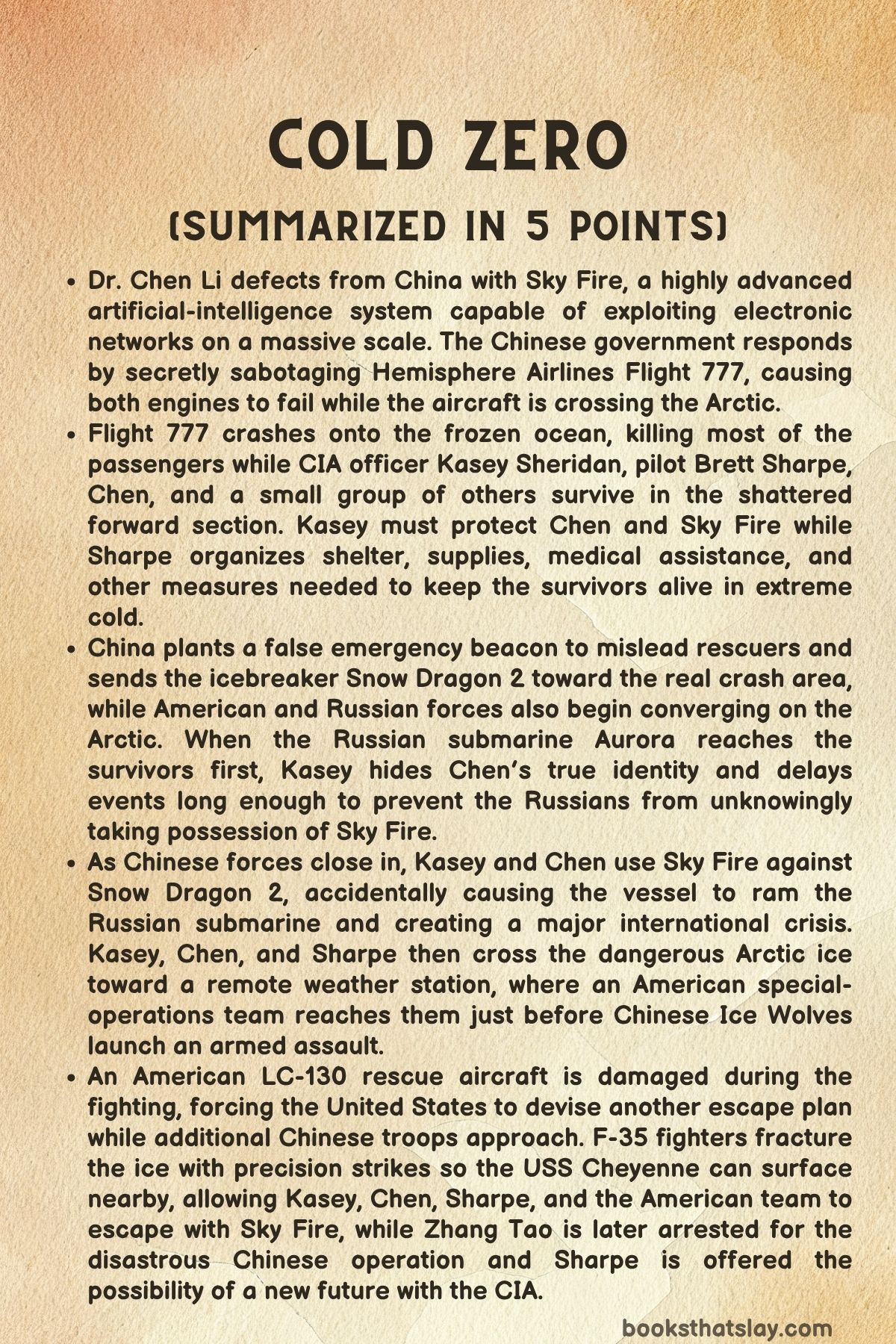
Summary
Chinese scientist Dr. Chen Li is the head of Tianhou, or Sky Fire, one of China’s most secret military programs. Determined to escape the Chinese government because of his opposition to its abuses, Chen arranges a complex defection with the CIA while carrying the only complete portable prototype of Sky Fire, an artificial-intelligence system capable of penetrating and controlling sophisticated electronic networks.
China’s Ministry of State Security attempts to capture Chen in Hong Kong, but he successfully deceives the surveillance teams assigned to him. He transfers his electronic trackers and phone signals to an autonomous taxi, allowing CIA officers Kasey Sheridan and Walter Ho to move him through Macau and onto Hemisphere Airlines Flight 777 bound for New York.
Before leaving Chinese control completely, Chen remotely destroys the design records for Sky Fire, making the prototype in his possession uniquely valuable. In Beijing, Seventh Bureau chief Zhang Tao realizes that losing Chen and the technology could destroy his career and possibly cost him his freedom or life.
The Chinese leadership refuses to permit Sky Fire to reach the United States. When shooting down a civilian aircraft is judged politically dangerous, Chen’s former deputy Wu Mei reveals that hidden malicious software embedded within the aircraft’s electronic systems can be activated remotely.
While Flight 777 crosses the Arctic, the malware sends false temperature information to the aircraft’s engine-control systems. Believing both engines are dangerously overheating, the automated systems shut off their fuel supplies, leaving Captain Bill Fowler and First Officer Brett Sharpe with a powerless airliner above a severe Arctic storm.
Attempts to restart the engines fail, while Chinese interference prevents the aircraft from sending a proper distress signal. Unable to reach land, Fowler and Sharpe decide their only chance is a belly landing on the frozen ocean.
The aircraft strikes the ice and then crashes violently into a large ridge. Its heavier rear section breaks away and sinks into the Arctic Ocean, killing most of the passengers, while the lighter forward section remains on the surface.
Kasey regains consciousness inside the shattered forward fuselage and immediately shifts into survival mode. She searches for the injured, gathers clothing and blankets, and begins protecting those who remain alive while trying to locate Chen, Walter, and the Sky Fire case.
Sharpe survives, but Fowler and relief pilot Scott Burns are dead. He discovers that the rear portion of Flight 777 has sunk beneath the ice and later confirms that only a small group survived.
Walter is among those who died, leaving Kasey alone as Chen’s CIA protector. Chen is badly injured but alive, and Kasey recovers the black case containing Sky Fire and hides it among the wreckage.
Meanwhile, China launches an elaborate deception intended to prevent American rescuers from finding the true crash site. A Chinese aircraft drops an emergency beacon more than two hundred miles away while communications interference and the loss of Flight 777’s real beacons create confusion about where the aircraft actually went down.
The CIA initially fears the entire mission has been lost. Deputy Director for Operations David Flynn begins coordinating with the Pentagon, the FAA, and intelligence partners while trying to determine whether Chen and the prototype survived.
The American submarine USS Cheyenne happens to be operating in the region with a multinational Arctic special-operations team led by former SEAL Peter Drake. Its members include American Marcus Williams and Finnish operators Raine and Juri, who are redirected toward the supposed crash location.
Russia also becomes involved when its advanced submarine Aurora, commanded by Captain Arkady Khurtin, notices unusual American and Chinese activity in the region. China simultaneously sends its icebreaker Snow Dragon 2 toward the presumed wreckage, creating a growing international contest around what initially appears to be an aviation disaster.
At the crash site, Kasey and Sharpe organize the surviving passengers and convert the remaining fuselage into a rough shelter. Their cooperation becomes strained when Sharpe discovers Kasey secretly using Sky Fire and demands to know why she has concealed sophisticated technology during a life-threatening emergency.
Kasey finally admits that she is a CIA officer and that Chen is a Chinese defector carrying technology important enough for Beijing to have deliberately destroyed the aircraft. Sharpe is furious that innocent passengers have died because of the operation, but he understands that protecting the survivors requires cooperation rather than resentment.
Chen confirms that the crash could indeed have been produced through Chinese malware. He also warns Kasey that every use of Sky Fire may reveal its approximate position to the MSS, meaning their best way to contact the United States is also capable of guiding China toward them.
The Cheyenne eventually reaches China’s planted beacon and immediately discovers that there is no aircraft wreckage nearby. American officials realize the signal was deliberately placed on the ice, exposing the deception and convincing Flynn that China is actively trying to prevent anyone else from reaching the real crash site.
Kasey succeeds in contacting Langley through Sky Fire and confirms that she and Chen survived. Before American forces can arrive, however, the Russian Aurora surfaces near the wreck and becomes the first foreign military asset to reach the survivors.
Khurtin offers assistance but refuses to place the civilians aboard his highly classified submarine. His decision unintentionally helps Kasey because it delays the removal of Chen while she waits for American rescue.
Kasey pretends to understand only limited Russian while secretly following the Russians’ conversations. She carefully hides Chen’s importance and monitors their behavior, but Russian media soon broadcasts images of the survivors, revealing to Beijing that people from Flight 777 are still alive.
Zhang and Wu discover another critical fact: whenever Sky Fire connects to a satellite, China can estimate its location. Beijing therefore knows Chen survived and sends an elite special-operations unit called the Ice Wolves toward the Arctic.
Snow Dragon 2 also begins racing toward the genuine crash location. Realizing Chinese forces will soon arrive, Kasey decides that she and Chen must abandon the relative safety of the wreck and carry Sky Fire away across the ice.
Before leaving, she orders Chen to use Sky Fire against the approaching Chinese icebreaker if necessary. Chen gains access to its computerized control systems and disrupts the ship’s engines and navigation.
The consequences are far greater than either expects. Snow Dragon 2 becomes uncontrollable and rams directly into the Russian Aurora, damaging both vessels and creating what appears to be an intentional Chinese attack against a Russian nuclear submarine.
The collision produces exactly the confusion Kasey needs. While Russian and Chinese personnel turn their attention toward one another, she and Chen escape eastward into worsening Arctic weather.
Khurtin, believing China deliberately attacked his submarine, boards Snow Dragon 2 with armed Russian sailors and effectively takes control of the damaged vessel. Neither side realizes that Chen caused the collision remotely.
Kasey and Chen now face a different threat: exposure. Chen’s injuries make walking increasingly difficult, and Sky Fire cannot remain active continuously because China can detect its satellite connections.
Langley directs them toward an unmanned Arctic weather station that could provide shelter and serve as an extraction point. Their progress is slow, and Chen appears close to physical collapse.
Sharpe eventually leaves the main group of survivors and follows them. He brings supplies and a folding stretcher, refusing to accept the possibility that Kasey and Chen could die alone on the ice.
Together they cross open water using the stretcher as a temporary bridge before using it to transport Chen. They finally discover infrastructure belonging to the weather station and take refuge inside a small utility building equipped with a heater.
Flynn meanwhile organizes a complex American rescue. Drake’s four-man team leaves the Cheyenne and travels across the ice, while an LC-130 Hercules equipped with skis flies north from Greenland to land near the weather station.
The situation worsens when American intelligence detects several Chinese military transports approaching the same area. The first carries twenty-four Ice Wolves, while larger airborne forces follow behind.
Drake’s team reaches Kasey, Chen, and Sharpe shortly before the Chinese troops arrive. Everyone begins moving toward the proposed landing zone as the LC-130 appears overhead.
The Hercules successfully lands, but the Ice Wolves attack before the Americans can board. Gunfire damages the aircraft, Sharpe is wounded in the leg, and the planned evacuation immediately collapses.
Kasey fights beside Drake’s team while helping protect Chen and the prototype. Despite being outnumbered, the Americans hold their position, but additional Chinese forces are still approaching and the damaged Hercules can no longer carry them away.
Washington hesitates to authorize direct attacks against the incoming Chinese transports because destroying them could begin an open war. Kasey proposes a different solution: American fighters can threaten the transports while attacking the Arctic ice instead of the aircraft themselves.
Commander Hansen aboard the Cheyenne develops another unconventional plan. By using explosives and the effects of precision strikes to fracture the thick pack ice, the submarine may be able to surface much closer to the stranded group.
F-35 fighters arrive and place the Chinese transports under threatening radar locks while releasing precision-guided bombs onto carefully selected sections of ice. Six explosions fracture the frozen surface and create a large opening.
The Cheyenne moves beneath the broken pack and surfaces through the newly created gap. Kasey, Chen, Sharpe, Drake, Williams, Raine, and Juri make their way toward the submarine while the wounded are helped aboard.
Kasey refuses to relax until Chen, Sky Fire, and the others are safely inside. The combined efforts of intelligence officers, pilots, submariners, special operators, and fighter crews finally place the prototype beyond China’s reach.
In Beijing, Zhang learns that Chen and Sky Fire have been recovered by the Americans. His attempt to repair the original failure has instead produced a destroyed passenger aircraft, a damaged Chinese icebreaker, confrontation with Russia, dead soldiers, and the permanent loss of China’s most advanced technology.
Wu appears to sympathize with him, but she has already positioned herself to survive the political consequences. Senior security officials arrive with evidence against Zhang, and he is arrested while Wu remains protected.
Two weeks later, Kasey meets Sharpe in Virginia. Investigations continue into the sabotage of Flight 777, while Chen works with American specialists and the survivors remain bound by national-security secrecy.
Kasey warns Sharpe that China may eventually suspect he played a larger role than that of an ordinary pilot because he disappeared from the wreck with her and Chen. She suggests that continuing his international aviation career could place him in danger.
When Sharpe asks what alternative he has, Kasey hints that the CIA may have a place for someone with his courage, judgment, aviation experience, and ability to function under extreme pressure. The Arctic disaster therefore closes one chapter of his life while opening the possibility of an entirely different future.
Characters
Kasey Sheridan
Kasey Sheridan is the central operational figure in Cold Zero, combining the instincts of an intelligence officer with the practical toughness required to survive a disaster far beyond anything anticipated in her original assignment. Her mission begins with the controlled objective of escorting Chen safely to the United States, but the crash strips away planning, support, communications, and institutional protection.
Her strongest characteristic is adaptability. Immediately after regaining consciousness, she assesses injuries, searches for survivors, protects Chen, recovers Sky Fire, and begins calculating both environmental and strategic threats while others are still trying to understand what happened.
Kasey is also morally complicated because protecting the prototype repeatedly forces her to make decisions that place other people at risk. Her authorization for Chen to interfere with Snow Dragon 2 produces a devastating collision with the Aurora, showing how quickly field decisions can acquire consequences far beyond their intended purpose.
She nevertheless accepts responsibility rather than hiding emotionally from what she has done. Her ability to continue functioning comes not from indifference but from a disciplined belief that hesitation could cause even greater loss.
Her relationship with Sharpe gradually changes her position within the story. She begins by concealing information from him because secrecy is part of her profession, yet she eventually recognizes that survival requires trust and that Sharpe has earned the truth.
Kasey also becomes the human connection between Chen’s technological importance and the ordinary lives destroyed by the operation. She understands that Sky Fire matters strategically, but she never completely loses sight of the people whose deaths and injuries give that strategy a terrible cost.
Brett Sharpe
Brett Sharpe develops from a highly capable airline pilot into one of the moral anchors of Cold Zero. His first defining challenge is professional rather than political: when Flight 777 loses both engines, he helps Fowler manage an almost impossible emergency and remembers the crash coordinates even while the aircraft is falling toward the ice.
After surviving, Sharpe instinctively accepts responsibility for the remaining passengers. He searches the wreckage, assesses the destruction, organizes shelter, gathers supplies, and becomes the natural civilian leader because his sense of duty continues long after his formal responsibilities as first officer should have ended.
His anger toward Kasey after learning the truth is one of his most important moments. Sharpe recognizes that innocent people died because a covert struggle over Chen and Sky Fire was taking place aboard his aircraft, and his reaction prevents the human consequences of the intelligence operation from being treated as an abstraction.
Yet he does not allow that anger to become selfishness. Once he understands the stakes, he helps Kasey protect Chen, delays foreign forces, supplies her escape, and eventually follows her across the ice even though doing so exposes him to enormous personal danger.
Sharpe’s decision to leave the crash survivors and pursue Kasey is especially revealing. He cannot accept remaining safe while people he feels responsible for may die, demonstrating a form of loyalty based on conscience rather than orders.
By the ending, his courage and judgment have effectively carried him beyond the boundaries of civilian aviation. Kasey’s suggestion that the CIA could use someone like him feels credible because the Arctic ordeal has already shown that he can think clearly, lead others, improvise, and remain dependable when normal systems completely fail.
Dr. Chen Li
Dr. Chen Li is both the reason for the crisis and one of the most sympathetic figures in Cold Zero. As the scientist responsible for Sky Fire, he possesses knowledge that governments regard as strategically priceless, yet his decision to defect is motivated by moral rejection of the Chinese regime rather than simple ambition.
Chen demonstrates extraordinary technical intelligence from the beginning. He anticipates electronic surveillance, manipulates autonomous systems, transfers trackers to another vehicle, destroys the remaining design records, and ensures that the portable prototype becomes the only complete version of his work.
His relationship with his own creation is uneasy. Sky Fire offers almost unlimited possibilities for manipulating electronic systems, but Chen repeatedly understands that technical success can produce consequences that no algorithm can safely predict.
That tension becomes clearest when Kasey orders him to interfere with Snow Dragon 2. Chen knows the action is dangerous, and the resulting collision proves that controlling technology does not mean controlling every outcome produced by its use.
Physically, Chen spends much of the novel in a weakened state, but this does not diminish his importance. His injuries force him to depend on Kasey and Sharpe, creating an interesting contrast between his immense technological power and his personal vulnerability on the ice.
Chen ultimately represents the double-edged nature of advanced technology. His knowledge can protect societies or destabilize them, and his defection suggests that the moral character of those controlling powerful systems may matter as much as the systems themselves.
Zhang Tao
Zhang Tao functions as the primary antagonist of Cold Zero, although his characterization is shaped as much by fear as by cruelty. He is an experienced intelligence official whose personal survival is tied to recovering Chen and Sky Fire after the defection exposes an enormous failure under his authority.
His worsening trigeminal neuralgia and dependence on medication make his situation increasingly unstable. Instead of admitting weakness or accepting responsibility, he hides his physical deterioration because he understands the political system around him will punish vulnerability rather than accommodate it.
Zhang repeatedly values state power and personal survival above human life. He accepts the destruction of a passenger aircraft, supports deception designed to delay rescue, directs armed recovery operations, and eventually orders that American resistance be eliminated without concern for prisoners.
His desperation gradually narrows his judgment. Each failed attempt to regain control leads to a more extreme response, creating a cycle in which recovering Sky Fire becomes more important than the damage caused by trying to recover it.
The tragedy of Zhang’s position is that everything he does to save himself ultimately strengthens the case for sacrificing him. By the time Chen reaches American custody, Zhang has become the most convenient person for the Chinese leadership to blame for a disaster that extends far beyond his original mistake.
His final betrayal by Wu is therefore fitting rather than surprising. Zhang has spent the story operating inside a system built on fear, secrecy, and self-preservation, and when his usefulness ends, that same system turns on him without hesitation.
David Flynn
David Flynn represents the institutional side of the CIA response, coordinating operations from Langley while Kasey handles the physical crisis on the ice. His character highlights the difference between possessing enormous strategic resources and being unable to control events occurring thousands of miles away.
Flynn responds quickly when Flight 777 disappears, drawing together intelligence, military assets, aviation resources, and senior government officials. Once the planted beacon is discovered, he correctly understands that the situation is not merely a rescue mission but a deliberate Chinese effort to recover Chen and the prototype.
His frustration grows because many of the crucial decisions cannot be made from headquarters. He can send instructions and redirect forces, but Kasey must decide how to handle the Russians, when to activate Sky Fire, whether to abandon the wreck, and how to respond when Chinese troops attack.
Flynn nevertheless proves effective because he keeps adapting the larger rescue structure to those changing realities. He brings together the Cheyenne, Drake’s team, the LC-130, and eventually F-35 support, turning scattered American assets into a coordinated recovery effort.
Wu Mei
Wu Mei is one of the most intellectually dangerous characters in the novel because she combines extraordinary technical expertise with exceptional political awareness. As Chen’s former deputy and a leading researcher connected to Sky Fire, she understands both the prototype itself and the hidden vulnerabilities embedded within other systems.
Her role in the attack on Flight 777 demonstrates the frightening power of technological knowledge when it is placed inside a state-security operation. She provides the method that allows China to disable the aircraft while initially making the event resemble a mechanical emergency.
Wu differs from Zhang because she rarely allows desperation to control her behavior. While he becomes increasingly emotional and physically unstable, she observes, calculates, and protects her own position.
Her final betrayal of Zhang confirms that self-preservation has guided her throughout the crisis. By cooperating with senior officials against him, Wu escapes the immediate consequences of the failure while ensuring that someone else absorbs the political punishment.
Peter Drake
Peter Drake brings professional military discipline into the later stages of the story. A former SEAL platoon commander serving as an Arctic instructor, he enters the crisis almost accidentally because his training team happens to be aboard the Cheyenne when Flight 777 disappears.
His defining strength is calm adaptation. Once the exercise becomes a real mission, Drake immediately shifts from instructor to operational leader without dramatizing the change.
He understands that his four-man group may face a much larger Chinese force, yet he does not confuse courage with recklessness. His focus remains reaching Kasey, Chen, and Sharpe, protecting the extraction, and using the terrain and available American support intelligently.
Drake also works effectively with people outside his normal command structure. He accepts Kasey’s intelligence role, integrates Sharpe into the group, protects the injured Chen, and coordinates with Langley, the Cheyenne, and approaching air support.
Marcus Williams, Raine, and Juri
Marcus Williams, Raine, and Juri form the rest of Drake’s highly capable Arctic team. Although they receive less individual development than Kasey or Sharpe, their presence gives the rescue operation credibility because each man contributes specialized experience in cold-weather movement, combat, and survival.
Their multinational composition also matters. Americans and Finns cooperate as a single tactical group because the crisis has moved beyond ordinary national exercises into a situation where practical trust is more important than institutional boundaries.
Juri becomes particularly visible during the battle around the landing zone, while Williams and Raine remain dependable members of the defensive effort. Collectively, the three characters represent disciplined professionalism without the political obsession driving Zhang or the national pride influencing Khurtin.
Captain Arkady Khurtin
Captain Arkady Khurtin is a proud and calculating Russian submarine commander whose arrival complicates the conflict without making him a simple villain. He views the Aurora as one of Russia’s most sensitive military assets and therefore refuses to casually place foreign civilians aboard it.
His decision frustrates ordinary rescue expectations but makes sense from his strategic perspective. Khurtin is constantly balancing humanitarian responsibility against his obligation to protect Russian military secrets and maintain national influence.
The collision with Snow Dragon 2 transforms him from cautious observer into an angry participant. Because he does not know Chen manipulated the Chinese ship, Khurtin reasonably interprets the ramming as possible aggression and responds by boarding the icebreaker with armed sailors.
Khurtin therefore shows how incomplete information can create dangerous international escalation. He is intelligent and observant, yet even a capable commander can reach the wrong conclusion when another actor secretly alters the evidence.
Captain Yong Shiu
Captain Yong Shiu is portrayed as an ambitious but limited officer whose career has benefited greatly from political connections. His command of Snow Dragon 2 gives him responsibility far beyond what he seems emotionally prepared to handle once the icebreaker becomes central to the Sky Fire recovery.
Yong does not fully understand what he is searching for or why numerous Chinese institutions are issuing increasingly urgent and contradictory orders. His main concern becomes avoiding personal blame, which reflects the same political culture that shapes Zhang’s behavior.
The collision with the Aurora leaves Yong trapped inside a disaster he did not create and cannot explain. Because Chen secretly controls the ship’s systems, Yong appears responsible for an event over which he actually has almost no control.
Captain Bill Fowler
Captain Bill Fowler represents professional courage during the initial aviation disaster. Once both engines fail, he works with Sharpe to test every realistic explanation and restart procedure before accepting that the aircraft cannot reach land.
His decision to attempt a belly landing on the ice gives some passengers a chance to survive. Fowler dies in the crash, but the survival of the forward section means his final actions were not futile.
His limited time in the story still establishes an important standard of responsibility. Unlike the officials who knowingly sacrifice civilians for strategic objectives, Fowler spends his final moments trying to save people whose lives have been placed in his hands.
Walter Ho
Walter Ho is Kasey’s CIA colleague during Chen’s extraction and serves as a reminder of the human losses hidden beneath the larger intelligence conflict. He helps escort Chen aboard Flight 777 and initially shares Kasey’s relief that the dangerous defection appears to have succeeded.
Walter dies when the rear section of the aircraft sinks beneath the Arctic Ocean. His death leaves Kasey without her original partner and forces her to carry the mission alone until Sharpe gradually becomes someone she can trust.
Although his role is brief, Walter’s absence remains meaningful because it prevents the crash from becoming merely an adventurous obstacle. The intelligence operation has permanent consequences, and people who understood the risks still die without receiving heroic endings.
Ronny Tang
Captain Ronny Tang appears early as the MSS officer directing the failed Hong Kong pursuit. His aggressive reaction after capturing the wrong passengers reveals an intelligence culture in which pressure, humiliation, and fear encourage impulsive behavior.
Tang’s assault on Luo Sheng becomes especially damaging because Luo is a government minister rather than the suspected defector. The mistake illustrates how Chen defeats the MSS not through greater physical force but by manipulating its confidence in electronic surveillance.
Tang also serves as the first visible example of the larger institutional failure that Zhang spends the rest of the novel trying to repair. Once the deception succeeds, every Chinese response becomes more dangerous than the original error.
Themes
Technology, Power, and the Loss of Human Control
Technology in Cold Zero is never presented as neutral simply because it is advanced. Sky Fire, autonomous vehicles, aviation software, satellite systems, electronic surveillance, and computerized ship controls repeatedly show that greater technological capability also creates new opportunities for manipulation.
Chen’s escape succeeds because he understands the systems monitoring him better than the agents depending on those systems. The same principle later destroys Flight 777 when malicious code does not directly seize the aircraft but instead feeds false information into legitimate safety mechanisms.
The danger becomes even clearer with Snow Dragon 2. Chen can manipulate its systems through Sky Fire, but neither he nor Kasey can perfectly predict the physical result, and an attempt to stop the Chinese vessel becomes a collision with a Russian nuclear submarine.
This pattern questions the assumption that technical access produces genuine control. People may command software, but once those commands interact with aircraft, ships, weapons, governments, weather, and human judgment, consequences expand beyond calculation.
Sky Fire therefore matters not simply because it can penetrate networks. Its deeper threat lies in collapsing the distance between digital decisions and physical destruction, making a line of code capable of producing casualties, international crises, and military escalation.
Duty Versus Personal Survival
Nearly every major character must decide how much personal safety should be sacrificed for responsibility. Kasey repeatedly chooses the mission and the lives of others over her own comfort, while Sharpe continues assuming responsibility for survivors even after the aircraft crash has technically ended his professional duty.
Sharpe’s decision to follow Kasey and Chen across the ice is perhaps the clearest example. Remaining near the wreck would have been safer, but he cannot accept knowing that two injured people may die when he possesses the strength and equipment to help them.
Drake and his team operate according to a more formal version of the same principle. Their original Arctic deployment is training, yet once a genuine crisis develops, they move directly toward a numerically superior enemy because rescuing Chen and the others has become their assigned responsibility.
The contrast is Zhang, whose decisions are driven increasingly by personal survival rather than ethical duty. He does not protect the state by accepting responsibility for failure; instead, he tries to save himself through progressively more destructive actions.
The novel therefore distinguishes between duty that demands personal sacrifice and ambition that sacrifices everyone else. Characters such as Kasey and Sharpe accept danger themselves, whereas Zhang repeatedly transfers danger onto strangers.
Trust, Secrecy, and Cooperation
Secrecy shapes almost every relationship in Cold Zero, but survival gradually proves that secrecy has limits. Kasey initially withholds Chen’s identity, her CIA role, the importance of Sky Fire, and her understanding of events because operational security has taught her that information should be restricted.
That approach becomes unsustainable once Sharpe discovers the hidden case. His anger is not simply emotional; he has been leading people through a deadly emergency while being denied information directly affecting their safety.
Kasey eventually chooses partial transparency because she recognizes that trust cannot develop when one side alone possesses all meaningful knowledge. Once Sharpe understands what happened to Flight 777, he becomes one of her most dependable allies.
International relationships show the opposite problem. Russia, China, and the United States operate with incomplete information, causing each side to interpret the actions of the others through suspicion.
Khurtin assumes Snow Dragon 2 deliberately rammed his submarine because he has no way of knowing Chen secretly manipulated the ship. That false conclusion nearly turns a covert intelligence operation into direct interstate conflict.
The story consequently treats information as both protection and danger. Secrets may safeguard missions, but excessive secrecy can weaken cooperation, distort judgment, and cause rational people to make catastrophic decisions from incomplete evidence.
Survival, Leadership, and Adaptation
The Arctic strips away many of the systems that normally define authority. Government titles, technological superiority, professional routines, and carefully designed mission plans matter far less once people are injured on drifting ice in lethal temperatures.
Leadership therefore becomes practical rather than ceremonial. Sharpe leads because he searches for survivors, organizes shelter, gathers supplies, and accepts responsibility, while Kasey leads because she can assess threats and make difficult decisions when information is incomplete.
Their strengths are different but complementary. Sharpe remains focused on the human needs of the survivors, whereas Kasey continually considers the strategic danger surrounding Chen and Sky Fire.
The same principle applies to the American rescue. Drake adapts a training team into a combat unit, Driscoll attempts a landing on unsuitable Arctic terrain, F-35 pilots use weapons to reshape ice rather than destroy aircraft, and Hansen considers torpedoes as tools for creating a route through the frozen surface.
Survival repeatedly belongs to people willing to abandon conventional expectations without abandoning judgment. The environment punishes rigid thinking because conditions change too rapidly for one plan to remain effective.
By the end, endurance is shown as more than physical toughness. It is the ability to keep observing, adapting, cooperating, and choosing under pressure even after every original plan has failed.