Crash Into Me Summary, Characters and Themes
Crash Into Me by Robinne Lee is a contemporary novel about art, beauty, desire, betrayal, race, memory, and the complicated ways people carry unfinished parts of their past into adulthood.
At its center is Cecilia Chen, a photographer whose move from Paris to Los Angeles unexpectedly reunites her with former model Anouk Ferrand, a woman connected to a disturbing fashion shoot from nearly twenty years earlier. As Cecilia’s marriage, artistic ambitions, family responsibilities, and attraction to Anouk begin to collide, she is forced to reconsider what she remembers, what she has avoided, and how much of her present life has been shaped by choices she once refused to confront.
Summary
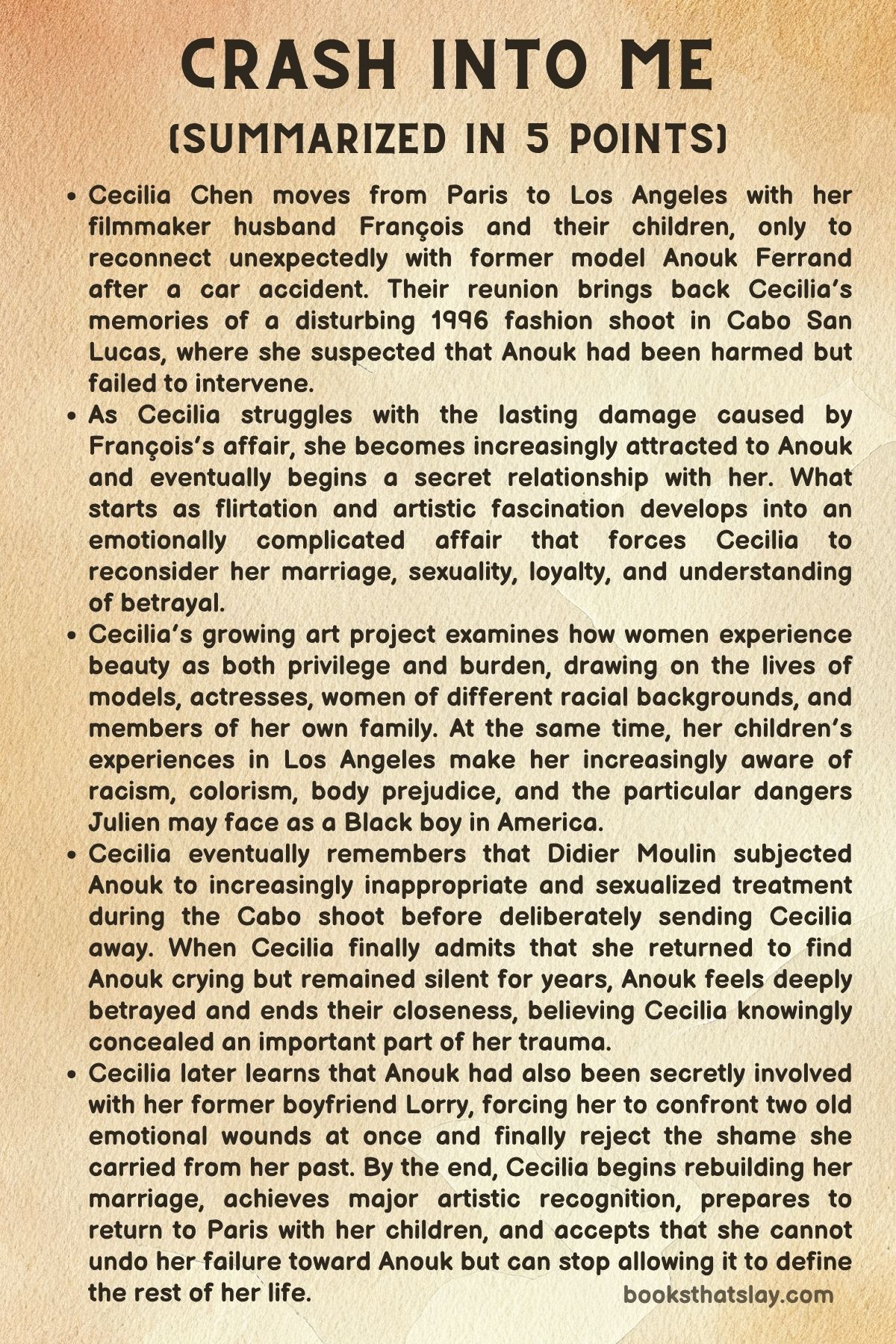
Photographer Cecilia Chen has recently moved from Paris to Los Angeles with her filmmaker husband François and their children, Julien and Lucie. The relocation follows François’s major professional breakthrough: he has been hired to direct a lucrative science-fiction trilogy, a career opportunity large enough to uproot the entire family from the life they had built in France.
For Cecilia, Los Angeles feels less like a fresh beginning than an interruption. She has spent years establishing herself as a serious artist, and once again her work appears to be reorganizing itself around her husband’s ambitions.
Her uneasiness becomes far more personal when a car accident brings her face-to-face with Anouk Ferrand, a world-famous former model whom Cecilia knew during a fashion campaign in Cabo San Lucas in 1996. Anouk helps Cecilia after the collision without initially recognizing her, but Cecilia immediately remembers the young model and the troubling circumstances surrounding their earlier encounter.
Cecilia later visits Anouk to replace the towel Anouk used to stop her bleeding. The meeting gradually becomes more intimate as the women discuss careers, beauty, race, family backgrounds, and the fashion industry.
When Cecilia mentions the Cabo campaign and its participants, however, Anouk’s mood shifts. Both women seem aware that the glamorous shoot contains memories neither fully understands or wants to name.
Cecilia’s present life is already unstable. Fifteen months earlier, François confessed that he had been unfaithful with actress Élodie Cloutier, and although the couple remained together, Cecilia has never truly recovered.
Her photographic series called Après became a way to process that betrayal. She photographed François asleep, turning his physical presence and emotional distance into art, even though he resented the exposure.
While traveling to New York, Cecilia also confronts another unresolved part of her life: Lorry Kenter, the former boyfriend whose rejection devastated her in her twenties. She has secretly searched for him online for years, following his marriage, family, and eventual move to Los Angeles.
Cecilia understands that this habit keeps an old injury alive. Lorry’s breakup once contributed to a suicidal depression, yet part of her has continued to measure her adult success against the possibility that he might someday see what she became and regret losing her.
At the same time, Anouk begins remembering more of Cabo. Cecilia retrieves old journals and reconstructs the week in fragments.
In 1996, Cecilia was a twenty-six-year-old assistant working for powerful fashion photographer Didier Moulin. She was ambitious but insecure, especially within an industry that celebrated extremely thin bodies and treated women’s appearance as both artistic material and commercial property.
Anouk, then nineteen, immediately attracted Cecilia’s attention. Their shared Caribbean heritage created an unusual connection, and their conversations carried an attraction Cecilia did not initially know how to understand.
The campaign slowly revealed an environment in which professional authority and sexual entitlement were dangerously close. Models discussed unwanted touching, nudity, suggestive poses, and the expectation that women should tolerate behavior from celebrated photographers because such behavior had become normalized.
Cecilia admired Didier and wanted to believe that the fashion world represented creative freedom. Because of that admiration, she repeatedly explained away moments that disturbed her.
During the same week, Lorry ended his relationship with Cecilia by telephone. Already emotionally devastated, Cecilia became more vulnerable to the attention she received from Anouk.
After Cecilia injured her hand at the closing dinner, Anouk took her to a private suite and carefully removed glass from her palm. The intimacy turned into kissing and sexual contact, giving Cecilia her first experience with another woman.
In the present, Cecilia and Anouk begin recreating that attraction. Anouk encourages Cecilia’s artistic ambitions, especially her developing project On Beauty, which examines how women experience the social power and personal burden attached to physical appearance.
Anouk eventually agrees to be photographed. During their private session, the old division between observer and subject reverses: Cecilia is now the artist deciding how the famous model will be seen.
Their attraction becomes an affair during a trip to Napa Valley. Cecilia discovers that intimacy with Anouk gives her an intense sense of being desired and physically present, something she has struggled to feel since François’s betrayal.
She tells herself that the relationship may be an adventure, retaliation, artistic fascination, or temporary freedom. Yet the women continue meeting, traveling together, exchanging private gifts, and building a relationship that becomes increasingly emotional.
Cecilia nevertheless realizes that Anouk resists definition. Anouk wants closeness without conventional rules and has a history of becoming intensely attached to people before moving on.
Their affair also changes Cecilia’s understanding of François. She begins considering whether sexual fascination outside a marriage can exist without necessarily erasing the deeper emotional structure of that marriage.
While Cecilia’s private life grows more complicated, Los Angeles forces her to confront race in ways she had not experienced while raising her children in France. She becomes increasingly conscious that Julien will be seen not simply as French, mixed-race, privileged, or well educated, but as a Black boy in America.
When mall security singles out Julien and his Black friend Isaiah after a group of teenagers enters an off-limits area, Cecilia becomes frightened by how quickly an ordinary adolescent mistake could become dangerous. François initially assumes status and privilege can protect their son, but Cecilia insists that such protection has limits.
Lucie faces another form of racial pressure. Girls in ballet tell her that the body of a Black girl is unsuitable for classical dance, causing her to become ashamed of her shape and eventually quit something she once loved.
Cecilia recognizes painful similarities between Lucie’s experience and her own childhood insecurity. She becomes determined not to allow racist beauty standards or her mother Olive’s habits of commenting on women’s bodies to shape her daughter’s self-worth.
Meanwhile, Cecilia’s artistic project becomes increasingly ambitious. She photographs women of different races, ages, careers, and backgrounds, asking them to discuss how beauty has affected their lives.
Actresses such as Victoire de Fleury and Cressida James describe aging in industries where women’s careers depend heavily on remaining visually desirable. Tamsin Desai discusses colorism, while Anouk describes a modeling career that brought wealth and fame but also taught strangers to behave as though her body were available for inspection.
Cecilia eventually remembers the final Cabo shoot more clearly. Didier had pushed Anouk into increasingly sexual poses, forced his fingers into her mouth while demonstrating an instruction, and later asked her to remove most of her clothing.
Then he deliberately sent Cecilia away. When Cecilia returned, she found Anouk alone, soaked, trembling, and crying, but Didier stopped Cecilia from approaching her.
For twenty years, Cecilia had lived with the knowledge that something terrible probably happened after she left. Yet she never confronted Didier, never spoke to Anouk, and allowed professional obedience and fear to silence her.
When Cecilia finally tells Anouk what she remembers, Anouk feels betrayed. She has blocked much of the incident and tells Cecilia that Cabo was only one of many violations she endured while modeling.
What hurts Anouk most is discovering that Cecilia suspected something was wrong yet entered an intimate relationship with her decades later without revealing the truth. Anouk begins distancing herself and eventually tells Cecilia that seeing her now brings Cabo back.
The separation becomes even more painful when Cecilia learns that Anouk has secretly been involved with Lorry. Anouk had repeatedly encouraged Cecilia to reconnect with him while concealing her own relationship with him.
The revelation brings together two of Cecilia’s oldest emotional wounds. The woman she trusted has entered a relationship with the man whose rejection once nearly destroyed her, while also lying about being exclusive with Cecilia.
Yet confronting Lorry eventually gives Cecilia something she had lacked for twenty years. She tells him how deeply his rejection and his family’s attitudes made her question her worth, especially across divisions of race, class, and privilege.
She no longer accepts the idea that she was inadequate. The past may still hurt, but it no longer has the authority to define her.
Cecilia’s relationship with François also begins changing. She finally meets Élodie without collapsing, and later Élodie apologizes for the affair.
Instead of remaining trapped inside the betrayal, Cecilia begins to see it as something that happened rather than something continuously happening to her. Her renewed sexual connection with François suggests that forgiveness is becoming possible even though complete certainty may never return.
Her greatest professional achievement arrives when On Beauty opens at the Hammer Museum. The installation combines damaged and reconstructed portraits with projected images and overlapping recordings from women discussing beauty.
The exhibition succeeds because Cecilia transforms years of insecurity, observation, anger, desire, and self-questioning into a work with a distinct artistic identity. Even relatives who once dismissed her career finally recognize the seriousness of what she has created.
Success does not solve everything. Problems involving Julien, Lucie, drugs at school, racial anxiety, François’s work, and Anouk’s behavior eventually convince Cecilia that Los Angeles may be costing her family too much.
She discovers that Anouk also entered Cecilia and François’s Paris apartment and took an intimate photograph of Cecilia. Although Cecilia fears that something happened between Anouk and François, he insists that he remained faithful.
Cecilia ultimately chooses to believe him. She prepares to return to Paris with the children and recognizes that Anouk, however important, was never the whole of her life.
The novel then returns to Cabo in 1996. On the morning after the final shoot, Cecilia sees Anouk with swollen eyes and bruises on her arm.
She considers approaching her and saying something, but worries about professionalism, appearances, and the rest of her own life. She watches Anouk leave and returns to work, making the choice that will remain with both women for decades.
Characters
Cecilia Chen
Cecilia is the emotional and intellectual center of Crash Into Me, and much of her complexity comes from the distance between the person she believes herself to be and the choices she actually makes. She is observant, intelligent, artistically ambitious, culturally adaptable, and deeply sensitive to other people, yet she repeatedly avoids situations that would force her to act on uncomfortable truths.
Her profession reinforces this contradiction. Photography trains Cecilia to look closely, but seeing does not automatically make her courageous; in Cabo, she recognizes warning signs around Anouk yet allows professional hierarchy and self-protection to override her instincts.
Cecilia is also shaped by insecurity about beauty, artistic legitimacy, race, marriage, motherhood, and belonging. Her development comes through learning that self-knowledge requires more than understanding why she was hurt; it also requires admitting the ways fear, silence, jealousy, desire, and avoidance have influenced her own behavior.
Anouk Ferrand
Anouk is one of the most complicated figures in Crash Into Me because she exists simultaneously as someone who has been exploited and someone capable of hurting other people. Her beauty gives her enormous social power, yet the book repeatedly demonstrates that the same beauty caused others to believe they possessed rights over her body, image, attention, and sexuality.
She responds to vulnerability through freedom, movement, pleasure, secrecy, and emotional compartmentalization. Rather than allow other people to control her, she often refuses definitions altogether, but that resistance to restriction can become a justification for dishonesty.
Her relationship with Cecilia contains tenderness, attraction, generosity, manipulation, unresolved trauma, and betrayal. Anouk’s decision to become involved with Lorry shows that surviving exploitation does not automatically make someone ethically careful with the vulnerabilities of others.
François
François is neither reduced to the unfaithful husband nor presented as an uncomplicated partner. His affair with Élodie causes immense damage, but he remains a loving father, a creative collaborator, and someone who continues valuing Cecilia’s artistic intelligence even when the consequences of his own choices make intimacy difficult.
His professional success also creates an imbalance within the marriage. The move to Los Angeles allows him to fulfill an old dream while Cecilia must adapt her work, friendships, parenting, and sense of home around his opportunity.
François gradually becomes more capable of hearing concerns that he initially underestimates, especially Cecilia’s fears about Julien’s experience as a Black boy in America. His relationship with Cecilia survives not because the betrayal disappears, but because both eventually decide that a damaged marriage can still contain genuine love, history, attraction, and possibility.
Lorry Kenter
Lorry represents the emotional authority Cecilia once gave to romantic rejection. He is remembered first as intensely romantic, idealistic, attentive, and imaginative, which explains why his later uncertainty became so destructive.
His decision to end the relationship while repeatedly insisting that he loved Cecilia created a form of ambiguity that kept her emotionally attached long after the relationship ended. Because some of his criticisms concerned her career and ambition, Cecilia absorbed his doubts into her own understanding of herself.
When they meet again decades later, Lorry has become less powerful precisely because Cecilia has changed. Confronting him allows her to recognize that the shame she carried about race, class, family approval, and supposed inadequacy belonged to an earlier version of herself.
Didier Moulin
Didier embodies the danger created when artistic prestige becomes an excuse for entitlement. Cecilia admires him as a photographer, which makes her slow to interpret his behavior honestly.
He exists within a professional culture that treats provocation, nudity, sexual suggestion, and boundary violations as evidence of creative boldness. Because everyone around him has learned to normalize his conduct, individual moments of misconduct are repeatedly dismissed instead of challenged.
His treatment of Anouk demonstrates how power can make refusal difficult even without explicit physical force. He controls the assignment, the atmosphere, the professional opportunities, and the expectations surrounding the model, allowing coercion to hide beneath the language of photography and artistic direction.
Lucie
Lucie allows the story to show how beauty standards are inherited by children long before they fully understand the systems producing them. Her relationship with ballet initially appears to be a private passion, but racist comments from other girls teach her to see her own body as incompatible with classical ideals.
Her decision to quit becomes especially painful for Cecilia because it repeats patterns from Cecilia’s own youth. Both mother and daughter encounter institutions that suggest their bodies are somehow wrong, excessive, or unsuited to the beauty being celebrated.
Lucie also forces Cecilia to reconsider parenting. Protecting a child cannot mean preventing every painful experience; it requires creating enough trust that the child can eventually explain what has happened.
Julien
Julien represents the complicated transition from childhood innocence into racial awareness. Raised largely in France, he has not been taught to organize his identity primarily around the expectations attached to being a Black male in the United States.
The mall incident changes Cecilia’s understanding of what his adolescence may require. Julien behaves like an ordinary teenager, yet Cecilia realizes that the consequences of ordinary teenage mistakes may not be distributed equally.
His experiences with security, romantic rejection, and American social attitudes challenge his parents’ belief that education, wealth, mixed heritage, and cultural privilege can insulate him from racial judgment. Through Julien, the story shows Cecilia confronting dangers that François initially understands only abstractly.
Olive
Olive, Cecilia’s mother, is both a source of pressure and an important source of wisdom. Her comments about weight and appearance reflect values Cecilia experienced as damaging, which is why Cecilia reacts quickly when Olive begins directing the same scrutiny toward Lucie.
At the same time, Olive possesses a strong understanding of migration and belonging. Her explanation that people carry home within themselves helps Cecilia reconsider her belief that identity requires choosing one country or culture over another.
Her orchid metaphor becomes particularly significant. Growth does not require denying one’s original roots, but neither does it require remaining permanently attached to the place where those roots first developed.
Jane
Jane functions as one of Cecilia’s more emotionally dependable relatives. Unlike family members who treat Cecilia’s artistic career dismissively or competitively, Jane takes her work seriously and offers support without demanding that Cecilia justify her choices.
She also serves as an outside observer of Cecilia’s Los Angeles life. Jane notices the chemistry between Cecilia and Anouk and warns Cecilia against becoming so impressed by wealth, celebrity, and social access that she loses perspective.
Her role is relatively quiet, but that quietness is important. In a story filled with unstable desire and secrecy, Jane represents a form of affection that does not require drama to prove its value.
Andrew
Andrew provides Cecilia with a family relationship in which uncomfortable truths can be spoken directly. When she finally tells him about Anouk, his concern is not primarily focused on Cecilia being involved with a woman.
Instead, he immediately recognizes the ethical and familial consequences of two married people maintaining a secret affair. His questions force Cecilia to consider whether her relationship began as revenge against François and whether personal liberation can be separated from responsibility toward other people.
Andrew therefore acts as a moral counterweight without becoming self-righteous. He allows Cecilia space to explain herself while refusing to pretend that desire automatically makes every choice harmless.
Frederick
Frederick occupies an unusual position because he is Anouk’s husband but is never developed as a conventional romantic rival to Cecilia. His marriage appears to operate with freedoms and understandings that Cecilia’s marriage does not share.
That difference matters because Cecilia repeatedly tries to interpret Anouk’s behavior through assumptions derived from her own relationship with François. Frederick’s presence suggests that marriages can be organized around very different agreements.
Yet the exact limits of his knowledge remain partly outside Cecilia’s understanding. This uncertainty contributes to the larger question of whether Cecilia truly understands the relationship she has entered or has simply accepted the version of it Anouk chooses to show her.
Sacha
Sacha provides Cecilia with one of the clearest warnings about Anouk’s pattern of attachment. His reference to Cecilia as the possible new version of someone from Anouk’s past immediately destabilizes Cecilia’s belief that their relationship is uniquely important.
Because Sacha has observed his mother over time, his comment carries a different authority from gossip offered by outsiders. He understands that Anouk can become intensely fascinated with someone and later redirect that attention.
His bluntness forces Cecilia to recognize something she would prefer not to see: emotional intensity is not necessarily the same thing as permanence.
Clément
Clément functions as both friend and observer, repeatedly warning Cecilia that Anouk’s attention can be temporary. His comparison of Anouk to a moth attracted toward whatever shines most brightly captures her restless pursuit of emotional stimulation.
His warnings matter because they arrive before Cecilia is ready to accept them. Like many other uncomfortable truths in her life, Cecilia hears what Clément says but initially treats it as information she can safely ignore.
Later, when he reports Anouk’s behavior around François, his role becomes more consequential. He helps expose how Anouk’s attraction to novelty repeatedly crosses boundaries Cecilia believed were protected.
Élodie Cloutier
Élodie initially exists in Cecilia’s imagination more powerfully than she exists as an actual person. Because François’s affair with her represents humiliation, competition, abandonment, and sexual betrayal, Cecilia turns Élodie into the embodiment of everything that injured her marriage.
Their eventual encounter complicates that image. Cecilia discovers that she can stand in front of Élodie without collapsing and even acknowledge her beauty.
Élodie’s later apology does not erase what happened, but it removes some of the symbolic power Cecilia had assigned to her. She becomes a flawed human participant in the affair rather than the permanent enemy Cecilia’s pain had created.
Victoire de Fleury
Victoire is important to Cecilia both artistically and personally because she offers an alternative way of thinking about age and beauty. Rather than treating youth as the highest form of female attractiveness, she describes feeling more beautiful in middle age than she did when younger.
She also encourages Cecilia to stop thinking of Los Angeles only as the place where François’s career is advancing. Her suggestion that Cecilia treat the move as an opportunity contributes to the development of On Beauty.
Victoire demonstrates that female aging does not have to be understood entirely through loss. Her confidence broadens Cecilia’s artistic investigation by separating beauty from the demand to remain permanently young.
Cressida James
Cressida contributes an entertainment-industry perspective to Cecilia’s project. As a successful actress who has spent decades watching women’s professional value become linked to whether they still satisfy conventional standards of desirability, she understands beauty as an economic force as well as a personal one.
Her willingness to discuss cosmetic procedures, shrinking opportunities, and comparison with her younger filmed image demonstrates the strange cruelty of celebrity. A famous actress can possess wealth and cultural power while still being judged against an earlier version of her own face.
Cressida also widens Cecilia’s Los Angeles network and helps establish the seriousness of her evolving artistic work.
Tamsin Desai
Tamsin expands the discussion of beauty beyond the largely Western fashion and Hollywood environments surrounding Cecilia. Her experience with colorism shows that appearance-based hierarchies operate differently across cultures while producing similar pressures.
Her comments about lighter skin being socially preferred reveal how beauty standards can become entangled with race, marriageability, class assumptions, and inherited prejudice. Cecilia’s project gains greater depth because voices such as Tamsin’s prevent beauty from being treated as a single universal experience.
Tamsin therefore represents the importance of allowing women to describe the specific systems that have taught them how their bodies are supposed to be valued.
Bas
Bas is initially part of the glamorous atmosphere surrounding the Cabo campaign, but his role becomes important because he helps demonstrate the mixture of ignorance, attraction, professionalism, and complicity operating within that world. His offensive question about Cecilia’s ancestry reveals how casually racial difference can be reduced to crude categories even among socially sophisticated people.
His later apology suggests that ignorance and malice are not always identical. More significantly, his participation in the sexualized photography with Anouk illustrates how models can simultaneously be workers, performers, objects of desire, and participants in uncomfortable professional arrangements.
Near the end, his statement that Cecilia is a good person becomes painful because Cecilia herself is no longer certain that goodness without action is enough.
Marc
Marc understands Cecilia’s attraction to Anouk before Cecilia fully admits it to herself. His teasing observations provide an external confirmation that the connection between the two women is visible rather than purely imagined.
He also represents the ordinary social atmosphere surrounding the fashion shoot, where flirtation, sexual experimentation, gossip, and professional work coexist. His presence helps show why Cecilia can interpret her encounter with Anouk as exciting while failing to recognize how much more dangerous the surrounding environment has become.
Marc is not central to the later story, but his perspective helps establish Cecilia’s younger self as someone still learning how to name her own desires.
Khalil Mansour
Khalil represents Cecilia’s professional life beyond her marriage and family. As her longtime dealer, he takes her artistic ambitions seriously and recognizes value in work that other people, including some members of her own family, have underestimated.
His warning that Anouk can behave unpredictably is another early sign that Cecilia is entering a relationship whose emotional rules she does not fully understand. Cecilia nevertheless continues, showing how attraction can make informed people discount information they would normally consider carefully.
Khalil also represents continuity. While Los Angeles destabilizes Cecilia personally, her connection to galleries and serious art reminds her that she possesses an identity independent of François and Anouk.
Sylvie
Sylvie initially embodies the family skepticism Cecilia has spent years resisting. Her polished dismissiveness toward Cecilia’s artistic career reinforces the feeling that Cecilia must continually prove that photography is not merely an indulgence.
That is why Sylvie’s praise at the museum opening carries unexpected significance. Cecilia has reached a point where even someone accustomed to minimizing her artistic choices can no longer deny what she has achieved.
Sylvie does not cause Cecilia’s success, but her changed response provides a measure of how far Cecilia has traveled professionally. Recognition from a skeptic becomes less important than recognition from Cecilia herself, yet it still marks the collapse of an old judgment.
Themes
Beauty as Power, Labor, and Consumption
Beauty creates access, admiration, wealth, desire, and cultural influence, but the story repeatedly questions who benefits from that power. In Crash Into Me, women who are considered beautiful often discover that admiration produces a dangerous assumption that other people are entitled to look at them, evaluate them, touch them, modify them, photograph them, or make decisions about their bodies.
Anouk’s modeling career captures the contradiction clearly. Her appearance gives her extraordinary privilege, yet her livelihood depends on allowing clients, photographers, stylists, audiences, and strangers to consume an image of her that gradually becomes detached from her control.
Cecilia’s On Beauty project turns this process back toward the viewer. Her installation asks people to look at beautiful women while surrounding them with the women’s own voices, experiences, anxieties, and judgments.
By damaging and reconstructing portraits, Cecilia refuses to present beauty as untouched perfection. The physical destruction of the images suggests that the social production of beauty often contains pressure, violence, alteration, shame, labor, and loss.
The theme also reaches beyond models and celebrities. Lucie encounters racist ideas about which bodies belong in ballet, Tamsin describes colorism, Cressida discusses aging, and Cecilia remembers years of believing her own body was wrong.
Beauty therefore becomes less a fixed quality than a system of value. The novel keeps asking what happens when a person is praised for appearance so persistently that other parts of the self become harder for the world to see.
Memory, Silence, and Moral Responsibility
Cecilia’s memories of Cabo do not return as a complete account because she has spent years protecting herself from what those memories might require her to admit. She remembers pieces of Anouk’s distress, Didier’s behavior, her own uneasiness, and the moment she was sent away, but uncertainty allows her to postpone responsibility.
The crucial moral problem is not simply whether Cecilia knew exactly what happened. She knew enough to recognize that Anouk was frightened and injured, yet she allowed professional pressure and fear of embarrassment to stop her from approaching her.
The story therefore treats silence as an action with consequences. Cecilia did not cause Didier’s behavior, but her decision not to acknowledge what she saw becomes part of the injury Anouk later associates with her.
Confession creates another complication. When Cecilia finally tells Anouk the truth, she hopes honesty may repair something, but Anouk experiences the disclosure as a new betrayal because Cecilia had become her lover while withholding information directly connected to Anouk’s trauma.
The book refuses the comforting idea that admitting wrongdoing automatically earns forgiveness. Cecilia must accept that confession may relieve the person carrying guilt without helping the person who was originally harmed.
Her development comes when she stops treating intention as the only measure of morality. Caring about Anouk did not erase what Cecilia failed to do, and feeling guilty cannot reverse the past.
Desire, Betrayal, and the Unstable Meaning of Fidelity
Romantic loyalty becomes complicated because nearly every important relationship challenges Cecilia’s assumptions about what betrayal means. François’s affair initially appears to divide the world neatly into the person who was betrayed and the person who betrayed her, allowing Cecilia to organize her anger around his wrongdoing.
Her affair with Anouk destroys that simplicity. Cecilia experiences desire outside marriage without immediately ceasing to love François, which forces her to reconsider whether attraction, sex, emotional attachment, and commitment always belong to the same category.
This understanding does not excuse François, nor does it excuse Cecilia. Instead, the story becomes interested in the difference between understanding why someone crosses a boundary and pretending that the crossing causes no harm.
Anouk complicates the issue further because she prefers relationships without conventional labels while still becoming jealous and demanding forms of exclusivity. Her secret involvement with Lorry exposes the weakness of using freedom as a substitute for honesty.
Cecilia eventually recognizes that fidelity involves more than sexual behavior. Anouk’s relationship with Lorry violates a deeply vulnerable part of Cecilia’s emotional history, while Cecilia’s concealment of the Cabo memories violates Anouk’s trust even before either woman discusses exclusivity.
The novel ultimately presents commitment as a continuing series of choices rather than a permanent feeling. Desire may be unpredictable, but responsibility begins with what people choose to do with it.
Race, Identity, and the Question of Home
Cecilia’s return to the United States changes how she thinks about race because American institutions repeatedly assign meanings to her family that differ from the identities they developed in France. Her children understand themselves through multiple cultures, yet Los Angeles increasingly requires them to confront categories imposed from outside.
Julien’s encounter with mall security becomes especially important because Cecilia sees how quickly childhood privilege can become secondary to racial perception. Money, education, nationality, and mixed heritage may influence how others interpret him, but none can guarantee protection.
Lucie encounters the same problem through beauty rather than policing. Racist comments at ballet teach her that certain bodies are treated as naturally belonging while others are framed as deviations from the ideal.
Cecilia herself also experiences casual assumptions about class and race, including being mistaken for someone’s nanny. These moments remind her that returning to America means reentering a social environment whose racial codes she had learned to experience less constantly while living abroad.
Her mother Olive offers a different approach to belonging. Rather than defining home as a single geographical place, Olive believes people carry their histories with them.
Cecilia gradually understands that being Jamaican, American, French, Caribbean, Black, Chinese, immigrant, expatriate, wife, mother, and artist does not require selecting one identity and rejecting the rest. Home becomes less about recovering a perfect place than about learning to live without treating complexity as evidence that she belongs nowhere.