Cross My Heart I Hope You Die Summary, Characters and Themes
Cross My Heart I Hope You Die by Mallory Arnold is a darkly comic thriller about betrayal, revenge, friendship, and the dangerous difference between imagined violence and the real thing.
Nora Callahan, Ruby Monroe, and Champagne “Cham” Fenno begin as strangers who discover that the same man has been romantically involved with all three while taking money, valuables, and trust from each of them. Their attempt to frighten him into admitting his fraud leads them to an isolated mountain cabin, where a controlled revenge scheme becomes a fight for survival involving murder, family secrets, a violent cult history, and people willing to kill to keep the past buried.
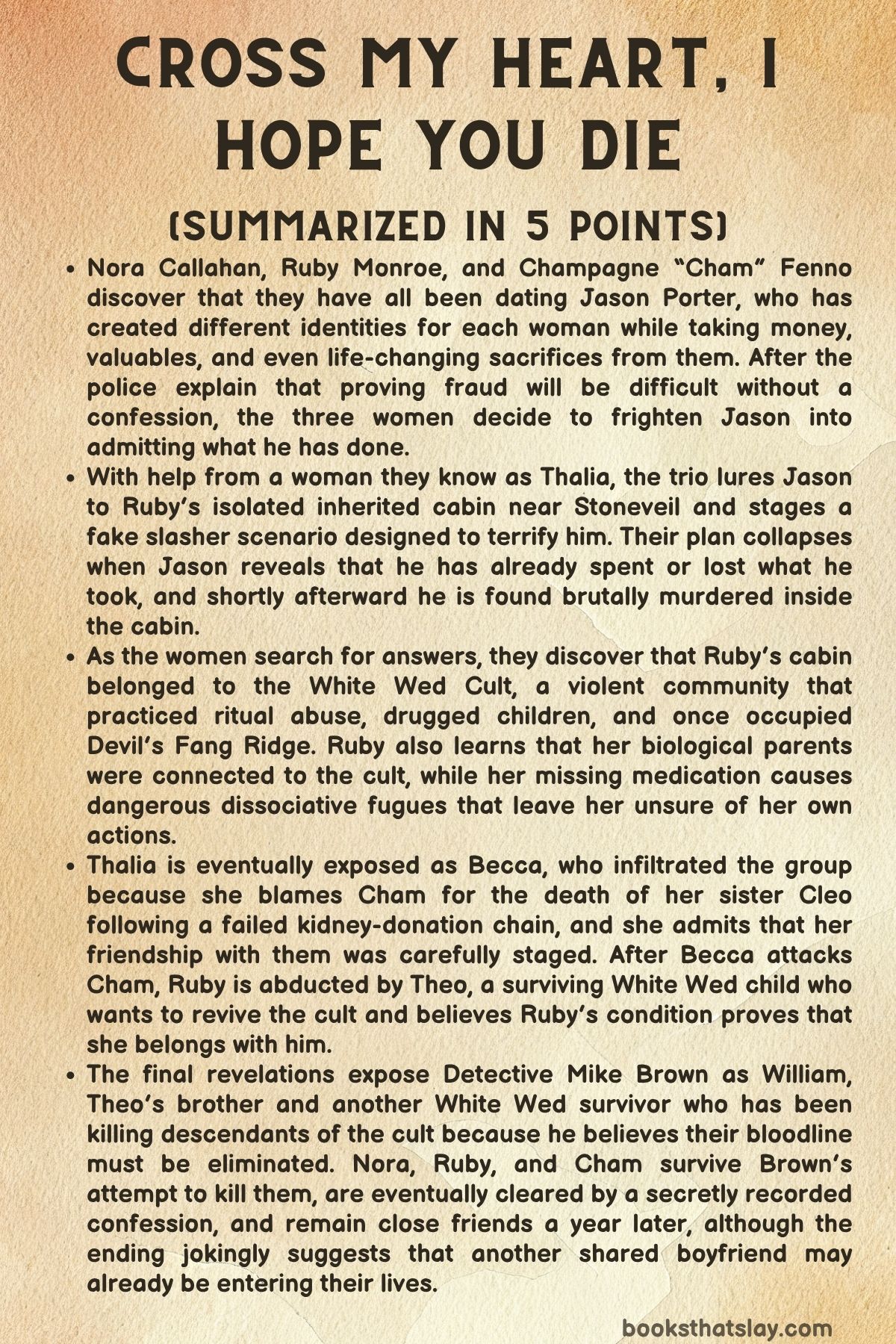
Summary
Nora Callahan first appears as a disciplined high-school cross-country coach whose orderly life has been shaped by the demanding but practical upbringing of her single father. She believes her boyfriend, Jason Porter, shares her athletic interests and values, and although she is careful with money, she agrees to give him ten thousand dollars after he claims his seriously ill mother needs urgent heart surgery.
Something about Jason’s performance troubles her almost immediately. He appears to be crying while discussing his mother’s condition, yet Nora notices that his face is completely dry, creating the first sign that his emotions may be calculated rather than genuine.
Ruby Monroe, a thirty-year-old kindergarten teacher, believes Jason is a successful insurance professional who has finally given her the serious romantic relationship she has long wanted. He encourages her to invest twenty thousand dollars in a cryptocurrency called Zip Coin, using praise, emotional pressure, and the question of whether she trusts him to overcome her doubts.
Ruby does not actually possess that amount herself, so she secretly takes the money from her wealthy adoptive parents with the intention of replacing it when Jason’s promised profits arrive. His declaration of love seems important to her until he immediately turns the conversation back toward the money, revealing how closely affection and financial gain are connected in his behavior.
Champagne “Cham” Fenno has known Jason far longer than the other women. A mechanic and motorcycle enthusiast, she values independence and tends to find machines more reliable than people, yet she has trusted Jason enough to lend him money repeatedly and eventually allows him to borrow professional tools worth thousands of dollars.
Small contradictions appear in Jason’s stories about who needs the tools and why. Cham notices them but initially dismisses the inconsistencies because her relationship with him has already survived years of irregular behavior, and because her loyalty to him is far deeper than anyone yet realizes.
Nora’s confidence finally collapses when Jason stops responding after taking her savings. She visits the house where he supposedly lives, hoping to surprise him, only to discover that a teenage boy and his mother live there and have never heard of him.
Humiliated and distracted, Nora drives away, nearly hitting Ruby before crashing into a utility pole. Ruby comforts the stranger instead of blaming her, and their accidental meeting eventually brings them to Cham’s garage, where both women hear Jason’s voice and realize that Cham recognizes him too.
The three women compare photographs and confirm that they have all been dating the same man. More disturbing than the infidelity is the discovery that Jason has created different identities for each relationship, presenting himself as athletic for Nora, successful and wealthy for Ruby, and adventurous but financially unstable for Cham.
Each woman has recently given him something valuable. Nora has lost ten thousand dollars, Ruby has handed over twenty thousand, and Cham has lost access to expensive tools, so what initially looks like romantic betrayal begins to resemble carefully planned fraud.
When they try confronting him, they discover that Jason has already emptied his basement apartment and disappeared. The police offer little help because the women have no formal loan agreements, while Jason has deliberately described their transfers as gifts in written messages.
The officer handling the complaint explains that a recorded admission could strengthen their case. That suggestion gives the women an idea: if they cannot legally force Jason to admit what he has done, perhaps they can frighten the truth out of him.
Cham’s anger is especially intense because Jason took more from her than tools or money. She donated a kidney to save his life, and the revelation of his deception forces her to reconsider a sacrifice she once viewed as an expression of love.
After the women intervene when a man apparently assaults a woman named Thalia at a café, Thalia gains their trust. She later agrees to help their plan by creating a dating profile designed to attract Jason, while Ruby offers an isolated cabin she has recently inherited near the remote Montana village of Stoneveil.
Their plan is deliberately theatrical rather than physically violent. Knowing Jason is frightened by horror films, they intend to stage a fake slasher scenario, secretly record him, and scare him into acknowledging that he cheated and financially exploited them.
Stoneveil, however, proves unsettling before the plan even begins. Ruby hears about the White Wed Cult, a group that once lived on Devil’s Fang Ridge and supposedly vanished, while Nora encounters locals who warn her that the mountain is associated with death, disappearances, and danger.
The inherited cabin stands among several apparently abandoned buildings that once formed a larger settlement. Inside, the women find disturbing artwork, old containers filled with dark blood, and evidence suggesting that Ruby’s biological parents may have had connections to the people who once lived there.
Ruby also discovers that the medication controlling her dissociative fugue episodes has disappeared. Because missing treatment can cause her to act while retaining no later memory of her behavior, the loss creates both a medical danger and a terrifying uncertainty about whom she can trust.
Jason arrives believing he has arranged a romantic mountain weekend with a wealthy woman he met online. His own perspective reveals that he feels little remorse for maintaining three relationships, takes pride in adapting his personality to each woman, and sees deception as a skill rather than a moral failure.
The women knock him unconscious, restrain him, and begin their performance. Masks, darkness, false threats, staged noises, photographs, and fake blood are intended to convince him that dangerous strangers have taken him captive.
Their control weakens when Ruby accidentally says Cham’s name, allowing Jason to realize who is behind the attack. They stage Thalia’s murder with a retractable knife and bags of blood, frightening Jason badly enough to make him believe he has witnessed a killing.
Jason eventually admits that there is almost nothing left to recover. He sold Cham’s tools, gambled away the money, and even borrowed from Nora’s father, destroying the women’s hope that one confession could restore what they lost.
The situation becomes genuinely dangerous when the power fails. Jason disappears from his restraints, bloody tracks suggest that another person has been inside the cabin, and Cham later discovers Jason’s body in the mudroom with his neck violently broken.
Suspicion briefly falls on Cham because she is carrying a real knife and had openly expressed the greatest rage toward Jason. Their fragile unity is tested further when Thalia panics and runs into the blizzard, forcing the others to follow her into the abandoned buildings surrounding the cabin.
Inside a former White Wed chapel, the women discover evidence that the old community practiced ritualized violence. Decomposed bodies hang below the building, and the containers of blood they had assumed came from animals are revealed to contain blood taken from tortured human victims.
An old diary describes a patriarchal cult in which children were drugged during ceremonies, women were subordinated, and violence was treated as religious duty. Ruby is horrified by the possibility that she might have grown up inside that system if she had not been adopted.
Thalia then reveals that she is actually Becca, a woman who has deliberately inserted herself into Cham’s life. Her sister Cleo had been expecting a kidney through a paired-donation chain until Cham chose to give her kidney directly to Jason, leaving Cleo to return to the waiting list and eventually die.
Becca holds Cham responsible and admits that even the abusive encounter at the café was staged to gain access to her. She intends to kill Cham, but Nora intervenes and reveals that she is pregnant with Jason’s child, causing Becca to spare her and fire at Cham instead.
Cham survives because the White Wed diary inside her coat stops the bullet. Ruby, meanwhile, enters a fugue after being deprived of her medication and later awakens with blood on her hands beside Becca’s dead body, which has been impaled with a ski pole.
Unable to remember what happened, Ruby fears that she killed Becca. Her terror increases when Jason’s corpse also disappears, making her question what she might have done during periods she cannot recall.
Ruby is eventually taken to another cabin by a masked man who claims to be her relative and says that he experiences similar dissociative symptoms. He reveals that White Wed children were deliberately given hallucinogenic substances and suggests that Ruby’s condition may have resulted from being drugged when she was an infant.
The man wants Ruby to remain on the mountain and help restore the White Wed community. He admits that he stole her medication so her fugues would return, and although he assures her she did not kill Becca, his actions reveal that he sees her illness as a spiritual inheritance rather than something deserving medical care.
Nora and Cham learn from the old diary that the White Wed Cult did not simply disappear. Armed Stoneveil residents attacked the settlement, killing many adults and older children while allowing some younger children to survive and be adopted elsewhere.
The diary’s writer is revealed to be Theo, the friendly man Ruby met in the Stoneveil café. Ruby eventually discovers that Theo is also the masked man holding her captive, and she escapes after fighting him and seriously injuring him with falling icicles.
Nora and Cham are attacked separately as well. Nora is nearly strangled by a man with all ten fingers, proving that Theo, who has lost a finger during an earlier struggle, cannot be the only person hunting them.
Ruby finally returns badly injured, and the three women refuse to separate again. With the gondola unusable, they begin descending the mountain on foot while dragging Jason’s body because Nora can no longer accept leaving anyone behind.
Their decision explains the bizarre scene that greeted police at the beginning: the women eventually reach Stoneveil bloodied, injured, and using the body bag as an improvised sled. Instead of being treated simply as survivors, they are interrogated by Detective Mike Brown, who assumes their revenge scheme proves that they murdered Jason.
Theo unexpectedly appears at the station and identifies Brown as the second attacker from the mountain. He also reveals that Brown is his younger brother, William, another child who survived the destruction of White Wed.
Brown shoots Theo and confesses that he has spent years trying to eliminate surviving White Wed bloodlines. Raised by a former police chief involved in the massacre, he believes people connected to the cult carry a dangerous contamination that must be destroyed.
He confirms that Becca killed Jason and that he later killed Becca. He also admits attacking Nora and manipulating the investigation in the hope of placing the women in prison while keeping Stoneveil’s past hidden.
Nora appears to betray Ruby by telling Brown that she and Cham will let him kill her. Cham immediately understands that Nora is pretending and supports the performance until Brown comes close enough for Nora to attack him with a pen.
Nora drives the pen into his neck, and although Brown shoots her in the shoulder, she survives while he dies. The women are still temporarily arrested because the evidence against them looks overwhelming, but police transcriptionist Delaney Fenwix has secretly recorded Brown’s confession beneath the interrogation desk.
One year later, Nora, Ruby, and Cham are together in Aspen, where they are deliberately returning to the kind of mountain environment associated with their trauma. Nora is raising her baby son Robby with support from her father and friends, Ruby is repaying the money she took from her parents by working at Cham’s garage, and their experience has made the three women famous as the Ice Queens.
The final moment returns humorously to the coincidence that first brought them together. Ruby announces that she has met a man named Andrew, Nora says she has met someone called AJ, and when the man enters the lodge, Ruby recognizes him, leaving open the possibility that the three women may once again have discovered the same romantic target.
Characters
Nora Callahan
Nora functions as one of the strongest centers of action in Cross My Heart I Hope You Die because her personality is built around discipline, responsibility, and the belief that difficult situations can be solved through preparation. Her career as a cross-country coach reflects this outlook: she understands endurance, planning, competition, and the value of continuing even after exhaustion has set in.
Her relationship with her father explains both her toughness and her hunger for approval. He loves her through practical instruction rather than easy displays of affection, so Jason’s ability to win his respect becomes particularly painful because it allows the deception to reach into one of Nora’s most emotionally sensitive relationships.
Nora’s greatest weakness is that confidence in her own judgment makes betrayal especially destabilizing. She does not simply lose money when Jason deceives her; she loses trust in her ability to recognize what is real, and this helps explain why she responds so forcefully once the three women discover the truth.
At the same time, Nora repeatedly tries to impose ethical limits on the revenge scheme. She insists that they are supposed to frighten Jason rather than physically torture or seriously injure him, showing that anger has not entirely replaced her sense of responsibility.
Her pregnancy transforms her understanding of survival. At first it becomes something others use as a reason to protect her, but Nora eventually rejects the idea that protecting herself means abandoning Ruby or Cham.
Her strongest moment comes during Brown’s final attack, when she uses his confidence against him. By pretending to surrender Ruby, Nora performs the same kind of manipulation that has been used against the women throughout the book, but she uses it defensively to create an opening that saves all three.
Nora’s development therefore moves from controlled independence toward a more collective understanding of strength. By the end, she is still determined and physically courageous, but she no longer treats survival as something an individual must achieve alone.
Ruby Monroe
Ruby begins as the character most accustomed to emotional security yet least certain of her own judgment. She has loving, wealthy adoptive parents and a stable profession, but her anxiety about privilege, romance, motherhood, and her medical condition leaves her particularly vulnerable to someone like Jason, who presents confidence as certainty.
Her financial mistake grows directly from this insecurity. She steals twenty thousand dollars from her parents not because she is greedy, but because Jason has made trust in him feel like a test of love and intelligence.
Ruby’s dissociative fugues are central to her characterization because they create a terrifying gap between action and memory. She fears not only what might happen to her during an episode but what she might discover about herself afterward, especially when she wakes beside Becca’s body with blood on her hands.
That fear becomes connected to the discovery of her biological background. Learning that her parents belonged to White Wed causes Ruby to wonder whether cruelty, instability, or violence might be inherited, and the people around her repeatedly offer competing interpretations of what ancestry means.
Theo tries to persuade Ruby that her condition represents a spiritual inheritance and deliberately removes the medication that gives her control over it. Ruby’s rejection of him is therefore larger than an escape from physical captivity; it is a rejection of the idea that other people are entitled to define her through her biological past.
Her friendship with Nora and Cham gradually strengthens her confidence. She begins as someone desperate to host properly even while devastated, but she becomes someone capable of defending Cham’s loyalty, facing her own fears, fighting Theo, and later rebuilding an independent relationship with her adoptive parents.
Ruby ends the novel still carrying uncertainty, but she no longer treats uncertainty as proof that something is wrong with her. Her survival supports the story’s repeated argument that origin, blood, and inherited history do not dictate moral character.
Champagne “Cham” Fenno
Cham is the most physically fearless member of the trio and initially appears to be the least emotionally dependent. Her work as a mechanic reflects her preference for things that can be understood through direct cause and effect, while her guarded personality suggests that emotional relationships feel less predictable to her.
Her relationship with Jason reveals how misleading that self-image is. Cham has not merely trusted him for three years; she has given him part of her body by donating a kidney, making his betrayal inseparable from questions of sacrifice, obligation, and regret.
Her anger is therefore more complicated than romantic jealousy. Jason turned an act Cham understood as devotion into something that now seems exploited, and her discovery that he sold her tools makes even her professional identity feel violated.
The paired-donation history complicates her moral position further. Cham chose to donate directly to Jason after learning they were compatible, even though doing so removed a kidney from the chain that would have benefited Cleo, and she continues to carry guilt about that decision.
Becca forces this guilt into the open by blaming Cham for Cleo’s death. Yet the book does not reduce Cham to either innocent victim or guilty cause, because the tragedy comes from a medical system, individual choices, grief, and Becca’s decision to transform loss into revenge.
Cham’s deepest development concerns belonging. Ruby’s description of her as fiercely loyal to “her people” affects Cham because she realizes that Nora and Ruby have become a chosen family she never expected to need.
By the end, her toughness is no longer defined simply through aggression or self-reliance. It is expressed through loyalty, protectiveness, and willingness to place herself at risk for people whose lives have become inseparable from her own.
Jason Porter
Jason is the immediate source of conflict in Cross My Heart I Hope You Die, but his importance goes beyond being an unfaithful boyfriend. He is a practiced manipulator who studies what each woman wants and constructs a different personality for each relationship.
His point of view confirms that these identities are deliberate performances rather than confused attempts to maintain several relationships. He takes pride in remembering his lies, digitally supports false claims when necessary, and thinks of emotional manipulation almost as a professional ability.
What makes Jason particularly dangerous is his understanding of emotional leverage. He uses family illness to exploit Nora’s compassion, intelligence and romantic reassurance to influence Ruby, and years of accumulated loyalty to obtain money, tools, and even a kidney from Cham.
He also protects himself legally by describing transfers as gifts. This shows that his behavior is not merely impulsive dishonesty but contains enough planning to make his victims doubt whether justice is possible.
Jason is not portrayed as secretly noble once he is caught. Even when his perspective becomes available, he remains self-centered and treats the emotional consequences of his actions as inconveniences created by women who were supposed to remain separated from one another.
His death changes the structure of the story because the women’s intended victim becomes an actual murder victim. Once he dies, they must confront the uncomfortable reality that a cruel person can still be wrongfully killed and that their desire for revenge has placed them in circumstances where the truth is difficult to prove.
Becca / Thalia
Becca initially enters the women’s lives under the name Thalia, appearing to be another woman harmed by a violent man. That appearance allows her to benefit from Nora, Ruby, and Cham’s growing instinct to protect women whose suffering has been ignored.
The apparent abuse is later revealed to have been staged specifically to gain their trust. Becca therefore mirrors Jason in an important way: both construct false identities by studying the emotional weaknesses and moral instincts of other people.
Her motivation, however, is different. Becca’s deception grows from grief over her sister Cleo, who lost an expected transplant after Cham changed the paired-donation arrangement and later died.
Becca turns grief into a fixed theory of blame. Instead of recognizing that Cham’s choice occurred inside a complicated medical and ethical situation, she treats Cham as the single person responsible for Cleo’s death and builds her life around punishment.
Her willingness to murder the doctor connected to the compatibility mistake shows that her revenge has already expanded beyond Cham. She is no longer seeking accountability but assigning death to anyone she believes contributed to her sister’s loss.
Becca is consequently one of the book’s clearest warnings about the difference between pain and moral permission. Her suffering is understandable, but the story refuses to treat suffering as justification for calculated violence.
Theo
Theo first appears as one of the few people in Stoneveil willing to speak kindly with Ruby. His friendliness becomes significant because Ruby already feels watched and unwelcome, making him seem like a rare source of information and safety.
The later discovery that he is a surviving White Wed child completely changes the meaning of that encounter. The diary reveals that Theo witnessed the destruction of his community as a boy and survived while many adults and older children were killed.
Theo’s trauma has not led him toward rejection of White Wed ideology. Instead, he has preserved a romanticized interpretation of the community and wants Ruby to join him in rebuilding it.
His treatment of Ruby exposes the contradiction in his supposed concern for family. He steals her medication, drugs her, manipulates her fugue condition, confines her, and interprets the resulting symptoms according to his own spiritual beliefs.
Theo therefore represents the danger of turning inherited trauma into inherited ideology. He has legitimate reasons to condemn the massacre that destroyed his childhood community, yet acknowledging that injustice does not make the cult’s abuses acceptable.
His relationship with Ruby is especially important because both descend from the same history but make opposite choices. Theo treats ancestry as a command, while Ruby gradually learns that ancestry provides context without creating obligation.
Detective Mike Brown / William
Detective Brown initially appears to be an aggressive investigator convinced that the three women created the violence they later claim to have survived. His suspicion seems plausible because their revenge plan did involve kidnapping Jason, threatening him, and staging a murder.
His hostility becomes increasingly personal, however, especially in the way he dismisses their explanations and treats Ruby’s claims about White Wed as absurd. This eventually reveals that the interrogation is not simply an investigation but part of his attempt to control the story.
Brown is actually William, Theo’s younger brother and another child who survived White Wed. Unlike Theo, he was raised within the worldview of the Stoneveil residents who destroyed the cult and came to believe that surviving White Wed descendants represented a continuing danger.
His ideology converts fear into extermination. Rather than judging individuals according to their actions, Brown treats ancestry itself as evidence of contamination and concludes that people such as Ruby must be removed.
This makes him the ideological opposite of Theo while also making the brothers disturbingly similar. Theo believes White Wed blood should be gathered and revived, while Brown believes it should be eliminated, but both deny Ruby’s right to define herself independently of ancestry.
His role as a police officer adds another level of danger because personal prejudice gains institutional power. Brown can manipulate evidence, shape interrogations, control official narratives, and place innocent people in circumstances where their version of events appears unbelievable.
Nora’s Father
Nora’s father is not present through most of the mountain ordeal, yet he strongly influences Nora’s identity. His parenting emphasizes discipline, sport, preparation, and endurance, giving Nora many of the skills that later help her survive.
His emotional reserve also leaves Nora particularly sensitive to his approval. Jason’s success in earning that approval becomes painful because Nora sees her father giving Jason the kind of open acceptance she has often wanted for herself.
Jason’s decision to borrow money from him deepens the violation. The deception has therefore entered both Nora’s finances and her family relationship, making it impossible to treat Jason as merely a failed boyfriend.
The father’s final appearance provides an important change in their relationship. After Nora survives, he openly cries, embraces her, and tells her he is proud of how she fought, finally expressing the emotional recognition she has long understood only indirectly.
Ruby’s Adoptive Parents
Ruby’s adoptive parents represent security, protection, and the life she received outside White Wed. Their wealth sometimes makes Ruby uncomfortable because she does not want privilege to define her, but the story repeatedly makes clear that they provided genuine care.
Ruby’s decision to steal twenty thousand dollars from them therefore creates serious guilt. She knows that Jason has manipulated her, yet she also knows that her own fear of disappointing him led her to violate the trust of people who had consistently supported her.
Her later discovery of her biological family’s history creates an unnecessary competition in her mind between origin and upbringing. She wonders whether receiving a loving home somehow allowed her to escape a fate that should have belonged to her.
By the end, her relationship with her parents becomes more adult and balanced. They recognize her independence more fully after Stoneveil, while Ruby accepts responsibility for the money by working to repay it rather than hiding behind what Jason did.
Delaney Fenwix
Delaney appears to occupy a minor administrative role as the police transcriptionist, but she becomes essential to the women’s survival after Brown destroys the visible interrogation recording. Because the station’s equipment is unreliable, she has placed a separate digital recorder beneath the desk.
That practical decision captures Brown’s confession and prevents him from controlling the final version of events. The solution is fitting because the women have repeatedly suffered when powerful men determine which stories authorities will believe.
Brown’s dismissive treatment of Delaney also makes her contribution more satisfying. Someone he underestimates becomes the person whose careful work preserves the evidence capable of defeating his attempt to rewrite the case.
Officer Beagle
Officer Beagle represents the frustrating limitations of ordinary legal procedure rather than outright corruption. When the women report Jason’s fraud, he explains that the absence of written loan agreements and Jason’s careful use of the word “gifts” make prosecution difficult.
His description of the women as hysterical understandably angers Ruby because it reproduces a familiar way of dismissing women’s anger as emotional instability. Yet he also gives them the information that unintentionally inspires their revenge plan by explaining how useful a recorded confession could be.
He therefore occupies an ambiguous position in the story. He does not actively protect Jason, but his inability to offer meaningful help demonstrates why the women become tempted to create their own form of justice.
Cleo Draper
Cleo never participates directly in the main action, but her death shapes Becca’s entire motivation and complicates Cham’s moral history. She was supposed to receive a kidney through the paired-donation chain until Cham’s decision to donate directly to Jason disrupted the arrangement.
Cleo’s importance lies partly in the fact that she cannot speak for herself. Becca transforms her into a justification for revenge, but the book never establishes that Cleo herself would have wanted Cham punished or blamed for her death.
Her absence becomes a reminder that grief can distort the living person’s understanding of what the dead supposedly deserve. Becca claims to act for Cleo, yet her murders ultimately serve her own anger rather than her sister’s needs.
Kane
Kane, the Stoneveil bartender, offers Nora one of the early warnings about Devil’s Fang Ridge. He treats the mountain’s reputation with a degree of humor, yet his comments about disappearances, avalanches, and deaths help establish that the women’s apparently controlled location carries dangers they do not understand.
He is not presented as openly threatening, and that distinction matters in a town where Nora increasingly struggles to decide whom she should fear. Kane represents the possibility that not every uncomfortable local encounter hides a conspiracy, even though his casual disclosure of information about Nora and her friends contributes to her unease.
Bruno
Bruno functions primarily as a source of uncertainty during the women’s arrival in Stoneveil. His intimidating appearance and skull-handled knife make Nora suspect that she has encountered someone genuinely dangerous before she understands what is happening on the mountain.
The apparent blood on his blade further encourages both Nora and the reader to imagine immediate explanations that may not be correct. He therefore contributes to the story’s pattern of suspicion, where frightening appearances frequently overlap with real danger but do not always identify the person responsible for it.
Robby
Robby, Nora’s son, appears only after the central crisis, but he carries important symbolic weight. He is biologically connected to Jason and physically resembles him, which understandably worries Nora after everything Jason did.
Ruby’s response to those fears reinforces one of the novel’s central conclusions: resemblance and ancestry do not dictate character. Robby represents the possibility that something new can emerge from a painful history without being condemned to repeat it.
Themes
Chosen Family and Female Solidarity
The strongest emotional development in Cross My Heart I Hope You Die comes from the relationship formed among three women who initially have every reason to see one another as rivals. Nora, Ruby, and Cham discover one another through Jason’s betrayal, yet rather than competing over who mattered most to him, they gradually recognize that each has been manipulated by the same person.
That choice immediately challenges the kind of conflict Jason’s deception depends upon. His entire system works only while the women remain isolated and believe that their relationship with him is unique.
Once they speak honestly with one another, the identities Jason manufactured begin collapsing. Their shared knowledge becomes more powerful than any single lie he told.
Their friendship is not presented as instantly perfect. They become suspicious of Cham after Jason’s death, Ruby hides information about her fugues, and Nora and Cham sometimes disagree about how much risk they should accept while trying to save Ruby.
Those conflicts actually strengthen the theme because solidarity does not require constant agreement. What matters is their repeated decision to return to one another after fear creates reasons to separate.
Cham’s realization that Nora and Ruby have become “her people” is particularly important. A character who prides herself on independence begins to understand that belonging does not weaken self-sufficiency but gives courage a purpose.
The final confrontation with Brown completes this development. Nora’s apparent betrayal works only because Cham understands her well enough to recognize the lie, and the two women trust Ruby enough to risk a strategy that temporarily makes her believe she has been abandoned.
Their survival therefore depends less on individual toughness than on accumulated trust. The friendship created by one man’s deception eventually becomes the strongest defense against every later attempt to divide, frighten, or define them.
Revenge, Justice, and the Loss of Control
The women’s revenge begins with a recognizable desire for accountability. Jason has lied to them, taken their money and property, exploited their trust, and protected himself carefully enough that legal authorities cannot easily prove wrongdoing.
Their frustration is understandable because the official system can explain why their case is weak without actually repairing the harm. The distance between being morally wronged and having legally usable evidence creates the temptation to manufacture justice themselves.
At first, the women try to maintain clear boundaries. Their staged horror scenario is meant to frighten Jason into confessing rather than physically injure him, allowing them to imagine that they can control both the method and the consequences.
The plan exposes a dangerous assumption: fear can be created in measured amounts. Once Jason is restrained, psychologically terrorized, and shown what he believes is a murder, the women have already crossed into territory where control depends on everyone behaving exactly as expected.
Jason’s real death destroys the distinction between performance and reality. The women who wanted to imitate a slasher scenario suddenly find themselves surrounded by an actual corpse, real weapons, hidden attackers, and evidence that makes their explanation appear absurd.
Becca presents an even more extreme version of revenge. Her grief over Cleo contains a legitimate source of pain, but she allows that pain to become a permanent justification for murder.
Brown follows the same pattern through ideology rather than personal grief. He believes killing White Wed descendants protects Stoneveil, demonstrating how easily revenge can be renamed duty when a person is convinced that harm is morally deserved.
The book ultimately separates justice from punishment carried out in anger. Accountability requires truth, evidence, proportion, and recognition of individual responsibility, while revenge repeatedly reduces complicated situations to the comforting belief that hurting one person can repair an earlier loss.
Identity, Ancestry, and the Fear of Inheritance
Ruby’s discovery of her White Wed ancestry creates one of the story’s most serious psychological questions: how much power should origins have over identity? Her biological connection to the cult initially terrifies her because she has already spent years worrying that her dissociative condition might represent something dangerous inside her.
The abandoned settlement turns that anxiety into something concrete. Ruby sees evidence of torture, indoctrination, drugging, patriarchal violence, and ritual abuse, then realizes that these practices were part of the community into which she was born.
Her response is not simple curiosity. She fears that escaping that childhood through adoption may have changed her circumstances without changing whatever she imagines could exist in her blood.
Theo reinforces that fear from one direction by insisting that Ruby’s symptoms represent a special inheritance. He wants her to embrace the White Wed identity and treats biological connection as a reason she should help rebuild the community.
Brown approaches the same assumption from the opposite direction. He believes White Wed ancestry is a form of contamination and therefore concludes that descendants such as Ruby are dangerous regardless of how they actually live.
Both men commit the same fundamental error. They treat biology as destiny and deny Ruby the moral independence to determine what her inheritance means.
Ruby’s relationship with her adoptive parents provides the clearest alternative. The person she becomes is shaped by care, education, choices, relationships, mistakes, and deliberate values rather than by membership in a bloodline.
Robby extends the same idea into the next generation. Nora worries because her son resembles Jason, but resemblance does not make him Jason any more than Ruby’s ancestry makes her a White Wed believer.
The story repeatedly argues that inheritance may explain history, vulnerability, or circumstance, but it cannot replace individual responsibility. People remain accountable for what they choose to preserve, reject, repeat, or change.
Deception, Performance, and the Difficulty of Knowing the Truth
Nearly every major conflict begins with someone performing an identity designed for an audience. Jason creates separate versions of himself for Nora, Ruby, and Cham, carefully adjusting his interests, career, family background, and emotional behavior according to what each woman is likely to believe.
The effectiveness of his deception comes from mixing lies with genuine intimacy. He does not simply invent facts; he studies his partners well enough to understand which facts they want to hear.
Becca later uses the same method against the women. By appearing to be an abused woman in need of protection, she turns their compassion into the mechanism that gives her access to Cham.
Theo also begins behind a reassuring role. He first presents himself as the friendly Stoneveil resident willing to help Ruby understand the town, then later becomes the masked relative who claims to understand her condition better than anyone else.
Brown’s deception is institutional rather than romantic. He presents himself as an investigator seeking the truth while privately controlling an interrogation intended to hide his own crimes.
Even the protagonists participate in performance when they stage a false slasher attack against Jason. Their plan depends on masks, false blood, theatrical murder, manipulated lighting, and carefully managed fear.
The difference lies partly in intention, but the story refuses to pretend that good intentions make falsehood harmless. Their staged violence contributes directly to the difficulty of persuading police that later violence was real.
Truth therefore becomes something that must be reconstructed from incomplete memories, contradictory evidence, hidden motives, and unreliable appearances. Ruby’s fugues intensify this problem because she cannot always rely even on her own memory to tell her what she has done.
The final resolution depends on a hidden recording because spoken claims alone are no longer enough. Delaney’s device preserves what actually happened after Brown tries to destroy the official record, showing that truth can survive deception only when someone protects evidence from the people most determined to control the story.