Crossed by Emily McIntire Summary, Characters and Themes
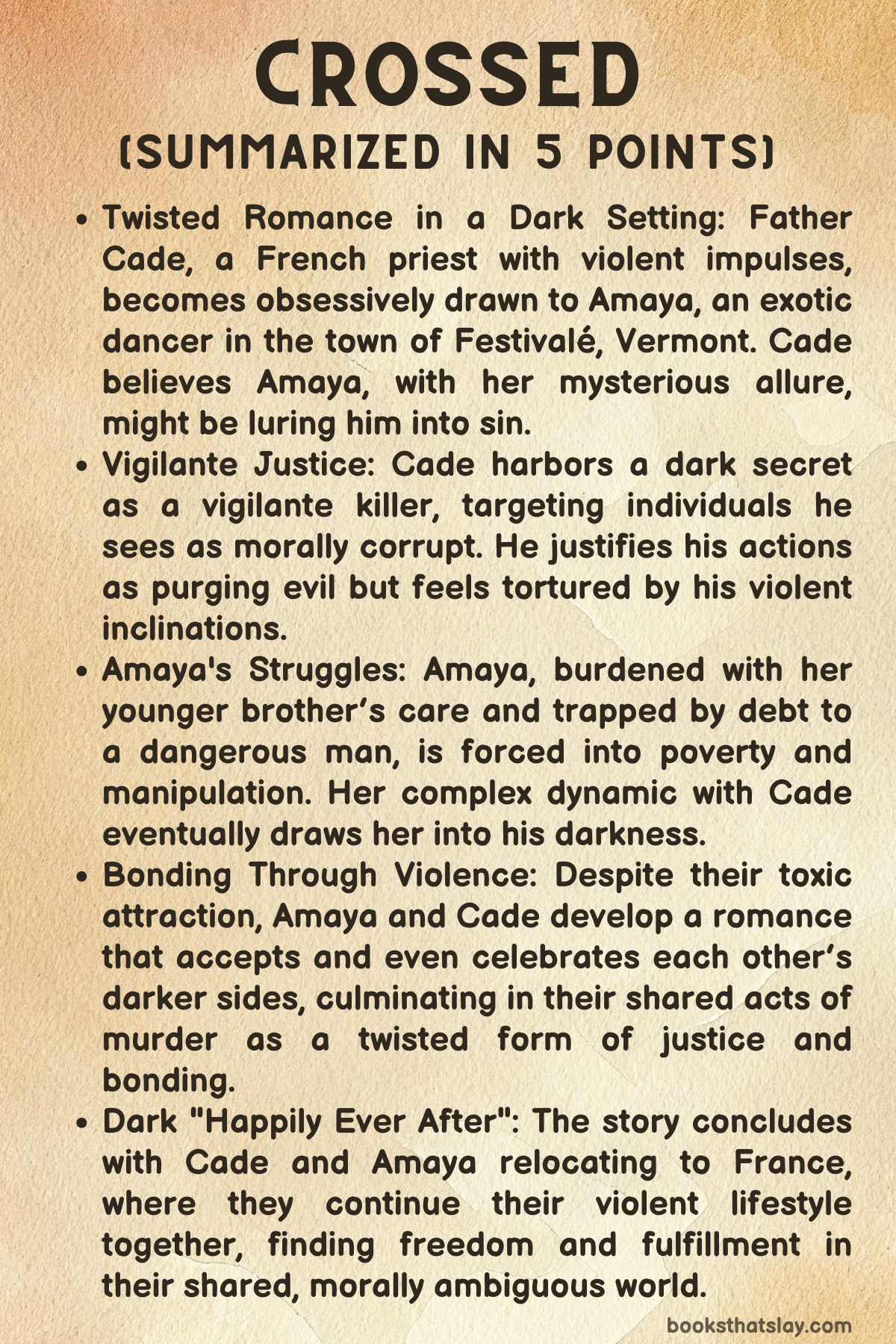
“Crossed” by Emily McIntire is the fifth book in the Never After series. This story reimagines The Hunchback of Notre Dame, presenting a twisted romance between Father Cade, a morally conflicted priest with violent impulses, and Amaya, an exotic dancer trapped in poverty and caretaking duties.
Set in the ominous town of Festivalé, Vermont, this psychological thriller delves into the darker sides of human nature, exploring themes of obsession, vengeance, and redemption. McIntire crafts a haunting and hyperbolic tale of romance where love collides with deadly intentions.
Summary
Cade arrives in the shadowed town of Festivalé with a mission he frames as holy, yet beneath the surface lies his compulsion for violence. His arrival is marked by murder: a woman he sees as a demon falls victim to his twisted perception of righteousness.
Cloaked as Father Cade Frédéric, he begins his post at the cathedral, bearing the façade of a spiritual leader while privately battling urges he has never escaped since his abusive childhood in a monastery. His sadistic upbringing at the hands of Sister Agnes, who declared him cursed, shapes the fractured man he has become.
Amaya, meanwhile, bears the weight of her family’s abandonment. Left to raise her autistic brother Quinten after her mother deserted them, she shoulders responsibility with little support.
Parker, a manipulative and wealthy figure tied to the mayor, uses her mother’s so-called debts to exploit her. To provide for Quinten’s therapy and survival, Amaya dances under the stage name Esmeralda at a club called the Chapel.
Though she finds fleeting control in her performances, she hides the work from Parker, who would twist it into further leverage against her.
The lives of Cade and Amaya collide at the Chapel. Cade, drawn against his will, watches her on stage and feels a stirring desire he cannot suppress.
Amaya notices his presence, sensing danger but also fascination. Their connection deepens during encounters at confession and chance meetings, where Cade oscillates between wanting to protect her and believing she must be purged of sin.
He punishes himself with self-flagellation and prayer after every moment of lust, but his obsession only grows.
Parker remains a constant, oppressive figure in Amaya’s life. His history with her includes manipulation, threats, and sexual violence, making him both her abuser and captor.
When Cade confronts him at the church, their clash establishes a rivalry. Parker flaunts his influence, but Cade resists, stating his loyalty lies only with God.
The encounter fuels Parker’s interest in Amaya’s entanglement with the priest, while Cade increasingly views Parker as a source of corruption in the town.
As the Festival of Fools approaches, tensions rise. Cade watches Amaya’s struggles from a distance, increasingly unable to control his need for her.
At the same time, Amaya balances caring for Quinten, enduring Parker’s cruelty, and sustaining her double life. Their bond sharpens during private lessons required for Amaya’s proposed marriage to Parker, where vulnerability draws them closer.
They share pieces of their painful pasts, binding them through shared wounds even as forbidden desire simmers beneath.
The attraction between them escalates dangerously. In one night, Cade spies on Amaya through her window, and she responds by asserting control over the priest who watches her.
The moment confirms their shared obsession, even as it terrifies them both. Their connection becomes a secret flame, masked under Parker’s dominance and Cade’s vows.
During Mass, Cade publicly humiliates Parker while lingering in intimacy with Amaya, heightening the dangerous triangle binding them together.
Parker tightens his grip, forcing Amaya into his penthouse and exerting ownership over every aspect of her life, from clothing to finances. He manipulates her need to protect Quinten, ensuring she cannot escape.
Cade, in turn, stalks her relentlessly, watching over her as both protector and predator. His struggle deepens when he learns Amaya is suspected of a murder he himself committed, binding his guilt to her suffering.
The Festival of Fools becomes the breaking point. During the celebration, Florence, Parker’s lover and ally, orchestrates Quinten’s humiliation in front of the townspeople.
Consumed by rage, Amaya attacks Florence in a bathroom, nearly killing her. Cade rescues her, hiding her in the Green Mountain Monastery.
There, Amaya confesses the depth of Parker’s abuse, and Cade vows to act. He finds Dalia, Amaya’s confidante, murdered by Parker, and realizes Quinten has been taken.
In a brutal confrontation, Cade subdues Parker, torturing him and leaving him near death after reclaiming Quinten. Together with Amaya, he buries Parker’s body deep in the forest.
Their sins multiply when Amaya discovers her estranged mother living as Sister Genevieve at the monastery. Years of pain erupt, and Amaya strangles her mother to death, with Cade again aiding in the cover-up.
To protect Amaya, Cade manipulates events so that Parker is blamed as the Green Mountain Strangler. Florence survives Amaya’s attack but is coerced into pinning the crimes on Parker.
With Parker dead but officially hunted, Amaya is freed from his hold. Cade abandons the priesthood, severing his ties to God in favor of his devotion to her.
The two escape Festivalé with Quinten, relocating to the mountains of France. There, they reinvent their lives.
Amaya invests Parker’s wealth into rebuilding her hometown from afar and opening dance studios in memory of Dalia. Quinten thrives with proper care, away from the cruelty of Festivalé.
Cade and Amaya, though haunted by their pasts, embrace their obsessive bond as husband and wife, merging faith, violence, and desire into their own code of love.
Years later, they remain unrepentant and inseparable. Their love is dark, consuming, and relentless, yet it grants them the belonging they had both been denied.
Amaya finds strength in Cade’s devotion, while Cade finds solace in her acceptance of his darkness. Together, they embody survival forged through vengeance and obsession, unbreakable in their shared eternity.
Characters
Cade Frédéric
Cade stands at the center of Crossed, a character defined by contradiction. On the surface, he is a priest who seeks to serve God and uphold the sanctity of his position.
Yet beneath that holy façade lies a man tormented by violent compulsions and obsessive desires. His past—marked by abuse at the hands of nuns who told him he was cursed—shaped him into someone who cannot reconcile faith with flesh.
This manifests in his brutal killings, which he cloaks in a ritualistic guise of exorcism. Cade’s struggle is not simply moral but existential; he both fears and worships his impulses, seeing them as a test from God.
His fixation on Amaya transforms him, simultaneously awakening desires he has suppressed and fueling his self-loathing. Obsessed, jealous, and violent, Cade nevertheless reveals tenderness when caring for Quinten, hinting at the fractured humanity beneath his darkness.
Ultimately, he abandons the priesthood, binding himself fully to Amaya, embodying a man who embraces sin as a form of redemption.
Amaya
Amaya emerges as the emotional core of Crossed, a woman hardened by abandonment and abuse yet defined by resilience. Raised by a neglectful mother who left her to shoulder the burden of caring for her autistic younger brother Quinten, Amaya’s life is one of survival.
To protect him and sustain their household, she takes on the secret life of Esmeralda, a pole dancer who finds power in performance even while battling shame and fear. Her history with Parker—the sexual assault, the blackmail, and his continual hold over her—leaves her scarred, but not broken.
Amaya’s defining trait is her devotion to Quinten, a devotion that drives her every choice, from enduring Parker’s cruelty to risking herself at the club. Her relationship with Cade is fraught: part dangerous obsession, part salvation.
She becomes both victim and agent, killing when cornered and eventually embracing a life steeped in violence with Cade. Through her, the novel explores themes of survival, empowerment, and the thin line between love and destruction.
Parker Errien
Parker represents corruption, manipulation, and unchecked power within Crossed. On the surface, he is a wealthy and influential man, admired and feared in Festivalé.
Beneath that veneer lies a predator who thrives on control and cruelty. His relationship with Amaya is built on domination, from the moment he sexually assaults her to his continued extortion under the guise of her mother’s debts.
He holds Quinten’s future hostage, using it to manipulate Amaya into compliance. Parker’s sadism emerges in acts both petty and brutal—killing Quinten’s pet, humiliating Amaya in public, and ultimately murdering Dalia.
Yet, he hides behind influence and respectability, shielded by alliances with the town’s elite. His presence fuels much of the conflict in the narrative, positioning him as both Cade’s adversary and Amaya’s tormentor.
His downfall at Cade’s hands is both personal vengeance and symbolic justice, as the embodiment of Festivalé’s rot is destroyed.
Quinten
Quinten provides the innocence and purity that contrasts with the darkness of Crossed. As Amaya’s younger brother, his autism shapes much of her life, creating both challenges and purpose.
He is frequently the target of cruelty, mocked by other children and belittled by adults like Florence, but through these moments his gentle nature shines. Quinten becomes a tether for Amaya, anchoring her to love and hope even in the face of despair.
His interactions with Cade reveal another side of the priest—compassion and genuine kindness—further complicating Cade’s character. While Quinten is often caught in the crossfire of the adult conflicts around him, he symbolizes what Amaya fights for: a chance at a better life.
In the end, his flourishing under Amaya and Cade’s care in France shows the possibility of healing and growth amidst trauma.
Florence Gammond
Florence embodies hypocrisy and malice within the story. Outwardly pious and socially influential, she uses her standing to belittle Amaya and Quinten, perpetuating the stigma against their family.
Her affair with Parker reveals her own duplicity, as she condemns others while engaging in moral corruption herself. Florence represents the judgmental cruelty of the town, hiding behind religion and reputation while causing harm.
Her public insults toward Quinten highlight the viciousness with which she wields her power, and her eventual confrontation with Amaya ends fatally. Though she survives Amaya’s brutal attack long enough to serve Cade’s manipulations, Florence’s downfall signifies the collapse of Festivalé’s false moral order.
Sister Genevieve
As both Amaya’s mother and later revealed as Sister Genevieve, she embodies betrayal and hypocrisy. In Amaya’s youth, she is neglectful, drifting between men and leaving her children vulnerable.
Her involvement with Parker sets the stage for much of Amaya’s suffering, as she abandons her children when life grows difficult. The revelation that she lived on as a nun adds another layer of duplicity: cloaking her abandonment in religious piety.
For Amaya, confronting her mother is the culmination of years of resentment and trauma. By killing her, Amaya symbolically severs the last tie to her painful past, an act that blends vengeance with liberation.
Genevieve thus serves as both the source of Amaya’s suffering and the final obstacle she must overcome to embrace her future.
Dalia
Dalia is one of the few sources of warmth in Crossed. Once a dancer herself, she provides both companionship and support to Amaya, helping care for Quinten and offering a semblance of friendship amid chaos.
Her character illustrates what survival looks like without succumbing to corruption: though disabled by an accident, she remains compassionate and grounded. Dalia’s murder at the hands of Parker is devastating, stripping Amaya of her closest ally and deepening her entrapment in violence.
She also serves as a contrast to Amaya—someone who chose a different path but whose life was still destroyed by the rot of Festivalé.
Jeremiah
Jeremiah, Cade’s young assistant, functions as both foil and witness to Cade. His innocence and eagerness contrast sharply with Cade’s corruption and darkness.
He represents the future of faith untainted, highlighting what Cade has lost. Through his eyes, the townspeople’s perceptions—such as their belief in Amaya’s family being cursed—are revealed, adding depth to the atmosphere of suspicion and superstition.
Jeremiah may not shape the central conflict, but his presence underscores Cade’s duality: the mentor who guides yet hides monstrous impulses.
Themes
Corruption and Power
In Crossed, the town of Festivalé itself becomes a living representation of corruption and decay, a place where power is concentrated in the hands of Parker Errien. His influence stretches beyond financial control; he manipulates the justice system, uses religion as a shield, and parades his respectability while concealing monstrous abuses.
The theme of corruption is not limited to Parker alone—institutions like the church and local government are complicit, creating an environment where the vulnerable are exploited. Cade’s arrival as a priest initially appears to counter this, but his own compulsions render him an ambiguous figure.
His role in the church, an institution traditionally tied to morality and purity, contrasts violently with his inner violence and obsession, exposing how even sacred spaces can harbor moral rot. Amaya’s forced entanglement with Parker also underlines how corruption thrives when those in power prey on women with little social or economic protection.
Ultimately, power in Festivalé is exercised not as responsibility but as domination, revealing how easily morality can be twisted to mask cruelty.
Violence and Salvation
Violence functions as both a curse and a salvation in Crossed, forming one of its most unsettling themes. Cade embodies this contradiction: he kills under the delusion that he is purging demons, and though his actions are brutal, he interprets them as holy rituals.
His self-flagellation after sexual arousal further underscores the way violence is tied to his sense of righteousness and punishment. Amaya, too, eventually succumbs to violence when pushed beyond endurance—her murder of Florence emerges not as a random act but as a desperate defense of her brother and herself.
The narrative blurs the line between destruction and deliverance, suggesting that violence becomes a means of reclaiming agency in a world where legal and moral systems fail the oppressed. Parker’s eventual torture and death at Cade’s hands reflects this cycle, presenting vengeance as a twisted form of justice.
In the end, salvation is not delivered through forgiveness or law but through acts of brutality that grant characters a warped sense of liberation.
Trauma and Survival
Every major character in Crossed is shaped by trauma, and survival becomes a daily act of negotiation with past wounds. Cade’s childhood under abusive nuns instills in him both a fractured faith and violent compulsions, leaving him perpetually torn between self-hatred and the search for divine purpose.
Amaya’s trauma is equally profound—sexual assault by Parker, abandonment by her mother, and the crushing responsibility of raising her brother under hostile circumstances. For her, survival is not just financial but emotional, as she must shield Quinten from the cruelty of the outside world while enduring Parker’s extortion.
The book portrays trauma not as a single event but as a recurring cycle that leaves scars on every choice and relationship. What stands out is the resilience forged in these conditions: Amaya finds strength in her dual life as Esmeralda, while Cade clings to faith even as it warps into obsession.
Survival becomes less about overcoming trauma and more about learning to live with it, shaping identities and choices in ways that cannot be undone.
Forbidden Desire
Desire in Crossed is never innocent or safe—it is always charged with danger, sin, and secrecy. Cade’s attraction to Amaya is filtered through his role as a priest, turning their bond into an act of blasphemy in his own mind.
His arousal, mixed with violent impulses, creates an atmosphere of menace, where lust becomes indistinguishable from compulsion. The infamous scene at Amaya’s window crystallizes this theme, showing how desire can shift power between them: Amaya, so often powerless under Parker’s control, finds a fleeting sense of empowerment in reversing the gaze and making Cade succumb to her presence.
For Cade, however, desire is entangled with guilt, punishment, and ritualistic suffering, revealing how forbidden intimacy corrodes his faith. This theme underscores how attraction becomes a battlefield, not an embrace—something both characters weaponize against their own vulnerabilities and fears.
Desire is not redemptive here; it is corrosive, obsessive, and inescapable.
Faith and Hypocrisy
Faith in Crossed is presented as both a guiding light and a tool of oppression. Cade’s priesthood positions him as a moral leader, yet his violent urges and lust expose the contradictions between religious ideals and human flaws.
His self-perception as God’s servant is compromised by his inability to resist sin, raising questions about whether his mission is divine or delusional. The hypocrisy extends beyond Cade to the broader religious institutions: Sister Agnes, who raised him, cloaked abuse in the language of spiritual correction, while figures like Florence used church authority to reinforce cruelty and social dominance.
Amaya’s relationship with faith is equally fractured—her mother forced her into religious observance despite her own hypocrisy, leaving Amaya disillusioned with its promises of protection. What emerges is a picture of faith corrupted by human agendas, where devotion becomes a mask for control.
Yet despite this, both Cade and Amaya reshape faith into something personal and unconventional, a twisted but binding force that allows them to justify their choices and find solace in each other.
Love, Obsession, and Redemption
The relationship between Cade and Amaya defies easy categorization. Their bond oscillates between love and obsession, each seeing in the other both danger and salvation.
Cade views Amaya as temptation and redemption simultaneously, torn between killing her and worshiping her. Amaya, though fearful of his fixation, comes to see in him a protector and partner who, unlike Parker, acknowledges her strength and pain.
Their union is forged in secrecy, violence, and rebellion against the forces that sought to destroy them. By the end of the novel, love transforms into a shared defiance of societal norms, a relationship built not on purity but on acceptance of darkness.
Redemption here does not mean forgiveness or moral cleansing—it means creating a life where their flaws, traumas, and sins become the foundation of intimacy. Their marriage and escape to France mark not a return to innocence but an embrace of their shared shadow, suggesting that love can thrive even in the darkest soil, provided it offers belonging and unflinching recognition.