Crossroads by Devney Perry Summary, Characters and Themes
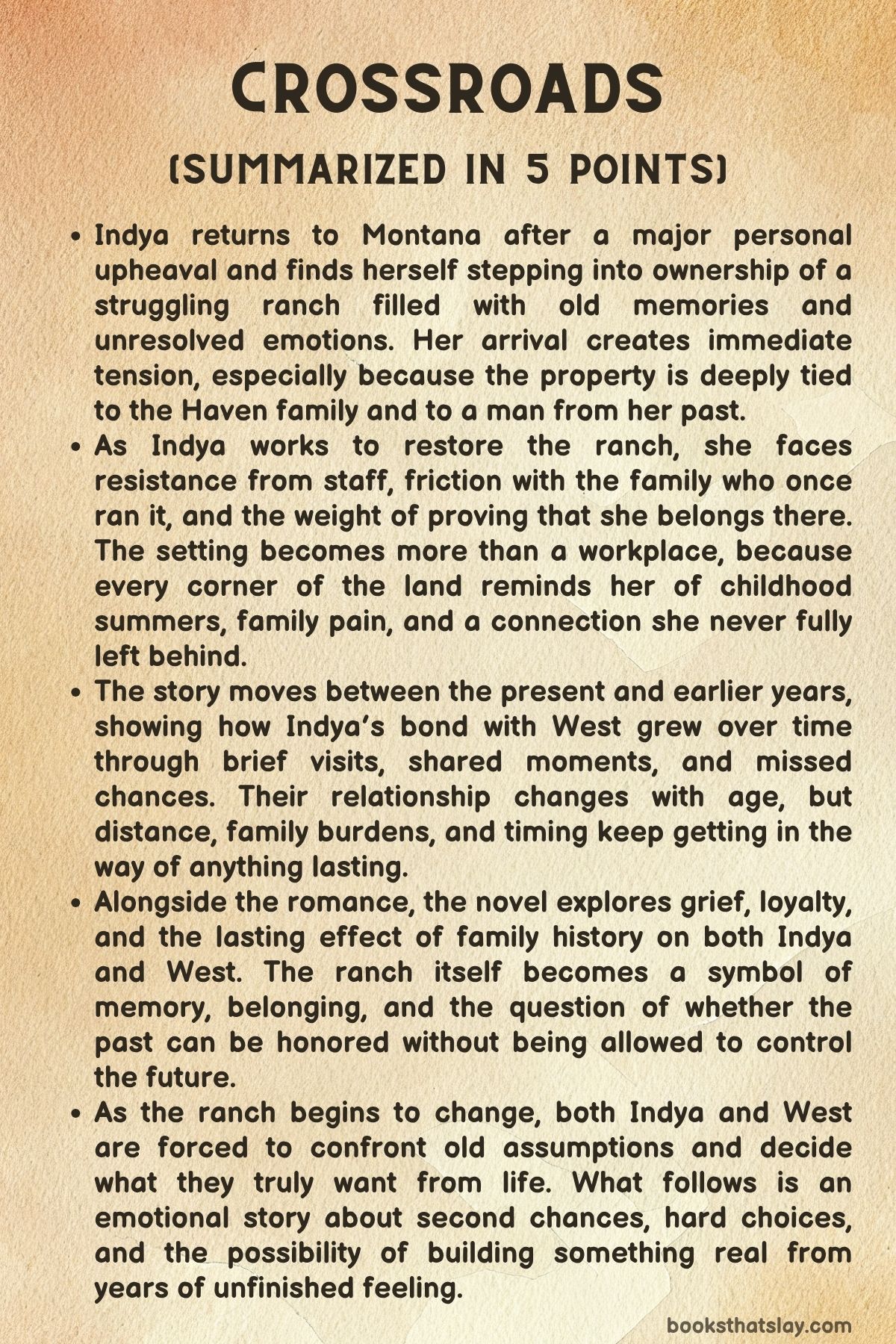
Crossroads by Devney Perry is a contemporary small-town romance set against the wide-open landscape of Montana. It follows Indya Keller, who arrives at a struggling ranch after a painful divorce and an unexpected purchase that shocks the Haven family, especially West Haven, the man tied to her past.
The story moves between the present and memories from earlier visits, showing how years of longing, missed chances, family hardship, and unfinished love shaped them both. At its core, this novel is about grief, loyalty, reinvention, and the question of whether two people who have always found each other at different moments in life can finally choose the same future. It’s the first book in the Haven River Ranch series.
Summary
Indya Keller drives from Texas to Montana after her divorce, heading toward the ranch that shaped many of her most important memories. The place once offered comfort to her father during his long fight with cancer, and it became the setting of her deep, complicated bond with West Haven.
When she arrives, she finds the property worn down and badly in need of attention. The guest cabins are neglected, the business is struggling, and the atmosphere is tense.
Her arrival causes an even greater shock when it becomes clear that she has bought the ranch from Curtis Haven, West’s father, without Curtis having warned his sons in advance.
The news lands badly. Jax Haven reacts with open disbelief, while West is stunned into silence and anger.
He has spent years working for the ranch, believing it would one day be his. To him, Indya’s purchase feels like theft, betrayal, and the final proof that he has been shut out of decisions about the land he loves most.
Indya, already uncertain of her welcome, feels even more alone. She knows she needs West if the ranch is going to survive, but she also knows their history makes every conversation harder.
Through flashbacks, the story shows how their connection began. Indya first came to the ranch as a child while her father was ill.
West, only a little older, became her guide to this unfamiliar world. He showed her his horse, played games with her, and slowly became the center of her happiest summers.
As the years passed, her family returned again and again. Indya’s father experienced periods of remission and decline, and each visit carried a different emotional weight.
At the same time, Indya and West grew from children into teenagers, and their friendship changed into attraction.
These memories reveal that Indya’s life was marked by fear, sadness, and uncertainty because of her father’s illness. The ranch gave her relief from that constant pressure.
West became linked to safety, freedom, and the feeling that she was most herself in Montana. For West, Indya was never just a guest.
She was the bright point in a hard home life. His family was cracking under the strain of Curtis’s failures and betrayal, and Indya’s visits became the moments he looked forward to most.
In the present, Indya takes control of the ranch with determination. She begins cleaning up operations, enforcing rules, improving service, and making practical changes that staff resist.
Some employees dislike her authority, others resent her as an outsider, and gossip spreads quickly. Even so, she keeps going.
She updates the business, pushes for renovations, adds menu options, hires workers, and starts pulling the ranch into a stronger financial position. West watches this with mixed feelings.
He still resents how she arrived and what her ownership represents, but he cannot deny that her decisions are working.
The tension between them remains intense from the start. Old attraction resurfaces almost immediately, mixed with years of hurt and unfinished feeling.
West confronts her, asking her to sell the ranch to him, though both know he cannot afford it. Their arguments are sharp because neither of them is talking only about business.
Beneath every exchange is the long history of what they were to each other, what they might have been, and what they lost through time and distance.
As more of the past comes into view, it becomes clear that Indya and West crossed paths at crucial ages. Their teenage bond deepened when Indya’s father’s cancer returned, and West offered comfort when she felt she had nowhere to put her fear.
Their first kiss changed everything. Later, when Indya was older, they had sex for the first time, and for her it carried emotional weight far beyond desire.
Montana and West came to represent home in a way Texas never fully did. Yet real life always interrupted them.
She would leave. He would stay.
They would part with promises and longing, but never a true plan.
Years later, those old emotions turn physical again. After confusion, jealousy, and hesitation, Indya and West give in to their attraction.
Their connection is immediate and familiar, but it also unsettles them because it awakens feelings they never resolved. Indya especially struggles with this.
She has come to Montana with a purpose and an exit plan. She tells herself she will only stay a year, fix the ranch, and leave.
Letting West matter again threatens that structure. West, meanwhile, is caught between hope and caution.
He knows how deeply he feels for her, but he also knows their timing has failed before.
As the ranch improves, West gradually begins to understand the scale of what Indya is doing. Bookings increase, the property looks better, and the business starts attracting guests again.
Even Jax softens somewhat. West also shares painful truths about his family: Curtis’s affair, the damage it caused, the complicated origins of Jax, the divorce, bad financial decisions, and the manipulations that helped push the ranch toward collapse.
These revelations explain why West is so fiercely attached to the land and why Curtis’s sale cut so deeply.
Indya’s own emotional burden grows heavier because of unfinished ties in Texas. Her ex-husband, Blaine, pressures her about legal documents connected to her father’s company.
For Indya, that business is one of the last living links to her father. Holding onto it feels like holding onto him.
Yet Blaine’s continued interference makes clear that her old life still has power over her. When he arrives in Montana and forces the issue, she signs the papers that give him control.
Though the deal provides financial security, it feels like another death. The loss hits her hard, and she breaks down in grief, especially when she learns her father’s old voicemail is finally gone, ending one of the rituals that had kept his memory close.
At her lowest point, West stays with her. He holds her through the grief instead of trying to fix it, and that support allows Indya to finally speak the full truth.
She admits that buying the ranch was never about taking something from him. Blaine had been waiting for the chance to buy the land and turn it into something shallow and unrecognizable.
Indya could not let that happen. She used the money from the sale of her father’s company to buy the ranch first, protect it, restore it, and ultimately preserve it for West and for what the place meant to her father.
She had planned to return it, but she kept the truth secret because she believed West would resist or misunderstand her motives.
West is hurt that she did not trust him with the truth from the beginning, and his anger is real. But once he understands the heart of what she did, he also sees the depth of her love, not only for the ranch but for him.
Indya did not come to destroy his future. She came to save it.
That realization changes everything.
In the end, the emotional distance that has defined their relationship finally closes. West tells Indya he loves her.
Indya admits she no longer wants to leave Montana. What had always been temporary between them becomes permanent.
They choose each other openly, without the old pattern of departure and regret.
Seven years later, their shared life proves that choice was the right one. The ranch is thriving under their leadership, their family is growing, and the meadow once tied to Indya’s father has become the place where their own future stands.
After years of meeting only in passing moments, they have built a home at the very place where their story began.
Characters
Indya Keller
Indya is the emotional and moral center of Crossroads, but what makes her compelling is that she is never presented as simple or easy to understand. She arrives in Montana carrying several layers of loss at once: the end of her marriage, the long shadow of her father’s illness and death, and years of unresolved feeling tied to the ranch and to West.
Her outward manner is controlled, efficient, and often firm to the point of coldness, yet that composure is less a sign of emotional distance than of survival. She has learned to function by containing her feelings, organizing problems, and moving forward even when she is breaking inside.
That habit explains why so many people at the ranch misread her. They see a sharp outsider who buys a beloved property and imposes new systems, but they do not see the grief, love, and fear that shaped every one of her choices.
One of the most interesting things about Indya is the contrast between how deeply she feels and how rarely she says what she feels in the moment. Her attachment to the ranch is not based on nostalgia alone.
It is tied to her father, to the memory of the few places where he seemed peaceful, and to the summers in which her own identity felt most natural and least constrained. That connection makes her purchase of the property far more personal than it first appears.
She is not chasing power or status. She is trying to protect something sacred.
At the same time, she is practical enough to recognize what the place needs in business terms. She sees poor management, neglected facilities, weak staffing, and outdated systems, and she moves quickly to correct them.
That combination of emotional loyalty and operational competence makes her more than a romantic heroine; it makes her a builder.
Indya’s inner conflict comes from the fact that she wants belonging but has trained herself to expect separation. Throughout her life with West, she has been the one who leaves.
Even when she imagines staying, she does not quite trust permanence. Her pattern is to love intensely and then pull back before that love can demand a full transformation of her life.
Her failed marriage reinforces that tendency, because it leaves behind humiliation, distrust, and a sense that she has already spent too much of herself on the wrong future. Her reluctance to explain herself to West is therefore consistent with her larger character.
She is not withholding because she enjoys secrecy. She is withholding because honesty would expose how much he still matters, and that exposure feels dangerous.
Her grief is also central to understanding her. The ritual of calling her father’s voicemail shows how deeply she resists finality.
She is a woman trying to keep a connection alive through routine, memory, and place. When she finally loses even that fragile line to him, her breakdown marks a turning point.
It forces her out of management mode and into full emotional truth. Only then can she admit not just why she bought the ranch, but what she wants for herself.
Her arc is therefore about more than romance. It is about moving from duty to desire, from controlled survival to chosen life.
By the end, she no longer treats Montana as a temporary stop or a problem to solve. She allows it to become home.
West Haven
West is written as a man shaped by land, labor, silence, and disappointment. He is deeply attached to the ranch not simply because he works there, but because it forms the structure of his identity.
He understands the rhythms of the place, the work required to keep it alive, and the pride of maintaining something with his own hands. For years, he has treated the property as his future, only to discover that his father never truly included him in the decisions that mattered most.
That betrayal explains the force of his reaction when Indya arrives as the new owner. His anger is not only about ownership.
It is about being denied inheritance in the deepest sense: not just land, but recognition, trust, and a place in the story of his own family.
West’s emotional style is direct in feeling but limited in expression. He is not dishonest with himself about desire, loyalty, or love, but he often struggles to translate those emotions into clear conversation.
His instinct is action. He rides, repairs, confronts, protects, and endures.
This gives him a powerful physical presence in the story, yet it also leaves him vulnerable to misunderstanding. When he pushes back against Indya, some of that behavior is about pride, but much of it comes from disorientation.
The world he counted on has shifted, and he has not had time to prepare for the change. His frustration with Curtis runs especially deep because it confirms what he has long suspected: that he can carry responsibility without being granted authority.
His relationship with Indya reveals the softer, more exposed parts of him. From childhood onward, she represents something outside the hardness of his daily life.
She is linked to play, longing, escape, and possibility. Yet because their connection develops in fragments over years, West never gets the ordinary progression of building a life with her.
He gets summers, stolen moments, half-finished conversations, and the ache of watching her leave. That history gives his love a durability that feels believable.
It is not based on fantasy alone. It has endured time, distance, other relationships, and disappointment.
At the same time, it has left him with habits of emotional caution. Even when he is physically close to her, he often seems to brace himself for loss.
West’s growth lies in his ability to move beyond hurt and see intention. For much of the narrative, he interprets events through the lens of betrayal: Curtis sold the ranch, Indya took it, and once again he is left reacting to choices made around him.
But as the truth emerges, he has to confront a more difficult reality. The woman he loves did not arrive to strip him of his future; she arrived to preserve it.
Accepting that requires humility, because it means admitting that his anger only told part of the story. His development is therefore not a rejection of his pride or strength, but a refinement of both.
He remains a man of conviction, yet he becomes more capable of trust, partnership, and emotional openness. By the end, he is no longer just the keeper of the land.
He becomes part of a shared future built with someone who understands what that land means.
Curtis Haven
Curtis is one of the most complicated figures in the novel because he is both the source of much of the damage and also a tragic figure in his own right. He represents failed leadership, not only in business but in family.
His poor decisions, resistance to change, moral weakness, and inability to communicate honestly leave lasting marks on everyone around him. The decline of the ranch is closely connected to his stubbornness and shortsightedness.
He allows the property to fall behind, mishandles financial matters, and shuts out the very son most prepared to help save it. His sale of the land without warning West becomes the clearest symbol of his failures as a father.
It is not simply a business transaction. It is an act that tells West his devotion and labor were never enough to earn trust.
At the same time, Curtis is not drawn as a flat villain. His decline carries the weight of regret, exhaustion, and emotional collapse.
By the time the present-day story unfolds, he is a man diminished by age, injury, drink, and the consequences of choices he can no longer undo. His indifference often feels less like cruelty in the moment and more like surrender.
He has made such a mess of things that he can only half-face it. That weakness does not excuse him, but it does make him believable.
He is the kind of man who allowed himself to drift into failure through ego and avoidance, then lost the strength to confront what he had done.
His history with West’s mother and the affair that led to Jax’s birth deepens the portrait. Curtis is someone whose selfish decisions fractured the emotional ground beneath his family.
He creates obligations he cannot manage and wounds he cannot repair. Yet the novel also suggests that he is trapped by his own limitations.
He does not know how to change, how to lead differently, or how to rebuild relationships once broken. This makes him less an active force of malice than a chronic source of instability.
What matters most in his characterization is how he contrasts with both West and Indya. Where Curtis avoids hard truths, they face them.
Where he lets the ranch decay, they restore it. Where he keeps secrets that destroy trust, they finally move toward honesty.
In that sense, he serves as a negative inheritance. The life West and Indya build is meaningful partly because it rejects Curtis’s model of ownership, masculinity, and authority.
He is the warning embodied in a father figure: love without responsibility, power without stewardship, and tradition without adaptation.
Jax Haven
Jax begins as a reactive and somewhat immature presence, but he plays an important role in showing how family instability affects people differently. He is the more openly vocal Haven son, quick to complain, resist, and speak in frustration.
His first reaction to Indya’s ownership is direct outrage, which makes him appear less controlled than West. Yet that openness also gives his character a certain honesty.
He says what others are trying not to say. The ranch matters to him, even if his connection to it is less disciplined or idealized than West’s.
His family position is crucial. Jax is the living result of Curtis’s affair, and that fact shapes his place in the family whether or not it is openly discussed every day.
He grows up in a tense emotional structure in which his existence is tied to pain and compromise. West’s mother cared for him but did not fully claim him, and Curtis’s failures created an environment where no one’s role was secure.
That history helps explain Jax’s defensive quality. He has likely spent much of his life negotiating rejection, resentment, and uncertainty about where he belongs.
Jax’s resistance to working under Indya is not only stubbornness. It reflects pride, wounded family loyalty, and fear of further displacement.
If West experiences the sale as betrayal, Jax experiences it as another reminder that nothing stable lasts. His willingness to repeat ugly gossip about Indya shows his immaturity, but it also reveals how quickly bitterness seeks easy language.
He is not as emotionally disciplined as West, and he lacks Indya’s sense of long-term purpose. For that reason, he initially seems smaller than the larger conflict around him.
Still, his gradual softening matters. As the ranch begins to improve, Jax is forced to confront results rather than assumption.
He may not become the emotional center of the story, but he helps show how change is often accepted in stages: first through resentment, then reluctant participation, and finally recognition. He represents a more ordinary human response to upheaval.
Not everyone adapts with grace or insight. Some complain, resist, and circle back slowly.
That realism gives him value. He is not there to be heroic.
He is there to show the rougher edges of family loyalty and the difficulty of accepting that an outsider may be saving what insiders could not.
Blaine
Blaine functions as both a personal antagonist and a symbol of the life Indya must leave behind. He is controlling, dismissive, and transactional in the way he relates to her.
His importance lies not in complexity but in what he reveals about Indya’s emotional history. Through him, the novel shows what happens when a woman who longs for safety and certainty chooses a future that looks respectable but offers neither respect nor understanding.
Blaine talks down to Indya, pressures her, distrusts her, and treats major emotional matters as problems to be managed on his own terms. He does not understand her bond with Montana, her father, or the ranch because he does not truly understand her.
His connection to the ranch makes him more threatening than a merely unpleasant ex-husband. He has been circling the property for years, waiting for the right opportunity to reshape it for profit.
That motive aligns with his general character. He sees value in terms of leverage, acquisition, and control.
The land is not meaningful to him as memory, home, labor, or inheritance. It is an asset.
This outlook places him in sharp contrast with both Indya and West, for whom the ranch holds emotional and moral value.
Blaine’s arrival in Montana during the later part of the story is especially telling because it interrupts one of the first periods in which Indya is beginning to live according to her own heart rather than obligation. His insistence on immediate signatures and his lack of sensitivity to what those papers mean to her expose his central flaw: he confuses legal possession with human understanding.
He believes that because something can be formalized, it can be stripped of emotional consequence. But for Indya, signing away her father’s company is bound up with grief, memory, and identity.
As a character, Blaine is useful because he sharpens the contrast between possession and partnership. He once held the place of husband in Indya’s life, but he never offered the kind of love that sees, honors, and supports who she really is.
That is why his role, though unpleasant, is necessary. He is not simply the man she leaves.
He is the embodiment of the wrong future.
Indya’s Father
Indya’s father has limited page presence, yet his influence reaches through almost every emotional thread in the novel. He is associated with warmth, encouragement, vulnerability, and a deep love for the Montana landscape.
The ranch becomes meaningful to Indya largely because it mattered to him. It was a place where illness did not entirely define him, where he could still feel wonder, rest, and possibility.
Because of that, his memory is built into Indya’s understanding of love and home. She does not separate the land from him.
To protect one is, in a sense, to protect the other.
What makes him important is not just that he dies, but how his illness shapes his daughter’s emotional formation. Indya grows up under the pressure of recurrence, remission, fear, and anticipatory grief.
Her father’s condition teaches her early that joy can be temporary and that peace must often be taken where it can be found. This helps explain why the ranch and West become so powerful in her imagination.
They are linked to moments when the burden lifted slightly.
He also seems to understand Indya better than many others do. He recognizes what the place gives her, and he senses her attachment even when she is uncertain about naming it.
His presence in the flashbacks often carries an emotional steadiness that counterbalances the instability elsewhere in her life. He is not idealized as a distant saint so much as remembered as the person whose love felt secure and grounding.
Even after death, he remains active in the story through memory, ritual, and the choices Indya makes. Her calls to his voicemail show that she is still speaking to him in order to orient herself.
The meadow he loved becomes a place of mourning and later of renewal. In many ways, her final decision is also a continuation of his legacy.
She chooses the life that honors what he cherished most: honesty of feeling, attachment to the land, and the courage to recognize where one belongs.
Courtney
Courtney represents manipulation, false promise, and the kind of relationship built on distortion rather than truth. Her role in the history of the ranch is larger than her immediate presence might suggest.
She is connected to financial damage, emotional confusion, and one more chapter in Curtis’s bad judgment. Through West’s recollection, she appears as someone who took advantage of weakness and helped intensify the ranch’s decline.
Her influence is therefore both practical and symbolic. She is part of the reason the property became vulnerable in the first place.
In West’s personal life, she functions as a contrast to Indya. His connection with Courtney seems to have been based less on deep emotional truth than on self-deception and convenience.
He admits, in effect, that he persuaded himself to love her. That matters because it reveals how long he has been trying to live around the absence of what he really wanted.
Courtney is the proof that intimacy without authenticity cannot hold. Her cheating only reinforces that the relationship lacked a solid foundation from the start.
She also has significance in Indya’s emotional history. As a younger woman, Indya encounters the idea of Courtney as a threat, a sign that West may belong to someone else or to another life she can never fully enter.
That anxiety makes Courtney larger in memory than she might otherwise be. She becomes the face of timing gone wrong, of showing up too late, of being displaced in a story one hoped would remain unfinished.
When Courtney appears in the present, the scene matters less because she could truly take West back and more because her presence forces clarity. West rejects her plainly, and that directness strips away old fears.
She becomes a final echo of confusion before the story turns fully toward honesty and commitment.
Deb
Deb may seem like a secondary workplace character, but she is useful in showing how power and resentment circulate through the ranch. She represents the old culture of low standards, informal misuse, gossip, and quiet resistance to accountability.
Her attitude toward Indya is shaped by class assumptions, workplace habit, and the tendency to vilify a woman in authority more quickly than a failing man. Deb tolerated disorder under previous leadership, but she resists discipline when it arrives in a female form that expects competence.
Her gossip about Indya and West is especially telling because it reduces a complicated emotional history to rumor. In doing so, she reflects the social environment surrounding the main characters.
At the ranch, private pain and public judgment sit close together. Deb is not simply malicious; she is part of a culture that is used to talking around truth instead of addressing it directly.
The moment when she is caught taking food for herself also captures the moral texture of her character. It is a small act, but it signals entitlement and the normalized erosion of standards that Indya is trying to change.
Deb’s eventual removal matters because it marks a break between the ranch as inherited neglect and the ranch as intentional stewardship. She is less important as an individual psychological portrait and more important as a representation of the resistance that meets reform.
Vanessa
Vanessa has a brief but significant role in the emotional movement of the story. She initially appears as a possible romantic threat, especially through Indya’s eyes, because her presence near West activates old insecurity and jealousy.
That reaction is important because it reveals how quickly Indya returns to the emotional patterns of her younger self around him. Years may have passed, but some fears remain immediate.
Once Vanessa is understood correctly, however, her role shifts. She becomes evidence that not every woman near West is a rival and that not every emotional assumption needs to become a wound.
Her marriage and family place her outside the central romantic conflict, allowing the misunderstanding to dissolve. In narrative terms, she helps clear emotional fog.
The truth about her opens space for Indya and West to stop circling around imagined obstacles and confront what is actually between them.
Vanessa also contributes to the sense of an ongoing community around the ranch. She reminds the reader that this setting is not just a stage for two lovers, but a place where histories overlap and lives continue in different directions.
Her small role supports the larger emotional realism of the setting.
Indya’s Mother
Indya’s mother is not the dominant parental figure in the story’s emotional memory, yet she remains important because she shows another way grief reshapes family life. During the years of Indya’s father’s illness, she is often managing crisis, controlling environment, and trying to hold daily life together.
That practical role can make her seem more distant in Indya’s recollection, especially because Indya is drawn toward her father’s vulnerability and West’s companionship. Still, the mother’s presence reflects the exhausting labor of caregiving and the strain of living beside long-term uncertainty.
Her reactions to Indya during adolescence also suggest generational misunderstanding. She notices her daughter’s differences and responds with concern that may not always feel supportive.
This helps explain why Indya experiences the ranch as a place where she can breathe more freely. At home, she is being interpreted.
In Montana, she is simply being.
Later, when she and Indya return to spread the father’s ashes, her role becomes more openly tender. She shares grief rather than managing around it.
That moment matters because it shows mother and daughter joined in loss, no longer organized around the task of preserving hope during illness. Even her decision to discontinue the voicemail reflects a painful realism.
She is further along in accepting finality, while Indya is still holding on. Their difference is not cruelty versus love, but two distinct forms of mourning.
Themes
Love Shaped by Timing, Distance, and Return
The relationship at the center of Crossroads is not built on instant transformation but on repetition across time. That structure gives the love story its emotional force.
Indya and West do not meet once and fall cleanly into a future. They encounter each other at different ages, under changing emotional conditions, and with long stretches of absence between those meetings.
Because of this, love in the novel is never separate from timing. Feeling alone is not enough.
Place matters, age matters, family circumstance matters, and readiness matters. Each time they find each other, something external prevents the relationship from fully taking shape.
One of them must leave, grief intervenes, family duty interrupts, or life moves in a direction that cannot yet hold what they feel.
This treatment of love resists the fantasy that the right emotion automatically solves practical barriers. The bond between them is real from early on, yet reality keeps testing whether that bond can survive without daily life to support it.
Their history becomes a record of almosts: almost enough time, almost enough honesty, almost the right moment. That pattern could have turned their connection into pure nostalgia, but the novel avoids that by showing how each reunion changes them.
They are not trapped in one ideal memory. They are continually meeting each other again, and each meeting asks a harder question about whether love can move from intensity to stability.
The theme also works because the story does not frame delay as meaningless suffering. The years apart hurt them, but they also reveal who they are when stripped of romantic idealism.
West’s endurance, Indya’s competence, their separate disappointments, and the relationships they survive all contribute to a fuller understanding of what it would mean to choose each other for real. By the time they finally come together openly, the choice carries weight.
It is not based on summer memory or physical desire alone. It is based on knowledge, history, and the willingness to remain.
What makes this theme especially strong is that return becomes as important as longing. Both characters return not only to each other but to earlier versions of themselves.
The ranch holds memory, but it also tests whether memory can become present life. Love here is not a straight path forward.
It is a series of returns that only become meaningful when both people stop treating the future as temporary.
Grief as a Force That Shapes Identity
Grief in this novel is not limited to scenes of mourning. It lives inside personality, habit, attachment, and decision-making.
Indya’s life is profoundly shaped by growing up beside her father’s recurring cancer. That experience teaches her to expect interruption, to measure joy against possible loss, and to hold tightly to rituals that preserve emotional connection.
Her repeated phone calls to her father’s voicemail show grief as something active rather than concluded. She is not merely remembering him.
She is maintaining a relationship in the only way still available to her. This gives grief a daily, almost structural presence in her life.
The ranch becomes one of the main containers for that grief. It is where her father found peace, where family memory remains vivid, and where she can still feel close to a version of life that was meaningful before death reorganized everything.
Her decision to buy the property is therefore not just strategic or romantic. It is also an act of mourning.
She is preserving a landscape tied to the person she loved most. In that sense, grief becomes productive as well as painful.
It moves her toward action, investment, and preservation.
The story also shows that grief rarely exists in pure form. It mixes with guilt, anger, denial, and the fear of being forced to let go.
When Indya signs away her father’s company and then learns that the voicemail is gone, the moment carries such force because several layers of symbolic loss happen at once. She is not only losing a business or a recording.
She is losing the last structures through which she has continued to orient herself toward him. The collapse that follows is less about one event than about accumulated delayed mourning finally breaking through.
Importantly, grief is not portrayed as something love erases. West does not rescue Indya from it.
He accompanies her through it. That distinction matters.
The emotional maturity of the novel lies partly in its recognition that grief does not end simply because a new happiness appears. Instead, healing begins when grief can be shared, spoken, and integrated into a future rather than hidden inside private routines.
The life Indya ultimately chooses does not replace the father she lost. It honors him by allowing her to live fully in a place he loved.
Land, Stewardship, and the Meaning of Home
The ranch is not just a setting. It is the material form of inheritance, memory, conflict, and moral responsibility.
Different characters see the property in radically different ways, and those differences reveal their values. For West, the land represents labor, lineage, and selfhood.
He has worked it, planned around it, and imagined his adulthood through it. For Indya, it is tied to memory, belonging, and emotional truth.
For Blaine, it is a business opportunity. For Curtis, it becomes a burden he fails to manage responsibly.
Because the land carries so many meanings at once, control over it becomes a question not only of ownership but of worthiness.
What the story makes clear is that possession alone does not equal stewardship. Curtis legally owns the ranch for years, but under his leadership it declines.
He does not adapt, invest wisely, or create a sustainable future. His attachment to tradition is hollow because it lacks the discipline and imagination required to protect what he claims to value.
Blaine, by contrast, would likely modernize and monetize the property, but in a way that strips it of character and history. He represents a form of control that sees land as surface and profit.
Neither man understands home in the deeper sense the novel is interested in.
Indya and West ultimately do. What is striking is that they come to stewardship from different directions.
West brings knowledge of the land itself: animals, labor, structures, terrain, and continuity. Indya brings strategic vision, management, adaptation, and the willingness to challenge old habits.
The ranch thrives only when both forms of care come together. This gives the theme real substance.
Home is not romanticized as something one simply inherits or feels. It is something one maintains, protects, and reshapes with respect.
The novel also suggests that home is not always the place where one was expected to remain. Indya’s movement from Texas to Montana is not framed as abandonment of one identity for another, but as recognition of where her deepest attachments have always pointed.
Home, in this story, is where memory, love, and purpose can coexist. The ranch becomes that place because it holds the past without trapping the future.
It is where legacy is preserved not through stagnation, but through active care.
Secrecy, Misunderstanding, and the Hard Work of Trust
Much of the emotional conflict in the novel grows from the gap between intention and communication. People act out of love, fear, shame, pride, or self-protection, but they often fail to explain themselves in time.
The result is that others fill in the silence with their own pain. West thinks Indya has taken what should have been his, while Indya believes that revealing too much too soon would only make him reject the very thing she is trying to save.
Curtis keeps life-changing information from his sons, claiming necessity while deepening old wounds. Even in smaller moments, the story shows how quickly assumption becomes emotional fact when honest explanation is absent.
This theme works especially well because secrecy is not treated as one thing. Some secrets are selfish, others protective, and many are both.
Curtis’s secrecy is rooted in weakness and avoidance. He withholds truth because he cannot face confrontation and because he has long operated without treating West as a real partner.
Indya’s secrecy is more complicated. She keeps her full motive hidden because she fears resistance and wants to complete her plan without interference.
Her intention is loving, but the secrecy still causes damage because it denies West the dignity of knowing what concerns his own future. The novel is careful here.
Good motives do not erase the cost of silence.
Trust, then, is shown as something that cannot exist on feeling alone. Indya and West have loved each other for years, yet that love does not spare them from confusion.
They still misread one another, retreat when vulnerable, and use restraint as a shield. Their physical connection is often easier than their emotional clarity.
What changes their relationship in the end is not simply desire, but disclosure. The turning point comes when Indya finally tells the full truth and West is forced to reconsider the story he has been telling himself.
The theme also extends beyond romance into work, family, and inheritance. A failing ranch, a broken marriage, and a fractured father-son bond all emerge from versions of mistrust and incomplete truth.
By contrast, the future West and Indya create depends on transparency, shared labor, and the willingness to be known accurately. Trust in this novel is not passive confidence.
It is the hard-earned result of saying what one fears to say and remaining present after it is heard.