Cursed Daughters Summary, Characters and Themes
Cursed Daughters by Oyinkan Braithwaite is a multi-generational family story set in Lagos, told through three women bound by blood, memory, and a curse they can’t quite prove but can’t ignore either. After a young woman’s death, her cousin gives birth to a child who seems to carry the dead girl’s face, habits, and shadow.
As the family argues over tradition, faith, and blame, the past keeps resurfacing—through dreams, inherited fear, and love that never feels fully safe. It’s a sharp, intimate look at how families repeat stories, and how one woman tries to stop the repetition.
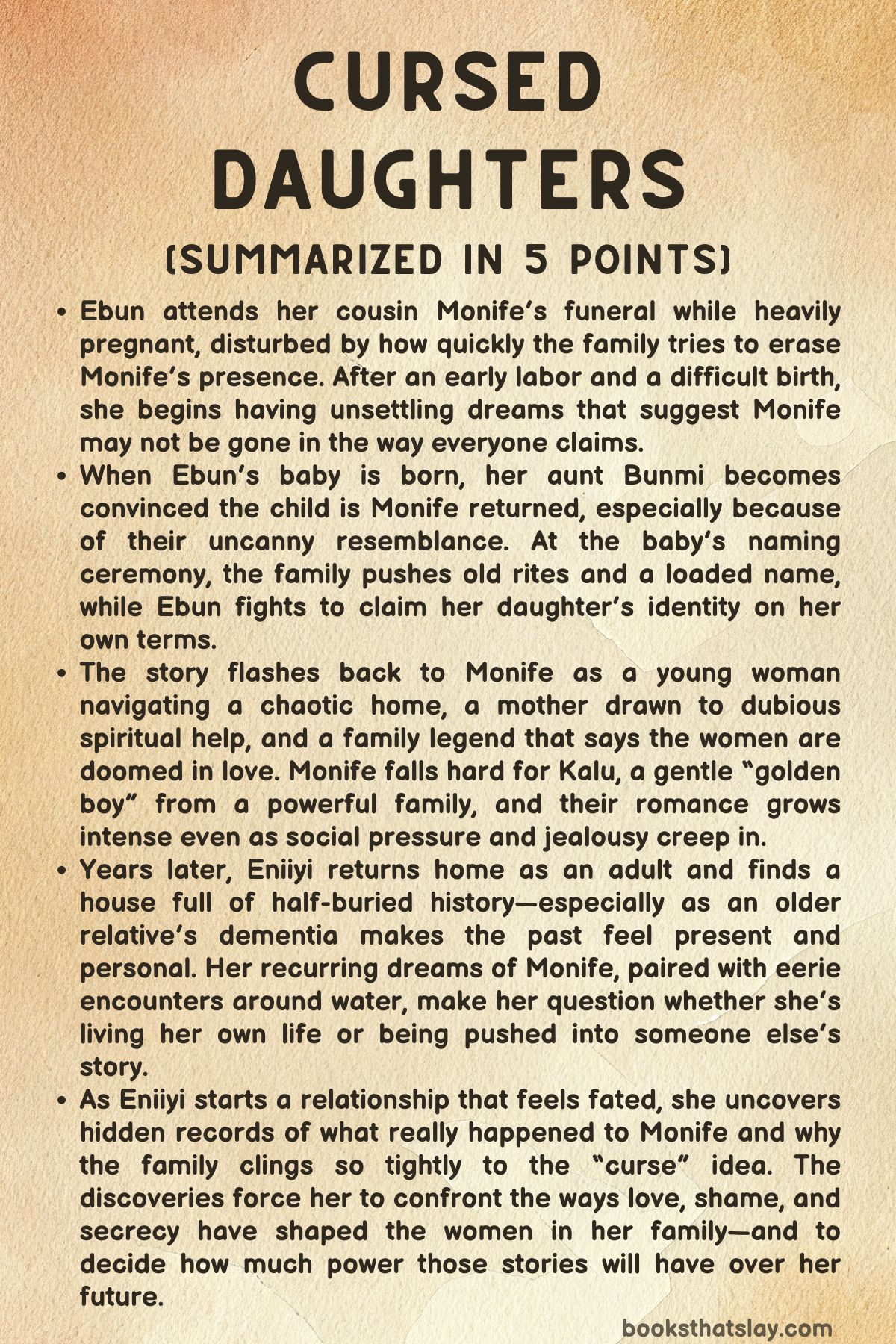
Summary
Ebun attends the funeral of her cousin Monife under a harsh sun, heavily pregnant and worn out. The day feels wrong to her: drums play, the heat presses down, and another nearby funeral sounds almost celebratory.
After the burial, she notices something unsettling at home—every photo of Monife has been taken off the walls. Her aunt Bunmi, Monife’s mother, has not come to the burial because of a family taboo, and when Ebun storms over to confront her, she finds Bunmi surrounded by women and the family’s spiritual adviser, Mama G. Ebun demands to know why Monife’s image is being erased, but in the middle of her rage her water breaks seven weeks early.
The room erupts into debate—prayers, rituals, panic—until Ebun forces the decision: she will go to the hospital.
Ebun gives birth to a baby girl after a painful labor. For a moment, everything narrows to relief: the child is alive, Ebun is alive, and her own mother bursts into joyful hymns and dancing with the newborn.
But that night Ebun dreams of Monife. In the dream, Monife appears barefoot and silent, lifting the baby from the crib and cradling her like she belongs there.
Ebun can’t move fast enough; fear pins her to the floor. She wakes to find the baby safe, telling herself it was only a nightmare, though the cold feeling stays.
As Ebun recovers, old memories sharpen. When she was eleven, Bunmi moved in with her children after her husband left.
Ebun’s cousin Tolu withdrew into himself, while Monife became Ebun’s companion and escape. Monife could be bright and funny, but her moods also turned sudden and dark.
During one of their childhood talks, Monife told Ebun about the Falodun curse: long ago, their ancestor Feranmi was cursed by a wronged wife after an affair, and since then the women of the family have expected love to sour, men to disappear, and heartbreak to arrive like a debt.
In the hospital, Bunmi takes one look at Ebun’s baby and reacts as if she’s seen a ghost. The child, she insists, looks exactly like Monife.
Bunmi claims Monife has returned in the baby—“come again”—and clutches the newborn with a desperate possessiveness that alarms Ebun. Ebun insists the baby is hers, not a second chance for anyone else, but her mother’s silence makes Ebun feel alone in the fight.
At the baby’s naming ceremony, the older women push traditional rites meant to protect the child, including humiliating symbolic foods Ebun doesn’t want. The names become a battlefield.
Bunmi chooses Motitunde, meaning “I have come again,” turning her belief into an official declaration. Ebun counters with Eniiyi, “a person of integrity,” trying to anchor her daughter to her own life instead of Monife’s shadow.
Years earlier, when Monife is a university student in the mid-1990s, she returns home to find Bunmi caught up in another spiritual scheme. Bunmi is convinced a spiritualist can bring back her estranged husband, and Mama G profits from that longing.
Monife, furious at the manipulation, confronts Mama G and sees the poverty and grime behind the promises. Around the same time, Monife brings home a puppy, Sango, against everyone’s wishes—an impulsive act that still feels like hope.
Monife’s home is tense: Bunmi is consumed by superstition and abandonment, while her sister Kemi throws herself into brief relationships, both women living under the same fear of being left. Monife tries to stay bold in the middle of it.
At a football match she notices Kalu, a graceful player with easy charm. They meet again at a party, and Monife pursues him with confidence.
She ends her current relationship quickly and sets her sights on Kalu, who soon asks her out. Their romance grows fast and soothing.
He listens, sketches with her, and offers a gentleness she hasn’t known at home. For once, she feels safe—yet she hides her family’s chaos from him, worried that talk of curses and spiritual fixes would stain their future.
A crack forms when Kalu’s wealthy mother, Mrs. K, meets Monife and treats her like a temporary distraction. Mrs. K questions her background, mocks her prospects, and even mentions rumors of a “family curse.” Monife walks out humiliated.
Kalu tries to smooth things over, but the pressure tightens when Ada Nnamani—polished, rich, and Mrs. K’s preferred match—appears in his orbit. Monife’s insecurity spikes, and she begins to imagine losing him not because he stops loving her, but because the world around him will not allow her in.
In desperation, Monife visits Mama G for help, insisting she doesn’t want anyone harmed. Mama G offers a charm to bind Kalu’s love: a powder to slip into his drink and a ritual involving his name and her menstrual pad.
Monife is disgusted, then ashamed that she even considered it, but fear makes her reckless. When Kalu later announces a trip where Ada’s family may be present, Monife secretly puts the powder into his malt.
When his silence afterward drives her frantic, she completes the ritual, telling herself she is only protecting what is already theirs.
Time passes, and the consequences arrive in a different form. Kalu becomes “Golden Boy,” married to Ada, but he returns to Monife anyway.
Their affair repeats in hidden meetings and lies until Ada confronts Monife directly and reveals she is pregnant. Soon Monife discovers she is pregnant too.
Kalu offers support without leaving his marriage; his mother demands an abortion. Monife refuses at first, then collapses under pressure and pain.
Ebun, pregnant as well, takes Monife with her to end their pregnancies. Monife miscarries in agony and falls into depression, while Ebun later admits she couldn’t go through with it and remains pregnant.
The betrayal Monife feels—by Kalu, by fate, by her own body, by the family story she was warned about—pushes her toward the water. One night she goes to a bridge, removes her shoes, and looks down.
In 2023, Eniiyi returns to the aging family house as an adult, carrying both affection and dread. Ebun is still practical and guarded.
One grandmother is loud and teasing; the other, Grandma West, is sinking into dementia and mistakes Eniiyi for Monife, growing distressed when corrected. Eniiyi has her own repeating dream of Monife by the sea, silent and watchful.
When Grandma West panics at the idea of Eniiyi going near water, Eniiyi feels trapped between superstition and the simple need to breathe.
At the beach, Eniiyi saves a young man from drowning—Zubby—and the rescue sparks a connection. As they grow closer, Zubby helps her rebuild a calmer relationship with water, while the house grows heavier: Grandma West’s illness worsens, and Eniiyi discovers Monife’s preserved room and a notebook that catalogues the family’s history of love, abandonment, and fear.
She learns, finally, that Monife did not die by accident—she died by suicide.
When Eniiyi prepares to introduce Zubby to her family, Ebun reacts with sudden hostility and orders him out, refusing to explain. That same night, Grandma West dies, and grief resets the house again.
In the aftermath, Eniiyi meets Zubby’s father and realizes he is Kalu Kenosi—Golden Boy himself. The past isn’t distant; it is sitting in front of her, still holding a photo of Monife and admitting he loved her.
Eniiyi spirals. She shaves her head, tries to numb herself with a choice she doesn’t even want, and then overhears another buried truth: Asuquo is her father, and Ebun hid the pregnancy.
When Eniiyi receives an offer for a genetics internship in the UK with visa sponsorship, she clings to it as a way out. Zubby begs her to trust what they have, but Eniiyi confesses she slept with someone else, ending the relationship before it can mirror Monife’s story.
Ebun admits she refused Asuquo’s proposal because she believes she doesn’t deserve happiness and hints she carries guilt about Monife’s end.
Before leaving, Eniiyi digs up the items tied to Monife’s attempt to bind Kalu and returns what belongs to him, closing a door that has been left open for decades. She says goodbye to her family and flies out, choosing distance, truth, and a future that is not named for anyone’s ghost.
Characters
Ebun
Ebun is the emotional center of Cursed Daughters, a woman torn between the rational world and the spiritual one that haunts her family. Her life begins in grief — at her cousin Monife’s funeral — and from the very first scene, she is forced to navigate loss, pregnancy, and superstition.
Ebun’s defining quality is her defiance: even when her family clings to tradition and prophecy, she chooses medical care over ritual, science over magic, and self-determination over inherited fate. Yet, despite this resilience, Ebun is deeply fearful; the notion that her daughter may be the reincarnation of Monife unsettles her faith in logic.
The story reveals her as both victim and challenger of generational trauma — a mother desperate to protect her child while battling the ghost of her past. As the years pass, her practicality hardens into emotional distance, particularly toward her grown daughter, Eniiyi.
This estrangement underscores Ebun’s lifelong struggle: to love without fear, to nurture without surrendering control. She embodies the ongoing conflict between belief and skepticism, grief and renewal, within the Falodun lineage.
Monife (Mo)
Monife, the luminous yet doomed cousin, drives much of the novel’s emotional force. Beautiful, unpredictable, and fiercely intelligent, she represents both the vitality and vulnerability of the Falodun women.
Her life oscillates between rebellion and despair, tenderness and fury. Monife’s tragic arc unfolds from a place of yearning — for love, for freedom, for escape from the curse that has defined her bloodline.
Her romance with Kalu begins as a tender defiance of that destiny but spirals into obsession, betrayal, and loss. Monife’s downfall is gradual and painfully human: she becomes entangled in the same cycle of heartbreak that once destroyed her ancestors.
Even in death, her presence lingers — as dream, memory, and possible reincarnation — symbolizing the unbroken thread of female suffering that stretches across generations. Yet, through her niece Eniiyi, Monife’s story finds redemption, suggesting that her spirit’s return is not merely a haunting but a chance for renewal.
Bunmi (Grandma West)
Bunmi, Monife’s mother and Ebun’s aunt, embodies the superstitious core of the Falodun legacy. She is a woman trapped between devotion and delusion, turning to spiritual healers and rituals as desperate acts to reclaim her lost husband and, later, her lost daughter.
Bunmi’s faith in curses and reincarnation shapes much of the family’s dysfunction. Her removal of Monife’s photographs and insistence that Ebun’s baby is Monife “come again” reveal a grief so profound that it blurs the line between love and possession.
Yet, beneath her flawed actions lies a recognizable human ache — the longing to make sense of tragedy, to believe that death does not have the final word. In her later years, her decline into dementia blurs further the borders between sanity and belief, until her confusion about Eniiyi’s identity becomes both tragic and prophetic.
Bunmi’s character encapsulates the danger of memory unhealed: the past, unexamined, becomes madness.
Kemi (Grandma East)
Kemi, Ebun’s mother and Bunmi’s sister, serves as Bunmi’s foil — pragmatic where her sister is mystical, grounded where Bunmi is desperate. Yet Kemi’s practicality is laced with her own form of denial: she treats love as fleeting and disposable, moving from one relationship to another in an effort to prove she’s immune to the family curse.
Her rivalry with Bunmi mirrors the broader conflict between faith and cynicism that defines the Falodun women. Kemi’s humor and liveliness bring moments of relief to the story, but beneath her spirited façade lies a woman haunted by the same fear of loss and loneliness.
As a grandmother, she oscillates between indulgence and exasperation, representing a generation that copes with trauma through laughter, gossip, and ritualized resilience.
Kalu (Golden Boy)
Kalu, the man whose love story with Monife anchors much of the novel’s tragedy, is both idealized and deeply flawed. Initially portrayed as gentle and thoughtful, Kalu represents the promise of love untainted by the past.
Yet his inability to defy his mother’s expectations and his eventual betrayal of Monife reveal the moral cowardice often concealed behind charm. His relationship with Monife is sincere but doomed, burdened by class divides, maternal control, and the ever-present curse.
When he reappears years later as Zubby’s father, the revelation completes the cycle — Kalu becomes the embodiment of repetition, a man whose choices ripple across generations. His meeting with Eniiyi, Monife’s niece, bridges the past and present, forcing both families to confront the cost of love’s failures.
Eniiyi
Eniiyi, the daughter of Ebun and possible reincarnation of Monife, stands as the story’s inheritor and liberator. From childhood, she carries the weight of her family’s superstitions and secrets, often feeling like a vessel for other people’s memories.
Her dreams of Monife and her resemblance to her late aunt blur identity and reincarnation, suggesting she embodies both continuity and resistance. As an adult, Eniiyi is intelligent, modern, and self-aware — a scientist who studies genetics, seeking logic in a world ruled by myth.
Her romance with Zubby mirrors Monife’s with Kalu, yet through courage and self-knowledge, she breaks the cycle of dependence and tragedy. In choosing to leave for the UK and begin anew, she symbolically ends the curse that bound her lineage.
Eniiyi’s journey transforms the story from one of fatalism to one of rebirth, proving that inheritance need not dictate destiny.
Mama G
Mama G, the self-proclaimed spiritual adviser, represents the exploitation of grief and faith. A manipulative figure who preys on the fears of women like Bunmi and Monife, she is less a character than a symbol — of the external forces that perpetuate the Falodun women’s bondage.
Through her rituals, she perpetuates the illusion of control, feeding on the desperation of those who feel powerless. Yet her presence also exposes a painful truth: in a world where women’s suffering is dismissed, superstition becomes a language of survival.
Mama G’s influence echoes throughout generations, shaping both tragedy and defiance.
Asuquo
Asuquo’s role emerges later in the novel, adding nuance to Ebun’s past and Eniiyi’s identity. As Ebun’s secret lover and the biological father of Eniiyi, he embodies both tenderness and regret.
His reappearance years later rekindles emotions long buried, forcing Ebun to confront her own capacity for love and guilt. Unlike Kalu, Asuquo represents a quieter form of devotion — flawed but sincere.
His proposal and rejection underscore the difficulty of healing after decades of inherited pain. Through him, the novel contrasts the destructive love of the past with the potential for redemption in the present.
Funsho
Funsho serves as Eniiyi’s emotional counterbalance — loyal, grounded, and quietly in love with her. His friendship provides stability amid chaos, yet when she sleeps with him in an attempt to sever her bond with Zubby, their relationship becomes a mirror of her confusion and inherited fear.
Funsho’s steadiness highlights Eniiyi’s internal turmoil, revealing how love, even when safe, can be distorted by trauma. He represents the possibility of genuine companionship, untainted by the supernatural — though Eniiyi is not yet ready to accept it.
Zubby
Zubby, the young man Eniiyi saves from drowning, becomes the modern echo of Kalu — the same magnetic presence, the same family connection. His relationship with Eniiyi begins with salvation and ends with heartbreak, illustrating the persistent tension between fate and free will.
Unlike his father, however, Zubby is open-hearted and unburdened by prejudice. He symbolizes the possibility of love beyond ancestral scars.
Yet his connection to Kalu binds him to the very past Eniiyi seeks to escape. Through Zubby, the novel closes its circle: the sins of one generation collide with the hopes of the next, forcing the characters to choose between repetition and renewal.
Themes
Family, Memory, and Generational Inheritance
The story in Cursed Daughters explores how the emotional and spiritual burdens of a family can persist across generations, shaping the destinies of women who inherit not only their bloodline but also its wounds. The Falodun family is haunted by a curse that stretches back to their ancestor Feranmi, whose transgression and subsequent punishment set in motion a cycle of heartbreak, loss, and superstition.
This inherited misfortune becomes more than a legend; it acts as a framework through which the women explain their pain, failed relationships, and fractured sense of self. Each generation attempts to resist or redefine this inheritance, yet the echoes of the past resurface—in Monife’s suicide, in Ebun’s fear that her daughter is her cousin reborn, and in Eniiyi’s struggle to break free from the myth that defines her existence.
Memory in the novel is unreliable, filtered through grief and guilt, and often expressed through dreams and hallucinations that collapse time. The living and the dead coexist, their stories entangled through memory and ritual, showing that the past is not merely remembered but continuously lived.
The absence of Monife’s photographs, Bunmi’s refusal to accept her daughter’s death, and the way reincarnation is used to fill emotional voids all point to how memory can both preserve love and imprison those who refuse to let go. Through this theme, the novel presents family as both sanctuary and curse, a space where affection and resentment, tradition and trauma, coexist in uneasy harmony.
The Weight of Superstition and the Conflict Between Faith and Rationality
Superstition governs much of the Falodun family’s life, shaping decisions, relationships, and even identities. The belief in reincarnation, curses, and spiritual manipulation offers comfort but also deepens fear.
Characters like Mama G exploit this vulnerability, turning grief and longing into opportunities for control. Bunmi’s desperation to reclaim her lost husband and her trust in false spiritualists reveal how superstition thrives on emotional need.
Ebun, though more skeptical, finds herself trapped between her modern, rational instincts and the traditional rituals imposed upon her. Her struggle to assert scientific reasoning over ancestral fear mirrors the broader cultural tension between old and new ways of understanding the world.
The novel does not dismiss faith outright; instead, it portrays how belief can coexist with doubt, how rituals can provide meaning even when logic fails. However, when faith becomes a tool of fear, it corrodes agency—particularly for women, who are blamed or bound by mystical narratives of sin and punishment.
Monife’s resort to Mama G’s love charm and her tragic downfall illustrate how superstition becomes both symptom and cause of despair. By the time Eniiyi enters adulthood, she faces the inherited residues of these beliefs and must decide whether to perpetuate them or confront them with reason.
Her work as a genetics counselor symbolizes an intellectual rebellion, suggesting that understanding human inheritance scientifically may be the first step in freeing oneself from the ghosts of superstition.
Womanhood, Love, and the Cycle of Betrayal
The novel examines womanhood as a condition shaped by love’s disappointments and society’s double standards. The Falodun women live in a world where their worth is constantly measured by their relationships with men, and love becomes both their greatest desire and their undoing.
Feranmi’s curse marks every generation with heartbreak, implying that female passion is dangerous, that to love deeply is to invite ruin. Monife’s romance with Kalu captures this tension between intimacy and destruction—her love, initially pure, turns possessive and desperate, mirroring the inherited fear that men will always leave.
Bunmi’s obsession with her estranged husband and Kemi’s serial affairs show two opposite yet equally painful ways of coping with abandonment. Ebun’s experience as a mother further complicates this cycle, as she fears that her daughter’s destiny will repeat Monife’s tragedy.
In this world, love is rarely liberating; it becomes a site of endurance, sacrifice, and repetition. Yet the novel also portrays acts of defiance—Eniiyi’s decision to walk away from both Zubby and Funsho, her refusal to let history dictate her choices, and her symbolic act of cutting her hair all reclaim her autonomy.
Through her, the story redefines love not as dependence or destiny but as self-recognition. By facing betrayal and choosing solitude over inherited pain, she transforms womanhood from a legacy of suffering into an act of resistance.
The Burden of the Past and the Possibility of Renewal
Throughout Cursed Daughters, the past operates not as a distant memory but as a living force that shapes identity, behavior, and fate. Every generation of Falodun women carries the invisible weight of what came before—the lost loves, the deaths, the unspoken guilt.
The repetition of patterns, from Monife’s doomed romance to Eniiyi’s near-reenactment of it, creates a haunting sense of inevitability. Yet the novel also questions whether this repetition is supernatural or psychological, suggesting that the curse may represent the inherited trauma passed through silence, repression, and fear.
The women’s dreams, hallucinations, and compulsive reenactments of past events are symptoms of unresolved grief transmitted across time. The true struggle lies in acknowledging that healing requires confrontation, not avoidance.
Eniiyi’s journey abroad at the novel’s end signifies more than escape—it marks a conscious decision to rewrite her story, to honor the dead without living for them. Her act of unearthing and destroying Monife’s love charms becomes a symbolic exorcism of the family’s collective guilt.
In doing so, she challenges the deterministic view of destiny and claims the right to define her own narrative. The burden of the past remains, but the possibility of renewal emerges when remembrance turns into understanding, when lineage becomes not a curse but a lesson.
The novel closes on that fragile hope—that survival lies not in forgetting but in transforming what has been inherited into something that can finally set one free.