Dante by Sadie Kincaid Summary, Characters and Themes
Dante by Sandie Kincaid is a dark contemporary romance set in the orbit of an old-world crime family where power is inherited, loyalty is enforced, and choices come with a price. Dante Moretti doesn’t want the crown his father hands him, but he takes it anyway—and becomes the kind of man who can’t afford softness
When he drags Katerina “Kat” Evanson into his mansion as payment for her brother’s debt, he expects fear and compliance. What he doesn’t expect is a sharp, stubborn nurse who refuses to be reduced to a transaction, and who forces him to confront what he has become.
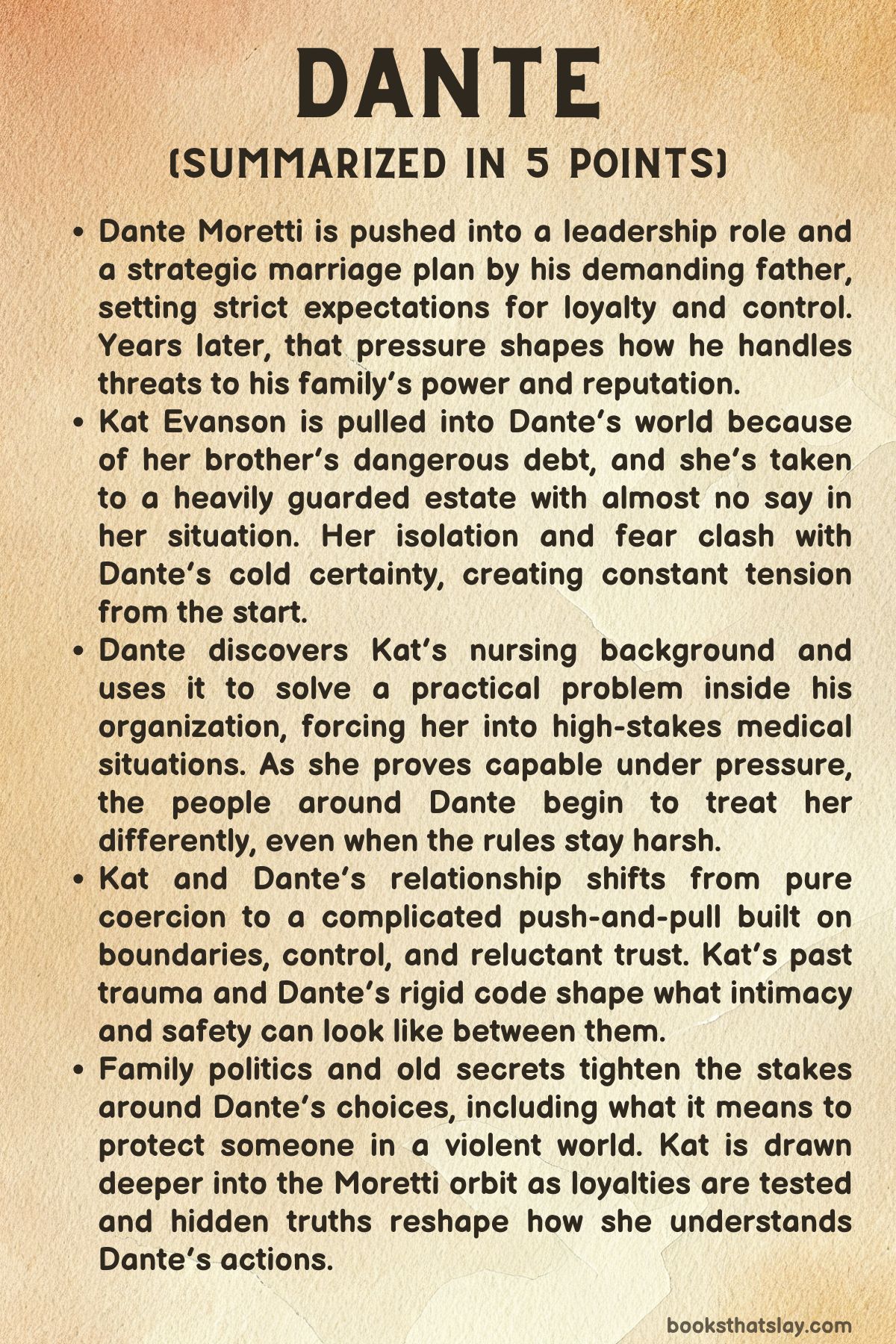
Summary
Dante Moretti’s life changes in a single meeting in his father Salvatore’s study. Salvatore demands that Dante’s older brother, Lorenzo, marry Nicole Santangelo to secure an alliance.
Lorenzo refuses because he’s committed to his Russian fiancée, Anya Novikov. The argument turns vicious, and Salvatore pivots to a punishment that becomes a promotion: he strips Lorenzo of the future leadership role and assigns it to Dante—along with Nicole as Dante’s bride.
Dante pushes back, but Salvatore makes it clear the family’s survival matters more than any son’s consent.
Six years later, Katerina “Kat” Evanson returns to her small home and immediately senses something is wrong: her door is ajar, and a black Porsche sits outside. Inside, two large men in expensive suits are waiting.
Kat panics, arms herself, and tries to fight her way out, but she’s outmatched. The men aren’t there to rob her—they’re there for her brother, Leo, who has vanished after stealing her savings and leaving her isolated.
The debt he ran from isn’t a minor one. It belongs to the Moretti family.
The man in charge introduces himself as Dante Moretti, and the name lands like a threat Kat already understands. Leo owes over a quarter of a million dollars.
Kat insists she doesn’t know where he is and can’t pay. Dante isn’t interested in bargaining, and he doesn’t pretend this is fair.
He tells her that if he finds Leo, he’ll kill him slowly. Since he found Kat first, he offers another option: Kat will come with him and “work off” the debt.
Kat argues that she’s a person, not collateral. Dante treats that truth like an inconvenience.
He orders his enforcer Maximo to pack her things. Kat fights, screams, and even hits Dante, but it changes nothing.
When she says people will notice she’s gone, Dante counters with a cold certainty that exposes how alone she truly is. She’s taken to his estate outside Chicago, placed under guard, and given a room.
The message is simple: she’s trapped until Dante decides otherwise.
Dante’s interest in Kat starts as practical—his research shows she’s trained as a nurse, once stable and successful at a major hospital, then suddenly gone from that life. Now she works nights, lives in a rough neighborhood, and keeps her circle small.
Dante tells himself her skills might be useful. He also can’t ignore the fact that she meets his control with open defiance.
She refuses to be called Katerina, insists she’s “Kat,” and the insistence hits a nerve in him, tugging at the memory of Nicole.
That night, Salvatore arrives for dinner and immediately presses Dante for results: where is the money, where is Leo, and why isn’t Dante more brutal about it? Dante admits Leo ran and Kat had no information.
Salvatore’s questions turn casual and cruel—he asks if Kat is dead. Dante says no and reveals he has her.
Salvatore assumes torture or bait. Dante says Kat is working for him, and Maximo adds that she can treat injuries.
Salvatore’s approval is faint, but his contempt for Dante’s restraint is obvious. When Salvatore needles him about weakness, Dante finally snaps, accusing his father of betraying their mother and hiding behind power.
Salvatore responds with a warning: being “good” and being boss don’t mix.
Kat’s days in the mansion are tense in a quieter way. She isn’t harmed.
She’s fed well. She’s watched constantly.
She begins to map the limits of her captivity: the west wing is hers to move through, Dante’s study is forbidden, and the east wing is locked for family members who are absent. Dante appears mostly at breakfast, calm and controlled, offering rules instead of answers.
He lets Kat call her cousin Mia once a week, but only from his office, only under supervision, and only if Kat behaves. Kat keeps asking what Dante expects from her, terrified she’ll be handed over to men.
Dante promises he won’t force her, but the way he references what his men might do is enough to keep fear close to her skin.
When a man named Lenny is stabbed in the chest, Dante finally uses Kat’s skills. He takes her to a private clinic room and orders her to stitch Lenny up.
Kat insists she’s not a doctor, but she steps in because the wound is real and time matters. She cleans it, argues for pain relief, and when Dante says the medication cabinet is locked, he smashes it to get morphine.
Kat administers it and sews Lenny carefully, steadying him with her voice until he calms. The men see her differently afterward—less like a hostage, more like a resource.
The shift comes with new danger. Later, Kat is in the kitchen wearing an oversized sleep shirt when Lenny flirts, touches her, and pushes too far.
Dante intervenes fast and furious, ordering Lenny away and scolding Kat for being a “distraction.” He notices the shirt belonged to an ex, demands she remove it, gives her one of his shirts instead, and throws the old one away. Kat is shaken by the possessiveness, but what happens next is worse: Dante punishes Lenny by cutting off two fingers as a warning.
The brutality terrifies Kat, and the possessive message is unmistakable—Kat is under Dante’s protection, but she is also under his claim.
Kat tries to avoid him, yet the tension between them keeps pulling tight. Dante admits to himself that he’s obsessed, but he wants Kat to choose him rather than be forced.
Their encounters become charged, then physical. After another emergency—this time a man named Mitch shot in the shoulder—Kat extracts the bullet and stitches him while the men joke around her.
Dante returns from violence with blood on him and treats his own injury with practiced ease. Later, alone with Kat, he proposes a challenge built on control and temptation, and he wins it.
Kat ends up in his bed, and the arrangement turns into a routine that blurs captivity into intimacy.
As they grow closer, Kat reveals pieces of why she’s guarded: she has a scar, nightmares, and a past assault that shapes what she can tolerate. Dante responds in his own way—still dominating, but attentive to her boundaries, giving her the ability to stop, pushing only when she chooses to keep going.
Kat begins to feel something she didn’t expect to feel in his house: moments of safety, even if the walls are locked.
Then the pregnancy hits hard. Kat becomes severely ill and spends days in the hospital with intense nausea and dehydration.
Dante stays beside her, shaken by how close he came to losing her and the baby. Guilt eats at him because he once suspected she was manipulating him instead of hearing her.
When they return to the mansion, Dante moves Kat into his bedroom and loosens the sense of confinement—doors aren’t locked against her in the same way, guards greet her instead of blocking her path. She starts spending time with Joey, Dante’s younger sister, and learns the family’s internal pressure is rising.
Dante grows distant, controlling himself so harshly it feels like punishment. Kat sees him escort a glamorous woman toward a loud party and assumes the worst.
The fight that follows forces Dante to confront how his silence fuels Kat’s fear. Kat finally corners him for an answer about what she is to him.
Dante tells her the truth he’s been avoiding: he intends to marry her before the baby is born because his child must be a Moretti. To him it’s not a romantic offer—it’s a decision.
Kat learns from Joey that Salvatore demanded Dante either marry Kat or kill her. The knowledge breaks whatever trust she’d started to build.
Dante tries to prove it isn’t only pressure by giving Kat a real proposal: a candlelit dinner, her favorite salted caramel cheesecake, and an emerald heirloom ring. He tells her he chose her.
Kat accepts, even as part of her wonders how much choice exists in a family like this.
Lorenzo returns with Anya, and the house fills with old history. Kat is unsettled by Lorenzo’s intensity, but she also learns Anya’s cancer has returned, which is why they came home for specialists.
Dante and Lorenzo talk privately, and Dante confirms he truly intends to marry Kat. Kat begins to see how the family functions: affection exists, but it’s always threaded with strategy and threat.
Dante later takes Kat to a secluded house and refuses to explain why until they arrive. Kat’s fear spikes when she sees a woman with a toddler and a little boy running out—she thinks Dante has another family.
The reveal is stranger: the woman is Nicci—Nicole Santangelo—alive and protected. The rumor that Dante killed his fiancée was allowed to stand as part of his reputation.
Nicci explains that she grew up abused and was meant to be traded into marriage. Dante staged their engagement to give her cover, then arranged an escape for her and her partner, Sabine.
Nicci’s violent male relatives vanished that same night, and Nicci and Sabine have been hidden ever since, raising their children in safety.
On the drive home, Kat pushes Dante about the secret. He admits the reputation helps business, but that isn’t the full reason.
The deeper truth is horrifying: Deacon, the little boy, isn’t Dante’s son. He’s Dante’s younger brother—fathered by Salvatore, who raped Nicci before the wedding and threatened her into silence.
Dante kept Nicci alive and hidden to protect her and to keep Salvatore from ever claiming or destroying the child. Kat understands why Dante refused to let Salvatore touch her at the wedding and why Dante needed Kat to meet Nicci—to stop Kat from believing she would be discarded someday.
Soon after, Maximo finds Leo in Los Angeles. Dante tracks him down, kidnaps him, and beats him to death in a rage fueled by what Leo did to Kat.
Leo admits something even uglier: he once handed Kat to men to settle a small debt. Before he dies, he drops another truth—Salvatore had approached Leo, demanded Kat as payment, and asked detailed questions about when Kat was taken and what happened to her.
Dante returns to Chicago determined to understand why his father cared.
Dante confronts Salvatore in his home, killing guards when they move against him and wounding Salvatore to force answers. Salvatore admits he wanted Kat dead because she might have seen “cages” holding women and children—evidence of trafficking.
Dante realizes Salvatore was part of the network behind the Santangelos’ cruelty and that destroying one family only cut off a piece. Salvatore also confirms the assault on Nicci and Deacon’s paternity.
Dante executes Salvatore and plans to frame the Russian leader Dominik Pushkin, pushing support toward Dmitri Varkov as a replacement to manage the coming war.
When Dante tells Kat they found Leo, she immediately understands what that means. She erupts in grief and anger, torn between the brother she remembers and the man he became.
That night, Kat’s trauma returns in a violent nightmare, and Dante cares for her with quiet tenderness—washing her, warming her, holding her until she can breathe again. Kat realizes Leo’s choices were never hers to carry.
She doesn’t call Dante a good man, and he doesn’t ask for that label. She calls him a good husband, and she believes he will be a good father.
Months later, the home that began as a prison has become their life. Kat watches Dante care for their baby daughter, Gabriella, with steady devotion.
Their future is still surrounded by danger and politics, but inside their marriage there is a new center: a family they chose, built from survival, loyalty, and love that had to be earned.
Characters
Dante Moretti
Dante begins as the reluctant son pressed into a role he never asked for, but over time he reveals himself as someone who converts reluctance into ruthless competence. His father’s “promotion” forces him to become the face of power, yet what defines him most is the tension between the monster he is expected to be and the protector he keeps choosing to become.
With Kat, his control is initially coercive and transactional—he takes her as leverage—yet his obsession quickly turns into a complicated devotion that reshapes his decisions, his self-image, and even his willingness to be seen as capable of care. Dante’s inner conflict is not about whether he can do violence (he can, and he does), but about whether tenderness makes him weak; the story repeatedly shows him trying to bury compassion under reputation, then acting against his own mask anyway.
By the end of Dante, he is still dangerous, but he has redirected that danger toward shielding the people he claims as his own, choosing responsibility and family on his terms rather than his father’s.
Katerina “Kat” Evanson
Kat is defined by survival skills that are easy to underestimate because she looks isolated and economically cornered, but her instincts are sharp, her anger is honest, and her courage shows up in moments where fear would be the simpler response. Her nursing background is not just a plot tool; it’s central to her identity as someone who steadies chaos, takes control in emergencies, and asserts boundaries through competence when power dynamics try to erase her agency.
Kat’s history of trauma shapes her relationship to control, touch, and safety, and the story treats her progress as uneven and intensely personal—she doesn’t “get over it,” she negotiates with it. What makes her compelling in Dante is that she never becomes a passive captive: even when trapped, she bargains, tests limits, demands clarity, and forces Dante to confront the human cost of his world.
Her arc moves from abandonment and invisibility to chosen belonging, not because she is “saved,” but because she insists on being seen as a whole person.
Salvatore Moretti
Salvatore is the engine of generational damage in the Moretti family, a man who confuses domination with leadership and views women as currency for alliances, obedience, or punishment. He weaponizes tradition and “family survival” to justify cruelty, and his most consistent trait is how quickly he turns intimacy into leverage—sons become assets, marriage becomes a contract, and morality becomes a joke.
His relationship with Dante is especially corrosive because he alternates between ridicule and entitlement, taking credit for Dante’s rise while accusing him of weakness whenever Dante shows restraint. As Dante progresses, Salvatore’s true monstrosity becomes clearer: his power is not merely criminal but predatory, tied to exploitation and secrecy that extend beyond ordinary mafia politics.
He functions as the story’s central antagonist not only because he threatens external harm, but because he represents the inherited template Dante must destroy to keep from becoming him.
Lorenzo Moretti
Lorenzo is introduced as the son willing to burn his inheritance to protect the woman he loves, and that choice establishes him as a different kind of Moretti: still intimidating, still embedded in the family machine, but less willing to pretend the machine is righteous. His presence carries weight because he embodies the road Dante might have taken—defiance with consequences—and his return later brings both practical pressure and emotional history back into the house.
Lorenzo’s loyalty is fiercely selective; he will not bend to Salvatore’s marital demands, yet he remains tied to family obligations in ways that complicate clean rebellion. In Dante, Lorenzo also acts as a quiet barometer for Dante’s leadership: his questions and reactions suggest that what matters is not whether Dante is violent, but whether Dante is principled in the few places that count.
Anya Novikov
Anya is positioned as both an outsider and an equal within the Moretti sphere, and her strength shows through the calm intensity with which she occupies spaces that would swallow less resilient people. Her relationship with Lorenzo carries a dynamic that can look severe from the outside, but the narrative frames it as consensual and structured, emphasizing that what appears threatening is, for them, a chosen language of trust.
Anya’s illness adds urgency and vulnerability without reducing her to fragility; she returns for treatment, but she is not portrayed as powerless, and her presence reinforces that love in this world is often expressed through logistics, protection, and hard decisions rather than softness. Within Dante, Anya also widens the moral landscape: she shows how intimacy and dominance can exist without exploitation, which sharply contrasts with Salvatore’s predation.
Maximo
Maximo is the quiet spine of Dante’s operation: disciplined, observant, and loyal, but not blindly so. He serves as enforcer, adviser, and moral pressure valve, often saying what others won’t and watching Dante for signs of self-destruction.
Maximo’s loyalty feels earned because he pushes back when Dante is reckless, challenges decisions that look emotionally compromised, and still acts decisively when violence becomes necessary. He also becomes a bridge between Kat and the Moretti world, not by kindness, but by predictable professionalism—he treats her as valuable and real, which matters in a house built on fear.
In Dante, Maximo represents the kind of loyalty that stabilizes power: not devotion to ego, but commitment to a leader who can still be steered.
Nicole Santangelo “Nicci”
Nicci’s role transforms the story’s meaning of “reputation” versus truth. For years she exists as a rumor—proof of Dante’s alleged brutality—until her reveal reframes Dante’s past and exposes how survival sometimes requires becoming a myth.
Nicci is not simply a rescued victim; she is a survivor who builds a life, forms a family, and carries complicated gratitude and grief without being defined only by what happened to her. Her history is horrifying, and the narrative uses it to highlight the difference between violence done for control and violence done to end abuse, even when both wear the same criminal clothing.
In Dante, Nicci also embodies the cost of secrecy: staying hidden keeps her safe, but it forces everyone around her to live inside a carefully maintained lie.
Sabine
Sabine functions as Nicci’s anchor and proof that tenderness can exist outside the Moretti world’s rules. She is portrayed as protective, pragmatic, and quietly brave, building a stable home in the shadow of danger and secrecy.
Sabine’s presence matters because it turns Nicci’s escape into more than relocation—it becomes transformation, a life chosen rather than merely spared. In Dante, Sabine also complicates the idea that safety is purely enforced by violent men; she represents safety built through partnership, parenting, and ordinary continuity.
Joey Moretti
Joey is the emotional counterpoint inside the mansion: candid, warm, and tired of the family’s silences. She forms a lifeline for Kat, offering companionship that is not transactional and validating Kat’s fear without treating her like glass.
Joey’s bluntness becomes a kind of courage, especially when she reveals truths that powerful men want hidden, even at the risk of retaliation. She also exposes how Salvatore’s abuse ripples through every relationship—her black eye and her fear are not background details, they are evidence that the family’s internal violence is ongoing, not historical.
In Dante, Joey is hope with teeth: she wants better for Dante, Kat, and herself, and she refuses to pretend that “family” excuses cruelty.
Sophia
Sophia is the household’s steady presence, offering kindness that feels almost radical in a setting designed to intimidate. Her warmth toward Kat is significant because it disrupts Kat’s expectation that everyone in Dante’s orbit will be cruel or afraid.
Sophia also serves as a subtle mirror to Dante’s leadership; the fact that she can be openly gentle in his home suggests that his power allows room for humanity, even if he tries to deny it. In Dante, Sophia represents domestic normalcy surviving in the margins of violence.
Leo Evanson
Leo is a portrait of betrayal without sentimentality. He weaponizes family ties, using Kat’s loyalty and compassion as resources to steal, disappear, and ultimately endanger her.
His debts and selfishness are not framed as a one-time mistake but as a pattern of exploitation that escalates from financial harm to life-threatening consequences. The most chilling aspect of Leo in Dante is how little remorse he shows when confronted; his relationship to Kat is revealed to be possessive and opportunistic rather than loving.
He functions as a catalyst for the plot, but also as a thematic warning: the danger in Kat’s life did not begin with Dante—it began with the people who taught her she was safe only when useful.
Mia
Mia exists largely at the edge of the action, but her importance is emotional: she is Kat’s last connection to a life where care is not purchased or coerced. The weekly call arrangement turns Mia into both a comfort and a reminder of captivity, because access to her becomes another controlled privilege.
Mia’s limited presence in Dante reinforces Kat’s isolation and explains why Kat’s disappearance might not trigger immediate rescue, deepening the story’s sense of how alone Kat has been.
Lenny
Lenny illustrates the culture of entitlement inside violent organizations, where boundaries are often treated as optional unless a superior enforces them. His injury scene shows the crew’s reliance on Kat’s competence, but his later behavior toward her reveals how quickly gratitude can curdle into objectification.
The punishment he receives is less about justice in a moral sense and more about property and hierarchy, emphasizing Dante’s possessiveness as much as his protectiveness. In Dante, Lenny is a reminder that even when Kat is “safe,” the environment is still saturated with threat.
Mitch
Mitch’s shooting and treatment scene expands Kat’s role from captive to indispensable, highlighting how her skills force the criminal world to pause and comply with her instructions. He also represents the way violence is routine for these men—an injury is an inconvenience, not a crisis—while for Kat it is a professional duty layered with moral discomfort.
Within Dante, Mitch helps show how Kat’s competence earns her a kind of authority that cannot be fully controlled by locks.
Dominik Pushkin
Dominik is less a fully drawn person than a strategic shadow: a Bratva power figure whose name signals external pressure, shifting alliances, and looming conflict. His importance lies in what he represents—organized violence at a geopolitical scale and the kind of partner Salvatore chooses when profit demands cruelty.
In Dante, Dominik is the face of the broader war Dante anticipates after cutting out his father’s corruption.
Dmitri Varkov
Dmitri operates as the political alternative in the Russian sphere, someone Dante believes can replace a more dangerous leader and stabilize the power vacuum. His presence shows Dante thinking beyond rage and revenge, making calculated moves that turn personal revelations into organizational strategy.
In Dante, Dmitri symbolizes pragmatic leadership: not goodness, but a preference for controllable outcomes over chaos.
Deacon
Deacon is the story’s most devastating symbol of hidden truth: a child whose existence is intertwined with secrecy, trauma, and the consequences of Salvatore’s predation. He is innocent, living an ordinary childhood, and that normalcy is precisely why the adults around him accept lifelong deception to protect him.
In Dante, Deacon is also a moral pivot for Dante—proof that protecting life sometimes demands living with a lie, and proof that Dante’s hatred of his father is rooted in more than power struggles.
Aurora
Aurora reinforces what Nicci and Sabine have built: a family defined by safety, continuity, and love rather than fear. She doesn’t drive the plot, but her presence makes the hidden household feel real and worth protecting, turning secrecy into something tangible rather than abstract.
In Dante, Aurora represents the future that exists when violence is used to end abuse rather than extend it.
Gabriella
Gabriella is the culmination of Kat’s and Dante’s transformation from coercion and uncertainty into commitment and stability. She represents permanence—proof that their choices have created a life that will outlast revenge cycles and power plays.
The closing image of Dante caring for her emphasizes the story’s core contradiction: a man capable of extreme brutality can also be attentive, gentle, and fully present as a father. In Dante, Gabriella functions as the emotional resolution, anchoring the promise that the home they’re building is not just another cage.
Themes
Power, Patriarchy, and Control as a Family System
In Dante – Sandie Kincaid, power is treated less like a personal trait and more like an inheritance that gets enforced through threat, obligation, and ownership. Salvatore’s authority is not persuasive or wise; it is coercive, and it relies on the assumption that bodies and futures can be assigned for political advantage.
Marriage is presented as a transaction that stabilizes influence, and the family title is framed as something a father can grant or revoke based on obedience. That structure turns love into liability and refusal into betrayal, which is why Lorenzo’s resistance is punished not only socially but strategically, by stripping him of succession.
Dante’s “promotion” exposes how control operates as a trap: responsibility is handed down as if it is an honor, even when it is clearly a cage. The story keeps returning to the difference between leadership and domination.
Salvatore claims domination is necessary to survive, yet his version of survival depends on exploiting women, hiding crimes, and making sons compete for approval. Dante’s conflict grows from living inside that blueprint while wanting to reject its ugliest rules without appearing weak.
The pressure to be “boss” requires emotional hardness, public cruelty, and a willingness to sacrifice individuals for the group’s stability. At the same time, Dante’s own behavior with Kat shows how easily control reproduces itself: he begins by taking her, restricting her movement, and using fear as leverage.
Even when he insists he won’t force sexual access, he still controls her environment, choices, and information, which shows how domination can exist even without explicit assault. The theme becomes sharper once the trafficking operation is revealed, because it reframes Salvatore’s “family survival” as a cover for systematic predation.
What looks like tradition or strategy is exposed as an excuse for ownership. The story’s tension comes from watching Dante try to build a different kind of authority while still benefiting from the same violent system that made him powerful, and from seeing how difficult it is to change the rules when the system rewards cruelty and punishes mercy.
Captivity, Consent, and the Slow Reconstruction of Agency
Kat’s arc begins with her life being treated as collateral, which makes agency the central psychological battleground. She is taken from her home without negotiation, stripped of contact, and kept behind locked doors with armed guards—conditions that communicate a single message: her consent does not matter.
The story doesn’t let captivity remain a simple plot device; it tracks the way confinement alters decision-making, self-worth, and risk assessment. Kat’s early resistance—arming herself, running, fighting—shows a person who still believes the world will recognize her rights if she can just hold her ground.
Dante’s blunt claim that no one will miss her lands as a social injury as much as a threat, because it forces her to confront isolation and the lack of safety nets that would normally protect someone from disappearance. Once in the mansion, the control becomes more subtle: food, comfort, and idle time soften the edges of violence, but they don’t restore autonomy.
Her freedom is conditional, monitored, and dependent on compliance, which keeps the power imbalance intact even during quiet moments. The narrative constantly tests what consent means when the context is coercive.
Dante’s promise not to force sex is meaningful, but it sits beside reminders that he is still her captor, that his men are dangerous, and that her access to communication is a privilege he can revoke. As their sexual relationship develops, the theme becomes complicated rather than erased.
Kat experiences desire, curiosity, and attachment, but those feelings are shaped inside an environment she did not choose. The story pays attention to boundaries, especially around restraint and triggers, and it shows Dante making space for her to stop and to set conditions.
Yet it also shows him acting possessive, punishing other men for touching her, and making decisions about her clothes and movements—choices that can read as protection while still functioning as control. Over time, agency is rebuilt through incremental permissions: medical authority in the clinic, the ability to request supplies, monitored contact with Mia, and the gradual reduction of physical restrictions.
The shift toward marriage further complicates the theme because it offers status and security while also formalizing ownership within the family’s rules. By the end, Kat’s agency is not presented as a sudden return to normal; it is presented as a negotiated state that she actively participates in, shaped by trauma, power imbalance, and the reality that her safety is tied to the same man who first took it away.
Trauma, Memory, and the Body as a Site of Fear and Repair
Kat’s history of assault is not treated as a distant backstory; it actively governs her body’s responses, her sense of safety, and her ability to trust her own desire. The narrative shows trauma as something that leaks into ordinary moments—sleep, touch, medical vulnerability, even the atmosphere of a locked house.
Her scar and nightmares function as evidence that the past is not over simply because time has passed. Trauma appears as hypervigilance and as dissociation: she keeps scanning for danger, calculating exit routes, bracing for punishment, and assuming the worst because the worst has happened before.
That lens also explains why Dante’s early threats hit so deeply. When he implies she could be handed over once she is “useless,” it echoes the logic of her earlier violation: the idea that her value is conditional, that her body can be traded, and that survival depends on reading men’s moods accurately.
Pregnancy intensifies the theme by shifting fear from self-protection to protection of a child. Severe sickness, hospital monitoring, and the possibility of complications bring a new vulnerability that Kat cannot fight with a bat or a gun.
That medical fragility becomes a turning point because it forces Dante to confront consequences he cannot dismiss as manipulation. His guilt marks a different kind of trauma response—one built from fear of loss and recognition of harm done.
The story also emphasizes that trauma recovery is not only internal; it depends on environment and relational behavior. When Dante adjusts his approach—offering reassurance, avoiding restraint, allowing stops, staying present in the hospital—he is providing predictability, which is one of the most important conditions for trauma repair.
Still, the narrative doesn’t pretend that tenderness fixes everything. Kat’s jealousy panic, her need for clarity, and her spirals after perceived betrayal show how trauma can attach itself to uncertainty and secrecy.
The most revealing moments come when her body reacts in ways that don’t match her conscious plans, such as feeling arousal alongside anger, or seeking Dante’s proximity while also fearing what closeness might cost her. The story frames healing as learning to tolerate intimacy without losing selfhood, and learning to name boundaries without expecting punishment.
By the epilogue, stability is shown through small domestic actions—care for their child, routine affection, plans for a future—suggesting that recovery is built from repeated evidence of safety rather than a single dramatic breakthrough. Trauma remains part of Kat’s story, but it no longer exclusively defines it.
Reputation, Secrecy, and the Performance of Being “Bad”
Public image functions as currency in the Moretti world, and the book repeatedly shows that reputation is not simply a byproduct of actions but a tool used to manage threats. Dante allows a story to circulate that he murdered Nicole because the fear it creates protects his organization and discourages challenges.
That choice turns identity into performance: he is expected to be ruthless, expected to confirm the worst assumptions, and expected to treat compassion as weakness. The tension is that his private actions often contradict the persona he benefits from.
He protected Nicole, arranged her escape, and kept her alive for years, but he cannot safely claim that goodness without risking her and the children. The secret surrounding Nicole becomes more than romance history; it becomes an ethical problem about who gets protected and at what cost.
Dante’s refusal to be seen as “good” also functions as emotional armor. If he accepts the label, he risks admitting vulnerability and responsibility, which would force him to confront how much he has been shaped by Salvatore.
The theme sharpens when Deacon’s parentage is revealed. Secrecy isn’t just strategic—it’s a shield against a father who weaponizes knowledge and uses family as cover for crimes.
The hidden child and hidden household show how reputation operates in two directions: Dante uses fear publicly to deter enemies, while he uses silence privately to keep innocents out of reach. Kat’s evolving interpretation of Dante highlights how reputation distorts intimacy.
She fears being disposed of because the myth of Dante’s cruelty makes that fear logical, especially after he threatens her. When he finally takes her to meet Nicole, it isn’t only a gesture of honesty; it is an attempt to dismantle the most dangerous part of his image inside his marriage.
At the same time, the story acknowledges that maintaining a violent reputation has consequences. It normalizes brutality, attracts violent challengers, and makes it easier for allies to excuse harm.
The plot’s larger conflict—rival operations, shifting Russian power, impending war—sits in the shadow of reputation management, where every act communicates strength or invites attack. By the end, Dante’s growth is not framed as becoming publicly gentle; it is framed as choosing private truth with Kat and choosing to cut out the source of rot (Salvatore) even if it requires more violence.
The theme suggests that in a criminal hierarchy, image is both protection and prison, and escaping it requires risks that can endanger everyone a person is trying to save.
Violence, Justice, and the Moral Line Dante Draws for Himself
The story treats violence as a language the characters already speak fluently, but it constantly questions what violence is for: punishment, deterrence, survival, revenge, or something that masquerades as justice. Dante’s world includes casual cruelty as routine business—interrogations, threats, mutilation—yet the narrative makes clear that not all violence is equal in motive or consequence.
The punishment of Lenny is a key moment because it is framed as ownership and warning, not fairness. It protects Kat from harassment, but it also turns her into property, and it demonstrates that Dante’s instinct is to solve problems through fear.
Later, the killing of Leo lands differently because it carries both protective intent and personal rage. Leo’s betrayal is not just financial; it is intimate exploitation, including the revelation that he previously traded Kat to men.
Dante’s beating of Leo reads as revenge for harm done to Kat, but also as a way to erase a recurring threat that would never stop using her. That creates an uncomfortable moral ambiguity: the outcome may increase Kat’s safety, yet the method reinforces Dante’s identity as executioner.
The confrontation with Salvatore pushes the theme into sharper ethical territory. When trafficking is revealed, violence becomes framed as stopping ongoing harm and preventing further victims.
Salvatore is not simply a harsh father; he is a predator with infrastructure. Dante’s decision to kill him is presented as both personal reckoning and strategic necessity, especially given the scale of the crimes.
Still, the narrative doesn’t give Dante a clean redemption arc through “righteous” killing. He plans to frame Dominik, manipulates Russian succession, and uses political chaos as cover, showing that justice in this world is never pure; it is mixed with calculation.
Kat’s response to Leo’s death keeps the theme grounded emotionally. Her grief and anger remind the reader that violence has ripple effects even when the victim is morally repulsive.
Her eventual acceptance is not a declaration that killing is good; it is an acknowledgment that Leo’s pattern made peace impossible. The book ultimately portrays Dante’s moral line as selective: he rejects trafficking, rejects his father’s sexual violence, and protects women and children he considers under his care, while still endorsing brutality as a governance tool.
The theme asks whether someone can be a good partner and parent while remaining a violent leader, and it answers by showing a domestic stability built on continued power—suggesting not moral purity, but a chosen direction: eliminating the worst evil inside the family, even if the remaining world is still stained.