Darling Daffodils Farm Summary, Characters and Themes
Darling Daffodils Farm by Brittanee Nicole is a small-town romance about coming home, facing family loss, and choosing the life that feels right instead of the one that seems practical. Set in the New England town of Hope Harbor, the story follows Tally Darling as she returns to her family’s flower farm after her father’s death.
She expects a short stay before pursuing her baking dreams elsewhere, but the farm, her family, and a guarded farmhand named Jesse Walker challenge everything she thought she wanted. The book blends romance, family healing, community support, and second chances in a warm rural setting.
Summary
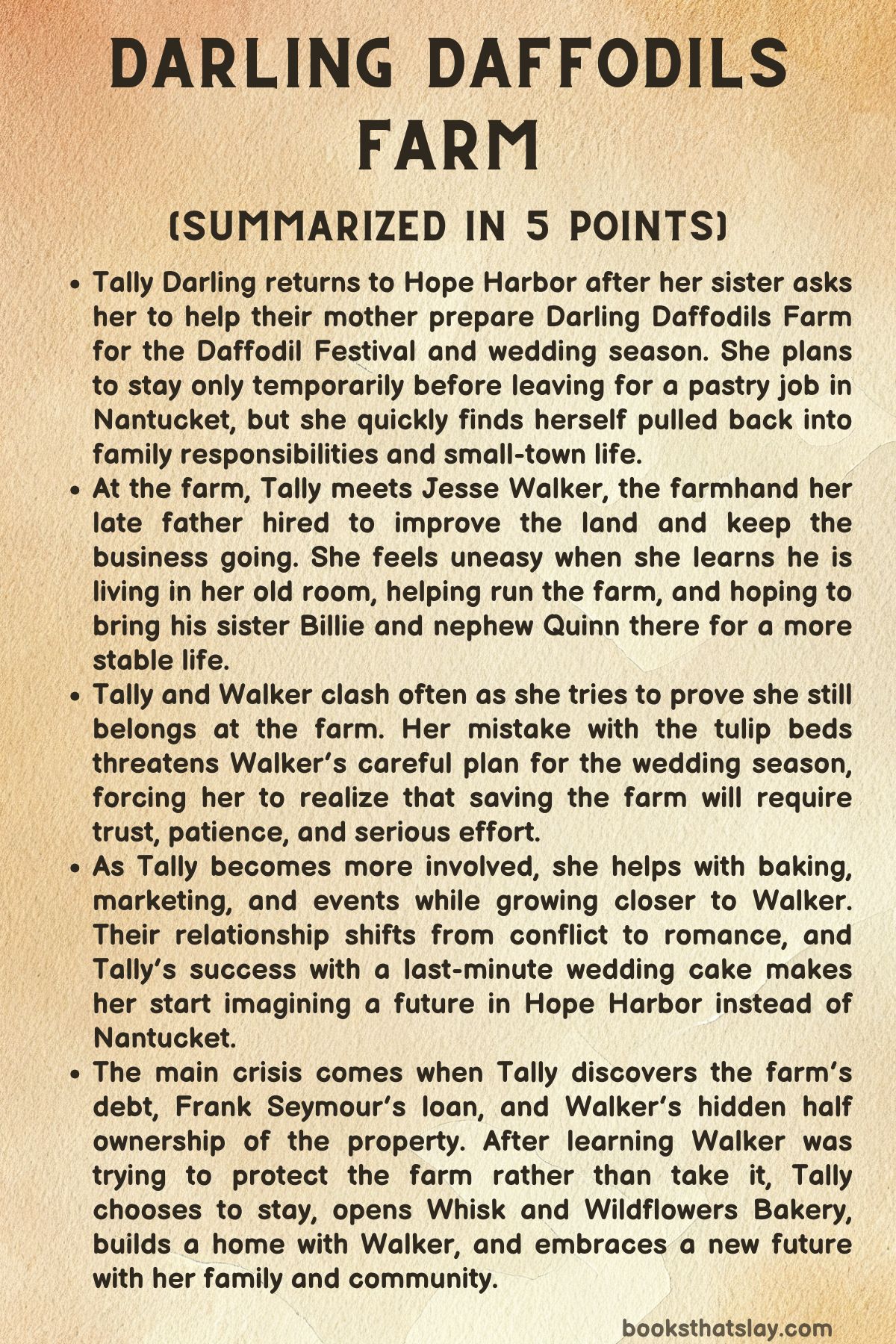
Tally Darling comes back to Hope Harbor after her sister, Penny, asks for help at Darling Daffodils Farm. Their father, Peter, has died, and their mother, Gail, is struggling to keep the farm ready for its busiest season.
The Daffodil Festival is approaching, and the farm is also preparing for weddings and guests. Tally does not plan to stay for long.
Her goal is simple: help until mid-May, then leave for Nantucket, where she has a pastry job waiting. That job is supposed to help her earn money for culinary school, and she sees it as the next step toward the future she has been planning.
When Tally arrives in town, she quickly realizes that Hope Harbor still works the way it always has. Everyone knows everyone, gossip moves fast, and people seem to know more about her life than she does.
On her way home, she meets several familiar faces, including Rayna McGovern, Eli Davis, and her best friend Rosie. Each of them mentions a man named Walker in a way that makes Tally curious and uneasy.
She has no idea who he is or why so many people assume she should already know about him.
At the farm, Tally discovers the answer. Jesse Walker is living in her childhood bedroom.
He is rough around the edges, attractive, and clearly comfortable on the property. To Tally, his presence feels like an invasion.
The farm is tied to her memories of her father and her childhood, and seeing a stranger occupying that space makes her feel pushed out. Penny explains that their father hired Walker the previous year to help improve the soil and extend the flower season.
After Peter died, Gail moved into a cottage, and Walker took over much of the farm’s daily work.
Tally does not trust him. Walker seems to know too much, control too much, and speak with too much authority for someone who is not family.
Her frustration grows when he suggests that his sister, Billie, should help with the wedding side of the business because she has event-planning experience. Tally sees this as another sign that Walker wants to replace the Darling family’s role on the farm.
Walker, however, has his own reasons. He wants Billie and her young son, Quinn, to move to the farm because he believes it could give them safety, work, and a real home.
Tally and Walker clash almost immediately. She wants to prove she belongs at the farm and that she can help save it.
He wants her to respect the systems he and Peter put in place. Their tension grows when Tally finds a letter from Frank Seymour offering to buy the property.
She and Penny begin to suspect that Walker may be working against them or hiding something serious. Tally’s fear of losing the farm makes her act before she fully understands what is happening.
Her biggest early mistake comes when she gathers townspeople to remove tarps from the tulip beds. She thinks she is helping the flowers and the farm, but Walker had covered the beds on purpose to delay the blooms for late-season weddings.
By removing the tarps, Tally may have damaged a plan that was meant to help the business earn money beyond the festival. Gail and Walker are upset, and Tally is forced to face the fact that wanting to help is not the same as knowing how to help.
After this, Tally begins to take the farm’s needs more seriously. She puts more energy into the work and starts finding ways to contribute that suit her strengths.
She bakes treats, helps with marketing, and begins to understand how much the farm means not only to her family but to the whole town. Hope Harbor rallies around Darling Daffodils Farm, helping with repairs and renovations so the cottages can be rented to wedding guests.
The farm becomes a shared project, and Tally starts to see the community with fresh eyes.
As Tally works alongside Walker, their relationship changes. Their arguments do not disappear, but beneath the conflict there is attraction, respect, and curiosity.
Walker is not as simple as Tally first believed. He is loyal to the land, loyal to Peter’s plans, and determined to protect the farm.
Tally, in turn, begins to show Walker that she is more than someone passing through. She is creative, hardworking, and deeply connected to the place, even if she has been telling herself she needs to leave.
Their attraction turns into a secret physical relationship. At first, it seems easier to keep things hidden because Tally still plans to go to Nantucket.
She does not want to make promises she may not keep, and Walker is not someone who gives his trust lightly. Yet their connection becomes harder to ignore.
They share private moments, learn each other’s fears, and begin to want more than secrecy. Eventually, they go on a real date and begin dating openly.
Tally’s baking also becomes an important part of her return. Her treats become popular, and people begin to recognize her talent.
When a wedding cake is ruined before an important event, Tally steps in and makes a replacement at the old Mabel’s Bakery. The pressure is intense, but she succeeds.
This moment proves that her dream of becoming a baker is not distant or unrealistic. She has the skill, courage, and creativity to build something meaningful.
Walker notices this. So do her family and the town.
Without telling Tally, Walker and others begin renovating Mabel’s Bakery. Their hope is to create a space where she can follow her baking dream without leaving Hope Harbor.
For Tally, this becomes part of a larger question: does she need to leave home to become who she wants to be, or can she build that life in the place she once thought she had outgrown?
The main conflict reaches its height when Tally learns the truth about the farm’s financial trouble. The situation is much worse than she knew.
Peter had taken out a loan from Frank Seymour, and Gail and Peter had also transferred half ownership of the farm to Walker. This transfer violated the loan terms, giving Frank the right to call the debt.
Tally feels betrayed. Walker had ownership in the farm, Gail had kept secrets, and everyone seemed to know pieces of the truth except her.
From Tally’s perspective, the people she loves have treated her like an outsider.
Hurt and angry, Tally leaves with Penny, intending to confront Frank. She believes action is needed, but she is also overwhelmed by the feeling that her father’s legacy is slipping away.
Walker, meanwhile, is desperate to protect both Tally and the farm. He works with Fletcher and the people of Hope Harbor to find a solution.
The town comes together and buys the wildflower meadow with a rule that nothing can ever be built there. This saves Tally’s favorite place from development while also helping pay down the debt.
The gesture changes Tally’s understanding of what has been happening. Walker was not trying to steal the farm.
He was trying to save it. His choices were imperfect, and the secrecy caused real pain, but his loyalty was genuine.
Walker tells Tally he loves her, and she begins to see that his love is tied not only to her but also to the land, her family, and the life they could build together.
Gail also helps Tally understand Peter’s wishes more clearly. Peter never wanted his daughters to sacrifice their own dreams for the farm.
He wanted them to chase what made them happy. This matters deeply to Tally because she has spent so much time believing she had to choose between family duty and personal ambition.
Instead, she learns that the right future may allow space for both.
Tally is then surprised with the newly renovated Whisk and Wildflowers Bakery, created by Walker and the town. It gives her a place to bake, create, and build a career in Hope Harbor.
Billie and Quinn move into the farmhouse, Gail returns there as well, and the farm begins to feel alive again. Tally and Walker make the cottage in the wildflower fields their home.
By the end of Darling Daffodils Farm, Tally chooses to stay in Hope Harbor. She opens her bakery, reconnects with her family, accepts the support of her town, and embraces her love for Walker.
The story closes with celebration, hope, and a sense of renewal as Tally dances with Walker in the fields and imagines a future rooted in love, work, family, and the place that has always been part of her.
Characters
Tally Darling
Tally Darling is the emotional center of Darling Daffodils Farm, and her journey is built around belonging, grief, responsibility, and self-discovery. At the beginning, she returns to Hope Harbor with a temporary mindset, seeing the farm as a place she must help stabilize before moving on to her own dream of working in Nantucket and eventually attending culinary school.
Her discomfort comes from feeling that her childhood home has changed without her permission, especially when she finds Walker living in her old bedroom and managing the land that once felt tied to her family identity. Tally’s early suspicion of Walker reveals how deeply unsettled she is by change; she reads his presence as a threat because she is not yet ready to admit that the farm continued needing care after she left.
Her mistake with the tulip beds becomes an important turning point because it forces her to confront the difference between wanting to help and actually understanding what the farm needs. As the story develops, Tally becomes more grounded, using her baking, creativity, and emotional connection to the town to contribute in a meaningful way.
Her relationship with Walker also pushes her to reconsider what home means, not as a place frozen in childhood memory but as a living space that can change and still belong to her. By the end of the book, Tally’s growth lies in choosing a future that does not require her to abandon her dreams.
She learns that staying in Hope Harbor is not the same as giving up; instead, it becomes the way she combines love, ambition, family, and independence.
Jesse Walker
Jesse Walker is one of the most layered characters in the book because he initially appears guarded, controlling, and difficult to trust, but his actions are rooted in loyalty and protection. His gruffness comes partly from the burden he carries: he has been entrusted with the farm by Peter and Gail, and he knows more about its financial danger than Tally does.
Because he is practical and focused on survival, he often clashes with Tally, who returns with emotional attachment but limited understanding of the farm’s current problems. Walker’s decision-making can seem secretive, especially because he does not immediately explain the full truth about the farm’s ownership and debt, but his secrecy is not driven by greed.
He wants to preserve the land, protect Gail, support Billie and Quinn, and honor Peter’s trust. His desire to bring his sister and nephew to the farm shows his nurturing side, even though he does not always express tenderness openly.
With Tally, Walker’s character softens gradually. Their romance grows out of conflict, shared labor, and mutual respect, making their relationship feel connected to the larger themes of trust and rebuilding.
His support of Tally’s baking dream is especially important because it proves he does not want her to shrink herself for the farm. By helping create Whisk and Wildflowers Bakery, he shows love through action, giving Tally not just affection but a future that allows her to thrive.
Gail Darling
Gail Darling represents grief, endurance, and the painful complexity of parental love. After Peter’s death, she is emotionally fragile but not passive; her decisions are shaped by the need to keep the farm alive while also facing the loss of her husband.
Moving into the cottage and allowing Walker to run the farm suggests that Gail understands she cannot carry everything alone, even if her silence later causes pain. Her secrecy about the financial crisis and Walker’s ownership is one of her major flaws, but it comes from fear rather than cruelty.
Gail seems to want to protect her daughters from the full weight of the farm’s instability, yet that protection creates distance and confusion. Her character is important because she reveals that love inside a family can still be imperfect, especially when grief and financial pressure make honesty difficult.
Gail’s later admission that Peter wanted both daughters to pursue their dreams gives emotional clarity to the story. She helps release Tally and Penny from the idea that loyalty to family must mean sacrificing themselves.
By returning to the farmhouse in the end, Gail also becomes part of the renewed family structure, showing that healing does not mean returning to the past exactly as it was, but finding a new version of home.
Penny Darling
Penny Darling is practical, protective, and deeply tied to the family’s emotional responsibilities. She is the one who asks Tally to return, which shows that she recognizes the farm’s needs but also understands that the family cannot handle everything separately.
Penny often acts as a bridge between Tally and the situation at home, though she also shares Tally’s suspicions when Walker’s role becomes unclear. Her loyalty to Tally is strong, especially when the truth about the debt and ownership comes out and she leaves with her sister to confront Frank.
Penny’s role in the book is not as romantically or professionally central as Tally’s, but she is important because she reflects another version of daughterly responsibility. She understands the pull of the farm and the weight of Peter’s death, yet she too must learn that family legacy should not become a trap.
Penny helps emphasize the story’s message that love for home and family is healthiest when it allows people to grow rather than forcing them into permanent obligation.
Peter Darling
Peter Darling is physically absent for most of the story, but his influence shapes nearly every major conflict and emotional decision. His death is the reason Tally returns, and his choices before dying continue to affect the farm, Gail, Walker, Tally, and Penny.
Peter’s decision to hire Walker shows that he was thinking realistically about the farm’s future, especially about improving the soil and extending the flower season. His transfer of half ownership to Walker complicates the family’s sense of inheritance, but it also suggests that Peter trusted Walker deeply and believed he could protect the land.
At first, this decision feels like a betrayal to Tally because it seems to place an outsider inside the family’s legacy. Later, however, Peter’s true wish becomes clearer: he did not want his daughters to sacrifice their own dreams out of duty.
In that sense, Peter’s character represents both the burden and blessing of legacy. He leaves behind problems that must be untangled, but he also leaves behind a vision of love that is not possessive.
His memory helps the characters understand that preserving the farm matters, but not at the cost of Tally and Penny’s futures.
Billie Walker
Billie Walker is significant because she broadens Walker’s character and gives the farm’s future a stronger sense of family and community. As Walker’s sister, she represents one of his deepest motivations: his desire to create stability for her and her young son, Quinn.
Her wedding-planning experience makes her a practical asset to the farm, and Walker’s suggestion that she help with events initially makes Tally feel replaced. However, Billie is not truly an antagonist.
Her presence challenges Tally’s insecurity because Tally must learn that belonging is not a limited space where one woman’s usefulness cancels out another’s. Billie’s eventual move to the farmhouse shows that the farm is becoming a shared home rather than a possession guarded by one branch of the Darling family.
She also supports the story’s larger movement from grief toward renewal, because her arrival with Quinn brings fresh energy, domestic warmth, and the possibility of a fuller future on the land.
Quinn
Quinn is a quieter but meaningful character because he represents innocence, stability, and the future. As Billie’s young son, he is part of Walker’s reason for wanting the farm to become a secure home.
Quinn does not drive the central conflict directly, but his presence gives emotional weight to Walker’s choices. Walker is not simply trying to manage land or money; he is trying to build a safe environment for the people he loves.
Quinn also helps shift the meaning of the farmhouse from a place defined by Tally’s childhood memories to a place that can hold new generations and new beginnings. Through Quinn, the story suggests that preserving a home is not only about honoring the past but also about making room for future life.
Rosie
Rosie serves as Tally’s best friend and one of her emotional anchors in Hope Harbor. Her presence helps reconnect Tally to the town she once knew, and she reflects the warmth, familiarity, and gentle pressure of a close-knit community.
Because Rosie knows Tally personally, she is able to stand beside her in ways that are different from Gail, Penny, or Walker. She represents friendship as a form of homecoming, reminding Tally that Hope Harbor is not only the farm or her family’s grief but also a network of people who still care about her.
Rosie’s role also helps balance the heavier emotional conflicts by giving Tally a connection rooted in affection rather than obligation. In the wider structure of the story, Rosie helps show why Tally’s return becomes more than a temporary visit: the town still has emotional claims on her heart.
Rayna McGovern
Rayna McGovern represents the lively gossip and social curiosity of Hope Harbor. Her role may seem minor, but she helps establish the small-town atmosphere where everyone notices everyone else’s business.
By mysteriously telling Tally to say hello to Walker, Rayna contributes to Tally’s early confusion and suspicion, making it clear that Walker’s presence is already common knowledge to the town even though it shocks Tally. Rayna’s character adds humor, pressure, and texture to the community.
She shows how difficult it is for private matters to remain private in Hope Harbor, especially when romance, grief, land, and family history are involved. Through Rayna, the book captures both the charm and discomfort of small-town life: people care, but they also talk.
Eli Davis
Eli Davis is part of the familiar social landscape Tally encounters when she returns to Hope Harbor. As a former hockey player and recognizable local figure, he helps reinforce the sense that Tally is stepping back into a town full of memory, shared history, and people who know more than they immediately say.
Like Rayna and Rosie, Eli’s early mention of Walker contributes to the mystery surrounding Walker’s role at the farm. His character helps build the feeling that Hope Harbor has continued moving forward while Tally was away.
Even if he is not central to the main romance or financial conflict, Eli adds to the community fabric that makes the setting feel lived-in and interconnected.
Frank Seymour
Frank Seymour functions as the main external threat to the farm. His offer to buy the property and his connection to Peter’s loan create the financial pressure that drives much of the later conflict.
Frank is important because he represents a colder, more transactional attitude toward the land. Where Tally, Walker, Gail, and the town see memory, labor, beauty, and belonging, Frank sees opportunity and leverage.
His ability to call the debt after the ownership transfer raises the stakes and forces hidden truths into the open. Although he is not emotionally complex in the same way as Tally or Walker, his role is essential because he turns the farm’s private struggles into an urgent crisis.
Frank’s pressure also reveals the strength of the community, because the town’s response becomes a collective act of protection against losing something meaningful.
Fletcher
Fletcher appears as a helpful and strategic figure during the effort to protect the farm. His work with Walker and the town shows that the solution to the crisis does not come from one person alone.
Fletcher’s role highlights the importance of community cooperation, especially when legal, financial, or practical problems become too large for the family to solve privately. He helps turn Walker’s desperation into action and supports the plan that allows the wildflower meadow to be preserved.
Although Fletcher is not one of the most emotionally explored characters, he matters because he helps make the town’s loyalty effective. Through him, care becomes organized, practical, and powerful enough to protect the land.
Themes
Grief, Memory, and the Work of Healing
Grief shapes the emotional foundation of Darling Daffodils Farm through the absence of Peter and the way his death changes every member of the Darling family. Tally returns home believing she is only helping with practical matters, but the farm forces her to face memories she has avoided.
The land is not just a business; it carries her childhood, her father’s dreams, and the pain of losing him. Gail’s retreat into the cottage shows how grief can make even familiar spaces feel unbearable, while Penny’s urgency suggests the pressure grief places on those left behind.
Tally’s healing begins when she stops treating the farm as a temporary obligation and starts understanding what it meant to her father. The story presents grief as something that cannot be solved quickly.
It must be lived through, worked through, and shared with others before it can become part of a hopeful future.
Belonging and the Fear of Being Replaced
Tally’s return is marked by a sharp feeling of displacement. Her childhood bedroom belongs to Walker, her mother has moved out of the farmhouse, and important decisions have been made without her.
This creates her suspicion that Walker has taken a place that should have remained hers. Her anger is not only about the room or the farm’s management; it comes from the fear that home has continued without her.
Walker’s competence makes this fear stronger because he seems to understand the land better than she does. Tally’s mistakes, especially with the tulip beds, reveal how badly she wants to prove she still belongs.
Over time, belonging becomes less about ownership and more about participation. She earns her place not by reclaiming the past, but by contributing to the farm’s future through baking, planning, and emotional commitment.
The story shows that belonging can change shape without disappearing.
Dreams, Sacrifice, and Choosing a Future
Tally begins with a clear plan: stay briefly, help the family, then leave for Nantucket and move closer to culinary school. Her dream appears separate from Hope Harbor, as if success requires distance from home.
At the same time, the farm’s crisis creates pressure for sacrifice, especially because family loyalty can easily become a reason to abandon personal ambition. Gail’s later honesty changes the meaning of Peter’s wishes.
He did not want his daughters trapped by duty; he wanted them to live fully. This allows Tally to see that choosing her dream does not have to mean leaving her family or the land behind.
The renovated bakery becomes a symbol of a future that combines passion, love, and home. Rather than forcing Tally to choose between independence and belonging, the story gives her a path where both can exist.
Her final decision feels earned because it grows from self-knowledge, not obligation.
Trust, Secrecy, and Love Built Through Honesty
The relationship between Tally and Walker develops in the shadow of secrets. Their attraction grows through conflict, shared labor, and moments of vulnerability, but trust remains fragile because key truths about the farm’s finances and Walker’s ownership are hidden.
Tally’s sense of betrayal is understandable because secrecy makes Walker’s actions appear controlling, even when his goal is protection. The conflict shows that love cannot survive on good intentions alone.
Walker may be trying to save the farm, but withholding the truth prevents Tally from being an equal partner in the struggle. His confession and the town’s effort to preserve the meadow help repair that damage because they reveal the care behind his choices.
Still, the emotional resolution depends on honesty, not simply romance. Tally must understand the truth, Walker must admit his feelings openly, and Gail must reveal what Peter truly wanted.
Trust is rebuilt when love becomes transparent and shared.