Crooked Summary, Characters and Themes
Crooked by Vi Keeland and Penelope Ward is a contemporary dark romance about danger, secrets, and the complicated pull between two people who should probably stay away from each other. Juliette Grecco has built a life in Los Angeles as a screenwriter, far from the criminal world of her father, Vince Ginocassi.
But when a threat against her safety forces Vince to assign her a bodyguard, Wes Callahan enters her life and refuses to leave. What begins as unwanted protection turns into attraction, trust, betrayal, and a love that has to survive both family loyalty and hidden truths.
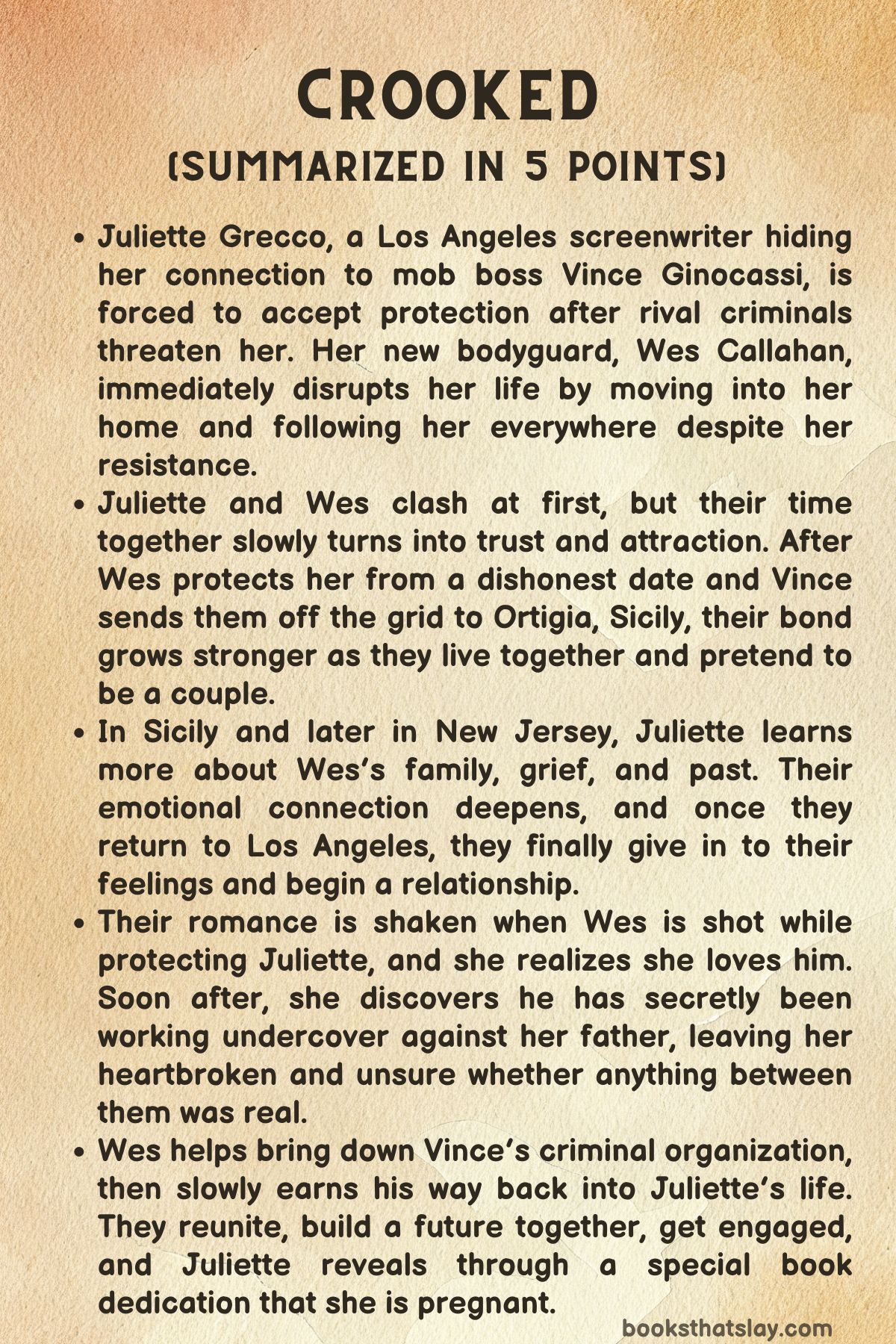
Summary
Juliette Grecco is a screenwriter in Los Angeles who has worked hard to keep her life separate from the one she was born into. Her real last name is Ginocassi, and her father, Vince, is a powerful mob boss.
Juliette wants no part of his criminal world, and she has spent years trying to build an identity of her own. Her days are usually filled with writing, meetings, difficult actors, and the ordinary frustrations of Hollywood.
But her distance from her father’s life becomes impossible to maintain when Vince learns that rival criminals may be targeting her.
Vince sends Wes Callahan to protect her, and his arrival could not be more awkward. Juliette is already having a terrible morning after dealing with Bradley Wilson, a demanding actor connected to her work.
In a moment of frustration, she accidentally throws her phone and hits Wes in the face. That becomes their first meeting, and it sets the tone for the early part of their relationship.
Juliette is irritated, defensive, and unwilling to accept that she needs a bodyguard. Wes is calm, stubborn, and completely unmoved by her attempts to get rid of him.
Wes moves into her house and immediately disrupts her routine. Juliette resents the loss of privacy, while Wes insists that his job is to stay close and keep her safe.
Their days become filled with arguments about boundaries, food, rules, and what she is allowed to do. Juliette’s nosy neighbor, Pam, notices everything, which only makes the situation more uncomfortable.
Wes also has a habit of walking around shirtless, and Juliette finds herself increasingly distracted by him despite her irritation.
Wes follows her everywhere. He goes to meetings, book club, yoga, and even her dates.
Juliette tries to continue her life as if nothing has changed, but his presence makes that almost impossible. She becomes interested in Jett Bradbury, an author, and plans to go out with him.
Wes, however, sees Jett kissing another woman shortly before the date and exposes him as dishonest. Juliette is embarrassed and disappointed, but instead of letting the night end badly, Wes takes her to Venice Beach.
There, they eat churros, laugh together, and joke over a strange cactus necklace that looks inappropriate. The outing shifts something between them.
For the first time, Juliette sees Wes as more than an unwanted guard.
The threat against Juliette soon grows more serious. Vince comes to Los Angeles and tells her that the danger has escalated.
He orders Wes to take her somewhere safer and more isolated. The destination is Ortigia, Sicily, where Juliette’s grandmother once lived.
Juliette is reluctant, but she has little choice. Wes takes her off the grid, away from her normal life, and into an old family house full of memory and history.
In Ortigia, Juliette and Wes settle into a slower rhythm. They explore the town by bicycle, swim, meet neighbors named Natalia and Mario, and begin pretending to be a couple to avoid questions.
The act becomes harder to separate from reality. Their attraction grows stronger every day.
Juliette feels safer with Wes, and Wes shows her a gentler side beneath his guarded exterior. Still, he keeps pulling back because Vince has warned him not to touch her.
Wes knows that falling for Juliette could create consequences for both of them.
Their time in Sicily is interrupted when Wes learns that his grandmother is dying. Juliette refuses to let him go through it alone and insists on traveling with him to New Jersey.
They arrive in time for Wes to say goodbye before his grandmother dies. The trip reveals more of Wes’s personal life to Juliette.
She meets his mother and learns about the family bonds, pain, and past choices that shaped him. Seeing him in that vulnerable state deepens her feelings for him, and their connection becomes harder to deny.
After they return to Los Angeles, Wes and Juliette finally stop resisting their attraction. They begin a physical relationship, even though the danger around them has not disappeared.
For a brief time, they allow themselves to be happy. Juliette feels seen and protected, not just guarded.
Wes seems devoted to her, and the emotional distance between them fades. Their relationship becomes intimate, playful, and serious all at once.
That happiness is shattered at a farmers’ market when a shooting breaks out. Wes reacts instantly, tackling Juliette and taking a bullet that could have been meant for either of them.
At the hospital, Juliette is terrified of losing him. As she waits for news, she realizes that her feelings are no longer simple attraction or comfort.
She loves him. Wes survives, but the shooting brings new attention to the threat against her and raises questions about what has really been happening.
The investigation leads to a devastating truth. Wes has not been completely honest with Juliette.
He is actually working undercover with law enforcement to build a case against Vince. His assignment as her bodyguard was never only about protecting her.
He originally agreed to cooperate because he wanted to clear his record and return to police work. In the past, Wes had been involved in a domestic violence case connected to Vince’s cousin, and Vince had helped him avoid prison after Wes used excessive force.
That debt and Wes’s desire to reclaim his career pulled him into the operation.
Juliette discovers Wes’s hidden phone and realizes the depth of his deception. The betrayal crushes her.
She had allowed herself to trust him in a way she rarely trusted anyone, and now she sees that he had entered her life under false pretenses. Wes tries to explain that his feelings became real, but Juliette is too hurt to listen.
She throws him out and warns him that if he stays, she will expose him to Vince. Wes leaves, knowing he has lost the woman he loves.
After leaving, Wes writes Juliette a letter. In it, he explains his guilt, his love for her, and the conflict between his assignment and his feelings.
But the damage has already been done. He continues helping law enforcement bring down Vince’s organization, while Juliette tries to move forward without him.
Three months pass. Wes moves closer to Los Angeles and quietly looks for ways to show Juliette that he still cares.
One of those gestures is secretly planting flowers outside her home.
Juliette tries to convince herself that she can forget him, but she cannot. Her anger remains, yet so does her love.
Vince is eventually arrested after one of his lieutenants turns against him. The fall of her father’s organization creates emotional chaos for Juliette.
Even though she rejected Vince’s criminal world, he is still her father, and his arrest changes her life. Wes remains nearby, supporting her from whatever distance she will allow.
When Juliette flies to New York, her mother hires Wes as her security. The arrangement puts Juliette and Wes together again, this time in a setting where neither can fully avoid the truth.
On the flight, the tension between them gives way to honesty. In New York, they finally admit that their feelings have survived the betrayal, the separation, and the fallout from Vince’s arrest.
Wes promises that he will follow Juliette anywhere. Their relationship begins again, this time with the truth between them.
Three months later, Wes has changed his life. He is no longer working in private security.
Instead, he has started a new career advising actors on police work, using his experience in a healthier and more stable way. Juliette has written a book inspired by their story, turning the chaos, pain, and romance of their relationship into fiction.
Their lives are no longer controlled by Vince’s power or Wes’s undercover assignment.
Wes visits Vince in prison and asks for permission to marry Juliette. Vince does not exactly give a warm blessing, but he does respond in his own threatening, protective way.
For Wes, the visit is a sign that he is ready to build a future with Juliette openly and honestly.
At a book-club gathering, Wes proposes to Juliette with a basketball-themed surprise. The proposal is personal, playful, and true to their relationship.
Juliette accepts. Later, she gives him a special copy of her book.
Inside is a dedication that reveals their next major chapter is already beginning. In nine months, they will become parents.
Their story ends with love, commitment, and the promise of a family built from everything they survived together.
Characters
The characters in Crooked are shaped by secrecy, danger, romance, loyalty, family pressure, and emotional transformation. Each character plays a specific role in moving the story forward, whether by deepening the central romance, exposing the consequences of Vince’s criminal world, or helping Juliette and Wes understand what they truly want from their lives.
Juliette Grecco
Juliette Grecco is the emotional center of the book, a woman who has worked hard to separate herself from the dangerous world she was born into. Secretly born Juliette Ginocassi, she uses the name Grecco as a way of building a life that feels independent, creative, and safe.
As a screenwriter in Los Angeles, she wants to be known for her own talent rather than for her father’s criminal power. Her frustration at the beginning of the story shows how overwhelmed she already is before Wes even enters her life.
She is dealing with professional pressure, difficult personalities, and the constant burden of having a family history she cannot fully escape. Her accidental first encounter with Wes, when she throws her phone at his face, immediately shows her impulsive, emotional, and defensive nature.
Juliette’s strongest trait is her desire for control over her own life. She resents Vince assigning her a bodyguard because it makes her feel like a prisoner inside a world she has rejected.
Her arguments with Wes over privacy, rules, food, and boundaries are not just playful romantic tension; they reveal how fiercely she protects her independence. She does not want to be treated as a helpless daughter of a mob boss, and she is especially resistant to anyone making decisions for her.
At the same time, her resistance hides vulnerability. The threat against her is real, and although she does not want to admit it, Wes’s presence gradually becomes a source of safety rather than only irritation.
As the story develops, Juliette becomes more open, affectionate, and emotionally honest. Her time with Wes in Venice Beach and later in Sicily allows her to experience freedom in a new way.
She is no longer simply running from her father’s world; she is beginning to imagine a future built on love, trust, and choice. In Ortigia, her connection to her grandmother’s house also gives her a deeper sense of family history.
The setting helps her reconnect with parts of herself that are not defined only by fear or shame. Her relationship with Wes grows because he sees her not as Vince’s daughter, but as a woman with humor, intelligence, loneliness, and courage.
Juliette’s heartbreak after discovering Wes’s deception is one of her most important moments in the book. Her reaction is intense because her greatest fear is being manipulated by the same criminal world she has tried to escape.
Wes’s betrayal hurts not only because she loves him, but because he becomes another person who has hidden the truth from her. When she throws him out, she is protecting her dignity and refusing to accept a love built on lies.
However, her eventual reconciliation with him shows that she is capable of forgiveness when remorse is genuine and love is proven through action. By the end of Crooked, Juliette has grown from a guarded woman trying to outrun her identity into someone ready to claim love, family, motherhood, and a future on her own terms.
Wes Callahan
Wes Callahan is one of the most layered characters in the book because he enters Juliette’s life under false pretenses while also developing real feelings for her. At first, he appears to be a confident, disciplined, and irritatingly persistent bodyguard who refuses to let Juliette push him away.
His physical confidence, protective instincts, and dry sense of humor make him both frustrating and attractive to her. He quickly becomes a disruptive force in her carefully managed life, moving into her home, following her everywhere, and challenging her at every turn.
Beneath his teasing and strict rules, however, Wes is carrying a heavy burden of guilt, ambition, and moral conflict.
Wes’s protectiveness is complicated because it begins as part of an undercover mission. He is not only guarding Juliette; he is also gathering information that can help law enforcement bring down Vince.
This makes his role morally difficult. He is lying to Juliette, but he is not emotionally detached from her.
As he spends more time with her, his duty and his feelings begin to clash. He wants to complete the operation and repair his own damaged career, yet he also starts to care deeply about the woman he is deceiving.
This tension makes him both sympathetic and flawed. He is not a simple hero because his love grows inside a situation built on dishonesty.
His past adds depth to his character. Wes’s involvement in an excessive force case and his connection to Vince reveal that he is a man trying to recover from a mistake that changed the direction of his life.
His desire to return to police work shows that he still wants purpose and redemption, but the way he tries to achieve it places him in another morally dangerous position. His relationship with his grandmother also softens him.
When Juliette accompanies him to New Jersey and sees his grief, Wes becomes more than a bodyguard or undercover operative. He becomes a grandson, a son, and a man who feels loss deeply but does not always know how to express pain.
Wes’s love for Juliette is shown most clearly through sacrifice and persistence. Taking a bullet at the farmers’ market proves that his instinct to protect her is real, regardless of the mission.
After she discovers the truth, his letter and later actions show that he understands the damage he caused. He does not simply demand forgiveness; he tries to prove that his love exists beyond surveillance, danger, and obligation.
By the end of the story, Wes has moved away from private security and created a healthier career for himself. His proposal demonstrates that he is no longer hiding behind duty or secrecy.
He becomes a man willing to follow Juliette anywhere, not as her guard, but as her partner.
Vince Ginocassi
Vince Ginocassi is a powerful and intimidating figure whose presence affects the entire story, even when he is not physically present. As Juliette’s father and a mob boss, he represents the world she has spent her adult life trying to avoid.
Vince is controlling, dangerous, and deeply connected to crime, but he is also protective of his daughter in his own harsh and morally compromised way. His decision to assign Wes as Juliette’s bodyguard comes from a real threat, yet it also reveals his belief that he has the right to control her life whenever he decides it is necessary.
Vince’s relationship with Juliette is complicated because it contains both love and domination. He does not appear to be indifferent to her safety; in fact, much of his behavior is driven by the need to keep her alive.
However, his protection comes at the cost of her freedom. He does not ask Juliette what she wants.
He orders, arranges, warns, and manipulates. This makes him a frightening father figure because his affection is mixed with the habits of a man used to power.
He wants to shield Juliette from danger, but he is also the reason danger surrounds her in the first place.
As a criminal leader, Vince creates the central conflict of the book. Rival threats, secrecy, surveillance, and forced relocation all stem from his world.
His influence is so strong that even Wes’s life has been shaped by him. Vince helped Wes avoid prison, but that help came with consequences, tying Wes to him and eventually making Wes part of the undercover operation against him.
Vince’s power therefore reaches into the lives of both main characters, shaping their choices before they fully understand the truth.
By the end, Vince’s arrest marks the collapse of the criminal structure that has haunted Juliette’s life. His prison conversation with Wes is especially revealing because even after losing power, he remains possessive and threatening.
His response to Wes asking for permission to marry Juliette is not warm approval, but a warning. This suits his character perfectly.
Vince may love his daughter, but he cannot easily stop being the man who controls through fear. He is one of the most important figures in the story because he embodies the family legacy Juliette must confront before she can fully move forward.
Bradley Wilson
Bradley Wilson is a smaller but useful character because he helps establish the stress and absurdity of Juliette’s professional life. As a demanding actor, he contributes to the miserable morning that leads to Juliette’s chaotic first meeting with Wes.
His presence shows that Juliette’s life is already filled with difficult people before the danger from her father’s world becomes impossible to ignore. He represents the shallow, exhausting side of Hollywood, where Juliette must manage egos, pressure, and unreasonable expectations while still trying to succeed as a writer.
Bradley’s role also helps reveal Juliette’s emotional state at the beginning of the book. Her frustration with him builds into the moment where she accidentally throws her phone at Wes.
In that sense, Bradley indirectly sets the romantic plot into motion. He does not need to be deeply involved in the main conflict to matter; his purpose is to show how overwhelmed Juliette is and how little patience she has left when Wes enters her life.
Through Bradley, the story highlights the contrast between Juliette’s public career problems and the far more dangerous private problems created by her family background.
Pam
Pam, Juliette’s nosy neighbor, brings humor and domestic energy to the book. Her presence gives the Los Angeles scenes a more grounded and lively feeling, especially because she observes Juliette and Wes with curiosity.
Pam’s nosiness creates awkwardness, but it also adds comedy to the forced-proximity situation. She makes Juliette’s private life feel less private, which is especially funny because Juliette is already struggling with Wes invading her space.
Pam also helps emphasize how unusual Wes’s presence is in Juliette’s everyday world. To outsiders, Wes can look like a romantic partner, an attractive houseguest, or a source of gossip, while Juliette knows the reality is much more complicated.
Pam’s reactions highlight the tension between appearances and truth. She sees pieces of what is happening but not the full danger behind it.
Her role may be lighthearted, but she helps show how Juliette’s life becomes impossible to keep ordinary once Wes moves in.
Jett Bradbury
Jett Bradbury serves as a contrast to Wes and helps Juliette recognize the difference between surface attraction and genuine connection. As an author Juliette is initially interested in, Jett appears to offer a normal romantic possibility outside the chaos of her father’s world.
He represents the kind of man Juliette might date if her life were simpler: creative, charming, and seemingly connected to her interests. However, Wes exposing him as a player quickly destroys that illusion.
Jett’s importance lies less in who he is and more in what he reveals. When Wes sees him kissing another woman before his date with Juliette, Jett becomes a symbol of false charm.
He looks appealing from a distance but fails under closer inspection. This moment also allows Wes to show care for Juliette in a way that goes beyond professional protection.
Instead of letting her walk into humiliation, he intervenes, and then takes her to Venice Beach to help her recover from the disappointment.
Through Jett, Juliette’s relationship with Wes takes an important emotional step forward. The failed date leads to laughter, churros, the ridiculous cactus necklace, and a softer kind of intimacy.
Jett’s betrayal gives Wes and Juliette the chance to connect outside arguments and rules. In that way, Jett acts as a catalyst.
He is not a serious romantic rival for long, but he helps Juliette see that Wes, despite his irritating control, may understand and protect her heart better than someone who simply looks good on paper.
Natalia
Natalia is one of the neighbors Juliette and Wes meet in Ortigia, and her role helps make Sicily feel warm, lived-in, and emotionally significant. She contributes to the sense that Juliette and Wes have entered a different world, one far removed from Los Angeles pressure and Vince’s immediate control.
Through characters like Natalia, the old family house and surrounding community become more than a hiding place. They become a space where Juliette and Wes can imagine a quieter, more intimate life.
Natalia also helps strengthen the couple-like illusion that Juliette and Wes maintain while in Sicily. Around neighbors, they must appear connected, and that performance gradually begins to reflect the truth of their feelings.
Natalia’s presence supports the emotional atmosphere of Ortigia, where ordinary interactions, local warmth, and daily routines create room for romance to grow. She is not central to the main conflict, but she helps shape the setting that allows Juliette and Wes to lower their defenses.
Mario
Mario, like Natalia, helps bring the Ortigia portion of the story to life. He represents the friendly local presence that surrounds Juliette and Wes while they are hiding off the grid.
His role contributes to the feeling that Sicily is not just a place of escape, but a place of connection. The people Juliette and Wes meet there help create a softer world where their relationship can develop away from the constant noise of Los Angeles and the direct pressure of Vince’s criminal life.
Mario’s importance comes from the way he supports the domestic and communal atmosphere of this section of the book. As Juliette and Wes explore by bike, swim, and settle into the old family house, characters like Mario make the setting feel natural and welcoming.
His presence also reinforces the pretend-couple dynamic, which becomes emotionally revealing for both main characters. The more they act like a couple in front of others, the harder it becomes for them to deny the real attraction and tenderness growing between them.
Wes’s Grandmother
Wes’s grandmother is a deeply meaningful character even though her role is brief. Her illness forces Wes to leave the protective arrangement and return to New Jersey, allowing Juliette to see an intimate and painful part of his life.
Through her, Wes becomes more emotionally exposed. Until this point, he often appears controlled, physically capable, and guarded.
His grandmother’s dying moments reveal his vulnerability, his capacity for grief, and the family bonds that have shaped him.
Her death also becomes a turning point in Juliette and Wes’s relationship. Juliette’s insistence on going with him shows her compassion and her growing emotional commitment.
She is no longer simply the woman he is assigned to protect; she becomes someone who wants to stand beside him during loss. This shared experience deepens their bond because grief strips away some of the teasing, resistance, and role-playing between them.
Wes’s grandmother therefore plays an important emotional role by allowing both characters to move closer through honesty and sorrow.
Wes’s Mother
Wes’s mother helps expand the reader’s understanding of Wes beyond his role as Juliette’s bodyguard. When Juliette meets her, she gains access to Wes’s family background and sees him through the eyes of someone who has known him long before the undercover operation, Vince, or Juliette herself.
This matters because Wes has been surrounded by secrecy for much of the story. His mother helps humanize him by connecting him to family, memory, and personal history.
Her presence also gives Juliette a clearer view of the man behind the guarded exterior. Through this family encounter, Juliette learns more about Wes’s past and begins to understand the emotional weight he carries.
Wes’s mother does not dominate the plot, but she helps create a more complete picture of him. She shows that he is not only defined by danger, physical protection, or deception.
He is also a son shaped by family relationships, regret, and the desire to become worthy of a better future.
Themes
Love Built Through Trust, Conflict, and Emotional Risk
Crooked presents love as something that grows through discomfort before it becomes safe. Juliette and Wes begin in a space filled with irritation, resistance, and unwanted closeness.
She sees him as an intrusion into her private life, while he sees her as someone he must protect even when she refuses that protection. Their relationship develops because they are forced to see each other beyond first impressions.
Wes becomes more than a bodyguard when he notices her hurt, protects her dignity, and gives her moments of escape from fear. Juliette becomes more than an assignment when she cares about his grief, follows him into his painful family moment, and stands by him after violence nearly takes him from her.
Yet their love is not simple because it is damaged by secrecy. Wes’s undercover role turns affection into betrayal, making Juliette question whether their bond was real.
The theme shows that love requires attraction, but it survives only when truth, apology, and accountability are strong enough to repair what has been broken.
Identity, Family Burden, and the Desire for Freedom
Juliette’s struggle is shaped by the difference between who she is and where she comes from. She has built a life in Los Angeles as a screenwriter, using a name and career that distance her from her father’s criminal world.
Her hidden birth identity represents the past she wants to escape, but Vince’s influence keeps pulling her back into danger. Even when she rejects his lifestyle, she cannot fully avoid the consequences of being his daughter.
The assigned protection, the threat from rival criminals, and the forced trip to Sicily all prove that family history can follow a person even into a life they carefully built for themselves. This theme becomes more complex because Juliette’s family background is not only a source of fear; it is also tied to memory, heritage, and belonging through her grandmother’s home in Ortigia.
Her journey shows the difficulty of separating identity from family without denying every part of the past. Freedom comes not from pretending the past does not exist, but from choosing which parts will define her future.
Betrayal, Forgiveness, and Moral Complication
Wes’s deception creates one of the strongest emotional conflicts because his betrayal is both personal and morally complicated. He lies to Juliette while protecting her, loves her while investigating her father, and risks his life while hiding the truth about his purpose.
This makes the betrayal painful because it cannot be dismissed as simple cruelty. His actions are connected to guilt, duty, and a desire to rebuild his own life after past mistakes.
Juliette’s anger is justified because her trust has been used without her consent. She allowed herself to be vulnerable with someone who was keeping a hidden phone and a hidden mission.
At the same time, the story does not present forgiveness as immediate or easy. Wes must leave, explain himself, help bring down Vince’s organization, and prove through action that his love was not just part of the operation.
The theme shows that forgiveness is not forgetting the harm. It is a slow decision made only after the person who caused the pain accepts responsibility and changes through consistent behavior.
Protection, Control, and Personal Choice
Protection is shown as both necessary and suffocating. Vince assigns Wes because Juliette is in real danger, but the decision is made without her permission, which makes safety feel like control.
Wes’s presence in her home, his constant surveillance, and his refusal to leave create tension because Juliette’s independence is restricted in the name of keeping her alive. This theme questions whether protection is truly loving when it removes choice.
Wes gradually becomes different from Vince because, although he begins by enforcing rules, he learns to understand Juliette as a person rather than treating her only as someone to guard. Their closeness grows when protection includes emotional care, not just physical defense.
Still, the danger around them proves that autonomy is fragile when powerful people make decisions around someone’s life. Juliette’s strongest moments come when she insists on choosing for herself: going with Wes to New Jersey, confronting his betrayal, deciding whether to forgive him, and accepting love on her own terms.
The theme shows that real protection must support a person’s freedom, not replace it.