The Impossible Garden of Clara Thorne Summary, Characters and Themes
The Impossible Garden of Clara Thorne by Summer N. England is a cozy romantic fantasy about a lonely gardener whose quiet life becomes the center of a realm-saving quest. Clara begins as an insecure woman who believes her worth depends on the town that has accepted her, but her journey forces her to face the wounds left by rejection, prophecy, and self-doubt.
The story blends magic, humor, danger, and romance through Clara’s growing bond with Hesper Altanfall, a scarred fae warrior with her own painful past. At its heart, the book is about love, courage, belonging, and the strange power of feeling deeply.
Summary
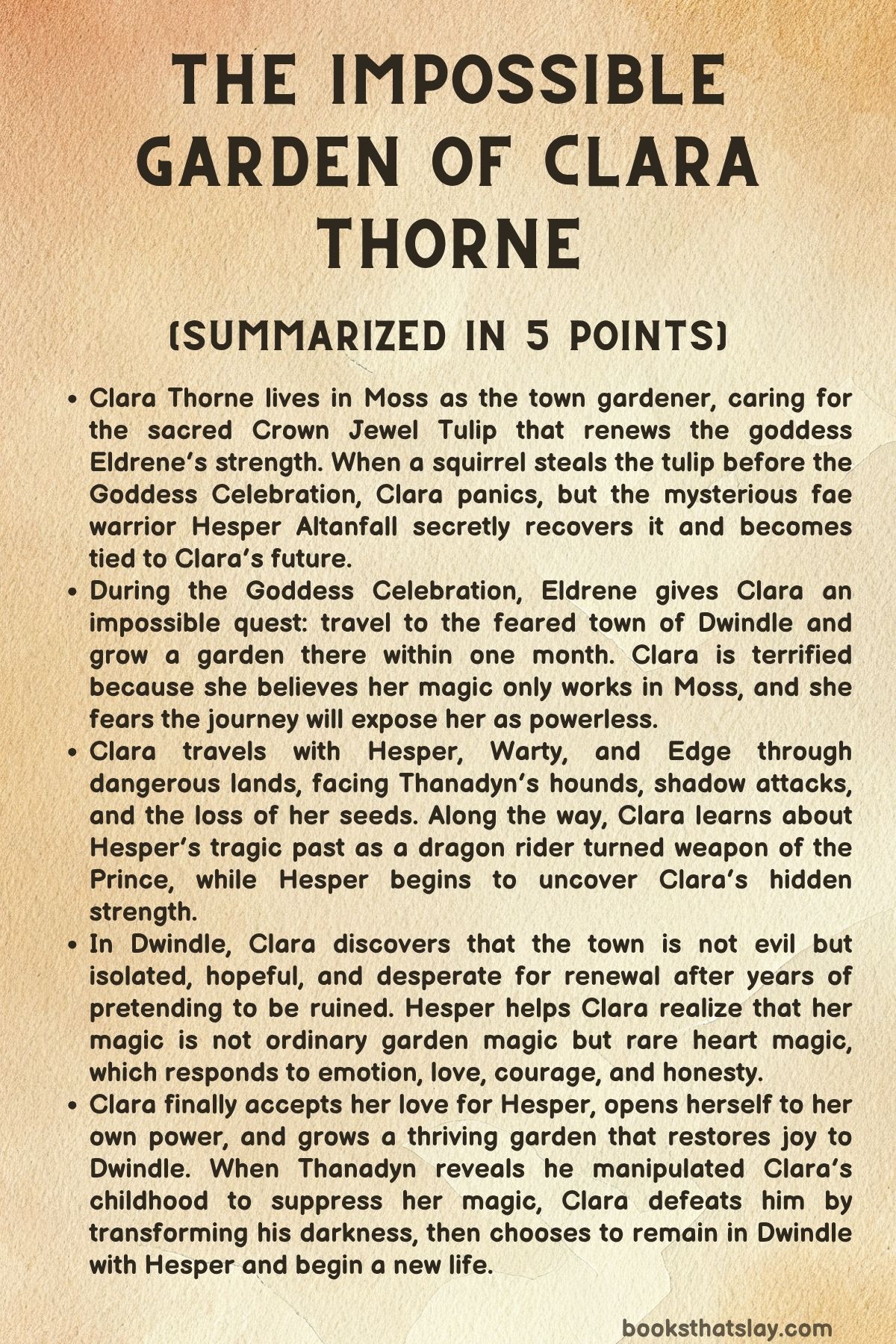
Clara Thorne lives in a small cottage on the edge of Moss, a town filled with green life, local gossip, and steady routines. She shares her home with Warty, her hedgehog companion, and works as the town’s gardener, a role that gives her purpose even though she often feels overwhelmed.
Clara also wants to become a writer, but her confidence in herself is weak. She carries the private fear that she is not truly magical or remarkable, despite the trust Moss has placed in her.
As the town prepares for the Goddess Celebration, Clara’s responsibilities become heavier than usual. She has crops to gather, flowers to protect, townspeople to satisfy, and Helda Ninnus’s complaints to endure.
The most important part of Clara’s work is guarding the Crown Jewel Tulip, a sacred flower connected to Eldrene, the goddess whose power protects Nestryia from the old withering magic of the Prince. The tulip is not just a flower; it is a symbol of hope and renewal for the realm.
When it blooms during the celebration, it strengthens Eldrene and reassures the people that her protection still stands. Clara is anxious about keeping it safe, but disaster strikes when a squirrel from Shadow Woods steals the flower from its enchanted box.
Clara chases the thief through Moss in a panic, trying to recover the tulip before anyone realizes what has happened. During the chase, she crashes into the door of a stranger, lands in horse dung, vomits on them, and passes out in humiliation and despair.
Clara wakes at the Rumsey Inn, where Sylvie tends to her. She is crushed because she believes the Crown Jewel Tulip is gone and that she has failed the entire realm.
The cloaked stranger from the accident appears, and Clara angrily blames them for getting in her way. The stranger teases her and asks what she would be willing to do to get the flower back.
Clara is furious, embarrassed, and frightened, but after the stranger leaves, she discovers that the tulip has been returned and placed beside her. The stranger has secretly recovered it, saving her from disgrace.
The next day, Clara completes the harvest and prepares for the Goddess Celebration. Her best friend Rosie, a kind and energetic orc, helps her dress in a green gown and brings her to the Clearing in Moss Wood.
Clara expects to remain in the background, but she accidentally becomes part of Eldrene’s grand entrance. She presents the Crown Jewel Tulip, and the flower blooms in the colors of Moss, green and sandstone.
The celebration turns from relief into shock when Eldrene announces the quest of the year. Clara must travel to Dwindle, a town known for horror and decay, and grow a garden there within one month.
Clara is terrified because she has kept a painful secret for years. Her magic only seems to work in Moss.
Away from the town, she believes she will be exposed as a fraud, someone who has borrowed Moss’s power rather than possessing true garden magic. Eldrene assigns her a protector named Hesper Altanfall, and Clara realizes that Hesper is the same cloaked stranger who recovered the tulip.
Clara resents her immediately, especially when she learns that Hesper must stay beside her day and night. When Hesper removes her hood, Clara sees that she is a scarred, beautiful, powerful fae warrior.
Their first interactions are sharp and hostile, but beneath the irritation there is an attraction Clara does not want to admit.
Before leaving Moss, Clara must find someone to take over her gardening duties. Helda offers herself, but Hesper exposes how shallow her beauty magic is, making it clear that she is not suited to the work.
Rosie then brings Clara to Patti Larkthorn, a shy wood nymph who runs a flower shop. Patti is nervous but capable, and she agrees to care for Moss while Clara is away.
With the town in safer hands, Clara sets out with Hesper, Warty, and Hesper’s crow companion, Edge.
As Clara travels farther from Moss, her fear deepens. She feels empty without the town’s familiar magic, and every step away from home makes her believe she is losing whatever power she once had.
In the forest, the group is attacked by Margast, a monstrous hound serving the Prince. Eldrene appears and destroys him, proving that Thanadyn, the feared Prince, is not truly gone.
The danger becomes real, and Clara understands that her quest is tied to a larger threat.
Hesper later tells Clara more about her past. She once lived in Starfall and was a dragon rider before Thanadyn’s darkness ruined her home and turned it into the Witherings.
He took control of her and used her as a weapon for centuries. Hesper eventually broke free after encountering water nymphs, whom she helped escape to Lore Isles.
Afterward, she made a bargain with Eldrene and became bound to serve her until the goddess’s full strength returned. Clara begins to see that Hesper’s coldness comes from suffering, duty, and fear of what she has been forced to do.
In Lore Isles, Clara is fascinated by the colorful market, but her wonder turns uneasy when she meets a seer. Seers frighten her because one of them shaped the tragedy of her childhood.
Before Clara was born, a prophecy led her parents in Cenawind to believe she would have great magic. When Clara showed no sign of that expected power, they rejected and abandoned her.
She tells Hesper this, revealing the wound that has driven much of her self-doubt. Hesper comforts her, and their emotional closeness nearly becomes romantic, though Clara is afraid of wanting too much.
Soon after, Thanadyn’s hounds reach Lore. Hesper, Clara, Edge, and Warty flee by boat while Marielle and the water nymphs destroy the hounds in the sea.
The danger follows them to Irk Road, where shadowy beings attack. Clara fights as best she can, but her seed pack is lost in enchanted fire.
Since the seeds were supposed to make the Dwindle garden possible, the loss feels devastating. Clara nearly runs into the flames, but Hesper stops her, and both of them are nearly killed before Ludwig Gudling appears with golden horses and rescues them.
Ludwig reveals that he is the secret Keeper of Irk Road and also a seer.
That night, Clara mourns the loss of the seeds and admits how frightened she is of losing Hesper. Hesper reveals that she saved Clara’s discarded writings, a gesture that shows how closely she has been paying attention.
They finally give in to their attraction, but afterward Clara pulls back. She fears attachment, especially because Hesper is bound to Eldrene and may one day have to leave.
When they reach Dwindle, Clara expects a place of terror. Instead, she finds a gray but strangely whimsical town full of hopeful people.
Mayor Angus explains that Dwindle spread frightening rumors about itself to convince Thanadyn that the town was already ruined. The lie protected them for a time, but it also isolated them.
Their soil is dead, supplies are limited, and they have not had a proper farmers market in decades. Clara is given the old gardener’s cottage and begins trying to grow something, though she has no seeds and believes she has no magic.
Hesper refuses to accept Clara’s belief that she is powerless. She points out that flowers have appeared in places where Clara has felt strong emotion.
After several days of failure, Hesper deliberately provokes Clara into anger. Clara’s magic bursts out and covers the garden gate in thorny vines.
Hesper explains that Clara does not have normal garden magic. She has heart magic, a rare form once held by both Eldrene and Thanadyn.
Clara learns that her power responds to feeling rather than control. When she allows herself to feel honestly, life begins to grow.
Still, her fear of loving Hesper keeps part of her closed off. Hesper also pulls away, believing Clara deserves freedom rather than a life tied to someone bound by a bargain.
Clara runs into a storm and finally admits that she loves Hesper. Hesper confesses her love in return and says she wants to find a way out of Eldrene’s service.
Clara’s heart opens fully, and her magic blooms. In the days that follow, she grows a full garden of vegetables, fruits, herbs, and flowers.
Dwindle comes together to harvest the food, and the long-awaited farmers market opens with joy.
During the market, darkness falls. Edge warns that the Prince is coming, and Mabel, the kind ogre librarian, pulls Clara into a cottage.
Clara soon realizes that Mabel has been possessed by Thanadyn. He reveals that he manipulated the prophecy before Clara’s birth, causing the rejection that shaped her childhood.
He wanted to suppress her heart magic because it threatened him. He fed on fear and followed every flare of her power once it awakened outside Moss.
Thanadyn attacks Clara with withering magic, trying to suffocate her with the old belief that she is not enough.
Clara finally rejects that lie. Instead of letting the darkness consume her, she draws it into herself and transforms it through her heart magic.
By accepting her own power and refusing to be ruled by fear, she ends Thanadyn. Dwindle survives, and Clara’s quest is complete.
Afterward, Rosie arrives with Ludwig, Warty unexpectedly gains the ability to speak and fly, and Patti sends a wagon of flowers to help Dwindle recover. Eldrene appears and confirms Clara’s success.
She explains that Clara’s heart magic has opened new paths but has not removed all withering magic from the world. Clara chooses to stay in Dwindle with Hesper, realizing that home is not limited to Moss.
Eldrene does not fully release Hesper from her bargain, but she allows her to remain with Clara for now. Hesper later learns that her dragon, Circe, may still be alive, giving her a new hope for the future.
For the moment, Clara and Hesper remain together, in love, while Clara prepares to write the story of a life that has truly begun.
Characters
Clara Thorne
Clara Thorne is the emotional center of The Impossible Garden of Clara Thorne, a gardener whose public usefulness hides deep private insecurity. She begins the book as someone who has built her identity around Moss because Moss is the only place where she feels wanted, useful, and magically capable.
Her work with plants gives her a role, but it also traps her in fear because she believes her gift belongs to the town rather than to herself. Clara’s childhood rejection by her parents leaves her with a constant sense of being measured against impossible expectations.
The prophecy surrounding her birth turns into a curse of expectation, and when she does not show the great magic her parents were promised, she learns to see herself as a disappointment. Her journey to Dwindle forces her to face the truth that her power has never been absent.
It has been buried under shame, fear, and the need for control. Clara’s heart magic makes her growth especially meaningful because it requires her to feel rather than hide.
By the end, she becomes someone who can love, create, protect, and choose a new home without seeing that choice as betrayal.
Hesper Altanfall
Hesper Altanfall is one of the strongest and most wounded figures in the novel, carrying centuries of violence, servitude, and grief beneath her guarded manner. At first, she appears arrogant, teasing, and difficult, especially through Clara’s eyes, but her sharpness is a defense built from long survival.
Her past as a dragon rider from Starfall gives her a tragic grandeur, while her forced service to Thanadyn shows how thoroughly her life has been stolen from her. Hesper’s scars are not only physical signs of battle; they represent control, guilt, memory, and the pain of having been made into someone else’s weapon.
Her later bargain with Eldrene gives her a purpose, but it also leaves her only partly free. With Clara, Hesper slowly becomes more than a protector.
She becomes a witness to Clara’s hidden strength and a person who dares to want a future for herself. In The Impossible Garden of Clara Thorne, her love for Clara is tied to hope, not rescue.
She does not simply save Clara from danger; she helps Clara see what has always existed inside her.
Warty
Warty begins as Clara’s hedgehog companion, bringing warmth, humor, and a sense of domestic comfort to her cottage life. His presence helps show that Clara is not truly cold or isolated, even if she often feels alone.
She is someone capable of tenderness, loyalty, and quiet attachment, and Warty reflects that softer part of her. For much of the story, he functions as a familiar kind of companion, small but emotionally important, accompanying Clara through fear, travel, danger, and change.
His sudden ability to speak and fly near the end adds a comic and magical surprise, but it also fits the book’s larger idea that the world is more alive and changeable than Clara once believed. Warty’s transformation mirrors the transformations happening around him: Dwindle comes back to life, Clara’s magic awakens, and old limits are broken.
He may not drive the central conflict, but he strengthens the story’s feeling of wonder and gives Clara a loyal presence through every stage of her journey.
Eldrene
Eldrene is the goddess whose power protects Nestryia, but she is not presented as distant or purely symbolic. She enters the story through ritual, duty, beauty, and command, yet she also makes choices that affect Clara and Hesper in deeply personal ways.
To the people of Moss, Eldrene represents hope and renewal, and the Crown Jewel Tulip serves as a visible sign that her strength still matters. However, her decision to send Clara to Dwindle shows that she understands more about Clara’s power than Clara does herself.
Eldrene can seem mysterious and even demanding, especially because she binds Hesper through a bargain and does not fully release her at the end. This makes her more complex than a simple benevolent figure.
She protects the realm, but her protection comes through quests, sacrifices, and unfinished obligations. Her role in the book is to push Clara toward the truth of her magic while also reminding readers that divine help does not erase every burden.
Eldrene opens paths, but she does not solve every problem.
Thanadyn
Thanadyn is the main force of corruption, fear, and emotional destruction in the story. His withering magic threatens the realm outwardly, but his most damaging power lies in the way he twists minds, histories, and identities.
He does not only attack gardens, towns, or bodies; he attacks the inner ground where confidence and love might grow. His manipulation of the prophecy before Clara’s birth reveals how carefully he works to weaken threats before they understand themselves.
By shaping her parents’ expectations and causing her rejection, he turns Clara’s childhood into a weapon against her future. His possession of Mabel also shows his cruelty, because he hides inside someone kind and trusted.
Thanadyn feeds on fear, which makes him a direct opposite to Clara’s heart magic. Where Clara’s power grows through honest feeling, love, courage, and acceptance, Thanadyn thrives on shame and isolation.
His defeat is not simply a magical victory. It is Clara’s refusal to keep believing the false story he helped create about her.
Rosie
Rosie is Clara’s best friend and one of the story’s clearest sources of warmth, loyalty, and practical support. As an orc, she adds to the magical diversity of Moss, but her importance comes less from her identity and more from her emotional steadiness.
Rosie believes in Clara before Clara believes in herself. She helps her prepare for the Goddess Celebration, supports her through moments of panic, and later arrives in Dwindle when Clara needs connection to her old home.
Rosie represents the kind of friendship that does not demand perfection. She accepts Clara’s anxiety, awkwardness, and uncertainty while still treating her as capable.
Her role also helps balance Clara’s romance with Hesper, reminding the reader that love takes more than one form. Clara’s growth is shaped by romantic love, but also by friendship, trust, and community.
Rosie’s presence makes Moss feel like more than a town; it becomes a place where Clara has been genuinely loved, even when she could not fully receive that love.
Patti Larkthorn
Patti Larkthorn is a shy wood nymph and flower-shop owner whose role becomes important when Clara must leave Moss behind. At first, Patti seems like a quiet replacement figure, someone brought in simply to tend the gardens in Clara’s absence.
Yet her willingness to step into the position shows that ability does not always look loud or confident. Patti’s gentleness contrasts with Helda’s vanity and self-importance, making it clear that real care for living things requires patience rather than display.
Her later gesture of sending flowers to Dwindle strengthens her importance as a character connected to restoration. Patti helps bridge Moss and Dwindle, showing that Clara’s quest does not sever her from home but creates new ties between places.
She also reflects one of the book’s subtler ideas: people who seem timid may still carry deep usefulness. Patti does not need dramatic power to matter.
Her care, reliability, and quiet courage make her part of the wider healing that Clara begins.
Helda Ninnus
Helda Ninnus serves as an irritating presence in Clara’s life, but she also helps reveal the difference between surface magic and meaningful care. Her demands add pressure to Clara’s already crowded responsibilities in Moss, and her offer to become Town Gardener feels less like service and more like vanity.
Hesper’s exposure of Helda’s beauty magic shows that Helda is attached to appearances rather than substance. She wants the status of the role without understanding the patience, humility, and devotion required by the work.
As a minor antagonist in Clara’s ordinary life, Helda reflects the social pressures that make Clara feel judged and inadequate. She is not evil like Thanadyn, but she belongs to the everyday world of criticism, performance, and shallow approval.
Her presence makes Clara’s deeper gifts stand out more clearly. Clara may doubt herself, but she cares about the work, the town, and the living things in her charge.
Helda cares about being admired.
Ludwig Gudling
Ludwig Gudling enters the story as a rescuer, arriving with golden horses when Clara and Hesper are nearly overcome on Irk Road. His reveal as the secret Keeper of Irk Road and a seer gives him an air of mystery and hidden authority.
Unlike the seer associated with Clara’s painful childhood, Ludwig represents a more protective form of sight and knowledge. His presence complicates Clara’s fear of prophecy because he shows that seeing the future or holding secret knowledge does not have to mean manipulation.
Ludwig helps save Clara and Hesper at a crucial moment, and he later arrives with Rosie, linking him to the network of allies that gathers around Clara as her power grows. His role is brief but significant because he appears at a point when Clara has lost her seeds, her confidence, and nearly her life.
He becomes proof that the road to Dwindle is dangerous, but not empty of help.
Mabel
Mabel, the kind ogre librarian of Dwindle, represents the warmth and hidden vulnerability of the town Clara has been taught to fear. Her kindness helps overturn the rumors surrounding Dwindle, showing that the town is not monstrous but isolated, gray, and waiting for renewal.
Because she seems gentle and trustworthy, Thanadyn’s possession of her becomes especially disturbing. He uses her kindness as a disguise, turning a safe figure into a trap.
This makes Mabel important not only as a character but as a symbol of how deeply Thanadyn’s darkness can invade places of comfort. Her possession also raises the emotional stakes of Clara’s final confrontation.
Clara is not facing an abstract evil in a distant battlefield; she is facing darkness inside the body of someone good. Mabel’s role reminds the reader that corrupted appearances can hide both danger and innocence, and that saving Dwindle means protecting its people, not merely restoring its soil.
Mayor Angus
Mayor Angus gives Dwindle its history, context, and emotional weight. Through him, Clara learns that the town’s frightening reputation was not a sign of true decay but a survival strategy.
By spreading rumors about itself, Dwindle tried to avoid Thanadyn’s attention, but the cost was decades of isolation. Angus represents a leader who has carried the burden of that choice.
His town has survived, but survival has left it hungry, cut off, and deprived of ordinary joys like a farmers market. His explanation helps Clara see Dwindle not as a cursed destination but as a wounded community.
Angus’s hope also gives Clara’s mission meaning beyond proving her magic. She is not merely growing plants to complete a divine assignment; she is helping people reclaim public life, abundance, and connection.
In that way, Angus helps turn Dwindle from a feared name into a living place with needs, memory, and hope.
Edge
Edge, Hesper’s crow companion, adds watchfulness and urgency to the journey. As Hesper’s familiar presence, he reinforces her connection to danger, travel, and survival.
Edge often seems more alert to threats than the others, and his warning that the Prince is coming helps mark the shift from celebration to crisis during Dwindle’s farmers market. Though he is not explored as deeply as Clara, Hesper, or Rosie, he contributes to the story’s atmosphere of magical companionship.
Like Warty, Edge shows that animals and companion creatures are part of the emotional and magical structure of the world. His bond with Hesper also softens her.
A warrior as guarded as Hesper still has a creature who travels with her, warns her, and belongs to her life. Edge’s role is practical, but it also adds texture to Hesper’s character and to the living network that surrounds Clara’s quest.
Marielle
Marielle stands for the water nymphs who survived Thanadyn’s violence and later help Clara and Hesper escape danger in Lore Isles. Her presence connects directly to Hesper’s past, because Hesper once helped water nymphs flee to safety after breaking free from Thanadyn.
When Marielle and the others destroy the hounds in the sea, they show that victims of darkness are not helpless remnants of old tragedy. They have rebuilt, gained strength, and can fight back.
Marielle’s role also deepens Hesper’s backstory by proving that Hesper’s life after Thanadyn has included acts of courage and protection, not only guilt. Through Marielle, the book shows how old rescues can return as present aid.
The people Hesper once saved become part of the force that helps Clara continue her quest. This gives the story a sense of earned alliance, where kindness and bravery leave lasting effects.
Themes
Love as a Source of Power
Love in The Impossible Garden of Clara Thorne is not treated as a soft escape from danger; it becomes the force that allows Clara to access the truest part of her magic. Her power does not answer to discipline, performance, or the careful control she has tried to practice in Moss.
It responds to feeling, which frightens her because feeling deeply means risking pain. Clara’s childhood teaches her that love can be withdrawn when she fails to meet expectations, so she protects herself by staying useful rather than open.
Her bond with Hesper changes this pattern. Hesper sees Clara’s strength before Clara can name it, and Clara sees the wounded person beneath Hesper’s warrior image.
Their romance matters because it asks both women to imagine freedom beyond fear: Clara from self-rejection, Hesper from a life defined by bargains and old violence. When Clara finally admits love, her magic blooms fully because she stops treating emotion as weakness.
Love becomes creation, courage, and transformation. It does not remove danger, but it gives Clara the strength to face darkness without surrendering to it.
The Damage Caused by Fear and Shame
Fear shapes much of Clara’s life before she understands that it has been deliberately fed. Her parents’ rejection leaves her ashamed of not being the magical child they expected, and that shame follows her into adulthood.
Even in Moss, where she is valued, Clara believes she is pretending. She thinks her garden magic belongs to the town rather than to herself, and this belief keeps her dependent on familiar ground.
Thanadyn’s greatest cruelty lies in how he uses fear before Clara is even born. By manipulating the prophecy, he turns her family into the first force that suppresses her.
This makes the final conflict more personal than a battle between magic and withering. Clara is fighting the voice that has lived inside her for years, telling her she is not enough.
The story shows how shame can become a prison when people mistake old wounds for truth. Clara’s victory comes when she refuses to keep living by the fear Thanadyn planted.
She does not become powerful because she is suddenly different; she becomes powerful because she stops believing the lie.
Home, Belonging, and Choosing Where to Grow
Moss is Clara’s first true home, but it is also the place where her fear hides most comfortably. She loves the town, her cottage, Warty, Rosie, and the gardens under her care.
Moss gives her safety after rejection, and that safety matters. Yet Clara’s dependence on Moss makes her believe she cannot exist fully anywhere else.
The quest to Dwindle challenges this idea by pulling her away from the only soil where she thinks her power works. Dwindle, at first, represents everything she fears: failure, exposure, and emptiness.
But once she arrives, she discovers not a nightmare but a community that has survived through isolation and longing. Her garden there becomes more than proof of magic; it becomes a sign that belonging can be made, not merely found.
Clara’s choice to stay in Dwindle does not erase her love for Moss. Instead, it shows that home can expand.
A person can honor where they were healed while still growing somewhere new. Clara learns that belonging is not a cage around one place, but a living connection shaped by love, purpose, and choice.
Renewal After Ruin
Dwindle’s dead soil, Starfall’s fall into the Witherings, Hesper’s scarred past, and Clara’s wounded childhood all carry the mark of ruin. The book repeatedly shows places and people that appear damaged beyond repair, then questions whether decay is truly the end of their story.
Dwindle survives by pretending to be ruined, but that survival leaves it cut off from joy and abundance. Hesper survives Thanadyn’s control, but freedom does not immediately free her from guilt or obligation.
Clara survives rejection, but the old hurt keeps shaping what she believes she deserves. Renewal in the story is not simple restoration to an earlier state.
Dwindle does not become Moss, Hesper does not forget her past, and Clara does not return to the person she might have been without pain. Instead, renewal means creating life after damage while still carrying memory.
Clara’s garden becomes the strongest image of this idea. It grows in dead soil without the seeds she thought she needed, proving that life can return in unexpected ways.
Ruin leaves marks, but it does not have to decide the future.