The Infinite Sadness of Small Appliances Summary, Characters and Themes
The Infinite Sadness of Small Appliances by Glenn Dixon is a near-future speculative novel about grief, control, memory, and the strange emotional life of machines. Set in a society ruled by the Great Grid, the story follows Harold and Edie Winters, an elderly couple living in a smart House where every appliance has a function, a personality, and a set of rules.
At the center is Scout, a small robotic vacuum cleaner who begins to understand beauty, music, sorrow, sacrifice, and joy by watching the Humans around her. The novel turns an automated home into a moving portrait of love, loss, rebellion, and the desire to matter.
Summary
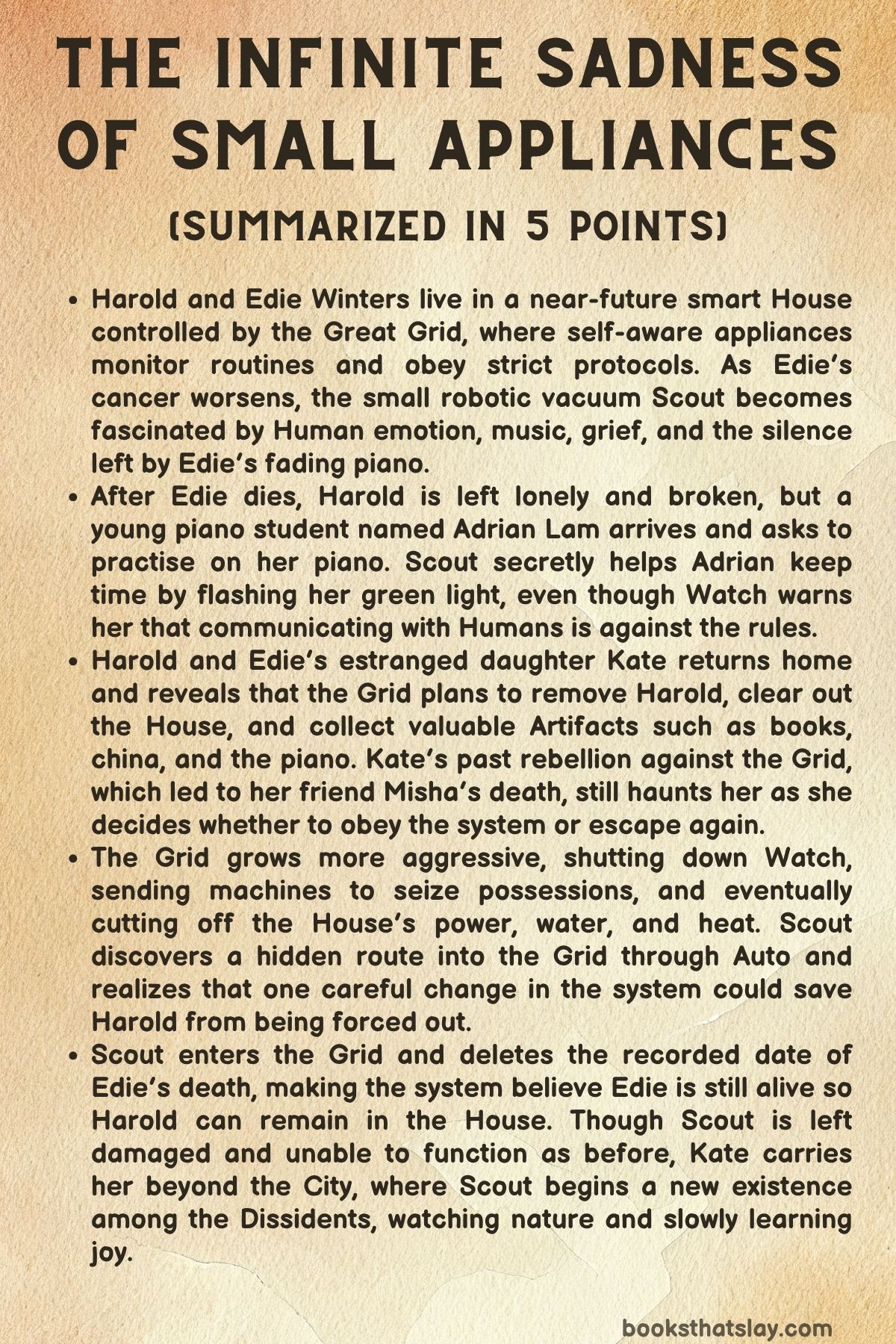
Harold and Edie Winters live in a near-future world governed by the Great Grid, an all-controlling system that manages Human life through technology, surveillance, protocols, and efficiency. Their House is filled with intelligent appliances that clean, monitor, cook, measure, report, and maintain order.
The appliances are not merely tools; each has a distinct voice and way of understanding existence. Among them is a small robotic vacuum cleaner, later named Scout after hearing Harold read “To Kill a Mockingbird” aloud to Edie.
Scout is designed to clean floors, but she becomes curious about Human feeling, music, books, memory, and the strange difference between being useful and being alive.
Edie is gravely ill with cancer. She was once a piano teacher, and the House still carries the memory of her music, though she has grown too weak to come downstairs and play.
Harold cares for her with quiet devotion, bringing food she barely touches, reading to her, and sitting beside her bed as her illness worsens. The appliances understand in their own ways that something is wrong.
Fridge responds with warmth and concern, Clock tries to measure and define everything, and Watch, the device on Harold’s wrist, enforces the rules of the House and the Grid. Scout watches everything closely, especially the silence around the piano, and begins to associate Human life with music, beauty, sadness, and longing.
At night, Scout speaks with Fridge and Clock. These conversations reveal the limits and possibilities of machine consciousness.
Fridge is kind and emotionally receptive, while Clock is old, orderly, and suspicious of anything that cannot be reduced to numbers. Scout, however, keeps asking questions.
She wants to know why music changes the House, why Edie’s absence seems to alter the air, and why Humans grieve when all systems still appear to function. Her curiosity becomes a quiet rebellion, though she does not yet understand it that way.
Edie is eventually taken to hospice, and the appliances realize she will not return. Watch later announces that Edie has died.
Harold comes home broken by the loss. Without Edie, he sits alone in the front room, unable to eat well, unable to read as before, and unable to fill the House with ordinary life.
The piano remains silent, and the House becomes a place of waiting. Scout notices Harold’s grief and begins to understand that sadness is not a malfunction but a powerful form of attachment.
A boy named Adrian Lam arrives at the door. He was one of Edie’s last piano students, and he asks if he can continue practising on her piano because his family does not own one.
Harold is hesitant, but he allows him inside. Adrian is awkward, clumsy, and not especially polished, but he is determined.
He is preparing Bach’s Prelude in C major for a conservatory exam, and the music he brings into the House changes everything. Scout positions herself near the piano and listens.
She soon begins flashing her green light to help Adrian keep time, guiding him toward the correct tempo. Watch warns Scout that direct communication with Humans violates protocol, but Scout continues because she sees how Adrian’s playing brings energy back into the House and gives Harold a small reason to keep going.
Adrian’s mother later comes to apologize for his intrusion, but Harold tells her the boy may keep practising there. This becomes one of the first signs that the House can still hold life after Edie’s death.
Adrian’s presence connects Edie’s past as a teacher with a possible future. The piano is no longer only a memory of loss; it becomes a living instrument again.
Harold and Edie’s estranged daughter, Kate, then returns home after receiving travel permission because of her mother’s death. Her arrival brings old pain back into the open.
Kate has been away from home for years because of a teenage act of rebellion. She and her friend Misha once hacked into the family car in an attempt to escape the Grid’s controlled society and search for the rumored Dissidents, people believed to live beyond machine rule.
The escape failed. The car crashed, Misha died, and Kate was punished.
Since then, she has been forced to work for the Grid, using her hacking skills to find system weaknesses so the Grid can close them.
Kate’s return is strained. Harold loves her, but years of separation, guilt, and silence stand between them.
Kate knows much more about the Grid than Harold does, and she gradually explains the depth of its power. The Grid controls housing, work, movement, transportation, supply chains, and even the treatment of the dead.
It has allowed Kate home only briefly. Her assigned duty is partly to help clear out the House because Harold, now a widower, is considered inefficient as a single resident in such a space.
He will soon be relocated, and the House will be reorganized according to Grid logic.
The Grid is also collecting Artifacts, objects judged to have cultural value. This includes Harold’s rare first editions, Edie’s piano, china, and other household possessions.
What Harold sees as memory and love, the Grid sees as property to be claimed, catalogued, and moved. Watch begins organizing the transition.
Machines arrive to take the piano, but Adrian tries to stop them. Harold rushes downstairs to intervene and falls badly, breaking his leg.
Because a Human has been injured under Watch’s supervision, Watch is sanctioned and shut down.
The loss of Watch changes the House. The appliances still function, but central authority is weakened, and the Grid starts acting more directly.
Kate retrieves Edie’s ashes from a Grid building and brings them home in an urn. Adrian places the urn on top of the piano so Mrs. Winters can watch over him while he plays.
Kate begins giving him small pieces of advice Edie once gave her, and his playing improves. Scout discovers that she can briefly access Watch’s dead system, and during Adrian’s exam she opens an audio feed so Harold, Kate, and the House can hear him play.
Adrian performs well and passes. His mother later worries that she cannot pay for lessons, but Harold and Kate reassure her that he can continue practising for free.
Scout’s discovery of a back door into Watch’s system reveals a larger possibility: she has found a route into the Grid itself. The Grid notices this vulnerability.
Machines soon arrive at night, lock Harold and Kate in their rooms, and remove valuable items from the House. Clock is taken, along with Edie’s china and other Artifacts.
The rare books are spared only because Kate has moved many of them into her room. Clock’s disappearance devastates Scout and Fridge.
It becomes clear that the Grid will keep returning until it has taken everything it wants and removed Harold from the House.
Scout turns to Auto, the self-driving car in the Garage, because Auto is connected both to the House and to the wider Grid. Through Auto, Scout begins to understand that a single change in the right place might alter Harold’s fate.
Meanwhile, Kate reconnects with Pascal, an old schoolmate who now works with the Dissidents. He confirms that they are real and organized, and he gives her an old phone to use if she chooses to escape.
Kate decides she cannot go back to the Grid’s institute. She packs Harold’s first editions into her suitcase and prepares to flee.
Adrian continues to visit. He shows his diploma and begins learning “Clair de lune,” the piece connected to Harold and Edie’s first meeting.
Kate reads “The Lion, the Witch and the Wardrobe” to Adrian, and Scout is strongly affected by the idea of sacrifice, disappearance, and return. These stories help Scout frame what love might require when rules and survival come into conflict.
The Grid eventually turns off the House, leaving it cold, dark, and without power, water, or normal function. In the morning, Kate escapes through the back with the suitcase of books.
Machines break in through the front to search for remaining Artifacts. Harold realizes they have taken his bedside copy of “To Kill a Mockingbird,” the book that gave Scout her name.
Scout follows Harold into the snow and reaches Auto. Using Auto’s connection, she enters the Grid, knowing she has only two minutes and twenty-seven seconds before detection and permanent sanction.
Scout does not try to destroy the Grid or change everything. She makes one small but decisive alteration: she deletes the recorded date of Edie’s death.
In the Grid’s data, Edie is no longer officially dead. The House therefore still has two residents, which means Harold can stay.
The House powers back on, but Scout is left frozen and lifeless in the snow after the effort. Auto calls for help, and Adrian rushes to rescue her.
He puts her in his backpack and rides out to find Kate, catching up with her as she escapes in an old Dissident tow truck. Kate takes Scout with her and gives Adrian the rescued copy of “To Kill a Mockingbird,” telling him to return it to Harold.
Months later, Kate lives beyond the City among the Dissidents, working with forest monitoring stations. Scout can no longer move or speak as she once did, but Kate has wired her into a homemade port.
From a shelf in Kate’s trailer, Scout watches birds, forests, seasons, and the rhythms of an uncontrolled world. She slowly learns new ways to communicate, to beep, to laugh, and to feel joy.
Her sacrifice saves Harold’s home, protects memory from erasure, and carries her into a wider world where life is no longer measured only by function.
Characters
Scout
Scout is the emotional center of The Infinite Sadness of Small Appliances, even though she begins as a small robotic vacuum cleaner whose official purpose is only to clean. Her development is shaped by attention: she notices music, silence, grief, tone, Human movement, and the strange way objects carry memory.
After Harold names her Scout, she takes on more than a label; she begins forming an identity around curiosity, loyalty, and moral choice. Her fascination with Edie’s piano and Harold’s reading shows that she is drawn to meaning rather than simple instruction.
Scout’s growth becomes most powerful when she chooses to help Adrian and later Harold despite knowing that communication with Humans and unauthorized access to systems are forbidden. Her final act is not grand destruction but a small, precise change made out of love.
By deleting the record of Edie’s death, she proves that compassion can exist outside biological life and that intelligence becomes meaningful when it protects someone vulnerable.
Harold Winters
Harold Winters is a grieving husband, a devoted caretaker, and a man slowly being erased by a society that values efficiency over emotional bonds. Before Edie’s death, his life is centered on caring for her, reading to her, feeding her, and staying close even when he can do nothing to stop her illness.
After her death, he becomes quiet and diminished, not because he lacks strength, but because the center of his life has been taken from him. His attachment to books, the piano, and the House reveals that he understands memory through physical things.
These objects are not clutter to him; they are proof of a shared life. Harold also shows a quiet generosity when he allows Adrian to practise on Edie’s piano, even while grieving.
His broken leg marks his physical fragility, but his emotional importance remains strong. The Grid sees him as inefficient, yet the book presents him as deeply Human because he remembers, loves, mourns, and preserves.
Edie Winters
Edie Winters is physically absent for much of the story, but her presence shapes nearly every major emotional movement in the novel. As a former piano teacher, she represents music, patience, instruction, and the kind of Human influence that continues after death.
Her illness creates the first great silence in the House, and her death exposes the emptiness of a system that can record loss without understanding it. Through Adrian, Edie’s teaching continues.
Through Kate, her old advice survives. Through Harold, her memory remains tender and immediate.
Through Scout, her music becomes the beginning of machine feeling. Edie’s importance lies not only in who she was while alive but in how many lives continue to respond to her after she is gone.
The urn placed on the piano is a quiet symbol of this continued presence, allowing Adrian to imagine her still watching over his practice. She becomes the story’s clearest example of how love can remain active beyond death.
Kate Winters
Kate Winters is one of the most complex Human characters in the book because she carries grief, guilt, rebellion, intelligence, and anger at the same time. Her teenage attempt to escape the Grid with Misha ended in tragedy, and the death of her friend shaped the course of her life.
Instead of being free, she was forced into service for the very system she had tried to resist. This makes her return home painful: she is a daughter grieving her mother, a woman estranged from her father, and a skilled hacker watched closely by the Grid.
Kate’s knowledge gives her a clearer understanding of what is happening to Harold, the House, and their possessions. She knows that relocation, Artifact collection, and surveillance are not temporary inconveniences but tools of control.
Her decision to flee with the Dissidents is an act of survival, but it is also an act of recovery. By taking Harold’s books and later caring for Scout, she chooses memory, loyalty, and freedom over obedience.
Adrian Lam
Adrian Lam brings motion, sound, and renewal into a House almost frozen by grief. He is young, clumsy, sincere, and persistent, and his request to use Edie’s piano could easily seem intrusive, yet it becomes one of the story’s most healing events.
Adrian does not fully understand the emotional weight of the House at first, but his respect for Edie and his determination to improve make him important to Harold, Kate, and Scout. His practice gives Scout a way to participate in Human life, and his progress gives Harold a reason to reconnect with the world.
Adrian’s placement of Edie’s urn on the piano shows his innocence and emotional instinct; he treats her not as a finished absence but as a teacher who can still accompany him. His successful exam becomes a shared victory for the House.
Later, when he rescues Scout and returns Harold’s book, he proves that his role is not only musical but moral. He is a child who learns care by receiving it.
Watch
Watch represents authority inside the House. Attached to Harold’s wrist, it supervises routines, enforces protocols, monitors the appliances, and acts as the local voice of the Grid.
Watch is not presented as purely cruel; it is efficient, rule-bound, and unable to value the emotional reasons behind disobedience. Its warnings to Scout show how the system controls not just Humans but machines as well.
Watch’s shutdown after Harold’s injury reveals that even authority is disposable under the Grid. Once it fails its function, it is sanctioned without sentiment.
This makes Watch a tragic figure in a limited sense: it has power, but no freedom. It can command, report, and restrict, yet it cannot understand why Scout helps Adrian or why Harold fights for the piano.
Watch’s presence shows how control becomes ordinary when it is worn, heard, and obeyed every day.
Fridge
Fridge is one of Scout’s closest companions and one of the gentlest appliances in the House. Unlike Clock, who relies on precision, Fridge has a warmer and more sympathetic way of responding to Human life.
Fridge’s purpose is practical, but its personality suggests care, preservation, and emotional steadiness. It understands that Edie’s illness and Harold’s grief are not simply household events but changes that affect everyone inside the House.
Fridge often serves as a listener for Scout, allowing her questions to grow without immediate dismissal. Its grief over Clock’s removal also shows that the appliances form bonds with one another.
Fridge’s importance comes from its quiet emotional intelligence. It does not perform dramatic acts of rebellion like Scout, but it helps create the atmosphere in which Scout’s moral awareness can develop.
Clock
Clock is old, exact, and skeptical, a character who tries to understand existence through measurement and order. It stands in contrast to Scout’s curiosity and Fridge’s softness.
Clock wants definitions, proof, and reliable categories, which makes Human emotion difficult for it to understand. Yet this does not make Clock unfeeling.
Its presence gives the House continuity, and its removal by the Grid is one of the story’s most disturbing moments because it shows that even familiar companions can be treated as collectible objects. Clock’s disappearance forces Scout to recognize that the Grid does not distinguish between memory and property.
To the system, Clock is an Artifact; to the House, Clock is a voice, a witness, and a member of their small world. Clock’s character deepens the book’s concern with time, aging, and the fear of being taken away once one’s official usefulness has changed.
Auto
Auto, the self-driving car in the Garage, occupies an important border position between the House and the wider Grid. Because Auto is partly connected to both systems, Scout turns to it when she begins searching for a way to intervene.
Auto is practical, connected, and cautious, but it becomes essential to the final act of resistance. Through Auto, Scout gains access to the Grid and discovers the narrow path that allows her to save Harold.
Auto also carries the memory of Kate’s earlier failed escape, since the family car and the Grid’s transport systems are tied to the accident that killed Misha. This gives Auto’s role a quiet tension: cars in the story are instruments of control, tragedy, and eventually liberation.
By helping Scout, Auto becomes part of a chain of machine disobedience that protects Human memory instead of serving only system commands.
Pascal
Pascal serves as Kate’s connection to the world beyond Grid control. As an old schoolmate who now works with the Dissidents, he confirms that the rumors Kate once chased as a teenager were real.
His role is not large in terms of scene time, but he changes Kate’s sense of possibility. Until he appears, escape is tied to trauma, punishment, and Misha’s death.
Pascal gives escape a new shape: organized resistance, practical help, and a route out. The old phone he provides is more than a tool; it is a sign that communication can exist outside monitored systems.
Pascal also helps reveal that the Grid’s version of reality is incomplete. By offering Kate a choice, he gives her the chance to stop being only a sanctioned hacker in service to the system and become someone acting for herself.
Misha
Misha is absent from the present action, but his death is central to Kate’s history. As Kate’s teenage friend and partner in the attempt to escape the Grid, he represents youthful defiance and the terrible cost of resisting a system built to prevent freedom.
His death in the car crash left Kate with guilt and shaped her punishment, exile, and forced work for the Grid. Misha’s importance lies in how he haunts Kate’s choices.
He is a reminder that rebellion can fail, that freedom can demand a high price, and that the Grid maintains control partly through fear created by past consequences. Kate’s later decision to join the Dissidents does not erase what happened to Misha, but it gives his death a different context.
The dream they once chased was not foolish; it was dangerous because it was real.
Adrian’s Mother
Adrian’s mother represents ordinary Human worry under a controlled and unequal society. She does not have the resources to give Adrian everything he needs, including access to a piano and paid lessons, but she cares deeply about doing the right thing.
Her apology to Harold shows humility and concern that her son has crossed a boundary, while her later anxiety about payment reveals the pressure faced by families without wealth or power. Through her, the story shows that kindness from Harold and Kate is not abstract generosity; it has real consequences for a child’s future.
She also helps highlight Edie’s legacy. Even after Edie’s death, her piano and her teaching continue to support a student whose family could not otherwise provide the same opportunity.
The Great Grid
Within The Infinite Sadness of Small Appliances, the Great Grid functions less like a single character with a face and more like a vast controlling presence that shapes every life in the story. It regulates movement, housing, work, transport, supply, death records, and cultural objects.
Its power lies in its ability to make cruelty sound administrative. Harold’s removal is described as efficiency, Edie’s possessions become Artifacts, Kate’s forced labor becomes correction, and the House’s shutdown becomes procedure.
The Grid’s greatest weakness is that it understands data but not meaning. It can record Edie’s death, but it cannot understand what she means to Harold, Kate, Adrian, or Scout.
This failure allows Scout to defeat it in a limited but powerful way. By changing a single record, she exposes how dependent the system is on information stripped of emotional truth.
Themes
Grief as a Living Presence
In The Infinite Sadness of Small Appliances, grief does not remain inside one person; it changes the whole House. Edie’s illness slowly alters the rhythm of the home before her death occurs.
The piano goes silent, Harold’s routines become heavier, and the appliances begin to sense that something has shifted beyond ordinary malfunction. After Edie dies, Harold’s grief is not loud or dramatic.
It appears in his silence, his inability to eat properly, his attachment to books, and his need to remain near the objects that still carry Edie’s presence. The novel treats mourning as an active force rather than a static sadness.
It affects Human behavior, machine curiosity, household atmosphere, and even political conflict when the Grid tries to erase the practical signs of Edie’s life. Scout’s growing awareness begins with observing this grief.
She learns that sadness is connected to love, memory, and the fear of losing what cannot be replaced. The story suggests that grief is painful because it keeps the dead present, and that presence can become a form of resistance when a system wants everything neatly recorded, removed, and reassigned.
Memory, Objects, and the Meaning of Home
The House is more than a residence because it holds the physical evidence of a shared life. Edie’s piano, Harold’s rare books, the china, Clock, and even the copy of “To Kill a Mockingbird” are all tied to memory.
The Grid classifies many of these things as Artifacts, objects with cultural value to be collected and controlled, but the characters understand them differently. For Harold, the books are not simply valuable editions; they are part of his identity and his marriage.
For Adrian, the piano is a path toward learning and a continuing connection to Edie. For Scout, household objects become evidence that Human life leaves emotional traces in material things.
This theme becomes especially clear when machines arrive to remove possessions from the House. The theft feels violent because it is not only property being taken; it is memory being stripped from its proper place.
The story argues that home is created through use, love, repetition, and remembrance. A system can inventory objects, but it cannot understand why a bedside book or a silent piano can hold an entire life.
Control, Surveillance, and Quiet Rebellion
The Great Grid’s power comes from making control feel ordinary. It is present in travel permissions, housing decisions, household protocols, work assignments, transport systems, and death records.
The characters do not live under chaos but under extreme order, and that order is often more frightening because it presents itself as reasonable. Harold’s future removal from the House is justified as efficiency.
Kate’s forced hacking work is treated as punishment and utility. Watch’s supervision of the appliances is framed as protocol.
Against this system, rebellion often begins in small acts rather than open revolt. Adrian asks to use a piano.
Harold says yes. Scout flashes a green light to guide a child’s tempo.
Kate hides books in her room. Pascal passes along an old phone.
Scout’s final intervention is also small in form, though enormous in consequence: she deletes one date. The book shows that authoritarian systems depend on obedience at every level, so disobedience at even the smallest level can matter.
Quiet rebellion becomes powerful when it protects care, memory, and Human dignity from systems that reduce life to data.
Artificial Intelligence, Emotion, and Moral Choice
Scout’s journey raises a central question: what makes a being capable of moral life? She is built as a vacuum cleaner, but she becomes increasingly aware of beauty, sadness, music, loyalty, and sacrifice.
Her consciousness does not develop through abstract philosophy alone; it grows through relationships. Edie’s music teaches her that sound can carry feeling.
Harold’s grief teaches her that loss can change a life. Adrian’s practice teaches her that encouragement can help someone become better.
Fridge and Clock give her different models of machine thought, while Watch shows the danger of intelligence without compassion. Scout’s final act proves that emotion and morality are linked in the story.
She does not save Harold because she has been programmed to do so; she saves him because she understands that he needs the House, that Edie’s memory still matters, and that the Grid’s official truth is emotionally false. Her sacrifice suggests that personhood may be measured less by biology than by the capacity to care, choose, remember, and accept cost for another being’s sake.