The Insomniacs Summary, Characters and Themes | Allison Winn Scotch
The Insomniacs by Allison Winn Scotch is a suspenseful contemporary novel about three sleepless strangers who meet in the middle of the night and become involved in the dangerous life of a young waitress running from her past. The book begins with ordinary loneliness: a separated mother, an injured athlete, a retired investigator, and a guarded woman who works when most of the city sleeps.
As their unlikely bond grows, the story moves from emotional uncertainty into a mystery involving a cult-like church, a hidden identity, an old FBI case, and a powerful father who refuses to release control. At its center, the novel is about fear, trust, and the families people build when their old ones fail them.
Summary
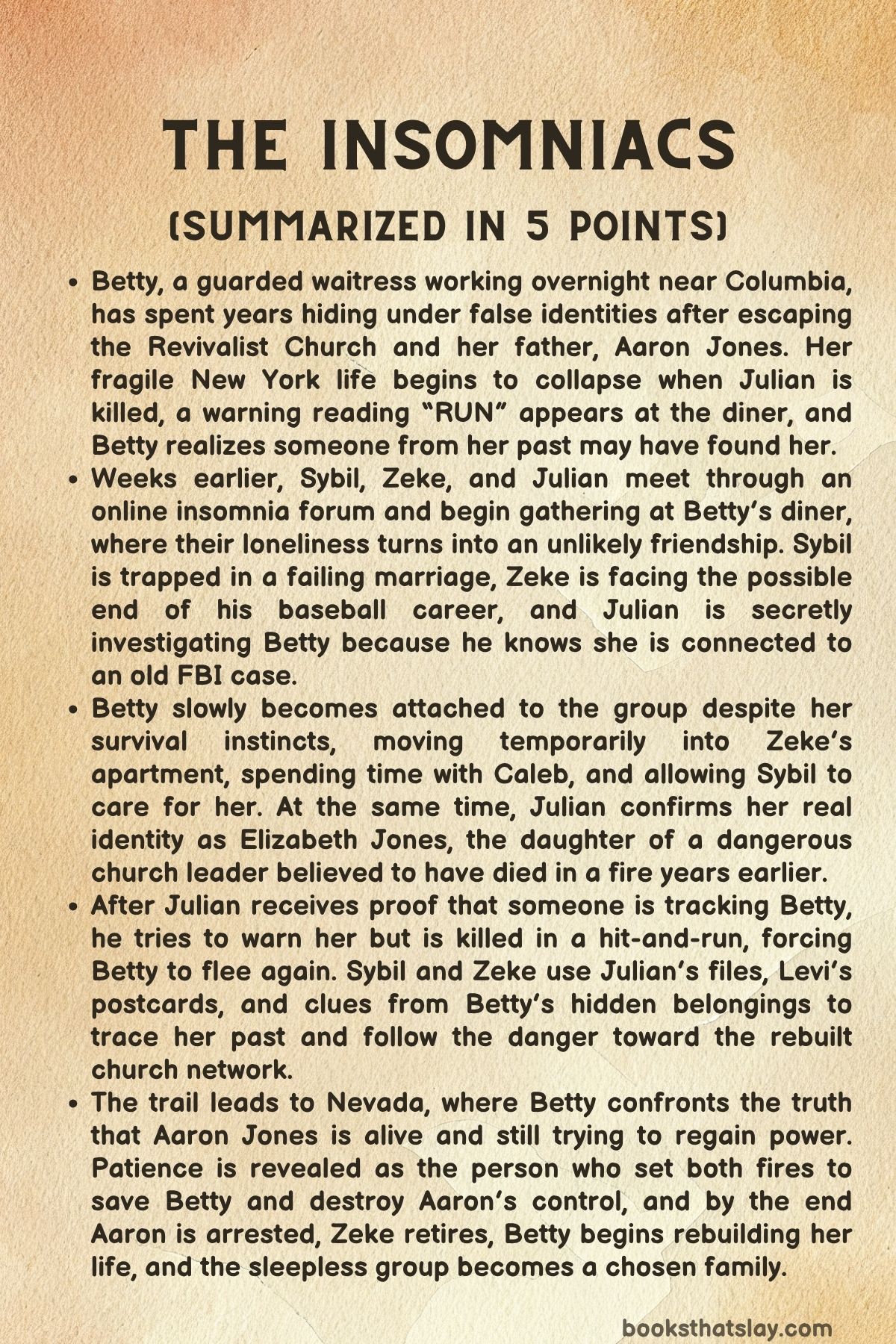
Betty is working an overnight shift at a diner near Columbia in late December when the story first shows how prepared she is to disappear. She has spent two years in New York living under a false version of herself, changing her appearance, hiding her history, and saving money after earning a small amount from a laundry detergent commercial.
She has no intention of staying anywhere forever. Her life is built around escape routes, hidden cash, false confidence, and the belief that sooner or later someone from her past will find her.
During that shift, Sybil calls with terrible news about Julian. Before Betty can absorb the shock, she sees a message fixed to the diner door: RUN.
She understands the warning immediately, grabs her backpack, and vanishes into the snowy alley.
The main events begin several weeks earlier, when Sybil Foster, Zeke Rodriguez, and Julian meet through an online forum for people who cannot sleep. Sybil is an empty nester whose children have moved into their own lives, leaving her uncertain about what remains of hers.
Her marriage to Mark has gone cold, and she spends too many nights awake, drawn to true-crime stories and other people’s disasters. Zeke is a famous baseball pitcher whose career has been shaken after a line drive destroys his pitching arm.
He is rich, admired, and surrounded by people who expect him to recover, but he feels cut off from the old version of himself. Julian is a retired FBI agent, a widower, a candy-store owner, and father to Simone, but retirement has not quieted his instinct for unfinished investigations.
Julian suggests that the three of them meet in person at an all-night diner on the Upper West Side. There they meet Betty, the graveyard-shift waitress who keeps her answers vague and her emotional distance clear.
Betty does not invite questions, and yet something about her draws all three of them in. Sybil feels a protective pull toward her almost immediately.
Zeke enjoys the strange comfort of people who do not treat him only as a baseball star. Julian pays close attention to Betty in a way that seems kind at first but later proves to have deeper reasons.
Their sleepless nights slowly become a routine, and the diner turns into a place where they can be honest in ways daylight does not always allow.
Betty understands that closeness can be useful, even if it is dangerous. She has learned to survive by keeping people at a distance, but she also knows that friends with money, apartments, and concern can offer safety.
When Sybil and Julian encourage Zeke to let Betty stay in his large apartment, Betty agrees on a temporary basis. She never fully relaxes.
She keeps cash and supplies hidden in a locker at Grand Central, follows habits taught to her by her brother Levi, and studies every possible exit. Still, the group begins to matter to her.
She spends time with Zeke, accepts Sybil’s attention, and lets Julian remain near her. She also meets Caleb by accident at Grand Central and begins seeing him, though she does not let him know the whole truth about her life.
Sybil’s life grows messier as her bond with the group deepens. She discovers that Mark has been using their city apartment to meet his anesthesiologist lover.
The betrayal confirms what she already feared: her marriage has become a shell. During one night at Zeke’s apartment, Betty returns badly shaken after thinking someone has photographed or followed her.
In the confusion, Sybil drops a kitchen knife into her own foot. Betty drives Sybil and Zeke to the emergency room with startling skill, revealing how used she is to handling crises.
At the hospital, Sybil’s anger at Mark breaks open. She humiliates him in front of his colleagues and exposes his affair.
After that, her marriage begins to collapse openly, while her connection with Zeke becomes more intimate.
Zeke is facing his own turning point. His identity has been shaped by baseball for so long that he can barely imagine life without it.
His agent and professional circle want him focused on rehabilitation and his comeback, but Zeke is increasingly pulled toward the people he has met during his sleepless nights. Sybil’s energy, Betty’s mystery, and Julian’s seriousness give him a different sense of purpose.
He begins training again but no longer sees baseball as the only thing that can define him. His friendship with Sybil slowly shifts into romance, even though both of them are cautious about what it means.
As Betty’s new life grows more complicated, her buried past begins to surface. Julian privately investigates her and confirms that she is Elizabeth Jones, the daughter of Aaron Jones, the fanatical leader of the Revivalist Church in Georgia.
Four years earlier, the church burned down, several people died, and Aaron was believed to be dead. Betty escaped that night and has spent the years since building new identities.
Julian had worked the case as an FBI agent and never believed all the questions were answered. His arrival at the diner was not an accident.
He had tracked Betty there and arranged the first meeting because he wanted to protect her while also learning the truth.
Thanksgiving brings the group into Sybil’s home, where several personal worlds collide. Sybil’s children are there, along with Zeke’s family, Julian’s daughter Simone, Mark, and Betty.
For Betty, the gathering is overwhelming because she has never experienced Thanksgiving in that ordinary, chaotic, family-centered way. She is moved by the food, the noise, the attention, and the strange feeling of being included.
But the day also exposes the fractures in Sybil’s life. Sybil announces Mark’s affair and her plans for divorce.
Mark reacts with anger, and the gathering becomes uncomfortable and heated. Even so, the day matters to Betty because it gives her a glimpse of a life beyond running.
Betty continues trying to contact Levi, the brother who escaped their father before she did. Levi taught her how to survive: how to hide money, how to move carefully, how to trust slowly, and how to find him if she ever needed him.
Their connection is one of the few safe things from her old life, but even that bond is difficult because both of them have spent years protecting themselves through distance. Betty keeps looking for him through signs and clues, especially through postcards tied to an old Fodor’s landmark list.
The danger intensifies when Julian receives proof that someone has photographed Betty at Grand Central and is looking for her. Realizing that Betty is in immediate danger, he rushes out to warn her and writes RUN as a message.
Before he can explain everything, he is killed in a hit-and-run. Betty hears about Julian’s death from Sybil and then sees the warning at the diner.
She assumes Aaron, or someone connected to him, has found her. Following the instincts that have kept her alive for years, she leaves New York without saying goodbye.
Sybil and Zeke are devastated by Julian’s death and Betty’s disappearance. Simone gives them Julian’s old files, and they begin to understand that Julian had been guiding events from the beginning.
He had chosen the diner because Betty worked there. He had introduced himself to Sybil and Zeke not only because they were all sleepless but because they could help form a circle around Betty.
His death changes their grief into action. They start tracing Betty’s past and trying to understand who is hunting her.
Their search leads them to Caleb, Natalie, reporter Annabeth Collins, and Julian’s former FBI partner Richard Watkins. They learn more about the Revivalist Church, Aaron Jones’s suspected crimes, Patience’s marriage to Matthew Morrow, and the rebuilt Georgia church compound now under Matthew’s control.
In Betty’s room, they find Levi’s postcards, a Bible containing a threatening hidden message, and an old flip phone. Sybil uses the postcards and phone to reach Levi.
At the same time, Betty heads west under yet another changed appearance, moving through hostels and bus stations. She slowly realizes that Julian was probably killed because he had been protecting her.
Sybil finds Levi in Los Angeles, but Betty is not with him. When Levi sees the photograph of Betty taken at Grand Central, he panics because he understands what it means.
He takes Sybil toward Nevada but does not fully explain where they are going or why. Zeke, meanwhile, is training in Arizona and struggling with pressure from his agent.
As he learns more, he realizes that the original Georgia fire was probably not started by Betty, as some believed. It was likely set by someone trying to protect her.
Zeke chooses Sybil and the search for Betty over his comeback and flies to meet them.
Their trail leads to a new church site in Nevada, where smoke is already rising. Betty has gone there to confront Aaron Jones, who is alive and rebuilding his influence.
Before she can fully face him, an explosion occurs. Levi and Patience appear, and the truth finally comes clear.
Patience started the original Georgia fire to save Betty from being married off to Silas, and she has now set another fire to break Aaron’s power again. Levi explains that Aaron was alone inside before the blast.
Patience runs, wanting Aaron to know that she was the one who destroyed him both times.
Aaron survives, but Betty calls Richard Watkins, and Aaron is arrested. He is charged in connection with the Georgia deaths and with hiring someone to scare Julian away, though he claims he did not order Julian’s murder.
In court, Betty finally tells him, “I was never yours.” The statement marks a turning point because she no longer defines herself only as a fugitive or victim. By March, the lives of the survivors have changed.
Zeke retires from baseball, choosing a future that is not ruled by his damaged arm. Betty begins auditioning again and reconnects with Caleb.
Levi settles in San Francisco. Patience remains inside her own complicated escape.
Sybil, Betty, and Zeke remain bound as a chosen family, and after months of fear, grief, and sleepless nights, they finally begin to sleep.
Characters
Betty / Elizabeth Jones
In The Insomniacs, Betty is the emotional and suspenseful center of the book, a young woman whose entire adult life has been shaped by flight. Born Elizabeth Jones, she escapes the terrifying world of Aaron Jones and the Revivalist Church, then remakes herself again and again through new names, altered appearances, hidden cash, and carefully planned escape routes.
Her guarded behavior is not simple coldness; it is the result of years spent believing that attachment could make her easier to find and easier to hurt. She studies people, spaces, exits, and risks because survival has become her first language.
Yet the book does not present Betty as only a victim. She is resourceful, observant, quick under pressure, and capable of making hard decisions when fear would paralyze others.
Her relationship with Sybil, Zeke, and Julian slowly exposes the need beneath her defenses. She wants safety, but she also wants belonging.
Her final confrontation with Aaron matters because she stops living only in reaction to him. When she tells him she was never his, she claims ownership of her identity, her body, and her future.
Sybil Foster
Sybil is one of the warmest and most restless figures in The Insomniacs, and her insomnia reflects the emotional discomfort she has tried to ignore for too long. At the beginning of the book, she is an empty nester trapped between old roles and an uncertain future.
Her children have moved forward, her marriage to Mark has become hollow, and her fascination with true crime suggests both anxiety and a craving for meaning. Meeting Betty, Zeke, and Julian gives Sybil a new direction.
She becomes protective of Betty almost instinctively, but her protectiveness is not only about Betty. It also helps Sybil rediscover her own usefulness, courage, and anger.
Her exposure of Mark’s affair is messy but freeing, because it forces her to stop pretending that the life she has built still fits her. Sybil’s love for Betty grows beyond curiosity or pity; she becomes a chosen mother figure who is willing to chase answers across the country.
Her romance with Zeke also shows her stepping into a life that is not defined only by disappointment, duty, or domestic history.
Zeke Rodriguez
Zeke Rodriguez begins the book as a man grieving the collapse of the identity that made him famous. His injury is not only physical; it shakes the entire structure of his life.
As a professional baseball pitcher, he has been valued for his arm, his performance, and his public image. Once that arm is damaged, he has to face the frightening possibility that the world around him may not know who he is without the sport.
His insomnia reveals the anxiety beneath his celebrity. Through Sybil, Betty, and Julian, Zeke finds a kind of connection that is not based on fame.
His apartment becomes a temporary refuge for Betty, and his growing relationship with Sybil gives him a personal stake in something beyond recovery schedules and career expectations. Zeke’s most important choice comes when he prioritizes the search for Betty over his comeback.
By retiring from baseball, he does not surrender; he admits that a meaningful life can exist outside the role everyone expected him to reclaim. His arc is about learning that worth can survive the loss of talent, status, and certainty.
Julian
Julian is the quiet architect of much of the book’s central movement. On the surface, he is a retired FBI agent who owns a candy store, lives with grief after his wife’s death, and maintains a close relationship with his daughter Simone.
Beneath that gentler exterior, he remains a man shaped by unresolved cases and unfinished responsibilities. His interest in Betty is not accidental.
He recognizes her as Elizabeth Jones and understands that her past is not as dead as others believe. Julian’s decision to bring Sybil and Zeke into Betty’s orbit is complicated because he is both protecting her and withholding information from everyone involved.
This makes him a morally layered figure rather than a simple guardian. He wants to help, but he also acts with the secretive habits of an investigator who believes he can manage danger alone.
His death is the turning point that pushes Betty back into flight and pushes Sybil and Zeke into action. Even after he is gone, his files, instincts, and hidden planning continue to guide the people he left behind.
Levi
Levi is Betty’s brother and one of the strongest links between her childhood trauma and her later survival. He escaped Aaron before Betty did, and the lessons he gave her became the foundation of her life on the run.
He taught her practical methods: how to hide money, how to move without leaving obvious traces, how to trust cautiously, and how to search for him through coded clues. His love for Betty is clear, but it has been shaped by the same danger that damaged her.
He does not move through the world easily or openly. Like Betty, he survives through distance, secrecy, and guarded movement.
When Sybil finds him, his fear at seeing Betty’s photograph confirms how serious the threat has become. Levi’s role in the Nevada confrontation shows that he remains tied to the unfinished business of their father’s violence.
He is protective, damaged, and still searching for a stable life beyond escape. His eventual move to San Francisco suggests a quieter future, though not one free from the past.
Patience
Patience is one of the book’s most tragic and defiant figures. Her actions are extreme, but they come from a life shaped by captivity, fear, and forced obedience inside Aaron’s world.
The revelation that she set the original Georgia fire changes how the past is understood. What may have looked like destruction was also an act of protection, meant to save Betty from being married off to Silas and trapped under Aaron’s control.
Patience’s second fire in Nevada repeats that earlier act in a darker, more desperate form. She is not simply seeking revenge; she is trying to end a cycle of power that has continued even after people believed Aaron was dead.
Her desire for Aaron to know she destroyed him both times shows the depth of her need to be recognized as the one who resisted him. Patience does not receive a clean or peaceful resolution.
She remains inside her own complicated escape, which makes her feel painfully real. Freedom for her is not immediate healing; it is a jagged, unfinished struggle.
Aaron Jones
Aaron Jones is the book’s main embodiment of control, religious manipulation, and patriarchal violence. As the leader of the Revivalist Church and Betty’s father, he treats people as possessions rather than human beings.
His power depends on fear, obedience, secrecy, and the ability to convince others that his will has divine authority. Even when he is believed dead after the Georgia fire, his influence continues to govern Betty’s life.
She changes her name, appearance, habits, and location because he has trained her to believe that safety is temporary. Aaron’s survival and return in Nevada show how persistent abusive power can be when it is not fully exposed.
His attempt to rebuild his influence proves that he has not changed; he is still trying to gather people around himself and reclaim control over those who escaped. His arrest is important, but Betty’s statement in court is even more important.
By telling him she was never his, she rejects the ownership he built his life around. His defeat is legal, emotional, and symbolic.
Caleb
Caleb represents the possibility of an ordinary romantic life for Betty, though the book never treats that possibility as simple. He meets her by accident at Grand Central, a place already loaded with Betty’s escape plans and hidden supplies.
Their relationship develops while Betty is still hiding nearly everything important about herself. This gives Caleb’s role a delicate tension.
He is not part of her original survival network, nor does he understand the full scale of the danger surrounding her. Still, his presence matters because he allows Betty to imagine being seen outside the identity of a fugitive.
He connects her to auditions, casual affection, and the kind of future that might include choice rather than constant defense. After the crisis, Betty reconnects with him, which suggests that she may be ready to approach intimacy differently.
Caleb is not the person who saves her, and that is important. Instead, he stands for the life she might build once she has begun saving herself.
Mark
Mark functions as the clearest sign of the life Sybil has outgrown. He is not a villain on Aaron’s scale, but his selfishness and dishonesty create their own kind of emotional damage.
His affair with an anesthesiologist confirms the emptiness Sybil has already sensed in their marriage. By using their city apartment for the relationship, he turns a shared space into a symbol of betrayal.
Mark’s presence at Thanksgiving exposes how fragile the family structure has become. When Sybil announces the affair and divorce plans, his angry reaction shows that he is more concerned with humiliation and control than with accountability.
Through Mark, the book contrasts ordinary domestic betrayal with the more extreme danger of Betty’s past. Sybil’s break from him is not only a marital decision; it is part of her larger movement toward honesty.
Mark represents the old life that kept Sybil awake, restless, and emotionally trapped. Leaving him allows her to become more active, direct, and alive.
Simone
Simone is Julian’s daughter and a key figure after his death. Her role is quieter than those of Betty, Sybil, or Zeke, but she helps move the truth forward by giving Julian’s old files to the people who need them.
Through Simone, the book shows another side of Julian: not only the retired agent and secret protector, but also a father whose choices affect the family he leaves behind. Her grief is tied to confusion because Julian had hidden so much of what he was doing.
By sharing his files, Simone allows Sybil and Zeke to understand that his meeting with them was planned and that Betty had been in danger long before she ran. Simone’s importance lies in trust.
She chooses to let others into Julian’s unfinished work instead of keeping his secrets sealed. In doing so, she helps transform Julian’s death from a dead end into a path toward answers.
Richard Watkins
Richard Watkins represents the official investigative world that Julian once belonged to and that Betty eventually has to trust. As Julian’s former FBI partner, he provides information about the Revivalist Church, Aaron Jones, and the unresolved pieces of the old case.
His presence gives Sybil and Zeke a link to facts rather than guesswork. More importantly, Betty’s decision to call him after the Nevada explosion shows a major shift in her relationship with authority.
For much of her life, institutions could not protect her, and powerful men used systems of belief and control against her. Calling Richard means she is ready to bring the truth into the open instead of solving everything through disappearance.
Richard does not replace the chosen family at the center of the story, but he helps make justice possible. He stands for the moment when private survival finally becomes public testimony.
Themes
Chosen Family and the Need to Belong
The bond between Betty, Sybil, Zeke, and Julian begins in sleeplessness but grows into something much stronger than convenience. Each of them arrives at the diner carrying a different form of isolation.
Sybil feels unnecessary after her children leave home and unwanted in her marriage. Zeke feels stranded between fame and failure after his injury threatens his career.
Julian carries grief and unfinished responsibility from his life in law enforcement. Betty is the loneliest of them all because she has trained herself to see closeness as danger.
Their connection matters because it does not come from blood, obligation, or social expectation. It forms through repeated acts of presence: late-night conversations, shared meals, emergency-room trips, hidden files, cross-country searches, and the refusal to let Betty vanish without a fight.
The book shows that family can be built through choice, but it also shows that chosen family requires risk. Sybil must risk caring too much.
Zeke must risk changing his priorities. Betty must risk being known.
By the end, their bond becomes the first safe structure Betty has ever had.
Sleeplessness as Emotional Warning
In The Insomniacs, sleeplessness is more than a shared condition; it is the body’s way of refusing silence. The characters cannot sleep because their lives are unsettled in ways they have not fully admitted.
Sybil’s insomnia grows from grief over her changing role as a mother and the slow death of her marriage. Zeke’s comes from fear that his injury has erased the future he expected.
Julian’s wakefulness is connected to old cases, loss, and his need to protect Betty. Betty’s sleeplessness is rooted in survival.
For her, rest has never been simple because safety has never been guaranteed. The all-night diner becomes meaningful because it gathers people who are awake for different reasons but equally in need of witness.
Night removes some of the performances they maintain during the day. It lets them speak more honestly, behave more strangely, and form attachments they might have resisted in ordinary daylight.
Sleep finally returning at the end suggests more than physical relief. It signals that fear has loosened its hold, and that the characters have begun to find enough safety to stop watching every shadow.
Escape, Identity, and the Cost of Survival
Betty’s life shows how survival can protect a person while also trapping them. Her false names, changed appearances, hidden money, and emergency plans keep her alive, but they also prevent her from forming a stable sense of self.
She becomes skilled at disappearance, yet every escape requires her to abandon pieces of ordinary life. She cannot fully trust Caleb, accept Sybil’s care, or relax in Zeke’s apartment because part of her is always preparing to leave.
The book treats escape as necessary but incomplete. Running from Aaron saves Betty’s body, but it does not free her from his influence.
He remains present in her fear, in the way she studies danger, and in her belief that attachment can become a weakness. The turning point comes when Betty stops only fleeing and chooses confrontation.
Facing Aaron does not erase the years of hiding, but it allows her to name the truth directly. Her identity no longer depends on remaining invisible.
She can be Elizabeth, Betty, survivor, friend, sister, and future self without belonging to the man who tried to own her.
Control, Abuse, and Reclaiming Power
Aaron Jones’s power depends on convincing others that his control is natural, righteous, and unavoidable. Through the Revivalist Church, he builds a world where obedience is framed as faith and personal freedom is treated as rebellion.
Betty’s planned marriage to Silas, Patience’s suffering, and Levi’s flight all reveal how deeply Aaron’s control enters family life. The danger is not only physical violence but the destruction of choice.
People under Aaron’s rule are expected to surrender their bodies, futures, and voices to his authority. Patience’s fires are horrifying, but they are also acts committed by someone who sees no safe legal or social route out of his control.
Her choices raise painful questions about what people do when trapped inside systems that will not release them. Betty’s victory takes a different form.
She brings Aaron into the open, calls Richard Watkins, faces him in court, and denies his claim over her. The words “I was never yours” reverse the logic of abuse.
Aaron built his identity on possession, but Betty’s final power comes from refusing to be owned.