The Library of Amorlin Summary, Characters and Themes
The Library of Amorlin by Kalyn Josephson is a fantasy novel about survival, trust, power, and the cost of choosing a new life after years of being trapped by an old one. The story follows Kasira Vitalis, a former con artist and condemned soldier who is forced into a dangerous political scheme inside a magical library.
What begins as an act of impersonation becomes a test of conscience as Kasira discovers that the truths she was taught about beasts, magic, and loyalty are false. At its center, the book is about a woman learning that freedom is not only escape, but the courage to protect what matters.
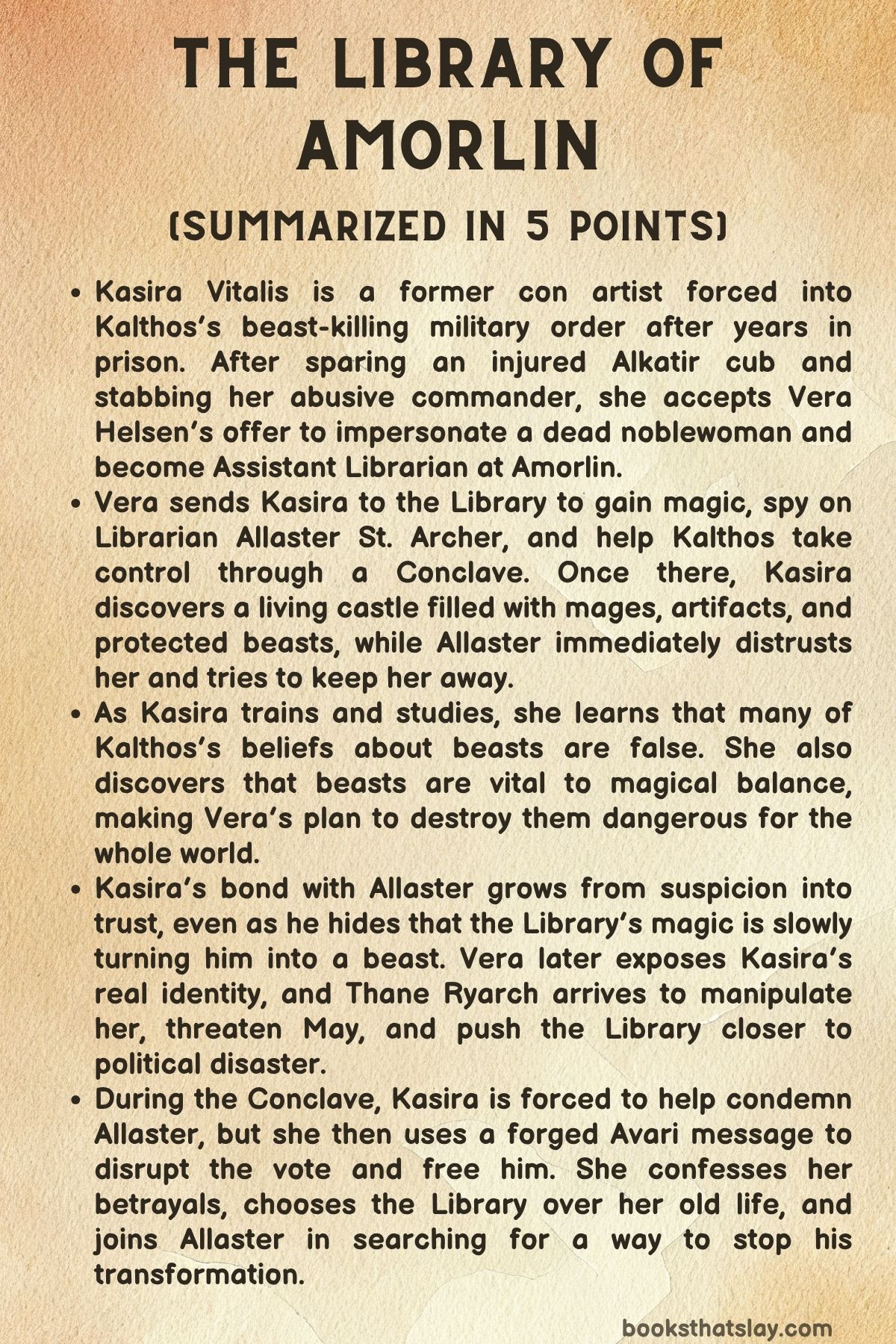
Summary
Kasira Vitalis has spent much of her life being punished for who she was and what she once did. A former con artist with a criminal past, she is serving a forced sentence in the Malikinar, the beast-killing military order of Kalthos.
Her place there is not one of honor. She is marked as a “Kott,” a criminal soldier, and is treated with suspicion by those around her.
Her history with the criminal Thane Ryarch still shadows her, and she has little hope of gaining a future that is truly her own.
During a hunt in the Isherwood, Kasira and the soldiers are sent after Alkatir, a kind of beast she has been trained to fear and kill. But when she finds an injured cub, she secretly spares it.
The act is dangerous because it goes against everything expected of her. It also makes the distrust around her worse.
Commander Dessen, who already sees her as a problem, uses the incident to tighten his control over her. Later, when he tries to force himself on her in the woods, Kasira defends herself by stabbing him.
Her punishment is brutal. She is whipped almost to death and wakes to find herself before Paratal Helvarin and Ambassador Vera Helsen.
Vera offers Kasira a choice that is not much of a choice at all. She can return to prison, or she can take on the identity of Eirlana Corynth, a dead noblewoman, and go to Amorlin as the Kalish Assistant Librarian.
Kasira accepts because it is the only way out of Belvar and the only chance she has to escape the life that has been closing around her. Vera’s plan is clear.
Kasira must enter the Library, gain the trust of Librarian Allaster St. Archer, obtain access to magic, and collect evidence that can be used against him. Kalthos wants control of Amorlin, and Kasira is meant to help make that possible.
Before leaving, Kasira protects herself by framing Dessen for theft, removing him as an immediate threat. She deserts during the Paratal’s public Burning ritual and flees through the Isherwood.
The journey nearly kills her when she is attacked by a Zeras, but she survives and reaches the carriage that will take her to Amorlin.
The Library is unlike anything Kasira has known. It is a living castle filled with mages, magical artifacts, hidden rooms, and protected beasts.
Its beauty and strangeness challenge everything Kalthos has taught her. She is greeted first by Iylis, a talking snow leopard, and then by Allaster St. Archer himself.
Allaster distrusts her from the beginning. He knows enough to be wary, and Kasira’s false identity does not easily fool him.
To test her and frighten her away, he gives her a harsh magical tour of the Library and makes it clear that he does not want her close.
Kasira begins her work carefully. She maps the Library, studies its routines, and tries to understand how its magic functions.
She also befriends Airamay “May” Selvera, the First Mage, whose warmth gives Kasira one of her first real connections in Amorlin. Through May, the beasts, and her own experiences, Kasira starts to realize that many Kalish beliefs about beasts are wrong.
The creatures she was taught to see as monsters are part of the world’s magical balance. Killing them is not an act of protection but a threat to the natural order.
Allaster has his own secret. The Library’s magic is changing him into a beast, just as it changed the previous Librarian, Mora.
He is trying to keep control of himself while hiding the truth from those who would use it against him. His coldness toward Kasira comes partly from fear, partly from duty, and partly from the burden of knowing what may happen to him.
Kasira does not understand all of this at first, but she sees enough to know that he is carrying something dangerous and painful.
As Kasira spends more time at Amorlin, she proves herself in ways that are hard for Allaster to ignore. She helps calm Benlo, a Relin, showing courage and empathy rather than fear.
She survives a Zeras bite after another encounter connected to the wounded Alkatir cub she had once spared. Eventually, she is granted Library magic and officially becomes Assistant Librarian.
This marks a turning point. She is no longer only pretending to belong.
The Library has accepted her in a way Kalthos never did.
Her relationship with Allaster changes slowly. Suspicion gives way to uneasy cooperation, then to trust.
They train together, spar, share mylak, and face the Library’s troubles side by side. Kasira learns that Allaster is not the enemy Vera described.
He is flawed, guarded, and often difficult, but he is also committed to protecting Amorlin and the fragile balance it preserves. The more Kasira learns, the harder it becomes for her to continue Vera’s mission.
Vera wants to exterminate beasts, but Kasira now understands that doing so could lead to famine, disasters, and the collapse of magic itself.
The truth eventually catches up with her. Vera arrives at Amorlin with Dessen and reveals Kasira’s real identity.
Allaster is shocked and hurt by the betrayal, but he does not hand her over. Kasira stays, hoping to earn back his trust, though the damage between them is deep.
Her position becomes even more dangerous when Thane Ryarch appears at the Library as Vera’s hidden partner. Thane represents the old life Kasira has tried to leave behind.
He pressures her, threatens May, and manipulates events to push the Library toward a Conclave, where its leadership can be challenged.
Kasira tries to protect the people she has come to care about while still trapped by the bargain she made with Vera. She discovers evidence that seems to point to the mage Elyae as Vera’s spy.
Elyae is banished, though Kasira senses that the truth is more complicated than it first appeared. The Library is becoming a place of fear and suspicion, and Vera’s influence keeps spreading.
The conflict grows beyond Amorlin when Kalthos-backed forces attack Spenshire and other targets. Allaster and Kasira are forced into rescue efforts, and the threat to the wider world becomes impossible to deny.
Revna, who had survived and made her own bargain, returns in royal service, adding another layer to the political struggle surrounding the Library. Then Thane kidnaps May, using her as leverage against Kasira.
This forces Kasira to make a final break with the person she used to be. She confronts Thane and kills him, choosing May, Allaster, and Amorlin over fear, criminal loyalty, and self-preservation.
At the Conclave, Vera presents her case against Allaster. Kasira, still bound by her bargain, helps condemn him, and Allaster is chained and taken away.
It seems, for a moment, that Vera has won. But Kasira uses the rules of the proceeding against her.
She argues that the vote is incomplete because Avaria’s vote cannot be considered forfeit if contact has been made. To support this, she produces a forged Avari message.
The move buys time and forces the dignitaries out, breaking Vera’s control over the moment.
Kasira frees Allaster and confesses the full truth of her betrayals. She does not ask him to forget what she has done, but she asks him to keep fighting.
Their bond, damaged but not destroyed, becomes honest at last. They share a kiss and choose to search for a way to stop his transformation.
The ending does not give them an easy victory. Allaster knows that if the beast fully overtakes him, Kasira may still have to kill him.
Even so, they move forward together, no longer as enemies or deceiver and target, but as people who have chosen each other and the Library despite the danger ahead.
Characters
The characters in The Library of Amorlin are shaped by secrecy, survival, loyalty, betrayal, and the complicated question of what makes someone worthy of trust. Many of them begin the story trapped by institutions, bargains, punishments, or past choices, and their development comes from how they respond when those pressures become impossible to ignore.
Kasira Vitalis
Kasira Vitalis is the central figure of the book, and her character is built around survival, deception, guilt, and the difficult possibility of redemption. At the beginning, she is not presented as an innocent victim, but as someone with a criminal past, a history as a con artist, and a connection to Thane Ryarch that continues to haunt her.
Her forced service in the Malikinar shows how little freedom she has left, and the label of “Kott” marks her as someone society has already judged and discarded. Yet Kasira’s decision to spare the injured Alkatir cub reveals that her instincts are not as cruel or selfish as others believe.
This act of mercy becomes one of the first signs that she is more than her record, and that beneath her defensive habits is a person capable of compassion even when compassion places her in danger.
Kasira’s journey is also defined by performance. When she agrees to impersonate Eirlana Corynth, she is once again using deception to survive, but this time the deception forces her into a world that changes her understanding of everything she has been taught.
At Amorlin, she begins as a spy planted by Kalthos, but the more she learns about the Library, the beasts, and magic, the more unstable her original mission becomes. She discovers that the beliefs used to justify violence against beasts are false or incomplete, and this knowledge begins to reshape her loyalties.
Her growth is not simple or immediate because she continues to lie, withhold information, and make choices that hurt others, especially Allaster. This makes her morally complex rather than purely heroic.
Kasira’s strongest development comes from her gradual movement away from fear-based loyalty and toward chosen loyalty. In her old life, she survives by making bargains with dangerous people, hiding her true motives, and anticipating betrayal.
At the Library, she is offered something different: friendship, trust, responsibility, and a place where her intelligence and courage can be used for protection rather than manipulation. Her friendship with May, her growing bond with Allaster, and her care for the beasts all help her imagine a self that is not controlled by Thane, Vera, Kalthos, or her criminal past.
By the end, Kasira is still flawed and still responsible for serious betrayals, but she chooses to act against the forces that once controlled her. Her decision to kill Thane, free Allaster, and fight for the Library shows that her redemption is not based on being forgiven easily, but on actively choosing a better allegiance despite the cost.
Allaster St. Archer
Allaster St. Archer is one of the most emotionally guarded and burdened characters in the book. As Librarian of Amorlin, he carries authority, power, and responsibility, but his position is also a form of isolation.
He is responsible for protecting the Library, its magic, its mages, its artifacts, and its beasts, while also facing the terrifying private truth that the Library’s magic is transforming him into a beast. This hidden suffering gives his character a tragic quality because he is not only fighting external political threats but also losing control of his own body and future.
His harshness toward Kasira when she arrives is not simply arrogance; it comes from fear, suspicion, and the knowledge that one mistake could endanger everything he protects.
Allaster’s distrust of Kasira is understandable because she enters Amorlin as a stranger from Kalthos under false pretenses, and Kalthos represents a direct threat to the Library’s values. His deliberately brutal magical tour shows his defensive nature and his desire to push her away before she can become a danger.
However, his character becomes more layered as his relationship with Kasira develops. He is stern and secretive, but he is also capable of patience, loyalty, humor, and deep care.
Through training, shared crises, and moments of vulnerability, Allaster slowly allows Kasira to see the person behind the role of Librarian.
The tragedy of Allaster’s character lies in the tension between duty and doom. He is trying to preserve a system that may ultimately destroy him, and he knows that his fate may mirror Mora’s.
This makes his bond with Kasira especially meaningful because she becomes someone who sees both his strength and his fear. When Kasira’s true identity is exposed, his horror is not only political but personal because his trust has been violated after he allowed himself to care.
Yet he does not simply hand her over, which shows that his judgment is not ruled entirely by anger. By the end, Allaster remains a powerful but vulnerable figure: a protector who may need to be protected, a leader who has been condemned, and a man facing the possibility that love and loyalty may not be enough to save him from transformation.
Vera Helsen
Vera Helsen is one of the most calculating political forces in the story. As an ambassador, she understands power, appearances, and manipulation, and she uses each of them with precision.
Her offer to Kasira is framed as a choice, but it is really a controlled bargain made with a desperate woman who has almost no real options. Vera recognizes Kasira’s skills as a liar and survivor and turns them into political tools.
She does not rescue Kasira out of mercy; she recruits her because Kasira can be used to infiltrate Amorlin and weaken Allaster from within.
Vera’s character represents ideological certainty taken to a dangerous extreme. Her desire to help Kalthos seize control of Amorlin is not merely personal ambition, although ambition is clearly part of her.
She also believes in a vision of the world where beasts are threats to be eliminated and magic should be controlled through political force. This makes her especially dangerous because she can justify cruelty as strategy and conquest as necessity.
Her plan depends on turning fear into policy, and her willingness to exploit Kasira, work with Thane, bring Dessen back into the conflict, and manipulate the Conclave shows that she values outcomes over people.
What makes Vera an effective antagonist is that she rarely needs to use open violence herself. She operates through systems: diplomacy, evidence, bargains, legal proceedings, public accusations, and political pressure.
She understands that a person can be destroyed through reputation and procedure as effectively as through weapons. Her exposure of Kasira’s identity is devastating because it strikes at the fragile trust Kasira has built.
Vera’s role in the book is therefore not only to oppose the protagonists but to test whether truth, loyalty, and moral growth can survive in a world where power rewards manipulation.
Thane Ryarch
Thane Ryarch is a figure from Kasira’s past who embodies control, corruption, and the danger of old loyalties. His connection to Kasira’s criminal history makes him more than a simple external villain; he is a living reminder of the person she once was and the world she is trying to escape.
Thane understands Kasira’s weaknesses because he helped shape the survival habits she relies on. He knows how to pressure her, how to threaten what she cares about, and how to make her feel trapped by former choices.
Thane’s power comes from manipulation rather than honor. He does not need to physically dominate every situation because he uses fear, information, and emotional leverage to corner people.
His threat against May is especially important because it shows that he recognizes Kasira’s new attachments and sees them as vulnerabilities. In this way, Thane tests the sincerity of Kasira’s transformation.
If she were still the person he expects her to be, she would protect herself first and sacrifice others if necessary. Instead, her confrontation with him becomes a turning point because she chooses her new loyalties over the criminal bond that once defined her.
Thane’s death is significant because it is not only the removal of a villain but also a symbolic break from Kasira’s former life. By killing him, Kasira does not erase her past, but she stops allowing that past to command her.
His role in the story is to show how difficult redemption becomes when the past actively returns to claim ownership. He is dangerous because he knows who Kasira was, but he ultimately underestimates who she is becoming.
Dessen
Dessen is a cruel and abusive figure whose authority exposes the brutality of the systems that punish and exploit people like Kasira. As Kasira’s commander in the Malikinar, he uses his position not to lead with discipline or justice but to intimidate, isolate, and control.
His suspicion of Kasira is intensified by her status as a criminal soldier, and he treats that status as permission to degrade her. The incident in the woods, where he attempts to coerce her, reveals the worst of his character: he is a man who believes power protects him from consequence.
Kasira’s stabbing of Dessen is a major moment because it shows both her desperation and her refusal to submit completely to abuse. The punishment she receives afterward makes Dessen’s role even more disturbing, because the institution around them punishes Kasira more severely than it protects her.
In this sense, Dessen is not only an individual antagonist but also a symbol of a larger culture that dehumanizes criminals, soldiers, and anyone without political protection. His later return with Vera keeps him tied to the forces trying to control Kasira and destroy her credibility.
Dessen’s character does not require moral complexity to be important. His function is to reveal the kind of violence Kasira is escaping and the kind of authority Kalthos is willing to tolerate.
He helps explain why Kasira is so defensive, suspicious, and survival-driven when she arrives at Amorlin. Through him, the book shows that not all monsters are beasts; some are people protected by rank and law.
Airamay “May” Selvera
Airamay “May” Selvera is one of the warmest and most grounding characters in the story. As First Mage, she has knowledge, status, and magical ability, but her importance to Kasira is deeply personal.
May becomes one of the first people at Amorlin to offer Kasira genuine friendship rather than suspicion, command, or manipulation. This matters because Kasira is used to relationships based on usefulness, debt, or threat.
May’s presence introduces a different kind of bond, one built on trust and emotional openness.
May also helps Kasira understand Amorlin as a living community rather than simply a target to infiltrate. Through May, Kasira sees that the Library is not just a place of power but a home for people who care about one another, study magic, and protect beings that Kalthos has taught her to fear.
May’s friendship contributes to Kasira’s moral education because it gives her something real to lose. When Thane threatens and kidnaps May, the danger is not abstract; it strikes directly at the emotional life Kasira has built.
May’s role as a character is also important because she represents the innocence and goodness that political games endanger. She is not naive, but she is open-hearted in a world full of secrets.
Her vulnerability does not make her weak; instead, it reveals how cruel the antagonists are when they use her as leverage. Kasira’s determination to save May shows how far she has moved from self-preservation alone.
May becomes one of the clearest signs that Kasira is capable of love, loyalty, and sacrifice.
Iylis
Iylis, the talking snow leopard, is one of the most striking representatives of Amorlin’s magical world. Her presence immediately challenges Kasira’s Kalish assumptions about beasts, intelligence, and danger.
For someone raised or trained to see beasts as threats to be hunted, meeting Iylis complicates that belief in a direct and memorable way. Iylis is not a mindless monster; she communicates, observes, and participates in the life of the Library.
As a character, Iylis helps establish that the beasts of Amorlin are not merely background creatures but part of the moral and magical structure of the story. She represents the possibility of coexistence between humans, mages, magic, and beasts.
Her intelligence and personality force Kasira to confront the false simplicity of Kalthos’s teachings. If a beast can speak, reason, and belong to a community, then the idea of exterminating beasts becomes not only dangerous but morally horrifying.
Iylis also contributes to the atmosphere of wonder that separates Amorlin from Belvar and the Malikinar. She is part of the living strangeness of the Library, a sign that Kasira has entered a world where old categories no longer work.
Her role may not be as politically central as Vera’s or emotionally central as Allaster’s, but she is essential to the book’s larger argument that what people call monstrous may actually be misunderstood, necessary, and worthy of protection.
Paratal Helvarin
Paratal Helvarin represents official power, punishment, and political calculation. He appears at a crucial point after Kasira has been nearly destroyed by the consequences of resisting Dessen.
His presence alongside Vera places Kasira’s fate in the hands of people who view her less as a person than as a useful piece in a larger strategy. He is connected to the machinery of Kalthos’s authority, and that authority is shown most vividly through public rituals, forced choices, and military control.
The Paratal’s role in the Burning ritual reinforces the harsh political and social order from which Kasira is trying to escape. The ritual is not simply a spectacle; it reflects a culture that uses fear, punishment, and public performance to maintain obedience.
Kasira’s desertion during this moment is therefore meaningful because it is not only a physical escape but also a rejection of the identity imposed on her by Kalthos. Helvarin’s importance lies in how he embodies the state power that makes Vera’s schemes possible.
Although he is not explored with the same emotional depth as Kasira or Allaster, Paratal Helvarin helps shape the stakes of the book. He represents a world where law and cruelty are closely linked, and where people like Kasira can be redirected from prison to espionage without true freedom.
His presence reminds the reader that the conflict is not only personal but institutional.
Eirlana Corynth
Eirlana Corynth is important even though she is dead before Kasira assumes her identity. Her character functions through absence, reputation, and disguise.
Because Kasira impersonates her, Eirlana becomes the mask that allows Kasira to enter Amorlin. This makes her central to the plot even without active participation, because her name and noble identity give Kasira access to spaces she could never enter as herself.
Eirlana’s role also highlights the difference between social identity and inner identity. To the outside world, names, titles, and appearances carry enormous power.
Kasira’s ability to become Eirlana shows how much political systems depend on surfaces, documentation, and performance. Yet the longer Kasira stays at the Library, the harder it becomes for her to hide behind the false identity.
Eirlana’s name opens the door, but Kasira’s choices determine what happens once she is inside.
As a character-shaped absence, Eirlana also deepens the theme of replacement. Kasira is not simply pretending to be someone else; she is occupying a life left empty by death and using that life for a mission built on lies.
This adds moral unease to Kasira’s position. Eirlana may not act within the present story, but her identity becomes the false foundation on which Kasira’s new life begins.
Mora
Mora is a tragic figure whose fate foreshadows Allaster’s possible future. As the previous Librarian, she represents the cost of the Library’s magic and the danger hidden beneath the wonder of Amorlin.
Her transformation into a beast reveals that the role of Librarian is not only prestigious or powerful but also potentially fatal to the self. Through Mora, the book shows that magic has consequences, and that even those who protect magical balance may be consumed by it.
Mora’s importance lies in the fear her story creates around Allaster. Once Kasira learns what happened to Mora, Allaster’s secrecy and suffering become more understandable.
Mora becomes a warning that love, intelligence, duty, and strength may not be enough to stop the transformation. Her fate gives urgency to Kasira and Allaster’s search for a solution because it proves that the danger is not theoretical.
Although Mora is not present in the same active way as other characters, she shapes the emotional atmosphere around the Librarian’s role. She is a reminder that institutions can demand terrible sacrifices from the people who serve them.
Her story gives the book a deeper tragic dimension because it suggests that protecting magic may require paying a price that no one fully understands until it is too late.
Benlo
Benlo, the Relin, is an important beast character because he helps reveal Kasira’s growing understanding of magical creatures. When Kasira helps calm him, the moment shows that her relationship with beasts is changing from fear and inherited prejudice to empathy and practical care.
Benlo is not just a creature to be managed; he becomes part of Kasira’s education in the emotional and magical complexity of Amorlin.
Benlo’s role matters because the book repeatedly challenges the idea that beasts are only dangerous enemies. His distress requires understanding rather than violence, and Kasira’s ability to respond to him suggests that she is beginning to unlearn the brutal assumptions of the Malikinar.
This moment also helps prove that Kasira may be suited to the Library in ways no one expected, including herself. She has instincts that can protect rather than exploit.
Through Benlo, the story strengthens its larger argument about coexistence. If beasts are essential to magical balance, then learning to understand them is not sentimental; it is necessary for survival.
Benlo helps Kasira move from theory to experience. He gives her a chance to act differently from the soldier Kalthos tried to make her become.
Elyae
Elyae is a complicated figure because suspicion gathers around them in a way that reflects the story’s atmosphere of secrecy and mistrust. When Kasira discovers evidence that makes Elyae appear to be Vera’s spy, Elyae becomes caught in the dangerous consequences of political manipulation.
Their banishment shows how quickly fear can turn into punishment when a community is under threat. Even in a place like Amorlin, which is more open and humane than Kalthos, judgment can still be distorted by incomplete evidence.
Elyae’s character is important because they show that the damage caused by Vera’s schemes does not fall only on Kasira and Allaster. The entire Library becomes vulnerable to suspicion.
A spy hunt changes how people see one another, and Elyae’s situation reveals how easily truth can be obscured when everyone is afraid. Kasira’s role in uncovering the evidence also complicates her moral position because her actions contribute to another person’s downfall, even while she is trying to protect the Library.
The ambiguity surrounding Elyae keeps the story morally tense. Rather than presenting every accusation as simple and every punishment as deserved, the book allows uncertainty to remain.
Elyae’s banishment becomes a reminder that in political conflict, people can be condemned not only because they are guilty, but because the available story makes them look guilty at the worst possible time.
Revna
Revna is a character associated with survival, secrecy, and difficult bargains. Her reappearance in royal service reveals that she has endured and found her own way forward, even if that way involves compromises the reader may not fully understand at first.
Like Kasira, Revna seems shaped by a world where survival often requires negotiation with power. Her return complicates the story because it shows that Kasira is not the only character making hidden choices under pressure.
Revna’s survival matters because it challenges assumptions about who has been lost, defeated, or removed from the board. Her presence in royal service suggests adaptability and intelligence.
She is someone who can move through dangerous political spaces and reemerge in a changed position. This makes her intriguing because she reflects one of the book’s recurring ideas: people are not always what their last known role suggested they were.
As a character, Revna helps widen the political world beyond Kasira’s immediate experience. Her bargain implies that many people are navigating competing powers, and not all of them can afford pure choices.
She adds complexity to the idea of loyalty because her path suggests that loyalty may be divided, hidden, strategic, or reshaped by necessity.
The Alkatir Cub
The injured Alkatir cub is a small but deeply important presence in the story because Kasira’s choice to spare it begins one of the major shifts in her character. In the Malikinar, Kasira is expected to kill beasts, and mercy toward a beast is treated as suspicious or dangerous.
By secretly sparing the cub, she acts against the violent logic of the institution controlling her. This moment reveals that even before Amorlin changes her, Kasira already has the capacity to question what she has been ordered to believe.
The cub also represents innocence within a category Kasira has been taught to fear. It is injured, vulnerable, and dependent, which makes it harder to see as a simple enemy.
Kasira’s encounter with it becomes an emotional contradiction: if beasts are only monsters, then why does this creature inspire protection rather than hatred? That contradiction grows throughout the book as Kasira learns more about magical balance and the role beasts play in the world.
The Alkatir cub is important not because it speaks or makes political choices, but because it exposes the moral failure of a worldview built on extermination. Its vulnerability helps awaken Kasira’s compassion and begins the process of separating her own judgment from Kalthos’s ideology.
In that sense, the cub is one of the earliest catalysts for Kasira’s transformation.
The Zeras
The Zeras functions as a dangerous beast presence that complicates the story’s treatment of magical creatures. Unlike Iylis or the injured Alkatir cub, the Zeras is associated with direct physical threat.
Kasira survives an attack by a Zeras in the Isherwood and later suffers from a Zeras bite, so the creature cannot be reduced to a harmless symbol of misunderstood nature. Its danger is real, and the fear surrounding such beasts is not entirely invented.
However, the Zeras also helps the book avoid a simplistic argument. The story does not suggest that beasts are safe in an ordinary sense or that humans have no reason to fear them.
Instead, it shows that danger does not justify extermination, especially when beasts are essential to magical balance. The Zeras represents the difficult truth that coexistence with powerful creatures requires knowledge, respect, and restraint, not blind hatred or careless control.
As a character-like force in the story, the Zeras sharpens Kasira’s internal conflict. She has personal reasons to fear beasts, yet she also learns that fear alone cannot be the foundation of moral judgment.
The Zeras therefore plays an important role in balancing the book’s view of beasts: they can be terrifying and still necessary, dangerous and still deserving of protection from political violence.
Avaria
Avaria is significant because of the role its vote plays in the Conclave and in Kasira’s final attempt to save Allaster. Although Avaria is not developed like an individual character in the same way as Kasira, Allaster, or Vera, it functions as a political presence with real influence over the fate of Amorlin.
The question of whether Avaria’s vote is forfeit becomes the opening Kasira uses to disrupt Vera’s victory and buy time.
Avaria’s importance lies in how it represents the broader world beyond Kalthos and the Library. Amorlin’s fate is not decided only by private feelings or individual battles; it is also shaped by international rules, diplomatic recognition, and the technicalities of political procedure.
Kasira’s forged Avari message shows both her old skills and her new purpose. She uses deception again, but this time not for theft, escape, or betrayal.
She uses it to protect the Library and resist Vera’s takeover.
Through Avaria, the book shows that politics can be manipulated by villains but also turned against them by someone clever enough to understand the rules. Avaria’s role may be indirect, but it is crucial to the ending because it allows Kasira to transform one of her most morally questionable talents into a tool of resistance.
Themes
Identity and Reinvention
Kasira’s journey in The Library of Amorlin is shaped by the painful effort to escape the identity forced on her by others. She begins as someone marked by crime, imprisonment, and military punishment, with labels like “Kott” reducing her to her past mistakes.
Her impersonation of Eirlana is first presented as another act of deception, but it gradually becomes a chance to imagine a different life. At Amorlin, Kasira is not immediately trusted, and that distrust forces her to confront whether she is only pretending to be better or actually becoming better.
Her new role does not erase her history; instead, it challenges her to decide what parts of herself she will carry forward. The theme becomes powerful because reinvention is not shown as simple freedom.
Kasira must face the consequences of lying, betraying trust, and surviving by manipulation. Her growth comes from choosing honesty, loyalty, and courage even when deception would be easier.
Trust and Betrayal
Trust is fragile throughout the story because nearly every major relationship is shaped by secrets, fear, or past harm. Kasira enters Amorlin with a false name and a hidden political mission, so her bond with Allaster is built on unstable ground from the beginning.
Yet the emotional force of the theme comes from the fact that trust grows despite that dishonesty. Allaster’s suspicion is reasonable, but his gradual willingness to see Kasira as more than a spy gives their relationship depth.
Kasira’s betrayals are not treated lightly; they wound him because genuine trust had formed between them. At the same time, the story shows that betrayal does not always end a relationship permanently.
What matters is whether the person who caused harm is willing to admit the truth and act differently. Kasira’s later choices show that trust cannot be demanded through apologies alone.
It must be rebuilt through sacrifice, honesty, and repeated decisions that prove loyalty under pressure.
Power, Control, and Political Manipulation
The struggle for control over Amorlin reveals how power is often justified through fear and false moral certainty. Vera’s plan depends on presenting the Library and its beasts as threats that must be controlled for the good of Kalthos.
Her political language hides ambition behind claims of protection, order, and national interest. Kasira is useful to Vera because she has little social power; her criminal status makes her easy to threaten, bargain with, and discard.
This theme is also visible in the way institutions treat people as tools. The military order punishes Kasira brutally, the political leaders use public rituals to create obedience, and the Conclave becomes a stage where evidence can be shaped to serve power.
Amorlin represents a different kind of authority, but even there leadership carries danger because Allaster’s role is bound to sacrifice and transformation. The story questions who deserves power, how easily justice can be staged, and how dangerous leadership becomes when it ignores truth.
Beasts, Prejudice, and Moral Awakening
Kasira’s changing understanding of beasts forms one of the strongest moral shifts in the story. She is raised in a culture that teaches her to see magical creatures as enemies, so her earliest act of mercy toward the injured cub already challenges the beliefs imposed on her.
At Amorlin, she discovers that the creatures she was trained to fear are intelligent, essential, and deeply connected to the world’s balance. This forces her to question not only Kalthos’s teachings but also her own past actions as a soldier in a beast-killing order.
The theme is not just about animals or magic; it is about prejudice created by propaganda. Kasira learns that fear can be manufactured when people are kept ignorant, and that violence becomes easier when living beings are described only as threats.
Her moral awakening grows through direct experience, compassion, and knowledge. By protecting the beasts and rejecting Vera’s vision, she chooses understanding over inherited hatred.