The Last Starborn Seer Summary, Characters and Themes
The Last Starborn Seer by Venetia Constantine is a fantasy novel about prophecy, exile, inherited guilt, and the cost of power. Set in the cursed world of Arcelia, the story follows Princess Leilani Stellarion, the last Starborn Seer of Estelia, whose Branded nature makes her both feared and needed.
Her kingdom blames people like her for the Sickening, a deadly curse spreading through the land, while her father tries to control her future through a forced binding. When Leilani learns that she may be the key to saving Arcelia, she must leave behind obedience, face ancient magic, and discover how much truth has been hidden from her. It’s the 1st book of the Chronicles of Arcelia series.
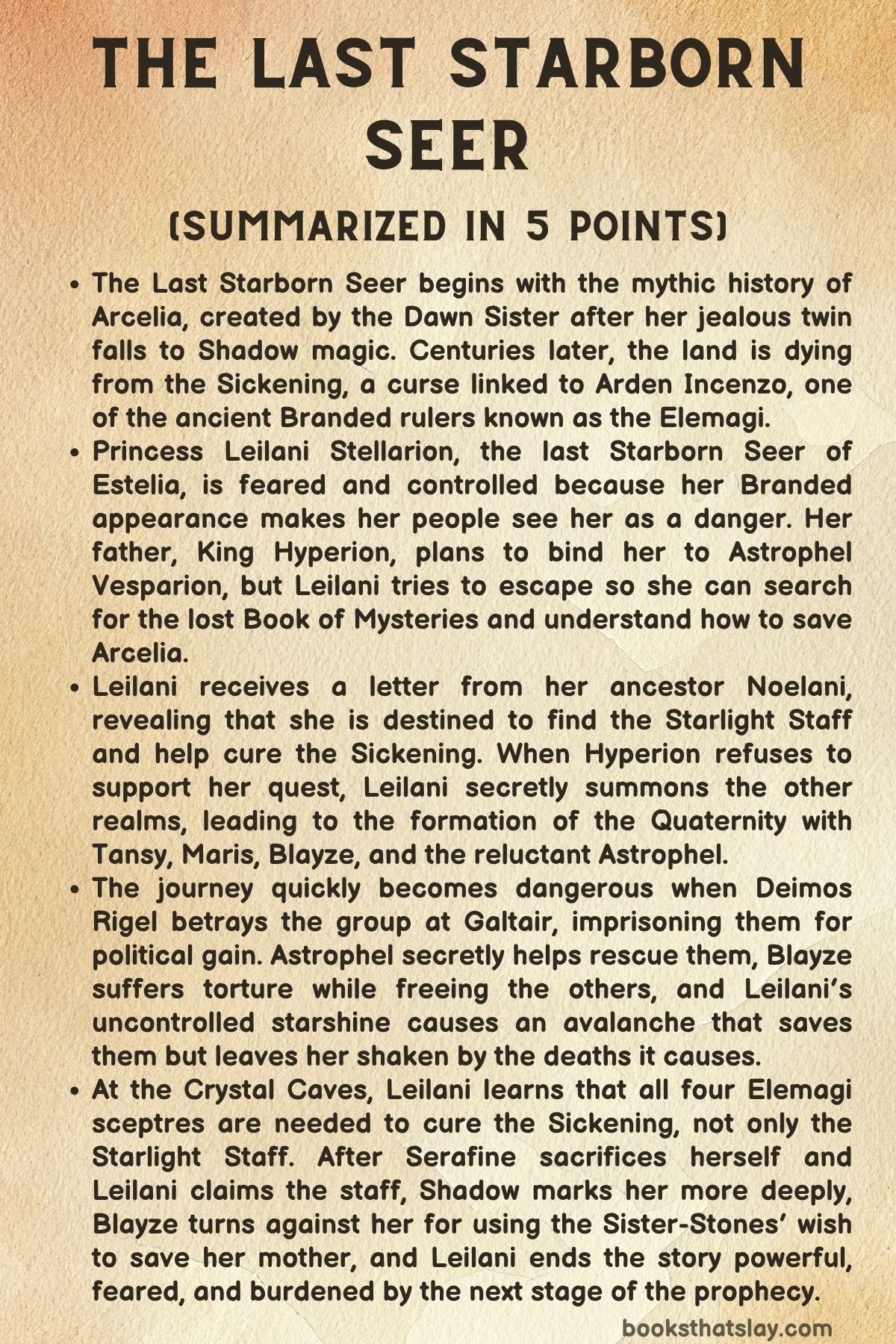
Summary
The Last Starborn Seer begins with an old myth that explains the origin of Arcelia and the deep wound at the heart of its history. Long ago, the Dawn Sister was cast out of the Cradleworld by her jealous twin, the Dusk Sister, whose Shadow magic had corrupted her.
From that exile came Arcelia, a world shaped by light, sorrow, magic, and the consequences of betrayal. Centuries later, Arcelia is no longer a place of wonder alone.
It is dying from the Sickening, a terrible curse released by Arden Incenzo, one of four ancient Branded rulers known as the Elemagi.
Princess Leilani Stellarion lives in Estelia as the last Starborn Seer, but her title brings her no freedom. To her people, she is a frightening reminder of the Branded, the very beings many blame for the Sickening.
Her silver skin, unusual eyes, opal hair, and Seer mark set her apart before she ever speaks. Instead of being honoured, she is watched, hidden, and controlled.
Her father, King Hyperion, treats her less like a daughter than a danger that must be managed. He has arranged for her to be bound to Astrophel Vesparion, a bastard-born nobleman whom he has raised in status and favoured like the son he always wanted.
Leilani does not want this binding. She wants to escape Meissa and reach the Asteum, where she hopes to search for the lost Book of Mysteries.
She believes the book may hold answers about the Sickening, the Elemagi, and her own strange place in Arcelia’s future. Her plan fails when her liegemaid, Elvi, unknowingly gives her away.
The Watchers capture Leilani, and Elvi is punished for helping her. Hyperion imprisons Leilani in the Sanctuary and makes clear that refusal will have consequences.
If she resists the binding, he threatens to send her to the Veiled Sisters, a fate meant to frighten her into submission.
On the night of the binding ceremony, Leilani receives a message that changes everything. Orthriel, her Guardian, gives her a letter from Noelani Stellarion, her ancestor and one of the Elemagi.
Noelani reveals that Leilani is destined to save Arcelia by finding the lost Starlight Staff. Orthriel also gives her Noelani’s Celestial Chain, which contains one of the Sister-Stones.
Under moonslight, the chain reveals a hidden instruction: Leilani must seek the Starlight Staff in the Crystal Caves beyond the Fallen Star.
Armed with this revelation, Leilani interrupts the binding ceremony and presents Noelani’s letter. This gives her enough authority to delay the marriage, but not enough to win her father’s support.
Hyperion refuses to back the quest. Rather than accept his decision, Leilani secretly ignites the Flarestone, a signal that summons representatives from the other realms.
She is no longer simply trying to avoid a forced future; she is taking the first step toward a mission that could decide whether Arcelia survives.
Delegates soon arrive from the other lands. Tansy comes from Xylia with Briar, her sylvanmare.
Maris arrives from Riveria with Delphine, a pearlsprite. Blayze Arcuri comes from Oralia with Serafine, his emberwing.
Each realm has its own fears and political concerns, but after debate, they agree to send a member of the Quaternity on the quest. Leilani, Tansy, Maris, and Blayze will travel together to find the Starlight Staff.
Hyperion also orders Astrophel to accompany them and keep watch over Leilani.
The group begins its journey with little trust between them. Astrophel is suspicious of the Outrealmers and loyal to the version of events Hyperion has taught him.
Blayze mocks him openly, Maris answers most tension with sharp remarks, and Leilani keeps too many secrets. She does not fully explain the Sister-Stones, Arden’s possible return, or the larger danger surrounding the sceptres.
The quest may have begun, but the party is fragile from the start.
Their first major crisis comes at Galtair. Deimos Rigel, the Arx Magnum, betrays them and takes the group prisoner.
He sees Leilani and the Outrealmers not as allies in a desperate mission, but as tools he can use for political advantage. Their Guardian creatures are also valuable to him, and he intends to exploit them.
At first, Astrophel appears to side with Deimos, making Leilani believe he has fully chosen power and obedience over her. In truth, he is secretly working with Orthriel to free them.
Astrophel helps Leilani escape, while Blayze frees the others after enduring torture. Their rescue comes at a cost.
Serafine and Briar are badly injured, and the group must flee on cragstalkers while Highlanders pursue them. In the chaos, Leilani uses starshine and causes an avalanche.
Guards are killed, and the party itself nearly dies. Though they manage to survive and find shelter, the moment leaves a mark on Leilani.
Her power is not clean or simple. Even when used to save lives, it can destroy.
As the group climbs the Astral Mountain, the emotional distance between some of them begins to shift. Astrophel admits that Hyperion lied to him, and he starts trying to repair the harm caused by his earlier loyalty to the king.
Leilani, meanwhile, grows closer to Blayze. He is bold, wounded, and more complicated than his teasing first suggested.
He reveals that he became Branded after retrieving the Book of Mysteries from the Burning Mountain. Though this makes him powerful, it also frightens him.
He hides his mark with a torc and fears what the magic inside him might mean.
On Nimbi, Orthriel gives Leilani a second message from Noelani. This message reveals that the Starlight Staff alone cannot cure the Sickening.
All four Elemagi sceptres are needed. The quest is therefore much larger than Leilani first understood.
Noelani also warns that night-birds guard the staff and that Arden may still be seeking the sceptres. The possibility that Arden’s threat is not buried in the past makes the mission more urgent and more dangerous.
When the group reaches the Starfields and the Crystal Caves, Leilani finally tells the others the truth. She explains the prophecy, the Sister-Stones, Arden, and the need to recover all four sceptres.
Her confession comes late, and it carries the weight of every secret she has kept from them. Still, they continue.
Inside the caves, they are attacked by night-birds, terrifying creatures tied to the staff’s protection and to the Shadow surrounding it.
Serafine sacrifices herself to fight off the night-birds and give Leilani the chance to find the Starlight Staff. The Quaternity performs the blood rite, and Leilani pulls the staff free.
Instead of bringing only light or healing, the act releases Shadow. Arden’s laughter echoes through the cave, and Leilani collapses.
Astrophel believes she has died, and for a moment the quest seems to have ended in disaster.
Leilani awakens in a strange space between life and death, where she meets a mysterious red-haired woman marked by two brands. The woman insists she is not Arden, but she warns Leilani that Noelani has hidden even more than she has revealed.
This encounter suggests that Leilani has been guided by partial truths from the beginning. The prophecy may be real, but the people who left it behind may not have told the whole story.
When Leilani returns, she is changed. Her eyes are darker, her power feels different, and Shadow now clings to her in a way that frightens even those who care about her.
She has one great chance to use the reunited Sister-Stones’ single wish. Blayze expects her to save Serafine, who is dying after her sacrifice.
Instead, Leilani uses the wish to save her own dying mother. The choice breaks something between her and Blayze.
Serafine dies in his arms, and he rejects Leilani for breaking her promise.
The story ends with victory and loss standing side by side. Leilani has found the Starlight Staff and can now command the night-birds.
She also knows where the next sceptre lies, meaning the quest to save Arcelia is far from over. Yet she is no longer only the feared Starborn Seer of Estelia.
She is marked by Shadow, burdened by death, and newly distrusted by the people closest to her. Her mission has begun, but saving Arcelia may cost her far more than she understood.
Characters
In The Last Starborn Seer, the characters are shaped by prophecy, inherited guilt, political fear, and the dangerous return of ancient magic. Each figure plays a role in showing how power can protect, corrupt, isolate, or transform someone, especially in a world where being Branded makes a person both feared and necessary.
Princess Leilani Stellarion
Princess Leilani Stellarion is the emotional and magical centre of the book. As the last Starborn Seer of Estelia, she carries both extraordinary power and unbearable social hatred.
Her silver skin, unusual eyes, opal hair, and Seer mark make her visibly different, and because she is Branded, her own people treat her as a living reminder of the Sickening. This makes Leilani deeply isolated before the journey even begins.
She is not only a princess but also a prisoner of expectation, fear, and royal control. Her father hides her, manages her future, and tries to bind her into a marriage that would secure his own authority rather than her freedom.
Leilani’s character is defined by the tension between vulnerability and defiance. She is frightened, controlled, and often uncertain, but she repeatedly chooses action over obedience.
Her attempt to escape Meissa shows that she is not passive, even when she has little power over her own life. Once she learns from Noelani’s letter that she is prophesied to save Arcelia, she gains a clearer purpose, but that purpose does not make her simple or purely heroic.
She hides truths from the others, delays full honesty, and makes choices that damage trust. Her decision to use the Sister-Stones’ wish to save her mother instead of Serafine reveals the painful human side of her character.
She is capable of devotion and sacrifice, but her love is personal before it is noble.
By the end of the story, Leilani has become more powerful but also more feared. Her contact with Shadow, her darker eyes, her command over the night-birds, and her possession of the Starlight Staff suggest that her destiny is not simply to restore light.
She is becoming something more complicated, perhaps more dangerous, than the saviour others expected. Her arc shows the cost of prophecy: saving the world may require her to become someone others no longer understand.
King Hyperion Stellarion
King Hyperion is a controlling and politically calculating ruler whose fear of disorder shapes his treatment of Leilani. As her father, he should protect her from the hatred surrounding her Branded identity, but instead he contributes to her imprisonment.
He hides her, restricts her, and treats her future as a matter of royal strategy. His arrangement of her binding to Astrophel shows that he values control and public stability over Leilani’s emotional freedom.
Hyperion is not presented as merely careless; he is actively manipulative. He elevates Astrophel because Astrophel represents the son he wished he had, and this favoritism deepens Leilani’s sense of rejection.
His threat to send Leilani to the Veiled Sisters if she refuses the binding reveals how easily he uses fear as a weapon. He does not trust Leilani’s agency, even when the fate of Arcelia depends on her.
His refusal to support the quest after Noelani’s letter is revealed shows a ruler more concerned with maintaining authority than responding to truth.
Hyperion represents the old power structures that the quest must move beyond. He is a king, but he is not a visionary.
His leadership is defensive, suspicious, and emotionally cold. Through him, the book shows how political fear can become a form of cruelty, especially when a parent treats a child as a threat to be managed rather than a person to be loved.
Astrophel Vesparion
Astrophel Vesparion is one of the most conflicted and gradually evolving characters in the story. At first, he appears to be an extension of Hyperion’s control over Leilani.
As a bastard-born nobleman elevated by the king, he occupies an uneasy social position: favoured by power but still marked by insecurity. His planned binding to Leilani is not rooted in mutual love, and his role as watcher and protector makes him feel like both companion and jailer.
Astrophel initially distrusts the Outrealmers and behaves with the stiffness of someone who has internalized Estelia’s prejudices and political anxieties. However, his character becomes more complex during the betrayal at Galtair.
When he appears to side with Deimos Rigel, he seems to confirm everyone’s worst suspicions, but his secret work with Orthriel proves that he is capable of courage, strategy, and loyalty. His rescue of Leilani becomes a turning point because it shows that he is not simply Hyperion’s instrument.
His later admission that Hyperion lied to him marks the beginning of a moral awakening. Astrophel must confront the fact that the system that raised and favoured him has also deceived him.
His attempts to make amends suggest that he wants to become worthy of trust rather than merely entitled to it. His grief when he believes Leilani has died also reveals genuine emotional attachment.
Astrophel’s arc is about unlearning loyalty to authority and discovering a more personal, ethical form of loyalty.
Blayze Arcuri
Blayze Arcuri is fiery, bold, wounded, and emotionally intense. As Oralia’s representative in the Quaternity, he brings open defiance and sharp energy into the group.
His emberwing Serafine reflects his connection to fire, but also his capacity for fierce attachment. Blayze often mocks Astrophel and resists Estelian arrogance, making him a source of tension, humour, and challenge within the travelling party.
Blayze’s deeper complexity comes from his Branded identity. He became Branded after retrieving the Book of Mysteries from the Burning Mountain, which makes him someone who has already risked himself for knowledge and survival.
Yet he fears the magic he carries and hides his mark with a torc. This concealment makes him a mirror to Leilani: both are Branded, both are afraid of what that means, and both are struggling with whether power makes them dangerous or chosen.
His closeness with Leilani grows from this shared burden, as well as from his willingness to see her as more than the monster her people imagine.
His reaction to Serafine’s death is one of the most devastating emotional turns in the story. Serafine’s sacrifice wounds him deeply, and Leilani’s choice to save her mother instead of the emberwing feels to him like a betrayal.
His rejection of Leilani is not simple cruelty; it is grief speaking through anger. Blayze’s character shows how love and loyalty can become unbearable when promises are broken.
He ends the book as a wounded ally whose trust has been shattered, making his future relationship with Leilani uncertain and emotionally charged.
Tansy
Tansy, the representative from Xylia, brings a grounded and natural presence to the Quaternity. Her connection with the sylvanmare Briar places her close to the living world, suggesting that she values harmony, loyalty, and practical courage.
Compared with characters such as Blayze and Maris, Tansy may seem quieter, but her role is important because she helps balance the group’s volatile personalities.
Tansy’s presence also broadens the story beyond Estelia’s royal conflict. She represents one of the other realms whose fate is tied to Leilani’s quest, reminding the reader that the Sickening is not just an Estelian problem.
Her agreement to join the journey shows bravery, especially because the quest is filled with uncertainty and because Leilani has not revealed the full truth at first. Tansy’s willingness to travel despite political tension suggests a strong sense of duty.
Through her bond with Briar, Tansy also reflects the emotional cost paid by the Guardian creatures. When Briar is badly harmed during the escape from Galtair, Tansy’s role becomes tied to the theme of innocent suffering.
She is part of the book’s quieter emotional structure: loyal, brave, and deeply connected to the natural magic that the Sickening threatens to destroy.
Maris
Maris, the Riverian representative, is sharp-tongued, intelligent, and emotionally guarded. Her connection with Delphine the pearlsprite gives her a watery, perceptive quality, and her speech suggests someone who does not easily accept foolishness, secrecy, or arrogance.
Within the Quaternity, Maris often functions as a challenger. She is not there to flatter Leilani or soften conflict; she forces tension into the open.
Her sharpness is important because the group is built on fragile trust. Leilani hides key truths, Astrophel begins as distrustful, and Blayze provokes conflict.
In that setting, Maris’s directness becomes necessary. She represents the kind of honesty the quest needs, even when it is uncomfortable.
Her attitude suggests that she understands the danger of political games and half-truths, especially when all four realms are being drawn into a prophecy none of them fully understands.
Maris also adds emotional variety to the group. She is not defined by softness, romance, or obedience, but by wit and suspicion.
Her presence helps prevent the quest from becoming centred only on Leilani’s internal struggle. As part of the Quaternity, she represents Riveria’s stake in Arcelia’s survival and shows that saving the world will require more than one chosen figure; it will require difficult cooperation among people who do not naturally trust one another.
Elvi
Elvi is Leilani’s liegemaid and one of the early examples of how dangerous life around Leilani can be. She unknowingly exposes Leilani’s attempted escape, which leads to Leilani’s capture and her own punishment.
Elvi’s role is brief but emotionally important because she shows that even loyalty can have painful consequences in a world ruled by surveillance and fear.
Elvi does not seem malicious. Her mistake comes from ignorance rather than betrayal, which makes her punishment feel especially cruel.
Through her, the book reveals how Hyperion’s court operates: control does not only fall on Leilani but also on those close to her. Elvi becomes a victim of the same system that imprisons the princess.
Her suffering intensifies Leilani’s guilt and reinforces the sense that Meissa is not a safe home but a gilded cage.
As a character, Elvi represents innocence caught in royal machinery. She also helps establish the stakes of Leilani’s rebellion.
Leilani’s choices affect others, and the story does not allow her desire for freedom to exist without consequences. Elvi’s punishment reminds the reader that oppressive systems survive by making examples of the powerless.
Orthriel
Orthriel, Leilani’s Guardian, is one of the most quietly significant figures in the story. He acts as a protector, guide, and keeper of hidden knowledge.
By giving Leilani Noelani’s letter and the Celestial Chain, he becomes the person who opens the path toward her true destiny. Without him, Leilani might remain trapped within Hyperion’s plans.
Orthriel’s loyalty is not passive. He works against the controlling structures around Leilani when necessary, including cooperating with Astrophel during the rescue at Galtair.
This shows that he is not loyal merely to the crown or to appearances; he is loyal to Leilani’s survival and to the larger truth of the prophecy. His actions require secrecy, courage, and careful judgment.
He also serves as a bridge between the past and present. Through Orthriel, Noelani’s messages reach Leilani at crucial moments.
His presence suggests that ancient knowledge has been preserved carefully, but not fully revealed all at once. Orthriel’s role is protective, but also mysterious, because he knows more than he can immediately explain.
He represents guidance, but the kind of guidance that still leaves Leilani to make painful choices herself.
Noelani Stellarion
Noelani Stellarion is an ancestral figure whose influence shapes the entire quest. As one of the ancient Elemagi, she belongs to the legendary past, but her letters make her active in the present.
She gives Leilani purpose by revealing that she is prophesied to save Arcelia and must seek the Starlight Staff. Her Celestial Chain and Sister-Stone also connect Leilani to the magical inheritance that has been hidden from her.
Noelani appears wise and protective, but she is not entirely transparent. Her second message reveals that all four Elemagi sceptres are needed to cure the Sickening, not just the Starlight Staff.
This changes the scale of the quest and suggests that Noelani has chosen to reveal the truth gradually. The mysterious red-haired woman later warns that Noelani has hidden even more, which complicates the reader’s understanding of her.
Noelani may be a guide, but she may also be withholding knowledge for reasons that are not yet clear.
Her character embodies the ambiguity of prophecy. She gives Leilani direction, but she also burdens her with incomplete information.
Noelani’s legacy is therefore both a gift and a trap. She represents ancestral wisdom, but also the danger of inherited missions that living people must suffer through without fully understanding.
Arden Incenzo
Arden Incenzo is the ancient source of much of the story’s fear. As one of the four Branded rulers known as the Elemagi, he is linked to the unleashing of the Sickening, the curse that is killing Arcelia.
Even before he appears directly, his name carries dread. He represents the destructive possibility of Branded power and the historical reason people fear figures like Leilani.
Arden’s presence is especially powerful because it is partly unseen. He is not simply a villain standing in front of the heroes; he is a shadow over the world’s history, politics, and magical memory.
The possibility that he may still be seeking the sceptres gives the quest urgency and danger. When Shadow pours from the Starlight Staff and his laughter echoes, he becomes more than a figure of the past.
He feels active, watching, and perhaps waiting.
Arden functions as a dark mirror to Leilani. Both are Branded, both are connected to immense power, and both are feared by others.
The difference is that Leilani is still choosing who she will become. Arden shows what the world believes Branded power leads to: corruption, curse, and ruin.
His role increases the pressure on Leilani because every frightening change in her risks making others see her as his successor rather than his opposite.
Deimos Rigel
Deimos Rigel, the Arx Magnum of Galtair, is a political betrayer who reveals how dangerous ambition can be during a crisis. When the party stops at Galtair, he imprisons Leilani and the others instead of aiding them.
His plan to use the Outrealmers and their Guardian creatures for political ends shows that he sees people not as allies but as resources to exploit.
Deimos is important because he proves that the heroes are threatened not only by ancient magic or monsters but also by human power. His betrayal exposes the instability within Arcelia’s political world.
Even when the Sickening threatens everyone, leaders like Deimos still pursue advantage. This makes the journey more morally complex because the group cannot assume that official authority means safety.
His treatment of Blayze and the harm done to Serafine and Briar make him especially cruel. Through Deimos, the book shows the brutality of political opportunism.
He is not corrupted by Shadow in the same grand mythic way as Arden, but his actions are still destructive. He represents the ordinary, calculating evil of those who exploit catastrophe for control.
Serafine
Serafine, Blayze’s emberwing, is one of the most emotionally important Guardian creatures in the story. She is not merely an animal companion; she represents Blayze’s heart, loyalty, and connection to Oralian fire.
Her bond with him gives his character tenderness beneath his mocking and defiant exterior.
Serafine suffers greatly during the journey. She is badly harmed after the betrayal at Galtair, yet she continues onward.
Her final sacrifice in the Crystal Caves is one of the most heroic acts in the book. By fighting off the night-birds, she allows Leilani to locate the Starlight Staff and gives the Quaternity the chance to complete the blood rite.
Her death is therefore tied directly to the success of the quest.
The tragedy of Serafine’s death lies not only in the sacrifice itself but in Leilani’s broken promise. When Leilani uses the wish to save her mother instead of Serafine, Serafine becomes the centre of the emotional rupture between Leilani and Blayze.
Serafine’s character represents faithful love and the terrible cost paid by those who cannot speak for themselves but give everything.
Briar
Briar, Tansy’s sylvanmare, represents natural grace, endurance, and the bond between Xylia and the living world. Like Serafine, Briar is more than a travelling creature.
Briar’s presence gives Tansy’s character depth and shows that the realms’ magic is not abstract; it lives through relationships between people and Guardian beings.
Briar’s suffering after Deimos’s betrayal reveals the cruelty of using Guardian creatures as political tools. When Briar is badly harmed, the damage feels personal and symbolic.
It shows how the quest’s dangers extend to the innocent and loyal companions who never sought power for themselves. Briar’s injury also deepens the group’s shared trauma, making the journey feel physically and emotionally costly.
As a character, Briar adds gentleness to a story filled with suspicion, prophecy, and violence. Briar reflects the natural world that the Sickening threatens to destroy.
Through Briar, the book reminds the reader that saving Arcelia is not only about crowns and sceptres; it is also about preserving life, beauty, and the bonds that make the world worth saving.
Delphine
Delphine, Maris’s pearlsprite, is connected to Riveria and helps establish Maris’s place within the Quaternity. Although Delphine receives less direct dramatic focus than Serafine, her presence still matters because she completes the pattern of realm representatives and Guardian companions.
She reflects the watery, perceptive, and fluid qualities associated with Maris’s homeland.
Delphine’s role also helps show that the quest is not carried by humans alone. The Guardian creatures embody the magical and emotional ties of each realm.
Through Delphine, Maris is not just an individual delegate; she becomes part of a wider Riverian tradition and magical ecosystem. Delphine’s presence strengthens the sense that the Quaternity is a union of realms, creatures, and powers.
Even with limited action, Delphine contributes to the story’s atmosphere of fragile alliance. She stands as a reminder that every representative brings more than political authority.
Each carries relationships, responsibilities, and vulnerabilities. Delphine’s quieter role contrasts with Serafine’s dramatic sacrifice, but both help show the importance of companionship in a dangerous magical world.
The Dawn Sister
The Dawn Sister belongs to the mythic foundation of the story. Cast out of the Cradleworld by her jealous twin, she creates Arcelia, making her a figure of origin, creation, exile, and light.
Her story gives the world a sacred and tragic beginning. Arcelia is not simply a place; it is born from rejection, loss, and creative power.
Her role also establishes one of the book’s central contrasts: Dawn and Dusk, light and Shadow, creation and corruption. The Dawn Sister’s act of creation suggests resilience.
Even after betrayal, she makes a world. This makes her a distant but meaningful ancestor to the themes surrounding Leilani, who must also respond to rejection and fear by trying to save rather than destroy.
The Dawn Sister represents wounded creativity. Her myth gives emotional depth to Arcelia’s suffering because the world was created from divine pain and is now threatened by ancient corruption.
She stands behind the story as a symbol of the light Leilani is expected to recover, though the ending complicates whether light alone will be enough.
The Dusk Sister
The Dusk Sister is the mythic source of jealousy, betrayal, and Shadow-corruption. Her envy of the Dawn Sister leads to exile and creation, meaning that the entire world of Arcelia is shaped by her betrayal.
She is not merely a background figure; she establishes the pattern of corrupted power that later echoes through Arden and the fear of the Branded.
Her Shadow magic makes her a foundational image of magic turned destructive. Because the Dusk Sister’s corruption predates the main events, the story suggests that the conflict between light and Shadow is ancient and deeply embedded in the world’s history.
Her actions also create a mythic mirror for later sibling-like, familial, and political betrayals, especially the ways people in power turn against those closest to them.
The Dusk Sister represents the danger of jealousy when joined with power. She helps explain why Shadow is feared not just as a force but as a moral corruption.
Her presence in the myth gives the later events a larger scale, making Leilani’s struggle feel connected to a pattern that began long before her birth.
Noelani’s Mysterious Red-Haired Woman
The mysterious red-haired woman appears during Leilani’s strange between-state after the Starlight Staff is freed. Her two brands immediately make her significant, because they suggest a level of magical identity and danger beyond what Leilani understands.
She insists that she is not Arden, which both answers one fear and creates another mystery. If she is not Arden, then there are other powerful forces at work that have not yet been revealed.
Her warning that Noelani has hidden even more changes the reader’s understanding of the prophecy. Until this point, Noelani has seemed like the clearest source of guidance, but the red-haired woman introduces doubt.
She suggests that Leilani’s mission may be built on partial truths and that the past is more complicated than the messages have admitted.
This character functions as a threshold figure. She appears between death and return, between knowledge and ignorance, between Leilani’s old self and her changed self.
Her role is brief but powerful because she signals that the quest for the sceptres will involve deeper secrets than simply finding lost magical objects.
Leilani’s Mother
Leilani’s mother is not heavily present in the action, but she becomes central through Leilani’s final choice. Her illness gives Leilani a deeply personal stake in the Sickening.
For Leilani, the curse is not only a political or magical catastrophe; it is something that is taking her mother from her. This makes the final wish emotionally understandable, even though it causes devastating consequences.
By choosing to save her mother instead of Serafine, Leilani reveals the conflict between public duty and private love. Her mother represents the family bond Leilani is desperate not to lose, especially in a life where her father has controlled and emotionally failed her.
Saving her mother is an act of love, but it is also an act that breaks faith with Blayze.
Leilani’s mother therefore matters less as an active character and more as an emotional force. She exposes the limits of heroic selflessness.
Leilani may be prophesied to save Arcelia, but she is still a daughter. Her choice makes her more human, more flawed, and more morally complex.
The Veiled Sisters
The Veiled Sisters function as a threatening presence rather than fully developed individual characters. Hyperion uses them as a punishment when Leilani resists the binding, which makes them symbols of confinement, erasure, and institutional control.
Whether or not they appear directly, their name carries fear because they represent what might happen to Leilani if she refuses obedience.
Their importance lies in what they reveal about Estelia’s treatment of difficult or dangerous women. The threat of being sent to them suggests a system designed to remove women who do not fit the desired role.
For Leilani, the Veiled Sisters represent a possible future in which her power and identity are hidden away permanently.
As part of the book’s world, they deepen the atmosphere of religious or social repression. They show that Leilani’s struggle is not only against one father or one arranged marriage, but against a broader culture that fears what it cannot control.
The Watchers
The Watchers are agents of royal control who enforce Hyperion’s authority. They capture Leilani after Elvi unknowingly exposes her escape attempt, and their actions help establish the oppressive atmosphere of Meissa.
They are not explored as individuals, but as a group they are important because they make Hyperion’s power physically real.
Their presence shows that Leilani is watched, contained, and treated as dangerous even before she has done anything truly harmful. The Watchers turn the palace into a place of surveillance rather than safety.
Through them, the reader sees how fear of the Branded has been institutionalized.
As characters in the wider sense, the Watchers represent obedience without compassion. They carry out punishment and imprisonment because the system demands it.
Their role helps explain why Leilani’s escape is not just a personal rebellion but a break from an entire structure of control.
The Night-Birds
The night-birds are frightening magical guardians connected to the Starlight Staff and Shadow. They attack the group inside the Crystal Caves, becoming one of the final obstacles before Leilani can claim the staff.
Their violence and association with Arden’s laughter make them feel like creatures of dread rather than ordinary beasts.
Yet their role changes after Leilani returns transformed. By the end, she can command them, which is one of the clearest signs that her power has shifted into something darker and more unsettling.
The creatures that once threatened the group now respond to her, making even her allies fear what she is becoming.
The night-birds symbolize the dangerous inheritance of the Starlight Staff. They are guardians, monsters, and possible servants, depending on who holds power over them.
Their connection to Leilani at the end of The Last Starborn Seer shows that her victory is not pure triumph. It is a transformation that binds her more closely to the very darkness she hoped to defeat.
Themes
Fear of Difference and Social Blame
Leilani’s life is shaped by the way society turns fear into judgement. Her Branded identity makes her a target before she has the chance to define herself through her own choices.
Her silver skin, unusual eyes, opal hair, and Seer mark are treated not as signs of power or destiny, but as evidence of danger. In The Last Starborn Seer, the Sickening has created a desperate need for someone to blame, and Leilani becomes an easy symbol of that suffering.
This theme shows how communities under pressure often reject what they do not understand, especially when old myths and inherited fears guide their thinking. King Hyperion’s treatment of Leilani reflects this wider fear on a personal level, because he hides and controls her instead of protecting her openly.
The novel suggests that prejudice does not only come from hatred; it can also come from panic, shame, and the desire to preserve power. Leilani’s journey forces others to question whether being marked truly makes someone dangerous, or whether danger lies in the fear that surrounds them.
Control, Freedom, and Self-Determination
Leilani’s conflict begins with the struggle to claim ownership over her own life. Her father treats her less like a daughter and more like a political problem that must be managed.
The arranged binding to Astrophel is not presented as a choice rooted in love or trust, but as another form of control meant to keep her contained. Her attempted escape shows that she already understands the cost of obedience: if she submits completely, she loses her voice, her future, and her chance to act on the truth she believes in.
This theme becomes stronger when Hyperion threatens her with the Veiled Sisters, turning family authority into punishment. Leilani’s decision to reveal Noelani’s letter and later summon the other realms is an act of resistance against both royal command and public fear.
Her freedom is not simple, because every independent choice brings danger and guilt. Still, the story shows that self-determination often begins when a character refuses to accept the role others have written for them.
Trust, Secrecy, and the Cost of Hidden Truths
The quest is weakened again and again by secrets. Leilani hides key truths about the Sister-Stones, Arden, the prophecy, and the need for the sceptres because she fears rejection and wants to control how much others know.
Her silence is understandable, yet it damages the fragile trust within the group. The companions are already divided by realm, temperament, class, and suspicion, so every concealed truth makes unity harder.
Astrophel’s own position is also shaped by deception, since Hyperion has misled him and used his loyalty for personal and political purposes. As the journey continues, truth becomes both necessary and painful.
When Leilani finally confesses the full danger of their mission, the group has already suffered enough to understand the weight of what was hidden. The theme does not suggest that honesty is easy; it shows that secrecy can feel protective in the moment while creating deeper harm later.
Trust in the story is not built through loyalty alone, but through the courage to be fully accountable.
Sacrifice, Power, and Moral Consequence
Power in the story never appears as something clean or harmless. Every major use of magic or authority demands a cost, whether physical, emotional, or moral.
Leilani’s starshine helps the group survive, but it also triggers destruction and death, forcing her to face the fact that even necessary action can leave lasting guilt. Serafine’s sacrifice in the Crystal Caves gives the group the chance to reach the Starlight Staff, but her death also exposes the painful limits of promises made under desperate conditions.
Leilani’s choice to use the wish to save her mother instead of Serafine is one of the most morally complex moments in the story. It is not a simple act of selfishness, because it comes from love and grief, but it breaks trust and devastates Blayze.
The ending makes this theme especially sharp: Leilani gains greater power, yet becomes more feared and more isolated. The story suggests that power does not free a person from consequence; it increases the weight of every decision.