The Ballad of Falling Dragons Summary, Characters and Themes
The Ballad of Falling Dragons by Sarah A. Parker is an epic fantasy romance centred on lost identities, broken gods, dragon bonds, political cruelty, and the dangerous power of love.
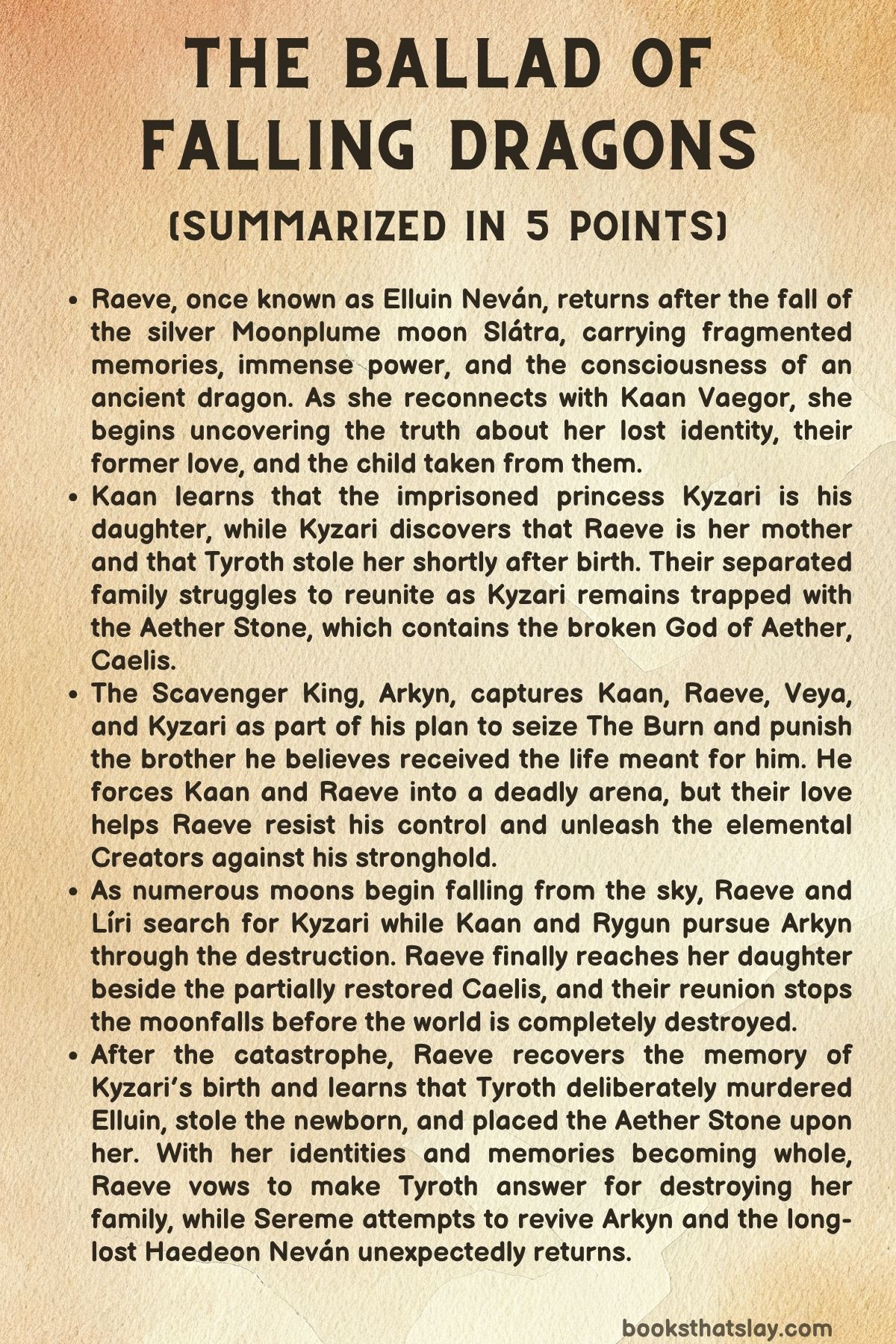
Raeve, once known as Elluin Neván, has survived death, imprisonment, and the destruction of her memories, but the past continues to rise within her. Around her, Kaan Vaegor searches for a way to restore what was taken, Kyzari fights to survive captivity, and ancient forces prepare to correct an injustice that has shaped the world for generations. As moons begin falling from the sky, personal reunions become inseparable from the fate of kingdoms, dragons, and gods. It’s the 2nd book of the Moonfall series.
Summary
The silver Moonplume moon Slátra falls from the sky and crashes above The Shade, releasing Raeve from its stone remains. Although she does not understand her origin, she is driven by an urgent need to reach Arithia.
Before she can complete that journey, Raeve is captured and imprisoned beneath a mountain. Years of torture, violence, and emotional loss transform her into a lethal fighter who survives by freezing painful memories and separating herself from vulnerability.
Raeve was once Elluin Neván, the princess of The Shade and the woman Kaan Vaegor loved. She also carries the consciousness of an ancient Moonplume called the Other, whose memories and instincts exist beneath the frozen surface of Raeve’s mind.
The elemental Creators know that Raeve’s return signals a reckoning connected to Caelis, the fragmented God of Aether. Long ago, the Creators trapped Caelis inside the Aether Stone, tearing his essence apart and scattering pieces of him throughout the world.
Kaan continues searching for Slátra’s missing moonshards while grieving Raeve’s departure from The Burn. He knows that Raeve is Elluin, but she has not recovered enough of her past to understand their entire history.
Kaan also learns that his companion Roan has been arrested in Bothaim for supposedly stealing the Book of Voyd. At the same time, Lumo foresees a catastrophe in which numerous moons fall from the sky together.
Elsewhere, Kyzari is held prisoner by the Scavenger King. The Aether Stone remains embedded in her diadem, leaving her terrified that her death might release Caelis in an uncontrollable state.
A parchment lark bearing the word Nee reaches Kyzari’s cell. The simple message that she does not need anyone encourages her to stop waiting for rescue and begin turning bones from her meals into lockpicks.
Veya discovers Elluin’s hidden diary in Arithia. The entries reveal that Kyzari was fathered by Kaan rather than Tyroth, meaning Kaan and Raeve have a daughter neither has knowingly raised.
Veya escapes with the diary, but Tyroth intercepts her. He forces open memories that reveal how their father, Ostern, used a Mindweft to remove Veya’s morality and compel her to poison the Neván family.
Overcome by guilt, Veya expects Tyroth’s imprisoned dragon Bharon to kill her. Bharon instead chooses mercy, carrying her away from Tyroth before dying peacefully beneath the sunlight he had been denied for years.
Raeve pursues Rekk, the man responsible for Essi’s apparent death and Líri’s suffering. Her Other takes control and brutally kills him, although Raeve is frustrated that she was not consciously present to complete her revenge.
Raeve and Utris carry Rekk’s body beneath Bothaim to feed it to a soul-devouring anthe. Their secret mission places them near Roan just as the Tri-Council prepares to execute him.
Kaan and Pyrok infiltrate Roan’s trial, where the council condemns him after he exposes their secret knowledge of protective moonfall runes. Kaan refuses to abandon him, even though a rescue could begin a war between Bothaim and The Burn.
At the anthe’s underground lake, Raeve sees Kaan attempting to save Roan. Terrified that the creature will consume him, she opens herself to the Creators and speaks Rayne’s language.
Rayne separates the lake, exposing the bones of countless victims and trapping the anthe behind a wall of water. Raeve holds the creature back while Kaan, Pyrok, and Roan reach the exit.
Their escape leads them through the Citadel’s treasury, where Raeve finds the Book of Voyd. The book had vanished when Roan entered its chamber, but it reappears for Raeve and permits her to cross lethal runes unharmed.
The group steals the book because its original runes may allow them to protect communities from the falling moons. Their escape becomes public when Roan uses Kaan’s blood to create an explosive rune that tears open the Citadel wall.
Kaan collapses from the rune’s effects, forcing Raeve and the others to carry him through Bothaim. Rygun, Kaan’s bonded Sabersythe, enters the city and fights the battalion pursuing them.
They escape to Beluhn, a hidden mountain village led by Kaan’s pregnant aunt Siharna. There, Raeve and Kaan confront the devotion, fear, and unfinished history between them.
Raeve accepts that Elluin never stopped loving Kaan, and she begins allowing herself to choose him again. Their reconciliation offers comfort, but closeness also awakens memories Raeve has spent years avoiding.
Líri arrives at Beluhn in a state of rage and grief. Raeve had promised to protect her after Rekk’s abuse but left without facing her, repeating the abandonment both of them fear.
To begin repairing the damage, Raeve approaches Líri without forcing obedience. She removes Rekk’s saddle and accepts the possibility of falling to her death rather than keeping the dragon bound.
Líri saves Raeve, and the two gradually form a bond. Raeve feels Líri’s heartbeat inside her, but the connection threatens to pull her away from her human identity and into a simpler life of hunting and instinct.
Kaan refuses to control Raeve, yet he also refuses to let her disappear. He asks her to return consciously, reminding her that avoiding grief would also destroy her ability to love Líri, Slátra, Kyzari, and him.
Raeve chooses to remain. Her relationship with Kaan becomes less about escaping pain and more about accepting that love always carries the possibility of loss.
Meanwhile, the Scavenger King is revealed as Arkyn, Ostern’s unacknowledged firstborn son. Born to a powerless null woman and rejected by his father, Arkyn believes Kaan received the crown, family, and recognition that should have belonged to him.
Arkyn captures Veya and brings her near Kyzari. Veya manages to pass Elluin’s diary through the bars, allowing Kyzari to learn that Kaan is her father and that her mother survived as Raeve.
The revelation gives Kyzari renewed hope, but Arkyn soon confiscates the diary and attacks her. His legitimate anger over his childhood has become cruelty directed at innocent people connected to Kaan.
Elsewhere, Grihm travels through Gondragh while mourning his dead dragon Inkah. He enters the volcanic nesting grounds of the Great Silver Sabersythe Ahra, whose eggs have been destroyed and whose grief has left her ready to die.
Grihm bonds with Ahra, not as a replacement for Inkah but as another wounded being choosing to continue. Guided by a silver aurora ribbon connected to Caelis, they begin travelling toward The Burn.
Raeve, Kaan, Pyrok, and Roan leave Beluhn to reproduce the protective runes and recover one of Slátra’s moonshards from a Moltenmaw nest. Raeve conceals the fact that Sereme, leader of the Ath, controls her through a blood bind.
The Other takes control of Raeve and approaches the grieving Moltenmaw dam. Rather than stealing the shard without compensation, she gives life to the dragon’s sterile egg and carries the shard back to Kaan.
Sereme then orders Raeve to assassinate a supposedly dangerous target. Raeve discovers that the target is Ahvi, a small silver-haired Mindweft imprisoned beside a dragon egg.
Raeve refuses to kill him and helps hatch the egg, producing a newborn dragon named Gruffin. Ahvi warns that soldiers are waiting to ambush Kaan’s group.
Raeve uses Bulder, Clode, and Rayne to swallow more than a hundred attackers beneath the bog. Her command of the Creators grows powerful enough to destroy armies, but Sereme’s blood bind continues tearing at her body.
Ahvi claims he can undo the bind if they return to the place where Sereme created it. The group travels to Gore and enters the abandoned Undercity, where Raeve confronts memories of Fallon and her escape from captivity.
Ahvi uses the Book of Voyd to connect Raeve’s present body to the original moment of binding. The ritual forces her to experience Sereme’s injuries across time, leaving Raeve near death.
Sereme arrives and takes Kaan captive after revealing that Kyzari is being held by Arkyn. Kaan surrenders to protect Raeve, Ahvi, and his daughter.
Raeve later awakens in Arkyn’s prison beside Kyzari. Although she initially mistakes the weakened young woman for Fallon, her body responds with instinctive protectiveness.
Arkyn chains Raeve and Kaan at a dining table and reads Elluin’s diary aloud. He reveals that Kaan is Kyzari’s father and that Raeve gave birth to her before Tyroth took the child.
The truth strengthens Raeve rather than destroying her. She silently claims Kaan and Kyzari as her family and promises that they will escape.
Arkyn places Kaan and Raeve inside his arena, intending to force Raeve to kill the man she loves. Instead, Kaan asks her to return to him, and Raeve publicly declares her love.
She calls upon the Creators and tears the arena apart. Bulder splits the ground, Ignos fills the cavern with molten destruction, and Rygun breaks through the mountain to reach Kaan.
As Arkyn escapes, the moons begin falling. Kaan pursues him with Rygun while Raeve searches the collapsing dungeons for Kyzari.
Veya and a miskunn named Uno have already freed Kyzari. Guided by a Fate Herder, they carry her into the snow as Caelis manifests beside her.
Kyzari’s weakening connection to the Aether Stone appears to trigger the moonfalls. Caelis holds her with immense tenderness, but his fragmented state cannot fully control the catastrophe.
Raeve and Líri reach Kyzari through the violent sky. When mother and daughter finally touch, the moons stop falling, suggesting that their reunion has temporarily restored an essential balance.
Kaan and Rygun bring down Arkyn, but Rygun suffers devastating injuries. Before Kaan can follow his dragon into death, Ahra and Grihm arrive, offering a possibility of rescue.
Raeve later enters her inner world and recovers the memory of Kyzari’s birth. She learns that Tyroth deliberately poisoned her, stole the newborn, and placed the Aether Stone on the child.
Slátra absorbed Elluin’s consciousness and carried her body into the sky. The dragon gave Elluin a final breath of silver essence before turning to stone around her, creating the moon from which Raeve eventually emerged.
With her identities finally aligning, Raeve accepts that Elluin’s life, motherhood, death, and pain belong to her. She directs her vengeance toward Tyroth, the man who murdered her and burdened Kyzari with a god’s prison.
Sereme survives and recovers Arkyn’s corpse along with the Book of Voyd. She attempts to restore him through fire and blood magic so that he will return completely obedient to her.
During the ritual, another lost figure appears: Haedeon Neván, Elluin’s brother, believed dead for generations. His return introduces another surviving piece of the past as the world prepares for war, divine restoration, and Raeve’s coming confrontation with Tyroth.
Characters
The characters in The Ballad of Falling Dragons are shaped by captivity, abandonment, inherited violence, and their different responses to grief. Some choose compassion despite what has been done to them, while others repeat the cruelty they once suffered.
Raeve and Elluin Neván
Raeve is the central force of the novel, carrying several identities inside one body. She is Elluin Neván, Prisoner Seventy-Three, the bonded companion of Slátra, a vessel for the Other, Kaan’s lost love, and Kyzari’s mother.
At the beginning, Raeve relies on anger, violence, and emotional separation to survive. She discards memories into an internal frozen lake because remembering them would force her to experience grief she believes would destroy her.
Her ruthlessness is genuine, but it is not the whole of her personality. Beneath her hostility remains Elluin’s instinct to protect children, prisoners, abused women, abandoned dragons, and anyone denied meaningful choice.
Her relationship with Líri proves that Raeve cannot repair harm through commands or possession. She must offer freedom, accept rejection, and earn trust without demanding that Líri forgive her immediately.
Kaan presents a similar emotional challenge. Raeve wants his love but fears that accepting it will make her vulnerable to another unbearable loss, so she repeatedly treats intimacy as a distraction until he asks her to remain consciously present.
Within The Ballad of Falling Dragons, Raeve’s recovery is not presented as a simple return to Elluin. She gradually accepts that Elluin, the prisoner, the assassin, the Other, and the woman she is becoming are all parts of one continuing life.
The discovery that Kyzari is her daughter reorganizes Raeve’s priorities. Revenge remains important, but protecting her family and freeing strangers become stronger evidence of who she truly is.
Kaan Vaegor
Kaan is a king whose authority is grounded less in ambition than in responsibility. He carries the bronze crown because he wants to build a kinder world than the one created by his father.
His childhood under Ostern taught him that tenderness would be punished. Humiliation over his stutter, imprisonment, family violence, and the death of his mother shaped his habit of concealing pain beneath control.
Kaan’s love for Raeve has endured for more than a century. He never replaced her because his devotion was not based on convenience, ownership, or the expectation that she would eventually reward him.
His greatest strength is patience. Even when Raeve threatens him, withdraws emotionally, or enters a feral state through her bond with Líri, he refuses to treat her fear as betrayal.
However, his protectiveness can become self-destructive. He repeatedly risks his life for Raeve, Roan, Kyzari, Rygun, Veya, and his citizens while acting as though his own survival is less important.
The revelation that Kyzari is his daughter devastates him because it exposes everything stolen from him. It also gives new purpose to his rule, since the world he hoped to create for others now becomes the world he wants his daughter to inherit.
Kyzari
Kyzari begins as a politically controlled princess who has learned to hide behind a harmless, uncertain persona. Her behaviour reflects years of isolation under Tyroth rather than a lack of intelligence or strength.
Captivity strips away the passivity encouraged by her upbringing. She uses bones as lockpicks, studies her surroundings, names the parchment lark Nee, and turns companionship into a source of resistance.
Her bond with Caelis is both intimate and terrifying. The Aether Stone has made her the unwilling prison of a fragmented god, leaving her responsible for a power she never chose to carry.
Nee’s destruction is especially cruel because the lark represents Kyzari’s growing independence. Arkyn attacks the belief that attachment can be a source of courage, yet the hope Nee created continues after the lark is gone.
Learning that Kaan and Raeve are her parents changes Kyzari’s understanding of her life. The secrecy, emotional neglect, and political manipulation surrounding her were not proof that she was unwanted but consequences of deliberate theft.
Her reunion with Raeve becomes essential to stopping the moonfalls. Kyzari is therefore not merely someone waiting to be rescued; her survival and emotional connections influence the balance of the entire world.
Veya Vaegor
Veya is one of the novel’s most morally complicated figures because she is both a victim and the physical instrument of terrible crimes. Her father and a Mindweft removed her compassion and forced her to poison the Neván family.
When her memories return, Veya immediately believes she deserves death. Her guilt is understandable, but it overlooks the extent to which her mind and body were controlled by others.
Her journey shifts from self-punishment toward atonement. Carrying Elluin’s diary, protecting Kyzari, opposing Tyroth, and surviving Bharon’s sacrifice allow her to act against the systems that once used her.
Veya’s connection with Kaan is rooted in the promise he formed after their mother died giving birth to her. Even when they are separated, his protective love remains one of the few forms of family devotion untouched by Ostern’s cruelty.
Her care for Kyzari is especially meaningful because saving the young woman offers no easy forgiveness. Veya cannot undo the Neván deaths, but she can prevent another innocent person from becoming a casualty of the Vaegor family’s violence.
Arkyn
Arkyn’s childhood gives him understandable reasons to hate Ostern and resent the social order that rejected him. As the unacknowledged son of a null woman, he was abused, denied status, and forced to watch Kaan receive recognition.
His tragedy lies in how completely he adopts the methods of the people who harmed him. He builds an arena from the suffering of prisoners, abuses Kyzari, manipulates Raeve, and treats loyalty as something valuable only when it becomes submission.
Arkyn believes Kaan stole his life, but Kaan was also a victim of Ostern. By directing his rage toward his brother and Kaan’s innocent family, Arkyn protects the memory of their real abuser from full responsibility.
His treatment of Sereme reveals his inability to trust mutual devotion. Because he fears being used, he assumes that power requires using others first.
Arkyn’s ambition for the crown is less about governing The Burn than proving that he should have been chosen. The recognition he seeks can never satisfy him because it is still measured according to Ostern’s corrupt standards.
Sereme
Sereme presents herself as the protector of The Flourish and the leader of an organisation serving the vulnerable. Her treatment of Raeve exposes a serious contradiction between that public purpose and her private methods.
The blood bind turns Raeve into an owned weapon. Sereme inflicts pain from a distance, withholds evidence about assassination targets, and assumes that saving some lives gives her the right to control another person completely.
Her order to kill Ahvi destroys the remaining moral authority she holds over Raeve. A child imprisoned by powerful institutions cannot reasonably be described as a threat requiring secret execution.
Sereme also misjudges Arkyn because she mistakes shared ambition for shared loyalty. Her expectation of becoming his queen reveals that she believes her service should purchase emotional and political ownership.
After Arkyn rejects her, Sereme does not reconsider the harm she has caused. Instead, she attempts to resurrect him as a being who will obey her without question, repeating the same hunger for control that defined her treatment of Raeve.
Tyroth Vaegor
Tyroth represents calculated political cruelty. He uses people, dragons, servants, lovers, and relatives according to their usefulness while hiding violence beneath royal authority.
His murder of Elluin is not an impulsive act. He arranges her poisoning, steals Kyzari immediately after birth, and transfers the Aether Stone to a newborn who cannot resist him.
Tyroth’s treatment of Bharon demonstrates his desire to control powerful beings by breaking them. He keeps the dragon imprisoned in a volcanic cage and expects abuse to produce permanent obedience.
Bharon’s final refusal exposes the weakness in Tyroth’s worldview. Mercy survives inside a creature Tyroth believed he had reduced to a weapon.
Tyroth also forces Veya to relive her crimes without acknowledging how the Vaegor family created the circumstances behind them. He uses truth as another method of torture rather than a path toward justice.
Pyrok
Pyrok often uses sarcasm, drinking, and irritation to conceal fear. His humour prevents emotional exposure, but it also helps his companions endure situations that might otherwise overwhelm them.
His loyalty to Kaan and Roan is unquestionable. He follows Kaan into Bothaim, helps rescue Roan, and continues supporting the group even when their choices place The Burn on the edge of war.
Pyrok’s relationship with Maell reveals his gentler side. Their affectionate reunion shows that his bond with his dragon is built on familiarity rather than domination.
His connection with Essi develops through shared care for Gruffin. What begins as suspicion becomes protectiveness, especially once Pyrok realises that Essi may lead him to his missing sister Dothea.
Pyrok’s reaction to Essi entering the fire exposes the grief beneath his humour. Her apparent death reawakens memories of his mother, demonstrating how quickly present danger can reopen injuries he has never fully addressed.
Roan
Roan is driven by curiosity, truth, and a willingness to challenge institutions that hide knowledge. His refusal to remain silent about the moonfall runes brings information to the public but also results in his condemnation.
The Tri-Council fears him because knowledge weakens their authority. Roan’s ability to study the Book of Voyd and reproduce unfamiliar runes could make life-saving power available beyond the council’s control.
He is physically less imposing than Kaan or Pyrok, but his intellectual contribution is essential. The group cannot protect settlements, understand the book, or undo many magical systems without him.
Roan also demonstrates courage during his punishment. He refuses to support the council’s lies even when he knows that resistance may end in death.
Líri
Líri is a young Moonplume whose behaviour reflects prolonged abuse. Her aggression after reaching Beluhn is not irrational violence but the response of a creature who has repeatedly been hurt by people she trusted.
Rekk’s saddle represents ownership, pain, and the denial of choice. Raeve’s decision to remove it without demanding anything in return becomes the first action capable of rebuilding trust.
Líri and Raeve recognise similar injuries in each other. Both respond to abandonment through anger, withdrawal, or emotional numbness, yet both also possess strong protective instincts.
Their bond is powerful because it is not formed through conquest. It begins when Raeve accepts that Líri must be free to reject, leave, or save her.
Líri’s attack on Sereme’s messenger and her protection of Raeve reveal fierce loyalty. However, the novel does not erase her independence once the bond forms, making her a partner rather than an extension of Raeve’s will.
Rygun
Rygun is Kaan’s bonded Sabersythe and one of the clearest expressions of devotion in the story. His connection with Kaan is so complete that separation affects Kaan’s ability to function.
He enters Bothaim because he senses Kaan collapsing and refuses to remain safe while his bondmate is in danger. His aggression is motivated by protection rather than a desire to dominate other dragons.
Rygun also understands Kaan’s family as his own. His pursuit of Arkyn is driven by the harm inflicted on Raeve, Kyzari, and Kaan, even when continuing the chase places him near death.
His catastrophic injuries reveal the danger of absolute devotion. Neither he nor Kaan knows how to preserve himself by abandoning the other.
The arrival of Ahra offers hope because another ancient dragon may possess the strength or knowledge needed to save him. Rygun’s survival remains important not only to Kaan’s emotional life but also to the stability of The Burn.
Slátra and the Other
Slátra is the Moonplume whose bond with Elluin continues beyond death. When Elluin is murdered, Slátra absorbs her consciousness, carries her away, and gives her a final breath of silver essence.
By turning to stone around Elluin, Slátra becomes the moon from which Raeve later emerges. Her final act transforms grief into preservation rather than allowing Tyroth to erase Elluin completely.
The Other is an ancient Moonplume consciousness existing inside Raeve. She remembers choosing Elluin as a child because of the girl’s courage, compassion, and refusal to abandon vulnerable lives.
Her presence initially frightens Raeve because it represents a power operating beyond her conscious control. Over time, however, the Other becomes a guardian of discarded memories and a protector of the people Raeve loves.
The Other’s treatment of the grieving Moltenmaw dam demonstrates her moral intelligence. She restores life to a sterile egg before taking Slátra’s shard, ensuring that healing does not depend on deepening another creature’s loss.
Caelis
Caelis is the fragmented God of Aether whose imprisonment lies behind the world’s instability. The Creators trapped him inside the Aether Stone, breaking his essence and condemning his separated pieces to centuries of suffering.
His relationship with Kyzari is defined by tenderness rather than domination. Even though she carries his prison, he recognises her as someone he loves rather than merely the vessel needed for his restoration.
Fragments of Caelis exist within aurora ribbons, Fate Herders, magical objects, and other silver forces. These pieces quietly guide people and dragons toward one another.
His partial reunion with Kyzari triggers or intensifies the moonfalls, showing that restoration can be dangerous when attempted before all necessary pieces are ready. Raeve’s arrival stabilises the situation because love and family become part of the magical balance.
Grihm
Grihm is a grieving dragon rider who has lost Inkah and no longer knows whether bonding again would honour or betray that relationship. His work in Gondragh shows that he remains committed to protecting dragons even while doubting his own future.
He helps Kilíth save a golden egg without expecting recognition. That act demonstrates that his care for dragons is larger than his personal desire to find another companion.
His decision to enter Ahra’s nesting chamber is motivated by empathy. He recognises her intention to die beside her ruined eggs because her despair resembles the emptiness he felt after Inkah’s death.
Bonding with Ahra does not erase his first dragon. It gives both of them a reason to continue carrying their grief without allowing it to end their lives.
Ahra
Ahra is the ancient Great Silver Sabersythe who has lost much of her clutch. Starvation, volcanic danger, and grief have left her prepared to remain in the nest until death.
Her decision not to kill Grihm suggests that she senses his respect and similar suffering. Their bond forms because each recognises the other’s desire to continue despite believing that continuation may be impossible.
Ahra’s connection to the silver aurora ribbon ties her to Caelis’s larger design. Her arrival near Kaan and Rygun is therefore both an emotional choice and part of the movement toward divine restoration.
Ahvi
Ahvi is a gifted young Mindweft treated as a resource by The Fade and the Tri-Council. His calm manner hides the loneliness of a child who constantly hears thoughts and understands dangers that adults refuse to explain honestly.
Sereme’s order to kill him reveals how institutions justify violence against individuals they cannot control. Raeve’s refusal to obey gives Ahvi his first meaningful experience of protection without exploitation.
Ahvi’s abilities are extraordinary, but Raeve insists that he retain choice. She refuses to turn his power into another debt that allows adults to own his future.
His work on the blood bind demonstrates both courage and risk. He willingly enters a dangerous magical process because he believes time, blood, and intention can be redirected toward freedom.
Essi
Essi is Raeve’s friend and one of the people whose supposed death drives Raeve’s revenge against Rekk. Her survival reveals that fire transformed her rather than destroying her.
She possesses a connection to the Elding Bird and can emerge from flame with restorative blood. This power explains why her history, apparent death, and hidden life in Gore are surrounded by secrecy.
Essi’s reunion with Pyrok develops through vulnerability rather than immediate trust. They exchange information about Raeve, Roan, Dothea, and the blood bind while caring for Gruffin.
Her decision to reveal her true nature in order to save Pyrok shows that loyalty matters more to her than remaining hidden. The discovery that she was also the Elding Bird carrying Arkyn adds painful complexity to her survival.
Siharna
Siharna leads Beluhn with practical authority, emotional clarity, and little patience for Kaan’s attempts to hide his suffering. Her pregnancy does not prevent her from directing the village’s preparations or challenging her nephew.
She understands that belonging requires accepting care. By insisting that Kaan and his companions stay in the family roost, she refuses his belief that love must be earned by avoiding burdening others.
Her successful delivery offers Kaan a healing contrast to his mother’s death. The birth demonstrates that family, danger, and new life do not always have to end in tragedy.
Siharna also recognises Raeve’s blood bind and encourages honesty. Her presence allows Raeve to experience a form of family authority that protects without controlling.
Borg
Borg is a sarcastic waif who feeds on painful memories. Although his nature appears unsettling, his exchanges with Kaan reveal how memory can become both currency and burden.
Kaan allows Borg to consume carefully chosen pieces of his past in exchange for information. These transactions expose the abuse Kaan usually hides from others.
Borg’s delight in the beads taken from Ostern introduces dark humour into painful material. His personality prevents him from becoming merely a magical device, since he has preferences, curiosity, and a mischievous relationship with Kaan.
Bharon
Bharon is Tyroth’s imprisoned Sabersythe and one of the clearest examples of a creature refusing to become what an abuser intended. Years of confinement leave him wounded, weak, and deprived of sunlight.
When Tyroth orders him to consume Veya, Bharon chooses mercy. He carries her away even though the effort costs him the last of his strength.
His death beneath the rising sunlight is tragic but free. Bharon’s final decision proves that cruelty cannot always erase conscience.
Rekk
Rekk is the direct source of much of Líri’s suffering and the apparent cause of Essi’s death. His use of pain, ownership, and violence makes him a target of Raeve’s concentrated revenge.
His death does not give Raeve the emotional release she expects. The failure of vengeance to empty her grief reveals that her pain extends beyond any single enemy.
Rekk therefore functions as both an antagonist and a test of Raeve’s beliefs. Destroying him removes a dangerous man but cannot restore what she lost.
Fallon
Fallon remains one of the most important figures in Raeve’s memories. During captivity and escape, she offers companionship, emotional understanding, and a reason to continue living.
Her advice about temporarily putting down unbearable pain becomes the origin of Raeve’s internal lake. Raeve later turns a compassionate survival method into permanent emotional avoidance.
Fallon’s death leaves Raeve with guilt and a distorted belief that attachment always ends in helplessness. Her memory influences Raeve’s instinctive protection of Kyzari, whom she initially mistakes for Fallon.
Ostern Vaegor
Ostern is the source of much of the Vaegor family’s inherited trauma. He abuses Kaan, Veya’s mother, Arkyn’s mother, Arkyn, and almost everyone whose vulnerability threatens his idea of strength.
His treatment of his sons produces different outcomes. Kaan rejects Ostern’s values and attempts to build a kinder kingdom, while Arkyn continues measuring worth through recognition, power, and domination.
Kaan’s revenge against Ostern is brutal but psychologically understandable. Even after killing him, however, Kaan discovers that vengeance cannot restore Elluin, his mother, or the childhood his father destroyed.
Uno
Uno is a small miskunn whose courage has consequences far beyond her physical size. She steals keys, frees Veya, and helps carry Kyzari from Arkyn’s prison.
Her intervention demonstrates that history is not changed only by kings, gods, and dragon riders. A seemingly minor individual can preserve the life on which an entire world depends.
Noeve
Noeve uses age, irritation, and theatrical confidence as practical weapons. She transports the group toward Gore and repeatedly protects them by appearing less dangerous than she truly is.
Her memory of a white-haired woman travelling the same route suggests that she possesses information connected to Elluin’s past. She also provides Kaan with evidence that Veya survived long enough to reach Gore.
Noeve’s complaints about blood on her cart create humour, but they also show her refusal to be intimidated by powerful passengers. She retains authority over her own space even during political and magical disaster.
Utris
Utris assists Raeve during the disposal of Rekk’s body. His knowledge of Bothaim’s underground routes and the anthe’s behaviour makes him an important practical ally.
He frequently advises caution, particularly when Raeve is tempted to challenge creatures or intervene in situations beyond their original mission. His warnings highlight how unusual Raeve’s willingness to face overwhelming danger has become.
Maell and Gruffin
Maell is Pyrok’s bonded Moltenmaw, whose affectionate behaviour reveals the tenderness beneath his harsh humour. She responds to him as a familiar companion rather than a subordinate.
Gruffin is the dragon hatched beside Ahvi. His enormous appetite brings Pyrok and Essi into a shared routine of feeding, protecting, and worrying over him.
Although young, Gruffin represents renewal during catastrophe. His birth turns an assassination mission into the formation of a small, unconventional family.
Rasha and Furn
Rasha and Furn assist Veya’s attempted escape from Arithia. Their deaths show how quickly Tyroth punishes anyone connected to betrayal.
Furn’s torture and Rasha’s murder deepen Veya’s guilt, but they also strengthen her determination to preserve Elluin’s diary. Their sacrifice ensures that the truth continues moving toward Kaan and Kyzari.
The Elemental Creators
Ignos, Bulder, Clode, and Rayne are elemental beings whose languages allow Raeve and others to command fire, stone, air, and water. They possess distinct desires, emotions, and responses rather than functioning as impersonal sources of magic.
Their ancient decision to imprison Caelis created consequences they can no longer control. The moonfalls become evidence that divine power cannot commit injustice without eventually destabilising the world.
Raeve’s growing ability to speak with them reflects the return of Elluin’s gifts. Her power depends not only on correct words but also on understanding each Creator’s nature and persuading them to act.
Themes
Love as a Force of Preservation and Rebellion
Love in The Ballad of Falling Dragons is powerful because it repeatedly survives the structures designed to destroy it. Kaan’s devotion continues across more than a century, Slátra carries Elluin beyond death, Raeve’s body recognises Kyzari before her mind understands the relationship, and dragons risk destruction to protect their bonded companions.
This love is not passive comfort. It motivates characters to challenge councils, kings, prisons, magical bindings, political traditions, and even divine decisions.
Arkyn attempts to turn love into weakness by forcing Raeve and Kaan to fight in his arena. Instead, their recognition of each other destroys his spectacle because Raeve’s conscious declaration of love restores the identity he wanted to erase.
Love also resists possession. Kaan refuses to demand Raeve’s return, Raeve gives Líri freedom rather than replacing one saddle with another, and Grihm bonds with Ahra without treating her as a substitute for Inkah.
The novel does not claim that love prevents suffering. Nearly every powerful bond creates fear because the characters know how devastating loss can become.
Its strength lies in making survival meaningful. Love gives the characters reasons to return from emotional numbness, confront dangerous truths, protect strangers, and imagine a world beyond revenge.
Freedom, Ownership, and the Right to Choose
Chains appear in physical, political, emotional, and magical forms throughout the story. Raeve is imprisoned, blood bound, assigned targets, and repeatedly treated as a weapon whose personal judgment does not matter.
Líri carries a saddle representing Rekk’s ownership, Kyzari carries the Aether Stone in a diadem she never chose, Bharon is confined in a volcanic prison, and Ahvi is controlled because institutions fear his abilities. Even the gods are not free, since Caelis has been fragmented and trapped through the decisions of the other Creators.
Freedom therefore requires more than opening a cell. Raeve must learn that protection can become another form of control when it denies someone the right to make dangerous choices.
Her relationship with Líri changes only when she removes the saddle and accepts the dragon’s right to reject her. She applies the same principle to Ahvi by refusing to claim his service as repayment for rescue.
The struggle against ownership also shapes romantic love. Kaan wants Raeve beside him, but he refuses to define devotion as obedience.
The story distinguishes belonging from possession. Belonging is chosen repeatedly and can survive distance, disagreement, or fear, while possession depends on force and collapses the moment the controlled person regains agency.
Grief, Memory, and Emotional Survival
Memory is both painful and necessary. Raeve survives captivity by placing unbearable experiences into an internal frozen lake, allowing her to function without constantly reliving torture, death, and abandonment.
This method begins as an act of survival rather than cowardice. Fallon gives Raeve permission to set down part of her burden temporarily, but Raeve eventually mistakes temporary relief for a permanent way of living.
The discarded memories continue shaping her even when she cannot consciously access them. Her bloodlust, fear of fire, reaction to Kyzari, connection with Slátra, and inability to trust happiness all arise from experiences buried beneath the ice.
Kaan handles grief differently but is equally controlled by it. He overworks, accepts pain without complaint, and risks his life because action feels safer than acknowledging helplessness.
Grihm, Ahra, Líri, Rygun, Veya, Pyrok, and Kyzari each demonstrate another response to loss. Some seek revenge, some withdraw, some become aggressive, and some continue serving the very systems that hurt them.
Healing begins when pain is shared rather than erased. Raeve does not recover because her grief disappears; she becomes stronger when she accepts that grief belongs beside love, memory, responsibility, and hope.
Inherited Violence and the Possibility of Breaking the Cycle
The conflicts of the present are rooted in crimes committed by parents, rulers, councils, and gods. Ostern’s abuse shapes Kaan, Arkyn, Veya, their mothers, and the political culture of The Burn.
Kaan and Arkyn represent opposite responses to the same inheritance. Kaan uses power to create shelters, protect citizens, and build the kinder kingdom denied to him, while Arkyn uses suffering as justification for reproducing the violence he endured.
Tyroth continues the cycle by treating people and dragons as tools. He murders Elluin, steals Kyzari, burdens a newborn with the Aether Stone, abuses Bharon, and expects fear to create permanent loyalty.
The Tri-Council follows the same pattern on an institutional level. It hides protective knowledge, executes those who challenge its authority, and values citizens according to bloodline and usefulness.
Even the Creators participate in inherited injustice through the fragmentation of Caelis. Their ancient decision produces consequences that later generations must repair.
Breaking the cycle requires characters to recognise that suffering does not grant moral permission to harm others. Kaan, Raeve, Veya, Grihm, Bharon, and Ahra move forward by making choices different from those made by their abusers, proving that pain can explain cruelty without excusing it.