The Author’s Weekend Summary, Characters and Themes
The Author’s Weekend by Laura Zigman is a darkly comic literary suspense novel about fame, professional rivalry, aging, creative insecurity, and the commercial machinery surrounding popular authors. Set during an elaborate reader retreat on an isolated Massachusetts island, the story follows bestselling mystery writer Faye Wader as her carefully planned celebration begins collapsing under the weight of old lies and present betrayals.
Through several perspectives, the novel examines how writers, editors, agents, assistants, publicists, and fans turn private lives into profitable stories. What begins as a weekend of books, food, activities, and reader appreciation gradually becomes a closed-circle tragedy in which ambition and resentment prove far more dangerous than any fictional mystery.
Summary
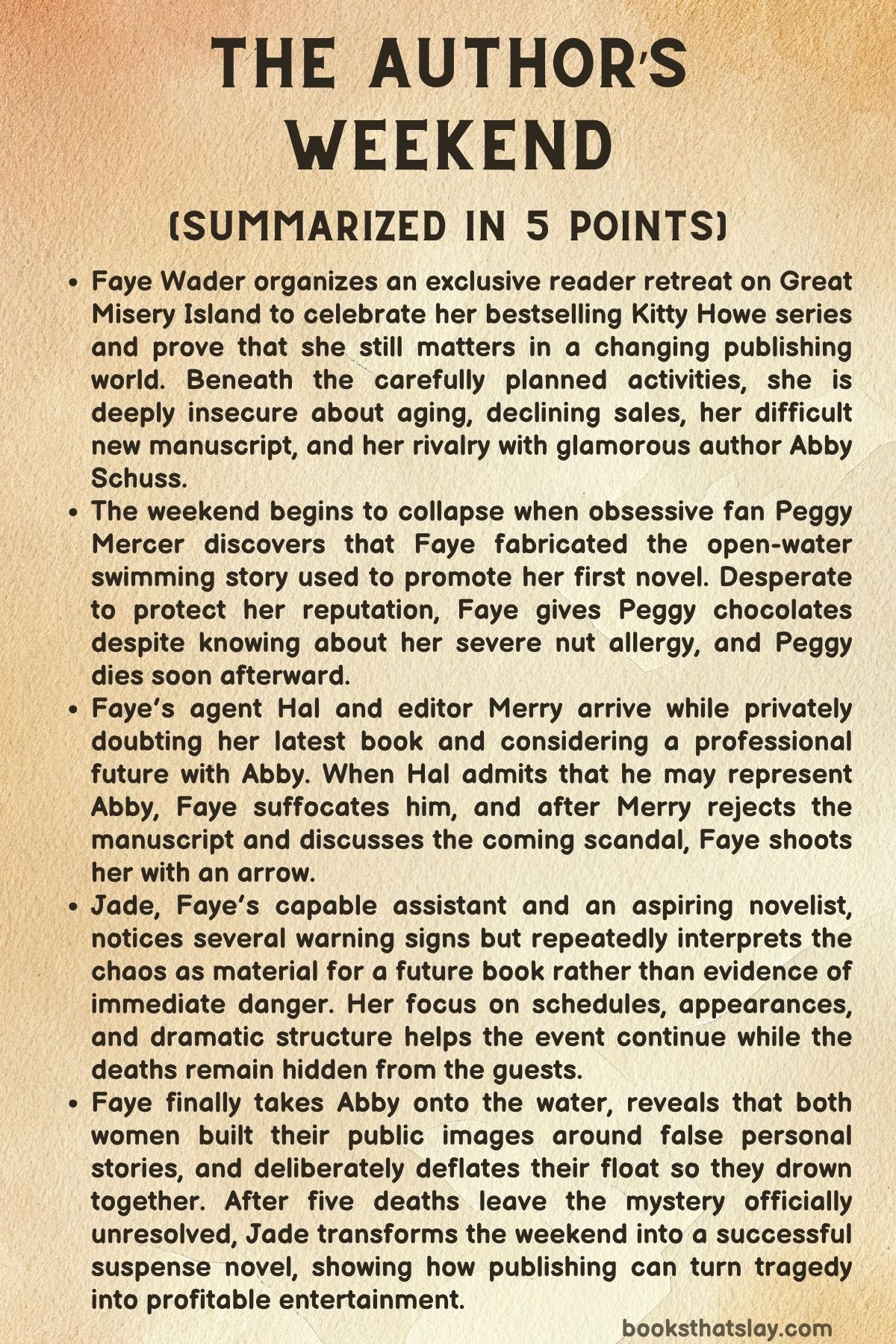
Bestselling suspense writer Faye Wader organizes her first Author Weekend at Great Misery Manor, an isolated luxury resort off the Massachusetts coast. Fifty devoted readers are scheduled to spend three days participating in activities inspired by Faye’s fourteen-book Kitty Howe detective series.
The weekend has been carefully designed by Faye’s assistant, Jade, who has arranged themed meals, meditation sessions, swimming, archery, literary discussions, beach events, drinking, dancing, and a midnight float to Little Misery Island. Faye’s agent, Hal Tinder, and editor, Merry Golden, are also expected to attend a publishing panel, along with Faye’s glamorous professional rival, Abby Schuss.
Although the event is presented as a celebration of readers and books, Faye created it largely because she envies Abby. Abby’s own fan weekends attract hundreds of readers, and her beauty, confidence, celebrity friendships, and emotional connection with fans represent everything Faye believes she lacks.
Faye has enjoyed a successful career, but she is approaching sixty, her sales are declining, and her latest manuscript, High Tides, has received no clear response from Hal or Merry. She feels that readers love Kitty Howe rather than the woman who created her, making the weekend an attempt to prove that Faye herself still matters.
Great Misery Island also carries painful memories from Faye’s adolescence. She visited the island when she was young, during a period when she felt overlooked beside her beautiful sister, Lindsay, who eventually stole Faye’s boyfriend and attended the prom with him.
Faye later transformed the island into part of the mythology surrounding Night Swim, her first novel. For years, she has claimed that she completed extraordinary open-water swims there, using the experience as inspiration for Kitty Howe’s background.
The story is false. Faye cannot swim, and the heroic personal history that helped launch her career was created because it made Night Swim more compelling and marketable.
Hal suspected from the beginning that the swimming claims were logistically unlikely, but he never investigated them. The novel was commercially powerful, publishers accepted the story, and both Hal and Faye benefited from allowing fiction, memory, and publicity to merge.
Jade knows nothing about this deception. She is an aspiring literary novelist with an MFA who originally accepted the assistant job because her graduate-school friends encouraged her to treat working for a famous commercial writer as material for future fiction.
During three years with Faye, Jade has become highly skilled at managing her employer’s demands, anxieties, and angry outbursts. Faye can be cruel and exhausting, but Jade understands that much of her behavior comes from grief, isolation, professional fear, and the early death of her husband, David.
Faye is jealous of Jade’s youth, education, appearance, and emotional composure. At the same time, she respects Jade’s intelligence and recognizes that she is the most capable assistant she has ever employed.
Faye’s therapist, Greg Bond, has created a system in which she must send Jade money whenever she behaves aggressively. The arrangement gives their relationship a strange mixture of employment, discipline, dependence, resentment, and affection.
Shortly before the readers arrive, Abby’s assistant announces that Abby will be delayed until Saturday. Jade discovers that the stated explanation is false and realizes that Abby is already in New York, but she does not immediately tell Faye.
Jade herself invited Abby, partly out of professional courtesy and partly because she believed the rival’s presence would create dramatic tension. She has already started imagining the weekend as the possible foundation for a novel and quietly records conversations, scenes, and conflicts.
Faye initially feels relieved by Abby’s delay, but she quickly begins imagining that it is a strategy intended to unsettle her. Her obsessive comparisons with Abby expose how thoroughly professional competition has entered her thoughts about her body, clothing, age, personality, and worth.
The arrival of the guests forces Jade to become the visible host because Faye is too nervous to greet them. Jade collects their phones, distributes schedules and promotional items, and keeps the entire event functioning while Faye watches from her room.
Among the attendees is Margaret “Peggy” Ipswich Mercer, Faye’s self-proclaimed number-one fan. Peggy dresses like Kitty Howe, owns extensive merchandise, attends nearly every local event, corrects grammatical mistakes, and expects a special relationship with Faye.
Peggy is also a copy editor with a severe nut allergy. More dangerously for Faye, she has researched the supposed open-water swims and discovered that weather records, tides, support requirements, and historical information do not match Faye’s account.
During the opening lunch, Faye drinks enough prosecco to overcome her fear and gives an emotional speech about Kitty, Great Misery Island, and the swims that supposedly inspired her career. The fans respond with warmth and admiration, temporarily giving Faye the personal love she hoped to experience.
Afterward, Peggy confronts Faye with the inconsistencies she has uncovered. She requests exact dates and suggests that Faye may have invented the swimming story because it provided excellent material.
Faye panics because Peggy’s investigation could expose the lie at the center of her public identity. She visits Peggy’s room carrying chocolates, pretending that they are a peace offering while attempting to convince her to stop investigating.
Peggy refuses to abandon the truth and keeps the security chain fastened while speaking with Faye. Faye leaves the chocolates behind despite knowing about Peggy’s allergy, claiming to herself that she only wants to frighten or temporarily disable her.
Peggy does not appear at dinner that night, but the schedule is so crowded and the guests are drinking so heavily that her absence goes largely unnoticed. The event continues to look flawless even as danger remains hidden behind the polished atmosphere.
On Saturday morning, Jade becomes worried that Peggy has not emerged from her room. During a wellness check, she finds Peggy dead on the floor beside three empty chocolate wrappers.
Faye immediately realizes that the chocolates caused Peggy’s death. Rather than confess, she tells herself that Peggy should have carried an EpiPen and that she never intended to kill her.
Faye persuades Jade not to alarm the guests because Peggy’s death appears natural. Jade coordinates with the authorities, extends the morning activities, and keeps the readers away from the dock while Peggy’s body is quietly removed.
As the coroner’s boat leaves, the ferry carrying Hal, Merry, Abby, publicist Xoey Catz, and Xoey’s social-media-famous cat, Fluff, arrives. Jade films the two boats passing, disturbed by the contrast between the concealed death and the cheerful new arrivals.
Hal and Merry are both deeply worried about High Tides. Faye has made the novel more personal, placing greater emphasis on menopause, aging, regret, and Kitty Howe’s emotional life while weakening the conventional mystery structure that readers expect.
Hal believes the manuscript needs more suspense, mathematics, and tidal science. Merry privately believes it may require complete reconstruction and fears that the publisher will be unable to market such a major departure from the established series.
Both Hal and Merry also know that Faye’s declining sales make her professionally vulnerable. They still care about her, but their affection is mixed with financial anxiety, self-preservation, and concern about their own careers.
Abby’s arrival intensifies every insecurity Faye possesses. Abby immediately charms the fans, remembers details about people, praises Jade, and makes Hal and Merry feel valued in ways that Faye rarely does.
During the publishing panel, Jade allows Abby to join Faye, Hal, and Merry onstage. Part of Jade knows that the decision will humiliate Faye, but she is angry after Faye mistreated her and has grown tired of protecting her employer from every emotional consequence.
Faye is furious but cannot object without appearing jealous in front of her readers. When High Tides is discussed, Merry’s evasiveness exposes her lack of enthusiasm, although Faye regains some control by speaking passionately about Kitty and the long relationship she shares with her fans.
After the panel, Abby privately approaches Hal and Merry with a proposal. She wants to leave her current publisher and agent, join Merry at Hatchet House, and have Hal represent her.
The offer flatters them and promises prestige, strong sales, and professional renewal. Neither initially knows that Abby’s current publisher has actually declined to renew her contract because her recent books have failed financially.
While Faye signs books, Jade learns from a staff member that Faye requested chocolates the previous evening. Jade briefly connects the chocolates with Peggy’s allergy but rejects the possibility that her employer could have caused the death.
Jade then overhears enough of Abby’s proposal to learn that she wants Merry as her editor. When Faye orders her to spy, Jade reveals this information without realizing that Abby has also asked Hal to become her agent.
Faye confronts Hal and demands reassurance. Hal finally admits that Abby wants him to represent her and that he is seriously considering the offer because he must think about his finances, his partner Paul, their aging parents, and his future.
Faye regards the agent-author relationship as exclusive and experiences his answer as an emotional betrayal. Hal occupies part of the space left by David’s death, so the possibility of losing him feels like another version of Lindsay stealing her boyfriend and the publishing world choosing Abby over her.
When Hal tries the Scream Muffler he once gave Faye, she presses it over his mouth and nose and blocks the opening with her hand. She suffocates him, then stages the room to make the death appear accidental.
Merry, meanwhile, discovers that Peggy contacted publishing-industry reporters before her death. The reporters plan to expose Faye’s fabricated swimming history, meaning Peggy’s death has not stopped the scandal.
Merry confronts Hal about what he knew, and their discussion reveals how many people benefited from never asking difficult questions. Faye invented the story, but agents, editors, marketers, journalists, and publishers helped turn it into profitable truth.
Unaware that Hal is dead, Merry meets Faye near the archery activity to discuss High Tides. She admits that Abby wants to join Hatchet House and explains that Faye’s manuscript cannot be published successfully in its current condition.
Merry also warns that the coming swimming scandal may make recovery impossible. Faye hears the professional judgment as confirmation that both her work and her identity have been declared worthless.
As Merry walks away, Faye draws a bow and shoots her in the back. She leaves Merry’s body in the tall grass and returns to the event with a plausible story that the editor has gone walking.
Jade notices that Faye is behaving strangely and that both Hal and Merry are missing, but she assumes they are avoiding emotional conflict. She has become so accustomed to publishing arguments and Faye’s volatility that disappearance seems less alarming than it should.
Faye later abandons the fashionable clothing selected by her publishing team and returns to jeans, flannel, and practical shoes. Having killed the people who wanted to reshape or replace her, she no longer feels compelled to perform the glamorous identity designed to compete with Abby.
During a book-club discussion, Faye publicly praises Jade and announces that her assistant is also a writer. She describes Jade as a possible successor and gives her the encouragement that once helped Faye believe in herself.
Jade is deeply moved and confesses that she invited Abby, believing the resulting professional disaster is her fault. Faye forgives her because she has already turned her attention toward a final confrontation with Abby.
Xoey eventually tells Jade that Peggy had contacted the press. Jade also learns that Abby’s presentation of herself as a successful author seeking creative freedom is misleading because her publisher has already rejected her.
Faye and Abby are therefore more alike than either wants to admit. Both are aging authors facing declining sales, both depend on manufactured stories, and both are attempting to preserve careers that the industry is preparing to move beyond.
After the evening celebrations, Faye insists on completing the scheduled midnight float. Most of the guests have gone to bed, leaving Faye and Abby alone on the beach with an inflatable pizza float and wooden paddles.
Jade interprets the sight of the two women laughing together as a reconciliation. She allows them to paddle away even though Faye has been drinking and has endured an emotionally devastating day.
Once they are on the water, Faye deliberately changes direction toward the exposed side of Little Misery Island. Abby becomes frightened and admits that she cannot swim.
Faye reveals that she cannot swim either and that her famous open-water history was invented. She then exposes Abby’s own false recovery story, explaining that Abby’s absence from skiing involved an injured knee rather than addiction and rehabilitation.
Faye tells Abby that Hal and Merry are dead and therefore belong to neither woman. She has also removed the plug from the inflatable float, which rapidly loses air as the tide carries them toward open water.
Abby struggles and screams, but Faye accepts that they will die together. The two rivals become equal in the end: both are frightened women whose professional identities depend on stories they created about themselves.
On Sunday, Jade reports Faye and Abby missing when Faye fails to send her usual morning messages. Their bodies wash ashore along with the nearly deflated float.
Investigators also discover Hal in his room, Merry near the archery area, and Peggy’s earlier death. Because Faye staged or concealed the crimes, officials initially consider several deaths accidental or natural, and the complete truth remains unknown.
Five people have died during a weekend designed to celebrate Faye’s achievements. The phones collected to encourage engagement have delayed outside communication, while the packed schedule has made it possible for disappearances and deaths to remain unnoticed.
After the tragedy, Jade finally completes a novel called Point of Telling, based on the unsolved events. The book receives a major three-book deal from Whitney Prose, the ambitious assistant who takes Merry’s position at Hatchet House.
Jade is represented by Bennett Stern, Abby’s former agent. Xoey and Fluff also sell a book about trauma, allowing the publishing industry to transform the deaths into successful commercial products.
Faye’s weekend ends her career and life, but it gives other people the stories that advance theirs. Jade follows Faye’s advice by assembling separate scenes into a complete novel, proving that even tragedy can become material once the right person controls the narrative.
Characters
Faye Wader
Faye Wader is the central figure of The Author’s Weekend, a bestselling suspense novelist whose professional success has failed to give her lasting emotional security. She wants admiration, loyalty, and reassurance, yet her suspicion and volatility repeatedly damage the relationships that might provide them.
Her identity has become inseparable from Kitty Howe, the fictional detective who gave Faye financial independence and cultural recognition. Because she has no children and lost her husband early, her books, agent, editor, assistant, and readers have become substitutes for a conventional family.
Faye’s jealousy of Abby is rooted in more than professional competition. Abby represents the beauty, ease, popularity, and social confidence Faye has felt denied since childhood, particularly during the years when Lindsay overshadowed her.
Her false swimming history reveals how deeply she believes success requires a more impressive self than the one she actually possesses. Instead of trusting her imagination and writing alone, she creates an inspirational biography that eventually becomes impossible to separate from her public identity.
Faye remains capable of insight, humor, generosity, and artistic intelligence. Her advice helps Jade begin writing, and her public praise gives the younger woman confidence, but these positive qualities exist beside cruelty, manipulation, self-pity, and a dangerous inability to accept rejection.
The deaths mark a progression in her moral collapse. Peggy dies through a reckless attempt at intimidation, Hal is intentionally suffocated during an emotional confrontation, Merry is deliberately shot, and Abby is taken into the ocean as part of Faye’s planned final act.
Faye ultimately destroys the professional family she fears losing. Her tragedy is that many of her insecurities are understandable and some of her suspicions are correct, but she responds to pain by treating other people as obstacles within a story she alone has the right to control.
Jade
Jade begins the book as a disciplined and emotionally contained assistant who believes she can observe Faye’s chaotic life without becoming morally involved. In The Author’s Weekend, she gradually learns that observation is itself a form of participation when the observer organizes events, withholds information, or allows conflict to continue.
Her MFA background makes her interested in motivation, interior life, structure, causality, and the moment that makes a story worth telling. She initially considers Faye’s commercial novels artistically inferior, but working beside a successful professional writer challenges some of her academic assumptions.
Jade’s competence makes the weekend possible. She manages transportation, schedules, guest information, merchandise, staff, emergencies, public appearances, and Faye’s moods, often performing the labor that allows Faye to appear successful.
However, Jade’s ability to turn reality into potential fiction creates emotional distance. She watches arguments as scenes, thinks of guests as characters, and allows Abby onto the panel partly because she wants dramatic consequences and partly because she wants Faye punished.
Her handling of Peggy’s death reveals her central ethical conflict. Jade knows that concealing the body’s removal from the guests feels wrong, but she allows logistical efficiency and Faye’s reasoning to override her judgment.
She also ignores several warnings because the explanations she creates are narratively satisfying. She assumes Hal and Merry are hiding after professional arguments and interprets Faye and Abby’s apparent friendliness as reconciliation rather than danger.
Jade survives because she remains outside Faye’s deepest emotional circle, yet she profits from the tragedy by writing Point of Telling. Her success fulfils Faye’s advice, but it also raises uncomfortable questions about whether transforming real deaths into entertainment differs completely from the publishing behavior the novel criticizes.
Hal Tinder
Hal is Faye’s longtime literary agent and one of the principal architects of her career. He once understood her work instinctively, championed Night Swim, and helped turn Kitty Howe into a bestselling character.
His affection for Faye is genuine, but it is tied to income, reputation, nostalgia, and professional dependence. He needs the money her books produce and fears what declining sales or public scandal will mean for his household with Paul.
Hal’s greatest failure is his preference for comfortable uncertainty over difficult truth. He questions the swimming story from the beginning but does not investigate because the biography makes the novel easier to sell.
The same passivity appears during the weekend. He knows Abby’s presence on the panel will hurt Faye, understands that High Tides is in trouble, and recognizes the danger of Abby’s offer, but repeatedly delays direct intervention.
His interest in representing Abby is professionally understandable. She appears to offer prestige and financial stability, but Hal underestimates how completely Faye views their relationship as personal, exclusive, and emotionally necessary.
Hal’s conversation with Faye is especially damaging because he admits that he may choose Abby while withholding the full seriousness of Peggy’s allegations. He asks Faye to understand his self-interest without giving her the information that makes his urgency comprehensible.
The Scream Muffler becomes a fitting symbol of their broken bond. A gift originally intended to help Faye express frustration becomes the object with which she permanently silences the man she believes has stopped hearing her.
Merry Golden
Merry is Faye’s longtime editor, a skilled publishing professional caught between loyalty to an author and responsibility to a commercial company. She recognizes that High Tides may contain Faye’s most emotionally honest writing, but she also believes the manuscript does not function as a successful Kitty Howe mystery.
Her predicament shows the tension between artistic development and brand stability. Supporting Faye’s creative growth could produce a brave but commercially unsuccessful novel, while demanding the familiar formula may protect sales at the cost of silencing the writer’s changing concerns.
Merry contributes to Faye’s insecurity by participating in the campaign to improve her image. She helps persuade Faye that better sales require more fashionable clothes, luxurious food, polished photographs, and a personality closer to Abby’s.
Although Merry believes she is helping, the rebranding communicates that Faye’s authentic identity is no longer marketable. Her affection is therefore compromised by manipulation and fear of professional consequences.
Merry’s response to Abby exposes an inconsistency. She regards Abby’s desire for reinvention as exciting while treating Faye’s experimentation as an unacceptable risk because Abby appears more glamorous and commercially secure.
She is also threatened by her ambitious assistant, Whitney, which makes her more receptive to any opportunity that might strengthen her position. Her choices are shaped not only by editorial judgment but also by fear of becoming replaceable.
Merry’s final honesty arrives too late. When she tells Faye that High Tides is not publishable in its current state and that the swimming scandal may be disastrous, Faye interprets the assessment as a declaration that her entire future should be discarded.
Abby Schuss
Abby is presented for much of the novel through Faye’s resentful imagination. She appears beautiful, athletic, elegant, socially gifted, emotionally generous, and capable of creating effortless devotion wherever she goes.
Her greatest talent is making people feel noticed. She remembers personal details, offers praise, shows physical warmth, and treats assistants, readers, agents, editors, and service workers as though their presence matters.
This behavior explains her powerful public brand, although the novel leaves room to question how much is spontaneous and how much is professional skill. Abby rarely promotes herself directly, but her stories constantly remind listeners of her success, glamorous lifestyle, and popular retreats.
Her proposed move to Hal and Merry seems at first like the confident decision of a powerful author seeking creative freedom. The later revelation that her publisher has declined to renew her contract shows that the proposal is also a desperate attempt to hide career decline.
Abby therefore mirrors Faye more closely than either woman admits. Both fear irrelevance, both depend on manufactured personal histories, and both use narrative to present professional vulnerability as personal strength.
The major difference lies in their responses to insecurity. Abby searches for new representation and maintains her performance of warmth, while Faye responds through violence and destruction.
Abby’s final vulnerability is revealed on the water. Beneath her athletic identity and recovery mythology, she cannot swim and is terrified, leaving her dependent on a rival who has already decided that neither woman should survive.
Peggy Mercer
Peggy is Faye’s most devoted fan and the first person to threaten the false foundation of her career. Her loyalty is intense, possessive, demanding, and occasionally unsettling, but it is also sincere.
She has invested years of emotional meaning in Kitty Howe and in the belief that Faye’s personal courage inspired the character. Discovering inconsistencies in the swimming story therefore feels like a betrayal of a relationship Peggy considered genuine.
Her training as a copy editor shapes her moral outlook. Dates, grammar, records, capitalization, weather, and factual accuracy are not minor details to her but parts of an ethical commitment to truth.
Faye initially treats Peggy as a comic inconvenience and compares her to a dangerous fictional superfan. This framing makes it easier for Faye to dismiss Peggy’s intelligence, humanity, and right to question a public claim.
Peggy’s nut allergy becomes the means through which Faye attempts to silence her. Although Faye claims she expected only temporary illness, giving allergen-contaminated food to someone with a known severe allergy demonstrates a willingness to risk serious harm.
Peggy’s investigation succeeds even after her death because she has already contacted journalists. Her commitment to accuracy defeats Faye’s effort to control the story, proving that information cannot always be contained by removing the person who discovered it.
Xoey Catz
Xoey is Faye’s distracted publicist, although much of her attention is devoted to Fluff, her famous cat. Her comic presence exposes a publishing culture in which social-media visibility and personal branding can matter as much as literary work.
She participates in the effort to modernize Faye’s image, often using meaningless promotional language and making absurd requests. These decisions contribute to the feeling that Faye must be redesigned as a product rather than respected as a person.
Xoey appears professionally unserious, but she notices important signs that others ignore. She senses something disturbing in the Manor, learns about the press allegations, and begins questioning whether Peggy’s death was truly natural.
Her concern is mixed with self-interest and performance. Even after the tragedy, she thinks about Fluff’s emotional response and eventually converts the weekend into a marketable book project.
Xoey’s survival and later success reinforce the novel’s satire. The publicist who often seems least engaged with literature understands instinctively how to turn attention, trauma, and personality into commercial opportunity.
Lloyd
Lloyd is a member of the Manor staff who first meets Jade while delivering elaborate pastries. His calm and relative distance from the publishing world make him an appealing contrast to the anxious professionals surrounding Faye.
He is one of the few people who gives Jade attention without demanding that she manage a crisis. Their conversations introduce the possibility of a personal life beyond her employment and support her growing belief that she can leave Faye.
Lloyd also provides a vital clue when he mentions that Faye requested chocolates before Peggy’s death. His comment is made partly as an insensitive joke, but it gives Jade enough information to suspect a connection between Faye, the chocolates, and Peggy’s allergy.
Jade’s refusal to pursue the clue demonstrates how strongly she still resists seeing Faye as dangerous. Lloyd’s hopeful watercolor about attending Jade’s future author weekend also distracts her on the night Faye and Abby disappear.
His role is small but structurally important. He represents the ordinary future Jade might claim while also unintentionally placing the truth in front of her before she is prepared to accept it.
Greg Bond
Greg is the therapist who attempts to improve Faye’s workplace behavior and her relationship with Jade. His Venmo penalty system shows that Faye’s aggression has been serious and frequent enough to require an external structure.
He understands that Faye’s rivalry with Abby provides emotional energy as well as distress. Faye needs someone against whom she can measure herself, even though the comparison repeatedly damages her confidence.
Greg generally interprets Faye through psychological patterns such as loneliness, insecurity, grief, and fear of abandonment. These explanations are accurate, but the weekend demonstrates the limits of treating harmful behavior mainly as emotional dysregulation.
Jade avoids contacting him after the deaths begin because she does not want to be questioned or managed. His absence leaves her without one of the few people who might have challenged Faye’s explanations and encouraged stronger action.
David Wader
David is Faye’s deceased husband and the emotional standard against which she measures every later relationship. He loved her without requiring glamour, refinement, beauty, or a more marketable personality.
His support gave Faye the confidence to write and helped her feel that her ordinary self was worthy of affection. After his death, she placed increasing emotional pressure on her professional relationships because she lacked another source of unconditional belonging.
Faye’s grief is not the direct cause of her violence, but it helps explain the intensity of her dependence on Hal, Merry, Jade, Kitty, and her readers. Every professional rejection becomes connected to the earlier experience of losing the person who made her feel fully accepted.
David’s absence also makes the imposed rebranding especially painful. Faye believes he would have recognized that the fashionable version created by her team was not the woman he knew.
Lindsay
Lindsay is Faye’s sister and one of the earliest sources of her insecurity. She is remembered as more beautiful, socially successful, and naturally admired, creating a pattern in which Faye understands relationships as competitions she is destined to lose.
The most damaging event occurs when Lindsay takes Faye’s boyfriend and attends the prom with him. Faye never fully separates that adolescent betrayal from later professional experiences.
Abby eventually becomes a symbolic replacement for Lindsay. Her beauty, popularity, and apparent ease reactivate Faye’s belief that a more attractive woman will always be chosen over her.
Faye’s inability to process this old wound contributes to her distorted response when Abby approaches Hal and Merry. Rather than seeing a complicated business decision, she experiences the situation as the repetition of a personal theft that must finally be stopped.
Paul
Paul is Hal’s partner and the person who occupies the central place in Hal’s private life. His presence forces Faye to confront the difference between being Hal’s most important client and being the most important person in his life.
Faye resents that distinction because she wants their professional partnership to provide the exclusivity of a marriage. Hal’s commitments to Paul, their home, financial responsibilities, and aging parents become reasons he must consider opportunities beyond Faye.
Paul also recognizes the implausibility of the swimming story more quickly than many publishing professionals. His outside perspective demonstrates how willfully the industry ignored contradictions that were obvious to someone without a financial interest in believing them.
Hal wishes he could consult Paul after Abby’s offer, suggesting that Paul represents his moral and emotional stability. His inability to reach that support before confronting Faye leaves him alone with a decision he handles incompletely.
Whitney Prose
Whitney is Merry’s ambitious assistant, a younger professional waiting for an opportunity to advance. Her repeated offers to read High Tides and attend the weekend appear helpful, but Merry correctly recognizes them as attempts to move closer to her position.
Whitney spreads or acts upon information suggesting that Hatchet House will reject Faye’s manuscript before Merry has made a final decision. Her behavior contributes to Merry’s fear that she is losing control inside her own company.
After Merry’s death, Whitney takes her role and acquires Jade’s novel. She demonstrates how quickly publishing institutions replace individuals while presenting each transition as an exciting development.
Whitney is not responsible for the tragedy, but she benefits from it with remarkable efficiency. Her rise supports the novel’s view that professional systems survive personal disaster by assigning new people to old positions and creating fresh products from the wreckage.
Bennett Stern
Bennett is Abby’s longtime agent and later becomes Jade’s representative. Abby describes leaving him as part of a creative reinvention, although her professional difficulties suggest that her decision is also driven by financial panic.
After Abby’s death, Bennett signs Jade and profits from the novel based on the weekend. The reversal is ironic because the agent Abby intended to abandon becomes one of the chief beneficiaries of the story created from her death.
Bennett represents the durability of publishing networks. Individual loyalties may collapse, but agents continue searching for the next promising manuscript and the next marketable narrative.
Kitty Howe
Kitty Howe is the fictional detective at the center of Faye’s bestselling series, but she functions almost like a living presence in the story. She has provided Faye with money, identity, companionship, reader devotion, and a structure through which to interpret the world.
Kitty’s background is partly constructed from the false swimming history, tying the fictional heroine to Faye’s fabricated public identity. Exposing the lie therefore threatens not only the author’s reputation but also the emotional authenticity readers attach to Kitty.
Faye repeatedly interprets real events through mystery conventions, searching for inciting incidents, motives, rising action, and climaxes. This habit allows her to distance herself from consequences by imagining that life can be arranged with the same authority as a novel.
In the end, Kitty becomes the detective who is absent when the greatest mystery occurs. The public jokes that she would have been uniquely qualified to solve the Author Weekend deaths, unaware that her creator is responsible for them.
Fluff
Fluff is Xoey’s social-media-famous cat and one of the novel’s broadest comic elements. The cat travels in elaborate equipment, wears styled accessories, and receives more publicity attention than many of the human writers.
Fluff represents the attention economy surrounding modern publishing. Marketability can be created through personality, novelty, visual appeal, and social-media engagement even when those qualities have little connection to books.
The cat is also treated as emotionally sensitive, with Xoey claiming that Fluff detects the Manor’s disturbing atmosphere. After the deaths, Fluff becomes part of a trauma memoir, demonstrating how even an animal’s supposed emotional response can be packaged and sold.
Jade’s Writing Cohort
Jade’s graduate-school friends form a collective voice encouraging her to treat her employment as literary research. Their messages focus on causality, character, dramatic structure, interiority, conflict, and the elusive point of telling.
Their advice helps Jade begin writing, but their distance from the island turns disturbing events into entertainment. They react to Faye’s drinking and Abby’s arrival as though they are watching reality television rather than observing real people moving toward disaster.
The cohort reinforces Jade’s emotional detachment. Because they expect dramatic material, she becomes increasingly willing to interpret conflict as useful rather than dangerous.
Their influence is not malicious, but it contributes to the mindset that allows Jade to keep collecting scenes instead of questioning what those scenes may mean. They represent artistic ambition separated from immediate responsibility.
Themes
Identity, Reinvention, and the Fear of Becoming Obsolete
Faye’s professional identity has been built from several overlapping creations: Kitty Howe, the open-water-swimming legend, the practical New England author persona, and the public image constructed by her publishing team. When these identities stop supporting one another, she can no longer determine which version of herself is real or valuable.
The attempt to “elevate” Faye through fashionable clothing, refined food, luxury branding, and glamorous presentation is presented as a business strategy, but it functions as personal erasure. She is told indirectly that the qualities once considered authentic and appealing have become unattractive to the current market.
Abby appears to represent successful reinvention, yet her own image is equally unstable. Her recovery story is false, her publisher has rejected her, and her proposed professional move is an act of desperation disguised as confidence.
In The Author’s Weekend, reinvention is therefore both necessary and dangerous. Characters must adapt to changing markets, aging bodies, new technologies, declining sales, and shifting reader tastes, but every alteration creates anxiety about whether the original self is being improved or replaced.
Faye’s final return to jeans, flannel, and practical shoes is a rejection of the manufactured version created for the event. Unfortunately, she achieves this apparent authenticity only after destroying the relationships and institutions through which her career existed.
Storytelling, Deception, and Control
The novel repeatedly questions where storytelling ends and dishonesty begins. Faye’s fabricated swimming history is not part of a novel, yet it is defended through the language of imagination, inspiration, memory, and promotion because it helped everyone sell books.
Hal, Merry, publishers, marketers, and journalists all benefit from the story without investigating its credibility. Their silence demonstrates that commercially useful narratives often survive because institutions prefer emotional appeal to factual accuracy.
Faye also uses storytelling to control immediate reality. After Peggy dies, she constructs a respectful public explanation; after killing Hal and Merry, she stages scenes and supplies plausible accounts of their absence.
Jade’s behavior creates a subtler version of the same problem. She observes real events as possible fiction, selects meaningful details, shapes conflict, and eventually publishes a successful novel based on deaths whose full truth remains unknown.
The contrast between Faye and Jade is therefore not simply the contrast between a murderer and an innocent writer. Both convert people into characters and experience into narrative, although only Faye uses direct violence to force reality toward the ending she desires.
The publishing industry completes the process by marketing Jade’s novel and Xoey’s trauma book. Once events become stories, questions of responsibility are easily replaced by questions of genre, audience, publicity, and sales.
Jealousy, Comparison, and Emotional Possession
Faye’s jealousy of Abby contains professional, physical, social, and personal dimensions. She does not merely want Abby’s sales; she wants her beauty, ease, prestige, charisma, reader intimacy, clothing, friendships, and ability to make people feel valued.
The rivalry is strengthened by Faye’s childhood relationship with Lindsay. Abby becomes another beautiful woman who can enter Faye’s life and take the people whose loyalty Faye considers exclusively hers.
Faye treats Hal and Merry less like independent professionals than members of a private family. Their interest in working with Abby therefore feels like romantic betrayal rather than an ordinary career decision.
Her possessiveness also affects Jade. Faye envies Jade’s youth and stability, demands constant availability, and reacts angrily whenever the assistant exercises judgment that does not center Faye’s emotional needs.
Jealousy creates a self-fulfilling pattern. Faye fears abandonment, behaves cruelly because she expects betrayal, and thereby gives the people around her stronger reasons to leave.
Abby’s own envy is quieter but still significant. She wants Faye’s agent, editor, publishing house, and apparent stability because her glamorous career is failing beneath the surface.
The conflict between the two women shows how industries built on ranking, sales, publicity, beauty, and attention encourage people to experience another person’s success as evidence of their own disappearance.
Publishing, Ambition, and the Commercial Use of Tragedy
The publishing world is portrayed as a system in which affection and exploitation can exist at the same time. Hal and Merry care for Faye, yet they also depend on her income, evaluate her market value, reshape her identity, conceal difficult judgments, and consider replacing her with a more attractive opportunity.
Writers are encouraged to transform themselves into brands, while assistants, editors, agents, and publicists must protect their positions inside unstable institutions. Everyone speaks the language of loyalty, but nearly every relationship is influenced by money, sales figures, publicity, and career survival.
Jade initially believes literary fiction offers greater artistic seriousness than Faye’s commercial mysteries. Her eventual success, however, depends on turning five deaths and an unsolved scandal into a suspense novel marketed through comparisons with other popular works.
Whitney replaces Merry, Bennett profits after Abby’s death, and Xoey converts Fluff’s supposed trauma into a book. The industry absorbs loss without changing its basic behavior because every ending creates a vacancy, a manuscript, a publicity angle, or a new professional alliance.
Faye’s fear that she is becoming commercially irrelevant is therefore not imaginary. The market is already preparing to continue without her, but her violence cannot stop that process.
Her final weekend becomes more valuable after her death than it might have been as a successful promotional event. The tragedy exposes the coldest principle governing the story’s publishing world: private suffering can always be transformed into public material when someone survives to package it.