The Arcane Arts Summary, Characters and Themes
The Arcane Arts by S. D. Coverly (the pen name of Dana Schwartz and Dan Frey) is a dark academic fantasy that combines forbidden magic, murder, romance, and questions about intellectual responsibility. The story follows Ellsbeth Storer, a gifted young scholar whose career was destroyed after a magical vision revealed her sister’s death, and Professor Thaddeus Rawlins, a celebrated academic burdened by guilt over a former student.
Their secret research into magical control soon develops into a dangerous personal relationship. As Ellsbeth investigates her sister’s supposed suicide, she uncovers a powerful society that has used ritual murder to manufacture success, forcing both characters to confront the consequences of controlling others in the name of knowledge, justice, or love.
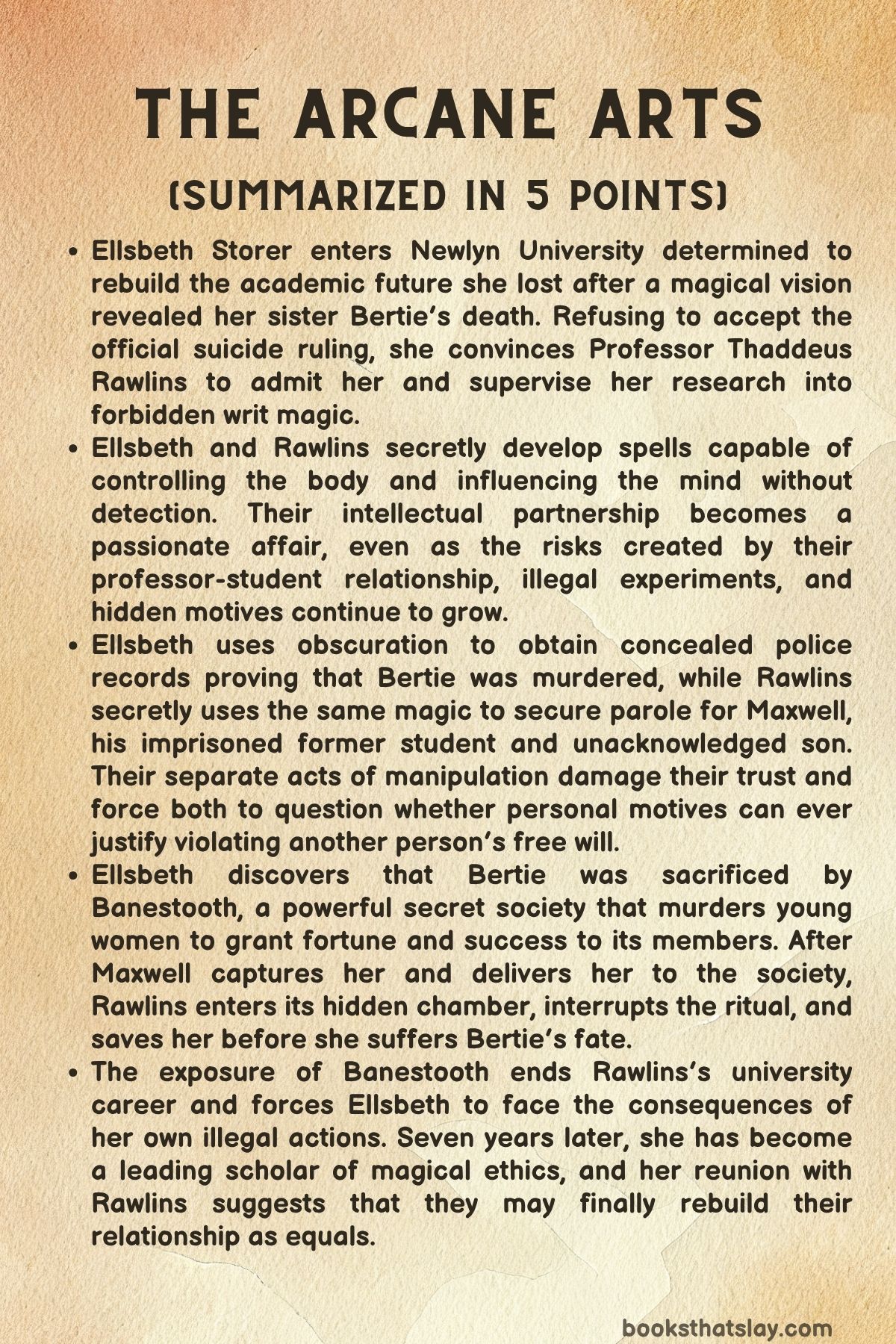
Summary
A masked Magister presides over a secret ritual in an underground chamber, where eight young men prepare to sacrifice a kidnapped woman. The victim is placed inside a Fibonacci spiral surrounded by gold, powdered bones, burning figures, and magical materials designed to transfer good fortune from her suffering to the men conducting the ceremony.
The magic requires complete despair, but the captive remains angry and determined to survive. When her cellphone rings, the Magister plays a loving voicemail from someone who promises to visit her, and the message finally makes the woman understand that she will never return to the people she loves.
Her hope collapses, allowing the ritual to succeed. The Initiates kill her while the Magister collects her blood and celebrates the fortune they believe they have harvested.
Years later, twenty-four-year-old Ellsbeth Storer secretly enters Professor Thaddeus Rawlins’s introductory lecture at Newlyn University. She is not enrolled, but she is determined to attract the attention of one of the most respected scholars in the arcane arts.
Ellsbeth was once a brilliant student of arcane mechanicals at St. Andrews and expected to continue her education at Cambridge. During the Arcanus examination, however, a scrying ritual showed her younger sister Bertie bleeding to death in a bathtub at Newlyn.
Ellsbeth abandoned the examination and tried to obtain help, but Bertie was already dead. Because Ellsbeth left the test unfinished, her academic score was ruined, closing the path she had expected to follow.
The authorities declared Bertie’s death a suicide, but Ellsbeth has never accepted that conclusion. The position of Bertie’s body, the distribution of blood, and the university’s evasive responses have convinced her that someone is hiding the truth.
Rawlins notices Ellsbeth during his lecture and immediately recognizes that she does not belong in the class. Instead of removing her, he allows her to stay, intrigued by her attention and confidence.
Ellsbeth later emails him and requests admission to Newlyn’s elite graduate program despite her incomplete Arcanus score. Their correspondence becomes witty and combative as Rawlins challenges her qualifications and Ellsbeth argues that one interrupted examination should not erase years of exceptional work.
Rawlins initially refuses because of his past with Maxwell Keene, a gifted former student whom he encouraged to attempt increasingly dangerous research. Maxwell eventually conducted a forbidden ritual that caused a fire and killed three students, leaving Rawlins distrustful of brilliance without restraint.
During a graduate Practicum, Rawlins introduces time dilation and asks whether any student would volunteer to become the human subject of an illegal experiment. The students refuse, and Rawlins pretends that the request was only a test, though he is genuinely disappointed by their caution.
Ellsbeth confronts him afterward and says she would have volunteered. Her willingness to take intellectual risks awakens the excitement Rawlins has lacked since Maxwell’s downfall, persuading him to admit her provisionally.
When Rawlins asks Ellsbeth to propose a thesis, she chooses writ magic, the forbidden practice of controlling another person’s body or mind. She argues that suppressing research has not eliminated the danger but has instead left scholars unable to understand or defend against it.
Rawlins warns that practical research would require a human subject. Ellsbeth proposes using herself and asks him to perform the rituals, deliberately drawing him into a secret partnership that could destroy both their careers.
Their meetings become increasingly charged with attraction. Ellsbeth initially treats flirtation as a strategy for securing Rawlins’s attention, but her feelings become genuine as she recognizes his intelligence, loneliness, and dissatisfaction with conventional scholarship.
Rawlins is equally drawn to her, though he understands that a relationship between professor and student would be professionally disastrous. His warnings become less convincing as their academic discussions take on personal and sexual meanings.
Ellsbeth also begins investigating Bertie’s life at Newlyn. Officer Marcos refuses to provide the complete police file, while university officials respond to Ellsbeth’s questions with sympathy and bureaucratic avoidance rather than evidence.
Convinced that normal methods will never reveal the truth, Ellsbeth privately plans to use writ magic on anyone who may have concealed information. Rawlins believes he is supervising theoretical research, but she intends to turn their work into a practical investigative weapon.
Their first experiment successfully immobilizes Ellsbeth inside a ritual circle. The spell proves that her prohibited method works, while the vulnerability and trust involved intensify the attraction between them.
Rawlins touches her under the excuse of monitoring her physical response but stops himself before kissing her. Both understand that the experiment has joined magical domination, consent, desire, and scholarly discovery in a way that will be difficult to separate.
Ellsbeth briefly dates Oscar, a kind medical student who offers the possibility of an ordinary relationship. She finds herself unable to connect with him because her thoughts remain fixed on Rawlins and the dangerous intimacy of their work.
She next proposes studying obscuration, a legendary type of writ magic that allows the caster to influence someone without the subject realizing it. Rawlins is horrified by its ethical implications but also fascinated by its potential.
His interest is partly connected to Maxwell, who remains imprisoned and is approaching a parole hearing. Rawlins believes the conservative chairman Alan Greywall will never support Maxwell’s release, making obscuration a possible means of changing the outcome.
Rawlins and Ellsbeth begin an affair in his office after admitting that their attraction has made concentration nearly impossible. Their sexual relationship reflects the dominance and submission present in their magical work, with both insisting that their private arrangements are negotiated and consensual.
The affair soon extends beyond physical desire. They exchange ideas, challenge each other’s assumptions, and experience a level of intellectual companionship that neither has found elsewhere.
Ellsbeth discovers the key to obscuration while studying an obscure magical text. Earlier scholars attempted to overpower the mind directly, but she realizes that undetectable influence requires the caster to understand the target’s existing mental patterns and strengthen ideas the person is already inclined to accept.
Her ritual is elegant and revolutionary. Instead of forcing a completely foreign thought into the mind, it guides the subject along familiar emotional and intellectual paths.
Rawlins becomes absorbed in adapting the spell for Greywall. He intends to create a delayed influence that will make the parole chairman view Maxwell with greater sympathy over several weeks.
At the same time, Ellsbeth secretly tests obscuration on Officer Marcos. She uses magical clay during a handshake, commands him to surrender the concealed files on Bertie, and orders him to forget their encounter.
The files confirm that Bertie did not die by suicide. She suffered blunt-force trauma, lost a large amount of blood, and appears to have been moved before her body was discovered.
Ellsbeth is relieved to know that her suspicions were justified, but she is disturbed by Marcos’s empty obedience. Nevertheless, she continues the investigation and hides her actions from Rawlins because she fears he would stop her.
Rawlins performs his own obscuration ritual on Greywall. Maxwell is unexpectedly granted parole, but Rawlins feels guilty because the decision was achieved by secretly violating another person’s judgment.
Ellsbeth soon discovers that Maxwell is Dean Margaret Lennox’s son and notices his resemblance to Rawlins. When she confronts Rawlins, he finally reveals the history he has hidden for decades.
As a nineteen-year-old student, Rawlins had an affair with Lennox, who was his older, married professor. She became pregnant but refused to leave her husband or acknowledge Rawlins publicly as Maxwell’s father.
Rawlins watched Maxwell grow from a distance and later became his academic mentor without revealing their relationship. His eagerness to support Maxwell’s talent contributed to the reckless experiment that killed three students and sent Maxwell to prison.
Ellsbeth responds with compassion, helping Rawlins understand that Maxwell made his own choices. Their emotional honesty deepens their relationship, and both admit that they love each other.
Their happiness remains fragile because each is still concealing serious actions. Rawlins does not initially disclose that he manipulated Greywall, while Ellsbeth hides her use of obscuration on Marcos and the continuing investigation into Bertie’s murder.
A clue appears in an old faculty photograph showing Professor Paul Gallway wearing a pin associated with Banestooth, an exclusive secret society. Ellsbeth learns that privileged students and influential graduates have long been connected to the organization.
During the winter break, Ellsbeth and Rawlins live almost like an ordinary couple, dividing their time between magical research, meals, public outings, and private intimacy. They discuss the future and imagine publishing together, though their work and relationship must remain hidden.
Their secrecy becomes dangerous when Mary-Abigail Pinkney unexpectedly enters Rawlins’s office and discovers them together. Ellsbeth uses obscuration to erase Mary-Abigail’s memory and then lies to Rawlins about how she handled the situation.
Rawlins later finds compounding clay in Ellsbeth’s bag and realizes what she has done. Because she used the magic so confidently, he begins to suspect that she has performed obscuration before.
His fear soon becomes personal. Rawlins wonders whether Ellsbeth may have manipulated him and whether his love, desire, and willingness to break rules are genuine.
Ellsbeth senses his coldness but does not know what caused it. Rather than confessing, she focuses on Curt Ladove, a graduate student connected to Banestooth.
Curt initially claims not to remember Bertie, but he accidentally reveals that he knows her favorite film. Ellsbeth realizes that he lied and may possess direct information about her sister’s final days.
Architectural records suggest that the Banestooth house contains a hidden underground space. Using invisibility magic, Ellsbeth enters the building and discovers a concealed staircase leading to a chamber built around a Fibonacci spiral.
The chamber proves that Banestooth conducts ritual sacrifices to transfer fortune to its members. Ellsbeth also overhears Maxwell blackmailing Gallway, who is revealed as the masked Magister.
Maxwell knows that the society murders young women every four years to grant its members success, charm, foresight, and social influence. He demands that Gallway perform the ritual for him as compensation for his imprisonment and his silence.
Ellsbeth understands that Bertie was one of Banestooth’s victims. Before she can safely escape, someone follows the footprints left by her invisible body in the frost, attacks her, and knocks her unconscious.
Rawlins receives an urgent message from Ellsbeth but responds cautiously because he remains suspicious of her. When she disappears, anger gives way to fear, and he enters her apartment looking for evidence of where she may have gone.
There he finds police reports, photographs, newspaper articles, and records of young women whose deaths occurred at four-year intervals. He finally understands that Ellsbeth’s obsession with obscuration was connected to Bertie’s murder rather than a plan to control him.
Ellsbeth awakens bound in the Banestooth chamber. Maxwell explains that he discovered her footprints and handed her over to the society, while Curt helps construct a false story in which Ellsbeth will appear to have died by suicide after an affair with her professor.
Gallway prepares to sacrifice her and transfer the resulting fortune to Maxwell. Ellsbeth tries to speak the trigger word for a defensive obscuration ritual, but the men reinforce her gag.
Rawlins enters Banestooth by using obscuration on a young member named Percy. When another guard notices him, Rawlins is badly beaten but continues toward the basement after hearing the ceremony below.
He reaches the chamber before Ellsbeth is killed and disrupts the ritual. Using his knowledge of magical systems, he turns the carefully arranged ritual forces against Gallway and the Initiates.
Rawlins frees Ellsbeth as police sirens approach. Their rescue exposes Banestooth’s crimes, but it also makes their illegal research, their affair, Maxwell’s involvement, and the university’s failures public.
Investigators uncover a pattern of ritual murder protected by influential alumni, professors, and institutional silence. Gallway had encouraged the university to treat suspicious deaths as suicides, allowing Banestooth to preserve its reputation and continue sacrificing vulnerable women.
Ellsbeth must answer for her own crimes, including the manipulation of Marcos and Mary-Abigail. Although her actions helped reveal the truth, she admits that her purpose does not erase the harm caused by taking control of innocent minds.
Rawlins resigns from Newlyn because his affair, illegal experimentation, manipulation of Greywall, and connection to Maxwell have destroyed his academic position. Before leaving, he persuades Lennox to protect Ellsbeth’s funding and allow her to continue her research.
Ellsbeth remains at Newlyn and redirects her work toward the ethical, psychological, and legal consequences of writ magic. She comes to believe that dangerous practices cannot be controlled through silence because secrecy only benefits those already willing to misuse them.
Rawlins accepts a teaching position at the less prestigious Coleridge School in Boston. He follows Ellsbeth’s career from a distance, believing that renewed contact would revive the scandal and make people question achievements that belong to her.
Over the next seven years, Ellsbeth completes her doctorate, studies at Oxford, teaches internationally, and becomes a major authority on magical control. Her book, The Mechanical Mind, transforms public understanding of coercion, cognition, and magical ethics.
Despite her success, she remains lonely and emotionally guarded. Eventually, she invites Rawlins to moderate the final public event of her book tour in Boston.
Their conversation onstage is professional but filled with private meaning. They discuss ambition, loneliness, danger, and whether the choices that caused so much suffering were worth making.
Ellsbeth indicates that she does not regret seeking knowledge or loving Rawlins. Their reunion occurs after she has built an independent career, removing the academic hierarchy that once made their relationship unequal.
After the event, Ellsbeth declines a professional invitation and meets Rawlins outside. Her happiness in seeing him suggests that their long separation may finally end and that they can begin again without secrecy, mentorship, or control defining their connection.
Characters
Ellsbeth Storer
Ellsbeth Storer is the intellectual and emotional center of The Arcane Arts, driven by a combination of brilliance, grief, ambition, and anger. Her failed Arcanus does not reflect a lack of ability but an instinctive decision to place Bertie’s life above her own academic future.
She begins the book determined to regain the career she lost, yet her desire for education cannot be separated from her need to understand her sister’s death. Every academic choice she makes eventually serves both purposes, making her research intellectually sincere but morally compromised.
Ellsbeth possesses unusual confidence in her own intelligence. She refuses to accept that existing rules, academic traditions, or official conclusions deserve obedience simply because powerful people defend them.
Her courage allows her to challenge Rawlins, develop revolutionary magic, and enter Banestooth alone. However, the same confidence causes her to underestimate danger and believe that she can control the consequences of violating other people’s minds.
Her use of obscuration reveals her greatest contradiction. She condemns institutions for hiding the truth, yet she deceives Rawlins, manipulates Marcos, erases Mary-Abigail’s memory, and withholds information whenever honesty might interfere with her plans.
Ellsbeth’s sexuality also reflects her complicated relationship with control. She willingly submits to Rawlins in carefully negotiated situations, but that submission is chosen, limited, and connected to trust rather than weakness.
Her later achievements demonstrate that she never required Rawlins’s status to become important. By transforming her private discoveries into a public framework for ethical regulation, she converts personal trauma into knowledge that may prevent others from suffering similar violations.
Thaddeus Rawlins
Within The Arcane Arts, Thaddeus Rawlins is both a mentor who recognizes genius and a damaged man who repeatedly confuses love with rescue. His celebrated reputation hides deep loneliness, unresolved shame, and a lifelong attraction to intellectual risk.
Rawlins understands the dangers of forbidden research because he has already witnessed its consequences through Maxwell. Nevertheless, he misses the excitement of guiding an unusually gifted student and allows Ellsbeth’s curiosity to revive the part of him that once encouraged Maxwell too far.
His relationship with Ellsbeth exposes both his tenderness and his capacity for self-deception. He repeatedly acknowledges the professor-student imbalance but then convinces himself that her maturity, intelligence, and consent make the relationship ethically manageable.
Rawlins’s history with Lennox explains why authority, submission, secrecy, and emotional control have such power over him. As a young student, he was placed in a relationship whose terms were dictated by an older professor, leaving him sensitive to abandonment while also teaching him to hide unacceptable desires.
His manipulation of Greywall shows that guilt can become as dangerous as ambition. Rawlins believes he is correcting an injustice and helping his son, but he does so by violating another person’s freedom.
When he suspects Ellsbeth has manipulated him, his emotional certainty collapses. His decision to rescue her despite that doubt proves that his love ultimately expresses itself through action rather than unquestioned confidence.
Rawlins’s resignation represents both punishment and sacrifice. He accepts obscurity so Ellsbeth can build an independent career, eventually finding a quieter and more honest form of teaching outside the elite academic world.
Bertie Storer
Bertie is absent from the present-day action, yet her death shapes nearly every major decision Ellsbeth makes. She represents both a beloved younger sister and the unresolved wound that prevents Ellsbeth from returning to an ordinary life.
The official description of Bertie as emotionally unstable and suicidal allows the university and police to dismiss evidence of violence. Her treatment demonstrates how institutions can turn assumptions about a victim’s private life into excuses for avoiding investigation.
Bertie’s practical skepticism toward expensive and inaccessible magic also contrasts with Ellsbeth’s romantic attachment to the field. She understood that magical scholarship often served wealthy institutions while offering limited benefit to ordinary people.
Once the truth is revealed, Bertie becomes one of several women selected because their deaths could be misrepresented as personal despair. Her murder exposes how Banestooth depends not only on ritual magic but also on social prejudices that make certain victims easier to disregard.
Ellsbeth initially believes that solving Bertie’s murder will repair the past. By the end, she understands that justice can expose guilt and prevent future crimes, but it cannot restore the person she lost.
Maxwell Keene
Maxwell Keene is a tragic example of talent corrupted by resentment, secrecy, and entitlement. He was once a brilliant student whose willingness to test dangerous ideas resembled the qualities Rawlins later admires in Ellsbeth.
His fatal experiment resulted in three deaths, but Maxwell views himself partly as the victim of Rawlins’s encouragement and the university’s punishment. Years in prison deepen his anger and convince him that the success he deserved was stolen from him.
The revelation that Rawlins is his biological father intensifies rather than resolves Maxwell’s resentment. He interprets the hidden parentage as proof that Rawlins and Lennox controlled his life while denying him the truth.
Maxwell’s decision to blackmail Gallway reveals how completely he has abandoned responsibility. Instead of rejecting Banestooth’s murders, he demands access to the same fortune ritual because he believes his suffering entitles him to compensation.
His betrayal of Ellsbeth is especially significant because he knows exactly what the society intends to do to her. Delivering her to Banestooth shows that his desire for power has become stronger than empathy, loyalty, or moral judgment.
Maxwell reflects what Ellsbeth and Rawlins might become if they treat intelligence as permission to ignore other people’s humanity. His fate demonstrates that suffering may explain destructive behavior, but it does not excuse the decision to harm innocent people.
Margaret Lennox
Margaret Lennox is a dean, former professor, mother, and guardian of institutional stability. Her decisions are shaped by ambition and fear, but she is not presented as entirely cold or incapable of remorse.
Her affair with the young Rawlins establishes an early pattern of unequal authority. She controls the terms of the relationship, remains married, and refuses to acknowledge him as Maxwell’s father, leaving Rawlins emotionally wounded and permanently connected to her family.
As dean, Lennox values Newlyn’s reputation and responds to dangerous situations by limiting exposure. This instinct makes her susceptible to Gallway’s argument that investigating Bertie’s death would only create scandal and deepen the family’s suffering.
Her treatment of Maxwell also reveals the tension between motherhood and self-protection. She distances herself from him after his imprisonment, partly because acknowledging his pain would require confronting her own choices.
Lennox’s warnings about Ellsbeth are not entirely hypocritical because she recognizes patterns from her own relationship with Rawlins. She correctly sees that admiration, authority, and desire can make consent more complicated than either participant wishes to admit.
After Banestooth is exposed, Lennox accepts some responsibility and agrees to protect Ellsbeth’s academic future. This decision cannot erase the earlier concealment, but it shows a willingness to use her authority for restoration rather than reputation alone.
Professor Paul Gallway
Paul Gallway is the masked Magister and the central organizer of Banestooth’s murderous rituals. His respected academic position allows him to appear cultured, successful, and trustworthy while concealing decades of calculated violence.
Gallway represents the complete corruption of scholarship. He understands mathematics, ritual construction, magical history, and institutional psychology, but he uses that knowledge to convert human suffering into personal advantage.
His youthful appearance and continued success imply that he has benefited repeatedly from the sacrifices. Rather than viewing the victims as people, he treats them as materials within an arcane mechanism.
Gallway also understands that magical secrecy is not enough to protect Banestooth. He influences university leaders, encourages police indifference, and relies on social assumptions that allow murdered women to be described as unstable or suicidal.
His confrontation with Maxwell demonstrates that Banestooth’s rules are based on privilege rather than principle. Gallway objects to Maxwell receiving fortune because he is not an Initiate, not because the ritual itself is immoral.
The exposure of Gallway destroys the image of academic respectability that protected him. His character warns that intelligence and professional prestige provide no guarantee of ethical character.
Curt Ladove
Curt Ladove initially appears to be an arrogant graduate student connected to Newlyn’s privileged social world. His membership in Banestooth gradually reveals that his confidence is supported by secrecy, wealth, and protection from consequences.
His first claim that he does not remember Bertie is disproved when he mentions her favorite film. The mistake indicates that he knew her and has deliberately participated in concealing what happened.
Curt’s role in preparing Ellsbeth’s false suicide story shows how easily he reduces another person’s life to a believable public narrative. He understands exactly which details will make people accept her death without asking difficult questions.
His participation in the sacrifice also proves that Banestooth’s younger members are not merely passive inheritors of an old tradition. They actively choose personal fortune over human life.
Curt lacks Gallway’s authority and Maxwell’s emotional history, making his actions particularly revealing. He participates because the system benefits him and because he expects his social position to protect him.
Gracie Fitzwilliams
Gracie Fitzwilliams is one of Ellsbeth’s fellow graduate students and initially functions as both a rival and a guide to Newlyn’s academic culture. She is intelligent, observant, competitive, and willing to test whether Ellsbeth deserves her unusual admission.
Her decision to expose Ellsbeth’s incomplete reading demonstrates the insecurity produced by elite programs. Students compete for recognition because they believe another person’s success may reduce their own opportunities.
Gracie also reveals the difference between official caution and private behavior. She objects when Rawlins suggests an illegal experiment in class, yet she attends parties where students casually perform unsanctioned rituals while drinking.
Unlike the members of Banestooth, however, Gracie does not treat rule-breaking as permission to destroy others. Her ambition remains within the recognizable pressures of academic rivalry rather than developing into organized cruelty.
Her presence helps Ellsbeth enter the social world connected to Bertie’s life. She also shows that Ellsbeth’s isolation is partly self-created, since potential friendship exists even when grief makes trust difficult.
Mary-Abigail Pinkney
Mary-Abigail Pinkney has a relatively small role, but her discovery of Ellsbeth and Rawlins becomes a decisive moral turning point. She is an innocent witness who happens to enter the wrong office at the wrong time.
Ellsbeth immediately views her as a threat to be neutralized rather than a person entitled to retain her own memories. The use of obscuration against Mary-Abigail proves that Ellsbeth’s magic has moved beyond investigating Bertie’s murder.
Her erased memory also triggers Rawlins’s crisis of trust. Once he discovers the compounding clay, he can no longer know whether Ellsbeth has used the same method on him.
Mary-Abigail therefore represents the ordinary individual harmed when powerful people decide that their goals justify control. Her experience forces Ellsbeth to admit that a worthy cause cannot make every violation acceptable.
Officer Marcos
Officer Marcos embodies bureaucratic indifference and the failure of ordinary institutions to protect vulnerable people. He dismisses Ellsbeth’s concerns as the distorted perceptions of a grieving sister and repeatedly insists that no further records exist.
His behavior helps preserve the false suicide ruling, whether through direct corruption, pressure from superiors, or simple unwillingness to challenge an established conclusion. In each case, his refusal allows Banestooth’s protection to continue.
When Ellsbeth obscures him, Marcos becomes an example of the very power imbalance she is attempting to expose. His obstructive conduct does not remove his right to control his own mind.
The empty obedience he displays after the ritual unsettles Ellsbeth because it reveals the human cost of her discovery. Through Marcos, she obtains necessary evidence but crosses a boundary that permanently changes how she must understand her own actions.
Oscar
Oscar represents the ordinary future Ellsbeth believes she should desire. He is kind, direct, emotionally available, and interested in building a relationship without secrecy or intellectual danger.
Ellsbeth’s inability to respond to him does not reflect a failure in Oscar. Instead, it demonstrates how completely grief, ambition, and Rawlins have altered her sense of intimacy.
His reappearance at the ballet reminds Ellsbeth and Rawlins that their relationship cannot exist comfortably in public. Rawlins’s jealousy also exposes his desire to possess a place in Ellsbeth’s life that he cannot openly claim.
Oscar serves as a contrast rather than a rival. He shows that safety and kindness cannot create emotional connection when a person is still driven by unresolved loss and desires that an ordinary relationship cannot satisfy.
Alan Greywall
Alan Greywall is the conservative chairman whose opposition threatens Maxwell’s parole. Rawlins sees him as an obstacle, but the book does not establish that Greywall’s judgment is irrational or corrupt.
His caution may be understandable because Maxwell caused a disaster that killed three people. Rawlins nevertheless decides that his personal knowledge and paternal guilt give him the right to alter Greywall’s thinking.
Greywall’s manipulation is important because it removes the excuse of immediate danger. Unlike Marcos, who conceals evidence connected to murder, Greywall is performing an official duty and making a difficult judgment.
By obscuring him, Rawlins uses revolutionary research to solve a private emotional problem. Greywall therefore becomes proof that even compassionate motives can produce serious violations of autonomy.
Brianna
Brianna, Ellsbeth’s publicist, appears during the later stage of Ellsbeth’s career and provides an outside view of her success. She sees the polished author, the demanding schedule, and the professional opportunities that define Ellsbeth’s public identity.
Her observations also reveal what public achievement has not given Ellsbeth. Despite prizes, sales, and influence, Ellsbeth rarely displays genuine warmth or emotional openness.
When Brianna watches Ellsbeth meet Rawlins after the Boston event, she notices a happiness absent from the rest of the tour. Her perspective confirms that the reunion is not merely an academic courtesy but the return of an important emotional connection.
Themes
Power, Consent, and Control
The Arcane Arts repeatedly questions whether consent can remain meaningful when power is unequal. Ellsbeth willingly participates in rituals and sexual encounters with Rawlins, but he is still her professor, academic gatekeeper, and intellectual authority.
Their negotiated relationship shows that submission can be chosen without eliminating independence. At the same time, the professional hierarchy creates consequences that personal agreement alone cannot remove, since Ellsbeth’s education and Rawlins’s career are tied to decisions they make in private.
Obscuration turns these concerns into a literal magical problem. Once a person can be influenced without knowing it, consent becomes impossible because the subject cannot identify which desires, judgments, or emotions originated within the self.
Rawlins experiences this terror after finding the clay in Ellsbeth’s bag. His fear is not simply that she lied, but that she may have entered the private space from which love, trust, and choice emerge.
Banestooth represents the most extreme form of control. Its members reduce women to sources of despair whose lives can be converted into male success, treating human beings as components within a system.
The book therefore distinguishes chosen surrender from stolen autonomy. Trust can make voluntary vulnerability meaningful, but secrecy, coercion, and institutional authority can transform similar actions into exploitation.
Grief and the Search for Truth
Ellsbeth’s investigation begins because grief cannot accept the explanation offered by Newlyn and the police. Her magical vision, memories of Bertie, and knowledge of the physical evidence all conflict with the official claim of suicide.
Grief gives Ellsbeth the determination to continue when others dismiss her as irrational. Without her refusal to abandon the case, Bertie and the other murdered women would remain hidden beneath convenient accounts of emotional instability.
The same grief also narrows Ellsbeth’s judgment. She increasingly believes that any act is acceptable if it brings her closer to the truth, including trespassing, deception, mind control, and entering Banestooth alone.
Her search demonstrates that truth and healing are not identical. Discovering what happened to Bertie validates Ellsbeth’s memories and exposes the killers, but it cannot return her sister or restore the future they lost.
Rawlins is similarly governed by unresolved grief over Maxwell. His attempt to free his son is partly an effort to rewrite the past and prove that the damage caused by his mentorship can still be repaired.
Both characters eventually learn that grief must be acknowledged rather than defeated through control. Justice can create accountability, but survival requires building a life that does not depend on making the past reversible.
Institutional Corruption and Manufactured Silence
Banestooth survives because its crimes are protected by systems far larger than the ritual chamber. Wealthy students, respected professors, influential alumni, police officers, and university administrators all contribute to an environment in which suspicious deaths are quickly categorized and forgotten.
The society carefully selects victims whose deaths can be explained through familiar prejudices. Young women can be portrayed as unstable, isolated, romantically distressed, or overwhelmed, allowing evidence of violence to be reinterpreted as personal tragedy.
Gallway’s influence demonstrates how institutions often protect themselves without requiring every participant to know the entire truth. Lennox does not initially understand that Bertie was sacrificed, but her desire to avoid scandal makes her willing to accept Gallway’s recommendation.
Officer Marcos similarly reinforces the concealment by treating Ellsbeth’s questions as symptoms of grief. His refusal to investigate becomes useful to the killers even if he is not personally involved in Banestooth.
Academic secrecy also contributes to the danger surrounding writ magic. By forbidding open research, institutions leave ethical scholars unable to detect or counter techniques already used by criminals.
The story argues that corruption depends as much on respectable silence as on deliberate evil. Banestooth’s murders continue because too many people find it easier to defend existing explanations than to challenge powerful colleagues and organizations.
Knowledge, Ambition, and Ethical Responsibility
Ellsbeth and Rawlins are united by their belief that fear has weakened magical scholarship. They see rules against dangerous research as evidence that universities value safety, reputation, and routine more than discovery.
Their criticism has genuine merit because understanding writ magic eventually helps expose murder and creates methods for regulating coercive practices. Ellsbeth’s later work proves that difficult knowledge can serve the public when studied openly and responsibly.
However, the existence of valuable knowledge does not justify every method used to obtain it. Rawlins and Ellsbeth conduct unapproved experiments, conceal conflicts of interest, use themselves as subjects, and test obscuration on people who have not agreed to participate.
Banestooth represents ambition without ethical limitation. Its members do not seek excellence through discipline or contribution but use ritual murder to acquire fortune, charm, foresight, and professional success.
Maxwell also believes that intelligence and suffering entitle him to recognition. His demand for the fortune ritual shows how ambition becomes destructive when achievement is treated as something owed rather than earned.
The book ultimately refuses to condemn knowledge itself. Instead, it places responsibility on the people who create, teach, apply, and regulate powerful ideas, insisting that intellectual courage must be accompanied by accountability for every person affected.