The Bridge Back to You Summary, Characters and Themes
The Bridge Back to You by Riss M. Neilson is a second-chance romance about love, grief, family, and the difficult work of finding a home. The story follows Olivia Jones, a newly divorced private chef, and Carmello Rodriguez, her first love, who is now a grieving father and restaurant owner.
When Carmello’s late mother unexpectedly leaves Olivia part ownership of Celia’s Place, the Filipino American restaurant at the center of their shared past, Olivia is pulled back into Carmello’s life. What begins as conflict over a will becomes a deeper reckoning with unfinished love, old wounds, and the meaning of belonging.
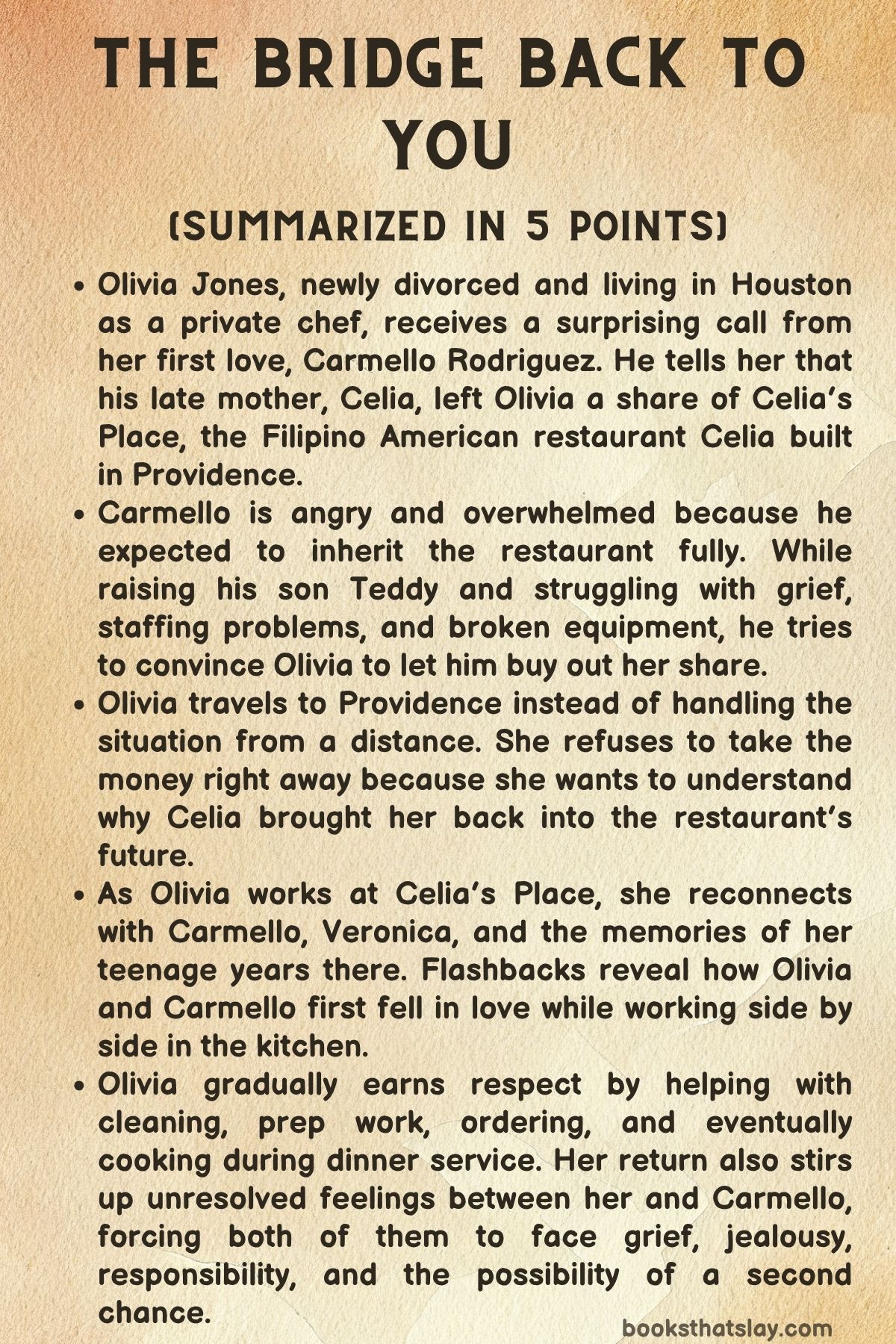
Summary
Olivia Jones is trying to mark the end of one life and the start of another. Newly divorced from Michael, she is out celebrating with her friend Denise and a group of women when her phone rings with a call she never expected.
The caller is Carmello Rodriguez, her first love, a man she has not spoken to in ten years. His voice immediately unsettles her, not only because of their long silence, but because he belongs to a part of her life she has never fully resolved.
Carmello has called with news that changes both of their lives. His mother, Celia Rodriguez, died of breast cancer six months earlier, and in her will she left Olivia a share of Celia’s Place, the restaurant she built and ran in Providence.
The news shocks Olivia. She had loved Celia and the restaurant years ago, but she never imagined she would become one of its owners.
Carmello is just as shaken, but his reaction is anger rather than surprise. He had believed the restaurant would be his alone.
Celia had made him her partner before she died, and he has been carrying the weight of the place ever since.
Carmello’s life is already full of pressure. He is raising his six-year-old son, Teddy, managing the restaurant, dealing with staff shortages, broken equipment, and his own grief.
Celia’s Place is not simply a business to him. It is his mother’s legacy, the place where he grew up, and the one thing he is determined not to lose.
Olivia’s sudden ownership feels like an intrusion, even though she did not ask for it. His father and lawyer explain that contesting the will would be expensive and uncertain, so Carmello decides the best path is to buy Olivia out.
He contacts her, hoping she will sign away her shares and leave the restaurant to him.
Olivia refuses. Her decision is not about money.
She is a successful private chef based in Houston, but her life is less settled than it appears. Her marriage ended because she and Michael wanted different things and were never truly suited for each other.
She travels for work, moves through beautiful kitchens and impressive events, and yet feels deeply alone. Her childhood was shaped by movement, with activist parents who took her from place to place.
As an adult, she has built a career but not a permanent home. Celia’s unexpected gift forces her to consider whether the restaurant might represent something she has been missing.
Olivia also knows something Carmello does not: Celia had kept in touch with her for years through email. Their connection did not end when Olivia and Carmello broke up.
Shortly before Celia died, she had asked Olivia about possible ideas for refreshing the restaurant. The conversation they planned never happened, but the memory of it stays with Olivia.
She begins to wonder whether Celia left her the shares because Celia’s Place needed help, or because Celia wanted Olivia and Carmello to face what still remained between them.
Rather than joining their scheduled Zoom meeting from Houston, Olivia flies to Providence and appears at Celia’s Place in person. Carmello is stunned when she reveals that she is sitting at the bar of “our restaurant.” Their reunion is tense from the start.
Carmello accuses her of not understanding or caring about the business, while Olivia insists that she needs time to understand why Celia wanted her there. She does not want to be bought out without first seeing the restaurant, the staff, and the life Celia left behind.
Olivia also reconnects with Veronica, Carmello’s cousin and her former best friend, who now works at Celia’s Place. That reunion brings back another layer of Olivia’s past, reminding her that she did not only lose Carmello when she left; she lost a whole place where she once belonged.
The story also looks back to Olivia and Carmello’s beginning. Fourteen years earlier, teenage Olivia repeatedly came into Celia’s Place, drawn to the restaurant and to Celia herself.
Eventually, she convinced Celia to hire her. Olivia and Carmello began working together in the kitchen, learning each other through long shifts, shared tasks, teasing, and food.
Their bond grew slowly, built through small acts of care and understanding. One important memory centers on Carmello making Dominican spaghetti for Celia.
When Olivia burned her hand and got sauce on her cheek, Carmello gently helped clean her up. The tenderness of that moment led to their first kiss.
Olivia warned him that she never knew how long she would stay in Rhode Island, but their feelings were already too strong to ignore.
In the present, Olivia tries to prove she has a place at Celia’s Place. Carmello does not make it easy.
At first, he assigns her basic, tiring tasks, hoping the daily demands of restaurant work will push her away. Instead, Olivia works hard.
She cleans, preps food, organizes orders, and helps wherever she is needed. Her effort begins to change how the staff sees her.
She is not just Carmello’s former girlfriend or a sudden co-owner. She is someone willing to show up, work, and respect the restaurant.
Olivia’s return also stirs up grief. She visits Celia’s grave and asks why Celia brought her back.
The question has no simple answer, but it reveals how deeply Olivia still values Celia’s guidance. Celia was more than Carmello’s mother to her.
She was a mentor, a steady presence, and perhaps the closest thing Olivia had found to the rooted family life she always wanted. Being back at the restaurant means facing Celia’s absence as well as her influence.
Carmello remains guarded. He is hurt by Olivia’s return, frustrated by the will, and protective of the restaurant.
Yet his anger cannot erase their history. The old attraction between him and Olivia keeps surfacing in brief looks, accidental touches, and shared memories in the kitchen.
The restaurant becomes both a battlefield and a reminder of who they once were together. Carmello wants control, while Olivia wants answers.
Neither of them can fully ignore the pull between them.
When Olivia tells Carmello that she and Celia had been emailing for years, the revelation wounds him. He feels excluded from a part of his mother’s life, especially during a period when he was trying to be everything for Celia and the restaurant.
At the same time, the emails help explain Celia’s choice. Celia trusted Olivia’s skill, judgment, and love for the restaurant.
Carmello may resent it, but he begins to understand that his mother’s decision was not random.
The practical problems at Celia’s Place continue to build. The faulty fridge, already a recurring issue, floods again.
Olivia secretly works with Paula and Steven to replace it. Carmello is irritated that she acted without him, but he is also grateful because the restaurant badly needed the help.
This moment marks a shift. Olivia is no longer only asking for a place there; she is actively contributing to the restaurant’s survival.
Carmello eventually lets Olivia cook during the dinner rush, a meaningful sign that he is beginning to trust her. For Olivia, being back in the kitchen at Celia’s Place is not just work.
It reconnects her to her younger self, to Celia, and to the relationship that shaped her. For Carmello, allowing Olivia behind the line means accepting that she may have something real to offer, even if her return complicates everything.
At the same time, Olivia learns that Carmello has been seeing a woman named Rachael. The discovery brings up jealousy she does not want to admit.
It forces her to face how much she still cares about him. Carmello’s connection with Rachael, however, appears uncertain.
He seems uneasy with Rachael’s efforts to move closer, and his emotional life is still tied to grief, fatherhood, responsibility, and Olivia’s presence. He is trying to protect himself, his son, and his mother’s legacy, but Olivia’s return makes it impossible for him to pretend the past is finished.
Through Olivia and Carmello’s strained reunion, The Bridge Back to You explores how love can remain unfinished even after years of silence. The restaurant stands at the center of the story as a place of memory, conflict, and possibility.
Celia’s final decision brings two wounded people back into each other’s lives, not with an easy answer, but with a chance to understand what was lost, what still matters, and what kind of future they might be brave enough to build.
Characters
Olivia Jones
Olivia Jones is the emotional center of The Bridge Back to You, and her character is shaped by restlessness, unresolved love, and a deep longing for belonging. At the beginning of the book, she appears independent and successful, having built a career as a private chef and survived the end of her marriage to Michael.
However, beneath that success, Olivia is lonely and unsettled. Her divorce does not simply mark the end of a relationship; it forces her to face the larger truth that she has never truly built a permanent home for herself.
Her nomadic childhood with activist parents has made her adaptable, but it has also left her uncertain about stability, commitment, and emotional roots.
Olivia’s return to Providence shows how much of her past remains unfinished. When she learns that Celia has left her a share of Celia’s Place, she does not treat the inheritance as a financial opportunity.
Instead, she sees it as a mystery, a responsibility, and possibly a final message from someone who understood her more deeply than she realized. Her refusal to sell her shares immediately reveals her stubbornness, but it also reveals her need for meaning.
Olivia wants to understand why Celia trusted her with something so precious, and that desire pushes her to confront the life and love she once left behind.
Her relationship with Carmello is central to her development because it forces her to face the consequences of leaving and the possibility of staying. Their old chemistry is still present, but Olivia is not simply returning to romance; she is returning to a place that once made her feel seen.
In the kitchen, she proves herself through work rather than words. She cleans, preps, organizes, and gradually earns respect, showing that she is not the careless outsider Carmello fears she might be.
Olivia’s growth comes from realizing that love is not only about passion or memory, but also about responsibility, patience, and choosing to remain present when things are difficult.
Carmello Rodriguez
Carmello Rodriguez is one of the most emotionally burdened characters in the book. He is grieving his mother, raising his young son, managing a struggling restaurant, and trying to protect the legacy Celia left behind.
His anger over Olivia’s inheritance is not only about ownership; it is about fear, exhaustion, and betrayal. He believed the restaurant would fully belong to him because he had worked beside his mother and had already been made her partner.
When Olivia suddenly becomes co-owner, Carmello feels as though both his grief and his labor have been dismissed.
Carmello’s character is defined by loyalty and responsibility, but those same qualities also make him guarded. He works constantly because he feels the weight of everyone depending on him.
Celia’s Place is not simply a business to him; it is his mother’s dream, his family’s history, and the center of his current life. This makes Olivia’s return deeply unsettling.
She represents both the love he lost and a disruption to the fragile control he is trying to maintain. His harshness toward her comes from pain, not cruelty.
He wants her to leave because her presence forces him to remember what he once wanted and what he still feels.
As the story develops, Carmello’s emotional walls begin to crack. Olivia’s willingness to work hard, her secret help with the fridge, and her connection with Celia all challenge his assumptions about her.
He begins to see that she is not there to take something from him, but perhaps to help save what he loves. His discomfort with Rachael also reveals that he is not emotionally free, even when he tries to move forward.
Carmello’s journey is about learning that protecting a legacy does not mean carrying it alone, and that accepting help does not weaken his love for his mother or his devotion to his son.
Celia Rodriguez
Celia Rodriguez remains a powerful presence in the story even though she has already died before the main events unfold. Her influence shapes the choices, conflicts, and emotional journeys of the characters around her.
As the founder of Celia’s Place, she represents warmth, resilience, family, and cultural pride. The restaurant is an extension of her identity, built through years of labor and love.
Her death from breast cancer leaves a painful absence, especially for Carmello, who is left trying to preserve her dream while still grieving her loss.
Celia’s decision to leave Olivia a share of the restaurant shows that she was thoughtful, perceptive, and possibly more aware of the future than the people around her understood. She had maintained an email relationship with Olivia for years, which suggests that she saw something in Olivia that remained important despite the breakup with Carmello.
Celia may have recognized Olivia’s talent, her emotional connection to the restaurant, and her need for a place to belong. Her inheritance is not presented as random; it feels intentional, almost like a final act of guidance.
Celia also functions as a bridge between past and present. In the flashbacks, she gives teenage Olivia a chance by hiring her, allowing Olivia to enter the world of the restaurant and grow close to Carmello.
In the present, her will brings Olivia back to that same place. Celia’s wisdom lies in her ability to see connections that others avoid.
She seems to understand that the restaurant needs more than survival; it needs renewal. Through her final decision, Celia continues to challenge Olivia and Carmello to confront grief, love, responsibility, and the possibility of healing.
Teddy Rodriguez
Teddy Rodriguez, Carmello’s six-year-old son, represents innocence, continuity, and the future of the Rodriguez family. Although he is not described as a major decision-maker, his presence deeply affects Carmello’s choices and emotional state.
Carmello is not only a grieving son and restaurant owner; he is also a father trying to provide stability for his child. Teddy adds tenderness to Carmello’s character because he shows what Carmello is fighting for beyond the restaurant itself.
Teddy’s role in the book also increases the emotional stakes of Carmello’s life. Every broken appliance, staffing shortage, and financial problem matters more because Carmello is responsible for a child.
Teddy reminds the reader that Carmello cannot collapse under grief, even when he is exhausted. He has to keep going because his son needs him.
This makes Carmello’s guardedness more understandable, since any disruption to his life also affects Teddy’s security.
Teddy also represents the next generation connected to Celia’s Place. The restaurant is not only a memory of Celia; it may also become part of Teddy’s inheritance, identity, and family story.
His presence suggests that the choices Olivia and Carmello make are not only about repairing the past but also about shaping the future. Through Teddy, the story shows that love and legacy are not abstract ideas; they are lived through daily care, sacrifice, and responsibility.
Veronica
Veronica is Carmello’s cousin, Olivia’s former best friend, and one of the key links between Olivia’s past and present. Her presence at the restaurant reminds Olivia of the life she once had in Providence and the relationships she left behind.
Because Veronica once knew Olivia closely, she carries emotional history that complicates Olivia’s return. She is not just another employee at Celia’s Place; she is someone who can remember who Olivia used to be.
Veronica’s role is important because she helps create a sense of community around the restaurant. While Carmello initially responds to Olivia with anger and suspicion, Veronica’s connection to Olivia suggests that the past was not entirely broken.
Her presence gives Olivia a chance to reconnect with friendship as well as romance. This matters because Olivia’s journey is not only about Carmello; it is also about finding a wider sense of home.
As a character, Veronica seems to represent loyalty, memory, and emotional continuity. She belongs to the family and the restaurant, but she also belongs to Olivia’s earlier life.
This places her in a unique position between the two central characters. Through Veronica, the story shows that returning to the past is not simple.
It involves facing old bonds, old wounds, and the people who witnessed both love and loss.
Denise
Denise appears as Olivia’s friend during the celebration of Olivia’s divorce, and her role helps establish Olivia’s emotional state at the beginning of the story. She is part of the social circle that surrounds Olivia after the end of her marriage, suggesting that Olivia is not completely alone.
However, the celebration itself also reveals a contrast between outward confidence and inner uncertainty. Olivia may be marking her divorce as a new beginning, but Carmello’s unexpected call quickly exposes how unsettled she still feels.
Denise’s presence helps show the difference between Olivia’s current life and the life she left behind. In Houston, Olivia has friends, work, and independence, but she does not seem fully rooted.
Denise belongs to the world Olivia has built after Carmello, while Carmello’s call pulls Olivia back into the emotional world she never truly resolved. This makes Denise important even if her role is smaller, because she helps frame Olivia’s life before the inheritance changes everything.
Denise also represents support during a transitional moment. Olivia is newly divorced, vulnerable, and trying to redefine herself.
Having Denise nearby shows that Olivia has people who care about her, but it also highlights the deeper loneliness Olivia must confront on her own. Denise cannot answer the questions Celia’s will raises.
She can support Olivia, but Olivia must make the journey back to Providence herself.
Michael
Michael, Olivia’s ex-husband, is important because his failed marriage with Olivia reveals what Olivia has been missing emotionally. Their divorce is not described as dramatic or cruel, but as the result of being mismatched.
This makes Michael less of a villain and more of a sign that Olivia’s life has not aligned with her deeper needs. Through him, the story shows that stability without emotional truth is not enough.
Michael’s role helps clarify Olivia’s inner conflict. She has achieved professional success and has experienced marriage, yet she still feels lonely and disconnected.
The end of her marriage forces her to question whether she has been moving through life without truly belonging anywhere. Michael represents the life Olivia tried to build away from Carmello and Providence, but that life did not give her the rootedness she secretly wanted.
As a character, Michael also serves as a contrast to Carmello. While Carmello belongs to Olivia’s past, he also represents a kind of emotional intensity and shared history that Michael apparently did not provide.
The divorce makes Olivia available for change, but more importantly, it makes her honest with herself. Michael’s place in the story is therefore meaningful because his absence opens the door for Olivia to reconsider what home, love, and commitment should actually feel like.
Rachael
Rachael is the woman Carmello has been seeing, and her role creates emotional tension in the present-day storyline. She represents Carmello’s attempt to move forward after loss and heartbreak, but his discomfort with her growing closeness shows that he is not fully ready for that future.
Rachael’s presence makes Olivia jealous, forcing Olivia to recognize that her feelings for Carmello are still strong. Without Rachael, Olivia might be able to pretend that her return is only about Celia’s will and the restaurant.
Rachael is important because she reveals Carmello’s emotional conflict. He may be trying to create a new life, but his grief, responsibilities, and unresolved love for Olivia keep him from fully opening himself to someone else.
His discomfort does not necessarily make Rachael wrong; instead, it shows that Carmello is emotionally divided. She becomes a mirror for what Carmello cannot yet admit about himself.
As a character, Rachael also complicates the possibility of reunion between Olivia and Carmello. Her presence prevents their connection from feeling too simple or automatic.
Olivia has to confront the fact that ten years have passed and Carmello has tried to live without her. Rachael reminds the reader that returning to an old love does not erase the lives people built in the meantime.
Paula
Paula is part of the restaurant world that Olivia enters when she returns to Providence. Her involvement in helping Olivia secretly replace the faulty fridge shows that she is practical, cooperative, and invested in the survival of Celia’s Place.
Even though she is not at the emotional center of the story, she helps reveal how much the restaurant depends on the effort of people beyond Carmello and Olivia.
Paula’s role is especially meaningful because she participates in one of Olivia’s first major acts of contribution. The fridge problem symbolizes the restaurant’s larger struggles: aging equipment, financial strain, and Carmello’s inability to handle every burden alone.
By working with Olivia and Steven, Paula becomes part of the quiet support system that helps the restaurant keep functioning.
Through Paula, the book shows that community is built through action. She does not need a dramatic storyline to matter.
Her willingness to help demonstrates that Celia’s Place is held together by people who care enough to solve problems, even when emotions are complicated. Paula helps Olivia prove that she is not merely a co-owner in name, but someone willing to invest in the restaurant’s future.
Steven
Steven, like Paula, contributes to the practical life of Celia’s Place. His role in helping arrange the replacement of the faulty fridge places him among the characters who support the restaurant’s survival behind the scenes.
He represents the kind of steady, useful presence that a struggling business needs. While Carmello carries the emotional weight of the restaurant, people like Steven help carry its daily realities.
Steven’s involvement also helps Olivia take meaningful action. Olivia does not simply talk about helping; she works with Paula and Steven to solve a problem that has been hurting the restaurant.
This makes Steven part of a turning point in Carmello’s attitude toward Olivia. Even though Carmello is irritated that the decision was made without him, he is also grateful, and that mixed reaction helps move the relationship forward.
As a character, Steven helps show that the restaurant is a shared ecosystem. Its survival depends on collaboration, trust, and practical problem-solving.
He may not have the same emotional history as Olivia, Carmello, or Celia, but his presence strengthens the sense that Celia’s Place is a living community rather than just a setting.
Carmello’s Father
Carmello’s father appears as a voice of practical advice during the conflict over Celia’s will. His role is important because he helps ground Carmello when Carmello is reacting from anger and grief.
By advising him that contesting the will would be difficult and expensive, he pushes Carmello toward a more realistic solution, even if that solution still involves trying to buy Olivia out.
His presence also shows that Carmello is not completely alone, even though he often feels overwhelmed. Carmello has family around him, but his grief and responsibilities make him feel as if the burden is mainly his.
Carmello’s father represents a more measured perspective, one that understands the legal and financial realities surrounding the restaurant. He does not erase Carmello’s pain, but he helps prevent Carmello from making a rash decision.
As a character, Carmello’s father adds to the family dimension of the story. Celia’s death has affected more than one person, and the question of the restaurant’s future matters to the wider family.
His guidance shows the tension between emotion and practicality, a tension Carmello must learn to manage throughout the book.
Themes
Healing Through Return
Olivia’s return to Providence becomes more than a practical visit about restaurant ownership; it becomes a confrontation with the emotional life she left unfinished. In The Bridge Back to You, her journey back to Celia’s Place forces her to face old love, unresolved grief, and her own lack of rootedness.
Although she has built a successful career, her life still carries the restlessness of her childhood and the loneliness of a marriage that never fully fit her. The restaurant becomes a physical reminder of the person she once was and the home she almost allowed herself to have.
By coming back, Olivia is not simply revisiting the past; she is being asked to understand it differently. Her presence in the kitchen, her talks with Carmello, and her visit to Celia’s grave all show that healing often begins when a person stops running from painful memories and starts asking what those memories still have to teach.
Grief and Responsibility
Carmello’s grief is shown through pressure, exhaustion, and anger rather than open sadness. Celia’s death has left him with a restaurant to manage, a son to raise, and a legacy he feels responsible for protecting.
His frustration with Olivia is not only about ownership; it is also about fear that someone who was absent might change or threaten the last living piece of his mother. The failing equipment, staff shortages, and constant demands of the business reflect the weight he carries every day.
He is grieving while trying to remain useful, strong, and in control, which makes him resistant to help even when he needs it. His reaction to Olivia’s return shows how grief can make people protective and unfair at the same time.
He wants to honor Celia, but he struggles to accept that honoring her may require trusting the choice she made before she died.
Love, Timing, and Unfinished Feelings
Olivia and Carmello’s connection is shaped by love that never completely disappeared, even after ten years apart. Their present-day tension is charged because it contains both hurt and longing.
Every disagreement about the restaurant carries the weight of their old relationship, and every quiet moment reminds them of what once existed between them. Their teenage romance began in the kitchen, where shared work, food, and closeness created a bond that felt natural but uncertain.
Olivia’s warning that she might not stay revealed the instability that later affected them, while Carmello’s guardedness in the present shows how deeply her absence wounded him. The theme of unfinished feelings is not treated as simple romance; it is tied to timing, maturity, and emotional readiness.
The question is not only whether they still love each other, but whether they have changed enough to choose each other with honesty and stability.
Home, Belonging, and Chosen Family
Celia’s Place represents a form of home that Olivia has spent much of her life avoiding or searching for without realizing it. Her childhood with activist parents taught her movement and purpose, but it did not give her a lasting place to belong.
The restaurant offers something different: routine, community, shared meals, history, and people who remember her. Her reconnection with Veronica and the staff shows that belonging is built through daily presence, work, and care rather than through ownership alone.
At first, Olivia is treated like an outsider, but her willingness to clean, prep, organize, and cook proves that she is not there merely to claim something. Celia’s decision to leave her a share suggests that family can be chosen through trust, memory, and love.
The restaurant becomes a test of whether Olivia can stop seeing home as something temporary and begin accepting it as something she is allowed to keep.