The Lie of Having It All Summary, Characters and Themes
The Lie of Having It All by Morgan Elizabeth is a contemporary romance about fame, control, second chances, and the search for a life that feels honest. The story follows Willa Stone, a successful pop star whose career is carefully managed by others, and Leo Sinclaire, a publicist trying to leave behind the pressure of celebrity image-making.
When both of them end up in the small town of Holly Ridge, old history and new feelings force them to face what they gave up years ago. The book explores whether love, ambition, friendship, and personal freedom can truly exist in the same life.
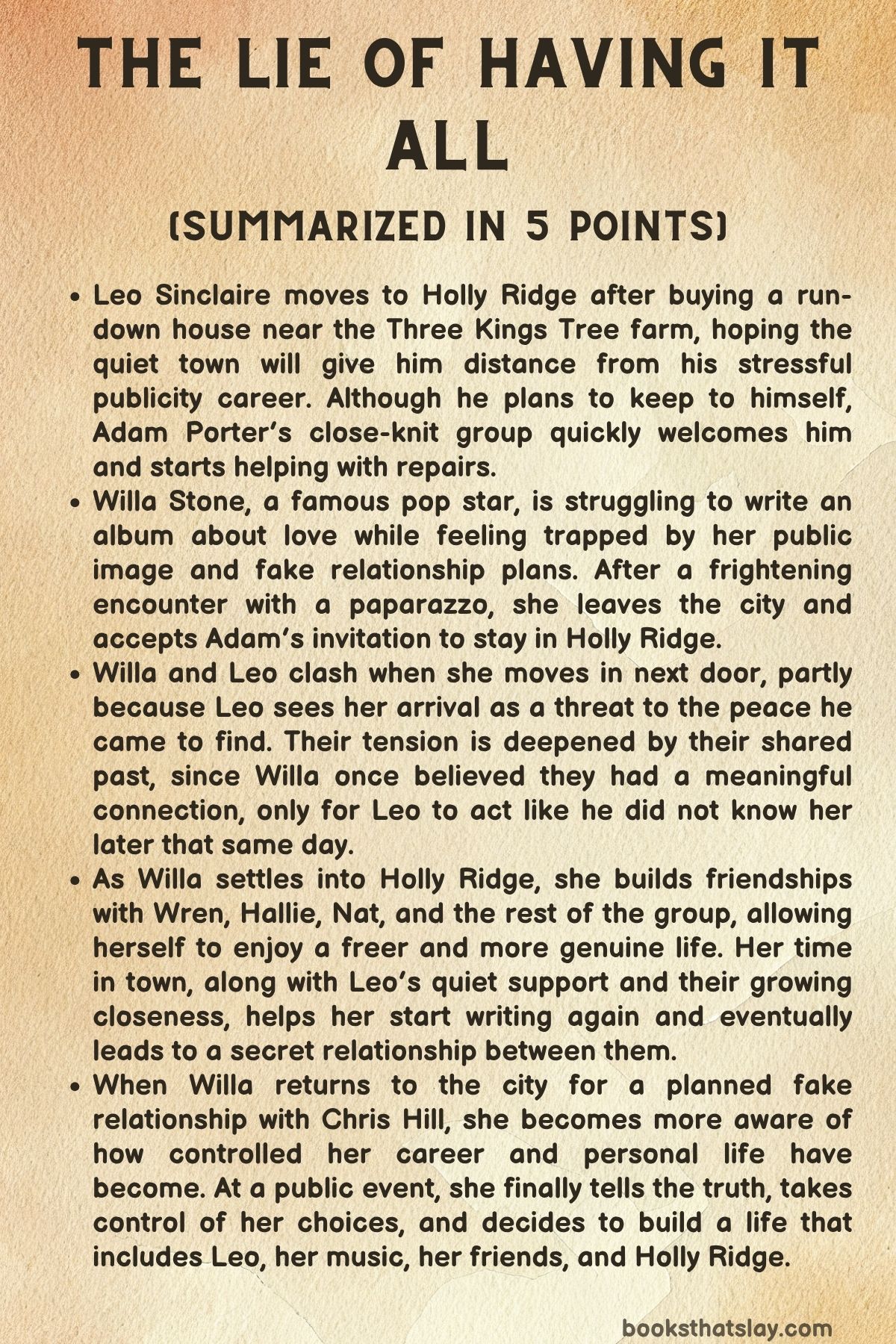
Summary
Leo Sinclaire arrives in Holly Ridge hoping for peace, distance, and a fresh start. After years of working in publicity, managing celebrity images, fixing scandals, and living under constant pressure, he buys a neglected house near the Three Kings Tree farm.
The house is in rough shape, but that suits him. He wants a project he can control and a place where nobody needs anything from him.
His plan is simple: stay quiet, work on the house, and keep to himself.
That plan does not last long. Holly Ridge is not the kind of town that lets someone disappear easily, especially when Adam Porter and his close circle get involved.
Adam, Hallie, Jesse, Madden, and Wren quickly take an interest in Leo’s new home and in Leo himself. They inspect the property, joke about its condition, point out everything that needs fixing, and arrange to help him with repairs.
Leo resists the attention at first, but the group’s warmth and humor start to break through his guarded nature. He may have come to town for solitude, but Holly Ridge keeps offering him community.
At the same time, Willa Stone is facing a different kind of pressure. She is a pop star with a successful career, but her next album is stalled.
The album is supposed to be about love, yet every song she writes feels false. Her team expects results, her public image needs constant attention, and another planned fake relationship is waiting to be rolled out for publicity.
Willa is surrounded by people, but she feels trapped by a version of herself that has been created for the public.
Adam suggests that what Willa needs is not just a new place, but a different pace of life. He invites her to Holly Ridge, thinking the town might give her space to breathe.
At first, Willa does not seem ready to accept. Her career is demanding, and her team is focused on keeping her visible and marketable.
Leo, who is still connected to her publicity world, wants her to keep a low profile before the next staged relationship begins. The pressure around her grows heavier after a paparazzo harasses her outside a coffee shop and physically grabs her.
Shaken by the incident, Willa decides she needs to leave the city. She drives to Holly Ridge on her own and takes Adam up on his offer.
Her arrival does not go smoothly. She first goes to Adam’s old house by mistake and meets Wren, who welcomes her with easy kindness.
Since Adam now lives with Wren and there are few rental options in town, Wren arranges for Willa to stay in Hallie’s old place on the Three Kings property. This puts Willa right next door to Leo, who is not pleased.
He reacts badly when he discovers she has moved in nearby, accusing her of bringing chaos into the one place where he thought he could escape it. Willa pushes back, reminding him that she is not the problem he has made her out to be.
Their argument reveals that the tension between them is not only professional.
Willa has never forgotten the first time she met Leo. Eight years earlier, before her career fully became a machine, they crossed paths in a coffee shop.
Leo spilled coffee on her, gave her his sweatshirt, and spent the morning talking with her. For Willa, the encounter felt rare and meaningful.
She believed there was a real connection between them. Later that same day, she saw him again in a professional meeting about her first fake relationship with Riggins Greene.
Leo acted as if he did not recognize her. The moment hurt her deeply, and she chose to bury the memory, focus on her career, and move forward.
Leo has carried his own regret from that day. He chose ambition, reputation, and professional distance over the possibility of something real.
In Holly Ridge, being near Willa forces him to face that choice. He tries to keep his distance, but Willa is not easy to ignore.
She is funny, stubborn, talented, wounded, and more genuine than the public version of her suggests. As the days pass, his irritation gives way to concern, then attraction, and finally something deeper.
Willa begins to change in Holly Ridge. Away from the city and her team’s constant control, she starts to experience ordinary freedom.
She forms real friendships with Wren, Hallie, and Nat. She joins in town activities, lets herself be messy and playful, and becomes part of the group’s chaos.
She even takes part in toilet-papering Leo’s house, goes out to The Mill, drinks too much, laughs more freely, and allows herself to have fun without calculating how it will look to the public. These experiences loosen something inside her.
Her writer’s block begins to fade, and she starts writing songs that feel honest again.
Leo and Willa keep being drawn together. He helps her when she needs it, watches out for her, and lets her into the renovation work on his house.
They paint, repair, talk, and share quiet moments that neither of them can easily dismiss. Working side by side gives them a way to connect without the noise of fame or career strategy.
The house becomes more than Leo’s escape; it becomes a place where both of them can imagine a different kind of life.
During a rainstorm, their attraction finally turns into honesty. Leo admits that he has regretted the choice he made years ago when he pretended not to know her.
He knows he hurt her, and he knows he let fear and ambition decide for him. Willa has spent years believing she was the only one who remembered that morning, so his confession matters.
The old wound does not disappear instantly, but it opens the door for them to stop pretending. They begin a secret relationship.
Their relationship has to stay hidden because the situation is complicated. Willa is still connected to Leo professionally, and Leo is still tied to Perfect Image, the publicity company he plans to leave.
He wants to start his own boutique firm once his contract allows it, a firm that works with more integrity and less manipulation. Until then, both he and Willa know that going public could create trouble.
For a while, they keep their happiness private. They spend the summer together in Holly Ridge, building something real while Willa writes music, joins local events, helps with the house, and learns what it feels like to belong somewhere.
But Willa’s career cannot stay away forever. She eventually has to return to the city for the fake relationship planned with actor Chris Hill.
Chris is arrogant, controlling, and unpleasant, and Willa feels the full weight of the public story being arranged around her. She is expected to smile, perform, and accept a romance that has nothing to do with her real life.
The contrast between Holly Ridge and the celebrity machine becomes impossible to ignore. In Holly Ridge, she had friends, music, laughter, and Leo.
In the city, she has contracts, handlers, cameras, and a man she does not want.
Leo supports her privately, but the strain grows. Jackie becomes suspicious of his influence over Willa and warns Willa that Leo may hurt her.
Willa is forced to examine what she wants and whom she trusts. She also has to face a larger truth: the problem is not only one fake relationship or one difficult publicity plan.
The problem is that too much of her life has been shaped by other people’s choices. Her image, her romances, her schedule, and even parts of her music have been filtered through what others believe will sell.
Willa reaches a turning point at a major public event. Instead of continuing to play the role assigned to her, she speaks up.
She reveals the truth behind the fake relationships and refuses to keep pretending that the public version of her life is real. She takes ownership of her music, her choices, and her future.
It is a risky decision, but it is also the first fully honest one she has made in a long time. By telling the truth, she breaks away from the system that has controlled her and begins to claim the life she actually wants.
Leo becomes part of that life, but not as her savior. Their relationship matters because it is built on choice, honesty, and the willingness to fight for something real.
Willa also chooses her friendships, her connection to Holly Ridge, and a career that belongs more fully to her. Leo, in turn, moves closer to the future he wants, one where his work is not built around hiding the truth or shaping false narratives.
By the end of The Lie of Having It All, Willa understands that having everything does not mean living perfectly or pleasing everyone. It means deciding what matters and being brave enough to protect it.
Love, work, friendship, freedom, and home are not handed to her neatly. She has to fight for them, risk losing comfort, and disappoint people who benefited from her silence.
With Leo beside her and Holly Ridge behind her, she is ready to build a life that is finally her own.
Characters
Willa Stone
Willa Stone is the emotional center of The Lie of Having It All. She is a famous pop star whose public life looks successful, polished, and enviable, but the story reveals how deeply controlled and exhausted she feels beneath that image.
Her writer’s block is not just a creative problem; it reflects how disconnected she has become from her own feelings. She is expected to write about love while being pushed into fake relationships and carefully managed publicity narratives, so her art begins to feel dishonest even to herself.
This makes Willa a character caught between performance and truth. She has fame, recognition, and professional success, but she lacks privacy, freedom, emotional safety, and the ability to make choices without considering how they will be packaged for the public.
Willa’s arrival in Holly Ridge marks the beginning of her emotional recovery. Away from the pressure of her team and the city, she slowly learns what it feels like to be treated as a person rather than as a brand.
Her friendships with Wren, Hallie, and Nat help her rediscover spontaneity, humor, and belonging. She joins in silly, messy, and ordinary activities, which are important because they give her the kind of normal life she has been denied.
Through these friendships, Willa becomes more grounded and less isolated. She does not immediately become fearless, but she begins to understand that she has the right to want more than professional success.
Her relationship with Leo is complicated because it is built on old hurt, present attraction, and the professional boundaries that still exist between them. Willa once believed their first meeting was meaningful, only to feel rejected when Leo acted as if he did not recognize her later.
That memory shaped the way she guarded herself around him. In Holly Ridge, however, she sees the regret and care beneath his controlled exterior.
Their growing relationship gives her emotional support, but it also forces her to confront the fact that love cannot be another secret managed by other people. By the end of the book, Willa’s most important development is her decision to claim ownership of her life.
She refuses to keep letting contracts, publicity plans, and fear define her. Her strength comes not from having everything easily, but from choosing to fight for a life that feels honest.
Leo Sinclaire
Leo Sinclaire is a guarded, burdened, and emotionally restrained character who begins the story trying to disappear into Holly Ridge. His move to the neglected house near the Three Kings Tree farm shows his desire for escape and control.
After years in publicity, he is tired of cleaning up other people’s public messes and managing carefully constructed images. The broken-down house reflects his own emotional state.
It needs work, patience, and attention, just as Leo does. He wants solitude, but the town and Adam’s found-family circle quickly challenge that desire by pulling him into a community that refuses to let him remain completely closed off.
Leo’s early reaction to Willa’s arrival reveals both his defensiveness and his unresolved feelings. He accuses her of disrupting the peace he came to Holly Ridge to find, but his anger is not only about the present situation.
It is tied to guilt, regret, and the memory of choosing his career over a real connection with her years earlier. Leo is not cruel, but he is often controlled by fear and professional responsibility.
He has learned to prioritize damage control over emotional honesty, which makes him slow to admit what he wants. His character arc depends on learning that protecting people is not the same as keeping them at a distance.
As Leo spends more time with Willa, his softer qualities become clearer. He helps her, protects her, includes her in his renovation projects, and allows her into the private space he had intended to keep for himself.
The house renovation becomes a symbol of his gradual openness. Each repaired piece of the house mirrors his willingness to rebuild parts of his life that he had neglected.
His love for Willa pushes him to reconsider the career that once defined him. By planning to leave Perfect Image and start his own boutique firm, Leo shows that he wants a life shaped by integrity rather than constant compromise.
By the end of the story, he becomes someone willing to choose love, honesty, and emotional risk over safety and professional habit.
Adam Porter
Adam Porter plays an important role as a connector between people. He is part of the found-family circle that immediately surrounds Leo, and he is also the person who encourages Willa to come to Holly Ridge.
Adam understands that Willa does not only need a new place; she needs a different rhythm of life. His suggestion that she needs a change of pace shows his emotional intelligence.
He recognizes that creativity and healing require more than distance from the city. They require a space where Willa can breathe, form real bonds, and remember who she is outside of celebrity expectations.
Adam’s presence also helps define Holly Ridge as a place of warmth and chosen family. He is not simply a background figure; he represents the kind of stable, welcoming community that both Leo and Willa need.
Through Adam, the book shows how healing often begins because someone notices what another person needs and gently opens a door for them. He does not force Willa’s transformation, but he creates the opportunity for it.
His connection to Wren and the rest of the group reinforces the importance of relationships that are not based on publicity, usefulness, or obligation, but on genuine care.
Wren
Wren is one of the warmest and most welcoming characters in the story. When Willa arrives at Adam’s old house by mistake, Wren responds with kindness instead of confusion or suspicion.
She immediately helps Willa find a place to stay, arranging for her to live in Hallie’s old place on the Three Kings property. This moment establishes Wren as someone who creates safety for others.
She has a natural ability to make people feel included, which is especially important for Willa, who is used to being watched, judged, and managed.
Wren also represents the emotional openness of Holly Ridge. Through her friendship, Willa experiences a kind of acceptance that does not depend on her fame.
Wren does not treat Willa like a celebrity project or a problem to solve. Instead, she welcomes her into everyday life and gives her room to simply exist.
Her role in the story is nurturing but not passive. She actively helps build the environment that allows Willa to rediscover joy, friendship, and personal freedom.
Wren’s kindness helps make Holly Ridge feel like a real home rather than just a temporary hiding place.
Hallie
Hallie is part of the lively found-family group that brings energy, humor, and chaos into the story. Her connection to the Three Kings property and her old place gives Willa a physical space in Holly Ridge, but her importance goes beyond that.
Hallie helps introduce Willa to the kind of friendship that is playful, unfiltered, and emotionally refreshing. She is involved in the group’s teasing, house inspections, and chaotic activities, which helps break down the tension around Leo and Willa.
Hallie’s character helps show the value of ordinary fun. For someone like Willa, whose life is usually controlled by schedules, contracts, and public appearances, Hallie’s world offers freedom.
Activities like toilet-papering Leo’s house and going to The Mill may seem lighthearted, but they are meaningful because they let Willa act without being packaged for public consumption. Hallie contributes to the story’s sense of community, showing how friendship can be both silly and healing.
Her presence reminds Willa that life does not always have to be strategic or polished to be valuable.
Jesse
Jesse appears as part of the found-family circle that quickly pulls Leo into Holly Ridge life. His role helps create the lively group dynamic that contrasts with Leo’s original desire for isolation.
Jesse’s presence during the inspection of Leo’s neglected house and the plans to help repair it shows that he belongs to a community where people step in for one another. He contributes to the sense that Holly Ridge is not a place where someone can easily remain alone, especially when others recognize that help is needed.
Although Jesse is not at the emotional center of the story, he matters because he strengthens the atmosphere of belonging around Leo and Willa. Characters like Jesse make the town feel lived-in and emotionally connected.
His involvement in group teasing and practical support helps soften Leo’s guardedness. Through Jesse, the book shows that found family is built not only through dramatic emotional moments, but also through everyday acts of showing up, helping with repairs, and refusing to let someone disappear into loneliness.
Madden
Madden is another member of Adam Porter’s found-family circle, and his role contributes to the warmth and humor surrounding Leo’s arrival in Holly Ridge. Like Jesse and Hallie, Madden helps inspect Leo’s neglected house and becomes part of the group that pushes Leo toward connection.
His presence reinforces the idea that Holly Ridge operates through community involvement. People notice one another, tease one another, and help one another, even when the person receiving help insists that they do not need it.
Madden’s importance lies in how he adds to the collective force that challenges Leo’s isolation. Leo comes to town hoping for quiet and emotional distance, but Madden and the others make that impossible in the best way.
They create a social environment where Leo is seen, included, and gently pressured to accept care. Madden may not drive the central romance, but he helps create the conditions that allow Leo to change.
His role supports one of the story’s major ideas: healing is easier when a person is surrounded by people who make loneliness difficult to maintain.
Nat
Nat becomes part of Willa’s circle of friendship in Holly Ridge and helps her experience a freer, more grounded version of herself. Alongside Wren and Hallie, Nat gives Willa access to a world that is not ruled by fame or public image.
Her friendship matters because Willa needs women around her who see her as more than a pop star. Nat contributes to the ordinary, joyful, and sometimes chaotic experiences that help Willa loosen her grip on the carefully managed version of herself.
Nat’s character supports Willa’s emotional transformation by helping create a space of belonging. In the city, Willa is surrounded by people who often view her through the lens of career strategy.
In Holly Ridge, Nat and the others offer companionship that feels genuine. This allows Willa to laugh, drink too much, participate in mischief, and slowly reconnect with her creativity.
Nat’s role shows that friendship can be just as important to a character’s growth as romance. Through her, the story emphasizes that Willa’s new life is not built only around Leo, but also around a larger community that accepts her.
Chris Hill
Chris Hill functions as a clear representation of the controlling and artificial world Willa is trying to escape. As the actor chosen for her planned fake relationship, he is arrogant, unpleasant, and controlling.
His presence shows how little freedom Willa has within the publicity machine surrounding her career. The fake relationship is supposed to serve a public narrative, but for Willa it becomes another reminder that her image is being shaped without enough regard for her comfort or dignity.
Chris is important because he intensifies Willa’s realization that she cannot continue living according to other people’s plans. Unlike Leo, whose professional control is complicated by regret and genuine care, Chris seems more concerned with power and performance.
He represents a version of fame that is hollow, transactional, and emotionally suffocating. Willa’s discomfort around him helps push her toward the public act of self-assertion that defines her later growth.
Through Chris, the book makes the cost of false narratives very clear.
Jackie
Jackie is a protective but complicated figure in Willa’s professional life. She becomes suspicious of Leo’s influence and warns Willa that he may hurt her.
On one level, Jackie’s concern may come from a place of caution. Willa’s career is vulnerable to scandal, and Leo’s history with her creates a situation that could become emotionally and professionally risky.
Jackie understands the industry’s dangers and sees how easily personal choices can be turned into public consequences.
At the same time, Jackie also represents the controlling structures that Willa must challenge. Her warnings may be protective, but they also reflect a world where Willa’s choices are constantly monitored and questioned.
Jackie’s role is important because she is not simply an enemy. She shows how control can sometimes disguise itself as care.
Willa’s growth requires her to recognize the difference between advice that protects her and influence that limits her. By standing up for herself, Willa does not just reject Chris or the fake relationship system; she also begins to push back against the professional voices that have trained her to doubt her own judgment.
Riggins Greene
Riggins Greene is significant because he is connected to Willa’s first fake relationship and to the painful memory of Leo choosing professionalism over personal recognition. Although he is not presented as a central active figure in the main Holly Ridge storyline, his role matters because he represents the beginning of Willa’s long history with manufactured romance.
The professional meeting about her fake relationship with Riggins becomes the moment when Willa realizes that the meaningful connection she thought she had with Leo may not matter in the world of publicity and career management.
Riggins therefore functions more as a symbol of Willa’s early loss of romantic innocence. His name is tied to the point where Willa chooses her career and buries her feelings.
That moment shapes the emotional distance between Willa and Leo for years. Riggins is important not because of his personal development, but because of what his role reveals about Willa’s career.
He represents the system that turns love into strategy and public attention into currency. His presence in the backstory helps explain why Willa struggles to write honestly about love later in life.
Themes
The Pressure of Public Image
The Lie of Having It All presents celebrity success as something carefully controlled, polished, and exhausting rather than purely glamorous. Willa’s career depends not only on her music but also on a public version of herself built by managers, contracts, publicity plans, and fake relationships.
Her love life becomes a marketing tool, and even her emotions are treated as material that can be shaped for public consumption. This pressure leaves her creatively blocked because she is expected to write about love while being denied the freedom to experience it honestly.
Leo’s career also reflects the same problem from the other side. He has spent years managing crises, cleaning up scandals, and helping shape false narratives, but this work drains him and pushes him away from the life he actually wants.
The theme becomes clear through both characters: image can protect a career, but it can also trap a person inside a version of life that feels artificial, lonely, and emotionally dishonest.
Choosing Authenticity Over Control
Willa’s journey is shaped by her growing refusal to let other people decide what her life should look like. At first, she accepts the systems around her because they helped build her career, but success has come at the cost of personal freedom.
Holly Ridge gives her space to notice how much of her life has been arranged for public approval rather than private happiness. Her friendships, her songwriting, and her relationship with Leo all help her reconnect with her own voice.
The more honest her life becomes, the more her creativity returns, showing that authenticity is not separate from her art but necessary to it. Leo faces a similar choice when he begins planning to leave his old firm and build something smaller and more personal.
Both characters must decide whether safety and control are worth the loss of truth. By the end, choosing authenticity means accepting risk, but it also becomes the only path toward real happiness.
Healing Through Community
Holly Ridge becomes more than a setting; it becomes the emotional space where both Willa and Leo begin to heal. Leo arrives hoping to be left alone, but the town refuses to let him disappear into isolation.
Adam, Wren, Hallie, Jesse, Madden, and Nat bring warmth, humor, and loyalty into his life before he is ready to admit he needs them. Willa also finds something in Holly Ridge that fame has not given her: friendship without performance.
The women welcome her as a person rather than a celebrity, giving her the freedom to be messy, playful, unsure, and honest. This sense of belonging changes the way she sees herself.
She is no longer only a public figure managed by others; she becomes part of a chosen community. The theme shows that healing often happens when people are surrounded by others who see them clearly, support them without conditions, and make ordinary life feel safe again.
Love as Courage and Self-Discovery
The romance between Willa and Leo is not only about attraction; it becomes a force that pushes both of them to face the choices they have avoided. Their past encounter left behind regret, misunderstanding, and missed possibility, but their reunion gives them a chance to be more honest than they were before.
Leo must confront the fact that his ambition once made him choose his career over connection, while Willa must admit that she wants a love that belongs to her rather than to a publicity plan. Their relationship develops through small acts of trust: helping with repairs, sharing quiet moments, protecting each other, and imagining a life beyond professional expectations.
Love does not magically solve their problems, but it helps them see what they are willing to fight for. Through Leo, Willa recognizes that wanting love, career, friendship, and home is not selfish.
It is a claim to a fuller life, built through courage rather than permission.