Toe to Toe Summary, Characters and Themes
Toe to Toe by Falon Ballard is a contemporary romance about ambition, desire, self-trust, and the cost of chasing a dream in a demanding world. The story follows Allegra Hart, a gifted ballet soloist who wants to rise to principal dancer, and Cord Donovan, a magnetic performer with a painful past tied to ballet.
Their relationship begins as a practical arrangement: she needs help finding sensual confidence for a career-changing audition, while he needs her expertise for a dance routine. As their lessons grow personal, both must face fear, family pressure, old wounds, and the question of whether love can survive when career and identity collide.
Summary
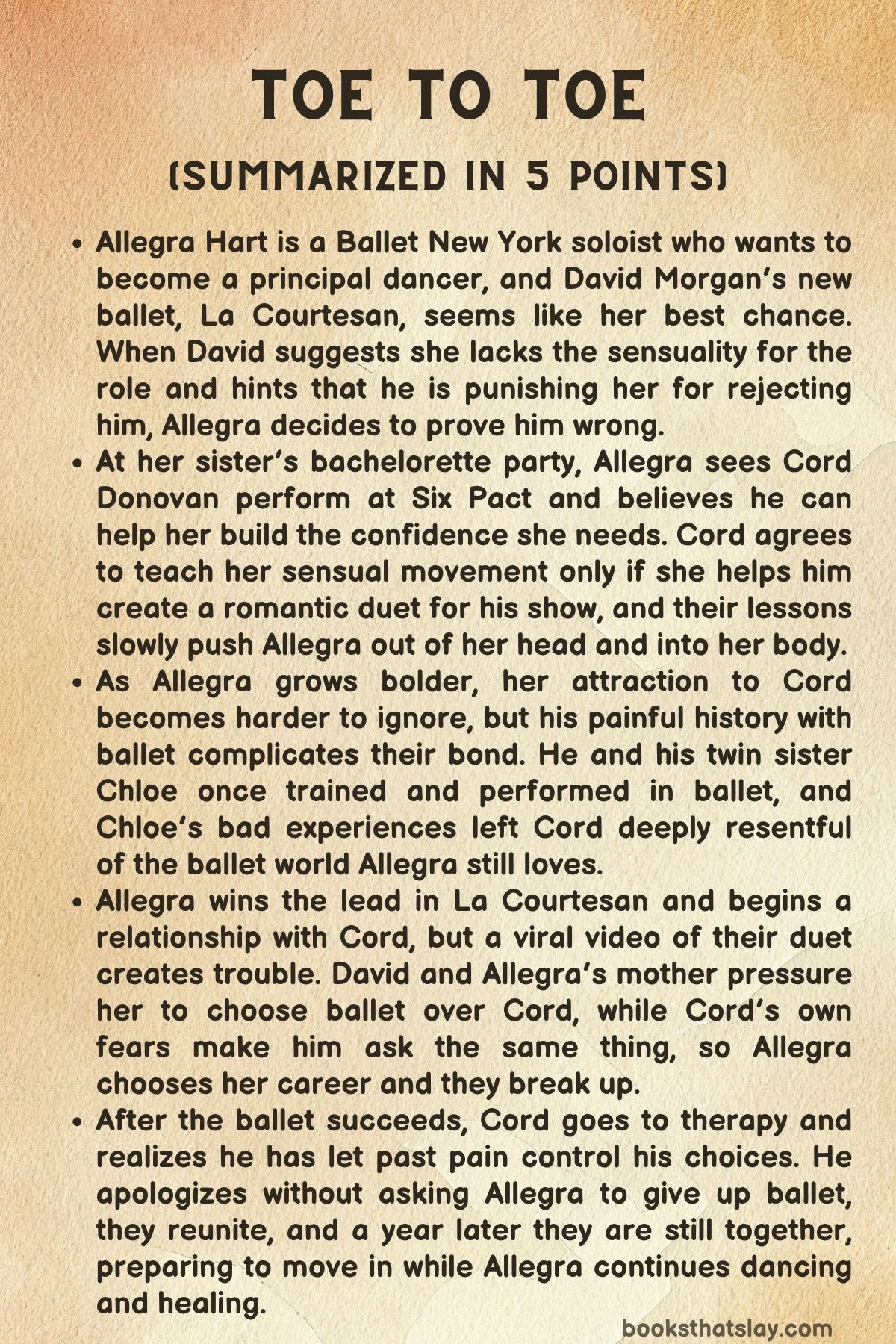
Allegra Hart has spent most of her life working toward one goal: becoming a principal dancer at Ballet New York. She is already a talented soloist, known for her precision, discipline, and control, but she knows that technical excellence alone may not be enough to move her to the next level.
When David Morgan, the company’s artistic director, announces an original ballet called La Courtesan, Allegra immediately sees the lead role as the chance she has been waiting for. If she can win the part, she may finally prove that she deserves to stand at the top of the company.
David makes it clear that the role will demand more than classical skill. The dancer who plays the lead must bring sensuality, confidence, and sex appeal to the stage.
Allegra privately tells him that she wants to audition, but instead of encouraging her, David undermines her. He suggests that she lacks the sexual energy the part requires, and his words carry a darker meaning.
He implies that she might have had better opportunities if she had accepted his past advances. Allegra realizes he is punishing her for rejecting him.
The conversation humiliates her, but it also strengthens her determination. She refuses to let David decide who she is or what she can become.
Soon after, Allegra attends her sister Bethany’s bachelorette party at Six Pact, a male dance revue. She expects the night to be silly and fun, but she is surprised by the lead dancer, Cord Donovan.
Cord performs with ease, sensuality, and total command of his body. Allegra watches him and recognizes exactly what she needs: the kind of confidence that can fill a room without apology.
She decides that Cord may be the one person who can help her prepare for the audition.
After the show, Allegra approaches Cord with an unusual proposal. She wants to hire him to teach her how to access the sensual side of her dancing.
Cord is doubtful at first. He is wary of ballerinas and of the ballet world in general, though he does not immediately explain why.
Still, he agrees to help her on one condition: Allegra must help him create and test a romantic, sensual duet for Six Pact. Since she understands partner work and choreography, she can give him the structure and refinement he needs.
Their arrangement begins as a trade, but it quickly becomes more complicated.
Their early lessons are uncomfortable for Allegra. Cord watches her dance and sees that her technique is nearly flawless, but he also sees that she is controlled by thought and fear.
She is always judging herself, always trying to be correct, and that keeps her from fully inhabiting her body. Cord gives her assignments that are meant to loosen that control.
He exposes her to lap dancing, hip movement, salsa, burlesque, pole work, and a sensual photo shoot. Each exercise pushes Allegra outside the narrow limits she has accepted for herself.
As Allegra learns, she begins to change. At first, she is self-conscious and embarrassed, but slowly she becomes more willing to take up space.
She learns that sensuality is not something David owns, defines, or grants. It is not a performance created for someone else’s approval.
It can come from comfort, confidence, pleasure, and choice. Cord helps her see that her body is not only a tool for ballet but also a source of power and expression.
The more Allegra trusts herself, the stronger her dancing becomes.
At the same time, Allegra and Cord grow increasingly attracted to each other. Their lessons often place them in intimate situations, and the line between practice and desire becomes harder to maintain.
Cord challenges Allegra, but he also respects her boundaries in a way David never has. Allegra, in turn, sees beyond Cord’s stage persona.
She notices his kindness, his loyalty, and the pain he keeps hidden. Their connection deepens through movement, honesty, and the quiet moments between rehearsals.
Cord’s relationship with ballet is more complicated than Allegra first understands. He and his twin sister Chloe were both trained as ballet dancers and had professional experience.
But Chloe suffered deeply in that world, and Cord still carries anger about what ballet took from her and from their family. His resentment makes him guarded around Allegra, especially because ballet remains central to her life.
He does not reveal everything at once, and the secrecy creates tension as their emotional bond grows.
While working with Cord, Allegra continues performing with Ballet New York. She does well in Swan Lake and begins receiving positive attention from patrons.
Her confidence grows onstage as well as in her private lessons. David remains a troubling presence, but Allegra focuses on the audition and on proving that his judgment of her was wrong.
The night before the audition, Cord gives her one final test: he asks her to give him a lap dance. What begins as an exercise becomes intensely personal.
Both Allegra and Cord are shaken by the strength of their attraction and by how much they now mean to each other.
At the audition for La Courtesan, Allegra finally lets herself perform without hiding. She brings sensuality, strength, and control together, no longer treating them as separate things.
She knows as soon as she finishes that she has done what she came to do. She has not only met the demands of the role; she has claimed them on her own terms.
Soon after, Allegra attends Bethany’s wedding, where Cord is also present. During the celebration, Allegra’s mother discovers Cord’s past connection to ballet and reacts badly.
Her reaction forces Cord to tell Allegra more about his history with Pacific Ballet, Chloe, and the reasons ballet still hurts him. Allegra is overwhelmed by the truth and by the fact that Cord kept it from her.
She needs time to understand what it means, and they part on uncertain terms.
Allegra later learns that she has won the lead role in La Courtesan. It should be the happiest moment of her career, but her joy is mixed with loneliness.
She misses Cord, and Cord misses her too. During their time apart, he begins to confront the trauma he has avoided for years.
Allegra eventually goes to Six Pact, ready to see whether they can build something real despite the difficulties between them. Cord admits that he wants to try as well.
They finally give in to their feelings and begin a relationship.
For a while, things are good. Allegra feels more alive in her dancing, and David even praises her work.
Cord and Allegra also complete the duet they have been developing for Six Pact. When they perform it, their chemistry is obvious, and a video of the routine goes viral.
The attention creates serious problems. Allegra’s mother is furious, worried about reputation and control.
David uses the situation as a weapon and pressures Allegra to choose between Ballet New York and Cord. Cord, still afraid of the damage ballet can cause, also tells Allegra he cannot be with her if ballet remains the center of her life.
Allegra is forced into an impossible position. Ballet is not only her career; it is part of who she is.
Though she loves Cord, she cannot give up everything she has worked for. She chooses her career, and they break up.
The separation hurts both of them. Allegra throws herself into La Courtesan, using the pain to fuel her performance.
Cord begins therapy and starts to understand how much his past has shaped his choices. He realizes that he has been asking Allegra to carry the weight of wounds that were not her fault.
La Courtesan opens successfully, and Allegra receives strong reviews. Professionally, she has achieved what she wanted, but she is also beginning to see the cost of the pressure around her.
By the end of the run, she confronts her mother about the control, expectations, and fear that have shaped her life. This conversation marks another step in Allegra’s growth.
She is learning to define herself not only against David’s judgment or her mother’s demands, but by her own needs and desires.
Cord decides to fight for Allegra in a healthier way. He comes to see her, apologizes, and admits that he was wrong to make her choose between him and ballet.
He tells her he wants another chance without asking her to abandon the life she has built. Allegra accepts him back, and they reunite.
Together, they attend the closing celebration, no longer pretending that love requires either of them to erase part of themselves.
One year later, Allegra and Cord are still together. Their relationship has grown stronger, and they are preparing to move in with each other.
David has resigned after misconduct allegations, and Brianna now runs the company. Allegra has begun therapy, continuing the work of understanding herself beyond perfection and performance.
She and Cord remain in love, still dancing, and still building a life where ambition, healing, and desire can exist side by side.
Characters
Allegra Hart
Allegra Hart is the central figure of Toe to Toe, and her character is built around ambition, discipline, vulnerability, and self-discovery. As a soloist at Ballet New York, she has spent much of her life shaping herself into the kind of dancer others expect her to be: technically perfect, controlled, elegant, and obedient to the demands of the ballet world.
Her dream of becoming a principal dancer drives her intensely, but that dream also makes her vulnerable to the power structures around her, especially David Morgan’s manipulation. Allegra begins the story believing that perfection and hard work should be enough to earn her the lead role, but David’s cruel implication that she lacks sensuality forces her to confront a part of herself she has long suppressed.
Her journey is not simply about learning to appear seductive onstage; it is about reconnecting with her own body, confidence, pleasure, and agency.
Allegra’s growth is especially meaningful because she does not abandon her ambition in order to become freer. Instead, she learns to redefine what ambition can look like when it is not controlled by fear, shame, or external approval.
Through Cord’s lessons, she begins to move beyond rigid technique and discovers a more emotionally honest style of performance. Her sensuality becomes less about pleasing David or proving him wrong and more about claiming ownership over herself.
This change affects not only her dancing but also her personal life, as she gradually allows herself to desire, trust, and be seen. Allegra’s romance with Cord challenges her because it asks her to balance love with career, freedom with discipline, and personal happiness with professional identity.
Allegra is also shaped by pressure from her mother, whose expectations have influenced much of her life. This makes Allegra’s eventual confrontation with her mother an important moment of emotional maturity.
She finally recognizes that success is not meaningful if it requires her to erase her own needs. Her choice to pursue ballet even after Cord initially asks her to choose between him and her career shows her strength, because she refuses to let love become another form of control.
By the end of the book, Allegra has become more than a talented dancer chasing a promotion. She is a woman learning to live fully inside her own life, to protect her dreams without sacrificing herself, and to accept love without surrendering her independence.
Cord Donovan
Cord Donovan is one of the most emotionally layered characters in the book, because his confidence as a performer hides deep pain connected to his past in ballet. Onstage at Six Pact, Cord appears sensual, charismatic, playful, and completely at ease with his body.
This makes him seem like the perfect person to teach Allegra how to unlock the confidence David claims she lacks. However, Cord’s outward ease contrasts with his unresolved resentment toward the ballet world.
His history with Pacific Ballet, and especially the harm Chloe experienced, has left him angry, protective, and distrustful of the institution Allegra still loves. This conflict makes his relationship with Allegra both passionate and complicated.
Cord’s role in Allegra’s development is significant because he teaches her that sensuality is not a costume or a performance trick. He helps her understand that confidence comes from presence, self-acceptance, and bodily awareness.
His methods, from dance exercises to the duet they create together, push Allegra to stop treating her body as only an instrument of discipline and begin experiencing it as a source of expression and desire. Yet Cord is not only a mentor figure; he is also someone who learns from Allegra.
Her dedication to ballet forces him to question whether he has judged the entire art form through the lens of his trauma. He wants to protect himself and Chloe from pain, but his fear eventually causes him to hurt Allegra by demanding that she choose between him and her career.
Cord’s most important development comes when he recognizes that his past has been controlling his present. His decision to go to therapy shows that he is willing to do the emotional work necessary to love Allegra in a healthier way.
He stops seeing ballet only as a threat and begins to understand that Allegra’s love for dance is not the same as the harmful system that wounded his family. His apology near the end matters because he no longer asks Allegra to shrink her dreams to make him feel safe.
By returning to her with humility and openness, Cord proves that his love has matured. He becomes not just Allegra’s romantic partner, but someone capable of respecting the fullness of who she is.
David Morgan
David Morgan functions as one of the main antagonistic forces in the story, representing abuse of power within the ballet world. As the artistic director of Ballet New York, he holds enormous influence over Allegra’s career, and he uses that influence in a deeply unethical way.
His comments about the lead role in La Courtesan reveal how easily artistic language can be twisted into manipulation. When he suggests that Allegra lacks the necessary sexual energy and connects that judgment to “opportunities” she previously rejected, it becomes clear that his criticism is not objective artistic feedback.
It is punishment for her refusal to accept his advances.
David’s character is disturbing because he hides coercion behind authority, taste, and professional judgment. He understands how badly dancers like Allegra want advancement, and he exploits that desire.
His treatment of her shows the emotional danger of a workplace where one person has too much control over casting, reputation, and opportunity. Even when Allegra succeeds, David remains a threatening presence because his approval is never free from the power imbalance between them.
He praises or pressures her according to what benefits him, not according to what is fair or artistically honest.
David’s attempt to force Allegra to choose between Ballet New York and Cord after the viral video further exposes his controlling nature. He treats Allegra’s personal life as something he has the right to regulate, using the institution as a weapon against her.
His eventual resignation after misconduct allegations confirms that his behavior toward Allegra is part of a larger pattern, not an isolated moment. As a character, David is important because he reveals what Allegra is truly fighting against.
She is not only trying to win a role; she is trying to succeed in a system where talent can be overshadowed by exploitation, sexism, and abuse of authority.
Bethany Hart
Bethany Hart, Allegra’s sister, plays a smaller but meaningful role in the novel. Her bachelorette party is the event that brings Allegra to Six Pact, where Allegra first sees Cord perform.
In that sense, Bethany indirectly becomes the reason Allegra’s transformation begins. Although Bethany is not at the center of the romantic or professional conflict, her presence helps show that Allegra has a life outside ballet, even if that life has often been pushed to the margins by ambition and pressure.
The wedding also becomes a turning point because it brings Cord into Allegra’s family world and leads to the revelation of his connection to ballet.
Bethany’s character also helps highlight the contrast between different forms of femininity, celebration, and personal freedom. Her bachelorette party exists in a space of pleasure, fun, and release, which is very different from the controlled environment Allegra is used to in ballet.
Allegra enters that setting feeling humiliated and uncertain, but what she sees there changes her understanding of performance. Through Bethany’s celebration, the story places Allegra in an environment where sensuality is not treated as shameful or dangerous, but as expressive and powerful.
Bethany also represents family connection, even though the story’s deeper family tension centers more strongly on Allegra and her mother. Her wedding gathers important characters together and creates the emotional conditions for hidden truths to surface.
While Bethany does not drive the central conflict directly, she helps move the story into spaces where Allegra must face both desire and family pressure. Her role supports the larger development of the book by showing how major personal change often begins through ordinary family events and social gatherings.
Chloe Donovan
Chloe Donovan is one of the most important secondary characters because her past explains much of Cord’s anger toward ballet. As Cord’s twin sister, she shares his early connection to dance, and her painful experience in the ballet world becomes a wound that affects both of them.
Even when Chloe is not always at the center of the action, her history shapes Cord’s worldview. His protectiveness, resentment, and fear of Allegra being harmed by ballet are all tied to what Chloe endured.
Through Chloe, the story shows that the damage caused by toxic institutions does not affect only the person directly harmed; it can also reshape the lives and choices of the people who love them.
Chloe’s presence in the pole class is also meaningful because it shows another relationship to movement and the body. Like Cord, she exists outside the formal ballet world by the time Allegra meets her, but she still understands dance, strength, and performance.
Her role helps broaden Allegra’s understanding of what dance can be. Ballet has taught Allegra discipline and beauty, but Chloe and Cord’s world teaches her confidence, playfulness, sensuality, and physical freedom.
Chloe therefore becomes part of Allegra’s education, even if Cord is the main teacher.
Chloe also represents survival after artistic harm. Her experiences suggest the darker side of ballet culture: pressure, judgment, and emotional damage hidden beneath beauty and prestige.
Because of this, she is not only Cord’s backstory but also a reminder of what is at stake for Allegra. Allegra loves ballet, but Chloe’s history makes it impossible to romanticize the institution completely.
Through Chloe, the story asks whether someone can continue loving an art form while acknowledging the harm caused by the systems around it.
Allegra’s Mother
Allegra’s mother is a major influence on Allegra’s emotional life because she represents pressure, control, and inherited expectations. Her reaction to Cord’s past connection to ballet shows that she is deeply invested in reputation, status, and the boundaries of the ballet world.
She does not simply respond as a concerned parent; she responds as someone who believes Allegra’s life and career should follow a carefully controlled path. This helps explain why Allegra has grown into someone so disciplined and self-contained.
Her mother’s expectations have taught her to value success, but they have also made it harder for her to listen to her own desires.
Her anger over the viral duet further reveals her controlling nature. Rather than seeing Allegra’s performance as an expression of artistry, growth, or joy, she sees it as a threat to Allegra’s professional image.
This reaction mirrors the larger judgment Allegra faces from Ballet New York and from David. Allegra’s mother may not be malicious in the same way David is, but she still contributes to the pressure that keeps Allegra trapped.
She wants Allegra to succeed, but her version of success leaves little room for messiness, sensuality, romance, or personal freedom.
The confrontation between Allegra and her mother near the end is crucial because it allows Allegra to name the emotional cost of being shaped by someone else’s expectations. Allegra does not reject her career, but she does reject the idea that her mother gets to define what her career should mean.
This makes her mother an important character in Allegra’s journey toward independence. She embodies the family pressure Allegra must outgrow in order to become not only a better dancer, but a more self-possessed person.
Brianna
Brianna’s role becomes especially important near the end of Toe to Toe, when she takes over the company after David’s resignation. Although she is not as central as Allegra or Cord, her presence signals the possibility of change within Ballet New York.
David’s leadership represents exploitation, manipulation, and fear, while Brianna’s new position suggests that the company may move toward a healthier future. Her rise matters because it shows that institutions are not fixed forever; they can be reshaped when harmful figures are removed and different people are allowed to lead.
Brianna also serves as a contrast to David. Where David uses his authority to control and punish, Brianna’s leadership represents a chance for stability and renewal.
Her presence at the end helps create a more hopeful professional future for Allegra. Allegra does not have to give up ballet in order to escape David’s influence, because the company itself begins to change.
This is important to the story’s emotional resolution: Allegra can keep the art form she loves while also beginning to separate it from the abusive power structures that once threatened her.
As a character, Brianna represents institutional recovery. She is not simply a replacement director; she is a sign that accountability has consequences and that the world Allegra works in may become less toxic.
Her role supports the book’s larger message that healing can happen on both personal and professional levels. Allegra and Cord work through their individual wounds, while Ballet New York begins the process of moving beyond David’s misconduct.
Brianna’s leadership therefore adds quiet but important hope to the ending.
Themes
Ambition, Discipline, and the Cost of Perfection
Allegra’s pursuit of becoming a principal dancer in Toe to Toe is shaped by years of discipline, sacrifice, and emotional pressure. Her talent is never in doubt, but her ambition has been trained into a narrow form: perfect technique, obedience, control, and constant self-denial.
Ballet has taught her that success comes from pushing harder, asking for less, and accepting criticism without showing weakness. This makes her strong, but it also limits her.
Her desire for the lead role is not only about career advancement; it is about proving that she deserves space, recognition, and artistic authority. The story shows how ambition can become painful when it is tied to approval from powerful people, especially figures like David and her mother.
Allegra’s growth comes when she learns that excellence does not require emotional suppression. Her best performance happens when she allows confidence, desire, anger, and self-trust to enter her dancing.
The theme presents ambition as valuable, but incomplete without personal freedom.
Power, Exploitation, and Misconduct in Professional Spaces
David’s treatment of Allegra exposes how easily professional authority can be abused when ambition, hierarchy, and silence protect the powerful. He does not simply reject her artistically; he uses his position to punish her for refusing him.
His comments about her sensuality are not honest artistic feedback but a way to shame her, control her, and remind her that her career depends on his approval. This theme is important because the story does not present misconduct as one isolated incident.
Instead, it shows how institutions can create conditions where inappropriate behavior is hidden behind artistic standards, private meetings, and vague judgments about talent. Allegra’s fear is realistic because speaking up could threaten everything she has worked for.
The later allegations against David confirm that his behavior is part of a wider pattern. Through this, the narrative criticizes workplaces where reputation matters more than safety.
It also shows that real change requires more than individual bravery; it requires institutional accountability and leadership willing to protect dancers instead of protecting abusers.
Reclaiming the Body and Redefining Sensuality
Allegra’s journey with Cord changes her understanding of her own body. At the beginning, her body is treated mainly as an instrument of discipline.
It must be controlled, corrected, evaluated, and made useful for ballet. David’s comments make sensuality feel like something humiliating, something she lacks and must perform for approval.
Cord’s lessons help her separate sensuality from shame. Through dance styles outside ballet, movement classes, performance, and the photo shoot, Allegra begins to experience her body as expressive rather than merely technical.
This does not mean she becomes confident overnight. Her progress is gradual because she has spent years thinking that perfection matters more than pleasure or instinct.
Cord teaches her that sensuality is not about pleasing someone else’s gaze; it comes from comfort, self-knowledge, and trust. This theme is powerful because Allegra does not abandon ballet to find confidence.
Instead, she brings this new awareness back into her art. Her strongest dancing emerges when technique and emotional freedom finally work together.
Love, Trauma, and the Refusal to Choose One Identity
The relationship between Allegra and Cord is tested because both carry wounds connected to ballet. Allegra sees ballet as her life’s work, while Cord connects it to pain, damage, and what happened to Chloe.
Their conflict is not only romantic; it is about whether love can survive when two people attach opposite meanings to the same world. Cord’s demand that Allegra choose between him and her career comes from fear rather than cruelty, but it still repeats the control he wants to escape.
Allegra’s decision to choose her career is painful, yet necessary, because love that requires self-erasure cannot be healthy. Cord’s therapy matters because it allows him to understand that protecting himself should not mean limiting Allegra.
Their reunion feels earned because it is based on accountability rather than fantasy. Allegra also confronts her mother, which shows that choosing love does not mean giving up independence.
The ending suggests that a healthy relationship allows both partners to keep their identities, ambitions, and healing processes intact.