Turn Off the Light Summary, Characters and Themes
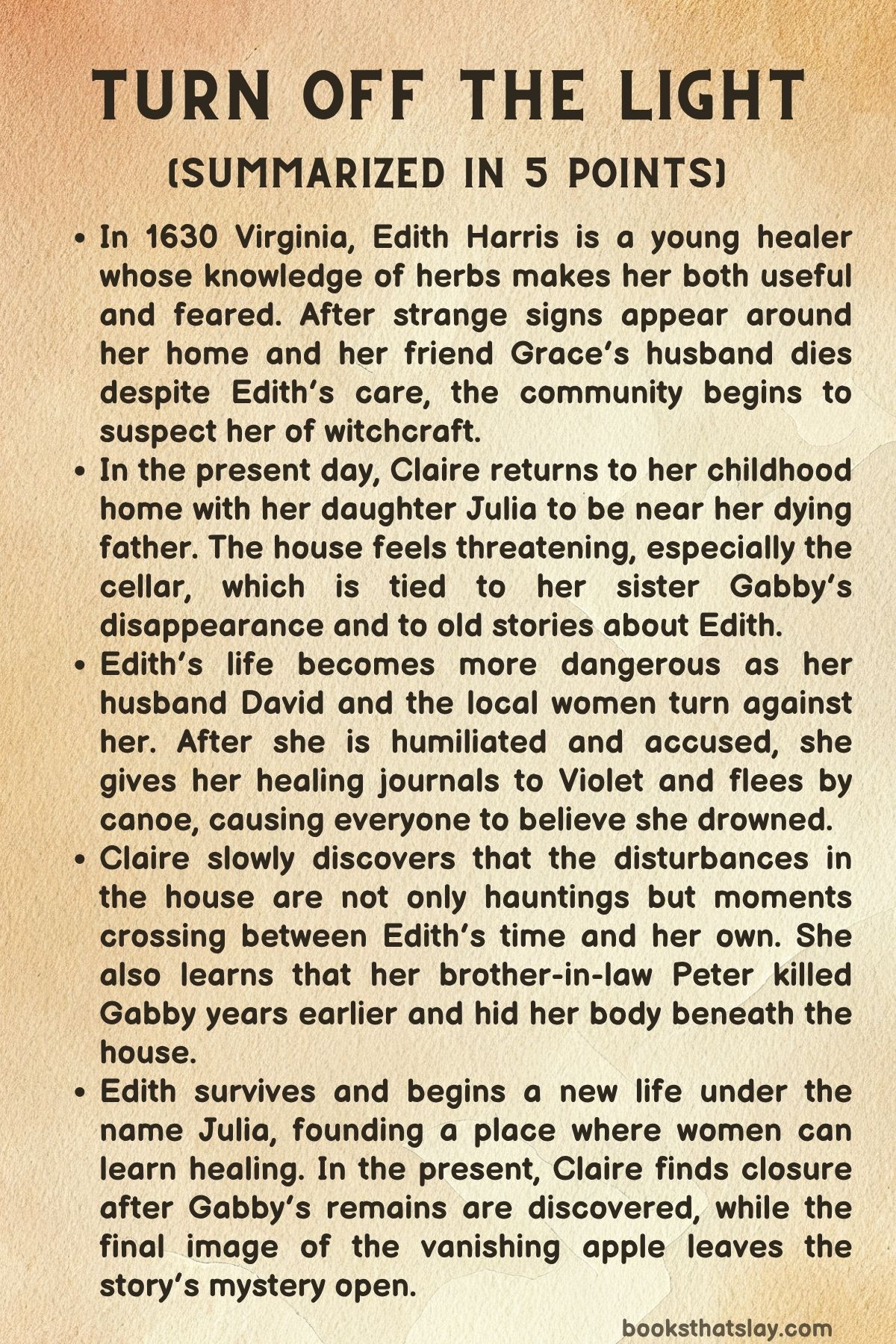
Turn Off the Light by Jacquie Walters is a dual-timeline supernatural mystery about fear, family secrets, and the way the past can press against the present. Set between seventeenth-century Virginia and a modern coastal town, the book follows Edith Harris, a healer accused of witchcraft, and Claire, a woman returning to her childhood home with her young daughter.
As strange events connect their lives across centuries, both women face danger from people who should have protected them. The story blends historical suspicion, domestic threat, and ghostly disturbances into a tense tale about survival, truth, and women finding strength in the face of violence.
Summary
Turn Off the Light opens in 1630 on Virginia’s Eastern Shore, where Edith Harris lives as a young healer. She knows the uses of plants, roots, and remedies, and her skill makes her valuable to neighbors in need.
Yet it also makes her vulnerable in a world where knowledge can easily be mistaken for evil. One day, Edith finds a strange apple near her hearth.
Its presence feels unnatural, and she takes it as a warning. Soon afterward, her friend Grace comes to her in panic.
Grace’s husband, Jacob, has fallen ill again with the summer sickness, and she begs Edith to help him.
Edith goes to Jacob and treats him with herbs, but she understands that his condition is grave. She can ease his suffering, but she may not be able to save him.
While she struggles with the limits of her healing, tension rises in her own home. Her husband, David, grows increasingly suspicious of her work.
Edith has not become pregnant, and her failure to bear a child adds to his bitterness. What was once a marriage now feels unsafe, watched, and judged.
Around this time, Edith begins experiencing events she cannot explain. Shutters open without being touched.
Whispers seem to come from the cellar. Blood appears where it should not be.
A knife is found out of place. Bruises and rashes appear on her body, and unseen voices speak her name.
Edith does not know whether she is being haunted, cursed, punished, or tested. Her fear is made worse by the way others look at her.
In a frightened settlement, a healer can quickly become a target.
When Jacob dies, the community’s grief turns into suspicion. People who once came to Edith for help now wonder whether her knowledge of herbs hides something darker.
Their fear finds a shape in the idea of witchcraft. Edith is not only mourning the death of a man she could not save; she is also watching her neighbors decide that she may be responsible for it.
The novel then moves to the present day, where Claire returns to her childhood home in Cape Chase with her four-year-old daughter, Julia. Claire has come because her father is dying from dementia.
Her sister Tilly and Tilly’s husband, Peter, have been caring for him, but the house is filled with unease. Claire has difficult memories of the place, especially of the cellar.
Years earlier, her older sister Gabby claimed to have seen a ghost there before she vanished. Gabby’s disappearance has haunted the family ever since, leaving pain, confusion, and unanswered questions behind.
Claire’s father behaves in disturbing ways. His illness makes him unpredictable, but some of his actions seem connected to something deeper.
He tries to cut his own hand with kitchen shears, warns about “the Devil,” and tells them not to drink tea. His words sound confused, yet Claire cannot dismiss them.
Strange things begin happening around Julia too. The child draws a symbol from the cellar even though she insists she has not gone down there.
Claire begins to believe the house may be haunted and that the presence in it could be tied to Edith Harris, a woman from the house’s history who was said to have drowned after being accused of witchcraft.
Back in Edith’s time, her isolation grows. She secretly teaches a neighbor girl named Violet about medicinal herbs, passing on the knowledge that has shaped her life.
Violet becomes important to Edith because she represents trust, youth, and the chance that healing knowledge might survive. But David’s suspicion becomes more dangerous, and the town’s fear sharpens after Jacob’s death.
A group of local women eventually comes to Edith’s house. They lock her inside, search her body for signs of witchcraft, and humiliate her.
Their cruelty is fueled by fear and by the need to blame someone for illness and death. During this attack, a violent disturbance shakes the house, almost like an earthquake.
Then a severed fingertip appears, though it belongs to none of the women present. The sight terrifies them.
To them, it proves Edith has summoned evil. To Edith, it is just as horrifying, because she does not understand it either.
Terrified that she has somehow opened a path to the Devil, Edith burns her herbs and sets fire to the cellar. She wants to destroy anything that might be tied to the darkness around her.
Still, she does not stop trying to do good. When Elizabeth, the minister’s wife, faces a dangerous childbirth, Edith goes to help her.
She hopes that saving Elizabeth will prove she is not wicked. But Edith’s enemies are already moving against her.
Violet overhears that David and others may be planning to kill Edith. Knowing she has little time, Edith gives Violet her journals of remedies so the healing knowledge will not die with her.
Then she flees by canoe. A sudden storm overturns the boat, and everyone believes Edith has drowned.
In the present, Claire’s investigation deepens. She reconnects with Ethan, an old love, and begins looking more closely into Edith’s story.
As she gathers information, she starts to understand that the disturbances in the house are not only the work of a ghost. Instead, moments from Edith’s life and Claire’s life appear to be touching each other across time.
Objects, warnings, fire, symbols, and fear pass between the two worlds in ways neither woman fully controls.
The danger in Claire’s own family becomes clearer when Tilly’s hand is badly injured in the garbage disposal after Peter flips the wrong switch. While Tilly is in the hospital, Peter’s true nature begins to show.
Claire realizes that the threat in the house is not only supernatural. Peter is violent and dangerous, and he has been hiding the truth for years.
He reveals enough for Claire to understand what really happened to Gabby. Gabby did not run away.
Peter killed her and hid her body in the crawl space near the cellar.
This discovery transforms Claire’s fear into a desperate fight for survival. Peter attacks her, and Claire must protect herself and Julia.
At that critical moment, the fire Edith set centuries earlier breaks through time. The force of that old act enters Claire’s present and creates the distraction she needs.
Claire and Julia escape, and the truth about Gabby finally comes into the open. The police later find Gabby’s remains beneath the house, and Peter is arrested.
Claire and Tilly are able to tell their dying father that Gabby has been found. This gives the family a measure of peace after years of uncertainty.
Before he dies, their father gives them his old three-squeeze sign of love, a small gesture that carries years of family meaning. His death comes after the truth has been restored, allowing the sisters to face their grief with answers instead of only questions.
Edith’s story also receives a different ending than the legend suggested. She does not drown in the storm.
She survives and finds her way to Reeve, who helps her begin again under a new name. In the present, Ethan discovers that Edith changed her name to Julia.
She went on to found a healing place called Apple Hollow and trained other women, turning the knowledge that nearly got her killed into a legacy of care and strength.
Claire realizes that her daughter Julia somehow helped save Edith by sending a message across time. The connection between the two Julias links past and present, showing that history is not as fixed as it first seemed.
Edith was not only a victim of fear and accusation; she became a survivor whose work continued through generations.
At the end of Turn Off the Light, Claire drops a bag of apples and notices that one seems to vanish. The moment recalls the mysterious apple Edith found at the beginning and leaves the story with a quiet sense of wonder.
The mystery is not fully closed, but the main truths have been brought into the light: Gabby has been found, Peter has been exposed, Edith survived, and the women connected by the house have helped one another across time.
Characters
Edith Harris
Edith Harris is the emotional and historical center of the book. In Turn Off the Light, she is presented as a young healer whose knowledge of herbs makes her useful to others but also dangerously vulnerable in a fearful society.
Edith is compassionate, skilled, and deeply committed to helping the sick, yet her goodness is constantly misunderstood by those around her. Her work as a healer places her in a difficult position because the same abilities that allow her to treat illness also make her neighbors suspect her of witchcraft.
Her inability to become pregnant adds another layer to her suffering, especially because David uses it as a reason to doubt and judge her. Edith’s fear grows as strange events begin happening around her, and one of the most tragic parts of her character is that she begins to question herself even when she has done nothing evil.
She is not simply a victim, however. Her decision to protect her journals, help Elizabeth, warn Violet, and finally flee shows courage, intelligence, and a strong will to survive.
By the end of the story, Edith becomes a symbol of female knowledge that refuses to be destroyed, even when society tries to silence it.
Claire
Claire is the main figure in the present-day storyline, and her character is shaped by memory, grief, fear, and the need to uncover the truth. She returns to her childhood home because of her father’s illness, but the house also forces her to return emotionally to the trauma of Gabby’s disappearance.
Claire is protective of Julia and deeply unsettled by the old house, especially the cellar, because it carries the weight of secrets she never fully understood as a child. Her fear does not make her weak; instead, it makes her cautious and observant.
As the supernatural disturbances become stronger, Claire gradually moves from confusion to investigation. She begins to connect Edith’s past with her own present, and this makes her one of the characters most responsible for understanding the book’s deeper mystery.
Claire’s strength lies in her persistence. She faces family pain, her father’s decline, the horror of Gabby’s fate, and Peter’s violence, yet she continues fighting to protect her daughter and reveal the truth.
Her journey is about reclaiming a story that was hidden from her and finally giving Gabby the justice she was denied.
Julia
Julia is a small child, but she plays a very important role in the story’s supernatural and emotional structure. Because she is only four years old, she is more open to the mysterious forces inside the house than the adults around her.
Her drawing of the cellar symbol suggests that she is connected to something beyond ordinary explanation, even when she insists she has not gone downstairs. Julia represents innocence, but she is not merely a passive child who needs protection.
Her connection across time helps Edith survive, which makes her surprisingly powerful within the story. She also strengthens Claire’s character because Claire’s love for Julia gives her a clear reason to keep fighting, even when the house becomes terrifying.
The discovery that Edith later takes the name Julia gives the child’s role even greater meaning. Julia becomes part of a larger pattern of survival, healing, and female connection across generations.
Tilly
Tilly is Claire’s sister, and her character shows the burden of staying behind. While Claire returns to the childhood home after being away, Tilly has been living closer to the family’s pain by helping care for their father.
This makes her practical and emotionally tired, but it also means she has been trapped near the same house and the same unresolved grief for years. Tilly’s relationship with Claire carries tension because they have experienced their family trauma differently.
Her injury in the garbage disposal is one of the story’s most disturbing present-day events, and it also exposes how unsafe her life has become around Peter. Tilly is important because she is both a survivor of family loss and a victim of hidden danger within her own marriage.
By the end, when she and Claire are able to tell their father that Gabby has been found, Tilly becomes part of the painful but necessary movement toward truth and closure.
Peter
Peter is one of the most sinister characters in the book because his danger is hidden beneath the appearance of normal family life. At first, he seems connected to the household through his marriage to Tilly and his role in helping care for Claire’s father.
However, as the story unfolds, he is revealed as a violent and deceptive man who has been hiding the truth about Gabby for years. Peter’s evil is especially disturbing because it is not supernatural.
While the house contains mysterious forces, Peter represents human cruelty, secrecy, and predatory control. His role changes the meaning of the haunting because the terror in the house is not only connected to the past but also to a real crime buried in the present.
His attack on Claire confirms that he is willing to harm others to protect himself. Peter’s arrest brings justice, but his character leaves a lasting sense of betrayal because he has lived close to the family while concealing the damage he caused.
Gabby
Gabby is physically absent for most of the story, yet her presence shapes the entire present-day plot. Her childhood claim that she saw a ghost in the cellar becomes an important part of the house’s mystery, and her disappearance leaves a wound in the family that never heals.
For years, Gabby is believed to have run away, but the truth is far more tragic: she was killed and hidden beneath the house. This revelation changes her from a missing sister into a victim of violence whose story was buried along with her body.
Gabby represents the way truth can be suppressed but not erased. Her absence affects Claire, Tilly, and their father, and the discovery of her remains finally allows the family to stop living inside uncertainty.
Gabby’s character is tragic because she never gets to speak for herself in the present, but the uncovering of her fate restores her place in the family’s story.
David
David, Edith’s husband, is a deeply troubling character because he reflects the suspicion and control that surround Edith in her time. Instead of protecting her, he becomes one of the people who makes her life more dangerous.
His doubts about her healing work and his reaction to her inability to become pregnant reveal how little emotional safety Edith has in her own home. David’s suspicion grows as strange events occur, and rather than trusting Edith’s character, he begins to see her through the same fearful lens as the wider community.
He represents patriarchal judgment, religious fear, and the danger of a husband who holds power over a woman but lacks compassion for her. His role is important because Edith’s persecution is not only public; it is also intimate and domestic.
Through David, the book shows how fear can turn love or duty into accusation and betrayal.
Grace
Grace is Edith’s friend, and her role begins with desperation. She comes to Edith seeking help for Jacob because she trusts Edith’s healing knowledge, at least when that knowledge might save someone she loves.
Grace represents the complicated position of women in Edith’s community. On one hand, she depends on Edith’s skills; on the other hand, she lives in a society where fear can quickly overpower loyalty.
Her request for help places Edith in danger because Jacob’s illness and death increase suspicion around Edith’s work. Grace is not shown as a villain in the same way as Peter or as controlling as David, but her presence reveals how easily need can turn into fear.
She helps establish the unfairness of Edith’s world, where a healer may be welcomed in moments of crisis but blamed when death cannot be prevented.
Jacob
Jacob is Grace’s husband, and although he is not one of the most active characters, his illness is a major force in Edith’s storyline. His return of “summer sickness” brings Edith into a situation where her healing abilities are tested against a disease she likely cannot defeat.
Jacob’s decline and death become a turning point because they intensify the community’s suspicion of Edith. He is important less for his personal choices and more for what his illness reveals about the world around him.
In a rational society, his death might be understood as the result of sickness. In Edith’s fearful community, it becomes a reason to suspect witchcraft.
Jacob’s character therefore helps show how grief and ignorance can become dangerous when people need someone to blame.
Violet
Violet is one of the most hopeful characters in the historical storyline. As a neighbor girl secretly learning about medicinal herbs from Edith, she represents the possibility that women’s knowledge can survive even when it is threatened.
Violet is curious, brave, and loyal enough to listen, learn, and later warn Edith about the danger she faces. Her connection with Edith is important because it shows Edith not only as a healer but also as a teacher.
By giving Violet her journals, Edith passes on more than remedies; she passes on a tradition of female wisdom and independence. Violet’s role becomes especially meaningful because the community tries to destroy Edith’s knowledge through fear, humiliation, and violence.
Through Violet, that knowledge has a chance to continue.
Elizabeth
Elizabeth, the minister’s wife, is important because her dangerous childbirth gives Edith a chance to prove her goodness in a society that has already judged her. Edith’s decision to help Elizabeth shows that she remains compassionate even after being humiliated and accused.
Elizabeth’s position as the minister’s wife also matters because she belongs to the religious center of the community, the very world that helps create suspicion around Edith. Her suffering during childbirth places life, death, faith, and female vulnerability in the same moment.
Edith’s attempt to save her is not just a medical act; it is also a moral act. Elizabeth helps reveal Edith’s true nature because Edith chooses to help even when helping may not save her reputation.
Reeve
Reeve is a quiet but significant figure because he offers Edith the possibility of life beyond persecution. After Edith survives the storm, Reeve helps her begin again under a new name.
His role contrasts sharply with David’s. Where David doubts and endangers Edith, Reeve becomes associated with refuge and renewal.
He does not erase Edith’s suffering, but he helps make survival possible. Reeve’s importance lies in what he represents: a path away from fear, accusation, and confinement.
Through him, Edith is able to transform from a hunted woman into someone who can build a future. His support helps make the ending of Turn Off the Light less tragic and more hopeful.
Ethan
Ethan is Claire’s old love and an important source of support in the present-day storyline. His reconnection with Claire brings warmth into a plot filled with grief, fear, and danger.
Ethan is also useful because he helps investigate Edith’s history, which allows the past and present storylines to come together more clearly. He is not simply a romantic figure; he helps Claire uncover the truth and understand that Edith’s story did not end in drowning.
His discovery that Edith survived, changed her name, and founded Apple Hollow gives the ending a sense of healing and continuity. Ethan’s character provides emotional balance, showing that Claire’s return home is not only about facing trauma but also about rediscovering trust, connection, and possibility.
Themes
Fear and Suspicion
Fear controls the behavior of both the past and present timelines in Turn Off the Light. Edith’s community does not understand her healing knowledge, so her use of herbs becomes a reason to distrust her.
Ordinary events are quickly treated as signs of evil because the people around her already believe she is different. Their fear turns into cruelty when they search her body, lock her in her own home, and convince themselves that she must be connected to witchcraft.
In Claire’s time, fear works in a more personal and psychological way. The old house carries years of silence, grief, and unanswered questions, making Claire doubt what is real and what is imagined.
Her father’s warnings, Julia’s strange drawings, and the disturbing events in the cellar all increase the sense that danger has never truly left the house. The novel shows how fear becomes most destructive when people use it to explain what they do not understand.
Women’s Knowledge and Power
Edith’s healing skills represent a form of female knowledge that is useful, practical, and life-saving, yet it is treated as dangerous because it exists outside male control. She understands plants, illness, childbirth, and remedies, but instead of being respected, she is watched with suspicion.
Her knowledge gives her power in a society that expects women to remain obedient, quiet, and dependent. This makes David and the wider community uneasy.
Edith’s decision to teach Violet is important because it turns private knowledge into inheritance. Even when Edith is threatened, humiliated, and forced to flee, her skills do not disappear.
They continue through her journals, through Violet, and later through the healing place connected to her new life. The theme suggests that women’s wisdom may be suppressed, but it can survive through teaching, memory, and courage.
Edith’s power is not shown through violence or authority, but through care, survival, and the refusal to let knowledge die.
The Burden of Hidden Truths
The house is filled with secrets that harm the people living inside it. In the present, Claire returns to a family that has never fully recovered from Gabby’s disappearance.
Everyone has lived under the weight of uncertainty, and that silence has shaped Claire’s fear, Tilly’s pain, and their father’s decline. Peter’s crime remains hidden for years, but the truth continues to press against the surface through the cellar, the strange disturbances, and the family’s unresolved grief.
In the past, Edith also suffers because truth is twisted by rumor. Her healing work is misread as witchcraft, and the truth of her goodness is buried beneath panic and accusation.
The novel shows that secrets do not remain still. They damage families, distort memory, and allow dangerous people to keep control.
When Gabby’s body is finally found and Peter is exposed, the truth brings pain, but it also allows healing to begin.
Survival and Renewal
Survival in the story is not only about escaping death; it is also about finding a way to live after fear, violence, and loss. Edith survives public shame, marital suspicion, the threat of murder, and the storm that should have ended her life.
Her survival becomes meaningful because she does not simply disappear. She begins again under a new name and creates a place where healing can continue.
Claire’s survival follows a similar pattern. She returns to a house filled with childhood trauma, faces the truth about Gabby, protects Julia, and escapes Peter’s violence.
Both women are connected by their ability to act when others try to silence or trap them. The apples at the end suggest renewal, memory, and the strange connection between past and present.
The ending does not close every mystery completely, but it shows that survival can create new beginnings. Pain remains part of the past, yet it no longer has total control over the future.