Two Bodies Are Better Than One Summary, Characters and Themes
Two Bodies Are Better Than One by Erica Ruth Neubauer is a mystery built around Lorraine Highsmith, a sharp advice columnist with a calm public image and a much darker private history. Set in Sheboygan Bay, Wisconsin, the story begins with a corpse on Lorraine’s lawn and soon opens into a case involving murder, money, drugs, betrayal, and small-town secrets.
Lorraine is not a normal amateur sleuth. She has old criminal skills, few moral limits, and a strong instinct for self-preservation. The result is a sly, darkly funny mystery where the person solving the crime may be just as dangerous as the criminals.
Summary
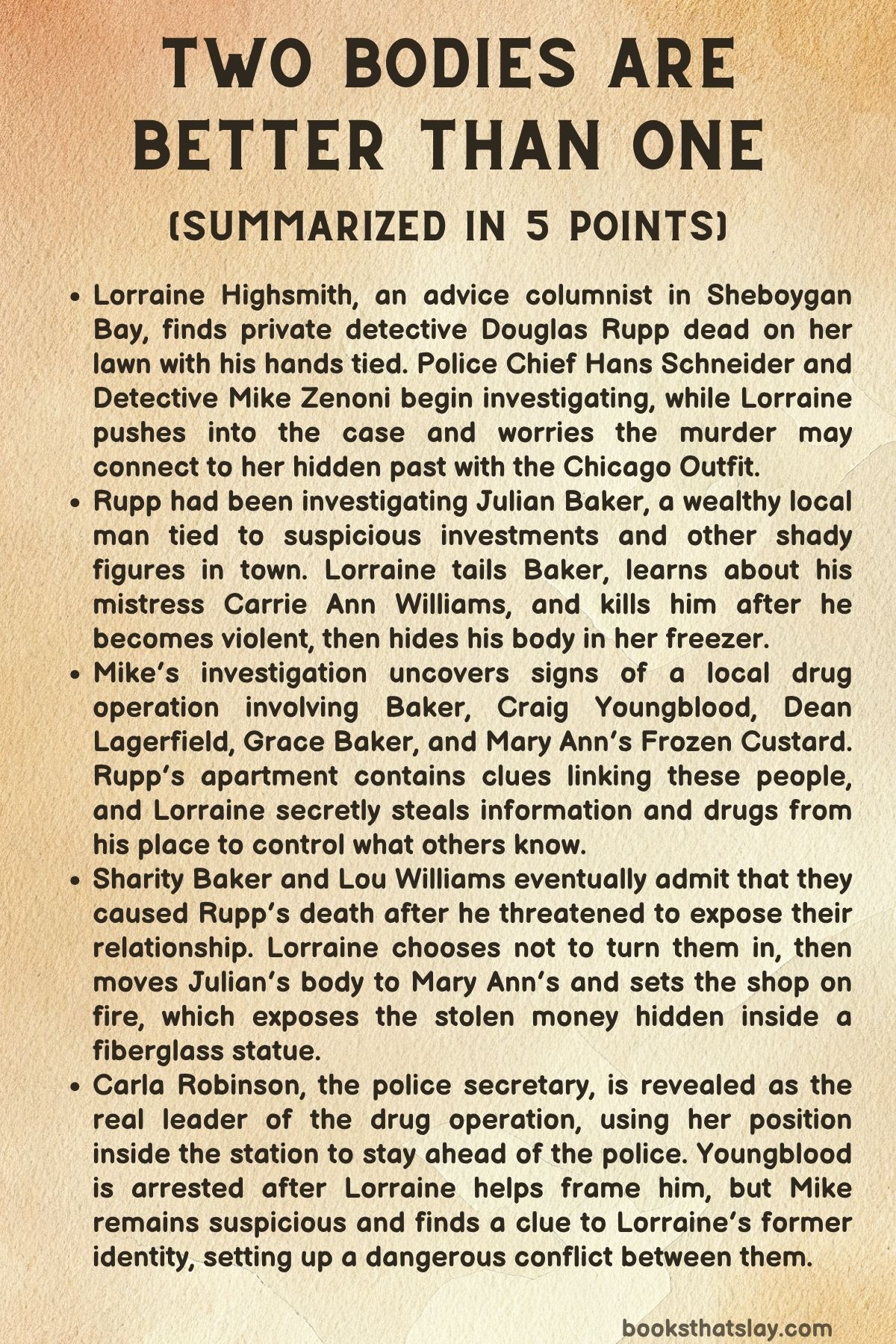
Lorraine Highsmith lives in Sheboygan Bay, Wisconsin, where she works as an advice columnist and presents herself as a respectable, slightly nosy local woman. Her quiet routine is broken when she discovers the body of Douglas Rupp on her neatly kept lawn.
Rupp is a former Milwaukee police officer who became a private detective, and the way his body has been left suggests that someone wanted to send a message. His hands have been tied, and his arrival on Lorraine’s property immediately draws police attention to her home.
Police Chief Hans Schneider comes to investigate, along with Detective Michaela “Mike” Zenoni, who has recently been promoted. Lorraine is not content to stay out of the case.
She watches, listens, and inserts herself wherever possible. At first, the police only know that Rupp had returned to town for some kind of private investigation.
His sister, Marjorie, confirms that he had been working on something, though she does not know all the details. When Schneider searches Rupp’s belongings, he finds a folder connected to Julian Baker, a wealthy local man whose business interests are vague and suspicious.
Lorraine’s interest in the case is more than simple curiosity. She has a secret past that could ruin her present life.
Before becoming Lorraine Highsmith, she worked with the Chicago Outfit and handled ugly problems for dangerous people. She knows how to hide evidence, manipulate suspects, and make deaths look different from what they are.
The body on her lawn worries her because it might connect to that old life, or it might expose skills she has tried to keep buried.
Lorraine follows Schneider when he goes to speak with Julian Baker. Baker denies knowing why Rupp would have been investigating him, but his behavior is uneasy.
He has recently lost a finger and claims it happened in a kitchen accident. Lorraine does not believe him.
Later, she tails Baker at night and sees him stop at Mary Ann’s Frozen Custard before going to a motel. There he meets Carrie Ann Williams, his mistress.
When Baker becomes violent and tries to hit Carrie, Lorraine steps in without revealing herself to the police. She tricks Baker into sitting in her station wagon, injects him with digitalis, and waits while he dies.
Once he is dead, she hides his body in her freezer.
While Lorraine secretly handles Baker, Mike continues the official investigation. She finds Rupp’s car and notices strange items in the trunk, including a shovel, a tarp, rope, and shoes that smell of pig manure.
These items suggest that Rupp had been preparing for something dirty or dangerous. At Rupp’s apartment, Mike discovers a board connecting Baker, Craig Youngblood, Mary Ann’s owner, and other signs of suspicious activity.
Lorraine manages to get inside the apartment while Mike is distracted by Rupp’s cat. She photographs the board and steals prescription drugs from the apartment.
Later, she uses one of the drugs to manipulate people and draw out information.
As Baker’s disappearance becomes harder to ignore, Mike finds that his life is connected to several others in town. Craig Youngblood, Dean Lagerfield, Grace Baker, and local businesses all appear to be tied to a drug operation.
The case grows stranger when Dean Lagerfield’s frozen body is discovered. Evidence begins pointing toward a network that uses local businesses and a boat to move drugs.
Mary Ann’s Frozen Custard seems to be more than a simple food shop. Mike suspects Youngblood is laundering money through it, while Baker may have stolen a large amount of cash from the operation.
Lorraine has her own problem: Baker’s body is still in her possession. She also begins receiving unsettling calls from Baker’s missing car phone.
The caller seems to know that Baker is dead, or at least knows enough to push Lorraine toward panic. Lorraine realizes that someone else is watching the situation closely.
She needs to dispose of Baker’s body, find out who knows what, and keep Mike from getting too close to her past.
The mystery of Rupp’s death eventually leads Lorraine to Sharity Baker, Julian’s wife, and Lou Williams, who is Carrie Ann’s sister and Sharity’s lover. Lorraine confronts them and learns that they are responsible for Rupp’s death, though not in the way the police assume.
Rupp had found out about their relationship and threatened to expose them. They lured him into Lake Michigan, intending to frighten him, but the plan went wrong.
Rupp drowned. In a panic, Sharity and Lou moved his body and dumped it on Lorraine’s sprinkler-soaked lawn.
Lorraine decides not to turn them in. Since Julian Baker is already dead and deeply involved in criminal activity, she believes Rupp’s death can be blamed on him.
Lorraine then turns her attention to Julian’s corpse and the missing money. She hides his body in a bathroom closet at Mary Ann’s Frozen Custard, hoping Craig Youngblood will burn the shop to destroy evidence and take the blame.
When Youngblood does not move quickly enough, Lorraine acts herself. She sets fire to the shop using gasoline and stolen files from Youngblood’s office so suspicion will point toward him.
During the fire, money falls through the flames. This reveals that Baker had hidden the stolen cash inside the shop’s hollow fiberglass statue.
The final surprise comes when Carla Robinson, the police secretary, reveals that she is the real head of the drug operation. From her position inside the police station, Carla had access to information and could stay ahead of the investigation.
She had used Baker and Youngblood as part of the network, and she was the one calling Lorraine from Baker’s car phone to push her into finding the missing cash. Carla also has Baker’s severed finger, proving that she knows far more than she has admitted.
She is aware that Lorraine moved Baker’s body, and Lorraine understands that Carla is too dangerous to challenge openly. Instead of exposing each other, the two women reach a silent agreement.
After the fire, the police find Julian Baker’s body and arrest Craig Youngblood. They believe he killed Baker and Dean Lagerfield, and Lorraine helps strengthen the case by turning over Youngblood’s files.
On the surface, the investigation appears solved. Rupp’s death can be tied to Baker, Baker’s death can be blamed on Youngblood, and the drug operation seems to have a convenient villain.
Mike, however, is not fully convinced. She remains suspicious of Lorraine and reveals that she has found a clue connected to Lorraine’s former identity.
This changes the balance between them. Lorraine understands that Mike is observant, persistent, and potentially dangerous.
Still, Lorraine believes she can stay one step ahead. By the end, she has protected herself, redirected blame, and survived another dangerous mess, but she has also gained a serious new threat in Mike Zenoni.
Characters
Two Bodies Are Better Than One presents its characters through secrecy, suspicion, manipulation, and moral compromise. Nearly every major figure in the book is connected to hidden motives, concealed relationships, criminal behavior, or personal survival, which makes the character network feel tightly interwoven and deliberately unstable.
Lorraine Highsmith
Lorraine Highsmith is the central and most morally complex character in the book. On the surface, she appears to be a respectable advice columnist living in Sheboygan Bay, someone who maintains her lawn carefully and has built a quiet, orderly public identity.
Beneath that calm exterior, however, Lorraine is shaped by a dangerous hidden past connected to the Chicago Outfit, where she learned how to handle threats, cover up crimes, and manipulate situations without leaving obvious traces. Her discovery of Douglas Rupp’s body does not merely shock her; it awakens her old instincts and makes her fear that the past she escaped may be returning.
Lorraine is intelligent, controlled, observant, and ruthless, and she often acts faster than the police because she is willing to cross lines they cannot.
Lorraine’s character is especially striking because she does not investigate from a purely moral position. She wants answers, but she also wants control.
When Julian Baker becomes a threat and reveals himself as violent and suspicious, Lorraine does not wait for the legal system to deal with him. She kills him with calculated precision, stores his body in her freezer, and later engineers circumstances to dispose of him while shifting suspicion elsewhere.
This shows that Lorraine’s sense of justice is deeply personal and practical rather than ethical in a conventional way. She protects people when it suits her, punishes men she sees as dangerous, and covers up crimes when exposing them would create more trouble for her.
At the same time, Lorraine is not presented as careless or purely cruel. Her actions often come from a desire to survive, preserve her new identity, and control chaos before it consumes her.
She is capable of sympathy, particularly toward women who are trapped, threatened, or exposed by men with power. Her decision not to report Sharity and Lou after learning what happened to Rupp reveals that she has her own moral code, even if that code is far from lawful.
Lorraine is one of the most compelling figures in the story because she operates as both investigator and criminal, protector and threat, ordinary woman and seasoned fixer.
Douglas Rupp
Douglas Rupp is important in the book even though he is dead when the central events begin. As a former Milwaukee police officer turned private detective, Rupp represents the investigative force that started uncovering the secrets hidden beneath Sheboygan Bay’s respectable surface.
His tied hands and sudden appearance on Lorraine’s lawn immediately make him a symbol of danger, intrusion, and unfinished business. He is not simply a victim; he is the person whose investigation sets the rest of the plot in motion.
Rupp’s character is defined through what he leaves behind. His folder on Julian Baker, his apartment board, and the strange items in his car suggest that he was persistent, observant, and close to discovering a much larger criminal network.
He had connected Julian Baker, Craig Youngblood, Mary Ann’s Frozen Custard, and other suspicious activities, which means he was more perceptive than many people realized. However, his decision to threaten Sharity and Lou also shows a harsher side of him.
He appears to have used information as leverage, and that choice directly leads to his death.
Rupp functions as both victim and catalyst. His death exposes hidden relationships, drug operations, money laundering, and Lorraine’s own capacity for violence.
He is also a reminder that private investigation can be dangerous when it enters the world of desperate people. Though he is absent for most of the active events, his presence remains powerful because nearly every major revelation traces back to something he discovered or provoked.
Police Chief Hans Schneider
Police Chief Hans Schneider represents official authority in the book, but he is not the most dominant investigative mind in the story. He arrives at Lorraine’s home after Rupp’s body is discovered and takes charge in a formal sense, yet he is repeatedly outmaneuvered or shadowed by Lorraine.
Schneider is professional and serious, but he is also limited by procedure, evidence, and the assumptions of lawful investigation. This makes him a useful contrast to Lorraine, whose methods are secretive, illegal, and much faster.
Schneider’s role also shows the gap between visible authority and hidden power. As police chief, he has the title and responsibility to solve the case, but he does not fully understand the forces moving around him.
Lorraine follows him, listens, inserts herself into the investigation, and often discovers or acts on information before the police can. Schneider is not foolish, but he is working within a system that Carla Robinson has already compromised from the inside.
His character therefore helps reveal how vulnerable official structures can be when corruption is hidden close to their center.
Detective Michaela “Mike” Zenoni
Detective Michaela “Mike” Zenoni is one of the sharpest and most important characters in the book. Newly promoted, she is determined to prove herself, and her investigation shows discipline, curiosity, and growing confidence.
Unlike some of the other officials, Mike notices patterns and follows evidence with care. Her discovery of the strange items in Rupp’s car, her attention to his apartment, and her gradual understanding of the links among Baker, Youngblood, Dean Lagerfield, Grace Baker, and the drug operation show that she is a serious investigator.
Mike is especially significant because she becomes one of the few people capable of threatening Lorraine’s safety. Lorraine can manipulate many people, distract them, drug them, or misdirect them, but Mike remains observant enough to sense that Lorraine is not merely a helpful civilian.
By the end of the story, Mike’s suspicion becomes more dangerous because she has found a clue to Lorraine’s past identity. This transforms her from a police detective working on a case into a direct threat to Lorraine’s carefully constructed life.
Mike’s character is built around persistence and instinct. She may not know everything Lorraine has done, but she understands enough to keep watching.
Her presence creates tension because she represents the possibility that Lorraine’s cleverness may eventually meet its match. In a story filled with criminals who underestimate one another, Mike stands out as a character whose intelligence continues to grow.
Julian Baker
Julian Baker is one of the most unpleasant and destructive characters in the book. Wealthy, evasive, and connected to suspicious investments, he appears at first to be a man hiding financial or criminal secrets.
His missing finger, his connection to Rupp’s investigation, and his nervous behavior all suggest that he is deeply involved in something dangerous. Julian’s wealth gives him status, but it does not give him dignity.
Instead, he is portrayed as cowardly, violent, and morally weak.
His treatment of Carrie Ann Williams reveals his cruelty most clearly. When he attempts to hit her, Lorraine sees enough to decide that he is not only suspicious but also personally dangerous.
Julian’s violence toward women makes him a natural target for Lorraine’s particular kind of punishment. His death at Lorraine’s hands is coldly planned, but the book frames him as the sort of man whose power depends on intimidation, lies, and exploitation.
Julian is also important because his stolen cash becomes a driving force behind several later events. Even after he dies, his secrets continue to shape the investigation.
His body, his money, his severed finger, and his connection to the drug operation all become pieces in a larger game. Julian is therefore both a villain and a useful object in the schemes of others.
He wants control, but in the end he becomes evidence, leverage, and a corpse that other characters use to protect themselves.
Marjorie Rupp
Marjorie Rupp plays a smaller but meaningful role as Douglas Rupp’s sister. She helps confirm his identity and reveals that he had returned to town for an investigation.
Her importance lies in giving Rupp a personal connection beyond his role as a dead detective. Through Marjorie, the reader is reminded that Rupp was not only a body on Lorraine’s lawn or a source of clues, but also someone with family ties and a life before the case.
Marjorie also helps move the investigation forward by confirming that Rupp’s presence in town was purposeful. She gives the police and Lorraine reason to believe that his death was connected to his work.
Although she is not deeply involved in the criminal network, her information helps establish the seriousness of Rupp’s investigation and reinforces the idea that his death was not random.
Carrie Ann Williams
Carrie Ann Williams is Julian Baker’s mistress and one of the characters who exposes his violent nature. Her relationship with Julian places her in a vulnerable position because he has social power, money, and a willingness to use force.
When Julian tries to strike her, Carrie becomes the immediate reason Lorraine intervenes. In that moment, Carrie’s presence reveals both Julian’s brutality and Lorraine’s protective instincts toward women who are being mistreated.
Carrie is not presented as a central mastermind, but her role is still important because she helps reveal the private life Julian tries to keep hidden. Through her, the book shows how men like Julian compartmentalize their lives, maintaining wealth and status while behaving abusively in secret.
Carrie also connects indirectly to Lou Williams, which makes her part of the wider network of relationships surrounding Julian, Sharity, and the hidden motives behind Rupp’s death.
Craig Youngblood
Craig Youngblood is a corrupt businessman whose ownership of Mary Ann’s Frozen Custard gives the criminal operation a public-facing cover. He is tied to money laundering, suspicious activity, and the drug network, making him one of the most important practical links between ordinary town life and organized crime.
His business appears harmless from the outside, but it is connected to hidden money, criminal files, and eventually the dramatic fire that exposes Baker’s stolen cash.
Youngblood is not as clever as Lorraine or Carla, and this weakness makes him useful as a scapegoat. Lorraine recognizes that suspicion can be directed toward him, especially because his files and connections already make him look guilty.
When he fails to burn the shop quickly enough, Lorraine takes action herself and makes the evidence point more strongly toward him. Youngblood’s character shows how criminals who think they are in control can become disposable when someone more intelligent manipulates the situation.
By the end, Youngblood becomes the person the police believe responsible for Julian Baker and Dean Lagerfield’s deaths. His arrest shows how easily the visible criminal can take the blame while the more dangerous hidden operators remain free.
He is guilty of many things, but the case against him is shaped and strengthened by Lorraine’s interference.
Dean Lagerfield
Dean Lagerfield is another victim whose death reveals the scale and danger of the criminal network. His frozen body suggests that the crimes surrounding the drug operation are not isolated or impulsive.
Instead, they involve planning, concealment, and a willingness to dispose of people who become inconvenient. Dean’s fate adds weight to the investigation because it proves that Rupp’s death is only one piece of a broader pattern.
Although Dean is not developed as fully as Lorraine, Mike, Julian, or Carla, his presence matters because he represents the human cost of the hidden operation. His death helps Mike connect people and events that might otherwise seem separate.
In that sense, Dean functions as evidence of a deeper rot in the town, showing that the criminal network has already destroyed lives before the central investigation begins.
Grace Baker
Grace Baker is part of the web of connections that Mike uncovers while investigating Julian Baker, Youngblood, Dean Lagerfield, and the drug operation. Her role is not as prominent as Sharity’s or Julian’s, but her connection to the Baker circle makes her part of the suspicious family and social network surrounding the crimes.
She helps widen the sense that the Baker name is tied to more than wealth and respectability.
Grace’s importance lies less in direct action and more in association. In a book where relationships, names, and hidden links matter greatly, being connected to Julian’s world carries weight.
Her presence helps reinforce the idea that the investigation is not simply about one murdered detective or one missing wealthy man, but about a larger system of people whose lives overlap with crime, secrecy, and deception.
Sharity Baker
Sharity Baker is one of the most emotionally complicated characters in the story. As Julian Baker’s wife, she is connected to wealth and social respectability, but her private life is shaped by secrecy and fear.
Her relationship with Lou Williams gives her both tenderness and danger, because their hidden love becomes the reason Rupp tries to threaten them. Sharity is not a hardened criminal like Lorraine or Carla, but panic and desperation push her into a fatal situation.
Her involvement in Rupp’s death is accidental rather than malicious. She and Lou lure him into Lake Michigan intending to frighten him, not kill him.
When he drowns, their fear leads them to move his body to Lorraine’s lawn. This act is both irrational and revealing.
Sharity is frightened enough to make a terrible decision, yet not cold enough to seem purely villainous. Her guilt comes from panic, secrecy, and the pressure of exposure.
Sharity also helps reveal Lorraine’s selective morality. When Lorraine learns the truth, she chooses not to expose Sharity and Lou because Rupp’s death can be blamed on Julian.
This decision suggests that Lorraine sees Sharity less as a murderer and more as a trapped woman who made a desperate mistake. Sharity’s character therefore adds emotional complexity to the book’s treatment of guilt and responsibility.
Lou Williams
Lou Williams is Sharity Baker’s lover and Carrie Ann Williams’s sister. Her relationship with Sharity is one of the hidden emotional centers of the book.
Lou’s actions are driven by love, fear, and the need to protect a relationship that Rupp threatens to expose. Like Sharity, Lou does not appear to intend murder, but her attempt to scare Rupp turns disastrous when he drowns.
Lou is important because she complicates the moral structure of the story. She is guilty of helping create the situation that kills Rupp and of helping move his body afterward, but she is not portrayed as a calculated killer.
Her choices come from fear of exposure and loyalty to Sharity. This makes her very different from Lorraine, who kills deliberately, and from Carla, who operates with cold strategic control.
Lou’s connection to Carrie Ann also ties together different parts of Julian Baker’s private life. Through the Williams sisters, the book links Julian’s abusive affair, Sharity’s secret relationship, and Rupp’s fatal discovery.
Lou’s character helps show how personal secrets can become deadly when they intersect with blackmail, violence, and public reputation.
Carla Robinson
Carla Robinson is the hidden mastermind and one of the most dangerous characters in the book. As the police secretary, she occupies a position that seems ordinary and administrative, but that role gives her access to information, movement, and trust inside the police station.
Her reveal as the true drug boss changes the meaning of the investigation because it shows that corruption has been operating from within the very institution meant to uncover it.
Carla is highly intelligent, patient, and manipulative. She uses Baker and Youngblood, monitors events closely, and even contacts Lorraine from Baker’s car phone to push her toward finding the stolen money.
Her possession of Baker’s severed finger proves that she is not merely a background organizer but someone directly connected to the violence and intimidation surrounding the operation. She understands leverage, and she understands Lorraine more clearly than most people do.
The silent understanding between Carla and Lorraine is one of the most important character moments in Two Bodies Are Better Than One. Both women know enough to destroy each other, and both recognize that silence is safer than confrontation.
Carla serves as a dark mirror to Lorraine: both are clever, controlled, secretive women who survive by reading people and manipulating evidence. The difference is that Carla’s power comes from running a criminal network, while Lorraine’s comes from her past skills and her willingness to act alone.
Their uneasy balance leaves the story with a sense that the most dangerous people are not necessarily the ones the police arrest, but the ones who know when to stay quiet.
Themes
Hidden Identity and the Burden of the Past
Lorraine’s calm public life rests on a carefully protected false identity, but the discovery of a corpse on her lawn threatens to pull her former self back into view. In Two Bodies Are Better Than One, identity is not shown as something fixed; it becomes something a person can build, defend, and weaponize.
Lorraine has remade herself as a respectable advice columnist, yet her old habits remain close to the surface. Her reactions are not those of an ordinary citizen frightened by murder, but of someone trained to control evidence, read danger, and remove threats.
This makes her past feel less like a completed chapter and more like a living force shaping every choice she makes. The theme becomes sharper because Lorraine is not simply hiding from others; she is also proving to herself that she can survive by staying one move ahead.
Her respectable name gives her safety, but her old skills give her power. The tension between those two versions of herself drives much of the story’s suspense.
Morality as a Matter of Convenience
Right and wrong are treated less as clear rules and more as flexible tools used by characters to protect themselves. Lorraine kills Julian Baker, hides evidence, drugs people, manipulates investigations, and still views many of her actions as practical solutions rather than moral failures.
Her choices are disturbing because they are often presented through a cool, controlled logic: if someone is dangerous, cruel, or useful as a scapegoat, then removing or redirecting that person becomes acceptable to her. Other characters also reshape morality to suit their needs.
Sharity and Lou conceal Rupp’s death because exposure would ruin them, while Carla runs a criminal operation from inside a place meant to enforce justice. The result is a world where guilt does not always lead to punishment and innocence does not guarantee safety.
The theme questions whether justice can survive when nearly everyone treats truth as negotiable. Lorraine’s intelligence makes her fascinating, but her moral flexibility makes her deeply unsettling.
Power Hidden Behind Ordinary Appearances
The story repeatedly shows that danger can hide behind familiar, ordinary surfaces. A lawn, a custard shop, a police station, a motel, and a quiet town all seem harmless at first, yet each becomes connected to murder, drugs, secrets, or corruption.
This contrast gives the setting a strong sense of unease. Lorraine herself represents the same idea: she appears to be a local advice columnist, but she is capable of calculated violence and expert deception.
Carla also embodies hidden power because her position as police secretary allows her to observe, influence, and protect a criminal network while remaining underestimated. Even Mary Ann’s Frozen Custard becomes more than a local business; it is tied to laundering money, stolen cash, and the destruction of evidence.
The theme suggests that appearances are often designed to lower suspicion. People and places survive by looking smaller, simpler, or safer than they really are.
This makes the ordinary world feel unstable, because what seems harmless may be carrying the greatest threat.
Control, Manipulation, and the Limits of Cleverness
Many characters try to control the story others will believe. Lorraine plants evidence, moves bodies, steals files, and shapes suspicion so that blame falls where she wants it to fall.
Carla uses phone calls, insider knowledge, and silence to guide events without openly exposing herself. Sharity and Lou attempt to turn a personal disaster into someone else’s crime.
Mike, however, challenges this pattern because she is observant enough to notice gaps that others miss. Her suspicion of Lorraine shows that manipulation is powerful but never perfect.
Every act of control leaves behind some trace: a clue, a pattern, a strange coincidence, or a person who remembers too much. Lorraine’s confidence comes from her ability to improvise quickly, but the ending makes that confidence feel dangerous rather than secure.
She has avoided exposure for now, yet Mike’s growing awareness proves that cleverness has limits. The theme gives the story its lasting tension: survival depends not only on being smart, but on never assuming that everyone else is foolish.