Two Kinds of Stranger Summary, Characters and Themes
Two Kinds of Stranger by Steve Cavanagh is a fast-moving legal thriller built around betrayal, public shame, and a murder case designed to look simple from the outside. The story follows Elly Parker, a popular New York influencer whose private heartbreak becomes global entertainment after she catches her husband with her best friend during a live video.
Soon after, an act of kindness puts her in the path of a calculated killer who turns her life into evidence against her. With lawyer Eddie Flynn and his team fighting to uncover the truth, the novel explores manipulation, justice, media judgment, and the danger of trusting the wrong stranger. This is the 9th installment in the Eddie Flynn series.
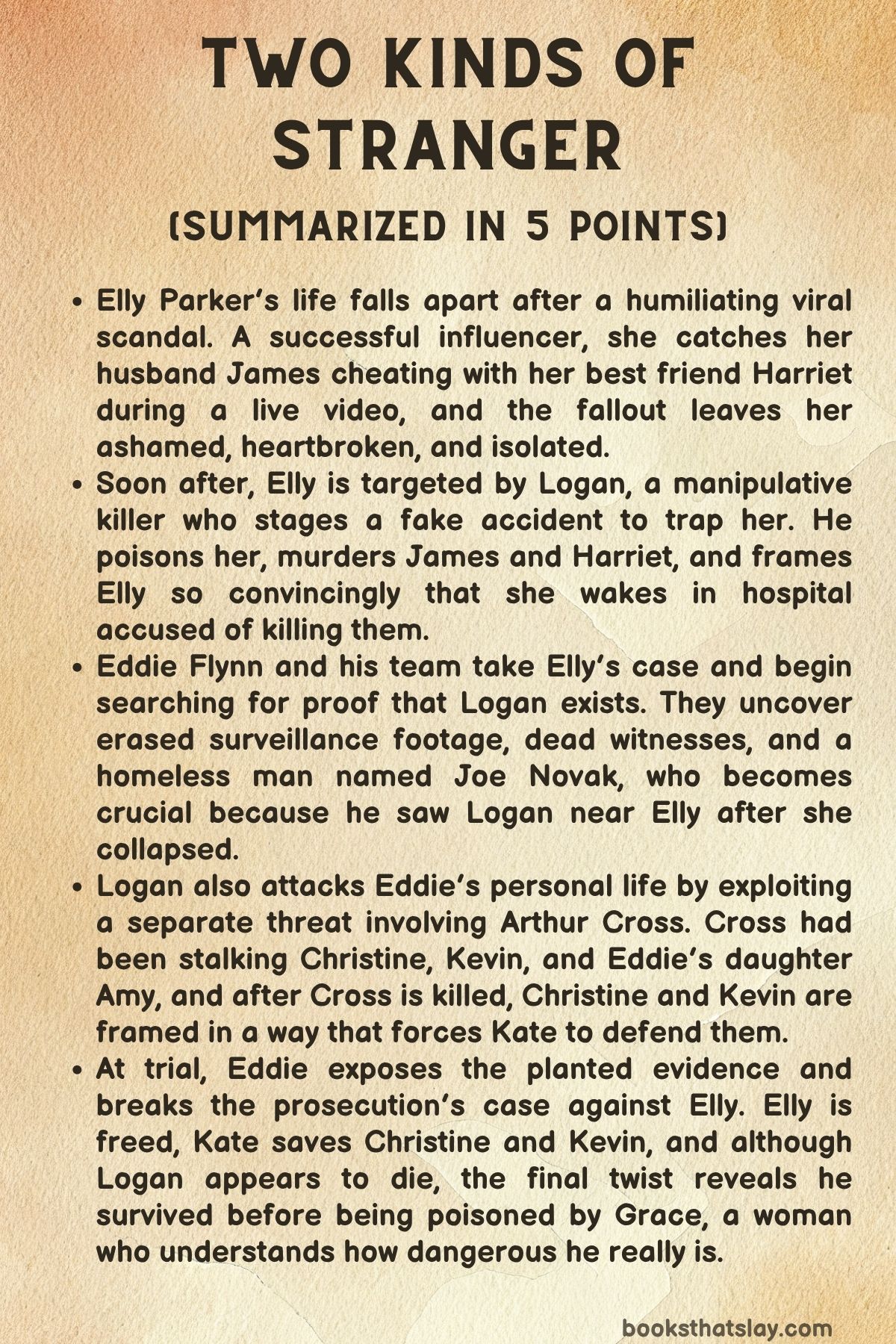
Summary
Elly Parker has built a successful public life around warmth, generosity, and carefully presented happiness. As a New York influencer, she is best known for lifestyle videos and daily acts of kindness, small public gestures that have helped shape her image as someone open, decent, and sincere.
Her marriage to James appears to be part of that polished life, until one ordinary moment turns into a disaster that the whole internet gets to watch.
During a live video, Elly walks into her home and finds James in bed with Harriet, her closest friend. The humiliation is immediate and total.
The video spreads across social media, and the scandal becomes a public spectacle. James and Harriet are attacked online, while Elly is pitied, praised, mocked, and watched by millions.
Although many people see her as the wronged woman, that does not protect her from the shock of betrayal. She withdraws to a hotel, ashamed, confused, and still emotionally tied to the life that has just been destroyed.
While moving through Grand Central, Elly notices an injured man named Logan. He is on crutches and seems to be struggling with a yellow suitcase.
Helping people is not only part of Elly’s online identity; it is also part of how she sees herself. She stops to assist him.
When the suitcase breaks open, she feels responsible and helps carry it back to his apartment. What begins as a simple favor quickly becomes frightening.
Inside Logan’s apartment, she drinks water from his fridge and becomes violently sick. She then finds two identical broken suitcases hidden in garbage bags and understands that the entire encounter was planned.
Elly escapes into the street, but she is too ill to get far. She vomits, collapses, and is helped by a homeless man named Joe Novak, who sees enough to become important later.
Elly wakes in hospital four days later, not as a victim, but as a suspect. She is handcuffed to the bed and accused of murdering James and Harriet.
Both were poisoned in her apartment, and the police believe Elly had the strongest motive. To the outside world, the story is easy to understand: a betrayed wife takes revenge after being humiliated online.
Elly insists that Logan poisoned her and framed her, but her account sounds unlikely. The police see a woman who had reason to hate her husband and best friend.
The media turns the case into the “TikTok murders,” reducing Elly’s life to a headline. Her public image, once useful and admired, now works against her.
Every clip, every emotional expression, and every public comment becomes part of the story being built around her.
Eddie Flynn takes on Elly’s defense with Kate Brooks, Harry Ford, Bloch, and Gabriel Lake. Eddie has built his career around cases where the truth is buried under performance, pressure, and carefully arranged evidence.
At first, Elly’s case looks almost impossible. The poison, the motive, the timing, and the public betrayal all point toward her.
Still, Eddie believes there is something wrong with how neatly everything fits.
The real threat is Logan, a wealthy behavioral psychologist and serial killer who has turned human weakness into a weapon. He studies people, predicts their choices, and designs situations that make innocent people look guilty.
Elly was not chosen at random. After seeing the viral video of her betrayal, Logan understood that the world would believe she had snapped.
He murdered James and Harriet, arranged the evidence, and intended Elly’s death to look like suicide after revenge killings. When Elly survives, his plan becomes more complicated, and he begins removing anyone who might connect him to the frame-up.
Eddie’s team starts searching for anything that supports Elly’s account. Surveillance footage could help, but key recordings have disappeared.
They discover that a Secure One technician named Karl Kaplinsky erased footage connected to the case. Karl might have explained who ordered it or what he saw, but Logan has already killed him.
Each possible lead seems to vanish before Eddie’s team can use it.
Joe Novak becomes one of the most important witnesses because he helped Elly after her escape and saw Logan nearby. Eddie’s team needs to find him before Logan does.
Gabriel Lake locates Joe, but Logan is also hunting him. Logan later shoots Joe and believes he has silenced him.
In reality, Joe survives and is hidden by Eddie’s team. His survival gives the defense a crucial advantage, because Logan does not know the witness who can identify him is still alive.
As Eddie fights to save Elly, another threat reaches into his own family. Arthur Cross, a conman who lost a large amount of money in an inheritance dispute, has been stalking Kevin, the new husband of Eddie’s ex-wife Christine.
Cross’s anger has spread toward Christine and Eddie’s daughter Amy, making the situation personal and dangerous. Logan sees this conflict as a chance to distract and wound Eddie.
Cross is killed, and Christine and Kevin are framed with Kevin’s gun. Eddie now has to protect Elly while Kate works to save Christine and Kevin from a separate murder accusation.
The trial against Elly begins with the prosecution presenting her as a woman driven by humiliation, anger, and revenge. The accusations grow even worse when prosecutors suggest she may also have poisoned her father years earlier.
This gives them a pattern: Elly, they argue, is not just a betrayed wife, but a practiced killer. Eddie understands that if the jury accepts that picture, the case may be over.
Eddie attacks the evidence piece by piece. He shows that the case depends on assumptions made after the public betrayal.
He challenges the idea that motive is the same as proof. He also exposes problems with the accusation involving Elly’s father.
The body had been tampered with after burial, and poison evidence was planted to make Elly look guilty of an older crime. That discovery damages the prosecution’s attempt to turn her into a long-term murderer.
The hidden strength of Eddie’s defense is Joe Novak. When Eddie reveals that Joe is alive and can identify the scarred man seen near Elly, Logan begins to lose control.
His confidence has always come from planning, distance, and the belief that people will behave as he expects. Joe’s survival creates a fact Logan cannot explain away.
In desperation, Logan sends Bruno Mont to attack Bloch and Lake and remove the threat. The attack fails.
Bruno is killed, and Logan appears, only to be wounded by Bloch.
Eddie, Bloch, and Lake chase Logan to a bridge. Cornered and injured, Logan jumps into the river.
He appears to die, giving Eddie the opening he needs to finish breaking the case against Elly. With the planted evidence exposed, Joe’s testimony available, and Logan tied to the larger scheme, the prosecution can no longer sustain its case.
The charges against Elly are withdrawn, and she is freed.
Elly returns to public life changed but not defeated. She chooses to continue her random acts of kindness, even after one such act nearly destroyed her.
This choice is not naive. It shows that Logan failed to turn her generosity into something shameful.
She understands the risk of trust more clearly now, but she refuses to let a killer define who she is.
Kate also manages to save Christine and Kevin by shifting blame for Arthur Cross’s death onto Bruno. She knows the move crosses an ethical line, but it protects innocent people from a trap built by someone far worse.
The victory is complicated, leaving the legal team with relief but also moral discomfort.
The final turn reveals that Logan did not die in the river. He escaped and fled with Grace, a woman he had stalked and later became involved with.
Logan believes he has once again survived by reading people better than they read him. But Grace has understood him more clearly than he realized.
On a boat off South Africa, she poisons him. As he dies, she reveals that she is dangerous too, and that his greatest mistake was trusting a stranger.
In the end, the man who built his crimes around manipulation is undone by the same weakness he exploited in others.
Characters
Elly Parker
Elly Parker is the emotional center of Two Kinds of Stranger, and her character is built around the painful contrast between public image and private suffering. At the beginning of the story, she appears to be a confident, successful New York influencer whose online identity depends on kindness, optimism, and visibility.
Her daily “random acts of kindness” videos suggest a person who wants to believe in goodness and who has made compassion part of her personal brand. However, the discovery of James and Harriet’s betrayal destroys not only her marriage and friendship but also her sense of control over her own life.
Because the betrayal happens during a live video, Elly’s humiliation becomes public entertainment, making her grief impossible to separate from social media judgment. This makes her a deeply vulnerable character, because she is punished emotionally before she is ever accused legally.
Elly’s kindness becomes both her strength and the weapon used against her. When she helps Logan with his crutches and suitcase, she acts according to the values she has built her life around.
The tragedy is that her instinct to help a stranger is exactly what allows Logan to trap her. Her poisoning and later arrest transform her from a betrayed wife into an accused murderer, and the public quickly changes from sympathizing with her to treating her as a monster.
This shows how fragile public opinion can be and how easily a person’s identity can be rewritten by accusation, media attention, and manipulation.
What makes Elly compelling is that she does not become cynical by the end of the book. After being betrayed, poisoned, framed, imprisoned, and publicly condemned, she still chooses to continue her acts of kindness.
This decision is not naive; it is an act of resistance. Elly’s survival is not only physical but moral.
She refuses to let Logan’s cruelty define the meaning of kindness. Her character shows that goodness can be exploited, but it does not become meaningless because someone evil takes advantage of it.
Eddie Flynn
Eddie Flynn is the central defender figure in the story, and his character represents intelligence, loyalty, persistence, and moral pressure under extreme circumstances. As Elly’s lawyer, he enters a case that appears almost impossible to win because the evidence against her seems overwhelming.
Eddie’s role is not simply to argue in court but to look beyond the obvious version of events. He understands that the truth is often hidden beneath performance, planted evidence, fear, and manipulation.
This makes him an ideal opponent for Logan, because both men understand deception, but Eddie uses that understanding to expose lies rather than create them.
Eddie is also important because the case becomes personal for him. Logan does not only attack Elly; he also pulls Eddie’s family into danger by exploiting the situation involving Arthur Cross, Kevin, Christine, and Amy.
This forces Eddie to fight on two fronts: professionally for Elly and emotionally for the people closest to him. His strength lies in his ability to keep working even when fear and anger could cloud his judgment.
He is not presented as detached or untouched by danger. Instead, he is effective because he feels the stakes deeply and still refuses to lose control.
As a character, Eddie represents the belief that justice requires more than legal procedure. He has to investigate, challenge assumptions, protect witnesses, and confront violence outside the courtroom.
His courtroom success comes from his ability to connect small details into a larger truth. By exposing the planted evidence involving Elly’s father and revealing Joe Novak’s survival, Eddie breaks apart the false story built around Elly.
His character shows that defending someone is not just about proving reasonable doubt; it is about restoring a stolen identity.
Logan
Logan is the main villain of the story and one of the most dangerous characters in the book because his violence is intellectual, controlled, and deeply manipulative. He is not a killer driven by sudden rage.
Instead, he studies people, predicts behavior, and builds traps around their emotional weaknesses. As a wealthy behavioral psychologist, he understands how people respond to shame, kindness, fear, guilt, and public pressure.
This makes him especially frightening because he does not merely commit murders; he designs entire realities in which innocent people appear guilty.
His targeting of Elly reveals his cruelty and his arrogance. He sees her viral betrayal as an opportunity, recognizing that she has motive, public humiliation, and emotional instability in the eyes of others.
Logan uses those circumstances to frame her for James and Harriet’s murders, then tries to make her death look like the final act of a guilty woman. His plan depends on society’s willingness to believe a simple story: betrayed wife takes revenge.
This shows how Logan weaponizes narrative as much as poison. He does not just kill bodies; he kills reputations.
Logan’s greatest weakness is his belief that he is always the smartest person in the room. He repeatedly underestimates the people he sees as disposable, including Elly, Joe, Eddie, Bloch, Lake, and finally Grace.
His apparent death at the bridge seems to confirm his ability to escape consequences, but the final twist proves that his own methods can be turned against him. Grace poisons him because she recognizes what he is, and this ending is fitting because Logan dies from the same kind of misplaced confidence he used to exploit in others.
His character represents the danger of intelligence without conscience.
Kate Brooks
Kate Brooks is a sharp and morally complicated member of Eddie’s legal circle. Her importance grows when she takes on the defense of Christine and Kevin after they are framed in connection with Arthur Cross’s death.
Kate is intelligent, strategic, and capable of operating under pressure, but her storyline also explores the ethical gray areas of defense work. She is not simply a supporting lawyer who follows clean rules.
She is someone who understands that the legal system can be manipulated by people like Logan, and she responds by using tactics that are effective even when they are uncomfortable.
Kate’s defense of Christine and Kevin shows her loyalty to Eddie and her commitment to protecting innocent people. At the same time, her decision to shift blame onto Bruno creates moral tension.
She knows the tactic crosses ethical lines, yet she also knows that failing to act could destroy the lives of people who have been trapped by a larger criminal scheme. This makes Kate an interesting character because she reflects one of the book’s central questions: how far can someone go in the pursuit of justice before the pursuit itself becomes morally dangerous?
Her role adds depth to the legal side of the story because she shows that justice is not always achieved through pure certainty or perfect choices. Kate is practical, brave, and willing to carry the burden of decisions that others might avoid.
She is not defined by innocence or corruption but by the difficult space between them. Her character shows that in a world shaped by lies, even good people may have to make troubling choices to prevent greater harm.
Harry Ford
Harry Ford is part of Eddie’s defense team, and his role is important because he contributes to the collective effort needed to save Elly. While Eddie is often the most visible figure, Harry represents the steadier professional support behind the case.
His presence helps show that Elly’s defense is not built on one person’s instinct alone but on teamwork, legal experience, and careful examination of evidence. In a case where the police and media have already accepted Elly’s guilt, characters like Harry matter because they help keep the defense grounded.
Harry’s character also adds balance to the legal team. He functions as part of the structure that allows Eddie to take risks, investigate leads, and challenge the prosecution.
The case against Elly is complex, involving poison, erased surveillance, planted evidence, manipulated witnesses, and public outrage. Harry’s involvement suggests discipline and reliability within that chaos.
He may not be the most dramatic character, but he contributes to the sense that justice requires many people working carefully against a powerful lie.
Through Harry, the story reinforces the importance of professional loyalty. He stands with Elly’s defense when the easier path would be to accept the public version of events.
His character is valuable because he helps create the legal foundation from which Eddie can attack the false case. Harry represents steadiness, competence, and the quiet importance of support in a high-stakes fight.
Bloch
Bloch is one of the strongest protective figures in the story, and her character brings physical courage, loyalty, and toughness into the defense team’s struggle. She is not merely a background investigator or assistant; she is directly involved in confronting the danger created by Logan and his associates.
Her role becomes especially important when Logan tries to eliminate Joe Novak and later when Bruno Mont attacks. Bloch’s courage under threat makes her one of the characters who actively prevents Logan’s plan from succeeding.
Her character is defined by action and resilience. When Bruno attacks, Bloch is placed in immediate danger, but she does not collapse under pressure.
Later, when Logan appears, she wounds him, helping to stop his attempt to control the situation. This moment is significant because Logan is used to manipulating people from a position of superiority.
Bloch disrupts that control through direct resistance. She is one of the characters who proves that Logan’s intelligence does not make him untouchable.
Bloch also represents loyalty without sentimentality. She is tough, practical, and focused on survival, but her actions show deep commitment to the people she protects.
In a story where kindness is exploited and trust is dangerous, Bloch’s loyalty has real weight. She is not easily fooled, and she does not rely on appearances.
Her character strengthens the story’s sense that truth sometimes has to be defended physically as well as legally.
Gabriel Lake
Gabriel Lake is another essential figure in the fight to uncover the truth, especially because he finds Joe Novak before Logan can silence him completely. Lake’s role is important because Joe is one of the few people who can directly support Elly’s account of what happened after she escaped Logan’s apartment.
By locating Joe, Lake helps preserve the human evidence that Logan is desperate to erase. His actions make him a crucial part of the defense team’s survival and investigative effort.
Lake’s character is marked by determination and alertness. He operates in a dangerous space where the people connected to the truth become targets.
Logan’s willingness to kill witnesses means that Lake’s search for Joe is not just investigative work but a race against a murderer. His success in finding Joe first changes the direction of the case, giving Eddie the chance to reveal that Joe is alive and able to identify the scarred man connected to Elly’s collapse.
Lake also adds to the theme of hidden truth. In the public version of events, Elly looks guilty and Logan appears invisible.
Lake’s work helps reverse that imbalance by bringing a forgotten witness back into the light. His character shows that justice depends not only on courtroom arguments but also on finding and protecting the people whom powerful criminals try to erase.
James
James is Elly’s husband, and although he dies early in the central crime, his actions shape much of the emotional and legal conflict. His betrayal with Harriet is the event that publicly destroys Elly’s life and gives Logan the motive he needs to frame her.
James is therefore important not because he is deeply explored as a living presence, but because his choices create the wound that the killer later exploits. He represents personal betrayal, broken trust, and the painful difference between private marriage and public image.
James’s affair makes Elly appear emotionally capable of revenge in the eyes of the public and the police. This is crucial to the false case against her.
The tragedy is that his betrayal makes her vulnerable twice: first emotionally, then legally. Because the video of his infidelity goes viral, James becomes part of a public scandal that strips Elly of privacy.
His death then turns that scandal into a murder narrative, allowing people to see Elly not as a humiliated victim but as a possible killer.
As a character, James is a reminder that selfish personal choices can have consequences far beyond the original betrayal. He does not create Logan’s evil, but his actions give Logan the perfect emotional setting for manipulation.
His role in the story shows how betrayal can become evidence in the hands of someone determined to twist reality.
Harriet
Harriet is Elly’s best friend and the second person involved in the betrayal that destroys Elly’s world. Her relationship with James makes the emotional damage even deeper because Elly is not only betrayed by her husband but also by someone who should have been loyal to her.
Harriet’s role is significant because she intensifies the sense of humiliation and isolation that surrounds Elly before the murders. The betrayal is intimate, but because it is revealed online, it becomes a spectacle.
Harriet’s death is central to the frame-up because it strengthens the prosecution’s version of Elly as a woman driven by revenge. Like James, Harriet becomes part of the motive Logan uses to make Elly look guilty.
Her presence in the story shows how easily a real emotional injury can be transformed into a false criminal explanation. Elly truly has reason to feel devastated by Harriet, but that pain is not the same as guilt.
Harriet’s character also reflects the fragility of trust. As Elly’s best friend, she should represent safety and emotional closeness, but instead she becomes part of the betrayal that leaves Elly exposed.
Her role is not heroic or sympathetic, yet it is important because it helps create the emotional landscape Logan exploits. Through Harriet, the story shows that the people closest to someone can cause wounds that strangers later use for darker purposes.
Joe Novak
Joe Novak is one of the most important witness figures in the book, and his character represents the value of overlooked people. As a homeless man who helps Elly after she collapses, Joe enters the story from the margins of society.
The police and public might not immediately treat someone like him as powerful or important, but his knowledge becomes crucial. He sees Logan nearby and can support Elly’s claim that another man was involved.
This makes him dangerous to Logan and essential to Eddie.
Joe’s survival is one of the turning points in the case. Logan tries to kill him because Joe threatens the false story built around Elly.
When Logan believes Joe is dead, he thinks one of the last loose ends has been removed. However, Joe survives and is hidden by Eddie, turning him into a secret weapon for the defense.
His reappearance destabilizes Logan and helps expose the truth. This gives Joe a powerful role despite his vulnerable social position.
Joe’s character shows that truth can come from people whom society often ignores. He is not wealthy, famous, or legally powerful, but he matters because he saw what happened and because he chose to help Elly when she was in danger.
His presence challenges the assumptions of a world that listens more readily to polished narratives than to vulnerable witnesses. Joe proves that a person’s importance is not determined by status.
Karl Kaplinsky
Karl Kaplinsky is the Secure One technician connected to the erased surveillance footage, and his role shows how Logan covers his tracks through both technology and murder. Karl is important because the missing footage could have helped prove that Elly’s story was true.
By erasing or interfering with surveillance evidence, he becomes part of the machinery that protects Logan’s frame-up. However, Karl is not ultimately safe within that machinery.
Logan murders him, showing that anyone who knows too much becomes disposable.
Karl’s character represents the danger of becoming useful to a killer. Whether motivated by pressure, corruption, fear, or convenience, his involvement with the footage places him inside Logan’s web.
Once he has served his purpose, Logan eliminates him to prevent exposure. This makes Karl both a participant in the concealment of truth and a victim of the larger criminal plan.
His death reveals Logan’s cold practicality.
Through Karl, the story explores how evidence can be controlled before it reaches the courtroom. The truth is not simply waiting to be found; it can be deleted, altered, buried, or destroyed.
Karl’s role makes the case against Elly more difficult to fight and shows why Eddie’s team must look beyond official records. His character is a reminder that modern crimes can depend as much on erased data as on physical violence.
Arthur Cross
Arthur Cross is a conman whose past grievance against Kevin becomes another weapon in Logan’s larger plan. Cross lost millions in an inheritance dispute handled by Kevin, and his anger leads him to stalk Kevin, Christine, and Amy.
This already makes him a threatening figure before Logan uses the situation for his own purposes. Cross’s resentment creates an existing atmosphere of danger around Eddie’s family, allowing Logan to exploit a conflict that is already in motion.
Cross is morally compromised, but he is also manipulated by a more dangerous mind. His stalking behavior makes him frightening, yet his death turns him into another piece of evidence in someone else’s scheme.
Logan uses Cross’s presence to target Eddie emotionally and to frame Christine and Kevin with Kevin’s gun. This makes Cross significant not only as a threat but also as a tool in a larger act of psychological warfare against Eddie.
His character shows how unresolved greed and revenge can create openings for greater evil. Cross’s own wrongdoing makes it easier for Logan to use him, but it does not make his murder less calculated.
He represents a secondary villain whose personal vendetta is absorbed into the main villain’s more elaborate design. Through Cross, the story expands the danger beyond Elly’s case and shows how Logan can manipulate separate conflicts into one destructive pattern.
Kevin
Kevin is Christine’s new husband and the person connected to the inheritance dispute that enraged Arthur Cross. His role brings Eddie’s personal life into the central danger of the story.
Because Kevin handled the dispute that cost Cross millions, he becomes the focus of Cross’s resentment. Later, when Cross is killed and Kevin’s gun is used in the frame-up, Kevin becomes legally vulnerable in a way that mirrors Elly’s situation.
Like Elly, he is caught in a story designed to make him look guilty.
Kevin’s character is important because he complicates Eddie’s emotional world. As Christine’s new husband, he belongs to Eddie’s family circle but not in a simple way.
Eddie still has deep connections to Christine and Amy, and Kevin’s danger forces Eddie to confront threats to a family structure that has changed. Kevin is not just a legal problem; he is part of the personal life Logan uses to pressure Eddie.
Through Kevin, the story shows how easily ordinary connections can be turned into evidence. A gun, a past dispute, and a dead enemy create a convincing surface narrative.
Kevin’s innocence is threatened not by a lack of facts but by the arrangement of facts into a misleading pattern. His character reinforces the book’s interest in frame-ups and the terrifying power of a well-designed false story.
Christine
Christine is Eddie’s ex-wife and Amy’s mother, and her role is important because she brings emotional stakes into the plot beyond Elly’s case. When she and Kevin are framed for Arthur Cross’s death, Christine becomes another innocent person threatened by Logan’s manipulation.
Her danger affects Eddie deeply because she is part of his past and still connected to him through their daughter. This makes Logan’s attack on her a direct emotional assault on Eddie.
Christine’s character reflects vulnerability within family bonds. She is not targeted because she has done something central to Logan’s original plan against Elly, but because hurting her gives Logan leverage over Eddie.
This makes her situation frightening because it shows how a person can be pulled into danger simply by being connected to someone who stands in the killer’s way. Her framing also parallels Elly’s ordeal, strengthening the story’s pattern of innocent people trapped by false evidence.
Christine’s importance lies in the way she humanizes Eddie’s struggle. The case is not just professional for him; the people he cares about can be destroyed if he fails.
Her presence reminds the reader that legal battles have emotional consequences for families, not only defendants. Christine represents the personal cost of Eddie’s fight against Logan.
Amy
Amy is Eddie’s daughter, and even though she is not at the center of the legal case, she is one of the most emotionally important figures in Eddie’s life. Her presence raises the stakes of the danger surrounding Arthur Cross, Christine, and Kevin.
When Cross stalks Eddie’s family, Amy becomes part of the threat environment that Logan later exploits. She represents innocence caught near adult revenge, manipulation, and violence.
Amy’s role is significant because she reveals Eddie’s deepest vulnerability. As a lawyer, Eddie can face prosecutors, killers, and impossible evidence, but as a father, he is emotionally exposed.
Logan understands this and uses Eddie’s family situation to increase pressure on him. Amy does not need to be heavily involved in the action to matter; her safety is enough to shape Eddie’s fear and determination.
Through Amy, the story shows that the consequences of crime spread beyond direct victims. Children and family members can become part of the emotional damage even when they are not responsible for any conflict.
Amy symbolizes what Eddie is fighting to protect: not only his client’s freedom, but also the safety and future of the people he loves.
Bruno Mont
Bruno Mont is a violent figure connected to Logan’s attempt to eliminate threats and regain control. His attack on Bloch and Lake shows that Logan’s plans are not limited to psychological manipulation or courtroom deception.
When necessary, Logan relies on direct violence through dangerous people like Bruno. This makes Bruno an extension of Logan’s brutality, turning hidden manipulation into physical threat.
Bruno’s role is especially important because he appears when Joe Novak’s survival threatens the entire frame-up. Logan needs Joe silenced, and Bruno becomes part of that desperate effort.
His violence raises the tension and shows that the closer Eddie’s team gets to the truth, the more dangerous the case becomes. Bruno’s death also marks the collapse of one layer of Logan’s control.
As a character, Bruno is less psychologically complex than Logan, but he is still important to the structure of the story. He represents force, intimidation, and the criminal violence that supports more sophisticated schemes.
Through Bruno, the book shows that behind elegant manipulation there is often plain brutality. He is the muscle behind a plan built by a mind like Logan’s.
Grace
Grace is one of the most surprising and dangerous characters in Two Kinds of Stranger because she changes the meaning of the final twist. At first, she appears to be another woman drawn into Logan’s orbit, someone he has stalked and then become involved with.
Because Logan is used to studying and controlling people, the reader may expect Grace to be another victim of his manipulation. However, the ending reveals that she has recognized what he is and has been playing her own game.
Grace’s poisoning of Logan is a powerful reversal. Throughout the story, Logan survives by exploiting strangers, reading their behavior, and assuming he can predict them.
Grace destroys that assumption. She understands enough about him to know he is dangerous, and instead of confronting him openly, she uses deception against him.
This makes her morally unsettling as well as satisfying. She is not simply a rescued victim or a symbol of justice; she is dangerous in her own right.
Her final revelation deepens the story’s theme of strangers and trust. Logan’s mistake is believing that he alone can hide behind charm, intelligence, and false intimacy.
Grace proves that he can also be deceived. Her character leaves the ending with a dark sense of balance: Logan escapes the law, but not consequence.
Grace becomes the final stranger he should never have trusted.
Elly’s Father
Elly’s father is important even though he is not active in the main events, because the accusation that Elly poisoned him years earlier is used to strengthen the case against her. By claiming that Elly had killed before, the prosecution tries to transform her from a woman accused of one revenge crime into a long-term poisoner.
This makes her father’s death a major part of the false narrative built around her character.
The discovery that his body was tampered with after burial is crucial because it exposes the extent of the frame-up. Logan’s plan is not limited to the recent murders of James and Harriet.
It reaches backward into Elly’s past, rewriting her family history to make her seem monstrous. This is one of the cruelest parts of the case because it violates both Elly’s grief and her father’s memory.
Elly’s father therefore represents the way the dead can be used against the living. He cannot defend himself or his daughter, so planted evidence turns his death into a weapon.
Eddie’s exposure of the tampering helps restore not only Elly’s innocence but also the truth of her relationship to her past. His role shows how deeply a false accusation can invade every part of a person’s life.
Themes
Trust and the Danger of Appearances
Trust becomes dangerous when kindness, weakness, and public identity are used as tools for control. Elly’s instinct to help Logan comes from a genuine habit of compassion, but he studies that habit and turns it against her.
The encounter at Grand Central looks accidental, even ordinary, yet every detail has been arranged to make her feel responsible and useful. This shows how appearances can hide threat, especially when people judge situations too quickly.
Logan understands that most people trust what seems familiar: an injured man, a broken suitcase, a polite request, a glass of water. His crimes depend not only on violence but on making others misread him.
The title Two Kinds of Stranger reflects this uncertainty, because strangers can appear helpless, generous, or harmless while carrying hidden danger. The theme becomes even stronger through Grace, who also hides her true nature.
By the end, the story suggests that trust is necessary in human life, but blind trust can become a weakness when evil learns how to imitate innocence.
Public Shame and the Loss of Control
Elly’s public humiliation shows how quickly a private betrayal can become a spectacle. Her pain begins with James and Harriet, but it becomes far worse because the moment is broadcast, shared, judged, and consumed by strangers.
The online world turns her suffering into entertainment, and once the video spreads, Elly loses control over her own story. People no longer see her as a hurt wife but as a character in a scandal.
This public judgment later helps the murder accusation feel believable, because the media has already reduced her to an emotional woman with a motive. The label attached to the case makes the tragedy sound like viral content rather than real human loss.
Through Elly, the narrative explores how fame can become a trap. Her online image was built on kindness and openness, but the same visibility makes her vulnerable to attack.
The theme also shows that public opinion can punish before truth is known, creating a second trial outside the courtroom.
Manipulation and Psychological Power
Logan’s greatest weapon is not physical strength but his ability to predict and direct human behavior. He studies people carefully, identifies their emotional weak points, and builds situations that push them toward the responses he wants.
Elly is chosen because she is wounded, visible, and known for helping others. Eddie is targeted through his family because Logan understands that fear for loved ones can cloud judgment.
This kind of manipulation makes the danger feel especially disturbing, because Logan does not simply commit crimes; he designs entire stories around his victims. He plants evidence, removes witnesses, creates false motives, and uses other people’s conflicts to protect himself.
His intelligence becomes a form of cruelty, because he treats human beings as pieces in an experiment. The theme asks what happens when knowledge of the mind is separated from morality.
Psychology, which should help explain and heal people, becomes a tool for domination in Logan’s hands. His downfall begins when others stop reacting as he expects.
Justice, Morality, and the Cost of Winning
The pursuit of justice in the story is never simple, because the legal system depends on evidence that can be planted, erased, or misunderstood. Elly is innocent, but the case against her appears strong because the facts have been arranged to point in the wrong direction.
Eddie and his team must fight not only the prosecution but also public opinion, police assumptions, and Logan’s careful planning. Their work shows that justice requires patience, courage, and attention to details others ignore.
At the same time, the story raises difficult questions about morality. Kate saves Christine and Kevin by using a tactic that may be legally effective but ethically uncomfortable.
This suggests that doing the right thing can become complicated when the system itself is being used unfairly. The theme does not present justice as clean or easy.
Instead, it shows that truth often survives because people are willing to challenge official versions, protect vulnerable witnesses, and accept personal risk to expose a lie.