Close to You Summary, Characters and Themes
Close to You by Nissa Renzo is a dark, emotional coming-of-age romance about survival, family, trauma, and the slow work of learning to feel safe. At its center is Milow, a girl whose childhood is shaped by cruelty and silence before she is rescued and adopted into a loving family.
The story follows her from a terrifying early life into adolescence, where friendship, loyalty, and love help her rebuild herself. Through Milow and Ashby’s bond, Close to You explores how love can become a place of shelter, especially for someone who has known fear before knowing kindness.
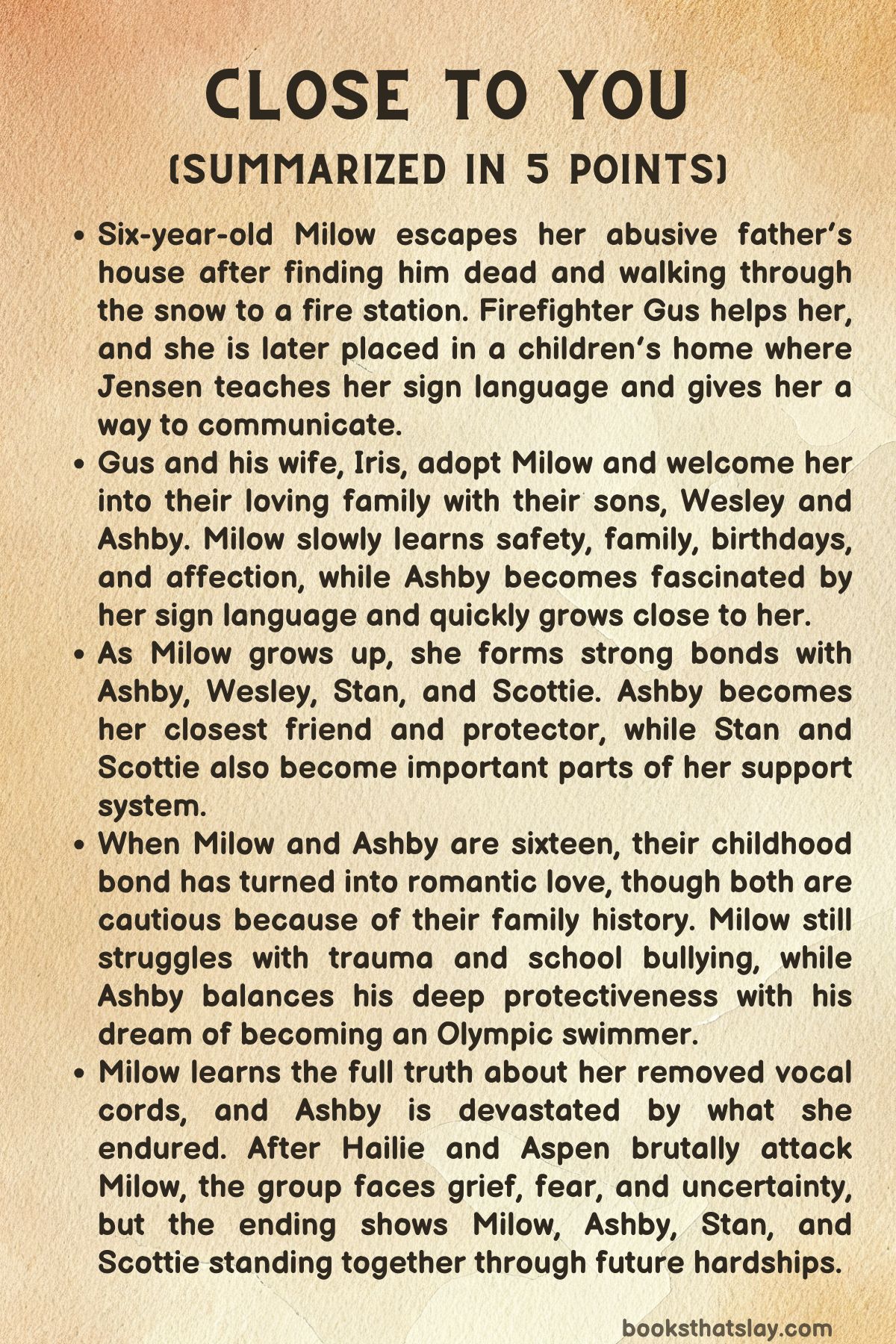
Summary
Milow is six years old when her life changes forever. Until then, her entire world has been the inside of one house and the rule of her abusive father.
He controls her through hunger, terror, lies, and violence. He has taught her that silence is part of being a good girl and has convinced her that her inability to speak is “magic.” Milow does not understand the full truth of what has been done to her.
She only knows that she must obey, stay quiet, and avoid making him angry.
One winter morning, Milow wakes up hungry and sneaks downstairs in search of cereal. Her father has not risen, which is unusual and frightening.
When she goes to check on him, she finds him still, with foam at his mouth. In her child’s mind, she believes a monster has attacked him.
Terrified and alone, she puts on his oversized boots and gloves and steps outside the house for the first time in her life.
She walks through the snow until she reaches a fire station. There, a firefighter named Gus finds her, brings her inside, warms her, and contacts the police.
Milow is frightened and confused, especially when she is taken past the house she escaped. When the authorities stop there, she panics, still believing the monster might be inside.
Officers enter the home, an ambulance arrives, and Milow eventually realizes that the body being removed is not a monster. It is her father, dead.
After this, Milow is placed in a children’s home. The shift is overwhelming, but it also becomes the first step toward safety.
A woman named Jensen works with her and begins teaching her sign language, giving Milow a way to communicate. For the first time, someone tries to understand her rather than punish her.
This new language becomes a bridge between Milow’s hidden thoughts and the outside world.
Gus does not forget her. He returns with his wife, Iris, and the couple visits Milow several times.
Their kindness is steady and patient, and eventually they adopt her. Milow enters their home and slowly learns what a family can be.
Gus and Iris become her parents in every way that matters. She meets their sons, Wesley and Ashby.
Wesley is older and gentle with her. Ashby, who is seven, is curious about Milow from the beginning.
Instead of treating her silence as strange, he sees her sign language as something special and asks her to teach him.
Milow’s early days with the family are full of small but meaningful discoveries. She learns what birthdays are.
She begins to understand love that does not demand fear in return. She learns to call Gus and Iris Mom and Dad.
Her bond with Ashby grows quickly. He becomes her friend, her protector, and the person most eager to enter her world.
During a medical appointment, Gus and Iris learn the terrible reason Milow cannot speak. Her biological father had her vocal cords surgically removed when she was four.
The truth devastates them. Milow does not fully grasp it at first, but the discovery makes clear the depth of what she has survived.
Her silence was never magic. It was violence forced onto her body.
As Milow grows, she becomes part of a close group. Ashby remains central in her life, always trying to comfort, defend, and understand her.
Wesley continues to be kind. Stan, another child in their circle, initially reacts badly to Milow’s mutism.
His confusion comes out as rudeness, but he later apologizes and becomes one of her friends. Scottie enters as bold, fearless, and hard to intimidate.
She quickly becomes important to Milow too.
Ashby’s feelings for Milow begin early, even if he is too young to understand their full meaning. At seven, he already knows that he loves her.
Their childhood bond is built through drawings, swimming, shared signs, comfort during nightmares, and the quiet trust that grows when someone consistently shows up.
The story then moves forward to their teenage years. Milow and Ashby are sixteen.
Milow is intelligent and deeply loved, but she still carries the effects of her childhood. Anxiety remains with her.
She tries to hide much of her pain from her family, not wanting to worry them or seem broken. Ashby has become a talented swimmer with Olympic dreams, and his devotion to Milow has only strengthened.
Their friendship has changed into romantic love, though both move carefully. Their history is complicated by the fact that they were raised in the same adoptive family, and they are aware of how fragile and serious their connection feels.
Their love is not sudden. It has grown out of years of trust, protection, shared language, and emotional closeness.
At school, Milow faces cruelty from Hailie and Aspen. They mock her mutism and target her because they know she is vulnerable.
Their bullying is not mild or casual; it is vicious and personal. Milow tries to endure it, but the abuse at school reopens old wounds and makes her feel unsafe in a place where she should be protected.
Meanwhile, Scottie and Stan’s relationship shifts. They often argue and challenge each other, but beneath the tension there is care.
When Scottie faints and ends up hospitalized, Stan is forced to confront how much she matters to him. Fear strips away his defensiveness, and he realizes he loves her.
Milow eventually learns the full truth about her vocal cords. The revelation is painful, not only for her but also for Ashby.
He reacts with shock, grief, and anger. For him, the knowledge that someone deliberately took Milow’s voice is almost unbearable.
It deepens his need to protect her, though that protectiveness sometimes comes with fear and guilt.
Around this time, Ashby and Milow begin to acknowledge their romantic feelings more openly. They kiss and admit what has long been between them.
Their relationship becomes more defined, but it is still handled with caution. They are young, deeply attached, and shaped by years of shared history.
Ashby wants to be close to her, but he is also afraid of failing her.
The bullying reaches a brutal peak when Hailie and Aspen attack Milow at school. They bloody her nose and crush her fingers in a locker in an attempt to force her to speak.
The attack is cruel because it targets the very wound that defines so much of Milow’s trauma. Ashby finds her injured, gets help, and takes her to the hospital.
Milow’s body begins to heal, but the incident shakes everyone around her. Ashby is especially affected, feeling guilt that he could not stop it before it happened.
Later, Hailie dies in unclear circumstances. The group considers different possibilities, including suicide and the chance that her abusive father may have been involved.
Hailie’s death complicates Milow’s feelings. Despite everything Hailie did to her, Milow chooses to attend the funeral.
This choice shows the kind of person Milow is: wounded, but not cruel; hurt, but still able to recognize another damaged life. Ashby stays beside her through it.
Near the end, Ashby receives major news about his future. He has been accepted to the University of British Columbia with a scholarship.
This marks a turning point for him, allowing him to celebrate the future he has worked toward. Milow is there with him, and their bond remains a source of strength as life begins to move beyond the pain that shaped them.
The bonus section shifts attention to Scottie, who receives devastating news and breaks down under the weight of it. She does not have to face it alone.
Stan, Milow, and Ashby gather around her, offering the same kind of loyalty that has carried them through so much already. The ending leaves the sense that pain has not disappeared from their lives, but none of them are isolated in it anymore.
They have built a chosen family strong enough to hold one another through fear, loss, love, and whatever comes next.
Characters
Milow
At the center of Close to You, Milow is a deeply wounded but remarkably resilient child whose life begins in fear, isolation, and confusion. At six years old, she has been trapped inside a house by her abusive biological father, deprived of safety, language, food, affection, and basic understanding of the outside world.
Her inability to speak is not simply a physical condition but the result of horrifying violence, and the fact that she has been taught to view it as “magic” shows how deeply her father has controlled her reality. Milow’s early innocence makes her suffering even more painful because she does not fully understand the cruelty done to her.
She interprets danger through the limited language of monsters, obedience, and punishment, which shows how abuse has shaped the way she sees the world.
As Milow grows, her character becomes a portrait of healing that is slow, uneven, and emotionally complex. She does not suddenly become free of trauma once she is rescued; instead, she carries her fear into every new relationship and every unfamiliar situation.
Her silence is both a physical reality and a symbol of everything taken from her. Learning sign language gives her a way to exist more fully, and it becomes one of the first steps in reclaiming her identity.
Her connection with Gus, Iris, Wesley, Ashby, Stan, and Scottie shows that love can rebuild parts of her life, but it does not erase the damage instantly. Milow’s strength lies in the fact that she continues to trust, love, and hope despite having every reason to withdraw from the world.
As a teenager, Milow becomes more aware of the full truth of what happened to her, and this awareness deepens her emotional struggle. She is intelligent, gentle, and loving, but she is also anxious and guarded.
She hides parts of her pain from her family because she does not want to burden them, which shows both her sensitivity and her loneliness. Her relationship with Ashby gives her comfort, but it also complicates her sense of belonging because their bond shifts from childhood friendship into romantic love.
Milow’s willingness to attend Hailie’s funeral despite the cruelty she endured reveals the moral depth of her character. She is not weak because she forgives or shows compassion; rather, she has a rare emotional courage that allows her to remain humane even after being hurt repeatedly.
Ashby
Ashby is one of the most emotionally intense and devoted characters in Close to You. From childhood, he is drawn to Milow not because he pities her, but because he is fascinated by her world and wants to understand her.
His interest in her “secret language” is innocent at first, but it quickly becomes a sign of his willingness to meet her where she is. Unlike people who see Milow’s mutism as a limitation, Ashby treats her communication as meaningful and worth learning.
This makes him one of the first people who helps Milow feel seen rather than broken.
As he grows older, Ashby becomes Milow’s protector, best friend, and eventually romantic partner. His love for her begins early, but it matures into something more complicated as they become teenagers.
He is careful with her because he understands her past, but his protectiveness sometimes becomes overwhelming. His reaction to learning the truth about her vocal cords shows the depth of his love, grief, and rage.
He is not only horrified by what was done to Milow; he also feels helpless because he cannot undo it. This helplessness fuels his protective instincts, especially after Hailie and Aspen attack her.
Ashby’s character is also shaped by ambition. His talent as a swimmer and his dreams of reaching the Olympics give him a future beyond trauma, fear, and family conflict.
Yet even when he has personal goals, Milow remains central to his emotional world. His scholarship to the University of British Columbia marks an important moment because it allows him to imagine a life where love and ambition can coexist.
Ashby’s strongest qualities are loyalty, tenderness, and devotion, but his flaw is that he sometimes responds to fear with possessiveness and anger. This makes him a passionate but imperfect character whose love is sincere, even when he must learn how to balance protection with trust.
Gus
Gus is a figure of safety, rescue, and fatherly warmth. His first major role in the story is saving Milow when she arrives at the fire station, freezing, terrified, and unable to explain what has happened.
His kindness in that moment is crucial because he becomes the first adult male in Milow’s life who does not represent fear. The contrast between Gus and Milow’s biological father is powerful.
Where her father used power to control and harm her, Gus uses gentleness to protect her. He does not demand that she speak or understand everything immediately; he responds to her fear with patience.
As Milow’s adoptive father, Gus becomes part of her healing. He gives her stability, affection, and a home where she is not punished for existing.
His devastation after learning the truth about her vocal cords shows how deeply he loves her and how seriously he takes the responsibility of being her father. Gus is not only a rescuer in a physical sense; he is also a moral opposite to the cruelty Milow has known.
He helps prove to her that fatherhood can mean protection rather than danger.
Gus’s character also reflects quiet strength. He does not need to be dramatic to be important.
His love appears in practical care, emotional steadiness, and his willingness to show up again and again. By adopting Milow, he does more than save her from one terrible situation; he gives her a place where she can slowly learn what family means.
He represents the kind of adult love that does not demand repayment and does not depend on perfection.
Iris
Iris is a nurturing and emotionally generous character whose love helps Milow understand what motherhood can be. She enters Milow’s life after Gus’s initial rescue, but she quickly becomes essential to Milow’s recovery.
As Milow’s adoptive mother, Iris gives warmth, patience, and daily care. She helps create the kind of home Milow has never experienced before, one filled with birthdays, affection, family routines, and emotional safety.
Iris’s role is especially important because Milow’s early life has deprived her of normal childhood experiences. Through Iris, Milow begins to learn that love can be soft, consistent, and dependable.
Iris does not treat Milow as a problem to be fixed; she treats her as a child to be loved. Her grief after learning what happened to Milow’s vocal cords shows the depth of her maternal attachment.
She is horrified not only by the physical harm but by the betrayal of innocence behind it.
Iris represents healing through tenderness. Her character does not rely on dramatic action but on emotional presence.
She helps Milow feel that she belongs in the family, and her acceptance allows Milow to begin using words like Mom and Dad with meaning. Iris’s motherhood is not defined by biology but by devotion, patience, and the daily act of making Milow feel safe.
Wesley
Wesley is a kind and stabilizing presence in Milow’s adoptive family. As the older son, he brings a calm warmth that helps Milow adjust to her new life.
He does not dominate the story, but his kindness matters because Milow’s healing depends not only on Gus and Iris but on the entire household accepting her. Wesley’s gentleness shows Milow that family can include siblings who do not threaten, mock, or control her.
His role is quieter than Ashby’s, but that does not make him unimportant. Wesley helps form the background of safety that Milow needs.
He is part of the normal, loving world she enters after years of captivity and abuse. His presence shows that healing is not created by one person alone; it is built through a whole environment of care.
Wesley’s character adds balance to the family dynamic because he offers steadiness without intensity.
Wesley also helps contrast different kinds of sibling love. Ashby’s bond with Milow is deep, emotional, and eventually romantic, while Wesley’s bond is more traditionally familial and protective in a gentle way.
Through Wesley, the book shows that love can be quiet and still meaningful. He may not be the central emotional force in Milow’s life, but he contributes to the sense of belonging that allows her to grow.
Jensen
Jensen is an important transitional figure in Milow’s life because she helps Milow move from silence and fear toward communication. At the children’s home, Jensen teaches Milow sign language, giving her a way to express herself after years of being trapped without a voice.
This makes Jensen one of the first people to restore a sense of agency to Milow. She does not simply care for Milow physically; she gives her the tools to be understood.
Jensen’s role is meaningful because language is central to Milow’s identity. Milow’s biological father took away her ability to speak, then manipulated her into believing that her silence was part of being good.
Jensen helps undo that lie by showing Milow that communication is not forbidden, shameful, or magical. It is natural, human, and deserved.
Through sign language, Milow begins to reclaim what was stolen from her, even if she can never speak aloud.
Although Jensen is not part of Milow’s permanent family, her impact is lasting. She represents the importance of compassionate professionals who meet traumatized children with patience instead of pressure.
Her character shows that healing often begins before adoption, romance, or friendship; it begins when someone teaches a hurt child that their thoughts matter.
Stan
Stan begins as a flawed and somewhat insensitive character, but his growth makes him important to the friend group. At first, he is rude and confused by Milow’s silence, which shows how people can react badly to what they do not understand.
However, his apology marks a turning point. Stan is not portrayed as cruel at heart; instead, he is immature and capable of learning.
His willingness to change allows him to become part of Milow’s circle rather than remain outside it.
As the story develops, Stan becomes especially important through his relationship with Scottie. Their dynamic is tense, argumentative, and full of friction, but beneath the bickering is real emotional attachment.
When Scottie faints and is hospitalized, Stan is forced to confront the depth of his feelings. His fear of losing her reveals that his teasing and defensiveness have been hiding vulnerability.
This makes him more layered than he first appears.
Stan’s character arc is about emotional honesty. He begins as someone who reacts before he understands, but he grows into someone capable of loyalty, love, and concern.
His relationship with Scottie shows that love does not always begin gently; sometimes it emerges through conflict, pride, and fear. By the end, Stan becomes part of the emotional support system surrounding Milow, Ashby, and Scottie, proving that he has matured into a dependable friend.
Scottie
Scottie is bold, fearless, and emotionally vivid. When she enters the story, she immediately brings a different energy to the group.
She intimidates Stan, befriends Milow quickly, and stands out as someone who does not easily shrink herself for others. Her confidence makes her an important friend for Milow because Milow has spent so much of her life being silenced, controlled, and afraid.
Scottie’s presence offers a contrast: she is loud in spirit, direct in personality, and unwilling to be easily pushed around.
At the same time, Scottie is not only a fearless friend. Her hospitalization reveals her vulnerability and forces the people around her, especially Stan, to recognize how much she matters.
This moment softens the way her character is seen. She may appear strong and intimidating, but she is still someone who can suffer, break down, and need support.
This gives her emotional depth and prevents her from being only the tough friend.
The bonus chapter adds another layer to Scottie by showing her receiving devastating news and collapsing under its weight. Her breakdown is important because it shows that even the strongest characters need care.
Stan, Milow, and Ashby gathering around her reinforces one of the story’s central ideas: love is not only romantic or parental, but also communal. Scottie’s character represents courage, sharpness, loyalty, and the painful truth that strength does not make someone invulnerable.
Hailie
Hailie is one of the most troubling characters in the story because she is both cruel and damaged. She bullies Milow viciously, mocking her mutism and targeting the exact vulnerability that comes from Milow’s trauma.
Her cruelty is not casual; it is deliberate, personal, and violent. The attack in which she and Aspen hurt Milow physically shows how far Hailie is willing to go to assert power over someone she sees as weaker.
In this sense, Hailie becomes a reflection of the abuse Milow has already survived, bringing fear and humiliation into a place that should be safer.
However, Hailie’s character becomes more complex after her death. The uncertainty surrounding what happened to her, along with the suspicion that her abusive father may have been involved, suggests that Hailie may also have been living inside a cycle of violence.
This does not excuse what she does to Milow, but it complicates the reader’s understanding of her. Hailie may be both a victim and a perpetrator, someone who turns her own pain outward and harms others because she has been harmed herself.
Milow’s decision to attend Hailie’s funeral is one of the most revealing responses to Hailie’s character. Hailie causes Milow real suffering, yet her death is still treated as tragic.
This prevents her from being reduced to a simple villain. She is cruel, but she is also a young person whose life ends under painful and unclear circumstances.
Hailie’s character shows how abuse can reproduce itself when pain is not healed, and how a person can deserve accountability while still being mourned.
Aspen
Aspen functions as Hailie’s companion in cruelty and plays an important role in escalating the bullying against Milow. While Hailie appears to be the more dominant force, Aspen’s participation matters because cruelty often becomes more dangerous when it is supported by others.
By joining in the attack on Milow, Aspen shows a willingness to harm someone vulnerable rather than challenge Hailie’s behavior. This makes Aspen morally responsible, even if she is not the central bully.
Aspen’s character represents the danger of passive or secondary cruelty. She may not carry the same emotional weight as Hailie, but her actions still have serious consequences.
Her presence shows how bullying is often sustained by people who follow, encourage, or assist the main aggressor. Aspen helps create an environment where Milow is not only mocked but physically unsafe.
Because the story gives less emotional background to Aspen, she remains more defined by her actions than by inner conflict. This makes her a sharper example of social cruelty.
She stands for the people who choose belonging with the powerful over compassion for the vulnerable. In Milow’s story, Aspen is a reminder that harm is not only caused by the person who leads it, but also by those who stand beside them and help it happen.
Themes
Trauma and the Long Process of Healing
Milow’s life is shaped by severe childhood trauma, and Close to You presents healing as a slow, uneven process rather than a quick escape from pain. Her rescue from her father’s house removes her from immediate danger, but it does not erase the fear, confusion, and bodily memory of abuse.
Even after she enters a loving home, her nightmares, anxiety, silence, and instinctive fear show how deeply trauma remains inside her. The kindness of Gus, Iris, Jensen, Ashby, and the others becomes important because healing is shown through repeated acts of safety: being fed, warmed, taught, listened to, protected, and accepted.
Milow’s growth does not come from simply forgetting the past; it comes from slowly learning that the world can contain people who do not hurt her. Her inability to speak also makes her healing more complex, because her body carries the permanent damage done to her.
The theme becomes powerful because recovery is not presented as a clean transformation, but as a lifelong movement toward trust, love, and self-worth.
Love as Protection and Emotional Safety
Love in the story is shown less through grand declarations and more through care, patience, and emotional protection. Gus’s first act of kindness at the fire station becomes the beginning of Milow’s new life, while Iris gives her the warmth of a mother she has never known.
Their adoption of Milow is not only legal belonging but emotional rescue, giving her a family where she is valued without needing to perform or explain herself. Ashby’s love is especially central because it grows from childhood companionship into romantic devotion.
He learns her sign language, comforts her after nightmares, notices her pain, and stands beside her when others target her. At times, his protectiveness becomes intense, showing how love can be shaped by fear when someone has already suffered too much.
Still, the story presents love as the force that allows Milow to feel seen. It does not undo the violence done to her, but it gives her a safe place from which she can begin to live differently.
Silence, Communication, and Being Understood
Milow’s silence is one of the most meaningful parts of her character because it is both a wound and a form of identity. Her father turns her mutism into a lie by calling it “magic,” using it to control her and keep her trapped in obedience.
Later, when the truth is revealed, her silence becomes evidence of the physical violence done to her. Yet the story does not reduce Milow to voicelessness.
Through sign language, she gains a way to express thoughts, feelings, fear, affection, and anger. Jensen’s teaching gives her access to communication, while Ashby’s eagerness to learn her “secret language” shows a deeper kind of love: he does not demand that she change in order to be understood.
The bullying she faces at school reveals how cruel people can be toward difference, especially when they mistake silence for weakness. Milow’s journey shows that having a voice is not only about speech.
It is about being heard, believed, and respected.
Found Family and Belonging
Milow’s movement from isolation into family is one of the strongest emotional changes in the story. At the beginning, the house is not a home but a prison, defined by hunger, fear, and control.
After her rescue, belonging does not arrive immediately; it has to be built through trust. Gus and Iris create a home where Milow learns ordinary things that were once denied to her, such as birthdays, comfort, affection, and the right to be cared for.
Wesley, Ashby, Stan, and Scottie expand this sense of family beyond adoption, showing that belonging can come through friendship as well as blood. Even characters who begin with misunderstanding, like Stan, are able to grow, apologize, and become part of Milow’s circle.
The group’s loyalty becomes especially important when Milow is bullied and when Scottie faces her own crisis. Family here is not defined by biology.
It is defined by the people who stay, protect, learn, forgive, and refuse to let someone suffer alone.